R E S E A R C H
Open Access
Representing annotation compositionality and
provenance for the Semantic Web
Kevin M Livingston
1*†, Michael Bada
1†, Lawrence E Hunter
1and Karin Verspoor
2,3Abstract
Background:Though the annotation of digital artifacts with metadata has a long history, the bulk of that work focuses on the association of single terms or concepts to single targets. As annotation efforts expand to capture more complex information, annotations will need to be able to refer to knowledge structures formally defined in terms of more atomic knowledge structures. Existing provenance efforts in the Semantic Web domain primarily focus on tracking provenance at the level of whole triples and do not provide enough detail to track how individual triple elements of annotations were derived from triple elements of other annotations.
Results:We present a task- and domain-independent ontological model for capturing annotations and their linkage to their denoted knowledge representations, which can be singular concepts or more complex sets of assertions. We have implemented this model as an extension of the Information Artifact Ontology in OWL and made it freely available, and we show how it can be integrated with several prominent annotation and provenance models. We present several application areas for the model, ranging from linguistic annotation of text to the annotation of disease-associations in genome sequences.
Conclusions:With this model, progressively more complex annotations can be composed from other annotations, and the provenance of compositional annotations can be represented at the annotation level or at the level of individual elements of the RDF triples composing the annotations. This in turn allows for progressively richer annotations to be constructed from previous annotation efforts, the precise provenance recording of which facilitates evidence-based inference and error tracking.
Keywords:Ontology, Conceptual data modeling, Annotation, Markup, Provenance, OWL, RDF
Background
Annotation of artifacts such as documents and images with metadata is a scholarly practice with a long history. A wide variety of annotations have been represented in a wide range of formats. In the bulk of that work, each an-notation consists of a basic association of one conceptual resource (e.g., an ontology class, schema element, database identifier) with one target (e.g., document, text span, data-base entry) via an explicit or implicit relationship. Single-concept annotations have proven very useful, for example, in computing term enrichment [1] or for indexing for search [2]; however, they do not provide a detailed repre-sentation of the content they are describing. As information
needs increase and annotation efforts expand to capture more complex information, complex knowledge structures formally defined in terms of more atomic knowledge struc-tures will need to be represented.
Where they exist, more structured annotations tend to be represented inad hocformats suited to one particular type of annotation or task but are not broadly applicable or interoperable. Several prominent annotation models not limited to specific types of tasks or information have been created, and components that enable annotations to denote knowledge structures more complex than atomic concepts have been added very recently to these models [3,4]. Yet there have been no mechanisms put forth by which these more complex annotations can refer to other annotations and by which their prov-enance can be unambiguously recorded. There have also been prominent efforts in scientific workflow prov-enance [5,6]. That work, however, primarily focuses on * Correspondence:[email protected]
†Equal contributors
1
Department of Pharmacology, University of Colorado Anschutz Medical Campus, Aurora, CO, USA
Full list of author information is available at the end of the article
annotating experimental data, typically annotating lists of identifiers or numeric data with their origins, not on annotating with dynamically composed and compo-sitional knowledge structures.
An effective annotation model, in addition to being ap-plicable to many annotation use cases and supporting the specification of complex knowledge structures, needs to be able to unambiguously represent annotation prov-enance. While ontologies strive to be complete, it is likely that specific applications will require dynamic con-struction of concepts, either through data-driven methods [7] or compositional concept formation [8]. To support and document the provenance of these more complex annotations, annotators (both human and computational) need the ability to refer to existing annotations as the basis of more complex annotations. For example, in the lin-guistic domain, an annotation representing part of a syntactic parse tree may wish to build upon existing token or part-of-speech annotations. Similarly, in the biomedical domain, a protein interaction event annotation may wish to leverage existing annotations identifying spe-cific proteins. As annotation efforts become more ambi-tious, they will naturally build upon previous annotation efforts, and tracking the provenance of constructed know-ledge representations being used for annotations at a fine-grained level will be important to facilitate inference and error analysis.
This paper proposes a task- and domain-independent formal ontological model for the creation of annotations and their linkage to their denoted knowledge representa-tions, which can be singular concepts or more complex knowledge in the form of sets of RDF assertions. With this model, progressively more complex annotations can be composed from other annotations, and this provenance can be unambiguously represented at either a coarse- or fine-grained level. We have designed our annotation model to be generic so as to facilitate the concurrent use of multiple types of annotations (e.g., syntactic annotation and semantic annotation). Additionally, it allows for the creation of arbitrarily complex annotations, both in terms of their denoted knowledge and of any other annotations upon which they rely. All of this information can be loss-lessly recorded, facilitating inference and error tracking in large computational annotation efforts. We have imple-mented this model as an extension of the Information Artifact Ontology in OWL and made it freely available. We also show how it can be integrated with several other prominent generic annotation models.
Results
Overview
A central aspect of our model is the capability to accurately capture the provenance of annotations, in terms of precur-sor annotations, created by a human or computational
annotator. The annotation model we present here is gener-ally applicable to arbitrarily complex, structured annota-tions applied to any content in any context. It is not specific to text annotations, although our primary use cases are related to understanding biomedical text.
Our model provides two key contributions above exist-ing annotation and provenance models. First, we provide a generic model for complex and compositional annota-tions that extends existing general-purpose annotation models. Second, we provide a model for documenting the provenance of the construction of the triples used as the denoted knowledge representations by these annota-tions. Our model goes beyond modeling the provenance of whole triples (for which there are sufficient existing methods, as discussed in the Related Work section) and extends the provenance modeling to document the source of individual statement elements that are used to construct triples.
This proposal is neutral with respect to annotation template; i.e., the choice of terminologies, ontologies, or schemas used for annotation and the nature of the de-noted knowledge representations is left to the annotator. Several existing annotation models handle the associ-ation of annotassoci-ations to text or other targets, and we dis-cuss the integration of their representations with our model in Additional file 1 and Additional file 2. Addi-tionally, as this proposal focuses on the linkage of anno-tations to their denoted knowledge represenanno-tations and on the provenance of these knowledge representations, details about the recording of other types of annotation metadata such as author and creation date (for which there are existing proposals, e.g., [3,4,9]) are largely elided from this paper. Finally, our ontological model is neutral with respect to the methodology by which any such annotations are created.
information content entity, as it is in some way about the entity it is annotating. We are engaged in the on-going process of submitting our model to the IAO for inclusion. An OWL representation of our model as an extension of the IAO is provided in Additional file 3.
Namespace and notation
Our in-house knowledge base of biomedicine (KaBOB) is the aggregator of our work. KaBOB extensions of an
ontology are named by prefixing the ontology’s
name-space with the letter‘k’; the namespacekiao: is therefore used for our extension of the IAO (whose namespace is
iao:), and theex: namespace is used for examples. In this
document,fixed-width fontwill be used to identify
concepts. Class names begin with a capital letter, while in-stance and property names begin with a lowercase letter. Additionally, instances are named mnemonically with let-ters corresponding to their class names; e.g., instances of
the class RdfResourceAnnotation have names
starting with“ra”. RDF triples and quads are presented using an abbreviated n-triple/quad format for
readabil-ity, using name-space-abbreviation:local-name
instead of full URIs.
Representation of annotations
We have created a top-level Annotation class,
defin-ing an annotation as an information content entity that is used to concisely describe, comment on, or otherwise make an assertion or set of assertions about an existing information content entity. Thus, for example, a linguis-tic part-of-speech tag can be used to annotate a word within a piece of text to describe its syntactic or
mor-phological behavior; a Java keyword (e.g.,
@depre-cated) can be used to annotate a segment of Java source code to specify a property of a Java class, method, variable, parameter, or package; and a GO term can be used to annotate a digital representation of a gene or gene product to make an assertion about some aspect of the biological functionality of the latter. Conciseness seems to be a common trait among the many types of annotations we have considered, so, e.g., a book written about a poem would seem to be beyond the bounds of what most would consider an annotation. Additionally, an annotation provides additional information about an entity but is typically not fundamental to the entity; therefore, we would not consider a title of a journal art-icle to be an annotation of the artart-icle: Even though it concisely describes an existing information content en-tity,i.e., the body of the journal article, it is a canonically required part of the article. Furthermore, an annotation is typically either incorporated into the entity (e.g., in the classical case of annotation of writing in the margins of a book, which becomes a physical part of the book) or can be otherwise retrieved along with the entity it is
annotating (e.g., in the case of GO-term annotations of database entries of proteins).
A subclass of Annotation could be defined for any
type of information content entity used to annotate another
entity (e.g.,PartOfSpeechTagAnnotation,
JavaKey-wordAnnotation, GoTermAnnotation). However, since we are motivated toward utility for the Semantic
Web, we introduce only two subclasses,
RdfResour-ceAnnotation and RdfGraphAnnotation, repre-senting RDF resources and graphs, respectively, that are used to annotate other information content entities. These two subclasses should be all that is needed for the repre-sentation of annotations in RDF stores, in which every-thing should be an RDF resource or graph. Furthermore, as long as information content entities used for annotation are offered as RDF constructs (so that they can be used in RDF stores), other annotation subclasses should not be needed for their representation in RDF stores. For ex-ample, since GO terms are also offered as RDF resources, GO-term annotations can be stored as instances of
RdfResourceAnnotation, obviating the need for a
GoTermAnnotation class (unless there is further de-sired axiomatization for GO-term annotations).
Resource annotations
In our model, a resource annotation is an annotation
that associates a singlerdfs:Resource with a target.
A resource annotation is modeled asrdf:type kiao:
RdfResourceAnnotation. The relation
iao:deno-tes is used to associate a given annotation with the
concept being used to annotate the target. This property relates an information content entity (in this case a re-source annotation) to something to which it is specific-ally intended to refer.
One of the primary types of text annotation is syntactic annotation, which is often produced by text mining systems (e.g., [11]). To demonstrate the applicability of our model to syntactic annotation, we use a fragment of the example sentence used by Liu et al. in their study of dependency parsing for information extraction [12], i.e., the phrase
“Interferons inhibit activation of STAT6”. (For the purposes of an example, we have taken some liberty in creating example classes and relations that we believe are faithful to the native dependency parse representations [13].)
Common tasks at the beginning of text mining pipelines include tokenization and part-of-speech tagging [14].
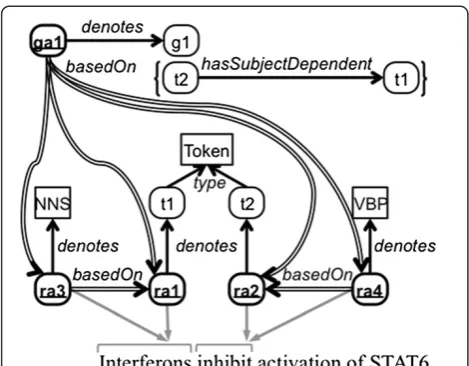
Figure 1 depicts four resource annotations: ra1, ra2,
ra3, andra4. The concepts in the object positions of the
denotes assertions are part of the domain model used by the annotator and are not part of the proposed annota-tion model itself.ra1 and ra2denote specific instances of tokens (represented here as instances of the class
by their Penn Treebank part-of-speech tags [15]). In this example, the annotator made the domain-specific repre-sentational choice to model the tokens as instances so that they can be specifically referred to later by subsequent an-notations, as will be shown in the next section. Abstract relations connecting the resource annotations to text spans are shown in Figure 1 as gray arrows, with gray brackets representing the text spans. Existing models for linking annotations to the object being annotated can be
used with our model, for example, the relations
oa:has-Target[3] orao:context[4] could be used to model these gray arrows. As our model is neutral relative to these representational decisions, this aspect of modeling the example annotations is elided from this document for simplicity and clarity.
The following are RDF triples representing two of these
annotations, asserting that ra1 and ra3 are resource
annotations that denote a particular instance of a token
(represented here as t1) and plural nouns (represented
here asNNS), respectively.
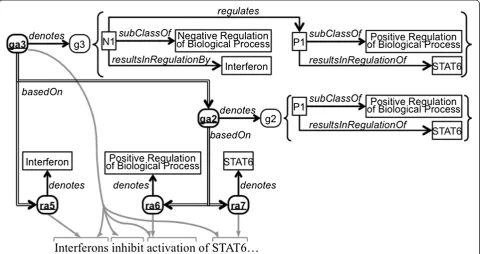
Semantic annotations of text fragments, such as those in the CRAFT Corpus [16], are another primary use case for the model presented here. In Figure 2, the example
sentence fragment from Figure 1 has been annotated with semantic classes in the manner of CRAFT annota-tion. (In some cases, we have used ontologies and classes not used in CRAFT in order to simplify the biology and therefore the example.) The biomedical classes and properties used to model the examples in this paper are not part of the proposed annotation model. In Figure 2,
the three example resource annotations ra5, ra6, and
ra7 denote relevant biological concepts: ra5 denotes
interferons, a group of proteins represented here by
Interferon (IPR000471) in the InterPro database of protein sequence signatures and families [17];ra6 de-notes the upregulation of biological processes, represented
here by positive regulation of biological
process(GO:0048518)ain the Gene Ontology [18]; and
ra7denotes STAT6 proteins, represented here bySTAT6
(PR:000001933) in the Protein Ontology [19]. The following are RDF triples for two of these annotations,
specifically asserting that ra6 and ra7 are resource
annotations that denote positive regulation of
biologi-cal processes (represented here as GO:0048518) and
STAT6 proteins (represented here asPR:000001933),
respectively.
Graph annotations
While a resource annotation relies on a single RDF
resource for annotation, a graph annotation is an RDF
graph, composed of a set of one or more RDF state-ments, that is being used to annotate another informa-tion content entity. A graph annotainforma-tion is modeled as
rdf:type kiao:RdfGraphAnnotation. A graph annotation is connected to a named graph of RDF
state-ments using the propertyiao:denotes. While a graph
annotation is directly linked to a named graph, it actually denotes thecontentof the named graph (i.e., the RDF graph that the named graph encodes or represents) and not the named graph itself; this is consistent with the semantics of named graphs proposed by Carroll
et al. [20], which states that any assertion in RDF about the graph structure of a named graph is understood to refer to the underlying RDF graph. As before, the nature of the denoted knowledge representations (i.e.,the set of RDF statements) is left to the user, as our metamodel focuses on the linkage of annotations to such represen-tations and, as presented in the next section, the prov-enance of compositional annotations.
Linguistic annotation is frequently done in a pipeline where subsequent stages build upon the annotations pro-duced by earlier stages. In addition to the aforementioned Figure 1Example syntactic annotations.This figure depicts five
resource annotations, Figures 1 and 2 depict several
RdfGraphAnnotation instances. In Figure 1, there is one graph annotation that denotes the subject dependency
of token t2 on token t1, represented here as a graph
(g1) containing one RDF triple with subjectt2, property
hasSubjectDependent, and object t1. The following are triples/quads for graph annotationga1:
Since the annotator made the domain-specific
model-ing choice to represent resource annotations ra1 and
ra2 as denoting instances of tokens, a dependency
assertion among them (i.e., that token t2 syntactically
depends on token t1 as the subject of the sentence, as
seen in Figure 1) was able to be created. If the annotator had pointed these resource annotations directly to the
class Token (analogous to the direct pointing of
re-source annotationsra3and ra4to the classesNNSand
VBP, respectively), then it could only have been asserted
at the class level thatToken hasSubjectDependent
Token rather than the assertions relating the specific tokens. It is important to remember that this representation of syntactic dependency is of our own choosing for this ex-ample and that any user of our metamodel of annotations
is free to represent syntactic dependency (or any other knowledge denoted by the annotations) as he chooses.
Semantic concept annotation, such as the manual annotation performed on the CRAFT Corpus or annota-tions created by text mining systems, can also be built in
layers. Figure 2 depicts twoRdfGraphAnnotation
in-stances ga2 and ga3. The former denotes the positive
regulation of STAT6 protein, represented here as a
graphg2 containing a dynamically constructed subclass
P1 of the GO class representing positive regulation
(GO:0048518) in which STAT6 (PR:000001933) is
regulated. The graph ga3 builds upon the denoted
knowledge representation ofga2 and denotes the
nega-tive regulation of the posinega-tive regulation of STAT6 pro-tein by an interferon, represented here as a dynamically
constructed subclass N1 of the GO class representing
negative regulation (GO:0048519) in which the
regulat-ing entity is an interferon (IPR000471) and the
regu-lated process is a positive regulation of STAT6 protein. The following are triples/quads for graph annotation
ga2:
The use of graphs has the advantage of separating the representation of the annotation from the representation of the denoted content and thus protects users of a given annotation from committing to or believing the propositions represented in the annotation unless desired. For example, a given annotation could denote the fact that STAT6 can bind calcium ions as one of its functionalities, which could be represented as, e.g., one
RDF triple (STAT6 hasFunction
CalciumIon-Binding) in an RDF graph. Since this triple is placed in its own graph, a reader of this annotation is not commit-ted to believing that STAT6 can bind calcium ions; what has been effectively represented is that this particular annotation says that STAT6 can bind calcium ions. Just as our model is agnostic with respect to the denoted knowledge representations of annotations, we do not seek here to explicitly represent confidence, trust, or other epistemological or modal information; however, such information could be modeled independently and added orthogonally or compositionally to our proposed model.
Provenance of compositional annotations
As annotations become more complex, tracking their provenance becomes increasingly important. Provenance tracking is necessary in order to know which other an-notations were used in constructing an annotation and how their individual denoted representations were com-posed into larger knowledge structures. Additionally, provenance is needed for error analysis and blame attri-bution. For example, referring to the example in Figure 2, if ga2is found to be incorrect only because it refers to the wrong protein, the error and blame should be prop-erly attributed to the author of ra7, as the latter was the source of the incorrect protein identification.
Like-wise if ra7 is determined to be incorrect, annotations
dependent on that annotation could be identified and retracted or updated as well.
Provenance information can be equally useful for dis-ambiguation. Consider the case in which there are mul-tiple competing annotations for the text “STAT6” (e.g.,
those denoting human, mouse, and rat homologs of the STAT6 protein, which are represented as distinct entities in prominent biological repositories such as UniProt [21] but are all canonically referred to as“STAT6”). If, as in this example, there are multiple competing annota-tions for the specific type of protein but only one is used as the provenance for a larger annotation, such asga2, then this provenance can be tracked to resolve the ambi-guity caused by the competing annotations. This is one of the ways language understanding systems can successfully resolve ambiguity [22]. An annotation model such as ours that captures this information and
provenance can be used to document these choices and facilitate error analysis.
In order to track provenance, we introduce the
tran-sitive relation kiao:basedOn, which is used to track
both coarse-grained, annotation-level provenance and fine-grained, statement-element-level provenance in our model. We propose that this relation holds between two information content entities; therefore, the value of
rdfs:domain and rdfs:range for this relation is
iao:information content entity. Informally,
kiao:basedOn holds between subject and object in-formation content entities when the subject entity has been created relying in whole or in part on the already existing object entity. In this proposal, we are interested in making assertions of annotation provenance by recording that specific annotations have been created wholly or partly relying on otherspecific annotations. We make no
restriction on the cardinality of kiao:basedOn, so a
subject information content entity can be based on mul-tiple object entities, and mulmul-tiple subject information con-tent entities can be based on the same object entity.
Annotation-level provenance
The simplest way to record provenance is to make
coarse-grained basedOn assertions between
annota-tions. A basedOnstatement can be made between two
annotations either when there is a direct relationship be-tween the annotations, such as one directly using one or more elements of another, or when there is an indirect relationship, such as one being used as the justification for another’s existence even though no part is explicitly shared (e.g., an annotation of a text span with a specific protein class being used to justify an annotation of the
same text span with the top-level class protein
(PR:000000001) from the Protein Ontology).
Most syntactic dependency parsers use tokenization and part-of-speech tags produced by other annotation systems as input. Figure 1 depicts six different annotation-level
basedOn assertions between syntactic resource
annota-tions. Those fromra3tora1and fromra4tora2have
been asserted because ra3 and ra4, denoting parts of
speech, were created based on ra1 and ra2, denoting
tokenization, respectively. The following triples represent the assertions of provenance among these four resource annotations:
here by the part-of-speech tagNNS, and tokent1);
how-ever,ra1 was instrumental in the creation of ra3, and
thebasedOnstatement documents this. The part of the syntactic dependency parse annotated by the graph
an-notation ga1 used both the tokenization annotations
(ra1andra2) and the part-of-speech annotations (ra3
and ra4) to determine that token t1 is the subject of
tokent2, and thusga1is modeled with abasedOn
re-lation to each of these four resource annotations. The following four triples represent the annotation-level
provenance of graph annotationga1:
Just as layers of annotation can build upon each other in syntactic annotation, semantic annotation can also be composed compositionally. Provenance relations are analogously depicted among the semantic annotations in
Figure 2. Graph annotation ga2 was built using
infor-mation from resource annotations ra6 and ra7.
Simi-larly, the larger graph annotation ga3 records that it
was built using information from resource annotation
ra5 and from graph annotation ga2. The provenance
information can be traced from annotation to
annota-tion, and in this case one can see that ga3 is (partly)
based onga2, which in turn is based onra6 andra7.
It is important to note that basedOnis general in that
it can be used to create an annotation-level assertion of provenance from either a resource or graph annotation to a set of any combination of resource and/or graph
an-notations. Instances of RdfGraphAnnotation need
not be strictly compositional; that is the statements in a graph annotation do not need to be based on other an-notations and can incorporate new information not yet
annotated elsewhere. For example, ga3 uses additional
information not explicitly previously annotated, which is shown in Figure 2 by an additional gray arrow pointing to a segment of the text not previously annotated.
Statement-element-level provenance
The second type of provenance represented in our model records detail at a more fine-grained level.
Refer-ring back to Figure 2, while the assertionga2 basedOn
ra7is sufficient to model that at least some part ofga2
was based on ra7, it does not capturewhich elements
ofga2are based onra7.Analogously, in Figure 1, the
graph annotationga1 documents that it is based on
re-source annotation ra1 but nothing more specific than
this. If the author of ga1 wishes to document that the
object element (which denotes token t1) of the RDF
statement of ga1 is based on ra1 (which also denotes
token t1), then recording provenance at the annotation
level is insufficient. In addition to documenting how compositional annotations were constructed for under-standing or training purposes, this type of provenance is necessary to perform detailed error analysis.
In RDF, the typical way to make statements about state-ments is to reify the statement itself as an instance ofrdf: Statement. An RDF statement identifies its subject, property, and object via the relationsrdf:subject,rdf: property, and rdf:object, respectively. However, RDF statements and their elements are conceptual repre-sentations; for example, in Figure 1, the RDF statementt2 hasSubjectDependent t1 represents the assertion that token t2 has as its subject token t1. To explicitly represent RDF statements as information content entities,
we introduce the class kiao:RdfStatement, which
is rdfs:subClassOf iao:information content entity. An example of a reifiedkiao:RdfStatement
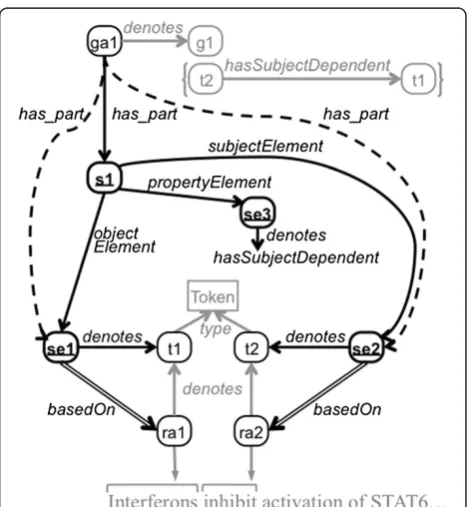
is the instances1in Figure 3. A graph annotation can then be connected to each reified statement of the graph
annota-tion using the propertyobo:has_part.
In order to record the provenance about individual parts of a statement, these parts must also be reified as
instances of kiao:RdfStatementElement. A
re-ified statement is linked to its component instances of
kiao:RdfStatementElement using three proper-ties that mirror the properproper-ties used to reify the
rdf:Statement itself (i.e., rdf:subject, rdf: property, and rdf:object): kiao:subject-Element, kiao:propertyElement, and kiao:ob-jectElement, each of which is rdfs:subProper tyOf obo:has_part; that is, a reified statement has these subject, property, and object elements as parts.c
Two reified instances of
kiao:RdfStatementEl-ement, se1 and se2, can be seen in Figure 3. The
correspondingiao:denotesassertions from these
state-ment elestate-ments to their denoted concepts (i.e., tokenst1
andt2, respectively) are also depicted.
With an assertion from a graph annotation to a
state-ment viaobo:has_partand another assertion from the
statement to a statement element via
kiao:subjectEl-ement, kiao:propertyElement, or kiao:object-Element (each a subproperty of obo:has_part), an
obo:has_partassertion from the graph annotation to the statement element can also be inferred. The follow-ing axiom holds for subject elements, and correspond-ing axioms hold for property and object elements:
This is simply applying obo:has_part transitively.
Figure 3 shows two derivedobo:has_partassertions:
Since graph annotation ga1 has_part statement s1,
and s1 is linked to its component statement elements
se1 and se2via subjectElement and objectEl-ement, respectively, it can be inferred that ga1 has these statement elements as parts.
Now that the reified statement has been
decom-posed into and appropriately linked to reified
RdfStatementElement instances, the provenance of these individual pieces can be recorded. In the
ex-ample in Figure 3,se1 is documented as being based
on resource annotation ra1, and se2 is documented
as being based on ra2. This is analogous to the use
of the basedOn among annotations, except in this
case the relation is being used among more fine-grained components of the model.
Our original model [23] used a more complex set of properties to record the same amount and type of infor-mation. The model proposed in this paper simplifies the representation of this information and the cognitive load of using the model significantly. The following triples
represent statements1 decomposed into statement
ele-mentsse1,se2, andse3, along with the provenance of
se1, as rendered in Figure 3:
The first two triples above represent that graph
an-notation ga1has statements1 as a part and that s1is
an RDF statement, and the next six triples decompose
s1 into RdfStatementElement instances and
spec-ify their denotations. The relations subjectElement,
propertyElement, and objectElement have an
rdfs:domainofkiao:RdfStatementand anrdfs: range of kiao:RdfStatementElement, and thus type information can be inferred using RDFS reason-ing, which we have omitted for conciseness. The sev-enth and eighth triples reify the object position of this statement, and the final triple documents that this statement element is based on resource
annota-tion ra1. In this way, the annotator constructing
ga1can explicitly document the origin of every
com-ponent piece.
Just as RdfStatementElement instances can be
based on instances of RdfResourceAnnotation,
they can also be based on other instances of
Rdf-StatementElement. As the composition of tations becomes more complex and the layers of anno-tation get deeper, graph annoanno-tations will build on other graph annotations. This is especially true for annotations produced and used by computational language under-standing systems [24]. For example, in Figure 4,
state-ment elestate-ment se9 is based on statement element se6,
which is in turn based on resource annotation ra7.
Figure 4 only shows the provenance of statement
elem-ent se6 of statement s2 along with the provenance of
statement element se9 of statement s3. Although not
depicted, statement-element-level provenance could
analogously be recorded for all elements of these state-ments, as well as for all statements of graph annotations
ga2and ga3. The following are triples representing
an-notation information for statements s2 and s3 and
The first group of eight triples and the ninth triple above are exactly analogous to the triples used in the previous example. As in the previous example, here there is one reified statement (s2) that is part of a graph annotation (ga2). Analogously, the reified statements3
is a part of graph annotation ga3, as can be seen in the third group of (eight) triples. However, in this example, there is an extended statement-element-level assertion of provenance: In the last triple, a statement element
(se9) is asserted to be based on another statement
element (se6), which was already created to partly
document the provenance of a graph annotation (ga2).
In this way, the annotator creating graph annotation
ga3 can unambiguously document the specific element
of the specific statement of graph annotation ga2 from
which its reference to the protein STAT6 derives. This low-level provenance is essential for understanding the dependencies between layers of complex composi-tional annotations and for being able to unwind these layers to perform tasks such as error analysis and blame attribution.
Discussion
Use cases
In this section, we discuss types of tasks that our anno-tation model enables, along with specific examples of such tasks, including projects on which we are working as well as external efforts.
Integrating different types of annotations
A wide variety of annotation models and formats have been created for a wide range of tasks; however, the large majority of these are suited to one particular type of annotation or task and are not broadly applicable or interoperable. Our proposal is a generic metamodel of annotations and their linkage to their denoted know-ledge representations. As such, it is neutral with respect to annotation template (i.e., the choice of terminologies, ontologies, or schemas used for annotation), the nature of the denoted knowledge representations created, and Figure 4Extended example of statement-element provenance.This figure depicts an extended example of statement-element-level
the methodology by which annotations and denoted knowledge representations are created. As a result, our model can be generically used to integrate different types of annotations in a common representation, in turn leading to enhanced interoperability and queryability among these different types of annotations. Such inte-gration is of substantial interest to us in the context of our efforts with the Colorado Richly Annotated Full-Text (CRAFT) Corpus, a collection of full-text biomed-ical journal articles that we have extensively marked up with a wide range of types of annotations, including those specifying mentions of biomedical concepts, coreference, discourse, as well as a variety of syntax, including sentence segmentation, tokenization, part-of-speech tagging, and Penn TreeBank tagging [16,25]. Relying on our generic metamodel, we are able to represent these disparate types of annotations and their denoted knowledge representations in a unified way. This, in turn, is required to enable matching of different types of annotations to various elements of formal natural-language patterns for automated understanding of biomedical text. This enables querying over multiple annotation types simultaneously, for example looking for all the noun-phrases that overlap with annotations to specific ontology terms, which might be a query for learning new vocabulary or patterns for identifying ontology terms in text.
Text is not the only artifact for aggregating multiple types of annotation. Tools such as the UCSC Genome Browser which layer annotation tracks over a visualization of the genome [26] demonstrate a clear need for integrat-ing various types of genomic annotation, such as dbSNP [27], COSMIC [28], OMIM [29], and the GWAS catalog [30]. Use of our model would enable such annotations to be more easily integrated into such tool via a standard rep-resentation, and would further enable the integration of annotations to be usable beyond the scope of specific tools (e.g., visualization) for new queries yet to envisioned by researchers.
Connecting annotations to the Semantic Web
Many types of annotations are represented inad hoc, idio-syncratic formats (e.g., Penn Treebank [15] for parts of speech, GAF 2.0 [31] for gene function, VCF [32] for SNPs) that, in addition to hindering interoperability, are obstacles to integration with the Semantic Web. We have implemented our annotation metamodel as a formal OWL ontology, and specific annotations are created as in-stances of relevant OWL classes. Consequently, linkage of these annotations and the data and knowledge they specify to existing ontologies [10], other RDF repositories [33], and the broader Semantic Web is considerably facilitated. Using our model, reasoning over annotation structure and
their denoted semantics simultaneously is also enabled through the use of RDF- and OWL-based querying sys-tems. For example, it is possible to query for annotations that are based on an annotation from a specific source that mention a subclass of a specific ontology term. Such a query might be used if a specific annotator is known to be highly accurate or inaccurate at a certain task. Such queries cannot be easily performed, if they can be per-formed at all, using combinations of tools on more idio-syncratic formats.
Linking annotations to arbitrarily complex knowledge representations
In most annotation efforts, each annotation consists of a basic association of one conceptual resource (e.g., an ontology class, schema element, database identifier) with one target (e.g., document, text span, database entry). However, as information needs increase and annotation efforts expand to capture more complex information, more complex knowledge structures will need to be repre-sented. For example, although most GO annotations of genes/gene products straightforwardly link GO terms to database entries representing these genes/gene products, there has been a call to associate the biological-functionality annotations of the genes/gene products with more specific contexts, such as the types of cellular locations or cells in which these biological functionalities were observed [31]. Similar calls for representing complex structures in linguistic annotation are also being made, for ex-ample representing semantic frames composed from other annotations [34]. In our own work, the next layer of annotation planned for the CRAFT corpus will also require the ability to dynamically construct concepts for use in assertional annotation [8]. To capture such information, annotations must point to knowledge struc-tures more complex than singular concepts. We have rep-resented two fundamental types of annotations: resource annotations, each of which points to a single RDF re-source, and graph annotations, each of which points to an RDF graph encapsulating one or more RDF statements. Using our model, a user can create any combination of re-source annotations and/or graph annotations, as moti-vated by the complexity of information that is sought to be captured in a given annotation effort.
Documenting the composition of annotations
Natural language processing (NLP) pipelines are fre-quently composed of sequences of components that each produce output based on the output of earlier annotation layers. For example, the output of a tokenizer might be fed into a part-of-speech detector, and both of which are fed into a named-entity recognizer, each component of which is dependent on the output of some or all of the previous components. There are generalized frameworks for building annotation pipelines, such as UIMA [35,36]; however these pipelines do not provide standardized models for docu-menting the compositional provenance of annotations. Other systems for language understanding, such as Direct Memory Access Parsing systems [37,38] including Open-DMAP [39] and REOpen-DMAP [24], use hierarchical patterns to compose semantic annotations. These systems produce knowledge structures that are analogous to those presented in Figure 2; however, they have no standard methods for documenting provenance. All of these use cases are covered in a generalized way by our model, which enables the track-ing of both coarse-grained, annotation-level provenance and fine-grained, statement-element-level provenance.
Understanding the genetic basis of disease is a major focus of current biological and bioinformatics research and requires the integration of numerous types of anno-tation. For example, epistasis captures interactions be-tween genes that affect function and phenotype, and
compositional epistasis has been introduced [40] as a way to model multiple genes affecting a phenotype. A typical method for identifying epistasis starts with anno-tations of SNPs (single-nucleotide polymorphisms) and then applies a procedure for determining interactions among them [41,42]; the inputs to such procedures are SNP annotations and the outputs can be modeled as a higher-order annotation over the genome sequence that connects two or more of the SNP annotations. Captur-ing the dependency of the epistasis relation on the prior SNP annotation is important; SNP identification (variant calling) is a process that is dependent on the initial se-quencing and assembly, the reference genome, and other factors and as such the SNP annotations of a genome may vary with different analyses. Our model would en-able identifying and distinguishing epistasis relationships determined on the basis of one variant analysis from those based on another analysis performed under differ-ing conditions.
Analyzing annotation errors and attributing blame
A common use of provenance information is for error analysis and blame attribution tasks. For example, if an annotation is deemed incorrect, the method by which that annotation was constructed needs to be investi-gated. This often starts with identifying all the annota-tions that contributed to its generation. It is possible that a lower-level annotation is incorrect and its use
alone led to the larger annotation being incorrect. In the case of DMAP-style pattern recognition, this type of analysis is critical both for debugging during develop-ment as well as for analysis of results such as that done in the evaluation of REDMAP [24]. For example, in that evaluation it was important to identify whether errors were due to named-entity recognizers improperly identi-fying entities in the text or to larger patterns being im-properly applied. Working in the opposite direction, if a lower-level annotation is deemed incorrect, it is impor-tant to identify all downstream annotations that are based on that annotation so that they too can be identi-fied as incorrect and retracted. (Please see later section
titled “Querying Using the Model” for examples of
SPARQL queries that extract this type of provenance in-formation using our model.)
Efficiency of the model
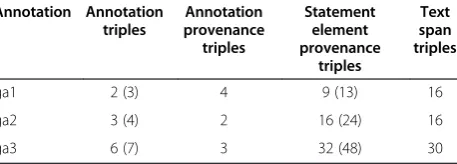
Modeling statement-element-level provenance comes with the cost of reifying the statements and statement elements. In the worst case, this cost is 10 triples per statement in the graph annotation, or 14 triples if infer-able type triples are explicitly represented as well: 7 tri-ples are required to reify the statement, and 1 triple is needed each for the subject, property, and object of the statement to record its provenance. (However, in our ex-perience, it is rare to record provenance for the prop-erty.) For example, as rendered in Figure 4,ga1requires 2 triples for the annotation (3 with type information), 4 triples to record annotation-level provenance, and 9 tri-ples (13 with types) to record the statement-element-level provenance. In contrast in the OA model [3] it takes 7 triples per text span to anchor an annotation to a piece of text. If the text has multiple spans there is an
additional 2-triple overhead. To connect ga1 to text in
the OA model requires 16 triples, 7 triples for each of the two text spans plus 2 triples of overhead for having multiple spans. Table 1 shows the number of triples re-quired to model the example graph annotations used in this document and their provenance. It also shows the number of triples required to anchor these annotations
Table 1 Counts of triples required to represent annotations
Annotation Annotation triples
Annotation provenance
triples
Statement element provenance
triples
Text span triples
ga1 2 (3) 4 9 (13) 16
ga2 3 (4) 2 16 (24) 16
ga3 6 (7) 3 32 (48) 30
to their corresponding spans of text using the OA model. In terms of counts of RDF triples required, it can be seen that recording statement-element-level prove-nance is comparable to associating annotations with text. We aimed in this work to lay down a low-level foun-dation for annotation provenance, which can then serve as the building blocks for higher-level models or axiomatization. We acknowledge that the use of reifica-tion to explicitly identify all of the low-level parts in our model leads to the production of additional triples. However, as more support for reasoning with ax-iomatizations in triple stores becomes available, exten-sions and abstractions of our model that reduce the counts of triples required could be defined. For example, if triples are reused from one graph to another, as is the
case for statements s2 and s3 in Figure 4, a relation
such as copyOf could be defined and used to directly
connect these statements so as to obviate the need to
reify and relate all of the corresponding
RdfState-mentElement instances from both statement triples. As the model is applied in practice, other patterns may emerge that point to additional optimizations or refine-ments. Mappings could also be constructed from our model to nanopublications [43,44] or RDF Molecules [45] to potentially reduce the number of redundant triples.
Querying using the model
Due to the manner in which the model was integrated with the Relation Ontology (RO) and the Information Artifact Ontology (IAO), querying of the model can be quite straightforward in SPARQL. A common provenance-tracking task might be to identify all the annotations that are based on a given annotation that is suspected of being incorrect. For example, the following SPARQL 1.1 query returns all of the annotations that are based onra7:
Similarly, a researcher may be interested in all of the
statementsthat are based on a given annotation. If these
RdfGraphAnnotation instances have had their statement-element-level provenance recorded using our model, such statements could be queried for directly. For
example, the following SPARQL 1.1 query would retrieve all statements each of which has at least one statement element that is based on resource annotationra7:
The first three namespaces are needed as part of the annotation model, and the last three are specific to the example domain and only used for more conveniently rendering the results. While this query and the one be-fore are modeled using SPARQL 1.1 property paths, there is nothing in our model that requires them for querying. For example, using SPARQL 1.0, the property paths could be expanded using blank nodes or variables that are not captured in the results.
Related work
Efforts in the representation of more structured anno-tations have tended to be idiosyncratic, specific to a particular type of annotation or task, and not broadly interoperable. For example, for the task of Gene Ontology (GO) annotation, in which the functionalities of genes and gene products represented in biomedical databases are as-sociated to GO terms [46], the Gene Association File format (GAF 2.0) [31] enables the representation of con-straints on the context in which a given annotation might be valid (e.g., the type of cell in which the functionality is asserted to be present); however, this format is specific to this narrow task. Analogously, the corpus and computa-tional linguistics communities have developed solutions for representing complex syntax and semantics for
docu-ments, e.g., the Penn Treebank format [15], but these
the RDF-based representation DADA [48], allow for the markup of a wider range of linguistic phenomena, but they only permit the specification of functional (single-valued) properties. POWLA [49] is another linguistic corpora an-notation formalism based in RDF and OWL, but, like LAF/GrAF, it introduces an ambiguity by using the same identifier to anchor information about both the annotation and what it denotes; hence, the formalism cannot clearly capture which information applies to the annotation and which applies to the denoted knowledge [50].
Several prominent efforts have focused on general rep-resentations of annotation, notably the Open Annotation (OA) model [3] and the Annotation Ontology (AO) [4]. These models represent three basic pieces of informa-tion for a given annotainforma-tion: the thing being annotated (e.g., a span of text), the denoted knowledge representa-tion (i.e.,the concept or set of assertions denoted by the annotation), and the annotation itself, which connects the other two. These three things can be broadly aligned across the two models as well as with our model for the linkage of annotations to their denoted knowledge representations. A proposed integration of our model with the Open Annotation model can be found in Additional file 1 and an integration with the Annotation Ontology model in Additional file 2. In this paper, we have elided discussion of metadata such as author and creation date as well the connection of annotations to their respective targets, and our annotation model makes no constraints or requirements as to how these pieces of information are represented. The relations used by the Open Annotation model and the Annotation Ontology would both work well, and for most of such metadata the two models largely capture the same details. Though constructs that can denote complex knowledge structures have very re-cently been added to these models, there have been no mechanisms put forth by which complex annotations can be composed of more atomic annotations with their prov-enance unambiguously recorded.
Both the OA and AO annotation models seem to sup-port one annotation pointing to multiple targets. However, it is ambiguous as to whether the annotation applies equally and independently to each target (e.g.,as for an an-notation targeting the text spans of multiple mentions of
“STAT6”in a piece of text with the corresponding Protein Ontology class (PR:000001933)) or if it is the union of the targets that is being annotated (e.g., as for an annota-tion targeting the two discontinuous spans of text “ c-ter-minal”and“tails”from the phrase“c-terminal cytoplasmic
tails” with the Sequence Ontology class c_terminal_
region(SO:0100015) [51]). We strongly assert that an annotation with multiple targets should be interpreted as a single discontinuous annotation and that the alternate shared-annotation interpretation should be disallowed by all models. On its surface, the shared-annotation
interpretation seems to be beneficial in that it saves triples and seems easier to create. However, it muddles informa-tion represented for the purposes of provenance tracking or error analysis; for example, if three out of four of the shared targets for an annotation are correct, but the fourth target is incorrect, this information could not be accu-rately captured. Furthermore, in the case of compositional annotations, it could not be clearly represented which of the shared annotations and targets are connected via
basedOnlinks and which are not. When considering in-creasingly complex annotations and how annotations will be used by downstream applications and models, it is clear
that one annotation to oneAnnotation instance is the
only lossless approach.
Numerous other models of triple-level provenance also exist, for example, PaCE [52] and RDF coloring [53], but these models require more complicated URI-minting pro-cedures and systems that can understand the composi-tional URIs they produce. The most related triple-provenance model is that for nanopublications [43,44],
which is compatible with ourGraphAnnotationmodel
in that it provides a method for recording triple-level provenance and annotating sets of triples with metadata. However, the primary purpose of nanopublications is to enable attribution and validation of scientific statements, and as such it does not model resource annotations, tar-geting annotations to other content such as text, or fine-grained statement-element-level provenance. Our approach is complementary to microattribution proposals to attribute data such as disease-implicated genetic variants to the sci-entists who determine them [54].
Also related to our research is work being done by the scientific workflow provenance community. Proof Markup Language [55] models the justifications of reasoning results from Semantic Web services, while work such as Provair [5] aims to document work-flow provenance. Trust and authenticity are also active areas of research [56]. Through provenance workshops [57] and challenge meetings [58], the Open Provenance Model (OPM) [59] has been devel-oped. Other community efforts have led to the creation of the PROV [60] model, which provides a data model for building representations of the entities, people and pro-cesses involved in producing a piece of data or thing. A proposed integration of our provenance relations with the object-centric portion of PROV-O (the OWL-ontology version of PROV) [61] is provided in Additional file 4.
Conclusions
to annotate targets, and graph annotations, in which graphs composed of one or more RDF triples are used. With this model, progressively more complex annotations can be composed from other annotations, and this provenance can be unambiguously represented at either a coarse- or fine-grained level. We have designed our annotation model to be generic so as to facilitate the concurrent use of multiple types of annotations. Additionally, it allows for the creation of arbitrarily complex annotations, both in terms of their denoted knowledge and of any other annotations upon which they rely. All of this information can be losslessly re-corded, thus facilitating inference and error tracking in large computational annotation efforts. We have provided an OWL representation of our model integrated with the Information Artifact Ontology, as well as proposed integra-tions with the Open Annotation model, the Annotation Ontology, and the PROV Ontology.
Endnotes a
Although activation (mentioned in the example sen-tence fragment in Figure 2) is semantically narrower
than positive regulation, we use the GO class
posi-tive regulation of biological process here for simplicity, as there is no more specific subclass in the GO that generically represents the activation of a biological process. Similarly, inhibition is semantically
narrower than the GO class negative regulation
of biological process.
b
The OBO Relation Ontology, upon which the ontol-ogies of the OBO library rely, uses theobo: namespace. We extend the Relation Ontology using the namespace
kro:.
c
While relations are typically named as verbs or verb phrases, we modeled these relation names to be analo-gous to the core RDF statement model.
Additional files
Additional file 1:Appendix A.Alignment with the Open Annotation Model. Appendix describing an alignment from the proposed model to the Open Annotation model.
Additional file 2:Appendix B.Alignment with the Annotation Ontology. Appendix describing an alignment from the proposed model to the Annotation Ontology model.
Additional file 3:OWL file containing proposed model as an extension of the IAO.
Additional file 4:Appendix C.Alignment with the PROV Ontology. Appendix describing an alignment from the proposed model to the PROV OWL model.
Competing interests
The authors declare that they have no competing interests.
Authors’contributions
KV and KML conceived the project. KML and MB were the primary developers of the proposed models. KV contributed to the text-mining use cases and to the alignment with existing annotation models. LEH
contributed to the alignment with IAO and other OBO efforts. KML, MB, and KV contributed to the writing of the manuscript. All authors reviewed and approved the work.
Acknowledgements
This work was supported by Award No. 2011- 02048–05 from the Andrew W. Mellon Foundation to KV. Additional support came from NIH grant 3 T15 LM00945103S1 to KML. KV receives funding through NICTA, which is funded by the Australian Government as represented by the Department of Broadband, Communications and the Digital Economy and the Australian Research Council through the ICT Centre of Excellence program.
Author details
1Department of Pharmacology, University of Colorado Anschutz Medical
Campus, Aurora, CO, USA.2National ICT Australia, Victoria Research Laboratory, Melbourne 3010 VIC, Australia.3Department of Computing and Information Systems, The University of Melbourne, Melbourne 3010 VIC, Australia.
Received: 12 April 2013 Accepted: 20 September 2013 Published: 22 November 2013
References
1. Huang DW, Sherman BT, Lempicki RA:Bioinformatics enrichment tools: paths toward the comprehensive functional analysis of large gene lists.
Nucleic Acids Res2009,37(1):1–13.
2. Aronson AR, Bodenreider O, Chang HF, Humphrey SM, Mork JG, Nelson SJ, Rindflesch TC, Wilbur WJ:The NLM indexing initiative. InProceedings American Medical Informatics Association 2000 Annual Symposium.American Medical Informatics Association; 2000:17–21.
3. Hunter J, Cole T, Sanderson R, Van de Sompel H:The open annotation collaboration: a data model to support sharing and interoperability of scholarly annotations. InDigital Humanities 2010: Conference Abstracts. Digital Humanities 2010.Edited by Pierazzo E. London, United Kingdom; 2010. (175-178). 7-10 July 2010.
4. Ciccarese P, Ocana M, Garcia Castro L, Das S, Clark T:An open annotation ontology for science on web 3.0.Journal of Biomedical Semantics2011, 2(Suppl 2):S4.
5. Sahoo SS, Sheth A, Henson C:Semantic provenance for eScience: managing the deluge of scientific data.Internet Computing, IEEE2008,12(4):46–54. 6. Zhao J, Sahoo SS, Missier P, Sheth A, Goble C:Extending semantic
provenance into the web of data.Internet Computing, IEEE2011,15(1):40–48. 7. Gessler DDG, Joslyn C, Verspoor K:A posteriori ontology engineering for
data-driven science. InData Intensive Science.Edited by Critchlow T, Dam KK. Boca Raton, FL: Taylor Francis CRC Press; 2013.
8. Bada M, Livingston K, Hunter L:From text to knowledge: toward systematic composition of complex representations. InDeep Knowledge Representation Challenge Workshop.Banff, Alberta, Canada: The Sixth International Conference on Knowledge Capture (K-CAP); 2011. 9. Dublin Core Metadata Initiative.http://dublincore.org.
10. Smith B, Ashburner M, Rosse C, Bard J, Bug W, Ceusters W, Goldberg LJ, Eilbeck K, Ireland A, Mungall CJ,et al:The OBO Foundry: coordinated evolution of ontologies to support biomedical data integration.
Nat Biotechnol2007,25(11):1251–1255.
11. Coulet A, Shah NH, Garten Y, Musen M, Altman RB:Using text to build semantic networks for pharmacogenomics.J Biomed Inform2010,43(6):1009–1019. 12. Liu H, Komandur R, Verspoor K:From graphs to events: a subgraph
matching approach for information extraction from biomedical text. In
BioNLP Shared Task 2011 Workshop.Stroudsburg, PA, USA: Association for Computational Linguistics; 2011:164–172.
13. De Marneffe MC, Manning CD:The Stanford typed dependencies representation. InCOLING’08 Workshop on CrossFramework and Cross-Domain Parser Evaluation.Stroudsburg, PA: Association for Computational Linguistics; 2008:1–8.
14. Verspoor KM, Cohen KB:Natural Language Processing. InEncyclopedia of Systems Biology.Edited by Dubitsky W, Wolkenhauer O, Yokota H, Cho K-H. New York: Springer; 2013.
16. Bada M, Eckert M, Evans D, Garcia K, Shipley K, Sitnikov D, Baumgartner WA, Bretonnel Cohen K, Verspoor K, Blake JA, Hunter LE:Concept annotation in the CRAFT corpus.BMC Bioinformatics2012,13:161.
17. Hunter S, Jones P, Mitchell A, Apweiler R, Attwood TK, Bateman A, Bernard T, Binns D, Bork P, Burge S:InterPro in 2011: new developments in the family and domain prediction database.Nucleic Acids Res2012,40(D1):D306–D312. 18. Ashburner M, Ball CA, Blake JA, Botstein D, Butler H, Cherry JM, Davis AP,
Dolinski K, Dwight SS, Eppig JT:Gene ontology: tool for the unification of biology.Nat Genet2000,25(1):25.
19. Natale DA, Arighi CN, Barker WC, Blake JA, Bult CJ, Caudy M, Drabkin HJ, D’Eustachio P, Evsikov AV, Huang H:The protein ontology: a structured representation of protein forms and complexes.Nucleic Acids Res2011, 39(suppl 1):D539.
20. Carroll JJ, Bizer C, Hayes P, Stickler P:Named graphs, provenance and trust. InInternet Computing, IEEE (Volume:15, Issue: 1).ACM; 2011:40–48. 21. Consortium TU:Reorganizing the protein space at the Universal Protein
Resource (UniProt).Nucleic Acids Res2012,40(D1):D71–D75. 22. Livingston KM, Johnson HL, Verspoor K, Hunter LE:Leveraging gene
ontology annotations to improve a memory-based language
understanding system. InIEEE Internet Computing - INTERNET.; 2010:40–45. 23. Livingston KM, Bada M, Hunter L, Verspoor KM:An ontology of annotation content structure and provenance. InProc Intelligent Systems in Molecular Biology: Bio-ontologies SIG.2011.
24. Livingston KM:Language Understanding by Reference Resolution in Episodic Memory.Evanston, IL: Northwestern University; 2009.
25. Verspoor K, Bretonnel Cohen K, Lanfranchi A, Warner C, Johnson HL, Roeder C, Choi JD, Funk C, Malenkiy Y, Eckert M, Xue N, Baumgartner WA, Bada M, Palmer M, Hunter LE:A corpus of full-text journal articles is a robust evaluation tool for revealing differences in performance of biomedical natural language processing tools.BMC Bioinformatics2012,13:207. 26. Meyer LR, Zweig AS, Hinrichs AS, Karolchik D, Kuhn RM, Wong M, Sloan CA,
Rosenbloom KR, Roe G, Rhead B,et al:The UCSC genome browser database: extensions and updates 2013.Nucleic Acids Res2013,41(D1):D64–D69. 27. Sherry ST, Ward M-H, Kholodov M, Baker J, Phan L, Smigielski EM, Sirotkin K:
dbSNP: the NCBI database of genetic variation.Nucleic Acids Res2001, 29(1):308–311.
28. Forbes SA, Bhamra G, Bamford S, Dawson E, Kok C, Clements J, Menzies A, Teague JW, Futreal PA, Stratton MR:The Catalogue of Somatic Mutations in Cancer (COSMIC).In: Current Protocols in Human Genetics. John Wiley & Sons, Inc.; 2008.
29. Amberger J, Bocchini CA, Scott AF, Hamosh A:McKusick’s Online Mendelian Inheritance in Man (OMIM®).Nucleic Acids Res2009, 37(suppl 1):D793–D796.
30. Hindorff LA, Sethupathy P, Junkins HA, Ramos EM, Mehta JP, Collins FS, Manolio TA:Potential etiologic and functional implications of genome-wide association loci for human diseases and traits.Proc Natl Acad Sci2009, 106(23):9362–9367.
31. Chan J, Kishore R, Sternberg P, Van Auken K:The gene ontology: enhancements for 2011.Nucleic Acids Res2012,40(D1):D559–D564. 32. Danecek P, Auton A, Abecasis G, Albers CA, Banks E, DePristo MA,
Handsaker RE, Lunter G, Marth GT, Sherry ST:The variant call format and VCFtools.Bioinformatics2012,27(15):2156–2158.
33. Belleau F, Nolin MA, Tourigny N, Rigault P, Morissette J:Bio2RDF: towards a mashup to build bioinformatics knowledge systems.Journal of Biomedical informatics2008,41(5):706–716.
34. ISO:ISO 24612:2012 language resource management–linguistic annotation framework (LAF). 2012. http://shop.bsigroup.com/ ProductDetail/?pid=000000000030107266.
35. Ferrucci D, Lally A, Verspoor K, Nyberg E:Unstructured Information Management Architecture (UIMA) Version 1.0, technical standard. In
OASIS, Organization for the Advancement of Structured Information Standards
2009. http://docs.oasis-open.org/uima/v1.0/uima-v1.0.html. 36. Ferrucci D, Lally A:UIMA: an architectural approach to unstructured
information processing in the corporate research environment.Nat Lang Eng2004,10(3/4):327–348.
37. Riesbeck CK, Martin C:Direct memory access parsing.Yale University Report
1985,354:1–40.
38. Riesbeck CK:From conceptual analyzer to direct memory access parsing: an overview. InAdvances in Cognitive Science, Volume 1.Edited by Sharkey NE. Chichester, UK: Ellis Horwood; 1986:236–258.
39. Hunter L, Lu Z, Firby JWAB Jr, Ogren PV, Cohen KB, Johnson HL: OpenDMAP: An open-source, ontology-driven concept analysis engine, with applications to capturing knowledge regarding protein transport, protein interactions and cell-specific gene expression.BMC Bioinformatics
2008,9(78):1–11.
40. Phillips PC:Epistasis–the essential role of gene interactions in the structure and evolution of genetic systems.Nat Rev Genet2008,9(11):855–867. 41. Wan X, Yang C, Yang Q, Zhao H, Yu W:The complete compositional epistasis
detection in genome-wide association studies.BMC Genet2013,14(1):7. 42. Goudey B, Rawlinson D, Wang Q, Shi F, Ferra H, Campbell R, Stern L,
Inouye M, Ong CS, Kowalczyk A:GWIS - model-free, fast and exhaustive search for epistatic interactions in case–control GWAS.BMC Genomics
2013,14(Suppl 3):S10.
43. Mons B, Van Haagen H, Chichester C, Hoen PB, Den Dunnen JT, Van Ommen G, Van Mulligen E, Singh B, Hooft R, Roos M,et al:The value of data.Nat Genet2011,43(4):281–283.
44. Groth P, Gibson A, Velterop J:The anatomy of a nano-publication.
Information Services and Use2010,30:51–56.
45. Ding L, Finin T, Peng Y, Da Silva PP, Deborah L:Tracking RDF Graph Provenance using RDF Molecules, 2005, Proceedings of the Fourth International Semantic Web Conference.2005.
46. Hill D, Smith B, McAndrews-Hill M, Blake J:Gene ontology annotations: what they mean and where they come from.BMC Bioinformatics2008, 9(Suppl 5):S2.
47. Ide N, Suderman K:GrAF: A graph-based format for linguistic annotations. InLinguistic Annotation Workshop at ACL 2007.Prague: Association for Computational Linguistics; 2007.
48. Cassidy S:Realisation of LAF in the DADA annotation server. InFifth Joint ISO-ACL/SIGSEM Workshop on Interoperable Semantic Annotation (ISA-5).
Hong Kong; 2010.
49. Chiarcos C:POWLA: Modeling linguistic corpora in OWL/DL. InThe Semantic Web: Research and Applications.Berlin, Germany: Springer; 2012:225–239.
50. Verspoor KM, Livingston KM:Towards adaptation of linguistic annotation to scholarly annotation formalisms on the semantic web. InThe Sixth Linguistic Annotation Worshop (LAW VI).Jeju, Republic of Korea: Association for Computational Linguistics; 2012.
51. Eilbeck K, Lewis SE, Mungall CJ, Yandell M, Stein L, Durbin R, Ashburner M: The sequence ontology: a tool for the unification of genome annotations.Genome biology2005,6(5):R44.
52. Sahoo SS, Bodenreider O, Hitzler P, Sheth A, Thirunarayan K:Provenance Context Entity (PaCE): Scalable provenance tracking for scientific RDF data. InScientific and Statistical Database Management.Berlin, Germany: Springer-Verlag; 2010:461–470.
53. Flouris G, Fundulaki I, Pediaditis P, Theoharis Y, Christophides V:Coloring RDF triples to capture provenance. InThe Semantic Web-ISWC 2009.Berlin, Germany: Springer-Verlag; 2009:196–212.
54. Patrinos GP, Cooper DN, Van Mulligen E, Gkantouna V, Tzimas G, Tatum Z, Schultes E, Roos M, Mons B:Microattribution and nanopublication as means to incentivize the placement of human genome variation data into the public domain.Hum Mutat2012,33(11):1503–1512.
55. Da Silva PP, McGuinness DL, Fikes R:A proof markup language for semantic web services.Inf Syst2006,31(4–5):381–395.
56. Hartig O:Provenance information in the web of data. InLinked Data on the Web Workshop (LDOW).Madrid, Spain; 2009.
57. Moreau L, Foster I (Eds):Provenance and Annotation of Data -International Provenance and Annotation Workshop, IPAW 2006, volume 4145 of Lecture Notes in Computer Science, May.Berlin, Germany: Springer-Verlag; 2006. 58. Groth P:First OPM workshop minutes. InInformation Science Institute, USC
(July 2008).2008. http://twiki.ipaw.info/bin/view/Challenge/ FirstOPMWorkshopMinutes.
59. Moreau L, Clifford B, Freire J, Futrelle J, Gil Y, Groth P, Kwasnikowska N, Miles S, Missier P, Myers j:The open provenance model core specification (v1. 1).
Futur Gener Comput Syst2011,27(6):743–756. 60. PROV.http://www.w3.org/2011/prov/wiki/Main_Page. 61. PROV-O.http://www.w3.org/TR/2012/WD-prov-o-20120503/.
doi:10.1186/2041-1480-4-38
Cite this article as:Livingstonet al.:Representing annotation
compositionality and provenance for the Semantic Web.Journal of