UCL
i ~ ~l
d z : ]
UNIVERSITY COLLEGE LONDON
DEPARTMENT OF CHEMICAL & BIOCHEMICAL ENGINEERING
O
nS
o m eR
e d u c e dO
r d e rM
o d e l s f o rP
a c k e dS
e p a r a t io nP
r o c e s s e sby Leonardo de Gil Torres, MSc
A thesis submitted for the degree of
Doctor of Philosophy
in the
University of London
Department of Chemical & Biochemical Engineering University College London
ProQuest Number: 10106825
All rights reserved
INFORMATION TO ALL USERS
The quality of this reproduction is dependent upon the quality of the copy submitted.
In the unlikely event that the author did not send a complete manuscript and there are missing pages, these will be noted. Also, if material had to be removed,
a note will indicate the deletion.
uest.
ProQuest 10106825
Published by ProQuest LLC(2016). Copyright of the Dissertation is held by the Author.
All rights reserved.
This work is protected against unauthorized copying under Title 17, United States Code. Microform Edition © ProQuest LLC.
ProQuest LLC
789 East Eisenhower Parkway P.O. Box 1346
Abstract 2
ABSTRACT
The use of packed-bed separation columns as a liquid-gas contact system in
absorption and distillation has steadily increased in the chemical and process
industries and with it the need for tools for their adequate design and control.
The mathematical models for packed separation columns are known for their
large dimensionality. This can pose a problem when one considers the design
and/or optimisation of systems involving more than one column or a single
large column. The use of reduced-order models came as an answer to this
problem. Reduced-order models presented to date do not rigorously solve the
mass transfer subproblem.
Four generalised steady-state reduced-order models for separation processes
in packed columns are developed and compared in this work. The models are
based on the two film theory of mass transfer and the more rigorous of them
have as a starting point one of the so called rate based methods. The mass
and energy transfer rates across the vapour liquid interface are evaluated by
means of different approximate solutions of the Maxwell-Stefan equations for
steady-state, unidirectional mass transfer. The differential equations of the
models are converted into algebraic equations through the application of the
orthogonal collocation procedure on the spatial variable. The resulting system
of algebraic equations is subsequently solved using a modification of the
Powell hybrid method. Three case studies dealing with distillation columns are
presented but the models are easily modified to work with other separation
processes (e.g., absorption).
The results of the simulations indicated a clear advantage when using more
rigorous methods for the computation of the interphase mass transfer rates.
Their inclusion in the reduced-order models improved the convergence
characteristics of the solution with respect to the number of collocation points
and also increased the robustness of the models in converging towards the
solution. These improvements were obtained without increasing significantly
the time spent in the simulations when compared with a model using an
Gabriel
Q a b i i i e û
^ e t o Quedes e ^ o n a M o %as(:os
é 20 de m a x
£ de deeejax que a % do H0220 amox
L M atéxia pxima desta cançào
^ iq u e a bxi^hax
£ é pxâ voce
£ pxâ todo mundo que quex txa^ex assim
lA pag no coxaçâo
uU eu poqueno amofi
£ de voce me hmbxax
ÇToda veg que a vida mandax ofto/i pm ecu
£ s tx ê la da manlia
u Ü eu pequeno gxande amox
Q u e c voce Qabxieê
% d pode/t sex fiivxe como a gente quig
Quexo te vex M ia
Acknowledgements
ACKNOWLEDGEMENTS
I would like to express my sincere gratitude to all those who provided support
throughout this work at University College London. Special thanks go to my
supervisor, Dr. David Bogle, for his constructive criticism during my research
and in the preparation of this thesis and, above all, for his friendship.
I would also like to thank the Universidade Federal Rural do Rio de Janeiro,
Brazil, which gave me the opportunity to come to England to develop this
research.
I am very grateful to all the members of the ‘United Nations of Room 305’ for
making my time at UCL so enjoyable. A special thought goes to Sam & Jackie,
Kenny & Bega, Firoozeh, Robert, Sabine, Annette & Chris, Rafael & Paty,
Patrick, Carlos and Pat Bloomfield.
A word of gratitude to my parents and my family in Brazil for their love. It is
extended to my family in London, Fernando, Norma (Livia) & Juliana, and to my
‘Brazilian’ friends Firton, Rafael & Andréa, Ney & Maria, Rodrigo & Valeria,
Angela & Carolina, Carlos & Margarita, etc.. They did not allow the banzo to
take over.
I am forever indebted to Cynésia for her endless patience, support and love.
I finally acknowledge the Coordenaçâo de Aperfeiçoamento de Pessoal de
Nivel Superior - CAPES - BRAZIL (the Federal Agency for Post-graduate
Acknowledgements
Table of Contents
TABLE OF CONTENTS
ABSTRACT 2
ACKNOWLEDGEMENTS 4
TABLE OF CONTENTS 6
INDEX OF FIGURES 12
INDEX OF TABLES 21
Chapter 1
1 INTRODUCTION 22
Chapter 2
2 RIGOROUS METHODS FOR THE SIMULATION OF MULTISTAGED
SEPARATIONS 24
2.1 Introduction 24
2.2 Models Based on the Equilibrium-Stage Concept 24
2.2.1 The equilibrium-stage 24
2.2.2 Basic equations for the equilibrium-stage 25 2.2.3 Classification of the methods of solution 27
2.2.4 Tridiagonal matrix algorithm 28
2.2.5 Bubble-point methods 29
2.2.6 Sum-rates methods 30
2.2.7 2N Newton methods 31
2.2.8 Simultaneous correction methods 32
2.2.9 Inside-out methods 34
2.2.10 Relaxation methods 34
2.2.11 Homotopy-continuation methods 36
2.3 Rate-Based Methods 38
2.4 Selection of the Method to Use 45
2.5 Models for Packed Columns 46
2.6 Conclusions 49
Chapter 3
3 REDUCED-ORDER MODELS BASED ON THE ORTHOGONAL
COLLOCATION PROCEDURE 51
3.1 Introduction 51
3.2 Tray Columns 52
3.3 Packed Columns 62
Table of Contents Chapter 4
4 MULTICOMPONENT MASS TRANSFER 70
4.1 Introduction 70
4.2 The Maxwell-Stefan Equations 71
4.2.1 Ideal gas mixtures 71
4.2.2 Nonideal fluids 72
4.3 Pick's Law for Multicomponent Systems 73
4.4 Interaction Effects 73
4.5 Diffusion Coefficients 75
4.5.1 Binary mixtures 75
4.5.2 Multicomponent mixtures 76
4.6 Interphase Mass Transfer 77
4.6.1 The film theory 78
4.6.1.a An exact solution of the Maxwell-Stefan
equations 79
4.6.2 The bootstrap problem 81
4.6.3 Mass transfer coefficients 83
4.6.3.a Binary mass transfer coefficients 83
4.6.3.b Multicomponent mass transfer coefficients 84
4.6.3.C Overall mass transfer coefficients 84
4.6.3.d An exact solution of the Maxwell-Stefan
equations - Mass transfer coefficients
formulation 86
4.6.4 Some approximate solutions of the Maxwell-Stefan
equations 88
4.6.4.a The linearised theory of Toor, Stewart, and
Prober 88
4.6.4.b Explicit method of Krishna 90
4.6.4.C Explicit method of Taylor and Smith 90
4.6.4.d Effective diffusivity methods 91
4.6.5 Film model for nonideal fluid systems 93
4.6.5.a Exact solution 93
4.6.5.b Approximate solutions 95
4.6.6 Simultaneous mass and heat transfer 98
4.6.6.a The film model for simultaneous mass and
energy transfer 99
4.6.6.b Interphase mass and energy transfer 101
Table of Contents 8 Chapter 5
5 EVALUATION OF TRANSPORT, THERMODYNAMIC, AND
PHYSICOCHEMICAL PROPERTIES 106
5.1 Introduction 106
5.2 Densities 106
5.2.1 Vapour phase density 106
5.2.2 Liquid phase density 107
5.3 Enthalpies 108
5.3.1 Vapour phase enthalpy 108
5.3.2 Liquid phase enthalpy 110
5.4 Surface Tension 111
5.5 Heat Capacities 111
5.5.1 Vapour phase heat capacity 111
5.5.2 Liquid phase heat capacity 113
5.6 Thermal Conductivities 114
5.6.1 Vapour phase thermal conductivity 114
5.6.2 Liquid phase thermal conductivity 116
5.7 Viscosities 116
5.8 Diffusion Coefficients 118
5.8.1 Vapour phase diffusion coefficients 118
5.8.2 Liquid phase diffusion coefficients 118
5.9 Equilibrium Ratios (fCvalues) and Thermodynamic Factors 119
5.9.1 Vapour pressure 120
5.9.2 Activity coefficient 120
5.10 Mass and Heat Transfer Coefficients 122
5.10.1 Mass transfer coefficients for randomly packed columns 122
5.10.2 Mass transfer coefficients for structured packings 123
5.10.3 Heat transfer coefficients 125
Chapter 6
6 REDUCED-ORDER MODEL 1 - R0M1 126
6.1 Introduction 126
6.2 Major Assumptions on the Development of the Model 127
6.3 Basic Equations of the Model 127
6.4 Generation of the Reduced-Order Model - Application of the
Orthogonal Collocation Procedure 129
6.5 Numerical Solution of the Reduced-Order Model 131
6.5.1 Variables and equations at the collocation points 131
Table of Contents
6.5.3 Estimation of the overall mass transfer coefficient 132
6.5.4 Solution of R0M1 equations 133
Chapter 7
7 REDUCED-ORDER MODEL 2 - R0M2 134
7.1 Introduction 134
7.2 Major Assumptions on the Development of the Model 134
7.3 Basic Equations of the Model 134
7.3.1 Mass balances 134
7.3.2 Energy balances 135
7.3.3 Interface relationships 136
7.3.4 The rate equations 136
7.3.5 Boundary conditions 137
7.4 Generation of the Reduced-Order Model - Application of the
Orthogonal Collocation Procedure 140
7.5 Numerical Solution of the Reduced-Order Model 143
7.5.1 Variables and equations at the collocation points 143 7.5.2 Variables and equations for the packed column 144
7.5.3 Solution of R0M2 equations 144
Chapter 8
8 REDUCED-ORDER MODELS 3 AND 4 - R0M3 & R0M4 145
8.1 Introduction 145
8.2 Major Assumptions on the Development of the Model 145
8.2.1 Model R0M3 145
8.2.2 Model R0M4 145
8.3 Basic Equations of the Model 146
8.3.1 The rate equations for model R0M3 146
8.3.2 The rate equations for model R0M4 148
8.4 Generation of the Reduced-Order Model - Application of the
Orthogonal Collocation Procedure 150
8.4.1 Model R0M3 151
8.4.2 Model R0M4 152
8.5 Numerical Solution of the Reduced-Order Model 153
8.5.1 Variables and equations at the collocation points 153
8.5.2 Variables and equations for the packed column 153
Table of Contents 10 Chapter 9
9 CASE STUDY 1 155
9.1 Introduction 155
9.2 Specification of the Problem 155
9.3 Initialisation of the Variables 155
9.4 Results from the Simulations 157
9.4.1 Overview 157
9.4.2 Influence of the number of collocation points 164
9.4.3 Comparison of the models 169
9.5 Preliminary Conclusions 177
Chapter 10
10 CASE STUDY 2 178
10.1 Specification of the Problem 178
10.2 Initialisation of the Variables 179
10.3 Results from the Simulations 179
10.3.1 Overview 179
10.3.2 Influence of the number of collocation points 186
10.3.3 Comparison of the models 191
10.4 Preliminary Conclusions 199
Chapter 11
11 CASE STUDY 3 200
11.1 Specification of the Problem 200
11.2 Initialisation of the Variables 201
11.3 Results from the Simulations 201
11.3.1 Overview 201
11.3.2 Influence of the number of collocation points 208
11.3.3 Comparison of the models 213
11.4 Preliminary Conclusions 219
Chapter 12
12 CONCLUSIONS AND FUTURE WORK 223
12.1 Mass Transfer Models 223
12.2 Initialisation of the Vector of Unknown Variables (jc) 224
12.3 Convergence of the Solution with Respect to the Number of
Collocation Points Employed 225
Table o f Contents 11
Chapter 13
13 NOMENCLATURE 227
13.1 English Letters 227
13.2 Greek Letters 232
13.3 Subscripts 234
13.4 Superscripts 235
13.5 Mathematical Symbols and Matrix Notation 236
Chapter 14
14 REFERENCES 237
Appendices
APPENDIX 1 - POLYNOMIALS EMPLOYED IN THE SIMULATIONS 251
APPENDIX 2 - SIMPLIFIED FLOWCHART FOR THE REDUCED-ORDER
MODELS 252
Index of Figures_________________________________________________________1^
INDEX OF FIGURES
Figure 2.1 Sketch of the equilibrium stage 25
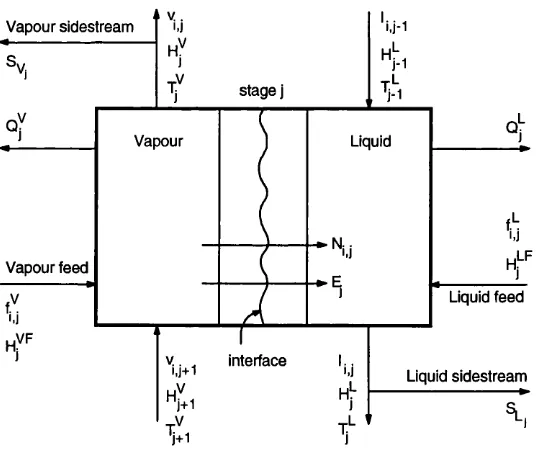
Figure 2.2 Sketch of the nonequilibrium stage 38
Figure 2.3 Composition and temperature profiles in the region of the
interface 40
Figure 2.4 Method decision diagram [Haas (1992)] 47
Figure 3.1 Definition of some variables on a tray 53
Figure 3.2 Two-film model of a packed column 62
Figure 3.3 Rectification section of a distillation column with a total
condenser 63
Figure 4.1 Interaction effects on diffusion in multycomponent systems
[adapted from Taylor and Krishna (1993)] 74
Figure 4.2 Mole fractions close to the interface during mass transfer 78
Figure 4.3 Interface region according to the film theory (film of
thickness 4 79
Figure 4.4 Mass and energy transfer across a phase boundary 102
Figure 5.1 Geometric properties of typical structured packings, (a) Flow
channel cross section, (b) Flow channel arrangement
[adapted from Fair and Bravo (1990)] 124
Figure 6.1 Sketch of the distillation column 126
Figure 9.1 Comparison between the initial profiles (o o o) and the profiles obtained using R0M1 with n=m=^0 (--- ) for example 1. Liquid mole fraction profiles 158
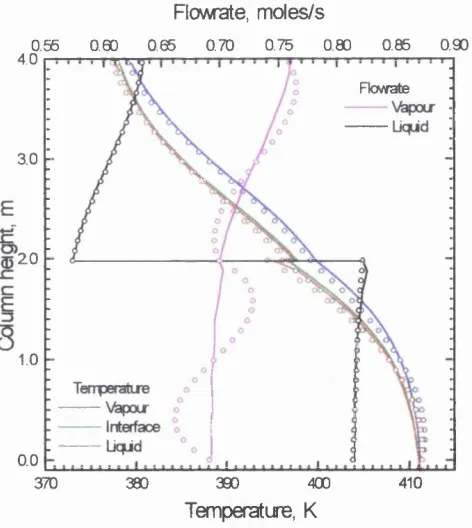
Figure 9.2 Comparison between the initial profiles (o o o) and the profiles obtained using R0M1 with n=m=10 (--- ) for
example 1. Temperature and flowrate profiles 158
Figure 9.3 Comparison between the initial profiles (o o o) and the profiles obtained using R0M1 with n=m=^0 (--- ) for example 1. Interphase mass transfer rate profiles 159
Figure 9.4 Comparison between the initial profiles (o o o) and the profiles obtained using R0M2 with n=m=10 (--- ) for
example 1. Liquid mole fraction profiles 159
Figure 9.5 Comparison between the initial profiles (o o o) and the profiles obtained using R0M2 with n=m=^0 (--- ) for example 1. Temperature and flowrate profiles 160
Index of Figures_________________________________________________________13 Figure 9.7 Comparison between the initial profiles (o o o) and the
profiles obtained using ROMS with n=m=10 ( ) for
example 1. Liquid mole fraction profiles 161
Figure 9.8 Comparison between the initial profiles (o o o) and the profiles obtained using ROMS with n=m=10 (--- ) for
example 1. Temperature and flowrate profiles 161
Figure 9.9 Comparison between the initial profiles (o o o) and the profiles obtained using ROMS with n=m=^0 (--- ) for example 1. Interphase mass transfer rate profiles 162
Figure 9.10 Comparison between the initial profiles (o o o) and the profiles obtained using R0M4 with n=m=^0 (--- ) for example 1. Liquid mole fraction profiles 162
Figure 9.11 Comparison between the initial profiles (o o o) and the profiles obtained using R0M4 with n=m=10 (--- ) for example 1. Temperature and flowrate profiles 16S
Figure 9.12 Comparison between the initial profiles o o) and the profiles obtained using R0M4 with n=m=^0 (--- ) for example 1. Interphase mass transfer rate profiles 16S
Figure 9.IS R0M1 - Comparison between the solution obtained with
n=m=2 ( o o o ) and the solution obtained using n=m=10 (---) for example 1. Liquid mole fraction profiles 165
Figure 9.14 R0M1 - Comparison between the solution obtained with
n=m=2 ( o o o ) and the solution obtained using n=m=^0 (---)
for example 1. Temperature profiles 165
Figure 9.15 R0M1 - Comparison between the solution obtained with
n=m=2 ( o o o ) and the solution obtained using n=m=^0 (---) for example 1. Interphase mass transfer rate profiles 166
Figure 9.16 R0M2 - Comparison between the solution obtained with
n=m=2 ( o o o ) and the solution obtained using n=m=10 (---) for example 1. Liquid mole fraction profiles 166
Figure 9.17 R0M2 - Comparison between the solution obtained with
n=m=2 ( o o o ) and the solution obtained using n=m=10 (--- ) for example 1. Temperature and flowrate profiles 167
Figure 9.18 R0M2 - Comparison between the solution obtained with
n=m=2 ( o o o ) and the solution obtained using n=m=^0 (---) for example 1. Interphase mass transfer rate profiles 167
Figure 9.19 R0M4 - Comparison between the solution obtained with
Index of Figures_________________________________________________________14 Figure 9.20 R0M4 - Comparison between the solution obtained with
n=m=2 ( o o o ) and the solution obtained using n=m=^0 (--- ) for example 1. Temperature and flowrate profiles 168
Figure 9.21 R0M4 - Comparison between the solution obtained with
n=m=2 ( o o o ) and the solution obtained using n=m=^0 (--- ) for example 1. Interphase mass transfer rate profiles 169
Figure 9.22 Comparison between the solution for example 1 obtained
with model R0M1 (o o o) and the solution obtained with model R0M4-- (--). Liquid mole fraction profiles (n=m=10) 170
Figure 9.23 Comparison between the solution for example 1 obtained
with model R0M1 (ooo)and the solution obtained with model R0M4 (---). Temperature and flowrate profiles (n=m=10) 170
Figure 9.24 Comparison between the solution for example 1 obtained
with model R0M1 (o o o) and the solution obtained with model R0M4 (---). Interphase mass transfer rate profiles
{n=m=^0) 171
Figure 9.25 Comparison between the solution for example 1 obtained with model R0M2 (o o o) and the solution obtained with model R0M4 (--). Liquid mole fraction profiles {n=m=^0) 171 Figure 9.26 Comparison between the solution for example 1 obtained
with model R0M2 (ooo) and the solution obtained with model R0M4 (---). Temperature and flowrate profiles (n=m=10) 172
Figure 9.27 Comparison between the solution for example 1 obtained with model R0M2 (o o o) and the solution obtained with model R0M4 (---). Interphase mass transfer rate profiles
(n=m=10) 172
Figure 9.28 Comparison between the solution for example 1 obtained
with model ROMS (o o o) and the solution obtained with model R0M4 (--). Liquid mole fraction profiles (n=m=^0). 173 Figure 9.29 Comparison between the solution for example 1 obtained
with model ROMS (ooo) and the solution obtained with model R0M4 (---). Temperature and flowrate profiles (n=m=^0) 173 Figure 9.30 Comparison between the solution for example 1 obtained
with model ROMS (o o o) and the solution obtained with model R0M4 (---). Interphase mass transfer rate profiles
(A7=A77=10) 174
Figure 9.31 Evolution of the Euclidean norm of the vector of functions with the iteration number. Solutions of example 1 with ten
Index of Figures 15 Figure 9.32 Evolution of the Euclidean norm of the vector of functions
with the iteration number. Solutions of example 1 with six
internal collocation points per section 175
Figure 9.33 Evolution of the Euclidean norm of the vector of functions
with the iteration number. Solutions of example 1 with four
internal collocation points per section 176
Figure 9.34 Evolution of the Euclidean norm of the vector of functions
with the iteration number. Solutions of example 1 with three
internal collocation points per section 176
Figure 9.35 Evolution of the Euclidean norm of the vector of functions
with the iteration number. Solutions of example 1 with two
internal collocation points per section 177
Figure 10.1 Comparison between the initial profiles (o o o) and the profiles obtained using R0M1 with n=m=^0 (--- ) for
example 2. Liquid mole fraction profiles 180
Figure 10.2 Comparison between the initial profiles (o o o) and the profiles obtained using R0M1 with n=m=10 (--- ) for example 2. Temperature and flowrate profiles 180
Figure 10.3 Comparison between the initial profiles (o o o) and the profiles obtained using R0M1 with n=m=^0 (--- ) for example 2. Interphase mass transfer rate profiles 181
Figure 10.4 Comparison between the initial profiles (o o o) and the profiles obtained using R0M2 with n=m=^0 (--- ) for example 2. Liquid mole fraction profiles 181
Figure 10.5 Comparison between the initial profiles (o o o) and the profiles obtained using R0M2 with n=m=^0 (--- ) for example 2. Temperature and flowrate profiles 182
Figure 10.6 Comparison between the initial profiles (o o o) and the profiles obtained using R0M2 with n=m=^0 (--- ) for example 2. Interphase mass transfer rate profiles 182
Figure 10.7 Comparison between the initial profiles (o o o) and the profiles obtained using R0M3 with n=m=^0 (--- ) for
example 2. Liquid mole fraction profiles 183
Figure 10.8 Comparison between the initial profiles (o o o) and the profiles obtained using R0M3 with n=m=^0--- (--- ) for example 2. Temperature and flowrate profiles 183
Index of Figures_________________________________________________________16 FigurelO.10 Comparison between the initial profiles (o o o) and the
profiles obtained using R0M4 with n=m=^0 (--- ) for
example 2. Liquid mole fraction profiles 184
Figure10.11 Comparison between the initial profiles (o o o) and the profiles obtained using R0M4 with n=m=^0 (--- ) for example 2. Temperature and flowrate profiles 185
Figure10.12 Comparison between the initial profiles (o o o) and the profiles obtained using R0M4 with n=m=^0 (--- ) for example 2. Interphase mass transfer rate profiles 185
FigurelO.13 R0M1 - Comparison between the solution obtained with
n=m=3 ( o o o ) and the solution obtained using n=m=10 (--- ) for example 2. Liquid mole fraction profiles 187
Figure10.14 R0M1 - Comparison between the solution obtained with
n=m=3 ( o o o ) and the solution obtained using n=m=10 (--- )
for example 2. Temperature profiles 187
Figure10.15 R0M1 - Comparison between the solution obtained with
n=m=3 ( o o o ) and the solution obtained using n=m=^0 (--- ) for example 2. Interphase mass transfer rate profiles 188
FigurelO.16 R0M2 - Comparison between the solution obtained with
n=m=3 ( o o o ) and the solution obtained using n=m=10 (--- ) for example 2. Liquid mole fraction profiles 188
Figure10.17 R0M2 - Comparison between the solution obtained with
n=m=3 ( o o o ) and the solution obtained using n=m=^0 (--- ) for example 2. Temperature and flowrate profiles 189
Figure10.18 R0M2 - Comparison between the solution obtained with
n=m=3 ( o o o ) and the solution obtained using n=m=10 (--- ) for example 2. Interphase mass transfer rate profiles 189
Figure10.19 R0M4 - Comparison between the solution obtained with
n=m=3 ( o o o ) and the solution obtained using n=m=10 (--- ) for example 2. Liquid mole fraction profiles 190
Figure10.20 R0M4 - Comparison between the solution obtained with
n=m=3 ( o o o ) and the solution obtained using n=m=10 (--- ) for example 2. Temperature and flowrate profiles 190
Figure10.21 R0M4 - Comparison between the solution obtained with
n=m=3 ( o o o ) and the solution obtained using n=m=^0 (--- ) for example 2. Interphase mass transfer rate profiles 191
Figure10.22 Comparison between the solution for example 2 obtained
Index of Figures 17 Figure10.23 Comparison between the solution for example 2 obtained
with model R0M1 (o o o) and the solution obtained with model R0M4 (---- ). Temperature profiles {n=m=^0) 192 Figure10.24 Comparison between the solution for example 2 obtained
with model R0M1 (o o o) and the solution obtained with model R0M4 (---). Interphase mass transfer rate profiles
(A7=n7=10) 193
Figure10.25 Comparison between the solution for example 2 obtained
with model R0M2 (o o o) and the solution obtained with model R0M4 (---- ). Liquid mole fraction profiles (n=/7?=10) 193
Figure10.26 Comparison between the solution for example 2 obtained
with model R0M2 (ooo) and the solution obtained with model
R0M4 (---). Temperature and flowrate profiles {n=m=^0) 194 Figure10.27 Comparison between the solution for example 2 obtained
with model R0M2 (o o o) and the solution obtained with model R0M4 (---). Interphase mass transfer rate profiles
{n=m=^0) 194
Figure10.28 Comparison between the solution for example 2 obtained with model R0M3 (o o o) and the solution obtained with model R0M4 (---- ). Liquid mole fraction profiles (n=m=^0). 195 Figure10.29 Comparison between the solution for example 2 obtained
with model R0M3 (ooo) and the solution obtained with model
R0M4 (--- ). Temperature and flowrate profiles (n=m=10) 195
Figure10.30 Comparison between the solution for example 2 obtained
with model R0M3 (o o o) and the solution obtained with model R0M4 (---). Interphase mass transfer rate profiles
(n=A77=10) 196
Figure10.31 Evolution of the Euclidean norm of the vector of functions
with the iteration number. Solutions of example 2 with ten
internal collocation points per section 197
Figure10.32 Evolution of the Euclidean norm of the vector of functions
with the iteration number. Solutions of example 2 with six
internal collocation points per section 197
Figure10.33 Evolution of the Euclidean norm of the vector of functions
with the iteration number. Solutions of example 2 with four
internal collocation points per section 198
Figure10.34 Evolution of the Euclidean norm of the vector of functions
with the iteration number. Solutions of example 2 with three
Index of Figures_________________________________________________________1^
Figure10.35 Evolution of the Euclidean norm of the vector of functions
with the iteration number. Solutions of example 2 with two
internal collocation points per section 199
Figure 11.1 Comparison between the initial profiles (o o o) and the profiles obtained using R0M1 with n=m=^0 ( ) for
example 3. Liquid mole fraction profiles 202
Figure 11.2 Comparison between the initial profiles o o) and the profiles obtained using R0M1 with n=nn=^0 ( ) for example 3. Temperature and flowrate profiles 202
Figure 11.3 Comparison between the initial profiles o o) and the profiles obtained using R0M1 with n=m=^0 ( ) for example 3. Interphase mass transfer rate profiles 203
Figure 11.4 Comparison between the initial profiles (o o o) and the profiles obtained using R0M2 with n=m=6 (--- ) for example
3. Liquid mole fraction profiles 203
Figure 11.5 Comparison between the initial profiles (o o o) and the profiles obtained using R0M2 with n=m=6 (--- ) for example
3. Temperature and flowrate profiles 204
Figure 11.6 Comparison between the initial profiles (o o o) and the profiles obtained using R0M2 with n=m=6 (--- ) for example
3. Interphase mass transfer rate profiles 204
Figure 11.7 Comparison between the initial profiles (o o o) and the profiles obtained using R0M3 with n=m=^0 ( ) for
example 3. Liquid mole fraction profiles 205
Figure 11.8 Comparison between the initial profiles (o o o) and the profiles obtained using R0M3 with n=m=^0 (---) for example 3. Temperature and flowrate profiles 205 Figure 11.9 Comparison between the initial profiles (o o o) and the
profiles obtained using R0M3 with n=m=10 (---) for
example 3. Interphase mass transfer rate profiles 206
Figurel 1.10 Comparison between the initial profiles (o o o) and the profiles obtained using R0M4 with n=m=^0 (---) for
example 3. Liquid mole fraction profiles 206
Figurel 1.11 Comparison between the initial profiles {o o o) and the profiles obtained using R0M4 with n=m=10 (---) for
example 3. Temperature and flowrate profiles 207
Figurel 1.12 Comparison between the initial profiles (o o o) and the profiles obtained using R0M4 with n=m=10 (---) for
Index of Figures_________________________________________________________1^
Figurel 1.13 R0M1 - Comparison between the solution obtained with
n=m=3 (o o o ) and the solution obtained using n=m=^0 (--- ) for example 3. Liquid mole fraction profiles 209
Figurel 1.14 R0M1 - Comparison between the solution obtained with
n=m=3 (o o o ) and the solution obtained using n=m=^0 (--- )
for example 3. Temperature profiles 209
Figurel 1.15 R0M1 - Comparison between the solution obtained with
n=m=3 (o o o ) and the solution obtained using n=m=10 (--- ) for example 3. Interphase mass transfer rate profiles 210
Figurel 1.16 R0M2 - Comparison between the solution obtained with
n=m=3 (o o o) and the solution obtained using n=m=6 (--- ) for example 3. Liquid mole fraction profiles 210
Figurel 1.17 R0M2 - Comparison between the solution obtained with
n=m=3 (o o o) and the solution obtained using n=m=6 (--- ) for example 3. Temperature and flowrate profiles 211
Figurel 1.18 R0M2 - Comparison between the solution obtained with
n=m=3 (o o o) and the solution obtained using n=m=6 (--- ) for example 3. Interphase mass transfer rate profiles 211
Figurel 1.19 R0M4 - Comparison between the solution obtained with
n=m=3 ( o o o ) and the solution obtained using n=m=^0 (--- ) for example 3. Liquid mole fraction profiles 212 Figurel 1.20 R0M4 - Comparison between the solution obtained with
n=m=3 (o o o ) and the solution obtained using n=m=10 (--- ) for example 3. Temperature and flowrate profiles 212
Figurel 1.21 R0M4 - Comparison between the solution obtained with
n=m=3 ( o o o ) and the solution obtained using n=m=10 (--- ) for example 3. Interphase mass transfer rate profiles 213
Figurel 1.22 Comparison between the solution for example 3 obtained
with model R0M1 (o o o) and the solution obtained with model R0M4--(---- ). Liquid mole fraction profiles {n=m=6) 214 Figurel 1.23 Comparison between the solution for example 3 obtained
with model R0M1 (o o o) and the solution obtained with model R0M4--(---- ). Temperature profiles (n=m=6) 215 Figurel 1.24 Comparison between the solution for example 3 obtained
with model R0M1 (ooo)and the solution obtained with model R0M4 (---). Interphase mass transfer rate profiles (n=m=6) 215 Figurel 1.25 Comparison between the solution for example 3 obtained
Index of Figures 20 Figurel 1.26 Comparison between the solution for example 3 obtained
with model R0M2 (o o o) and the solution obtained with model R0M4 (--- ). Temperature and flowrate profiles
(/7=/7?=6) 216
Figurel 1.27 Comparison between the solution for example 3 obtained
with model R0M2 (o o o) and the solution obtained with model R0M4 (---). Interphase mass transfer rate profiles
{n=m=6) 217
Figurel 1.28 Comparison between the solution for example 3 obtained
with model R0M3 (o o o) and the solution obtained with model R0M4 (---). Liquid mole fraction profiles (n=m=6). 217 Figurel 1.29 Comparison between the solution for example 3 obtained
with model R0M3 (o o o) and the solution obtained with model R0M4 (---). Temperature and flowrate profiles
(n=/77=6) 218
Figurel 1.30 Comparison between the solution for example 3 obtained
with model R0M3 (o o o) and the solution obtained with model R0M4 (---). Interphase mass transfer rate profiles
{n=m=Q) 218
Figurel 1.31 Evolution of the Euclidean norm of the vector of functions
with the iteration number. Solutions of example 3 with ten
internal collocation points per section 219
Figurel 1.32 Evolution of the Euclidean norm of the vector of functions
with the iteration number. Solutions of example 3 with six
internal collocation points per section 220
Figurel 1.33 Evolution of the Euclidean norm of the vector of functions
with the iteration number. Solutions of example 3 with four
internal collocation points per section 220
Figurel 1.34 Evolution of the Euclidean norm of the vector of functions
with the iteration number. Solutions of example 3 with three
internal collocation points per section 221
Figurel 1.35 Evolution of the Euclidean norm of the vector of functions
with the iteration number. Solutions of example 3 with two
internal collocation points per section 221
Index of Tables 21
INDEX OF TABLES
Table 4.1 Determinacy coefficients [adapted from Smith and Taylor
(1983)] 82
Table 5.1 Coefficients Cn for the series in equation (5.41) 115 Table 5.2 Atomic diffusion volumes [Reid etal. (1987)] 119 Table 5.3 Critical surface tension of packing materials [Perry et al.
(1984)] 123
Table 9.1 Specifications for case study 1 156
Table 9.2 Example 1 - Summary of results 164
Table 10.1 Specifications for case study 2 178
Table 10.2 Example 2 - Summary of results 186
Table 11.1 Specifications for case study 3 200
Table 11.2 Example 3 - Summary of results 208
Table A3.1 CPU time (s) spent in the simulations of case study 1 255
Table A3.2 CPU time (s) spent in the simulations of case study 2 255
Chapter 1 - Introduction 22
1 - INTRODUCTION
In the beginning, distillation was just a rudimentary technique for the production
of liquors through the concentration of the alcoholic content of beverages.
With the passage of the years, distillation developed tremendously to become
the most used and important unit operation of the chemical and process
industries.
Distillation was performed traditionally in tray columns and only in recent years
an increase in the use of packed distillation columns has been seen. For this
historical reason almost all the design and/or simulation of packed distillation
columns are made using techniques developed for tray columns.
Considering the increasing complexity of chemical processes, together with the
need to incorporate energy integration in the design, there is clearly an
opportunity for the introduction of optimisation procedures. Equation-based
optimisation requires the use of process models that accurately describe the
phenomena taking place in the equipment. However, the optimisation of
systems involving more than one column or a single large column can be
extremely time consuming due to the complexity and large dimensionality of the
mathematical model to be solved. The same concern with the size of the
models exists in control system synthesis studies where repeated simulations
are necessary.
This need for more efficient process models requiring less solution effort gave
rise to the development of several procedures for the reduction of the order of
the models. It is clear that, on one hand, the reduced-order models must retain
certain properties from the rigorous models (e.g., must retain the necessary
gradient information of the rigorous model to ensure convergence to the
optimum of the rigorous model) but, on the other hand, the dimensionality of
Chapter 1 - Introduction 23 Orthogonal collocation is one of the best known methods for the numerical
solution of differential equations in Chemical Engineering models. In the last
ten years or so, there has been a great interest on the development of reduced-
order models for distillation columns based on the orthogonal collocation
procedure. Apart from a small number of exceptions, this effort has been
concentrated in modeling tray columns.
The aim of this work is to develop steady-state reduced-order models for
packed separation processes in general, and for distillation in particular. These
reduced-order models are intended to incorporate in their core a more rigorous
approach (when compared with the current standards for reduced-order
models) in the evaluation of the interphase mass transfer rates.
As the starting point, in chapter 2, a review of the so called rigorous methods
for multistaged separation columns will be presented. Some emphasis will be
given to the rate based methods as they are intended to be the basis of the
reduced-order models to be developed. This will be followed, in chapter 3, by
an analysis of the reduced-order models based on the orthogonal collocation
method. As already mentioned, most of the work reported in the open literature
deals with tray columns. Nevertheless, there are many lessons to be learned
from these experiences.
The necessary tools to rigorously analyse multicomponent mass transfer are
discussed in chapter 4. These rigorous computations will need to be backed by
the evaluation of several properties of the system. This will be dealt with in
chapter 5.
Chapters 6, 7, and 8 are devoted to a comprehensive description of the
reduced-order models developed in this work while chapters 9, 10, and 11 will
present the results of three case studies.
Finally, in chapter 12, some conclusions on the performance of the reduced-
order models are presented together with some topics that deserve further
Chapter 2 - Rigorous Methods fo r the Simulation o f Multistaged Separations 24
2- RIGOROUS METHODS FOR THE SIMULATION OF
MULTISTAGED SEPARATIONS
2 .1 - In t r o d u c t io n
One of the basic aims of this work is to develop some models for the simulation
of packed separation processes. As Krishnamurthy and Taylor (1985c) pointed
out, there are basically two different approaches for modelling packed columns.
One of these approaches is to divide the continuous contact device into several
sections, where each of the sections is considered as if it were a stage in a
stagewise contactor. Therefore, as our final aim is to develop some reduced-
order models for the simulation of packed columns, some of the most important
rigorous methods for the simulation of multistaged separation processes will be
presented in this chapter.
In section 2.2 some methods based on the equilibrium-stage concept are
presented while the rate based methods (also known as nonequilibrium stage
models) are presented in section 2.3. Some information on where to find
guidelines on choosing the appropriate method for a specific application is
presented in section 2.4. Finally, in section 2.5, some of the key concepts for
the simulation of packed separation columns are discussed.
2 .2 - Mo d e l s Ba s e d on t h e Eq u il ib r iu m-St a g e Co n c e p t
2.2.1- The equilibrium-stage
Most of the simulation packages available nowadays for the simulation of
multicomponent multistage separations are based on the equilibrium stage
concept.
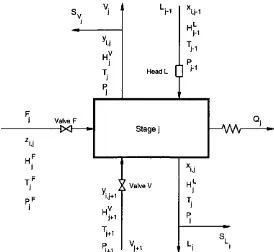
A scheme of a typical equilibrium-stage is presented in Figure 2.1 where the
index j refers to the stage number and / to the component. A separator consists of a number of such stages arranged in a countercurrent cascade. The stages
are numbered down from the top of the column. There is no limitation on the
Chapter 2 - Rigorous Methods for the Simulation of Multistaged Separations 25 phases leaving the stage are considered to be at thermal and mechanical
equilibrium.
hi
valve V Valve F
— M — ►
— V \A r
Q.
Figure 2.1. Sketch of the equilibrium-stage
2.2.2- Basic equations for the equiiibrium-stage
The equations used to describe the steady state operation of a distillation
column are often referred to as the MESH equations [after the work of Wang
and Henke (1966)]. The MESH acronym stands for:
• Material balance for each component (no equations per stage)
M/,y = ^y-i^/.y-i "I" ^y+iy/,y+i + ^ j ^ i j ~ (^y ^ Lj ) ^ i , j ~ (^y ^ V j ] V i , j (2- "I )
• Equilibrium relation for each component (no equations per stage)
^/,y = ViJ ~ ~ ®
The equilibrium constant, K,y, is usually a complex function of the general form
Chapter 2 - Rigorous Methods f o r the Simulation o f Multistaged Separations_______ ^
• Mole fraction Summations (one equation per stage)
nc
(^y)y = Z / w -l-O = 0 (2.4)
nc
= 0 (2.5)
• Heat or enthalpy or energy balance (one equation per stage)
H,, . + F jH j - {Lj + S,, )h^ - [v, + S,, )«)' - O, = 0 (2.6)
The enthalpies for each phase are functions of temperature, pressure and
composition and the relations have the general form
(2.7)
H i = H :{T ,.P j,y u ) (2.8)
Equation (2.4) or (2.5) can be replaced by a total material balance obtained
through the combination of equations (2.4), (2.5) and (2.1) summed over the nc
components and over stages 1 to j leading to
(2.9)
/c=1
Sometimes the bubble-point and dew-point equations are used in the solution
method to help in the determination of the stage temperature. These equations
are generated via the combination of the summation equation and the
equilibrium equation, leading to the bubble-point equation
= 0 (2 .10)
/=1
and the dew-point equation
= 0 (2 .11)
Chapter 2 - Rigorous Methods fo r the Simulation o f Multistaged Separations 27 A countercurrent cascade of Nsequilibrium-stages is represented by Ns(2nc+3) MESH equations. If all F), Zij, T f, P f, and Qj are specified the
system of Ns(2nc+3) nonlinear algebraic equations can be solved for the Ns(2nc+3) variables [%, 7], % and Lj.
2.2.3- Classification of the methods of soiution
There is in the open literature a wide variety of methods to solve the system of
equations presented in the previous section.
Lewis and Matheson (1932) and Thiele and Geddes (1933) are among the first
to address the solution of this system of equations in a stage-by-stage,
equation-by-equation calculation procedure based on equation tearing. These
methods were widely used for hand calculations of simple fractionators with
one feed and two products. In the first attempts to program the Thiele-Geddes
method in a digital computer the solution procedure was often numerically
unstable [Henley and Seader (1981)].
Several improvements in these early methods were presented in the literature
and in a classic study, Friday and Smith (1964) analysed a number of tearing
techniques for the solution of the MESH equations. They concluded that no
single technique is able to handle all types of problems. They also divided the
rigorous methods of solution into four basic classes, namely:
• bubble-point methods (BP);
• sum-rates methods (SR);
• the 2N Newton methods;
• the global Newton or simultaneous correction methods (SC).
The continuous development of new techniques led Haas (1992) to add some
classes to the previous ones, for example:
• inside-out methods;
• relaxation methods;
Chapter 2 - Rigorous Methods fo r the Simulation o f Multistaged Separations 28 In the following sections a brief description of some of the most important
methods of each class will be presented.
2.2.4- Tridiagonal matrix aigorithm
The tridiagonal matrix algorithm, introduced by Wang and Henke (1966) for
calculating the component and total flowrates, is used in most of the methods
presented in this chapter.
The tridiagonal matrix results from a modification of equation (2.1). The vapour
mole fractions are eliminated from equation (2.1) using equation (2.2) and the
total liquid flowrates are eliminated via substitution of equation (2.9) into
equation (2.1). The resulting equation for component / in stage y is:
where
'o , = - s . .-S v,)-V , (2.13)
k=^
2 < j < N s
M
= - '^y+1 ^ 4 +
{K
+ ®i'/ )^Uk=)
(2.14)
^ < j < N s
(2.15)
^ < j < N s - ^
(2.16)
^ < j < N s
and, for a typical distillation column, x, q = 0, = 0, = 0 and = 0.
Grouping equations (2.12) by component they can be partitioned in nc
Chapter 2 - Rigorous Methods fo r the Simulation of Multistaged Separations 29
0 0 0 0 ' ' ■ u,,
-'D , 0 • • 0 ^i,2 Ui.2
0 'D , 0 0 ^/.3 U,3
0 0 'D , ^/.4 U,,4
0
0
0
0 ^i.Ns-3 ^i.Ns-3
0 0 0 ^i.Ns-2 ^i.Ns-2
0 0 ^/,A/s-1
0 0 0 0
(2.17)
It is important to emphasise that and ^Dij depend only on the tear variables
(the vector of temperatures and the vector of vapour flow rates) provided that
the values of Kjj are composition independent. If not, compositions from the
previous iteration may be used to estimate the values of K),y.
The output variables of each equation (2.17) are the liquid mole fractions of
component / over the whole column (A/s stages).
There are some solution techniques specially tailored for tridiagonal matrices.
In their work Wang and Henke (1966) recommended the usage of an algorithm
developed by Thomas [Lapidus (1962)]. Boston and Sullivan (1972) presented
a modified Thomas algorithm that is able to handle difficult problems that arise
with columns with a great number of stages and with components whose
absorption factors vary significantly from top to bottom of the column.
2.2.5- Bubble-point methods
In this class of methods the stage temperatures are calculated by solving the
bubble point equation. These methods are generally used for narrow-boiling,
nearly ideal systems.
The Wang and Henke (1966) method uses the tridiagonal matrix to calculate
the compositions and those are used to calculate the temperatures by solving
Chapter 2 - Rigorous Methods fo r the Simulation o f Multistaged Separations 30 To start the iterative procedure one must assume values for the tear variables.
Frequently the assumption of constant molar interstage flows is a good starting
point. For the initial values of the vector of temperatures it is common practice
to assume a linear variation of the temperature with stage location. The top
temperature can be estimated from the bubble-point of the assumed liquid
distillate product and the bottom temperature from the dew-point of the
assumed bottom product. If the values of Kij are composition dependent one
also needs to estimate the initial liquid and vapour composition profiles.
Alternatively, ideal values of K),y can be used for the first iteration.
The corrected values of the flow rates are computed using equations (2.6) and
(2.9). The procedure is considered to be converged when the variations
between two consecutive sets of temperatures and between two consecutive
sets of flowrates are smaller than a specified tolerance. Frequently successive
substitution is used to update the tear variables.
An interesting alternative is to use the tridiagonal method to calculate the
compositions but a new direct procedure to evaluate temperatures avoiding the
iterative bubble-point temperature determination. This procedure, named the
K^-method, is an approximation of the dew or bubble-point equations and it is
one of the key features of the theta-method of Holland and co-workers [Holland
(1975)]. In the theta-method a convergence promoter, 0, is used to correct the
calculated values of the component flow rates obtained from the solution of the
tridiagonal matrix before they are used in the estimation of the stage
temperatures. The convergence promoter is used to force the overall
component balance as well as the total material balance to be satisfied. This
step is necessary since the flowrates of each component come from different
tridiagonal systems.
2.2.6- Sum-rates methods
The key characteristic of sum-rates' methods is that they use the energy
Chapter 2 - Rigorous Methods fo r the Simulation o f Multistaged Separations_______ M
to distillation but the reboiler and the condenser must be solved as separate
unit operations [Fonyo et aL (1983)]. Sum-rates’ methods are suited to
modelling absorbers and strippers, being able to simulate some extremely wide
boiling systems containing noncondensables.
Probably the most commonly used sum-rate method is the one developed by
Burningham and Otto (1967). The temperatures are calculated via the solution
of the stage energy balances using a Newton-Raphson technique [a
comprehensive discussion of the Newton-Raphson method and its variants can
be found in Holland (1981)]. Component flow rates are then evaluated using
the tridiagonal matrix algorithm. The component flow rates are then added to
get the total flow rates, a procedure that gives the name of the method (sum-
rates).
2.2.7- 2N Newton methods
Unlike in the bubble-point and sum-rates' methods in the 2N Newton methods
the temperatures and total flow rates are calculated in the same step using a
Newton-Raphson algorithm. The component flow rates are calculated in a
separate step. The name 2N is due to the necessity of writing down two
equations per stage, leading to a total of 2N equations (considering N the
number of stages).
These methods are a good alternative for systems involving the separation of
wide or middle boiling mixtures.
In his formulation Tomich (1970) uses as the first function a combination of the
summation equations for the vapour and liquid compositions [equations (2.4)
and (2.5)]. The second independent function is the stage energy balance. The
total vapour flow rates and the temperatures are chosen as the independent
Chapter 2 - Rigorous Methods fo r the Simulation o f Multistaged Separations_______ ^
To start the iterative procedure one should guess initial values for the
temperatures and total vapour flow rates. The next step is to evaluate the liquid
compositions using the tridiagonal algorithm. A new set of temperatures and
total vapour flow rates is then obtained via one single iteration of the Newton-
Raphson algorithm. If the norm of the functions is very small and any other
specified criteria are also met the final solution was reached. Otherwise the
whole procedure is repeated on the basis of the new set of temperatures and
total vapour flow rates.
Holland (1981) made a different choice on the functions and variables for the
Newton-Raphson iteration. The independent functions are either the dew-point
or bubble-point equations [equations (2.10) or (2.11)] and the energy balances.
The independent variables are the temperatures and Sy a multiplier defined as
follows:
(2.18)
KJ
COThe corrected values of the ratio Lj / Vj are used in the absorption and stripping factors employed in the component balances and in the total material balance.
The calculation sequence to be adopted is similar to that of Tomich (1970).
2.2.8- Simultaneous correction methods
The basic characteristic of the simultaneous correction methods is that they
attempt to solve all the MESH equations and variables together. Although they
are the most powerful in solving problems involving nonideal mixtures they
present the weakness of being extremely sensitive to the set of initial values.
Frequently there is the need to use another rigorous method to produce a good
Chapter 2 - Rigorous Methods fo r the Simulation o f Multistaged Separations_______ ^
In the Naphtali-Sandholm method [Naphtali and Sandholm (1971)] the chosen
independent variables for the Newton-Raphson calculation are the stage
temperatures and component liquid and vapour flow rates. The independent
variables are grouped by stage and ordered as presented above. The
independent functions for a stage are the energy balance, one equilibrium
equation for each component and one component balance for each component.
In order to keep the numerical values in the same order of magnitude the
independent functions are written in a normalised form.
These equations are grouped by stage and their order of appearance in the
vector of functions is first the energy balance, second the component balances
and finally the equilibrium equations. This will lead to a total of 2nc+1
equations and variables per stage.
All the variables are solved together producing a Jacobian of size
A / s ( 2 / 7 c + 1 ) x A / s ( 2 / 7 c + 1 ) . Due to the chosen grouping and ordering of the
equations the Jacobian will be sparse with a block-banded structure (blocks of
elements along the main, upper, and lower diagonals).
Starting from an initial set of temperatures and total vapour and liquid flow rates
for each stage the initial component liquid and component vapour flow rates
are calculated using the tridiagonal matrix algorithm. The results of the
previous step are then used to initialise the Newton-Raphson procedure that
will iterate until the norm of the independent function residuals is very small
and any other criteria specified are satisfied. The total flow rates and the duties
are calculated only after the solution is found.
There are in the open literature many other simultaneous correction methods
[e.g., Ishii and Otto (1973), Gallun and Holland (1976)] that introduce some
Chapter 2 - Rigorous Methods fo r the Simulation o f Multistaged Separations_______ M
2.2.9- Inside-out methods
Nowadays the inside-out methods are among the most popular methods due to
their flexibility and robustness.
In the methods presented in the previous sections every time the MESH
variables change there is the need to update the equilibrium constants, Kij, and
the enthalpies using complex correlations.
The basic idea of the inside-out methods is to employ simple enthalpy and
equilibrium constant models together with the MESH equations in a so called
inside loop where the MESH variables are calculated (using variations of the
methods presented before, e.g., bubble-point, 2N Newton). Then, on the basis
of the most recent set of MESH variables, the parameters for the simple
enthalpy and equilibrium constant models are updated using the complex
enthalpy and equilibrium constant correlations on the outer loop. It is important
to stress that the parameters of the simple models are unique for each stage
and are the variables of the outer loop.
As a consequence of the simplicity of the enthalpy and equilibrium constant
models the inside loop is remarkably stable for a wide range of mixtures.
The development of the inside-out methods started with Boston and Sullivan
(1974). Several improvements were then introduced by Boston and Britt (1978),
Boston (1980), Russel(1983), and Trevino-Lozano et al. (1984).
2.2.10- Relaxation methods
Rose et al. (1958) presented the first version of a relaxation method. Several
improvements were then introduced by, among others, Jelinek et ai. (1973),
Ketchum (1979) and Mori etal. (1987).
The steady-state solution of a column is determined in a relaxation method by
Chapter 2 - Rigorous Methods fo r the Simulation o f Multistaged Separations 35 realistic condition is used as the starting point to the integration scheme.
In the early methods only the component balances were written in a time-
dependent form as follows:
/ dx
('^y+iy/,y+1 + ~ ^ j ^ i j ) / ~ (2-19)
where the vapour holdup was considered negligible and the liquid holdup
assumed to be constant. The composition after a time interval At is calculated
using Euler's method:
df (2.20)
In the relaxation equations the /C-values and the total flowrates are considered
constants from one time step to the next. Once a new set of compositions is
obtained, the equilibrium constants are updated and the remaining MESH
equations are solved by one of the previous conventional solution methods.
Ketchum (1979) presented a review of relaxation methods and discussed three
of their main weaknesses:
• since the temperatures and total flow rates are calculated separately from
the compositions the temperature correction can be unstable or very slow;
• in the calculation there is no estimation on the variation of temperature
with time;
• in order to prevent instability the time step is kept small and this will cause
the method to move slowly, especially close to the steady-state condition.
Trying to eliminate such problems Ketchum (1979) transforms the global
Newton method of Naphtali and Sandholm (1971) into a relaxation method.
Now the variation of the temperature with time is expressed by
T; t + A t = T,^
Chapter 2 - Rigorous Methods f o r the Simulation o f Multistaged Separations 36
and one must include in the independent functions the transient version of the
energy balance of each stage, written as
' / = 1 /=1 - 1A j
=
6t ‘ij
/=1 ;=1
Depending on the size of the time step the method behaves as a relaxation or
as a global Newton method. When the At is small the changes in the
independent variables are small and the method behaves as a damped
Newton-Raphson method that moves slowly and monotonically towards the
solution. On the other hand if At is large the method performs as a Newton-
Raphson method.
Therefore Ketchum's relaxation method is fast and stable because one can
start with a small time step and proceed with it until the changes in the
temperature and liquid compositions become small. The time step is then
increased, switching to the global Newton-Raphson part of the algorithm. In
other words the relaxation method is used to produce very good starting values
for the global Newton method.
2.2.11- Homotopy-continuation methods
The homotopy or continuation methods start from a known solution of the
column and then follow a path towards the desired solution. The known solution
can be at different conditions or employing simpler correlations for the
evaluation of equilibrium constants and enthalpy making the solution easy to be
obtained.
The homotopy function is a blend of two functions
(2.23)
where g{x) is the known or simpler solution and f{x ) is the difficult solution of
Chapter 2 - Rigorous Methods fo r the Simulation o f Multistaged Separations_______ ^
solution travel from the known solution to the difficult one. Any new value of th
will produce a different set of independent variables x. The final solution is
found when f ( x ) = 0 which causes at th=^ -> h{x, th) = 0.
The homotopy methods can be divided into mathematical homotopies and
physical or parametric homotopies. The physical homotopies have a basis in
the MESH equations and, as pointed out by Taylor et al. (1987), they perform
better than the mathematical homotopies.
Vickery and Taylor (1986) developed a thermodynamic homotopy on which
ideal equilibrium constants and ideal enthalpies were used at the beginning of
the procedure and then were slowly switched to the rigorous equilibrium
constants and rigorous enthalpies by changing the value of the homotopy
parameter.
The steps of their homotopy method are as follows:
1. set up initial values (temperatures and total vapour and liquid flow rates
for every stage) and find out the known (easy) solution;
2. the homotopy parameter is set to zero. The solution of step 1 is the initial
value to jc;
3. solve h(x, th) = 0 using a global Newton method;
4. \f th<1 the current values of (djc/df^) are calculated from:
dx dx
vdf/,7
+ a = 0 (2.24)
5. use Euler's rule to calculate the new value of jc and return to step 3
djc ^
(2.25)
Taylor et ai. (1987) presented a physical homotopy based on a pseudo-
Murphree efficiency. Such pseudo efficiency is varied from, for example, 0.1, a
situation where very little separation is achieved, to a maximum of one at the