M E T H O D O L O G Y
Open Access
Developing clinical practice guidelines: reviewing,
reporting, and publishing guidelines; updating
guidelines; and the emerging issues of enhancing
guideline implementability and accounting for
comorbid conditions in guideline development
Paul Shekelle
1,2*, Steven Woolf
3, Jeremy M Grimshaw
4,5, Holger J Schünemann
6and Martin P Eccles
7Abstract
Clinical practice guidelines are one of the foundations of efforts to improve health care. In 1999, we authored a paper about methods to develop guidelines. Since it was published, the methods of guideline development have progressed both in terms of methods and necessary procedures and the context for guideline development has changed with the emergence of guideline clearing houses and large scale guideline production organisations (such as the UK National Institute for Health and Clinical Excellence). It therefore seems timely to, in a series of three articles, update and extend our earlier paper. In this third paper we discuss the issues of: reviewing, reporting, and publishing guidelines; updating guidelines; and the two emerging issues of enhancing guideline implementability and how guideline developers should approach dealing with the issue of patients who will be the subject of guidelines having co-morbid conditions.
Background
Clinical practice guidelines (hereafter referred to as guidelines) are one of the foundations for efforts to im-prove health care. The modern age of guidelines began with a 1992 IOM report, which defined guidelines as
“systematically developed statements to assist
practi-tioner and patient decisions about appropriate health care for specific clinical circumstances” [1]. In 1999, we authored a paper about methods to develop guidelines [2]. It covered: Identifying and refining the subject area of the guideline; Running guideline development groups; Identifying and assessing the evidence; Translating evi-dence into a clinical practice guideline; and Reviewing and updating guidelines. Since it was published, the methods of guideline development have progressed both
in terms of methods and necessary procedures and the broad context for clinical practice guidelines has changed.
To help users identify and choose guidelines there has been the emergence of guideline clearing houses (such as the AHRQ Guideline Clearing House (www.guideline.gov)) that identify and systematically characterize guidelines on a number of domains and the development of robust guide-line appraisal instruments such as the AGREE tool [3,4]. There has been the appearance of large scale guideline pro-duction organisations both at a national level (such as the UK National Institute for Health and Clinical Excellence or Scottish Intercollegiate Guidelines Network) and a condi-tion level (such as the Ontario Cancer Guideline Program). There have also been relevant reports (that some of us have participated in) for the World Health Organisation [5] and professional societies (Schünemann HJ, Woodhead M, Anzueto A, Buist AS, MacNee W, Rabe KF, Heffner J. A guide for guidelines for professional societies and other developers of recommendations: an official American Thoracic Society (ATS)/European Respiratory Society (ERS) Workshop Report; forthcoming). Such organizations * Correspondence:[email protected]
1RAND Corporation, Santa Monica, CA 90407, USA 2
Veterans Affairs Greater Los Angeles Healthcare System, Los Angeles, CA 90073, USA
Full list of author information is available at the end of the article
and those interested in producing and using guidelines now have a high profile society in the Guidelines International Network (http://www.g-i-n.net/). Against this background it seems timely to, in a series of three articles, update and extend our earlier paper on the methods of developing clin-ical practice guidelines. This series is based on a back-ground paper [6] we prepared for the Institute of Medicine report“Clinical Practice Guidelines We Can Trust”[7].
In the first paper we discussed target audience(s) for guidelines, identifying topics for guidelines, guideline group composition and the processes by which guideline groups function and the important procedural issue of conflicts of interest. In the second paper we discussed issues of identifying and synthesizing evidence: deciding what type of evidence and outcomes to include in guide-lines; integrating values into a guideline; incorporating economic considerations; synthesis, grading, presenta-tion of evidence; and moving from evidence to recom-mendations. In this third and final paper in the series we discuss the issues of: reviewing, reporting, and publish-ing guidelines; updatpublish-ing guidelines; and two emergpublish-ing issues - enhancing guideline implementability and how guideline developers should approach dealing with the issue of patients who will be the subject of guidelines having co-morbid conditions.
Reviewing, reporting, and publishing guidelines Peer review and consultation
Only so many experts and perspectives can be repre-sented on a guideline group. The review process pro-vides an opportunity to elicit input from broader and important perspectives that the group itself cannot en-compass but that have important insights into the evidence (and its contestability) or the challenges of adopting recommendations. This can be divided into the two steps of invited peer review, where the reviewers are identified by the guideline developers on the basis of their perceived ability to contribute, and public consult-ation, where the document is open to comment from any interested party.
Invited peer review
The means by which review comments are solicited is typically by mailing draft documents to the reviewers along with instructions on relevant criteria and a dead-line for feedback. However, some groups obtain similar input and criticism earlier in the process by forming ad-visory groups that include some of the above stake-holders. The advisory group may not have voting power but may receive draft documents, correspondence, and updates as the guideline group deliberates. The group’s meetings can also be attended by observers who repre-sent the above interest groups, or they may be invited to an open forum, hearing, or workshop to present papers
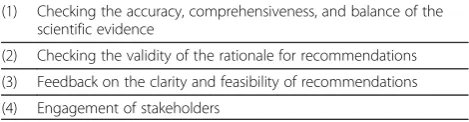
and testimonials to the guideline group. These observers may share criticisms in person at such meetings or for-ward concerns offline in correspondence with the group or its organizational/agency sponsor. As an endeavor in scholarship, documents and recommendations devel-oped by a guideline group should be critically reviewed by colleagues and experts to identify errors and omis-sions, suggestions for improvement and clarification, and debate about the rationale. The criticism is helpful in four ways (Table 1).
Reviewers with expertise on relevant past research and studies in progress and mastery of the clinical topic can identify relevant studies that were overlooked, mistakes made in describing studies or their results, flaws in commentaries about the quality of the studies, methodo-logical and statistical errors in pooling data in meta-analyses or models, and imbalance and asymmetry in presenting the evidence. Reviewers can challenge the logic used by the guideline group in translating the evi-dence into recommendations. They can note, for ex-ample, when the evidence presented does not support the recommendation offered and call attention to biases, political pressure, or other factors that may be coloring the group’s judgments. Reviewers with knowledge of the realities of clinical practice and the administration of health systems can provide useful feedback on how eas-ily the recommendations can be adopted, or even under-stood, by clinicians and systems of care. Language issues that create ambiguities in explicating which patients are affected and the details of the intervention can be
identi-fied. Reviewers grounded in the “real world” can also
identify broader policy ramifications, such as the lack of providers or technology to support a recommendation, implications for reimbursement or medico-legal liability, impracticalities created for information systems or per-formance review criteria, upcoming legislation or pol-icies that bear on the topic, and political resistance the recommendations will face.
The group’s procedures for selecting reviewers should pay attention to this consideration in choosing poten-tially harsh critics who can articulate their scientific or clinical reasoning. It should also take note of the need to be explicit about conflicts of interest (as discussed in the first paper in this series). Inviting criticism from provider groups and specialty societies who are expected to be critical is also important.
Table 1 Advantages of external review of a guideline
(1) Checking the accuracy, comprehensiveness, and balance of the scientific evidence
(2) Checking the validity of the rationale for recommendations
(3) Feedback on the clarity and feasibility of recommendations
Public consultation
It is prudent to share drafts with a spectrum of reviewers who include not only supporters but also the individuals, specialty groups, and industries expected to be critical of the group’s characterization of the evidence or of their recommendations. Reviewers can be given clear instruc-tions to accompany their criticisms with relevant scien-tific evidence and citations to support their criticisms and suggestions. Reviewers who express strong views but cannot present a cogent scientific rationale may be less helpful than critics who can articulate a sound sci-entific and clinical argument for their views.
Whether or not their feedback is useful on substance, inviting comments and criticism from stakeholders is important for“buy-in” to give the major players a sense of partnership in the process rather than feeling excluded. Thus, even if scientific and clinical review is already provided by leading experts, comments are often invited from relevant specialty societies (e.g., American Academy of Pediatrics), disease-related organizations (e.g., American Diabetes Association), government agen-cies (e.g., Centers for Disease Control), and other bodies that are relevant to the topic in question. Perhaps the most useful benefit of review by stakeholders lies in poten-tially engaging their assistance in promoting awareness and adoption of the recommendations when they are released. Specialty societies and other entities that have played a role in reviewing and improving guidelines are often willing to participate in an outreach effort to pro-mote its implementation.
Dealing with peer review
Inviting criticism of draft documents hardly guarantees that the final guideline will escape criticism. In particu-lar, critics of guidelines can fault the review process if there is a perception that their criticisms were submitted but ignored. Therefore, it is useful for the guideline group to adopt an open, systematic and fair process for receiving and responding to review comments. For ex-ample, the group can maintain a database in which it documents every criticism or comment it receives from every reviewer, how the guideline was or was not modi-fied, and the rationale for actions taken or for inaction. Making such a document available to the public is im-portant for transparency, and some groups even post it on their website.
How groups react to review comments is, or ideally should be, consistent with the methodology it used in making the original recommendations. For example, if a group accepted expert opinion as a determinant of recom-mendations, criticism by experts that the recommendation is inappropriate or public or political disfavor might be rea-son enough for rewording the recommendation. Con-versely, on the other extreme, if a group’s methodology
insists on evidence from well-designed randomized con-trolled trials, neither strident expert opinions nor a lengthy bibliography of supporting cohort studies are necessarily grounds for revising the recommendations. The harshest criticism from a topic expert or organization might merit no action if the reviewer cannot produce evidence or ra-tionale that is relevant to the group’s methodology for mak-ing recommendations. The group must hold an explicit methodology with explicit rules of evidence and criteria for recommendations, however, to justifiably invoke the latter as an excuse for ignoring criticisms.
Peer-reviewed publications
Publishing practice guidelines (or the evidence reviews on which they are based) in a peer-reviewed publication offers an additional opportunity for critical appraisal by anonymous reviewers and feedback to improve the guide-lines. Publication in a peer-reviewed journal also enhances the scientific credentials of the guideline and act as a “stamp of approval,” which can be important to some clinicians, patients, academia, and policymakers. For guideline groups and sponsoring organizations that lack the resources to widely publicize or disseminate guidelines on their own, journal publication provides a venue for distributing print copies and, increasingly, an online platform for full-text retrieval of electronic copies of the guidelines, evidence reviews, data tables, and other supplementary information.
of the journal, the peer-reviewed version may differ from other versions released by the guideline group or its sponsoring organization or agency, creating troubling inconsistencies.
Other publications
Guideline groups now often develop multiple products to cater to a multiplicity of target audiences. For ex-ample, a short guideline summary may be intended for busy clinicians or policymakers whose interest lies only in knowing the core recommendation and not the underlying evidence or the group’s rationale. A technical report, which may include detailed evidence reviews, evi-dence summary tables, and modeling results, may be produced for audiences interested in studying the sci-ence and critiquing the quality of the scientific reason-ing. A lay version of the guideline may be produced to explain the aspects of the guideline that are relevant to patients, often using language that is free of technical jargon and is accompanied by useful graphics or illustra-tions. The above documents are typically disseminated in an electronic format, as HTML or PDF documents accessible online, but some guidelines may also include a print publication in a peer-reviewed medical journal, to reach audiences who prefer print media or view the latter as an important metric for scientific credibility.
Two decades ago, whether as peer-reviewed or other publications, guidelines and related products (e.g., evi-dence reviews, data tables, modeling studies, patient education materials) were almost exclusively print publi-cations that arrived in the mail and sat on shelves and desks. In the modern era, although print publications re-main a staple, an increasing proportion of publications are available and more widely used electronically in searchable online HTML and PDF formats. Increasingly,
guidelines are being provided with interactive “front
ends” that allow users to navigate or interrogate the
guideline or supporting evidence. Some guidelines or supporting materials are available for full-text retrieval at no charge and are therefore more accessible to the general public, whereas others require some payment for controlled access. Guidelines sometimes spawn related decision support tools or software to implement the guideline in practice.
Updating guidelines
It is well recognized that guidelines become out of date and therefore require updating. We have previ-ously argued that there were six situations (Table 2) that might necessitate the updating of a clinical prac-tice guideline [8]. Changes in the values placed on outcomes often reflect societal norms. Measuring the values placed on outcomes and how these change over time is complex and has not been systematically
studied. When changes occur in the availability of resources for health care or the costs of interventions, a generic policy on updating is unlikely to be helpful, because policy makers in disparate health care sys-tems consider different factors in deciding whether services remain affordable. Most effort has been directed towards defining when new information on interventions, outcomes and performance justifies up-dating guidelines. This process includes two stages: 1) identifying significant new evidence, and 2) assessing whether the new evidence warrants updating. Within any individual guideline it is possible that there will be some recommendations that are invalid whilst others remain current. A guideline on congestive heart failure [9] for ex-ample, includes 37 individual recommendations. How many must be invalid to require updating the whole guideline? Clearly a guideline needs updating if the major-ity of recommendations are out-of-date, with new evi-dence demonstrating that the recommended interventions are inappropriate, ineffective, or superseded by new inter-ventions. In other cases a single, outdated recommenda-tion could invalidate the entire document. Judgments about whether a guideline needs updating are inherently subjective and reflect the clinical importance and number of invalid recommendations. Shekelle and colleagues described an operational method based on their concep-tual model, presented above, in relation to the need for updating of 17 clinical guidelines published by the Agency for Healthcare Research and Quality [10]. They found that seven guidelines were so far out of date that a major up-date was required, an additional six guidelines required a minor update, three guidelines were still valid, and for one guideline they could reach no conclusion. They concluded that as a general rule, guidelines should be re-evaluated no less frequently than every three years. In an evaluation of the need for updating systematic reviews, Shojania and colleagues found that almost one quarter of systematic reviews are likely out-of-date at two years post-publication [11]. This method provided a way of balancing the resources required for updating with the potential benefits assuming that a full re-development of a guideline on each occasion was not necessarily an efficient use of resources. Gartlerhner and colleagues [12] explicitly addressed this Table 2 Situations that might necessitate the updating of a clinical practice guideline
1. Changes in the evidence on the existing benefits and harms of interventions:
2. Changes in the outcomes considered important:
3. Changes in the available interventions:
4. Changes in the evidence that current practice is optimal:
5. Changes in the values placed on outcomes:
issue when they compared this method (which they termed the review method) with a“traditional”method of updating (comparable to de novo guideline development) across six topics from the 1996 US Preventive Services Taskforce Guide to Clinical Preventive Services in terms of the com-pleteness of study identification, the importance of any studies that were missed by either method and the ef-fort involved in the methods. Their results showed that “Although the review approach identified fewer eligible studies than the traditional approach, none of the studies missed was rated as important by task force members acting as liaisons to the project with respect to whether the topic required an update. On average, the review approach produced substantially fewer citations to review than the traditional approach. The effort involved and potential time saving depended largely on the scope of the topic”. On the basis of this they concluded that
“The revised review approach provides an efficient and
ac-ceptable method for judging whether a guideline requires updating”.
A description of updating in a cancer guidance pro-gram [13] concluded that for their purposes that a more frequent, three monthly, literature search was needed though they found that the productiveness of this varied across different guidelines.
These issues have been enshrined within the pro-cesses of some guideline development programs and in the UK the National Institute for Health and Clinical Excellence (NICE) recommends a combination of literature searching and professional opinion to inform the need for a “full” or “partial” updates and describes its processes for these - though they involve both changes in the evidence relating to a guideline and extensions of the scope of a guideline (changes in the outcomes consid-ered important or available interventions). The assess-ment of the need for an update happens every three years. In the National Guideline Clearinghouse, guide-lines are required to have been re-examined every three years.
Emerging issues
There are two emerging issues around which there is considerably less evidence or experience to guide guide-line developers - what guideguide-line developers can do to enhance guideline implementability and how guideline developers should deal with the fact that, despite guide-lines addressing single condition guideguide-lines, many patients do not just have single clinical conditions. Strategies to promote the implementation of guidelines are beyond the scope of this paper but the interested reader is directed to the work of the Cochrane Collaboration Effective Practice and Organisation of Care Review Group in the Cochrane Library (www.thecochranelibrary.com).
Enhancing guideline implementability
Guidelines are not self implementing. Developing guide-lines and making them available to health care profes-sionals does not ensure their use. Whilst guideline developers may have some responsibility for guideline dis-semination they rarely have responsibility for guideline implementation. Guideline dissemination is sometimes undertaken by the developer and sometimes undertaken by practitioners or managers of the health care system or professional societies or the pharmaceutical industry. By contrast, guideline implementation is usually the responsi-bility of practitioners or managers. As a result, it is not al-ways clear what role guideline developers should have in dissemination and implementation.
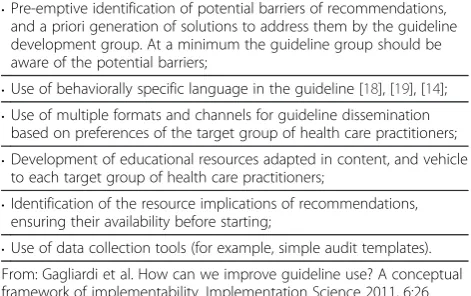
There are studies that suggest that the specificity of guideline recommendations affects their use [14] and observational studies that suggest that attributes of recommendations affect clinicians report of how they would use them [15]. There is also an instrument for assessing implementability [16] and a recent article has proposed an implementability framework [17]. The pro-posed implementablity framework (Table 3) was devel-oped by the authors and then tested against a number of guidelines. They reported that many of the guidelines did not include features that (even on current limited knowledge) are known to promote guideline use. How-ever, they also acknowledge that it is an empirical ques-tion as to whether including such informaques-tion increases guideline use. Apart from studies such as these, there is relatively little research evidence about how guideline developers should improve implementability but there are a number of ongoing studies that should provide guidance for developers in the next few years. If guide-line developers wish to enhance the implementability of their guidelines then current best practice suggests that developers should develop formal relationships with those in health care systems responsible for guideline
dissemination and implementation and then use
Table 3 Strategies to support guideline uptake
•Pre-emptive identification of potential barriers of recommendations, and a priori generation of solutions to address them by the guideline development group. At a minimum the guideline group should be aware of the potential barriers;
•Use of behaviorally specific language in the guideline [18], [19], [14];
•Use of multiple formats and channels for guideline dissemination based on preferences of the target group of health care practitioners;
•Development of educational resources adapted in content, and vehicle to each target group of health care practitioners;
•Identification of the resource implications of recommendations, ensuring their availability before starting;
strategies to support guideline uptake such as those in Table 3.
Accounting for comorbidities when developing guidelines
An emerging topic of interest when developing practice guidelines is how to shape guideline development to ac-count for patients who have multiple medical conditions. This issue was highlighted by Boyd and colleagues, who assessed the applicability of guidelines to a hypothetical 79 year old woman with five chronic conditions: osteopor-osis, osteoarthritis, diabetes, hypertension, and chronic obstructive pulmonary disease [20]. Boyd and colleagues noted that guidelines for these conditions, with the excep-tion of diabetes, did not discuss recommendaexcep-tions for management in patients with other chronic conditions. Applying the guidelines to their hypothetical patient, they found the patient would need to be advised of seven self-management tasks, the clinician would be responsible for performing 18 tasks, the patient would be recommended to take 12 separate medications in 19 doses per day, and that certain medications recommended for one condition could exacerbate symptoms or interact with medications for other conditions (e.g., NSAIDs for osteoarthritis po-tentially raising the blood pressure in hypertension; hydro-chlorothiazide for hypertension potentially raising glucose levels in diabetes). Boyd and colleagues concluded that attempting to apply current guidelines to patients with multiple health conditions may have undesirable effects.
It is perhaps not surprising that guidelines have remained largely silent about what to do when patients have multiple conditions and that there has been little progress in rectifying this situation. Clinical practice guidelines aspire to be evidence-based, and often the studies used as the evidentiary base have excluded patients with multiple chronic conditions. Consequently, there rarely are data about the effect that the presence of other health conditions have on the treatments and outcomes of care for a particular condition - knowledge that would translate into differences in treatment recom-mendations in a guideline depending on the presence of certain other chronic conditions. The exception to this general rule is diabetes, where there are data about dif-ferences in outcomes for patients with hypertension and with cardiovascular disease, in terms of optimal blood pressure control and LDL levels, and these data have been translated into differential treatment recommenda-tions in practice guidelines. Having epidemiologic data on the frequency of co-morbidities with the target condi-tion would inform the discussion regarding the presence or absence of evidence about how these comorbidities should or should not influence treatment decisions. In the context of diabetes, Piette and Kerr have articulated the concept of“concordant”versus“discordant”comorbidities,
with “concordant” comorbidities being ones that tend to have similar management plans (for example, the triad of hypertension, diabetes and coronary artery disease) while discordant comorbidities do not have the feature and do not share any underlying predisposing factor (diabetes and asthma or diabetes and prostate cancer) [21]. This concept may be useful to guideline development committees when thinking about dealing with recommendations for patients with co-morbidities. Likewise, Boyd and colleagues have developed a framework for thinking about disease severity in older adults, which includes the effect of the interaction of disease severity on other diseases [22]. Since treating one condition optimally (such as use of increased doses of non-steroidal anti-inflammatory drugs for osteoarthritis) may cause an increased risk of side effects (gastrointestinal bleeding) that can be mitigated by adding another medica-tion (proton pump inhibitors) that unfortunately has a pos-sible deleterious action on the outcomes of another health condition (the use of clopidogrel in patients who have had coronary artery revascularization interventions), weighing the risks and benefits of treatments across a patient’s health conditions will be necessary, and will likely involve a discus-sion with the patient about preferences for outcomes. Methods to incorporate individual patient values is an ac-tive area of research [23]. From the clinical area of respira-tory disease practical guidance will be forthcoming (Fabbri LF, BoydC, Boschetto P, Rabe KF, Buist AS, Yawn B, Leff B, Kent DM, Schünemann HJ. How to integrate multiple comorbidities in guideline development: An official ATS/ ERS Workshop Report. Forthcoming).
Summary
In this third and final paper in the series we discussed the issues around: reviewing, reporting, and publishing guidelines; updating guidelines, and the emerging issues of enhancing implementability and how guidelines ap-proach dealing with patients with co-morbid conditions.
Competing interests
MPE is Editor in Chief of Implementation Science; Jeremy Grimshaw is an Editorial Board member. All decisions on this paper were made by another editor. The authors have all been involved in guideline development for a range of different organizations.
Authors' contributions
All authors contributed to the writing of this article and approved the final draft.
Acknowledgements and funding
This paper was originally written as part of a commissioned report to inform IOM (Institute of Medicine) 2011.Clinical Practice Guidelines We Can Trust.
Washington, DC: The National Academies Press. JMG holds a Canada Research Chair in Health Knowledge Transfer and Uptake.
Author details
1
Hospital Research Institute, Ottawa, ON, Canada.5Department of Medicine, University of Ottawa, Ottawa, ON, Canada.6Departments of Clinical Epidemiology and Biostatistics and of Medicine, McMaster University, Hamilton, Canada.7Institute of Health and Society, Newcastle University, Baddiley-Clark Building, Richardson Road, Newcastle upon Tyne NE2 4AX, UK.
Received: 13 June 2011 Accepted: 16 March 2012 Published: 4 July 2012
References
1. Field MJ, Lohr KN, Committee to Advise the Public Health Service on Clinical Practice Guidelines IoM:Clinical practice guidelines: directions for a new program. Washington D.C.: National Academy Press; 1990. 2. Shekelle PG, Woolf SH, Eccles M, Grimshaw J:Clinical guidelines:
developing guidelines.BMJ1999,318:593–596.
3. The AGREE Collaboration Writing Group, Cluzeau FA BJ, Brouwers M, Grol R, Mäkelä M, Littlejohns P, Grimshaw J, Hunt C:Development and validation of an international appraisal instrument for assessing the quality of clinical practice guidelines: the AGREE project.Quality and Safety in Health Care2003,12:18–23.
4. Brouwers MC, Kho ME, Browman GP, Burgers JS, Cluzeau F, Feder G, Fervers B, Graham ID, Grimshaw J, Hanna SE,et al:AGREE II: advancing guideline development, reporting and evaluation in health care.J Clin Epidemiol
2010,63:1308–1311.
5. Oxman AD, Fretheim A, Schünemann HJ:Improving the use of research evidence in guideline development: introduction.Health Res Policy Syst
2006,4:12.
6. Shekelle PG, Schunemann H, Woolf SH, Eccles M, Grimshaw J:State of the art of CPG development and best practice standards. InIn in Committee on Standards for Trustworthy Clinical Practice Guidelines commissioned paper. Washington, D.C.: The National Academies Press; 2010.
7. IOM (Institute of Medicine):Cinical Practice Guidelines We Can Trust. InIn Book Cinical Practice Guidelines We Can Trust. City: The National Academies Press; 2011. Editor ed.^eds.
8. Shekelle P, Eccles MP, Grimshaw JM, Woolf SH:When should clinical guidelines be updated?BMJ2001,323:155–157.
9. Konstam MA, Dracup K, Baker DW, Bottorff MB, Brock NH, Dacey RA,et al:
Heart failure: evaluation and care of patients with leftventricular systolic dysfunction. Clinical practice guideline No 11. InIn Book Heart failure: evaluation and care of patients with leftventricular systolic dysfunction. Clinical practice guideline No 11. City: Agency for Health Care Policy and Research, Public Health Service, US Department of Health and Human Services; 1994. Editor ed.^eds.
10. Shekelle PG, Ortiz E, Rhodes S, Morton SC, Eccles MP, Grimshaw JM, Woolf SH:Validity of the Agency for Healthcare Research and Quality clinical practice guidelines: how quickly do guidelines become outdated?JAMA
2001,286:1461–1467.
11. Shojania KG, Sampson M, Ansari MT, Ji J, Doucette S, Moher D:How quickly do systematic reviews go out of date? A survival analysis.Ann Intern Med
2007,147:224–233.
12. Gartlehner G, West SL, Lohr KN, Kahwati L, Johnson JG, Harris RP, Whitener L, Voisin CE, Sutton S:Assessing the need to update prevention guidelines: a comparison of two methods.Int J Qual Health Care2004,
16:399–406.
13. Johnston ME, Brouwers MC, Browman GP:Keeping cancer guidelines current: results of a comprehensive prospective literature monitoring strategy for twenty clinical practice guidelines.Int J Technol Assess Health Care2003,19:646–655.
14. Shekelle PG, Kravitz RL, Beart J, Marger M, Wang M, Lee M:Are nonspecific practice guidelines potentially harmful? A randomized comparison of the effect of nonspecific versus specific guidelines on physician decision making.Health Serv Res2000,34:1429–1448.
15. Foy R, MacLennan G, Grimshaw J, Penney G, Campbell M, Grol R:Attributes of clinical recommendations that influence change in practice following audit and feedback.J Clin Epidemiol2002,55:717–722.
16. Shiffman RN, Dixon J, Brandt C, Essaihi A, Hsiao A, Michel G, O'Connell R:
The GuideLine Implementability Appraisal (GLIA): development of an instrument to identify obstacles to guideline implementation.BMC Med Inform Decis Mak2005,5:23.
17. Gagliardi AR, Brouwers MC, Palda VA, Lemieux-Charles L, Grimshaw JM:How can we improve guideline use? A conceptual framework of
implementability.Implement Sci2011,6:26.
18. Michie S, Lester K:Words matter: increasing the implementation of clinical guidelines.Qual Saf Health Care2005,14:367–370.
19. Michie S, Johnston M:Changing clinical behaviour by making guidelines specific.BMJ2004,328:343–345.
20. Boyd CM, Darer J, Boult C, Fried LP, Boult L, Wu AW:Clinical practice guidelines and quality of care for older patients with multiple comorbid diseases: implications for pay for performance.JAMA2005,294:716–724. 21. Piette JD, Kerr EA:The impact of comorbid chronic conditions on
diabetes care.Diabetes Care2006,29:725–731.
22. Boyd CM, Weiss CO, Halter J, Han KC, Ershler WB, Fried LP:Framework for evaluating disease severity measures in older adults with comorbidity.
J Gerontol A Biol Sci Med Sci2007,62:286–295.
23. van der Weijden T, Legare F, Boivin A, Burgers JS, van Veenendaal H, Stiggelbout AM, Faber M, Elwyn G:How to integrate individual patient values and preferences in clinical practice guidelines? A research protocol.Implement Sci2010,5:10.
doi:10.1186/1748-5908-7-62
Cite this article as:Shekelleet al.:Developing clinical practice guidelines: reviewing, reporting, and publishing guidelines; updating guidelines; and the emerging issues of enhancing guideline implementability and accounting for comorbid conditions in guideline development.Implementation Science20127:62.
Submit your next manuscript to BioMed Central and take full advantage of:
• Convenient online submission
• Thorough peer review
• No space constraints or color figure charges
• Immediate publication on acceptance
• Inclusion in PubMed, CAS, Scopus and Google Scholar
• Research which is freely available for redistribution