S Y S T E M A T I C R E V I E W
Open Access
The effectiveness of knowledge translation
interventions for promoting evidence-informed
decision-making among nurses in tertiary care:
a systematic review and meta-analysis
Jennifer Yost
1*, Rebecca Ganann
1, David Thompson
2, Fazila Aloweni
3, Kristine Newman
4, Afeez Hazzan
5,
Ann McKibbon
6, Maureen Dobbins
1and Donna Ciliska
1Abstract
Background:Nurses are increasingly expected to engage in evidence-informed decision-making (EIDM) to improve client and system outcomes. Despite an improved awareness about EIDM, there is a lack of use of research evidence and understanding about the effectiveness of interventions to promote EIDM. This project aimed to discover if knowledge translation (KT) interventions directed to nurses in tertiary care are effective for improving EIDM knowledge, skills, behaviours, and, as a result, client outcomes. It also sought to understand contextual factors that affect the impact of such interventions.
Methods:A systematic review funded by the Canadian Institutes of Health Research (PROSPERO registration: CRD42013003319) was conducted. Included studies examined the implementation of any KT intervention involving nurses in tertiary care to promote EIDM knowledge, skills, behaviours, and client outcomes or studies that examined contextual factors. Study designs included systematic reviews, quantitative, qualitative, and mixed method studies. The search included electronic databases and manual searching of published and unpublished literature to November 2012; key databases included MEDLINE, Cumulative Index to Nursing and Allied Health Literature (CINAHL), and Excerpta Medica (EMBASE). Two reviewers independently performed study selection, risk of bias assessment, and data extraction. Studies with quantitative data determined to be clinically homogeneous were synthesized using meta-analytic methods. Studies with quantitative data not appropriate for meta-analysis were synthesized narratively by outcome. Studies with qualitative data were synthesized by theme.
Results:Of the 44,648 citations screened, 30 citations met the inclusion criteria (18 quantitative, 10 qualitative, and 2 mixed methods studies). The quality of studies with quantitative data ranged from very low to high, and quality criteria was generally met for studies with qualitative data. No studies evaluated the impact on knowledge and skills; they primarily investigated the effectiveness of multifaceted KT strategies for promoting EIDM behaviours and improving client outcomes. Almost all studies included an educational component. A meta-analysis of two studies determined that a multifaceted intervention (educational meetings and use of a mentor) did not increase engagement in a range of EIDM behaviours [mean difference 2.7, 95 % CI (−1.7 to 7.1),I2= 0 %]. Among the remaining studies, no definitive conclusions could be made about the relative effectiveness of the KT interventions due to variation of interventions and outcomes, as well as study limitations. Findings from studies with qualitative data identified the organizational, individual, and interpersonal factors, as well as characteristics of the innovation, that influence the success of implementation. (Continued on next page)
* Correspondence:[email protected]
1
School of Nursing, Faculty of Health Sciences, McMaster University, Main Street West, Hamilton, ON, Canada
Full list of author information is available at the end of the article
(Continued from previous page)
Conclusions:KT interventions are being implemented and evaluated on nurses’behaviour and client outcomes. This systematic review may inform the selection of KT interventions and outcomes among nurses in tertiary care and decisions about further research.
Keywords:Knowledge translation, Evidence-informed decision-making, Nursing practice, Tertiary care, Systematic review, Meta-analysis
Background
Nurses are expected to use research evidence in practice to improve client and system outcomes. Standards of practice identify evidence-informed decision-making (EIDM) as an important and integral component of effective nursing practice. EIDM involves critically integrating research evidence with information about client preferences, clinical expertise, clinical context, and resources to inform clinical decisions [1–4]. Although awareness about EIDM has increased, it remains inconsistently operationalized for use in practice [5, 6]. In addition to multiple organizational and system factors, nurses continue to lack the necessary knowledge and skills to be able to find, access, and interpret the best available research evidence and sub-sequently apply, implement, and evaluate its impact on practice [7–10].
Previous systematic reviews have focused on effectiveness of knowledge translation (KT) interventions to promote the use of research evidence among healthcare professionals [5, 6, 9, 11–17]. Active interventions such as alerts, educational outreach, opinion leaders, audit and feedback, and point-of-care computer reminders show small to moderate improvements in EIDM behaviours and cli-ent outcomes, with insufficicli-ent evidence to support multifaceted interventions over single interventions [5, 6, 9, 11–17]. No analyses were specific to nurses in these reviews. Only one systematic review by Thompson and colleagues [15] considered the effect of KT interventions on nurses’research use. With a limited number of studies of poor quality, Thompson and colleagues concluded that there was insufficient evidence to support or refute the use of any specific intervention aimed at increasing research use in nursing [15].
Continuing to focus on nurses and expanding outcomes of interest, while addressing practice relevant questions, the knowledge user partners and review team members conducted a systematic review to determine among nurses in tertiary care settings:
(1) Are KT interventions effective for promoting EIDM knowledge, skills, and behaviours among nurses? (2) Do KT interventions targeted to nurses affect client
outcomes?
(3) What contextual factors affect the impact of KT interventions?
Methods
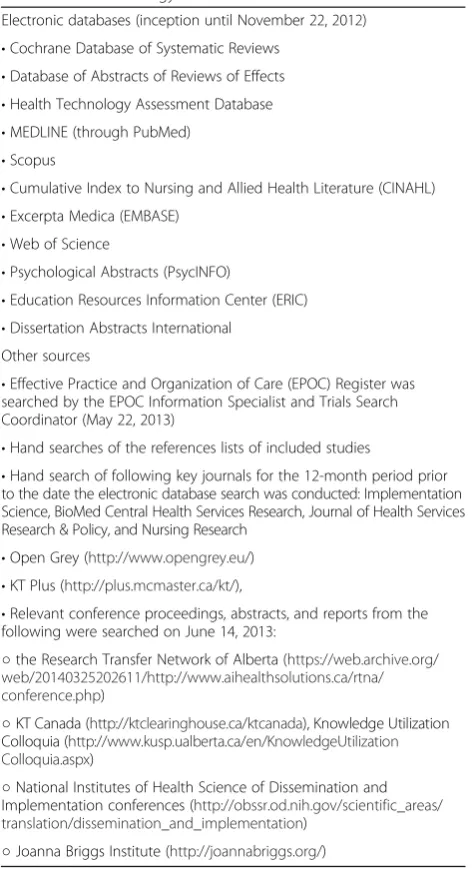
The search was developed by a review team member (AM) who reviewed existing systematic reviews as a starting point [15, 18]. Databases and other sources were searched on November 2012 (Table 1). Key databases included MEDLINE, Cumulative Index to Nursing and Allied Health Literature (CINAHL), and Excerpta Medica (EMBASE). Additional file 1 (Electronic database search strategy) provides full search details. Table 2 lists study inclusion and exclusion criteria. After de-duplication, two reviewers independently screened citations using predeter-mined relevance criteria: publication in English, acute care/hospital setting, description of a KT intervention and relevant outcome(s) (nurses’ knowledge or skill for research use, nurses’ research use (behaviour), client outcomes as a result of nurses’ research use, contextual factors for nurses’research use). Any citation classified as ‘include’ or ‘unsure’ by any reviewer was retrieved. Full-text papers were independently screened by two reviewers for relevance, with a third reviewer to resolve conflicts, using the following criteria: publication in English, study design (systematic review, randomized controlled trial (RCT), cluster RCT, non-randomized cluster controlled trials, controlled before and after studies, interrupted time series, mixed methods, qualitative), description of a KT intervention applied in an acute care setting, report of quantitative or qualitative data, relevant outcome(s) change in nurses’ knowledge or skill for research use, change in nurses’ research use (behaviour), client outcomes as a re-sult of nurses’ research use, and contextual information. See Additional file 2 for full details of the title and abstract and full-text screening criteria.
A standardized form was developed, piloted, and refined to extract data for study characteristics and outcomes of interest. Two reviewers independently extracted data, with a third reviewer available to resolve conflicts.
baseline difference in outcome(s), insufficient power, unit of analysis issues, participation rate of <80 %, not the same participants at all data points (not applicable for groups of patients), possibility for co-intervention, and/or contamination.
For qualitative studies, the Joanna Briggs Institute Qualitative Assessment and Review Instrument (QARI) was used [20]. The QARI assesses congruity between the philosophical perspective and research methodology as well as the research methods and objectives, data collection methods, representation and data analysis, and interpret-ation of the results. In addition to assessing the influence of the researcher on the research (and vice-versa), QARI also assesses if the researcher is located culturally/ theoretically, participants and their voices are adequately represented, the research is ethical, and conclusions flow
from the analysis/data interpretation. For mixed methods studies, methodological quality was assessed separately for both quantitative and qualitative methods using the aforementioned criteria.
For studies with quantitative data, the results were summarized by outcome taking into account the strength of the quality of the evidence and evidence of effect. The Grading of Recommendations Assessment, Development and Evaluation (GRADE) approach was used to identify the overall quality and strength of the body of evidence to support the confidence in the effect of KT interventions [21, 22]. Using GRADE, the confidence in the findings was judged as‘high’,‘moderate’,‘low’, or‘very low’ (‘high’, further research was very unlikely to change the confidence in the estimate of effect;‘moderate’, further research was likely to have an important impact on the confidence in the estimate of effect, possibly changing the estimate;‘low’, further research was very likely to have an important impact on the confidence in the estimate of effect, thus likely to change the estimate,‘very low’, when any estimate of effect was very uncertain) [21–23]. In applying GRADE, for continuous outcomes, the minimally important difference (MID) was used to calculate optimal information size (OIS) to determine imprecision [24]. When unable to identify the MID, it was assumed to be half of the reported standard deviation (SD) [25]. When the SD was absent, the MID was determined from data provided by the authors. To account for the size of effect, a relative risk (RR) or odds ratio (OR) of≥0.5 or≤2.0 was judged to be a small effect for dichotomous outcomes. For continuous outcomes, the MID determined the effect size. If the effect met the MID, it was judged to be small; if the effect was between the MID to 1.5 times the MID, it was judged to be moderate; and if the effect was 2.0 times the MID, it was judged to be large.
A high level of variation was anticipated between the included studies. Following data extraction, the appropri-ateness of summarizing studies use meta-analytic methods were made based on comparability of participants, intervention, outcome, and measurement of outcomes. In the presence of clinical heterogeneity, the results were synthesized narratively. For studies judged to be clinically homogeneous and appropriate to combine using meta-analytic techniques, statistical heterogeneity was explored using Cochrane’sQ (a= 0.10) andI2statistic to quantify the magnitude of statistical heterogeneity between studies; I2< 50 % representing minimal, I2≥
50 % representing moderate, and I2> 75 % representing substantial statistical heterogeneity across studies. A random effects model, providing a more conservative estimate of effect, was then used to calculate the overall estimation treatment effect.
For studies with quantitative data that did not determine the treatment effect between groups, the treatment effect
Table 1Search strategy
Electronic databases (inception until November 22, 2012) •Cochrane Database of Systematic Reviews
•Database of Abstracts of Reviews of Effects •Health Technology Assessment Database •MEDLINE (through PubMed)
•Scopus
•Cumulative Index to Nursing and Allied Health Literature (CINAHL) •Excerpta Medica (EMBASE)
•Web of Science
•Psychological Abstracts (PsycINFO)
•Education Resources Information Center (ERIC) •Dissertation Abstracts International
Other sources
•Effective Practice and Organization of Care (EPOC) Register was searched by the EPOC Information Specialist and Trials Search Coordinator (May 22, 2013)
•Hand searches of the references lists of included studies
•Hand search of following key journals for the 12-month period prior to the date the electronic database search was conducted: Implementation Science, BioMed Central Health Services Research, Journal of Health Services Research & Policy, and Nursing Research
•Open Grey (http://www.opengrey.eu/) •KT Plus (http://plus.mcmaster.ca/kt/),
•Relevant conference proceedings, abstracts, and reports from the following were searched on June 14, 2013:
○the Research Transfer Network of Alberta (https://web.archive.org/ web/20140325202611/http://www.aihealthsolutions.ca/rtna/ conference.php)
○KT Canada (http://ktclearinghouse.ca/ktcanada), Knowledge Utilization Colloquia (http://www.kusp.ualberta.ca/en/KnowledgeUtilization Colloquia.aspx)
○National Institutes of Health Science of Dissemination and Implementation conferences (http://obssr.od.nih.gov/scientific_areas/ translation/dissemination_and_implementation)
and corresponding 95 % confidence intervals (CI) were calculated using Review Manager (RevMan) [26] from raw data in the article. Authors were not contacted for missing data; however, in some instances, calculations could be done based on data provided in the studies.
For studies with qualitative data, one reviewer exam-ined the studies and data extraction files to become more familiar with the data, then generated initial codes [27]. The codes were searched for themes, which were then reviewed, defined, and named. A second reviewer verified examples of coding and subsequent themes. The qualitative data were then synthesized narratively by theme.
Results
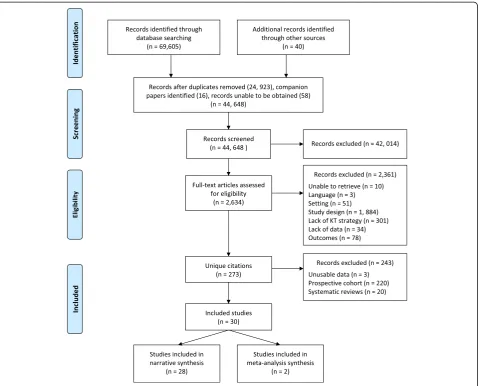
Following de-duplication, 44,648 unique references were screened (see Fig. 1, flow diagram) and 273 unique
references were identified. The list of the excluded studies is available upon request. Twenty systematic reviews were identified and reviewed to identify additional primary studies and to validate the search strategy. Although criteria initially included prospective cohort studies, these (n= 220) were subsequently excluded because a large number of studies with stronger methodological designs were found (RCTs, cluster RCTs, non-randomized controlled trials, and cluster controlled trials). The characteristics of the systematic reviews and prospect-ive cohort studies are reported elsewhere [28]. During data extraction, three quantitative studies [29–31] that did not provide comparisons between groups were excluded.
Thirty studies met the final inclusion criteria: 18 quantita-tive studies [32–49], 10 qualitative studies [50–59], and 2 mixed methods studies [60, 61]. The quantitative research
Table 2Inclusion and exclusion criteria
Study design
Quantitative designs [84]: Systematic reviews, randomized controlled trials (RCTs), cluster RCTs, non-randomized trials (including controlled before and after studies), cluster non-randomized trials, interrupted time series designs with a clearly defined point in time at which the intervention occurred and at least three data points before and after the intervention, and prospective cohort studies.
Qualitative designs: All qualitative designs (e.g. descriptive, phenomenology, grounded theory). Studies needed to demonstrate that a specific qualitative methodology was followed (e.g. referencing a methodology, describing the analysis).
Mixed methods study designs. Studies needed to adhere to the inclusion criteria for both quantitative and qualitative designs.
Exclusion: Non-systematic reviews, cross-sectional studies, quantitative studies using post-test only, case reports, discussion papers, and editorials.
Setting
Inclusion: Tertiary care.
Exclusion: Studies conducted exclusively in primary care, long-term care, outpatient clinics, or community settings.
Participants
Inclusion: Nurses; registered nurses (RNs), APNs [e.g., clinical nurse specialists (CNSs), nurse practitioners (NPs)], licensed practical nurses (LPNs) or registered practical nurses (RPNs), and student nurses. When the implementation of the intervention involved nurses as part of a group of healthcare professionals and the study met all other inclusion criteria, the citation was included for client outcomes.
Exclusion: Studies in which the intervention was implemented solely among nurses functioning as LPNs, RPNs, or student nurses due to fundamental differences in training, education, and scope of practice. When the implementation of the intervention involved nurses as part of a group of healthcare professionals and the outcomes were group knowledge, skills, and behaviours and effects for nurses could not be isolated.
Interventions
Inclusion: Any KT intervention directed towards target participants and aimed at promoting nurses’EIDM knowledge, skills, or behaviours, or affecting client outcomes. A list of KT interventions was compiled from similar systematic reviews conducted by the EPOC review group and the UK Health Technology Assessment Programme [6,8,71,84,101] (e.g. audit and feedback; educational materials, meetings, outreach visits; mass media; reminders).
Exclusion: Implementation of a guideline, which was not developed through a review of the best available evidence and/or accompanied in its implementation by an additional KT intervention.
Outcomes
Inclusion (quantitative): (1) EIDM knowledge, (2) EIDM skills, (3) EIDM behaviour, and (4) any client outcome. Nurses’EIDM knowledge, skills, and behaviour were conceptualized using the Classification Rubric for Evidence Based Practice (EBP) Assessment Tools in Education framework [17].
Knowledge: Facts and concepts about EIDM. Examples include: the ability to define the components of a clinical question, the ability to identify resources to search for the best available research evidence, or knowledge of critical appraisal concepts.
Skills: The application of knowledge. Examples include the ability to correctly construct a clinical question, appropriately conducted a search of the evidence, or accurately appraise the quality of evidence.
Behaviours: Behaviours reflecting the conduct of EIDM in nursing practice. Examples include identifying and constructing clinical questions, searching for the best available evidence, or critically appraise evidence.
designs included five RCTs [34, 39, 43, 45, 47], six cluster RCTs [33, 36, 38, 41, 44, 49], three non-randomized trials [35, 37, 46], and four cluster non-randomized trials [32, 40, 42, 48]. The qualitative research designs included eight descriptive studies [50, 52, 54, 56–59] and two grounded theory studies [51, 53]. The mixed methods studies were non-randomized trials with a qualitative component [60, 61].
Most KT interventions implemented were multifaceted [34, 37, 38, 40–46, 48, 49, 51, 52, 54, 57, 58, 60, 61]. Single interventions included educational meetings [35, 39, 47, 50, 55, 56, 59], educational materials [32, 33], and a clinical decision support system [53]. All included studies incorporated an educational aspect to interven-tions except one study that implemented computerized decision support [53].
While none of the included quantitative or mixed methods studies considered the outcomes of EIDM knowledge and skills, 12 studies reported on outcomes
associated with EIDM behaviours [32–35, 37, 39, 40, 42–44, 48, 60] and 8 studies reported on client out-comes [36, 38, 41, 45–49]. All qualitative and mixed methods studies reported contextual factors influen-cing the effectiveness of KT intervention implemen-tation. Further details about setting, study design, participants, interventions, and outcomes for included studies are in Additional file 3 (characteristics of included studies).
included studies is in Additional file 4 (quality assessment details).
Intervention effects
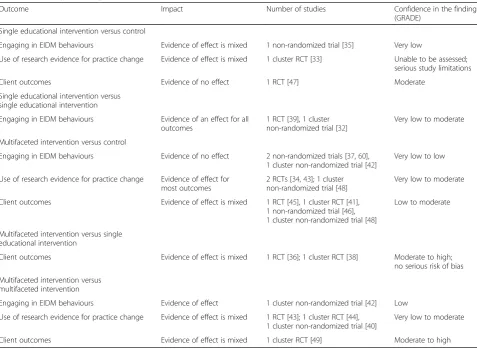
The intervention effects of the studies with quantitative data are categorized by the outcome of interest to the review. None of the included studies assessed changes in EIDM knowledge and skills. Outcomes of EIDM behaviours and client outcomes were assessed. In studies evaluating EIDM behaviours, behaviours were either engaging in EIDM behaviours (e.g. searching for the best available evidence, critically appraising research evidence) or the use of research evidence (e.g., an evidence-informed guideline, protocol, pathway) for practice change. The findings of 18 quantitative studies [32–49] and one mixed methods study [60] are presented. The results of the other mixed methods study [61] are not reported on, as the difference in the outcome between groups was not reported by the authors. Table 3 (summary of findings) presents a summary of findings by KT inter-vention and outcome and Additional file 5 (outcomes tables) provides further details about the intervention effects on EIDM behaviours and client outcomes,
including the effect estimates and confidence intervals for all studies.
Engaging in EIDM behaviours
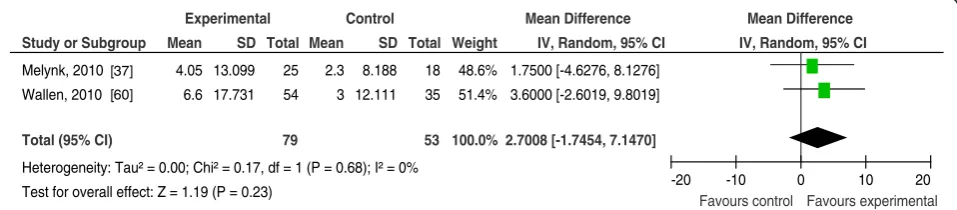
Of four studies implementing KT interventions to promote engagement in EIDM behaviours [35, 37, 42, 60], three did not have an effect, with very low to low confidence in the findings. Two studies evaluated the effectiveness of educa-tional meetings followed by the use of a mentor to promote a range of EIDM behaviours [37, 60]. The meta-analysis (Fig. 2) found that multifaceted KT inter-ventions (educational meetings and use of a mentor) did not increase change in self-reported engagement in a range EIDM behaviours at 6 months compared to no intervention [WMD (weighted mean difference) = 2.7, 95 % CI (−1.7, 7.1) P= 0.23,I2=0 %] as measured by the EBP implementation scale [37, 60].
In the two other studies, there was evidence of no effect for multifaceted interventions on use of research results [35] and incorporation of research evidence into practice decisions [42]. Tsai [35], however, demonstrated an effect comparing the impact of 8 weeks (~40 h) of educational meetings on research utilization to usual
Table 3Summary of findings
Outcome Impact Number of studies Confidence in the findings
(GRADE)
Single educational intervention versus control
Engaging in EIDM behaviours Evidence of effect is mixed 1 non-randomized trial [35] Very low
Use of research evidence for practice change Evidence of effect is mixed 1 cluster RCT [33] Unable to be assessed; serious study limitations
Client outcomes Evidence of no effect 1 RCT [47] Moderate
Single educational intervention versus single educational intervention
Engaging in EIDM behaviours Evidence of an effect for all outcomes
1 RCT [39], 1 cluster non-randomized trial [32]
Very low to moderate
Multifaceted intervention versus control
Engaging in EIDM behaviours Evidence of no effect 2 non-randomized trials [37,60], 1 cluster non-randomized trial [42]
Very low to low
Use of research evidence for practice change Evidence of effect for most outcomes
2 RCTs [34,43]; 1 cluster non-randomized trial [48]
Very low to moderate
Client outcomes Evidence of effect is mixed 1 RCT [45], 1 cluster RCT [41], 1 non-randomized trial [46], 1 cluster non-randomized trial [48]
Low to moderate
Multifaceted intervention versus single educational intervention
Client outcomes Evidence of effect is mixed 1 RCT [36]; 1 cluster RCT [38] Moderate to high; no serious risk of bias
Multifaceted intervention versus multifaceted intervention
Engaging in EIDM behaviours Evidence of effect 1 cluster non-randomized trial [42] Low
Use of research evidence for practice change Evidence of effect is mixed 1 RCT [43]; 1 cluster RCT [44], 1 cluster non-randomized trial [40]
Very low to moderate
practice. The intervention had a small effect on nurses’ self-reported participation in research (measured on a scale from 0 to 33, higher score indicative of greater participation) immediately post-intervention [MD (mean difference) = 4.00, 95 % CI (0.55, 7.45) P< 0.001; Note: MD and 95 % CI calculated using study data, here-after referred to as ‘calculated by review team’] and at 6 months post-intervention [MD = 4.50, 95 % CI (1.05, 7.95) P =0.003; calculated by review team]. The clinical significance of the small effect of this time- and cost-intensive intervention is unclear and due to serious study limitations, confidence in the findings of this study is very low.
Use of research evidence for practice change
Eight studies evaluated KT interventions to promote the use of research evidence (in the form of an evidence-informed guideline, protocol, or pathway) for a practice change [32–34, 39, 40, 43, 44, 48]. The direction of effects was similar across studies with effect sizes for increase in use of research evidence ranging from small to large [32–34, 39, 40, 43, 44, 48]; all but one [43] demonstrated an effect. Differences in types of KT interventions and measurements of outcomes across studies provide possible explanations for differences in effect size between the studies. However, other components (e.g. study quality, power analysis, use of theory, similarities in baseline characteristics, intervention length, and follow-up) were similar across studies. Most studies ranged from very low to moderate in confidence of the findings.
Single-component educational interventions compared to control or no intervention resulted in the largest effects on nurses’use of research evidence. In the study by Day and colleagues [39], nurses who received a 2-hr educa-tional programme which included didactic, interactive, and practical teaching demonstrations on endotracheal suctioning increased their mean performance score by 9.88 points more [95 % CI (3.42, 16.34)] at 4 days and 4 weeks after the intervention compared to nurses in the control group [nurses who received the same type of intervention, but on an unrelated topic (humidification for
mechanical ventilation)]. This represents a large and potentially clinically important effect (assuming a MID of 3 points) in which there is moderate confidence.
The study with the next largest effect also implemented a single component educational intervention [33]. Kirshbaum [33] mailed to breast care nurses a booklet of evidence-informed guidelines for recommending exercise to their cli-ents. Nurses in the control group received the booklet after the intervention period. Nurses who received the interven-tion were more likely than those in the control group to recommend exercise for nausea [OR 2.54, 95 % CI (2.53, 13.20)], loss of appetite [OR 3.67 9, 95 % CI 1.82, 3.76], and fatigue [OR 2.44, 95 % CI (1.12, 5.99)] consistent with the guideline; with no difference in making recommendations about weight gain, insomnia, loss of libido, panic attacks, altered body image, and head-aches. While confidence in the findings could not be assessed, this study had serious study limitations due to potential detection bias.
Studies using self-report [33, 40, 44] or observational measures [39, 48] demonstrated an effect compared to studies using chart audits, which demonstrated evidence of no effect [32, 43]. The implementation of educational meetings and materials with group feedback, individual feedback, or no feedback demonstrated evidence of no effect on nurses’ correct completion of Braden scoring upon admission (P= 0.38) and implementation of a care plan in accordance with the practice guideline for clients at risk or with stage 1 pressure ulcers (P= 0.85) [43]. There is moderate confidence in the findings of this study. In another study, the delivery of an open-book examination and individual competency assessment increased the chance that nurses were compliant with detoxification guidelines by 28 % relative to nurses who received only educational meetings [RR 1.28, 95 % CI (1.1, 1.48) P 0.000; calculated by the team] [32]. This is a small effect size, and confidence in the findings of this study is very low. The degree of completeness and accuracy of chart audit data might explain the lack of treatment effects [62]. Neither of these studies reported development and testing of
Study or Subgroup
Melynk, 2010 Wallen, 2010
Total (95% CI)
Heterogeneity: Tau² = 0.00; Chi² = 0.17, df = 1 (P = 0.68); I² = 0% Test for overall effect: Z = 1.19 (P = 0.23)
Mean
4.05 6.6
SD
13.099 17.731
Total
25 54
79 Mean
2.3 3
SD
8.188 12.111
Total
18 35
53 Weight
48.6% 51.4%
100.0%
IV, Random, 95% CI
1.7500 [-4.6276, 8.1276] 3.6000 [-2.6019, 9.8019]
2.7008 [-1.7454, 7.1470]
Experimental Control Mean Difference Mean Difference
IV, Random, 95% CI
-20 -10 0 10 20
Favours control Favours experimental
[37]
[60]
the audit tool or extraction process [63]. Missing or incomplete documentation was only acknowledged by one of the studies [43].
Studies reporting either validity [33, 44] or reliability [48], or both [39, 40], of the measurement tools demon-strated greater effects compared to studies that did not report reliability or validity [34, 43]. In one study without reported psychometric properties [43], there was evidence of no effect of a multifaceted KT intervention on practice improvements. Girouard [34] also did not report reliability and validity and demonstrated no change in reporting preoperative teaching by nurses and a small change in preoperative teaching as reported by clients. Nurses who received educational meetings, educational materials, and reminders taught 2.8 items more than those who did not receive the KT intervention, as measured by client report [MD 2.8 items, 95 % CI (1.57, 4.03) P< 0.004; calculated by review team]; there is low confidence in this finding. Studies with reported reliability and validity, however, demonstrated small to large effects. Hyndman and colleagues [40] used educational materials (clinical practice guideline, self-study package, and a 15-min video), educational outreach visits, and mass media compared to only educational meetings and mass media and found a small to moderate effect on the mean adherence score to the practice guideline for tobacco use and dependence [MD 6.5 at 10 weeks, 95 % CI (3.35, 9.65)P< 0.001; calculated by review team]. However, there is very low confidence in this finding. Day and colleagues [39] also used reliable and valid tools and had an effect as reported above. These examples indicate that use of valid and reliable measurement tools may have contributed to identification of the effect of the KT intervention on nurses’ use of research evidence.
Client outcomes
The use of research evidence (in the form of guide-line, protocol, or pathway) along with an additional KT intervention assessed client outcomes in eight studies [36, 38, 41, 45–49]. The effects were mixed with studies finding evidence of no effect [41, 45, 47] or an effect [36, 38, 46, 48, 49]. The confidence in the findings of most studies was moderate to high [36, 41, 45, 47, 49]; the confidence for other studies were very low [46], low [46, 48], or unable to be rated [38]. Differences in the interventions, follow-up, confidence in the findings, use of theory, baseline characteristics, and power analysis do not appear to explain differences in effect sizes. Possible explanations for differences include study design and outcome.
Among the cluster RCTs [38, 41, 48, 49] and cluster non-randomized trials [46], contamination, as a function of allocation, may have influenced the intervention effects. Larger effects (small to large) were demonstrated in studies
where allocation was done by hospital [36, 38, 48] versus evidence of no effect and small effects in studies where the KT intervention was allocated by unit within a hospital with multiple participating units thus introducing the possibility of contamination [41, 46, 49]. Contamination was unlikely in the study by Wesorick and colleagues [46] due to the use of a historic control in which the outcome data were collected from chart audits during the same months 2 years prior. Other factors, in this study with low confidence in the findings, may have contributed to the small effect size in percent patient days being hypoglycemic [OR 0.48, 95 % CI (0.27, 0.85) P= 0.01]. Dykes and colleagues [49] matched medical units in four hospitals in Boston with fall rates higher than the mean for the institution the year before, to units with similar fall rates and patient days, then randomized them. Clients cared for by healthcare professionals who received a fall prevention toolkit, use of computerized decision support, and mass media (posters above patient beds) experienced a small reduction in falls compared to clients receiving care from healthcare professionals who received usual education related to fall prevention [1.03 fewer falls per 1000 clients days, 95 % CI (−2.01, −0.57)P =0.04]. Seers and colleagues [41] conducted a study within a single spe-cialist orthopaedic hospital. Two surgical wards were ran-domized to receive the KT intervention and two surgical wards to control. Audit and feedback, approximately 10 h of educational meetings, and the use of an algorithm on the intervention units resulted in no differences in client report of pain intensity compared to the control units (no intervention). There was the possibility of contamin-ation due to the alloccontamin-ation by unit within the hospital and a possibility that the ward staff allocated to the control unit knew results of the baseline audit and contributed to the development of the algorithm.
Similarly, studies reporting either reliability [36], validity [48], or both reliability and validity [38] of the measure-ment of client outcomes demonstrated greater effects compared to studies that did not report reliability or validity [41, 46, 47] or simply reported that instruments were validated [45, 49]. Studies without reported reliability and validity demonstrated evidence of no effect on pain [41] and length of stay [45, 47] and small effects on diabetic control [46] or falls [49].
mean temperature (°C) [MD 0.09, 95 % CI (0.04, 0.15),
P= 0.001], the risk of temperature greater than 37.5 °C [RR, 0.64; 95 % CI (0.51, 0.81),P≤0.0001; RR and 95 % CI calculated by review team], and mean glucose [MD 0.54, 95 % CI (0.08, 1.01),P= 0.02] during the first 72 h in an acute stroke unit, as well as reduction in the risk of death or dependence [RR 0.72, 95 % CI 0.65, 0.84, P< 0.002; RR and 95 % CI calculated by review team] and an increase in physical health [MD 3.4, 95 % CI (1.2, 5.5),
P= 0.002]. Despite moderate to high confidence in these findings, the presence of mixed findings may limit the transferability of the findings; there was evidence of no effect for increasing mental health and functional dependence, as well as decreasing the risk of pneumonia upon discharge and length of stay.
The effect of one educational meeting which addressed guidelines for assessing and managing pain in older adults (6 h of instruction and 2 h of practical demon-stration) was evaluated by Manias and colleagues [48]. Clients of nurses in the intervention group experienced reductions in pain intensity compared to clients cared for by healthcare professionals receiving usual staff development activities. Pain intensity on movement measured using a visual analogue scale of 0 to 10 (validated tool; adequate reliability) was reduced by 2.15 units [95 % CI (−3.19, −1.11), P< 0.0001] imme-diately post-intervention and by 2.49 units 3 months post-intervention [95 % CI (−3.54, −1.44), P< 0.0001]. Pain intensity at rest was reduced by 1.65 units [95 % CI (−2.79,−0.52),P= 0.004] immediately-post intervention. The reduction in pain intensity 3 months post-intervention could be considered clinically important; however, this study was judged to have low confidence in the findings.
Titler [38] reported validity and reliability for the medical record abstract form used to collect pain intensity outcome data. Clients hospitalized with a hip fracture and cared for by healthcare professionals who received a multifaceted KT intervention experienced a 2.5-unit greater reduction in pain intensity during the first 24 h and a 1.5-unit greater reduction in pain intensity over 72 h compared to clients who were cared for by healthcare professionals who only received copies of the guideline being implemented. The multifaceted KT intervention involved educational materials, meetings, and outreach visits; mass media; opinion leaders; change champions; and audit and feedback. While the reductions in pain intensity during the first 24 h met the MID difference of 2.0 points [66], the substantial number of components of the intervention may limit transferability.
Three studies considered the effect of multifaceted KT interventions to promote the use of evidence-informed guidelines and pathways on length of stay [36, 45, 47]; confidence in their findings was moderate to high. Educational meetings followed by the use of an integrated
care pathway [47] or standard assessment form [45] compared to usual care did not result in an effect on length of stay. Educational meetings, educational outreach, and reminders compared to educational materials alone also demonstrated evidence of no effect on length of stay [36]. Multiple factors can influence length of stay; however, these factors were not accounted for in these KT intervention studies. This limitation makes it difficult to draw any conclusions about the effectiveness of KT interventions on length of stay.
Three additional studies considered the effect of multifa-ceted KT interventions on pain intensity with multiple pos-sibilities for the variable results [38, 41, 48]. For example, clients in the study by Seers and colleagues [41] were asked to report their pain since surgery 3 to 5 days after surgery, while the outcomes for Mania and colleagues [48] and Titler and colleagues [38] were abstracted from medical record audits where outcomes were recorded in‘real-time’ during nurses’assessments. The larger effect demonstrated by Mania and colleagues [48] may be due to unreported differences at baseline between the intervention and control groups.
Contextual factors influencing degree of success of KT interventions
Thirteen studies explored contextual factors related to success of KT interventions. Studies included 11 reports of 10 qualitative studies [50–59, 67] (all descriptive design, except for 2 grounded theory studies [51, 53]), 3 reports of two mixed methods studies [60, 61, 68], and 3 quantitative studies [37, 41, 44]. All studies included at least one educational component, and several were multifaceted. Most authors concluded that implementa-tion of KT intervenimplementa-tions was a complex undertaking, but factors related to success of KT strategies were identified at the level of the organization, the individual, and the planned innovation. Overall, the studies were considered to be of high quality. The findings are summarized below by themes.
Organizational factors
processes. Behaviours associated with these strategies included providing support, role modelling commitment, and reinforcing organizational policies and goals for evidence-based care [51, 67]. Other effective leadership contributions were supporting staff through adjusting workloads, allowing time to consider the evidence, and pro-viding resources to free up staff time to support engaging in EIDM [50, 56, 61, 68]. These mechanisms associated with finding time were critical even with very intensive and extensive interventions [56].
Within an organization, Melnyk and colleagues [37] found that a multifaceted educational intervention did not have an effect on EIDM behaviour. Findings of focus groups conducted with a convenience sample suggested that the CNSs were most knowledgeable about evidence-based practice, followed by nurse managers; but success was dependent on grassroots staff and administrative involvement. Leadership support and the allocation of resources were identified as key facilitators for con-tinuing to engage staff at all levels.
Another intervention was aimed at promoting culture change to facilitate greater interaction between research and nursing practice in a mental healthcare setting. Partici-pants believed their involvement in the Nursing Clinical Development Unit Program changed nursing practices and influenced a culture shift on their clinical units, which was exemplified by staff nurses reflecting on practice and ques-tioning the rationale for nursing actions and staff increased reading and critiquing of research evidence [55].
Individual and interpersonal factors
Individual staff nurse interest in research and the degree to which each was reading research regularly [56] facilitated research use, while reluctance to change and lack of time was a barrier [44, 61, 68]. However, when these attributes were measured, as opposed to being narratively reported, improved adherence to a protocol without alterations in propensity to change or attitudes to nursing research was found [44].
Nurses’ behaviours were not shaped solely by their personal attributes but shaped by interpersonal factors within their organizations [61, 68]. Individuals who perceived support by other managers, other nurses, and physician colleagues were more likely to utilize research after an educational programme [61, 68].
However, individual nurses’ perceptions of potential criticism by staff colleagues was a barrier. In the study by Royle and colleagues [57], staff perceived that organizational support was sufficient, where convinced clients would benefit from the chosen implementation of evidence, but felt that other staff members would criticize them for the time it would take to carry out the interven-tion with one client. This percepinterven-tion was consistent with a study by Seers who found that some nurses perceived that
evidence-based practice was not always seen as‘real’work and not a legitimate activity when nurses were busy [41].
Characteristics of the innovation
Educational interventions for evidence-based practice were associated with lower research utilization if the focus of the education or discussion intervention was on the conduct of research versus the utilization of evidence in practice. In contrast, the use of planned implementa-tion strategies [50], comprehensive training, and the effectiveness of staff education facilitated research uptake [61, 68].
Two studies assessed facilitation as a component of the Promoting Action on Research Implementation in Health Services (PARIHS) Framework. That framework has three key interacting elements that influence successful implementation of evidence-based practices:
evidence,context, andfacilitation[58, 59]. Using a mixed methods design, Wallin and colleagues [59] introduced a guideline in four clinical units, where two received additional facilitation strategies. Facilitation in the intervention units was no more effective than a focus on improved organizational culture where the nurse manager was actively involved in the change process. The authors concluded that implementation process is a social phenomenon that benefited from interaction. In one control group where no significant change activities were carried out, the guideline was regarded as trivial and not used. The other three units found the guideline to contain important knowledge. Thus, the successful aspect of implementation seemed to be the incorporation of a change team to manage the implementation of the guide-line, not the external facilitation [59]. Ellis and colleagues (2005) [58] used the PARIHS framework to explore the relative and combined importance of context and facilitation in their successful implementation of a new evidence-based clinical practice protocol in six rural hospitals. A 1-day educational workshop was held and follow-up support was given. All hospitals except one were successful in implementing a new protocol. The researchers found that the context of each hospital was different and that no hospital rated high in all domains of context (culture, leadership, evaluation). The rate of adop-tion varied from 2 weeks to months. Participants reported being better informed about evidence-based practice in general and were positive about their ability to improve practice and search more efficiently for best practice infor-mation. In this study, good facilitation appears to be more influential than context in overcoming barriers to uptake of evidence-based practice.
Discussion
nurses in tertiary care and, in turn, to promote client outcomes. Due to the variety of methodologies, clinical areas, interventions, outcomes, and outcome measurement among studies in this systematic review, recommendations cannot be drawn about the relative effectiveness of single or multifaceted KT interventions or components of these interventions. This is similar to the conclusion of previous systematic reviews [5, 6, 11–17, 69] and overviews of reviews [5, 70]. Although they have at times discerned the degree of effectiveness of specific KT interven-tions, implemented as a single intervention, compo-nent of a multifaceted intervention, or multifaceted KT intervention, these reviews generally concluded that specific KT interventions resulted in either evidence of no effect or small to moderate effect sizes, with broad imple-mentation not recommended.
Within this review, KT interventions for promoting EIDM among nurses are primarily limited to educational interventions alone or educational interventions as components of multifaceted intervention, similar to the existing literature [6, 15, 18]. All studies of multi-faceted KT interventions included at least one educa-tional component. With the exception of two studies, single interventions implemented were also educational interventions. Evidence from previous systematic reviews reports that educational interventions resulted in small to moderate improvements in engaging in EIDM behaviours and use of research evidence for practice change [6, 71] and that interactive education is more effective than didactic education [71–73]. Conversely, some researchers have identified that educational interventions are not effective for incorporating research evidence for prac-tice change [15, 18] and client outcomes [74]. The findings of this systematic review were mixed. The use of single-component educational interventions (educational materials or educational meetings) com-pared to a control or no intervention explained the largest effects on nurses’ use of research evidence and resulted in small effects on nurses’ engagement in EIDM behaviours; however, this did not explain dif-ferences in effects of KT interventions between the studies on client outcomes. In addition, multifaceted interventions where educational materials or meetings were one of the components demonstrated a range of no change to significant improvements in these out-comes. Despite finding that educational interventions were the most frequent type of KT intervention imple-mented, differences such as the intensity, length, and delivery method prevent drawing conclusions that cer-tain types of educational interventions are more effective than others.
This systematic review also considered qualitative and mixed methods studies, which broadens the included research designs to study implementation research
[75–78]. Within the qualitative and mixed methods studies, this systematic review identified consistent characteristics that were considered facilitators: positive interpersonal relationships, supportive environment, shared governance, and leadership; ability to engage staff nurses at different junctions and to overcome negative reactions to practice changes; and allocation of resources and adminis-trative support. Leadership was identified as integral to sup-porting the use of evidence in practice [44, 50–52, 54, 56, 59–61, 67], which is consistent with other literature [79–81]. Within this systematic review, some studies targeted the intervention to leaders within an orga-nization to garner leaders’ support of staff [38, 60], selecting staff to participate in the intervention [53], or skilling up the leaders on a particular leadership style [55]. While it is not clear what forms of leadership support implementation of evidence into practice, involving leadership in the implementation appears to contribute to effectiveness.
In addition to the identification of facilitators, context was found to be an important factor, different in each acute care setting and equally important to consider as the strength of the research evidence. Context is widely cited throughout the literature as being important to the implementation of evidence into practice [18, 81, 82]. Authors have suggested that a more positive context predicts research use [82] and that contextual factors likely contribute to environments that are conducive for implementing evidence into practice [83]. Although con-textual variability between the included studies and previous systematic reviews makes it difficult to make specific generalizations, evidence suggests that a posi-tive context contributes to nurses’ use of research in practice.
Recommendations for nursing practice
Directions for future research
From this review, several recommendations for future research have been identified. As a high number of prospective cohort studies (n= 221) were identified, it highlights the need for more robust study designs to evaluate KT interventions. While the use of a comparison group may not be feasible in many tertiary care settings, interrupted time series is a more rigorous and may be a more realistic methodology. Researchers and nurses involved in the implementation of KT interventions as part of continuous quality improvement efforts can identify a clearly defined point in time at which the KT intervention is implemented and ensure outcome measurement with at least three data collection points before and after the intervention [84]. The use of mixed methods designs should continue to evaluate the imple-mentation of KT interventions to capture facilitators, barriers, and contextual factors that contribute to the success or failure of interventions [76–78].
Improvement in the reporting of implementation is also needed; even the most detailed studies in this review failed to report important aspects of studies, such as detailed descriptions of KT interventions and adherence and fidelity to the interventions. This lack of reporting has been identified in similar systematic reviews [7, 11, 15, 18, 71, 85, 86], and multiple authors have found that interventions are only described in detail 5 to 30 % of the time [18, 87, 88]. While recommendations for reporting the implementation of interventions in RCTs, as well as non-randomized and observational studies exist [88–92], recently, recommendations for the reporting of KT interventions have been developed by the Workgroup for Intervention Development and Evaluation Research (WIDER) [87] and should be followed.
The process of integrating quantitative, qualitative, and mixed methods designs into reviews of complex interventions is largely underdeveloped [78]. To be included in this review, mixed methods studies had to meet both qualitative and quantitative inclusion criteria. This excluded multiple studies that were prospective cohort studies [93–96]. While other recommended practices exist for incorporating qualitative, quantitative, and mixed methods research into systematic reviews of complex interventions [78, 97, 98], little guidance is available on how to integrate inclusion/exclusion criteria of mixed methods research within a review including quantitative and qualitative research. Further exploration is recommended on the best approaches to integrate different study designs so that the research philosophy, analytical technique, strategies, and interpretations can all play an important part in the synthesis of the findings [76].
Finally, this review used the EPOC Group’s (http://epoc. cochrane.org) classification system for organizing and
describing interventions. While useful for drawing comparisons, these labels did not capture the types of interventions implemented within all of the studies included in this review. We were unsure of how to categorize strategies related to empowerment and celebrating successes [60]. While EPOC classifications should continue to be used, they may need to be expanded to acknowledge the complexity of interventions [78, 99] and to assist in comparisons across studies.
Limitations
This systematic review has several limitations. Language was limited to English. An update of this review is indicated; six included studies were published 2 years prior to the end of the search strategy (November 2012), and thus, it is likely that eligible studies have been published since the end of the search. Also, the know-ledge user partners and review team members deter-mined that the implementation of a guideline, protocol, or pathway needed to meet two criteria, that the authors needed to indicate that the guideline, protocol, or path-way being implemented (1) had been informed/devel-oped through a review of the best available research evidence and (2) had been accompanied in its imple-mentation by an additional KT intervention. There-fore, this systematic review does not reflect the body of literature on guidelines, protocols, or protocols as a sole KT intervention for nurses in tertiary care. For mixed methods studies, we applied the individual (qualitative and quantitative) inclusion criteria which limited the number of mixed methods studies. Four mixed methods, studies were excluded because the quantitative aspect was a prospective cohort design [94–96, 100].
The confidence in the findings, determined by applying the GRADE criteria, resulted in most studies with quanti-tative data being of very low to low confidence in their findings. Furthermore, due to differences between the studies, only two studies were able to be synthesized using a meta-analysis. Lastly, given the inclusion and exclusion criteria, the generalization of the findings is limited to nurses working within tertiary care and is not representa-tive of other settings (e.g. long-term care) or populations (e.g. student nurses).
Conclusions
an educational component were shown to contribute to improvements in client outcomes. Based on the review of contextual factors, leaders within an organization should be involved in the implementation of KT interventions; their involvement appears to positively influence EIDM among nurses. Above all, decision makers can refer to the synthesis and included studies in the review to assist in selecting KT interventions to be applied to their local context to promote evidence-informed nursing practice for the delivery of quality client care.
Additional files
Additional file 1:Electronic database search strategy.This file provides full details of the electronic database search strategy.
Additional file 2:Screening criteria.This file provides full details of the title and abstract and full-text screening criteria.
Additional file 3:Characteristics of included studies.This file provides the details of the characteristics of the included studies identified during data extraction.
Additional file 4:Quality assessment details.This file provides the risk of bias assessment for the included studies. This includes the review author’s judgements about each quality criteria for each of the final included studies.
Additional file 5:Outcomes tables.This file provides the citation, measurement period, brief description of the intervention and control groups, outcome measurements at baseline and follow-up, and overall effect estimates and confidence intervals for included studies with quantitative data.
Abbreviations
APN:advanced practice nurse; CI: confidence interval; CNS: clinical nurse specialist; EBP: evidence-based practice; EIDM: evidence-informed decision-making; EPOC: Effective Practice and Organization of Care; GRADE: Grades of Recommendation, Assessment, Development and Evaluation; KT: knowledge translation; LPN: licensed practical nurse; MD: mean difference; MID: minimally important difference; NP: nurse practitioner; OIS: optimal information size; OR: odds ratio; PARIHS: Promoting Action on Research Implementation in Health Services; QARI: Qualitative Assessment and Review Instrument; RCT: randomized controlled trial; RN: registered nurse; RPN: registered practical nurse; RR: relative risk; SD: standard deviation; WMD: weighted mean difference.
Competing interests
Ann McKibbon is a member of the Editorial Board of Implementation Science and that she had no involvement in the editorial decisions associated with this manuscript. The other authors declare that they have no competing interests.
Authors’contributions
AM, DC, DT, JY, MD, and RG contributed to the development of the systematic review. AM developed the search strategy. DC, DT, FA, JY, KN, and RG implemented the conduct of the systematic review (title and abstract and screening, full-text screening, data extraction, risk of bias assessment). AH contributed to data extraction and risk of bias assessment. JY drafted and critically revised the manuscript. AM, DC, DT, FA, AH, JY, KN, MD, and RG contributed to the synthesis and critical revisions of the manuscript. All authors read and approved the final manuscript.
Acknowledgements
The authors would like to acknowledge the Knowledge User Partners, Dr. Vanessa Burkoski (Vice President, Professional Practice and Chief Nursing Executive at London Health Sciences Centre) and Dr. Ruth Lee (Chief Nursing Practice at Hamilton Health Sciences). The authors would also like to acknowledge the members of the Advisory Committee: Lynda Aliberti
(Clinical Manager, Hamilton Health Sciences Centre), Irmajean Bajnok (Director International Affairs and Best Practice Guidelines Programs and Co-Director of the Nursing Best Practice Research Unit at the Registered Nurses Association of Ontario), Lisa Ducharme (Consultant, London Health Sciences Centre), Debbie Graham (Staff Nurse, Hamilton Health Sciences Centre), Debbie Mings (Clinical Nurse Specialist, Hamilton Health Sciences Centre), Sue Rivers (Manager, Hamilton Health Sciences Centre), Jill Smith (Coordinator, London Health Sciences Centre), Suganya Vadivelu (Education and Development Consultant, Hamilton Health Sciences Centre), Don Wildfong (Senior Nurse Advisor, Leadership and Knowledge Translation at the Canadian Nurses Association), and Jennifer Yoon (Director, London Health Sciences Centre). We would also like to acknowledge the work of Angela Eady in conducting the search, as well as Muhammad Usman Ali (Research Analyst), Andrew Bayer, Jamie O’Donnell, Donna Fitzpatrick-Lewis (Senior Research Coordinator), Sharon Peck Reid (Research Assistant), Cather-ine Salmon, and Rachel Warren (Research Assistant) from the
McMaster Evidence Review and Synthesis Centre for their assistance throughout the project. The contributions of Kim Reid for completing the GRADE assessments are also acknowledged. Lastly, the authors would like to acknowledge the following students in the School of Nursing, Faculty of Health Sciences, McMaster University for their contributions: Mallory Alcock, Alyanna Busa, Annie Lam, Erin Nieweglowski, and Erica Nightingale.
Funding
Funding was provided by the Canadian Institutes of Health Research Knowledge Synthesis Grant competition (CIHR FRN-124596).
Author details
1
School of Nursing, Faculty of Health Sciences, McMaster University, Main Street West, Hamilton, ON, Canada.2School of Nursing, Faculty of Health and
Behavioural Sciences, Lakehead University, 955 Oliver Road, Thunder Bay, ON, Canada.3Singapore General Hospital, 31 Third Hospital Avenue, Singapore,
Singapore.4Daphne Cockwell School of Nursing, Faculty of Community Services, Ryerson University, 350 Victoria Street, Toronto, ON, Canada.
5
Department of Medicine, McMaster University, St. Peter’s Hospital-Hamilton Health Sciences, 88 Maplewood Avenue, Hamilton, ON, Canada.6Clinical
Epidemiology and Biostatistics, Faculty of Health Sciences, McMaster University, Main Street West, Hamilton, ON, Canada.
Received: 22 July 2014 Accepted: 30 June 2015
References
1. DiCenso A, Ciliska D, Guyatt G. Introduction to evidence-based nursing. In: DiCenso A, Guyatt G, Ciliska D, editors. Evidence-based nursing: a guide to clinical practice. St. Louis, MO: Elsevier-Mosby; 2005. p. 3–19.
2. Canadian Nurses Association. Position statement: evidence-informed decision-making and nursing practice. 2013.
3. Kitson A. The state of the art and science of evidence-based nursing in UK and Europe. Worldviews Evid Based Nurs. 2004;1(1):6–8.
4. Sigma Theta Tau International Honor Society of Nursing. Evidence-based nursing position statement. 2005.
5. Grimshaw JM, Shirran L, Thomas R, Mowatt G, Fraser C, Bero L, et al. Changing provider behavior: an overview of systematic reviews of interventions. Med Care. 2001;39(8 Suppl 2):II2–45.
6. Grimshaw JM, Thomas RE, MacLennan G, Fraser C, Ramsay CR, Vale L, et al. Effectiveness and efficiency of guideline dissemination and implementation strategies. Health Technol Assess. 2004;8(6):iii–72.
7. Flodgren G, Parmelli E, Doumit G, Gattellari M, O’Brien Mary A, Grimshaw J, et al. Local opinion leaders: effects on professional practice and health care outcomes. Cochrane Database Syst Rev. 2011;8, CD000125.
8. Jamtvedt G, Young JM, Kristoffersen DT, O’Brien MA, Oxman AD. Audit and feedback: effects on professional practice and health care outcomes. Cochrane Database Syst Rev. 2006;2, CD000259.
9. Heselmans A, Van d, V, Donceel P, Aertgeerts B, Ramaekers D. Effectiveness of electronic guideline-based implementation systems in ambulatory care settings—a systematic review. Implement Sci. 2009;4:82.
11. Thomas L, Cullum N, McColl E, Rousseau N, Soutter J, Steen N. Guidelines in professions allied to medicine. Cochrane Database Syst Rev. 2000;2, CD000349.
12. Thomas LH, McColl E, Cullum N, Rousseau N, Soutter J. Clinical guidelines in nursing, midwifery and the therapies: a systematic review. J Adv Nurs. 1999;30(1):40–50.
13. O’Brien Mary A, Rogers S, Jamtvedt G, Oxman Andrew D, Odgaard-Jensen J, Kristoffersen Doris T, et al. Educational outreach visits: effects on professional practice and health care outcomes. Cochrane Database Syst Rev. 2007;4, CD000409.
14. Shojania Kaveh G, Jennings A, Mayhew A, Ramsay Craig R, Eccles Martin P, Grimshaw J. The effects of on-screen, point of care computer
reminders on processes and outcomes of care. Cochrane Database Syst Rev. 2009;3.
15. Thompson DS, Estabrooks CA, Scott-Findlay S, Moore K, Wallin L. Interventions aimed at increasing research use in nursing: a systematic review. Implement Sci. 2007;2:15.
16. Shojania KG, Jennings A, Mayhew A, Ramsay C, Eccles M, Grimshaw J. Effect of point-of-care computer reminders on physician behaviour: a systematic review. CMAJ. 2010;182(5):E216–25.
17. Tilson JK, Kaplan SL, Harris JL, Hutchinson A, Ilic D, Niederman R, et al. Sicily statement on classification and development of evidence-based practice learning assessment tools. BMC Med Educ. 2011;11:78.
18. Scott SD, Albrecht L, O’Leary K, Ball GD, Hartling L, Hofmeyer A, et al. Systematic review of knowledge translation strategies in the allied health professions. Implement Sci. 2012;7:70.
19. Higgins Julian PT, Altman AM, Sterne JAC, Cochrane Statistical Methods Group and the Cochrane Bias Methods Group. Assessing risk of bias in included studies. In: Higgins Julian PT, Green S, editors. Cochrane handbook for systematic reviews of interventions version 5.1.0 (updated March 2011). Chichester, UK: John Wiley & Sons; 2011.
20. SUMARI: user manual: version 5.0 system for the unified management, assessment and review of information [computer program]. 2013. 21. Guyatt GH, Oxman AD, Vist GE, Kunz R, Falck-Ytter Y, Alonso-Coello P, et al.
GRADE: an emerging consensus on rating quality of evidence and strength of recommendations. BMJ. 2008;336(7650):924–6.
22. Guyatt G, Oxman AD, Akl EA, Kunz R, Vist G, Brozek J, et al. GRADE guidelines: 1. Introduction-GRADE evidence profiles and summary of findings tables. J Clin Epidemiol. 2011;64(4):383–94.
23. Balshem H, Helfand M, Schunemann HJ, Oxman AD, Kunz R, Brozek J, et al. GRADE guidelines: 3. Rating the quality of evidence. J Clin Epidemiol. 2011;64(4):401–6.
24. Guyatt GH, Oxman AD, Kunz R, Brozek J, Alonso-Coello P, Rind D, et al. GRADE guidelines 6. Rating the quality of evidence—imprecision. J Clin Epidemiol. 2011;64(12):1283–93.
25. Norman GR, Sloan JA, Wyrwich KW. Interpretation of changes in health-related quality of life: the remarkable universality of half a standard deviation. Med Care. 2003;41(5):582–93.
26. Revman computer program [computer program]. Version 5.2 2012. 27. Braun V, Clarke V. Using thematic analysis in psychology. Qual Res Psychol.
2006;3(2):77–101.
28. Yost J, Thompson D, Ganann R, Aloweni F, Newman K, McKibbon A, et al. Knowledge translation strategies for enhancing nurses’evidence-informed decision making: a scoping review. Worldviews Evid Based Nurs. 2014;11(3):156–67.
29. Dufault MA, Bielecki C, Collins E, Willey C. Changing nurses’pain assessment practice: a collaborative research utilization approach. J Adv Nurs. 1995;21(4):634–45.
30. Koh SLS, Hafizah N, Lee JY, Loo YL, Muthu R. Impact of a fall prevention programme in acute hospital settings in Singapore. Singapore Med J. 2009;50(4):425–32.
31. Schultz MJ, Harmsen RE, Korevaar JC, Abu-Hanna A, Houckgeest FV, Van Der Sluijs JP, et al. Adoption and implementation of the original strict glycemic control guideline is feasible and safe in adult critically ill patients. Minerva Anestesiol. 2012;78(9):982–95.
32. Daly M, Kermode S, Reilly D. Evaluation of clinical practice improvement programs for nurses for the management of alcohol withdrawal in hospitals. Contemp Nurse. 2009;31(2):98–107.
33. Kirshbaum M. Translation to practice: a randomised, controlled study of an evidence-based booklet for breast-care nurses in the United Kingdom. Worldviews Evid Based Nurs. 2008;5(2):60–74.
34. Girouard S. The role of the clinical specialist as change agent: an experiment in preoperative teaching. Int J Nurs Stud. 1978;15(2):57–65. 35. Tsai SL. The effects of a research utilization in-service program on nurses.
Int J Nurs Stud. 2003;40(2):105–13.
36. Middleton S, McElduff P, Ward J, Grimshaw JM, Dale S, D’Este C, et al. Implementation of evidence-based treatment protocols to manage fever, hyperglycaemia, and swallowing dysfunction in acute stroke (QASC): a cluster randomised controlled trial. Lancet.
2011;378(9804):1699–706.
37. Melnyk BM, Bullock T, McGrath J, Jacobson D, Kelly S, Baba L. Translating the evidence-based NICU COPE program for parents of premature infants into clinical practice: impact on nurses’evidence-based practice and lessons learned. J Perinat Neonatal Nurs. 2010;24(1):74–80.
38. Titler M. Translating research into practice. Am J Nurs. 2007;107(6):26–33. 39. Day T, Wainwright SP, Wilson-Barnett J. An evaluation of a teaching
intervention to improve the practice of endotracheal suctioning in intensive care units. J Clin Nurs. 2001;10(5):682–96.
40. Hyndman KJ. An evaluation of a dissemination intervention to enhance registered nurses’use of clinical practice guidelines related to tobacco reduction. Canada: University of British Columbia; 2005.
41. Seers K, Crichton N, Carroll D, Richards S, Saunders T. Evidence-based postoperative pain management in nursing: is a randomized-controlled trial the most appropriate design? J Nurs Manag. 2004;12(3):183–93.
42. Tranmer JE, Lochhaus-Gerlach J, Lam M. The effect of staff nurse participation in a clinical nursing research project on attitude towards, access to, support of and use of research in the acute care setting. Can J Nurs Leadersh. 2002;15(1):18–26.
43. Lewicki LJ. Diffusion of pressure ulcer guidelines: testing an intervention. Case Western Reserve University (Health Sciences); 1997.
44. Linde BJ. The effectiveness of three interventions to increase research utilization among practicing nurses. University of Michigan; 1989. 45. Fan J, Woolfrey K. The effect of triage-applied Ottawa ankle rules on the
length of stay in a Canadian urgent care department: a randomized controlled trial. Acad Emerg Med. 2006;13(2):153–7.
46. Wesorick DH, Grunawalt J, Kuhn L, Rogers MAM, Gianchandani R. Effects of an educational program and a standardized insulin order form on glycemic outcomes in non-critically ill hospitalized patients. J Hosp Med. 2010;5(8):438–45.
47. Sulch D, Perez I, Melbourn A, Kalra L. Randomized controlled trial of integrated (managed) care pathway for stroke rehabilitation. Stroke. 2000;31(8):1929–34.
48. Manias E, Gibson SJ, Finch S. Testing an educational nursing intervention for pain assessment and management in older people. Pain Med. 2011;12(8):1199–215.
49. Dykes PC, Carroll DL, Hurley A, Lipsitz S, Benoit A, Chang F, et al. Fall prevention in acute care hospitals: a randomized trial. JAMA. 2010;304(17):1912–8. 50. Stetler CB, Caramanica L. Evaluation of an evidence-based practice initiative:
outcomes, strengths and limitations of a retrospective, conceptually-based approach. Worldviews Evid Based Nurs. 2007;4(4):187–99.
51. Gifford WA, Davies B, Edwards N, Graham ID. Leadership strategies to influence the use of clinical practice guidelines. Can J Nurs Leadersh. 2006;19(4):72–88.
52. Ploeg J, Davies B, Edwards N, Gifford W, Miller PE. Factors influencing best-practice guideline implementation: lessons learned from administrators, nursing staff, and project leaders. Worldviews Evid Based Nurs.
2007;4(4):210–9.
53. Weber S. A qualitative analysis of how advanced practice nurses use clinical decision support systems. J Am Acad Nurse Pract. 2007;19(12):652–67.
54. Happell B, Johnston L, Hill C. Implementing research findings into mental health nursing practice: exploring the clinical research fellowship approach. Int J Ment Health Nurs. 2003;12(4):251–8.
55. Happell B, Martin T. Changing the culture of mental health nursing: the contribution of nursing clinical development units. Issues Ment Health Nurs. 2005;26(9):921–33.
56. Kajermo KN, Nordström G, Krusebrant A, Lutzén K. Nurses’experiences of research utilization within the framework of an educational programme. J Clin Nurs. 2001;10(5):671–81.