M E T H O D O L O G Y
Open Access
Action, actor, context, target, time (AACTT):
a framework for specifying behaviour
Justin Presseau
1,2,3*, Nicola McCleary
1,2, Fabiana Lorencatto
4, Andrea M. Patey
1, Jeremy M. Grimshaw
1,2,5and
Jill J. Francis
6Abstract
Background:Designing implementation interventions to change the behaviour of healthcare providers and other professionals in the health system requires detailed specification of the behaviour(s) targeted for change to ensure alignment between intervention components and measured outcomes. Detailed behaviour specification can help to clarify evidence-practice gaps, clarify who needs to do what differently, identify modifiable barriers and enablers, design interventions to address these and ultimately provides an indicator of what to measure to evaluate an intervention’s effect on behaviour change. An existing behaviour specification framework proposes four domains (Target, Action, Context, Time; TACT), but insufficiently clarifies who is performing the behaviour (i.e. the Actor). Specifying the Actor is especially important in healthcare settings characterised by multiple behaviours performed by multiple different people. We propose and describe an extension and re-ordering of TACT to enhance its utility to implementation intervention designers, practitioners and trialists: the Action, Actor, Context, Target, Time (AACTT) framework. We aim to demonstrate its application across key steps of implementation research and to provide tools for its use in practice to clarify the behaviours of stakeholders across multiple levels of the healthcare system. Methods and results:We used French et al.’s four-step implementation process model to describe the potential applications of the AACTT framework for (a) clarifying who needs to do what differently, (b) identifying barriers and enablers, (c) selecting fit-for-purpose intervention strategies and components and (d) evaluating implementation interventions.
Conclusions:Describing and detailing behaviour using the AACTT framework may help to enhance measurement of theoretical constructs, inform development of topic guides and questionnaires, enhance the design of
implementation interventions and clarify outcome measurement for evaluating implementation interventions.
Keywords:Behaviour, Framework, Behaviour specification, TACT, Behaviour change, Health professional behaviour
© The Author(s). 2019Open AccessThis article is distributed under the terms of the Creative Commons Attribution 4.0 International License (http://creativecommons.org/licenses/by/4.0/), which permits unrestricted use, distribution, and reproduction in any medium, provided you give appropriate credit to the original author(s) and the source, provide a link to the Creative Commons license, and indicate if changes were made. The Creative Commons Public Domain Dedication waiver (http://creativecommons.org/publicdomain/zero/1.0/) applies to the data made available in this article, unless otherwise stated. * Correspondence:[email protected]
1Clinical Epidemiology, Ottawa Hospital Research Institute, Ottawa, Canada 2School of Epidemiology and Public Health, University of Ottawa, Ottawa,
Canada
Background
Innovations in health research have the potential to im-prove health but harnessing this potential requires that effective innovations be translated into routine health-care. Unfortunately, evidence-practice gaps continue to be documented: medicines are inappropriately pre-scribed [1], patient safety practices are not enacted [2] and harmful practices persist [3]. Sub-optimal clinical practices (over, under and misuse of tests/treatments) result in avoidable morbidity and mortality [4]. Such gaps in care are consistent across countries and clinical areas, leading some to suggest that health research is‘all breakthrough, no follow through’ [5]. Implementation science emerged in response to this, focusing on the rigorous scientific study and development of a cumula-tive base for how best to address evidence-practice gaps. A foundational requirement of implemen-tation is the need for someone (usually more than one person or group), somewhere(from organisational lead-ership through to those providing direct patient care) doing something (usually more than one thing) differ-ently. In short, taking up new evidence requires health-care providers and other health system stakeholders to change their behaviour.
Given the centrality of behaviour in implementation science, there is a need for describing behaviour as clearly as possible. Doing so may help to (a) clarify evidence-practice gaps, (b) clarify the various people and groups at different levels that need to do something dif-ferently, (c) identify modifiable barriers and enablers and design implementation interventions to address them, (d) provide an indicator of what to measure to evaluate
an intervention’s effect and (e) ultimately facilitate evi-dence synthesis. A generalisable framework may help to ensure consistency in the description and specification of behaviour in implementation research.
In the mid-twentieth century, after social psychologists identified that scores on attitude measures were not as-sociated with actual behaviour [6], Fishbein [7] proposed that the low predictive validity of attitude measures could be addressed by assessing attitude to an action
(e.g. voting for a specific political party) rather than assessing attitude to the target of that action (e.g. the political party). While now taken for granted, this focus on the action led to a paradigm shift in attitude-behaviour research and was a key principle underlying the Theory of Reasoned Action. Extending the approach, Ajzen [8] proposed the Theory of Planned Behaviour for predicting and explaining human behaviour in a specific context at a specific time. Together, these ideas gave rise to the specification of behaviour according to what be-came known as TACT: Target, Action, Context, Time [9]. Similarly, Michie and Johnston [10] proposed that when behaviours are described in terms of what, who, when, where and how, they are more actionable and hence more likely to be performed.
Clear specification of the behaviour is a key though often overlooked first step in conducting implementation re-search for a range of study objectives, such as identifying influences (barriers and enablers, and determinants) on behaviour or designing implementation interventions to support behaviour change among stakeholders in the health system. Despite half a century of guidance on behav-iour specification, research is frequently published in which the behaviour is poorly specified. A systematic review of 67 reports of behaviour change interventions found that the Action domain was clearly specified in 69% of reports, and that all components of the TACT framework were described in only 5 (7.5%) reports [11]. Poor specification makes it difficult to measure behaviour and behaviour change. Clear specification facilitates strong compatibility between the behaviour under investigation and the theore-tical constructs that predict that behaviour, which enhances prediction (cf. the principle of compatibility) [12,13].
Consider the following description of a potential guideline-recommended clinical behaviour for primary care practitioners: ‘For people with diabetes, record a blood pressure reading in the patient’s medical records’ (Example 1). Using the TACT framework to unpack this recommendation, the two specified components are the
Target (people with diabetes) and the Action (record a blood pressure reading in the patient’s medical record). While a seemingly straightforward description, it is not clear who should do the behaviour and when and where it should take place. Leaving this implicit introduces am-biguity that may undermine change efforts as well as Contributions to the literature
Behaviour change is a fundamental outcome of interest in implementation science and underpins change at multiple health care levels, but behaviour is often not clearly specified Detailed behaviour specification helps to clarify
evidence-practice gaps, clarify who needs to do what differently, identify barriers and enablers, design interventions and
provides an indicator of what to measure to evaluate an intervention’s effect on behaviour change
Existing frameworks (TACT) do not clarify the Actor(s) (e.g. clinicians) performing the behaviour, an important distinction given multiple Actors and multiple Actions of
interest in implementation science
We propose an extension: the Action, Actor, Context, Target, Time (AACTT) framework for behaviour specification We provide practical tools to aid in AACTT-specification for a
measurement of whether or not the behaviour has been performed.
Drawing upon Fishbein and Ajzen’s [9] early advice, a clearer, more actionable specification could be: ‘For people with diabetes (Target), record a blood pressure reading in the patient’s medical records (Action) in the primary care clinic (Context) when they attend for their annual diabetes review (Time)’ (Example 2). Example 2 specifies further components of the behaviour: Time (when patients attend) and Context (primary care clinic). This enhanced specification corresponds to the TACT framework, but still lacks a fundamental component:
who (i.e. which person or people on the primary care team) is responsible for performing the Action. Further-more, Example 2 arguably involves a sequence of discrete Actions (taking the blood pressure reading, accessing the patient’s medical records, entering the blood pressure reading into the record). It may also in-clude ancillary behaviours such as inviting the patient to attend the clinic for the annual review. These actions may be performed by different primary care staff (e.g. physician, nurse, administrator) to support the focal be-haviour of interest. This dimension of specification is not included in the TACT framework, which assumes that the individual is performing the behaviour for them-selves. In implementation research, individuals often perform a behaviour for someone else’s benefit (i.e. the Target, such as a patient). We propose to expand the TACT framework to guide specification of behaviour in terms of not only Target, Action, Context and Time but also Actor—the person(s) who will perform the Ac-tion(s). By clarifying the Actor, the Action then becomes clearer and more specific, allowing for clarification of complex behaviours (or sequences of behaviour) in terms of different Actions performed by different Actors in the health care setting at different times (i.e. prepara-tory and sequential Actions).
AACTT: an expanded framework for specifying behaviour
We propose the AACTT framework (Action, Actor, Context, Target, Time) for specifying behaviour. Re-arranging the order of domains in the framework reflects a more easily defined sequence for specifying behaviour than TACT that naturally begins with the Action and who performs it.
Although it may sometimes seem obvious who is to perform the Action, for behaviours that are performed by healthcare professionals or teams for, with or on be-half of their patients, specification of the Actor is par-ticularly helpful. Indeed, healthcare delivery behaviours have been described as‘collective behaviours’, suggesting that role confusion may be a barrier to performance [14] that could be illuminated by careful specification of the behaviour at the outset using AACTT.
While Action and Actor are important, specification of Context and Time allows the responder to keep these elements in mind when answering a questionnaire, responding in an interview or changing their behaviour. Behaviours are inherently tied to the time and place in which they occur, and thus clarification of these ele-ments provides an opportunity to situate analyses of bar-riers and enablers and intervention design within the contexts that behaviours take place. Recent theoretical advances emphasise the role of associative processes in behaviour [15], including automatic processes [16–19]. Specification of contextual and temporal cues in ques-tionnaire items, interview topic guides and observational tools may increase the validity of responses, especially if the behaviour has an element of automaticity. Context and time may also be important for identifying when and where it is appropriate to perform an Action, thus informing implementation efforts.
When considering the behaviour of individuals and teams as they deliver health care, a further refinement of
the ‘Target’ domain is appropriate. ‘Target’ is often
ex-plained as (performing) an Action tosomeone, i.e. who the behaviour is targeted at. However, current models of healthcare delivery place a focus on patients as active participants in their health care, and thus as a collabor-ator with the healthcare professional. Hence, rather than performing an Action toa passive recipient, the health-care professional may actwithorforthe patient. Thus, it is recommended that researchers frame (i) Action and (ii) Target as (i) doing what? (ii)to,for,withoron behalf ofwhom?
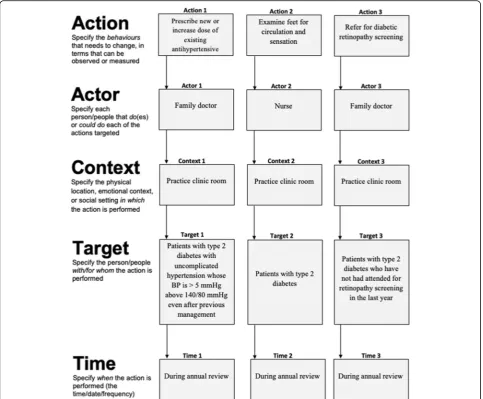
In doing so, the Actor-Target relationship need not only reflect a healthcare professional-patient relation-ship. As demonstrated in Fig. 3, for healthcare profes-sionals working in a team, one healthcare professional’s (Actor A) behaviour (Action A) may be for the benefit of another healthcare professional (Target A), enabling the latter’s subsequent behaviour (Action B). Such hori-zontal sequences within teams also apply to specifying the behaviour of vertical sequences of behaviour within the health system, where a policymaker’s (Actor A) be-haviour (Action A) sets the stage for a healthcare ad-ministrator (Target A/Actor B) to perform a behaviour within their role (Action B) that benefits the healthcare professional (Target B/Actor C) and enables them to provide care (Behaviour C) to benefit their patients (Target C). Thus, a given Actor’s Target can also be another Actor in the system.
hygiene in hospital, AACTT provides a means for clari-fying the behaviour of those engaging in hand sanitizing behaviour, but also the leadership in the organisation whose policy-enacting behaviour sets the stage for mid-dle management to engage in procurement behaviour to provide hand sanitizing stations and gels, through to maintenance staff engaging in refilling behaviour to ensure sanitizing gel is available for the healthcare providers. Each behaviour by these organisational Actors is required for healthcare providers to engage in hand-sanitizing activities. Rather than making implicit as-sumptions about such a sequence of behaviours or describing them as separate organisational factors, the AACTT framework helps to unpack the complexity and clarify the responsibility of all behaviours in organisa-tional health settings, providing a clear opportunity for behavioural approaches to inform organisational change. The level of granularity or aggregation in the specifica-tion of each AACTT domain should be defined by what is measurable, useful and practical for the given applica-tion, to ensure practical utility.
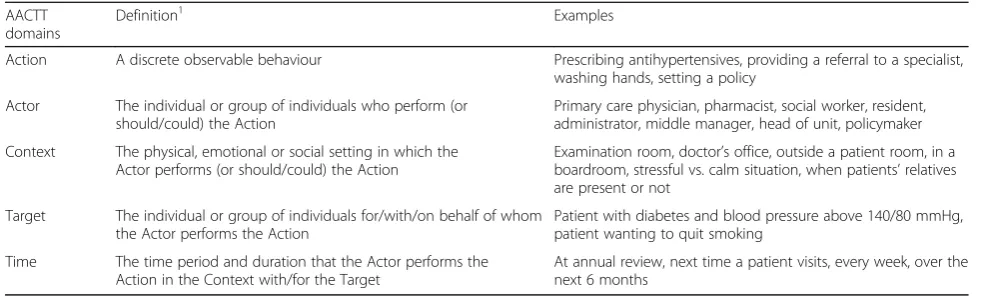
In summary, we propose a new framework: AACTT (Action, Actor, Context, Target, Time—see Table 1 for definitions and examples) to allow for the careful delin-eation of ‘who does what; to, for or with whom; when; where?’[10]. Herein, our aim is to demonstrate how the AACTT framework can be used within the main steps of an implementation research process and to provide a simple tool that implementation researchers and practi-tioners can use to apply the AACTT framework to specify the behaviour(s) of stakeholders.
Methods
We used French’s four-step implementation process model [20] to exemplify how AACTT can be applied to each of the key steps of the implementation process: Step 1 (clarify-ing who needs to do what differently), Step 2 (us(clarify-ing a the-oretical framework, which barriers and enablers need to be addressed), Step 3 (which intervention components could
overcome the modifiable barriers and enhance the enablers) and Step 4 (how can behaviour change be measured and understood). We selected French’s process model to guide the demonstration of AACTT’s application given that its foundational step involves clarifying the behaviour. However, AACTT aligns with other process models (e.g. Knowledge-to-Action Framework [21], the UK MRC framework for developing and evaluating complex interven-tions [22] and process evaluations [23]). At each step, we identified how the AACTT framework could be applied and provide published examples across a range of methodological approaches which align with those commonly used in implementation research [24].
Results
Step 1—Using AACTT to identify who needs to do what, differently, when and where
The AACTT framework can be used at this foundational step of implementation research to ensure coverage across key behaviours (Actions), stakeholders (Actors, Targets) in the particular settings (Time, Context) of desired perform-ance. This helps ensure that subsequent steps remain con-sistent with the AACTT-specified behaviour(s) established at the outset. Application of the AACTT framework at this step can help to identify which individuals at which levels of an organisational hierarchy need to do something differ-ently to implement an evidence-based practice (or indeed de-implement an outdated or non-evidenced practice). Actors often include healthcare professionals, but may also involve their colleagues within a team, administrative staff and middle and upper management whose own Actions fa-cilitate the clinical behaviour of the health professional, and ultimately patients and citizens behaviour. One can extend Actors to people at multiple levels in a healthcare system, e.g. organisational leadership, policy makers and political Actors, whose own behaviours may be centrally important to ensuring that the health professional can engage in a given guideline-recommended behaviour under investiga-tion. The AACTT framework can be employed to unpack
Table 1AACTT framework definitions and examples
AACTT domains
Definition1 Examples
Action A discrete observable behaviour Prescribing antihypertensives, providing a referral to a specialist, washing hands, setting a policy
Actor The individual or group of individuals who perform (or should/could) the Action
Primary care physician, pharmacist, social worker, resident, administrator, middle manager, head of unit, policymaker
Context The physical, emotional or social setting in which the Actor performs (or should/could) the Action
Examination room, doctor’s office, outside a patient room, in a boardroom, stressful vs. calm situation, when patients’relatives are present or not
Target The individual or group of individuals for/with/on behalf of whom the Actor performs the Action
Patient with diabetes and blood pressure above 140/80 mmHg, patient wanting to quit smoking
Time The time period and duration that the Actor performs the Action in the Context with/for the Target
At annual review, next time a patient visits, every week, over the next 6 months
1
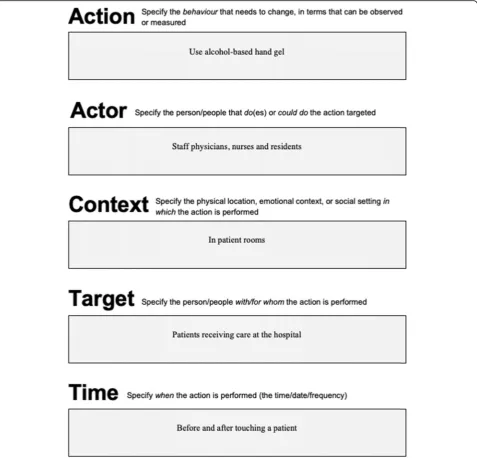
complex organisational and hierarchical inter-relationships into the multiple observable, measurable (and changeable) Actions of individuals at each level. This can provide the basis for clarifying whose behaviour to focus on in a given investigation. Figures1,2and3provide generalisable work-sheets with a worked example that can be used by imple-mentation researchers and practitioners, on their own or as part of a stakeholder engagement activity, to clarify who needs to do what, differently (see also Additional file1for blank versions of each worksheet).
The implication of identifying who needs to do what differently also suggests a need to clarify a gap in care.
In specifying behaviour using the AACTT framework, it may become clearer where specifically evidence-practice gaps exist (i.e. specifically whose behaviour in what settings and time) rather than broader generalisations of evidence of gaps in care typically available to justify a focused implementation diagnostic effort.
Step 2—Using the AACTT framework to inform
investigations to identify barriers and enablers
Having an AACTT-specified behaviour(s) can inform more focused investigations into the barriers and drivers of Actions for each Actor. A key benefit to specifying
the Actor using this framework is that it helps to iden-tify which specific agents one should engage with in eliciting their barriers and enablers to performing the Action; focusing consideration down specifically on those who are or could perform the Action. This may help in qualitative and quantitative approaches to in-vestigating barriers and enablers, including interviews/ focus groups to generate qualitative data and questionnaire-based quantitative data operationalizing theoretical constructs hypothesised to correlate with implementation behaviour. At the initial stages of inquiry, it may not yet be clear who all these potential Actors and Actions are but AACTT specification al-lows this to be further clarified and be made explicit. Initial broad specification at a higher level (e.g. primary care staff including nurses and physicians) may help to recognise the potential for multiple Actors to under-take the same Action, and to explore during the barrier elicitation whether this diffusion of responsibility is problematic (and thus may benefit from greater
specification for each Actor to promote role clarity) or acceptable/desirable (in which case a given setting may find it useful to allocate clear responsibility).
Interviews/focus groups An AACTT-specified
behav-iour provides greater focus to an interview or focus group to maximise the likelihood that responses are reflective of the specific Actions of the Actors situated in a time and place, which may also help with recall. Speci-fying the Actor up front helps to inform recruitment so that the respondents are those actually tasked with the Action (as opposed to others speaking on their behalf). Topic guides can then be designed to ensure that inter-view and focus group prompts are consistently focused on the AACTT-specified behaviours of the respondents (Actors). For instance, a broadly specified behaviour such as ‘improving blood pressure prescribing for pa-tients with type 2 diabetes’lacks AACTT-specificity and thus interview/focus group questions aiming to unpack views on readiness to change [25], beliefs about
Fig. 2AACTT specification for focal and ancillary Actions of multiple Actors, Contexts and Times, with worked example applied to improving
consequences and social influences [26, 27] or imple-mentation climate and culture [28] may remain at a level that does not clarify how those views translate into un-derstanding who needs to do what differently and why they do or do not. In contrast, while‘increasing the dose of existing antihypertensive medication (Action) by a family physician (Actor) during annual diabetes review (Context) for their patients with type 2 diabetes (Target) when their blood pressure is above 140/80 mmHg despite previous management (Time)’ provides an admittedly longer description, the specificity allows much greater insight into the factors that may determine this behaviour than might otherwise be missed by a broader specification. Describing the AACTT upfront also allows similar topic guides to be tailored to different Actors who may be engaging in the same or different Actions.
This is particularly aided when using theoretical frameworks to inform interview topic guide develop-ment, such as when using the Theoretical Domains Framework [26, 27], COM-B within the Behaviour Change Wheel [29] or Consolidated Framework for Implementation Research [28, 30, 31] to elicit views about barriers and enablers that are rooted in a given domain or construct. An AACTT-specified behaviour can also help a directed content analysis of theory-informed interviews by providing the capacity to code barriers and enablers described by respondents directly linked to a given AACTT-specified behaviour, to ensure that the barriers identified are in fact related to the Actions and Actors of interest. Importantly, AACTT-specification ensures that barriers and enablers are spe-cifically those linked to a particular Actor and behaviour in the time and context of performance, rather than
Fig. 3AACTT specification tool for team-based Actions and Actors with variable Target and consistent Context and Time, with worked examples
vague and broad barriers/enablers. This facilitates more targeted intervention development in Step 3.
Questionnaires The original TACT framework was
established to inform the careful development of ques-tionnaire items to operationalise constructs from the Theory of Reasoned Action, and then the Theory of Planned Behaviour that were used to predict behaviour using cross-sectional and prospective designs. This ap-proach, known as the principle of compatibility, involves developing questionnaire items tailored to the specific Target, Action, Context and Time to ensure consistency between the items measuring theoretical constructs and the subsequent behaviour being predicted while ensuring rigour in operationalisation of the theoretical constructs. The TACT-informed principle of compatibility was widely adopted in the 1980s and 1990s when testing of the Theory of Reasoned Action and Theory of Planned Behaviour grew in popularity in social and health psy-chology. At the turn of the century, these social cogni-tion models began to be adapted and adopted for use in implementation research to predict the behaviour of healthcare professionals. Francis and colleagues devel-oped specific guidance for developing Theory of Planned Behaviour-based questionnaires for use to understand and predict health care professional behaviour [32]. This highly cited and influential guidance provided a descrip-tion of how the TACT framework could be applied in this setting and influenced subsequent rigorous develop-ment of Theory of Planned Behaviour questionnaires to understand how its constructs explain variability in the behaviour of health care professionals (see Godin et al 2008 for a review [33]). Such methods were also then adopted to operationalise other theories, while to date this has largely been confined to theories of behaviour [34], there is an opportunity to consider how AACTT-specification can be integrated into the operationalisation of questionnaire items for other theories, models and frameworks used in implementation science and in particu-lar those for which there is concerted effort to developed measures such as Consolidated Framework for Implemen-tation Research [35], Organizational Readiness for Change [36] and Normalization Process Theory [37]. Huijg and col-leagues ([38], see their Table 5) developed and established the discriminant content validity of questionnaire items designed to assess domains from the Theoretical Domains Framework in such a way to allow any Action, Actor, Con-text, Target, Time to be integrated into the measure, and Eccles and colleagues operationalized questionnaires con-sistent with AACTT for a range of theories of behaviour ([34] see the Additional file 2 in Huijg et al. for examples of the questionnaire items that they developed). Opportunities present themselves for similar adaptations for other models, theories and frameworks.
Step 3—Using AACTT to inform selecting and operationalizing implementation intervention components to address barriers and enablers
Best practice in implementation intervention develop-ment involves selecting evidence-based techniques and strategies that address the barriers and enablers identi-fied [39], and clarifying who delivers and receives the intervention, how, when, where and how much [40]. Implementation intervention developers have a range of tools at their disposal for selecting and specifying inter-ventions: high-level descriptors of implementation stra-tegies such as those described in Cochrane’s Effective Practice and Organisation of Care (EPOC) [41] and Ex-pert Recommendation for Implementing Change (ERIC) [42] taxonomies and the Behaviour Change Wheel [29], as well as fine-grained descriptors of techniques such as those proposed in Behaviour Change Techniques Tax-onomy [43], Intervention Mapping [44] or emerging tools for linking behaviour change techniques to mecha-nisms of action [45]. Regardless of the strategies and techniques, it can help to know specifically whose (Actor) behaviour (Action) is being targeted for change with the strategies/techniques, and where (Context) and when (Time) the behaviour is expected to be performed, for/with whom (Target). This may help in narrowing and prioritizing amongst potential strategies and tech-niques. By having AACTT-specified behaviours defined, many of these decisions are made clearer and help to operationalise the strategies themselves. For instance, clearly articulated AACTT-specified behaviour can (i) inform selection of performance indicators provided to primary care physicians as part of an Audit and Feed-back (A&F) intervention, (ii) ensure that the A&F inter-vention is directed to the correct Actors and (iii) that it reflects the context and times of performance and (iv) that the data reflect the Target patients.
care (nursery) services [46], the action could be ‘prepar-ing food consistent with childhood dietary guidelines’, the actor could be ‘cooks’, the context‘in the day care centre kitchen’, the target ‘children attending day care’ and the time‘at lunch every week day’. Regardless of the apparent complexity of the implementation intervention being developed, the AACTT framework can provide transparency and clarity in terms of whose behaviour is targeted by the strategies in the intervention.
Step 4—Using AACTT to specify how behaviour change
can be measured and understood
The application of the AACTT framework in previous steps ensures compatibility with the measures used to assess change in Step 4. Implementation researchers are often interested in both whether an intervention changes behaviour (outcome) as well as explaining the (theory-informed) mechanisms through which change occurs.
Intervention outcome evaluation Irrespective of the
design used to evaluate an implementation intervention, a measure or indicator of behaviour is often central to demonstrating change. In some instances, outcome measurement is embedded within available routinely col-lected data, such as prescribing, ordering and referring, or specific process data collected locally or as part of lar-ger scale initiatives (e.g. Quality and Outcomes Frame-work in the UK) and national audits. When such data are accessible, they provide a pragmatic, low-burden means of evaluating implementation interventions. How-ever, this often involves having to balance consideration of pragmatism with those of measurement specificity. While the likelihood is low that routinely collected data perfectly correspond with the Action performed by the targeted Actor in the Context and Time for the Target designed for the intervention, having an AACTT-specification allows clarity of the degree (or not) of this correspondence. While it is true that in randomised de-signs, any additional ‘noise’ introduced by pragmatic outcome measures would at least be balanced by the randomisation, the more ‘noise’ (i.e. error variance) the less power to detect change in the actual outcome of interest, which has implication for sample size calcula-tions. Thus, even in randomised designs, AACTT-specification provides an opportunity to establish the degree of correspondence between the targeted behav-iour(s) and the indicators of behaviour available to assess the degree of noise (error) in the outcome.
In evaluations where no routinely collected data are available, outcome measures are sometimes developed for the intervention evaluation itself. In such instances, the added advantage of AACTT specification is that it can directly guide which data to collect and provides full control over what‘counts’as performance both in terms
of the behaviour of interest as well as ancillary be-haviours that necessarily support the behaviour of interest but in themselves are not sufficient.
Intervention process evaluation In addition to
evaluat-ing whether an implementation intervention is effective, it is important to understand the mechanisms through which this effect occurred both in terms of changing the targeted mediating constructs (mechanisms of change) and assessing delivery and receipt as designed (fidelity). AACTT-specified behaviours provide the same advan-tage as in Step 2 for informing the design of qualitative or quantitative assessment of mechanisms of change alongside outcome assessment, such as in theory-based process evaluations [47–49]. Using AACTT to inform the wording of process measures that operationalise the theoretical constructs targeted for change provides mea-sures of mediators tied directly to the behaviour the intervention is targeting for change. This provides more direct correspondence between mechanism and out-comes. In this instance, AACTT-specification provides greater measurement sensitivity.
AACTT-specification also allows for more careful as-sessment of fidelity (and adaptation) of delivery and re-ceipt of an implementation intervention by providing structure and transparency in terms of who should re-ceive the intervention (Actor) and which Action(s) under which circumstances (Time, Context) for which Targets. This specificity and transparency can clarify what and whom to track to assess fidelity and adaptation. Table2
provides worked examples of AACTT specifications across study designs.
Discussion
Using the Theory Comparison and Selection Tool (T-CaST) and checklist [51], the AACTT framework is de-signed to beusable(includes relevant domains, has been developed so that key stakeholders can use it, we provide steps for its application and methods for promoting its application across a range of possible studies and an ex-planation for how the domains influence each other),
testable/valid (can form the basis for testable hypoth-eses, includes face-valid explanations and has been used in empirical studies),applicable(focuses on a key imple-mentation outcome, can be applied across a range of methods and across a range of analytical levels, popula-tions and condipopula-tions and is generalisable across disci-plines) and is likely to beacceptable(to key stakeholders, and is the historical evolution of a framework rooted in a particular discipline). Thus, in principle it fulfils all the criteria for use of a framework by implementation science researchers and practitioners, though its actual usability, testability, applicability and acceptability will ultimately be determined through application of the tool across a range of types of implementation research [52].
Michie and Johnston made a call for making clinical practice guidelines more specific by specifying ‘what’,
‘who’,‘when’,‘where’and‘how’[10]. While sharing some
similarities with AACTT, there are three important differences that distinguish AACTT and underscore its potential added utility. First, the ‘who’ in Michie and Johnston’s recommendations refers to the ‘Actor’ but does not make any mention of ‘to, for or with whom’ the action is performed (i.e. the ‘Target’ in AACTT, which may be a patient, a healthcare team member or other organisational actor). Second, the ‘where’ is spe-cific to a physical location, whereas‘Context’in AACTT can refer to a broader set of contexts that include the physical location but could also include a context that is internal to the actor (e.g. emotional context of a stressful versus a calm situation) or the social context (e.g. when patients’ relatives are present). Third, in proposing AACTT as an extension to Fishbein and Ajzen’s TACT framework, we are deliberate in ensuring cumulative theory and methods development as it extends to applications within implementation science.
Existing calls for better specification and reporting have focused on the description and labelling of imple-mentation intervention strategies (e.g. with taxonomies of change strategies such as the ERIC [42] and BCT [43] taxonomies) and on the wider components of interven-tions (e.g. with checklists such as TIDIER [40]). Within implementation science, Proctor, Powell and McMillen [53] proposed seven domains for specifying implementa-tion strategies per se, including who delivers the strategy (actors), how they deliver the strategy (actions), what and to whom the strategy is directed (action target), the sequence of strategy delivery (temporality), intensity
(dose), implementation outcomes affected and justifica-tion. While some of the Proctor et al. domains share similar or overlapping nomenclature with AACTT (i.e. Actor, Action, Time), the scope of intended application of each framework and its domains differs. As exempli-fied in Table1, in the AACTT framework ‘Actor’ refers to the individuals or groups performing the behaviour that could be the recipient of an implementation strat-egy, the‘Action’refers specifically to the behaviour being performed by the Actor and is the object of change and
‘Time’refers to when that behaviour is performed. Thus,
whereas the seven dimensions proposed by Proctor et al. focus on detailing the delivery of animplementation strat-egy within an implementation intervention, AACTT do-mains focus uniquely on detailing behaviour(s). Thus, in the context of an implementation intervention that would be specified with Proctor et al.’s dimensions, the behaviour specified using AACTT would be an outcome that the (now well-specified) implementation strategy aims to change. Thus, AACTT is designed for specifying be-haviour as the object of change, rather than specifying implementation strategies designed to bring about that change.
Conclusion
The careful description of outcomes and measures is of central importance to the development of a cumulative and generalisable science. The AACTT framework pro-vides a means for establishing the core elements of behaviour targeted for change. The framework can be applied to describe the behaviour of Actors at multiple organisational levels. The framework facilitates the sys-tematic description of who needs to do what differently, understanding what may stop or help them from doing so, how to support them to address barriers to change and how to demonstrate that such support worked. AACTT is compatible with any theory, model or frame-work in which behaviour is the focus of inquiry and thus has the potential to be integrated alongside key theoretical approaches used in the field. Given on-going efforts to systematise the measurement of theoretical constructs [54], and description of intervention components [41–43], there is a need for ensuring that the object of change, i.e. behaviour, is equally as carefully described and under-stood. This will ultimately contribute to a greater capacity to synthesise research over time.
Supplementary information
Supplementary informationaccompanies this paper athttps://doi.org/10.
1186/s13012-019-0951-x.
Additional file 1.Blank worksheets for single-actor and multiple-actor/
Abbreviations
AACTT:Action, Actor, Context, Target, Time; A&F: Audit and Feedback; COM-B: Capability, opportunity, motivation, behaviour; EPOC: Effective Practice and Organisation of Care; ERIC: Expert Recommendation for Implementing Change; TACT: Target, Action, Context, Time; T-CaST: Theory Comparison and Selection Tool
Acknowledgements
We thank Ian D. Graham for thought provoking discussions on the order in which to present the framework’s domains.
Authors’contributions
JJF conceived the idea and all authors substantively developed the idea. JP and JJF drafted the manuscript. All authors contributed to refining the manuscript. All authors read and approved the final manuscript.
Funding
JMG is supported by a Tier 1 Canada Research Chair in Health Knowledge Transfer and Uptake and a CIHR Foundation grant for related work.
Availability of data and materials Not applicable.
Ethics approval and consent to participate Not applicable.
Consent for publication Not applicable.
Competing interests
JP is an associate editor and JMG and FL are on the editorial board for Implementation Science but were not involved in the management or decisions made for this manuscript.
Author details 1
Clinical Epidemiology, Ottawa Hospital Research Institute, Ottawa, Canada. 2School of Epidemiology and Public Health, University of Ottawa, Ottawa,
Canada.3School of Psychology, University of Ottawa, Ottawa, Canada. 4Centre for Behaviour Change, University College London, London, UK. 5
Department of Medicine, University of Ottawa, Ottawa, Canada.6School of Health Sciences, City University of London, London, UK.
Received: 25 July 2019 Accepted: 22 October 2019
References
1. Barnett ML, Linder JA. Antibiotic prescribing for adults with acute bronchitis in the United States, 1996-2010. JAMA. 2014;311:2020.
2. Erasmus V, Daha TJ, Brug H, Richardus JH, Behrendt MD, Vos MC, et al. Systematic review of studies on compliance with hand hygiene guidelines in hospital care. Infect Control Hosp Epidemiol. 2010;31:283–94.
3. Gonzalez-Urzelai V, Palacio-Elua L, Lopez-de-Munain J. Routine primary care management of acute low back pain: adherence to clinical guidelines. Eur Spine J. 2003;12:589–94.
4. Institute of Medicine. Committee on Quality of Health Care in America. Crossing the quality chasm: a new health system for the 21st century. Washington DC: National Academies Press; 2001.
5. Woolf SH. Unhealthy Medicine: All breakthrough, no follow-throw. Washington Post [Internet]. 2006; Available from:https://www. washingtonpost.com/archive/opinions/2006/01/08/unhealthy-medicine- span-classbankheadall-breakthrough-no-follow-throughspan/d3b838a9-db0b-4b23-a410-c5de185f51d0/
6. LaPiere RT. Attitudes vs. actions. Soc Forces. 1934;13:230–7.
7. Fishbein M, editor. Attitude and the prediction of behaviour (Chapter 51). In: Readings in attitude theory and measurement. New York: Wiley; 1967. p. 477–492.
8. Ajzen I. The theory of planned behavior. Organ Behav Hum Decis Process. 1991;50:179–211.
9. Fishbein M, Ajzen I. Defining and predicting behaviour (Chapter 2). In: Predicting and changing behavior: the reasoned action approach. New York: Psychology Press; 2010. p. 29–73.
10. Michie S, Johnston M. Changing clinical behaviour by making guidelines specific. BMJ. 2004;328:343–5.
11. Miller M. How well is the target behaviour specified in reports of behaviour change interventions for health care professionals? A systematic review of reporting practice [Master’s thesis]: City University of London; 2015. 12. Ajzen I, Fishbein M. Attitude-behavior relations: a theoretical analysis and
review of empirical research. Psychol Bull. 1977;84:888–918.
13. Siegel JT, Navarro MA, Tan CN, Hyde MK. Attitude–behavior consistency, the principle of compatibility, and organ donation: a classic innovation. Health Psychol. 2014;33:1084–91.
14. Eccles MP, Hrisos S, Francis JJ, Steen N, Bosch M, Johnston M. Can the collective intentions of individual professionals within healthcare teams predict the team’s performance: developing methods and theory. Implement Sci. 2009;4:24.
15. Strack F, Deutsch R. Reflective and impulsive determinants of social behavior. Personal Soc Psychol Rev. 2004;8:220–47.
16. Gardner B, Lally P, Wardle J. Making health habitual: the psychology of ‘habit-formation’and general practice. Br J Gen Pract. 2012;62:664–6. 17. Potthoff S, Rasul O, Sniehotta FF, Marques M, Beyer F, Thomson R, et al. The
relationship between habit and healthcare professional behaviour in clinical practice: a systematic review and meta-analysis. Health Psychol Rev. 2019;13:73–90.
18. Potthoff S, Presseau J, Sniehotta FF, Breckons M, Rylance A, Avery L. Exploring the role of competing demands and routines during the implementation of a self-management tool for type 2 diabetes: a theory-based qualitative interview study. BMC Med Inform Decis Mak. 2019;19:23. 19. Presseau J, Johnston M, Heponiemi T, Elovainio M, Francis JJ, Eccles MP,
et al. Reflective and automatic processes in health care professional behaviour: a dual process model tested across multiple behaviours. Ann Behav Med. 2014;48:347–58.
20. French SD, Green SE, O’Connor DA, McKenzie JE, Francis JJ, Michie S, et al. Developing theory-informed behaviour change interventions to implement evidence into practice: a systematic approach using the Theoretical Domains Framework. Implement Sci. 2012;7:38.
21. Graham ID, Logan J, Harrison MB, Straus SE, Tetroe J, Caswell W, et al. Lost in knowledge translation: Time for a map? J Contin Educ Health Prof. 2006;26:13–24.
22. Craig P, Dieppe P, Macintyre S, Michie S, Nazareth I, Petticrew M. Developing and evaluating complex interventions: the new Medical Research Council guidance. BMJ. 2008;337:a1655.
23. Moore GF, Audrey S, Barker M, Bond L, Bonell C, Hardeman W, et al. Process evaluation of complex interventions: Medical Research Council guidance. BMJ. 2015;350:h1258.
24. Brown CH, Curran G, Palinkas LA, Aarons GA, Wells KB, Jones L, et al. An overview of research and evaluation designs for dissemination and implementation. Annu Rev Public Health. 2017;38:1–22.
25. Weiner BJ. A theory of organizational readiness for change. Implement Sci [Internet]. 2009;4:67.
26. Michie S, Johnston M, Abraham C, Lawton R, Parker D, Walker A, et al. Making psychological theory useful for implementing evidence based practice: a consensus approach. Qual Saf Health Care. 2005;14:26–33. 27. Atkins L, Francis JJ, Islam R, O’Connor D, Patey A, Ivers NM, et al. A guide to
using the Theoretical Domains Framework of behaviour change to investigate implementation problems. Implement Sci. 2017;12:77. 28. Damschroder LJ, Aron DC, Keith RE, Kirsh SR, Alexander JA, Lowery JC.
Fostering implementation of health services research findings into practice: a consolidated framework for advancing implementation science. Implement Sci. 2009;4:50.
29. Michie S, van Stralen MM, West R. The behaviour change wheel: a new method for characterising and designing behaviour change interventions. Implement Sci. 2011;6:42.
30. Birken SA, Powell BJ, Presseau J, Kirk MA, Lorencatto F, Gould NJ, et al. Combined use of the Consolidated Framework for Implementation Research (CFIR) and the Theoretical Domains Framework (TDF): a systematic review. Implement Sci. 2017;12:2.
31. Kirk MA, Kelley C, Yankey N, Birken SA, Abadie B, Damschroder L. A systematic review of the use of the Consolidated Framework for Implementation Research. Implement Sci. 2015;11:72.
University of Newcastle upon Tyne; 2004. Available from:http://openaccess. city.ac.uk/1735/
33. Godin G, Bélanger-Gravel A, Eccles MP, Grimshaw J. Healthcare professionals’intentions and behaviours: a systematic review of studies based on social cognitive theories. Implement Sci. 2008;3:36. 34. Eccles MP, Hrisos S, Francis JJ, Stamp E, Johnston M, Hawthorne G, et al.
Instrument development, data collection, and characteristics of practices, staff, and measures in the Improving Quality of Care in Diabetes (iQuaD) Study. Implement Sci. 2011;6:61.
35. Kegler MC, Liang S, Weiner BJ, Tu SP, Friedman DB, Glenn BA, et al. Measuring constructs of the consolidated framework for implementation research in the context of increasing colorectal cancer screening in federally qualified health center. Health Serv Res. 2018;53:4178–203.
36. Helfrich CD, Li Y-F, Sharp ND, Sales AE. Organizational readiness to change assessment (ORCA): development of an instrument based on the Promoting Action on Research in Health Services (PARIHS) framework. Implement Sci. 2009;4:38.
37. Rapley T, Girling M, Mair FS, Murray E, Treweek S, McColl E, et al. Improving the normalization of complex interventions: part 1 - development of the NoMAD instrument for assessing implementation work based on normalization process theory (NPT). BMC Med Res Methodol. 2018;18:133. 38. Huijg JM, Gebhardt WA, Crone MR, Dusseldorp E, Presseau J. Discriminant content validity of a theoretical domains framework questionnaire for use in implementation research. Implement Sci. 2014;9:11.
39. Michie S, Johnston M, Francis JJ, Hardeman W, Eccles M. From theory to intervention: mapping theoretically derived behavioural determinants to behaviour change techniques. Appl Psychol. 2008;57:660–80.
40. Hoffmann TC, Glasziou PP, Boutron I, Milne R, Perera R, Moher D, et al. Better reporting of interventions: template for intervention description and replication (TIDieR) checklist and guide. BMJ. 2014;348:g1687.
41. Effective Practice and Organisation of Care (EPOC). EPOC Taxonomy. Oslo: Norwegian Knowledge Centre for the Health Services; 2002. Available at: https://epoc.cochrane.org/epoc-taxonomy.
42. Powell BJ, Waltz TJ, Chinman MJ, Damschroder LJ, Smith JL, Matthieu MM, et al. A refined compilation of implementation strategies: results from the Expert Recommendations for Implementing Change (ERIC) project. Implement Sci. 2015;10:21.
43. Michie S, Richardson M, Johnston M, Abraham C, Francis JJ, Hardeman W, et al. The behavior change technique taxonomy (v1) of 93 hierarchically clustered techniques: building an international consensus for the reporting of behavior change interventions. Ann Behav Med. 2013;46:81–95. 44. Kok G, Gottlieb NH, Peters G-JY, Mullen PD, Parcel GS, Ruiter RAC, et al. A
taxonomy of behaviour change methods: an Intervention Mapping approach. Health Psychol Rev. 2016;10:297–312.
45. Centre for Behaviour Change. Theory and Techniques Tool. Theory and Techniques Tool. 2019. Available from:https://theoryandtechniquetool. humanbehaviourchange.org/
46. Seward K, Wolfenden L, Wiggers J, Finch M, Wyse R, Oldmeadow C, et al. Measuring implementation behaviour of menu guidelines in the childcare setting: confirmatory factor analysis of a theoretical domains framework questionnaire (TDFQ). Int J Behav Nutr Phys Act. 2017;14:45.
47. McIntyre SA, Francis JJ, Gould NJ, Lorencatto F. The use of theory in process evaluations conducted alongside randomized trials of implementation interventions: a systematic review. Transl Behav Med. 2018:iby110; Available from:https://doi.org/10.1093/tbm/iby110/5208274
48. Presseau J, Grimshaw JM, Tetroe JM, Eccles MP, Francis JJ, Godin G, et al. A theory-based process evaluation alongside a randomised controlled trial of printed educational messages to increase primary care physicians’prescription of thiazide diuretics for hypertension [ISRCTN72772651]. Implement Sci. 2016;11:121. 49. Grimshaw JM, Zwarenstein M, Tetroe JM, Godin G, Graham ID, Lemyre L, et al.
Looking inside the black box: a theory-based process evaluation alongside a randomised controlled trial of printed educational materials (the Ontario printed educational message, OPEM) to improve referral and prescribing practices in primary care in Ontario. Canada. Implement Sci. 2007;2:38. 50. Wolfenden L, Yoong SL, Williams CM, Grimshaw J, Durrheim DN, Gillham K,
et al. Embedding researchers in health service organizations improves research translation and health service performance: the Australian Hunter New England Population Health example. J Clin Epidemiol. 2017;85:3–11. 51. Birken SA, Rohweder CL, Powell BJ, Shea CM, Scott J, Leeman J, et al.
T-CaST: an implementation theory comparison and selection tool. Implement Sci. 2018;13:143.
52. Hull L, Goulding L, Khadjesari Z, Davis R, Healey A, Bakolis I, et al. Designing high-quality implementation research: development, application, feasibility and preliminary evaluation of the implementation science research development (ImpRes) tool and guide. Implement Sci. 2019;14:80. 53. Proctor EK, Powell BJ, McMillen JC. Implementation strategies:
recommendations for specifying and reporting. Implement Sci. 2013;8:139. 54. Lewis CC, Mettert KD, Dorsey CN, Martinez RG, Weiner BJ, Nolen E, et al. An
updated protocol for a systematic review of implementation-related measures. Syst Rev. 2018;7:66.
55. Bussières AE, Patey AM, Francis JJ, Sales AE, Grimshaw JM. Identifying factors likely to influence compliance with diagnostic imaging guideline recommendations for spine disorders among chiropractors in North America: a focus group study using the Theoretical Domains Framework. Implement Sci. 2012;7:82.
56. McSharry J, Murphy PJ, Byrne M. Implementing international sexual counselling guidelines in hospital cardiac rehabilitation: development of the CHARMS intervention using the Behaviour Change Wheel. Implement Sci. 2016;11:134. 57. Presseau J, Mackintosh J, Hawthorne G, Francis JJ, Johnston M, Grimshaw JM, et al. Cluster randomised controlled trial of a theory-based multiple behaviour change intervention aimed at healthcare professionals to improve their management of type 2 diabetes in primary care. Implement Sci. 2018;13:65. 58. Lorencatto F, West R, Christopherson C, Michie S. Assessing fidelity of
delivery of smoking cessation behavioural support in practice. Implement Sci. 2013;8:40.
59. Grimshaw JM, Presseau J, Tetroe J, Eccles MP, Francis JJ, Godin G, et al. Looking inside the black box: results of a theory-based process evaluation exploring the results of a randomized controlled trial of printed educational messages to increase primary care physicians’diabetic retinopathy referrals [Trial registration number ISRCTN72772651]. Implement Sci. 2014;9:86.
Publisher’s Note