S T U D Y P R O T O C O L
Open Access
The Reinforcing Therapist Performance (RTP)
experiment: Study protocol for a cluster
randomized trial
Bryan R Garner
1*, Susan H Godley
1, Michael L Dennis
1, Mark D Godley
1, Donald S Shepard
2Abstract
Background:Rewarding provider performance has been recommended by the Institute of Medicine as an approach to improve the quality of treatment, yet little empirical research currently exists that has examined the effectiveness and effectiveness of such approaches. The aim of this study is to test the effectiveness and cost-effectiveness of providing monetary incentives directly to therapists as a method to improve substance abuse treatment service delivery and subsequent client treatment outcomes.
Design:Using a cluster randomized design, substance abuse treatment therapists from across 29 sites were assigned by site to either an implementation as usual (IAU) or pay-for-performance (P4P) condition.
Participants:Substance abuse treatment therapists participating in a large dissemination and implementation initiative funded by the Center for Substance Abuse Treatment.
Intervention:Therapists in both conditions received comprehensive training and ongoing monitoring, coaching, and feedback. However, those in the P4P condition also were given the opportunity to earn monetary incentives for achieving two sets of measurable behaviors related to quality implementation of the treatment.
Outcomes:Effectiveness outcomes will focus on the impact of the monetary incentives to increase the proportion of adolescents who receive a targeted threshold level of treatment, months that therapists demonstrate monthly competency, and adolescents who are in recovery following treatment. Similarly, cost-effectiveness outcomes will focus on cost per adolescent receiving targeted threshold level of treatment, cost per month of demonstrated competence, and cost per adolescent in recovery.
Trial Registration:Trial Registration Number: NCT01016704
Background
Alcohol and other drug abuse problems are increasingly being recognized as a chronic, relapsing condition that may last for decades and require multiple episodes of care over many years [1-3]. As over 80% of all people who develop alcohol and other substance use disorders start using under the age of 18 [4], there is clearly a need for effective treatment interventions designed spe-cifically for adolescents. Unfortunately, while a number of effective evidence-based treatments (EBTs) have been developed for treating adolescent substance abuse and dependence [5-14], the diffusion of such EBTs into
practice settings has been found to be a significant chal-lenge [15-18].
Since the identification of this important issue, there has been great interest in bridging the‘ research-to-prac-tice gap’, including research to understand the correlates of EBT adoption [19,20] and staff attitudes toward EBT use [21-23]. Additionally, several conceptual models of the EBT adoption and implementation process have been developed [24-27]. Despite these advances, there remains much room for further improvement, especially in the identification of methods that facilitate implemen-tation of EBTs [18,28,29]. This is a critically important area of research, given meta-analyses of treatment pro-grams have suggested that the degree of implementation can be as important as the nominal efficacy of the * Correspondence: [email protected]
1
Lighthouse Institute, Chestnut Health Systems, Normal, IL, USA
targeted EBT, with the biggest effects coming from well-implemented, highly efficacious interventions [30]. In order to reliably achieve effective treatment outcomes, it is necessary to empirically test ways to improve the EBT implementation process in practice settings.
While multiple factors influence the quality and degree of EBT implementation in practice settings, attention has increasingly focused on the role of the therapist as a key mediator of treatment delivery over the last decade [31-34]. Indeed, Walters, Matson, Baer, and Ziedonis [35] conducted a systematic review of the effectiveness of workshop training for psychosocial addiction treatments and concluded that workshop trainings generally improved therapist knowledge, atti-tude, and confidence in working with clients, as well as some skills immediately after training. However, they also found that these skills typically were not maintained for very long. In order for therapists to incorporate these skills in their repertoire for the long-term, they concluded that extended contact, including feedback, supervision, and consultation, is also necessary. Support for this conclusion is perhaps best provided by the stu-dies that used experimental designs to test different training strategies [33,34]. For example, Miller and col-leagues [33] evaluated four methods to help therapists learn motivational interviewing (MI), including: work-shop only; workwork-shop plus practice feedback; workwork-shop plus individual coaching; and workshop, feedback, and coaching. Only therapists in the full training condition (i.e., workshop, feedback, and coaching) had clients with significant changes in their response to treatment. How-ever, even these state-of-the-art training and technical assistance strategies may not be enough to ensure qual-ity implementation, as even within carefully controlled clinical trials that employ these strategies, there is often variation in how competently and reliably therapists implement interventions. For example, in an examina-tion of the relaexamina-tionship between therapist competence and clinical outcomes in the Treatment of Depression Collaborative Research Program (TDCRP), Shawet al. [36] found that therapists did not meet the set mini-mum standard for competence in 27% of sessions. Indeed, in multiple studies that examined this issue, the size of the‘therapist’effect has been as large as or larger than the mean effects between conditions [37-42].
Given therapists are critical in the implementation of high-quality treatment, research is needed to better understand how to improve the degree to which thera-pists competently deliver EBTs to adolescents. One approach recently recommended by the Institute of Medicine is called pay-for-performance (P4P), and is a variant of contingency management procedures (also called motivational incentives) that have been shown to be effective in the enhancement of a variety of behaviors
with alcohol and other substance abusers [43-50]. Inter-estingly, despite several studies having demonstrated the significant relationship between financial incentives and work performance [51-54], few studies have used rando-mized clinical trials (RCTs) to examine the impact of P4P initiatives within healthcare [55] or behavioral health [56]. Although not RCTs, there are several nota-ble examples of linking monetary incentives to perfor-mance within the substance abuse treatment field [57-59]. For instance, Andrzejewski et al. [57] found that providing graphical performance feedback and drawings for cash incentives increased implementation by 69% and 93%, respectively. Shepardet al. [58] found that providing therapists with a $100 bonus was an effective and cost-effective approach to improve the per-centage of clients who attended five sessions. McLellan et al. [59] reported on the Delaware Division of Sub-stance Abuse and Mental Health (DSAMH) ‘ perfor-mance contracting’ with all 11 of its outpatient addiction treatment programs. Results indicated that
‘capacity utilization’increased from an average of 54% in 2001 to an average of 95% in 2006 and that ‘active parti-cipation’increased from an average of 53% in 2001 to 70% in 2006. Although P4P methods appear to hold promise for improving treatment implementation, research utilizing rigorous experimental designs and lar-ger sample sizes is clearly needed.
The current paper describes the design and baseline characteristics of the therapists participating in the Rein-forcing Therapist Performance (RTP) study, which is a cluster randomized experiment examining the effective-ness and cost effectiveeffective-ness (CE) of providing monetary incentives directly to therapists as an innovative method to improve treatment service delivery and subsequent treatment outcomes for adolescents and their caregivers. This study is unique in that there are only a handful of studies that focus on staff characteristics and the mechanisms by which staff behaviors are changed, and even fewer randomized experiments in which staff are the unit of analysis.
Methods
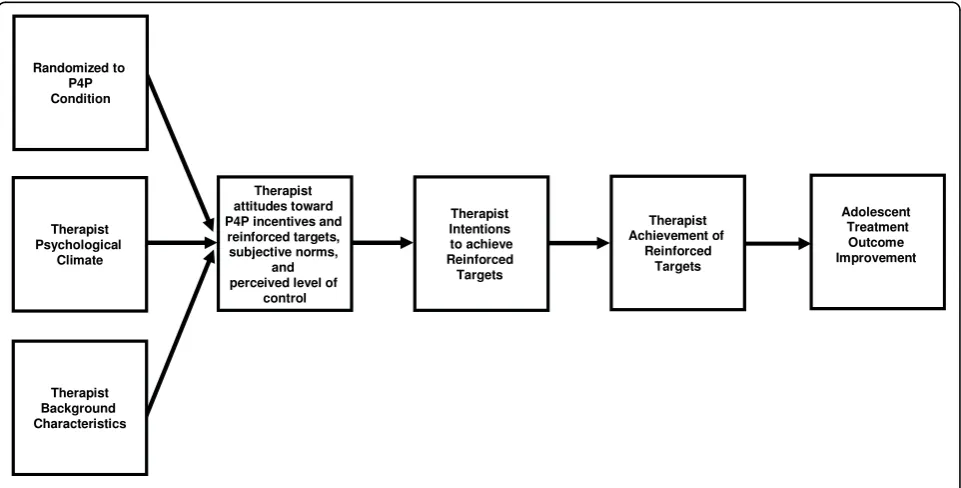
Overview of conceptual model
of performing a behavior). We also hypothesize that these antecedents of intentions will be directly related to: being randomized to the P4P condition, psychologi-cal climate [62] (i.e., therapist perceptions of the organi-zational climate), and background characteristics (e.g., age, gender, education level, experience). Finally, we hypothesize achievement of the reinforced targets will be associated with improved adolescent treatment out-comes (e.g., reduced substance use).
Study setting
Consistent with recommendations from a blue ribbon task force on health services research [63], this study represents a unique collaboration between the National Institute on Alcohol Abuse and Alcoholism (NIAAA) and the Center for Substance Abuse Treatment (CSAT). Indeed, the RTP study would not be feasible without the braiding of NIAAA research dollars and more than $30 million dollars from CSAT as part of its Assertive Ado-lescent and Family Treatment (AAFT) dissemination and implementation initiative. As CSAT’s AAFT initia-tive, which provides the foundational setting for the study, has been described in detail elsewhere (Godley, Garner, Smith, Meyers, & Godley, 2010), only a brief description is provided here.
Between 2006 and 2007, CSAT awarded three-year grants to 34 community-based organizations across the United States to implement a standardized assessment called the Global Appraisal of Individual Needs (GAIN) and two EBTs called the Adolescent Community Rein-forcement Approach (A-CRA) and the Assertive Conti-nuing Care (ACC). The latter are EBT adaptations for
adolescents of the Community Reinforcement Approach [64] (CRA), and have been shown to be effective in the treatment of adolescent substance abuse and depen-dence [8,9,65-68]. The purpose of these demonstration grants are to help address the research-to-practice gap by helping community-based treatment agencies imple-ment effective assessimple-ment and treatimple-ment practices for adolescents and their families/primary caregivers. Based on the research literature and the center’s experience that both training and ongoing consultation/coaching are necessary components of successfully implementing EBTs [24,33,34], CSAT also awarded a contract to Chestnut Health Systems to deliver the GAIN and A-CRA/ACC training and technical assistance model to all 34 grantees.
Overview of RTP study design
This RTP experiment and the rest of this article focus on improving the implementation of A-CRA/ACC. As part of the comprehensive A-CRA/ACC training model received by both RTP groups, participants: read the A-CRA manual and pass a knowledge test prior to train-ing; attending a 3.5-day training workshop; participate in bi-weekly telephone coaching calls with treatment model experts; receive quantitative and qualitative feed-back on actual session performance throughout the cer-tification process; receive feedback on actual session performance as part of randomly selected post-certifica-tion fidelity checks; and provide documentapost-certifica-tion of treat-ment impletreat-mentation via therapist reports of procedures delivered during each treatment session as well as corre-sponding digital session recordings (DSRs) of the
session. Thus, with 34 grantees across 15 states, the AAFT project represents one of the field’s largest disse-mination and implementation initiatives of an adoles-cent substance abuse treatment intervention to date. More importantly, the standardized level of funding and training being delivered to the 34 CSAT grantees pro-vides an ideal setting in which to examine methods to improve implementation.
RTP is a cluster randomized experiment examining the effectiveness and CE of providing monetary incen-tives to therapists as a method to improve treatment implementation and subsequent outcomes for adoles-cents and their caregivers. It builds upon prior work by Garner and colleagues [65] that has shown exposure to A-CRA procedures significantly mediates the relation-ship between treatment retention and outcomes, and empirically identified a threshold level of A-CRA expo-sure significantly related to positive post-treatment out-comes (i.e., being in recovery). Additionally, it builds upon research that has examined the relationship between therapist competency and treatment outcome for clients [36,69,70]. ACRA/ACC sites and therapists within site were recruited to participate in the study, and those who agreed were randomly assigned to either implementation as usual (IAU) or P4P. Participation was voluntary and the study is conducted under the supervi-sion of Chestnut Health Systems Institutional Review Board (IRB). Below are further descriptions of the inter-vention, procedures, measures, and analytic plans.
Study intervention
Implementation as usual (IAU)
Both groups receive the same training and technical assistance model they have been receiving since the inception of the AAFT initiative. As noted above, this state-of-the-art training and technical assistance model consists of a 3.5-day workshop training, bi-weekly tele-phone coaching calls with model experts, and ongoing monitoring and feedback (both quantitative and qualita-tive) as part of a standardized certification process. Pay-for-performance (P4P)
In addition to the above, the P4P group has the oppor-tunity to earn monetary bonuses for two sets of measur-able behaviors related to quality implementation of the model. These two behaviors are: delivering Target A-CRA and demonstrating Monthly A-A-CRA Descriptions of the rationale and reinforcement schedules for these two targeted behaviors are described in the sections below; however, detailed descriptions of Target A-CRA and Monthly A-CRA competency are provided in the study measures section.
Rationale and reinforcement schedule for target A-CRA
Research has suggested that the degree of implementa-tion can be as important as the efficacy of the EBT, with the biggest effects coming from well-implemented,
highly efficacious interventions [30]. Similarly, our prior research [65] has shown that adolescents who received a threshold exposure of A-CRA were significantly more likely to be in recovery at follow-up. Increasing the number of adolescents who receive Target A-CRA would be expected to result in a higher likelihood that adolescents would have more positive treatment out-comes. Thus, one of the questions the study was designed to examine is the extent to which monetary bonuses could increase the probability that an adoles-cent receives Target A-CRA. As part of the RTP, study therapists in the P4P condition receive a $200 bonus for each adolescent who receives Target A-CRA within the first 14 weeks of AAFT and in no fewer than seven A-CRA sessions. In order to attribute improvements in adolescent outcomes to the incentives, only outcome data from adolescents admitted to the AAFT project after sites were randomly assigned to the study condi-tions will be used in Target A-CRA-related analyses.
Rationale and reinforcement schedule for monthly A-CRA competency
In addition to reinforcing exposure to a threshold num-ber of procedures, we believed it was important to rein-force the quality of delivery (i.e., competence). Thus, P4P therapists also are provided the opportunity to earn a $50 bonus for each month that a randomly selected session recording has at least one core procedure rated at or above the minimum level of competence required for certification. Importantly, in order to ensure a repre-sentative sample of session recordings, only those thera-pists who submit at least 80% or more of treatment session recordings are eligible to have a session rated for competence. Because it would take approximately three months after randomization before P4P partici-pants would be eligible to begin receiving their first bonus associated with delivery of Target A-CRA, rein-forcing Monthly A-CRA competency is important as it can be reinforced sooner and more frequently.
Recruitment
The initial recruitment period for the study occurred between November 2008 and February 2009 and was limited to the sites and therapists participating in CSAT’s AAFT initiative. Since the two cohorts of AAFT were funded in different years, recruitment of the study sites was in months 27 and 15 of the cohorts’respective 36-month grants. Although the site’s therapists were the target population for the RTP, it was necessary to first obtain permission from each grantee’s principal investi-gator (PI) and/or treatment agency director.
Site recruitment
attachments included: the memorandum of understand-ing, which outlined the responsibilities of the study sites, the informed consent, which outlined the responsi-bilities of the therapist participants, and a signed letter of support from the CSAT project officer. The study PI (BRG) followed up the e-mail introductions with tele-phone calls with each site PI to answer questions and inquire about the site’s willingness to participate in the study. Out of the 34 grantees, two were excluded for study participation because they were not providing ser-vices in an outpatient setting, and two were ineligible because they could not be matched to a comparable site for randomization. Of the 30 eligible grantees, 29 (97%) agreed to participate by returning signed copies of the memorandum of understanding.
Staff recruitment
Recruitment of therapist participants for the study began one month after site recruitment. In order to be eligible to participate in the study, therapists had to work at one of the participating AAFT grantee sites and be deliver-ing A-CRA or ACC to adolescents. Study packets con-taining a cover letter, informed consent, staff survey, and a W-9 tax form were mailed to 92 eligible thera-pists. Of these, 82 (89%) agreed to participate.
Randomization
Although random assignment of therapists might appear ideal, a number of issues made such an approach impractical and led to the decision to randomize in clus-ters by site. For example, dividing small (two- to four-person) clinical teams within a site through random assignment may lead to unintended consequences due to some therapists being eligible for incentives and others not. For example, the IAU group might work harder than they normally would to achieve goals (i.e., compensatory rivalry), which would threaten the study’s internal validity (increasing type 2 error probability). Another possibility is that this situation would lead to resentful demoralization of therapists in the control group, and they would deliver sub-par effort (increasing type 1 error probability). In order to avoid these poten-tial problems, we used an adaptive randomization proce-dure referred to as urn randomization [71,72] to assign sites to the two study conditions. Shadish, Cook, and Campbell [71] recommend using such adaptive proce-dures whenever feasible and when good matching vari-ables can be found, and have noted that the best matching variables are pre-test scores on the outcomes of interest.
Given the two cohorts of AAFT grantees were in months 27 and 15 of their respective 36-month grants, pre-test data was available on several important match-ing variables. Usmatch-ing existmatch-ing project data on therapists performance and from staff questionnaires (described further below), we created several grantee-level
measures including: average Target A-CRA rate; average DSR upload rate; three-month client recovery rate; per-centage of Caucasian clients; perper-centage of Hispanic cli-ents; percentage of male clicli-ents; number of therapists; average therapist age; percentage of Caucasian thera-pists; percentage of male therathera-pists; and AAFT staff rat-ings of expected performance. This last measure was used to take into account any recent changes (e.g., turn-over of supervisor, major improvement/decrements in performance) that might impact performance in the study, and was based upon independent rankings from the director and coordinator of the AAFT training team. Both raters agreed on the rankings for all but two study sites (Kappa = 0.86), and the two raters were able to dis-cuss and resolve these two inconsistencies. Each of the above-mentioned existing measures was then entered by AAFT cohort into an urn randomization software pro-gram called gRand.
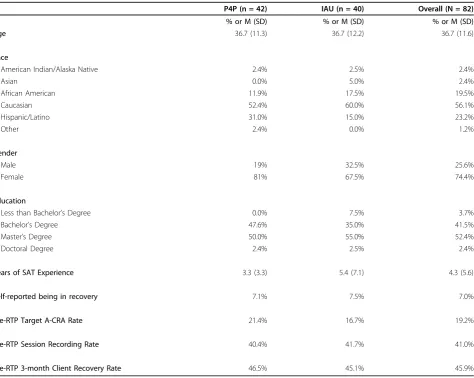
Although urn randomization was conducted at the site level, it resulted in a balanced distribution of therapists into the two study conditions (See Table 1). Of the 82 therapists used to randomize sites most were female (74.4%) and Caucasian (56.1%). They had an average age of 37 years (SD = 11.6). In terms of their education and work experience, most had either a Masters (52.4%) or a Bachelor’s (41.5%) degree, with an average of 4.3 years of substance abuse counseling experience. Seven percent reported personally being in recovery for alcohol or other drugs. Based on therapist self-report, the average achievement of Target A-CRA implementation prior to the experiment was 19.2%, and the average session recording rate of fidelity was 41.0%. Based on three-month post-intake follow-up data prior to the experi-ment, the average percentage of therapists’ adolescent clients in recovery was 45.9%. Notification to sites and individual participants about the official commencement of the study and their assignment to either the IAU or P4P conditions were sent via email on 16 January 2009 for the AAFT-1 and on 13 February 2009 for AAFT-2.
Study measurements
Given that the primary aims of the study were to exam-ine the effectiveness and CE of providing monetary incentives to therapists as a method to improve treat-ment impletreat-mentation and subsequent outcomes for adolescents and their caregivers, it was necessary to col-lect measures from multiple levels (i.e., therapist, adoles-cent, and grantee) and over several different time points.
Therapist background and attitude measures
gender; highest educational degree obtained; and years of substance abuse counseling experience. The survey also included the Minnesota Satisfaction Questionnaire (MSQ) [73], the Pay Satisfaction Questionnaire (PSQ) [74], several scales from the Organizational Readiness for Change (ORC) instrument [75], and several mea-sures adapted from the Provider Attitudes toward Incentive (PAI) [61] instrument. Assessment of changes in participants’ attitudes and work environments was measured via three-month follow-up versions of the survey.
Therapist implementation measures
The two implementation measures being reinforced as part of the study are Target CRA and Monthly A-CRA Competency. Developed using existing AAFT data, Target A-CRA is a dichotomous (1 = yes, 0 = no) mea-sure. It is defined as the delivery of 10 or more of the following 12 A-CRA procedures: functional analysis of substance using behavior; functional analysis of prosocial
behavior; happiness scale; treatment plan/goals of coun-seling; communication skills; problem solving skills; ado-lescent-caregiver relationship skills; caregiver overview, rapport building, and motivation; homework reviewed; drink/drug refusal skills; relapse prevention; and increas-ing prosocial recreation durincreas-ing the first 14 weeks of an adolescent’s AAFT treatment experience (but in no fewer than seven sessions). See the A-CRA treatment manual for a description of these A-CRA procedures [76]. Additionally, because identifying, discussing, and reviewing the adolescent’s reinforcers is considered a central mechanism of change within the A-CRA philo-sophy, as part of Target A-CRA, therapists also must demonstrate one of these three components in at least 50% or more of the sessions conducted during this time period. Therapist-reported data on more than 450 ado-lescents uploaded to AAFT’s implementation tracking system (i.e., https://www.EBTx.org) indicated adolescents who received Target A-CRA had significantly (p< 0.05)
Table 1 Baseline characteristics of therapists at randomization
P4P (n = 42) IAU (n = 40) Overall (N = 82)
% or M (SD) % or M (SD) % or M (SD)
Age 36.7 (11.3) 36.7 (12.2) 36.7 (11.6)
Race
American Indian/Alaska Native 2.4% 2.5% 2.4%
Asian 0.0% 5.0% 2.4%
African American 11.9% 17.5% 19.5%
Caucasian 52.4% 60.0% 56.1%
Hispanic/Latino 31.0% 15.0% 23.2%
Other 2.4% 0.0% 1.2%
Gender
Male 19% 32.5% 25.6%
Female 81% 67.5% 74.4%
Education
Less than Bachelor’s Degree 0.0% 7.5% 3.7%
Bachelor’s Degree 47.6% 35.0% 41.5%
Master’s Degree 50.0% 55.0% 52.4%
Doctoral Degree 2.4% 2.5% 2.4%
Years of SAT Experience 3.3 (3.3) 5.4 (7.1) 4.3 (5.6)
Self-reported being in recovery 7.1% 7.5% 7.0%
Pre-RTP Target A-CRA Rate 21.4% 16.7% 19.2%
Pre-RTP Session Recording Rate 40.4% 41.7% 41.0%
Pre-RTP 3-month Client Recovery Rate 46.5% 45.1% 45.9%
greater reductions in days abstinent at both three- and six- month post-intake assessments. Importantly, although therapist reports are used to identify adoles-cents who appear to have received Target A-CRA, offi-cial achievement of Target A-CRA for the study requires independent verification (via listening to DSR) by a trained A-CRA rater. See Garner, Barnes, and God-ley [77] for complete details regarding the training pro-cess for A-CRA raters.
Monthly A-CRA Competency is a dichotomous (1 = yes, 0 = no) measure and indicates whether or not a randomly selected session recording was rated at or above the minimum level of competence required for A-CRA certification (i.e., rating of 3 or higher on all com-ponents of the procedure). As described in the A-CRA coding manual [78], each component of an attempted A-CRA procedure is rated using the following cate-gories: 1 = poor, 2 = needs improvement, 3 = satisfac-tory, 4 = very good, and 5 = excellent. To ensure a representative sample of session recordings, only those therapist participants who submitted at least 80% or more of treatment sessions (minimum of five sessions per month) are eligible to have a session randomly selected and rated for competence. This requirement was implemented in order to reduce the risk of thera-pists trying to manipulate the criterion being reinforced by only uploading those sessions they expected would pass the competency rating.
Adolescent intake and follow-up measures
In addition to examining the extent to which monetary incentives improve treatment implementation (i.e., deliv-ery of Target CRA, demonstration of Monthly A-CRA Competency), a third aim of the RTP study is to examine the extent to which these two implementation measures impacted treatment outcome for the adoles-cent clients. Being‘in recovery’(i.e., no past month alco-hol or other drug use, abuse, or dependence symptoms while living in the community) was selected as the mary outcome of interest, as is consistent with the pri-mary clinical outcome used in the Cannabis Youth Treatment (CYT) study [8]. Intake and follow-up ver-sions of this measure were collected using the GAIN [79], which is a comprehensive biopsychosocial ment designed to integrate research and clinical assess-ment into one structured interview. The GAIN’s main scales have been shown to demonstrate good internal consistency (alpha greater than 0.90 on main scales, 0.70 on subscales), test-retest reliability (Rho greater than 0.70 on days/problem counts, kappa greater than 0.60 on categorical measures), and to be highly correlated with measures of use based on timeline follow-back methods, urine tests, collateral reports, treatment records, and blind psychiatric diagnoses (rho of 0.70 or more, kappa of 0.60 or more) [79-81]. GAIN data were
collected as part of the AAFT project’s evaluation and were de-identified prior to being used as part of the RTP study. In order to access this data, the study group sought and received a signed data sharing agreement from each site that explicitly allowed the use of the de-identified adolescent data for the purposes of research, public health, or healthcare operations.
Cost measures
Parallel to the RTP study’s effectiveness-related aims is a set of aims related to CE. The primary focus of the eco-nomic analyses is to compare the operating and reinfor-cement costs between the IAU and the P4P groups. Operating costs are defined as costs associated with treatment delivery, and reinforcement costs are defined as costs associated with reinforcing superior delivery/ implementation of treatment. Additionally, in order to be able to better interpret the findings, it also was necessary to collect information on training costs.
Analytic plan
Effectiveness-related analyses
Because of the multilevel nature of the data, Hierarchi-cal Linear Modeling (HLM) [85], which is able to handle this type of data by allowing the relationship between the variables of interest to vary by higher-level group-ings (i.e., therapists and/or sites), will be used to analyze the effectiveness-related hypotheses. For H1.1 (i.e., Tar-get A-CRA is more likely for adolescents in the P4P group), the main independent variable is group assign-ment (IAU versus P4P), and the dependent variable is whether adolescents received Target A-CRA. Adoles-cents are at level one, therapists are at level two, and sites are at level three. For Hypothesis H1.2 (i.e., Monthly A-CRA Competence is more likely for thera-pists in the P4P group), the main independent variable is group assignment (IAU versus P4P), and the depen-dent variable is the percentage of months therapists demonstrated A-CRA competence. Here, therapists are at the lowest level (i.e., level one), and sites are at the next highest level (i.e., level two). For Hypothesis H1.3 (i.e., being in recovery after intake is more likely for adolescents in the P4P group), the main independent variable is group assignment (IAU versus P4P), and the dependent variable is whether adolescents are in recov-ery post-intake. Again, adolescents are at level one, therapists are at level two, and sites are at level three. Cost effectiveness-related analyses
As is the usual case in CE analyses, we hypothesize that the experimental P4P group will be more expensive, but more effective relative to the IAU group. In order to test this general hypothesis, we relate the cost of reinfor-cement to its impact on each of the study’s effective-ness-related hypotheses described in the previous section. In addition to noting whether the P4P group was statistically superior to the IAU group on each out-come, we will report the cost per adolescent receiving Target A-CRA, cost per month of demonstrated A-CRA competence, and cost per adolescent in recovery after intake. Using the notation of Glick and colleagues [86], the CE measure for the RTP study is the ratio of cost (i. e., the difference between the average cost per individual in P4P and the average cost per individual in IAU, denoted by C) divided by effectiveness (i.e., the compar-able difference on effectiveness, denoted by Q). That is, CE = C/Q. Our basic CE measure is the CE of reinfor-cement using each of the measures in this study (i.e., cost per adolescent who receives Target A-CRA; cost per month of demonstrated A-CRA competence; and cost per adolescent in recovery after intake). Each of these measures will be calculated as CE (P4P) = C (P4P)/Q(P4P). Here, C (reinforcement) is the difference in costs between the P4P and IAU groups, converted to the appropriate scale, and Q(P4P) is the corresponding
difference in outcomes. Within CE measures, the numerator of each measure is the net cost (difference in cost per client and the grand mean), and the denomina-tor is the net effectiveness (difference in the outcome per client and the grand mean) for each of the three respective outcomes (% of months of A-CRA/ACC com-petence; % of adolescents receiving Effective Threshold of A-CRA/ACC, and % of adolescents in recovery after intake).
Discussion
The RTP study is one response to recommendations to examine the impact of P4P on improving the quality of care [87], and it represents the largest known rando-mized experiment to date to evaluate the impact of P4P methods at the staff level within the substance abuse treatment field. The study design was based on taking into consideration key P4P design elements as described by Rosenthal and Dudley [88], who have identified five key design elements of P4P programs. The following section briefly describes each of these elements and how they have been addressed in this study.
1. Individual versus group
The first element relates to whether the P4P initiative targets individuals or the organization. According to Rosenthal and Dudley [89], 14% of programs focused on individuals alone, 25% focused on both individuals and groups, and 61% focused on groups alone. However, consistent with their recommendation to provide incen-tives to the group or individual that is most responsible for the targeted behavior, therapists were selected as part of the RTP study given they are the ones who must ultimately implement the treatment with clients.
2. Paying the right amount
In order for an incentive to be effective, it must be com-mensurate with the costs in time and effort associated with achieving the targeted behavior. This is similar to the concept of financial salience being measured as part of the RTP study. Importantly, given the paucity of stu-dies within the field of alcohol and drug treatment that have used P4P methods, determining appropriate incen-tive amounts was perhaps the most difficult aspect of designing the study. That is, incentive amounts selected had to simultaneously be large enough to significantly improve therapist performance, and small enough to be considered within a practical range for community-based treatment providers to implement.
learn whether or not these incentives are large enough to impact performance.
3. Selecting high-impact performance measures
The third element relates to linking the incentives to performance measures that are meaningful and/or based upon sound scientific evidence and is similar to the con-cept of clinical relevance being measured as part of the RTP study. While research to date has provided only limited empirical support for the relationship between competency and outcomes, we believe this targeted behavior has considerable intuitive appeal and therefore will be perceived by therapists as being clinically rele-vant. Similarly, we believe therapists will find Target A-CRA to be a clinically meaningful performance measure, especially given the recent empirical evidence indicating that exposure to A-CRA procedures mediates the rela-tionship between treatment retention and outcome [65].
4. Making payment reward all high-quality care
The fourth element relates to rewarding all who meet or exceed some threshold level of ‘high quality care’ as opposed to rewarding only the top performers (e.g., top 10%)–the latter of which tends to create competition between providers and consequently decrease collabora-tion and sharing of ideas. Consistent with this recom-mendation, both Target A-CRA and Demonstration of Monthly A-CRA Competence represent threshold levels of high quality care, and achievement of one or both by one therapist does not reduce the opportunity for another therapist to also achieve the incentive.
5. Prioritizing quality improvement for underserved populations
The fifth element relates to reducing disparities in health and healthcare quality by offering relatively larger incentives for providing high-quality care to disadvan-taged populations. Although the incentive amounts offered as part of the RTP did not differ for underserved populations, it may be possible to examine if there were differential rates of achievement of the targeted beha-viors by race/ethnicity and/or gender.
Study strengths and weaknesses
In addition to the use of random assignment, the RTP study has several other strengths. For example, a unique strength of the RTP study is the level of standardization in regard to the funding and training provided to the 29 participating agencies and their therapists. Specifically, because CSAT’s approximately $30 million dollar AAFT initiative provided each of its grantees with close to $300,000 per year (for three years) as well as a compre-hensive training and technical assistance package (via a separate training contract), the AAFT initiative provided an ideal opportunity to focus on examining the effec-tiveness and CE of P4P to improve EBT implementation and subsequent treatment outcomes for clients. Other strengths of the study include its: use of a
theoretically-based conceptual framework; multi-site design; relatively large sample size; independent verification of therapist achievement of targeted behaviors; longitudinal assess-ment of therapist attitudes and client outcomes; inclu-sion of CE analyses; and hypothesis-driven multilevel analytic plan. Like all studies, however, the RTP study also has some limitations that must be acknowledged. First, although larger than any other known P4P experi-ment conducted to date, a greater number of sites and therapists would provide more statistical power and bet-ter generalizability. A second limitation of the study is that randomization was conducted by grantee rather than by therapist. However, as discussed previously, we believe the potential disadvantages associated with ran-domizing therapists within site (e.g., compensatory riv-alry, resentful demoralization) outweighed its advantages. Finally, because the targets being reinforced as part of this study are specific to the delivery of A-CRA procedures, the findings from this study may not generalize to other interventions and/or healthcare or behavioral health settings.
Next steps
Although the recruitment and randomization of AAFT grantees has been completed, it is possible that addi-tional therapists will be recruited as AAFT grantees hire new therapists. Indeed, this aspect of the RTP study is interesting in that in direct contrast to most studies, where attrition decreases statistical power, attrition actu-ally has the potential to increase statistical power, given that therapists are typically replaced. Additionally, our research team continues to monitor therapist achieve-ment of both Target A-CRA and Monthly A-CRA Com-petence and to administer both the therapist surveys and the TCAT. Given the study has just ended its first of three years, it will be some time before we are able to report on the impact of the incentives on therapist achievement of the targeted behaviors and on subse-quent client outcomes. However, we plan to begin test-ing other parts of our conceptual framework. For example, we plan to examine the extent to which thera-pists’attitudes toward the incentives and TPB constructs explain variance in their intentions to achieve these behaviors. Given the increasing need to not only under-stand what interventions work, but how they work [89,90], research to understand the mechanisms through which reinforcing therapist performance via monetary incentives work is a critically important step.
Acknowledgements
TI17847, TI17864, TI19313, TI19323, and contract no. 270-07-0191). The opinions are those of the authors and do not represent the position of the government. The authors also wish to thank Christin Bair for assistance in coordinating this project and Stephanie Merkle for assistance in preparing this manuscript for submission.
Author details
1Lighthouse Institute, Chestnut Health Systems, Normal, IL, USA.2Schneider
Institute for Health Policy, Heller School, Brandeis University, Waltham MA, USA.
Authors’contributions
BRG conceived of and developed the study protocol, leads the study implementation, and drafted this manuscript. SHG, MDG, MLD, and DSS helped develop the study protocol and contributed to drafting this manuscript. All authors read and approved the final manuscript.
Competing interests
The authors declare that they have no competing interests.
Received: 3 November 2009
Accepted: 26 January 2010 Published: 26 January 2010
References
1. Dennis ML, Scott CK:Managing addiction as a chronic condition.Addict Sci Clin Pract2007,4:45-55.
2. Dennis ML, Scott CK, Funk R, Foss MA:The duration and correlates of addiction and treatment careers.J Subst Abuse Treat2005,28(Suppl 1): S51-S62.
3. McLellan AT, Lewis DC, O’Brien CP, Kleber HD:Drug dependence, a chronic medical illness: implications for treatment, insurance, and outcomes evaluation.JAMA2000,284:1689-1695.
4. Dennis M, Babor TF, Roebuck MC, Donaldson J:Changing the focus: the case for recognizing and treatment cannabis use disorders.Addiction 2002,97(Suppl 1):4-15.
5. Brown SA, D’Amico EJ, McCarthy DM, Tapert SF:Four-year outcomes from adolescent alcohol and drug treatment.J Stud Alcohol2001,62:381-388. 6. Liddle HA, Dakof GA, Parker K, Diamond GS, Barrett K, Tejeda M:
Multidimensional family therapy for adolescent drug abuse: results of a randomized clinical trial.Am J Drug Alcohol Abuse2001,27:651-688. 7. Liddle HA, Rowe CL, Dakof GA, Ungaro RA, Henderson CE:Early
intervention for adolescent substance abuse: pretreatment to posttreatment outcomes of a randomized clinical trial comparing multidimensional family therapy and peer group treatment.J Psychoactive Drugs2004,36:49-63.
8. Dennis M, Godley SH, Diamond G, Tims FM, Babor T, Donaldson J, Liddle H, Titus JC, Kaminer Y, Webb C, Hamilton N, Funk R:The Cannabis Youth Treatment (CYT) study: main findings from two randomized trials.J Subst Abuse Treat2004,27:197-213.
9. Godley MD, Godley SH, Dennis ML, Funk RR, Passetti LL:The effect of assertive continuing care on continuing care linkage, adherence and abstinence following residential treatment for adolescents with substance use disorders.Addiction2007,102:81-93.
10. Henggeler SW, Clingempeel WG, Brondino MJ, Pickrel SG:Four-year follow-up of multisystemic therapy with abusing and substance-dependent juvenile offenders.J Am Acad Child Adolesc Psychiatry2002, 41:868-874.
11. Jainchill N, Hawke J, De Leon G, Yagelka J:Adolescents in therapeutic communities: one-year posttreatment outcomes.J Psychoactive Drugs 2000,32:81-94.
12. Muck R, Zempolich KA, Titus JC, Fishman M, Godley MD, Schwebel R:An overview of the effectiveness of adolescent substance abuse treatment models.Youth Soc2001,33:143-168.
13. Waldron HB, Slesnick N, Brody JL, Turner CW, Peterson TR:Treatment outcomes for adolescent substance abuse at 4- and 7-month assessments.J Consult Clin Psychol2001,69:802-813.
14. Williams RJ, Chang SY:A comprehensive and comparative review of adolescent substance abuse treatment outcome.Clin Psychol Sci Prac 2000,7:138-166.
15. Garner BR:Research on the diffusion of evidence-based treatments within substance abuse treatment: a systematic review.J Subst Abuse Treat2009,36:376-399.
16. Gotham HJ:Diffusion of mental health and substance abuse treatments: development, dissemination, and implementation.Clin Psychol Sci Prac 2004,11:160-176.
17. Lamb S, Greenlick MR, McCarty D:Bridging the Gap Between Practice and Research: Forging Partnerships with Community-Based Drug and Alcohol TreatmentWashington, DC: National Academy Press 1998.
18. Miller WR, Sorensen JL, Selzer JA, Brigham GS:Disseminating evidence-based practices in substance abuse treatment: a review with suggestions.J Subst Abuse Treat2006,31:25-39.
19. Knudsen HK, Ducharme LJ, Roman PM:Early adoption of buprenorphine in substance abuse treatment centers: data from the private and public sectors.J Subst Abuse Treat2006,30:363-373.
20. Knudsen HK, Ducharme LJ, Roman PM:The adoption of medications in substance abuse treatment: associations with organizational characteristics and technology clusters.Drug Alcohol Depend2007, 87:164-174.
21. Aarons GA:Mental health provider attitudes toward adoption of evidence-based practice: the Evidence-Based Practice Attitude Scale (EBPAs).Ment Health Serv Res2004,6:61-74.
22. McGovern MP, Fox TS, Xie H, Drake RE:A survey of clinical practices and readiness to adopt evidence-based practices: dissemination research in an addiction treatment system.J Subst Abuse Treat2004,26:305-312. 23. Willenbring ML, Kivlahan D, Kenny M, Grillo M, Hagedorn H, Postier A:
Beliefs about evidence-based practices in addiction treatment: a survey of Veterans Administration program leaders.J Subst Abuse Treat2004, 26:79-85.
24. Fixsen DL, Naoom SF, Blase KA, Friedman RM, Wallace F:Implementation Research: A Synthesis of the LiteratureTampa, FL: University of South Florida, Louis de la Parte Florida Mental Health Institute, The National
Implementation Research Network (FMHI Publication #231) 2005. 25. Simpson DD:A conceptual framework for transferring research to
practice.J Subst Abuse Treat2002,22:171-182.
26. Simpson DD, Flynn PM:Moving innovations into treatment: a stage-based approach to program change.J Subst Abuse Treat2007,33:111-120. 27. Thomas CP, Wallack SS, Lee S, McCarty D, Swift R:Research to practice:
adoption of naltrexone in alcoholism treatment.J Subst Abuse Treat2003, 24:1-11.
28. Edmundson E Jr, McCarty D:Implementing Evidence-Based Practices for Treatment of Alcohol and Drug DisordersBinghamton, NY: Haworth Medical Press 2005.
29. Gotham HJ:Advancing the implementation of evidence-based practices into clinical practice: how do we get there from here?.Prof Psychol Res Pr 2006,37:606-613.
30. Lipsey MW:What can you build with thousands of bricks? Musings on the cumulation of knowledge in program evaluation.New Directions for Evaluation1997,76:7-23.
31. Beutler LE:The psychotherapist as a neglected variable in psychotherapy: an illustration by reference to the role of therapist experience and training.Clin Psychol Sci Prac1997,4:44-52. 32. Garfield SL:The therapist as a neglected variable in psychotherapy
research.Clin Psychol Sci Prac1997,4:40-43.
33. Miller WR, Yahne CE, Moyers TB, Martinez J, Pirritano M:A randomized trial of methods to help clinicians learn motivational interviewing.J Consult Clin Psychol2004,72:1050-1062.
34. Sholomskas DE, Syracuse-Siewert G, Rounsaville BJ, Ball SA, Nuro KF, Carroll KM:We don’t train in vain: a dissemination trial of three strategies of training clinicians in cognitive-behavioral therapy.J Consult Clin Psychol2005,73:106-115.
35. Walters ST, Matson SA, Baer JS, Ziedonis DM:Effectiveness of workshop training for psychosocial addiction treatments: a systematic review.J Subst Abuse Treat2005,29:283-293.
36. Shaw BF, Elkin I, Yamaguchi J, Olmsted M, Vallis TM, Dobson KS, Lowery A, Sotsky SM, Watkins JT, Imber SD:Therapist competence ratings in relation to clinical outcome in cognitive therapy of depression.J Consult Clin Psychol1999,67:837-846.
38. Crits-Christoph P, Baranackie K, Kurcias JS, Beck AT, Carroll K, Perry K, Luborsky L, McLellan AT, Woody GE, Thompson L, Gallagher D, Zitrin C: Meta-analysis of therapist effects in psychotherapy outcome studies. Psychother Res1991,1:81-91.
39. Crits-Christoph P, Gallop R:Therapist effects in the National Institute of Mental Health Treatment of Depression Collaborative Research Program and other psychotherapy studies.Psychother Res2006,16:178-181. 40. Kim D-M, Wampold BE, Bolt DM:Therapist effects in psychotherapy: a
random-effects modeling of the National Institute of Mental Health Treatment of Depression Collaborative Research Program data. Psychother Res2006,16:161-172.
41. Najavits LM, Weiss RD:Variations in therapist effectiveness in the treatment of patients with substance use disorders: an empirical review. Addiction1994,89:679-688.
42. Luborsky L, Barber J, Siqueland L, McLellan AT, Woody G:Establishing a therapeutic alliance with substance abusers.Beyond the Therapeutic Alliance: Keeping the Drug-Dependent Individual in TreatmentWashington, DC: U.S. Government Printing OfficeOnken LS, Blaine JD, Boren JJ 1997, 233-240.
43. Condelli WS, Fairbank JA, Dennis ML, Rachal JV:Cocaine use by clients in methadone programs: significance, scope, and behavioral interventions. J Subst Abuse Treat1991,8:203-212.
44. Dennis ML:Ethical and practical randomized field experiments.Handbook of Practical Program EvaluationSan Francisco: Jossey-BassWholey JS, Hatry HP, Newcomer KE 1994, 155-197.
45. Higgins ST, Silverman KE:Motivating Behavior Change Among Illicit Drug Abusers: Research on Contingency Management InterventionsWashington, DC: American Psychological Association 1999.
46. Institute of Medicine:Bridging the Gap Between Practice and Research: Forging Partnerships with Community-Based Drug and Alcohol Treatment Washington, DC: National Academy Press 1998.
47. Lussier JP, Heil SH, Mongeon JA, Badger GJ, Higgins ST:A meta-analysis of voucher-based reinforcement therapy for substance use disorders. Addiction2006,101:192-203.
48. Miller WR, Wilbourne PL:Mesa Grande: a methodological analysis of clinical trials of treatments for alcohol use disorders.Addiction2002, 97:265-277.
49. Prendergast M, Podus D, Finney J, Greenwell L, Roll J:Contingency management for treatment of substance use disorders: a meta-analysis. Addiction2006,101:1546-1560.
50. Stitzer M, Petry N:Contingency management for treatment of substance abuse.Annu Rev Clin Psychol2006,2:411-434.
51. Jenkins GD Jr, Mitra A, Gupta N, Shaw JD:Are financial incentives related to performance? A meta-analytic review of empirical research.J Appl Psychol1998,83:777-787.
52. Condly SJ, Clark RE, Stolovitch HD:The effects of incentives on workplace performance: a meta-analytic review of research studies.Performance Improvement Quarterly2003,16:46-63.
53. Bucklin BR, Dickinson AM:Individual monetary incentives: a review of different types of arrangements between performance and pay.Journal of Organizational Behavior Management2001,21:45-137.
54. Rynes SL, Gerhart B, Parks L:Personnel psychology: performance evaluation and pay for performance.Annu Rev Psychol2005,56:571-600. 55. Dudley RA, Frolich A, Robinowitz DL, Talavera JA, Broadhead P, Luft HS:
Strategies to Support Quality-Based Purchasing: A Review of the Evidence. Technical Review 10(Prepared by the Stanford University of California San Francisco Evidence-based Practice Center under Contract No. 290-02-0017). AHRQ Publication No. 04-0057. Rockville, MD: Agency for Healthcare Research and Quality 2004.
56. Bremer RW, Scholle SH, Keyser D, Knox Houtsinger JV, Pincus HA:Pay for performance in behavioral health.Psychiatr Serv2008,59:1419-1429. 57. Andrzejewski ME, Kirby KC, Morral AR, Iguchi MY:Technology transfer
through performance management: the effects of graphical feedback and positive reinforcement on drug treatment counselors’behavior. Drug Alcohol Depend2001,63:179-186.
58. Shepard DS, Calabro JAB, Love CT, McKay JR, Tetreault J, Yeom HS: Counselor incentives to improve client retention in an outpatient substance abuse aftercare program.Adm Policy Ment Health & Ment Health Serv Res2006,33:629-635.
59. McLellan AT, Kemp J, Brooks A, Carise D:Improving public addiction treatment through performance contracting: the Delaware experiment. Health Policy2008,87:296-308.
60. Ajzen I:The theory of planned behavior.Organ Behav Hum Decis Process 1991,50:179-211.
61. Meterko M, Young GJ, White B, Bokhour BG, Burgess JF Jr, Berlowitz D, Gulden MR, Seibert MN:Provider attitudes toward pay-for-performance programs: development and validation of a measurement instrument. Health Serv Res2006,41:1959-1978.
62. James LR, Jones AP:Organizational climate: a review of theory and research.Psychol Bull1974,81:1096-1112.
63. Weisner C, McLellan T, Barthwell A, Blitz C, Catalano R, Chalk M, Chinnia L, Collins RL, Compton W, Dennis ML, Frank R, Hewitt W, Inciardi JA, Lightfoot M, Montoya I, Sterk CE, Wood J, Pintello D, Volkow M,
Michaud SE:Report of the Blue Ribbon Task Force on Health Services Research at the National Institute on Drug AbuseRockville, MD: National Institute on Drug Abuse 2004.
64. Hunt GM, Azrin NH:A community-reinforcement approach to alcoholism. Behav Res Ther1973,11:91-104.
65. Garner BR, Godley SH, Funk RR, Dennis ML, Smith JE, Godley MD:Exposure to Adolescent Community Reinforcement Approach treatment procedures as a mediator of the relationship between adolescent substance abuse treatment retention and outcome.J Subst Abuse Treat 2009,36:252-264.
66. Garner BR, Godley MD, Funk RR, Dennis ML, Godley SH:The impact of continuing care adherence on environmental risks, substance use, and substance-related problems following adolescent residential treatment. Psychol Addict Behav2007,21:488-497.
67. Godley MD, Godley SH, Dennis ML, Funk R, Passetti LL:Preliminary outcomes from the assertive continuing care experiment for adolescents discharged from residential treatment.J Subst Abuse Treat2002,23:21-32. 68. Slesnick N, Prestopnik JL, Meyers RJ, Glassman M:Treatment outcome for
street-living, homeless youth.Addict Behav2007,32:1237-1251.
69. Barber JP, Crits-Christoph P, Luborsky L:Effects of therapist adherence and competence on patient outcome in brief dynamic therapy.J Consult Clin Psychol1996,64:619-622.
70. Hogue A, Henderson CE, Dauber S, Barajas PC, Fried A, Liddle HA: Treatment adherence, competence, and outcome in individual and family therapy for adolescent behavior problems.J Consult Clin Psychol 2008,76:544-555.
71. Shadish WR, Cook TD, Campbell DT:Experimental and Quasi-Experimental Designs for Generalized Causal InferenceBoston, MA: Houghton Mifflin Company 2002.
72. Stout RL, Wirtz PW, Carbonari JP, Del Boca FK:Ensuring balanced distribution of prognostic factors in treatment outcome research.J Stud Alcohol Suppl1994,12:70-75.
73. Weiss DJ, Dawis RV, England GW, Lofquist LH:Manual for the Minnesota Satisfaction QuestionnaireMinneapolis, MN: University of Minnesota, Industrial Relations Center 1967.
74. Heneman HG III, Schwab DP:Pay satisfaction: its multidimensional nature and measurement.Int J Psychol1985,20:129-141.
75. Lehman WEK, Greener JM, Simpson DD:Assessing organizational readiness for change.J Subst Abuse Treat2002,22:197-209.
76. Godley SH, Meyers RJ, Smith JE, Godley MD, Titus JC, Karvinen T, Dent G, Passetti L, Kelberg P:The Adolescent Community Reinforcement Approach (ACRA) for Adolescent Cannabis Users (Cannabis Youth Treatment (CYT) Manual Series, Vol. 4)Rockville MD: Center for Substance Abuse Treatment, Substance Abuse and Mental Health Services Administration 2001. 77. Garner BR, Barnes B, Godley SH:Monitoring fidelity in the Adolescent
Community Reinforcement Approach (A-CRA): the training process for A-CRA raters.Journal of Behavior Analysis in Health, Sports, Fitness, and Medicine2009,2:43-54.
78. Smith JE, Lundy SL, Gianini L:Community Reinforcement Approach (CRA) and Adolescent Community Reinforcement Approach (A-CRA) Coding Manual Albuquerque, NM: University of New Mexico 2007.
79. Dennis ML, Titus JC, White M, Unsicker J, Hodgkins D:Global Appraisal of Individual Needs (GAIN): Administration Guide for the GAIN and Related Measures (Version 5)Bloomington, IL: Chestnut Health Systems 2003. 80. Dennis ML, Chan Y-F, Funk RR:Development and validation of the GAIN
disorders and crime/violence problems among adolescents and adults. Am J Addict2006,15:80-91.
81. Dennis ML, Ives ML, White MK, Muck RD:The Strengthening Communities for Youth (SCY) initiative: a cluster analysis of the services received, their correlates and how they are associated with outcomes.J Psychoactive Drugs2008,40:3-16.
82. Flynn PM, Broome KM, Beaston-Blaakman A, Knight DK, Horgan CM, Shepard DS:Treatment Cost Analysis Tool (TCAT) for estimating costs of outpatient treatment services.Drug Alcohol Depend2009,100:47-53. 83. Shepard DS, Beaston-Blaakman A, Horgan C:The ADSS Cost Study: Costs
of Substance Abuse Treatment in the Specialty Sector.DHHS Publication No. SMA 03-3762, Analytic Series: A-20. Rockville, MD: Substance Abuse and Mental Health Services Administration, Office of Applied Studies2003http:// www.oas.samhsa.gov/adss/ADSSCostStudy.pdf.
84. Shepard DS, Beaston-Blaakman A, Horgan C:An Interactive Approach to Estimating Costs of Drug and Alcohol Treatment: The ADSS Cost Study. . Presented at Addiction Health Services Research Conference, Santa Monica, CA, October 25-26; 2005.
85. Raudenbush SW, Bryk AS:Hierarchical Models: Applications and Data Analysis MethodsThousand Oaks, CA: Sage, 2 2002.
86. Glick HA, Doshi JA, Sonnad SS, Polsky D:Economic Evaluation in Clinical TrialsNew York: Oxford University Press 2007.
87. Institute of Medicine:Rewarding Provider Performance: Aligning Incentives in MedicareWashington, DC: National Academy Press 2007.
88. Rosenthal MB, Dudley RA:Pay-for-performance: will the latest payment trend improve care?.JAMA2007,297:740-744.
89. Kazdin AE, Nock MK:Delineating mechanisms of change in child and adolescent therapy: methodological issues and research
recommendations.J Child Psychol Psychiatry2003,44:1116-1129. 90. La Greca AM, Silverman WK, Lochman JE:Moving beyond efficacy and
effectiveness in child and adolescent intervention research.J Consult Clin Psychol2009,77:373-382.
doi:10.1186/1748-5908-5-5
Cite this article as:Garneret al.:The Reinforcing Therapist Performance (RTP) experiment: Study protocol for a cluster randomized trial.
Implementation Science20105:5.
Submit your next manuscript to BioMed Central and take full advantage of:
• Convenient online submission
• Thorough peer review
• No space constraints or color figure charges
• Immediate publication on acceptance
• Inclusion in PubMed, CAS, Scopus and Google Scholar
• Research which is freely available for redistribution