Age at Surgery and Outcomes
of an Undescended Testis
Francisco Javier Schneuer, PhD,a,b Andrew J.A. Holland, MB BS, PhD,c Gavin Pereira, PhD,d Sarra Jamieson, PhD,e Carol Bower, MB BS, PhD,e Natasha Nassar, PhDa,b
abstract
BACKGROUND: Undescended testis (UDT) is the most common genital anomaly in boys.
Current guidelines recommend surgery before 12 months of age to maximize fertility and potentially reduce the risk of future malignancy. We investigated the prevalence of UDT and examined rates of surgery and age at surgery in an Australian population.
METHODS: UDT was identified from all live-born infants in New South Wales, Australia,
from 2001 to 2011 using routinely collected record-linked birth and hospital data. The prevalence of UDT, surgery rates, age at surgery, postsurgical outcomes, and risk factors for surgery performed later than the recommended age were evaluated.
RESULTS: There were 10 875 (2.1%) boys with a recorded diagnosis of UDT. Corrective
surgery was performed in 4980 (45.8%), representing a cumulative prevalence of 9.6 per 1000 male births. Five percent of surgeries were orchidectomies, and 9% of boys had revision surgery. Median age at surgery was 16.6 months (interquartile range 11.8 to 31.0 months), decreasing from 21 months for boys born in 2001 to 13 months for boys born in 2010. Among those boys having surgery before 36 months (n = 3897), 67% had corrective surgery after the recommended 12 months of age; socioeconomic disadvantage, regional/ remote area of residence, and lack of private health insurance were risk factors for having corrective surgery after 12 months.
CONCLUSIONS: One in 50 boys born are diagnosed with UDT; two-thirds had no report of
corrective surgery. The age at surgery is decreasing; however, two-thirds of surgeries are performed after 12 months of age.
aClinical and Population Perinatal Health Research, Kolling Institute, The University of Sydney, Northern Sydney
Local Health District, St. Leonards, New South Wales, Australia; bMenzies Centre for Health Policy, School of
Public Health, Sydney Medical School,The University of Sydney, New South Wales, Australia and cDiscipline of
Paediatrics and Child Health, The Children’s Hospital at Westmead, Sydney Medical School, The University of Sydney, New South Wales, Australia; dSchool of Public Health, Curtin University, Bentley, Western Australia; and eTelethon Kids Institute, The University of Western Australia, Crawley, Western Australia
Drs Schneuer and Nassar conceived and designed the study, conducted the statistical analysis, and drafted the initial manuscript; Dr Holland provided clinical advice; Drs Holland, Pereira, Jamieson, and Bower critically reviewed and revised the manuscript; Drs Pereira, Jamieson, and Bower provided epidemiological advice; and all authors approved the fi nal manuscript as submitted and agree to be accountable for all aspects of the work.
DOI: 10.1542/peds.2015-2768
Accepted for publication Nov 16, 2015
Address correspondence to Francisco Schneuer, Level 6 The Hub, Charles Perkins Centre, The University of Sydney, NSW 2006, Australia. E-mail: [email protected] PEDIATRICS (ISSN Numbers: Print, 0031-4005; Online, 1098-4275).
Copyright © 2016 by the American Academy of Pediatrics
To cite: Schneuer FJ, Holland AJ, Pereira G, et al. Age at Surgery and Outcomes of an Undescended Testis. Pediatrics. 2016;137(2):e20152768
WHAT’S KNOWN ON THIS SUBJECT: Recent reports have revealed that a majority of undescended testis are surgically treated after the recommended age of 12 months, but most include acquired cases that have later presentation. There is a lack of population-based information about outcomes after surgery.
Undescended testis (UDT), or cryptorchidism, is the failure of 1 or both testes to descend to a normal scrotal position and is the most common genital anomaly in boys. The prevalence at birth, otherwise known as congenital UDT, ranges from 2% to 9%.1 Although a large proportion
of cases descend spontaneously to a normal position by 3 months of age, nearly 1% remain undescended and require surgery.2 UDT can also
develop in a previously descended testis, considered an acquired UDT, although these tend to present later in childhood and have increased prevalence in prepubertal boys.3
Approximately one-third of UDTs are persistent and need to be treated with orchidopexy, surgical repositioning of the testis within the scrotum.4 Although most surgical
procedures are successful, ≤33% have been reported to experience failures, depending on the original location of the testis, including severe complications such as testicular atrophy. These complications may ultimately require removal of the testis (orchiectomy) or revision orchidopexy. These findings may be overestimated, as many previous studies have tended to be from single pediatric referral centers, which include a disproportionate number of complex cases more likely to be associated with surgical failure.5
To date, there is a lack of data on outcomes of UDT surgery from large multicenter studies.
The importance of surgery for UDT is underpinned by the fact that boys with UDT have an increased risk of testicular cancer later in life.6 In addition, it has
been shown that UDT inhibits the differentiation of primitive germ cells, starting at 4 to 12 months, which is crucial for the production of germ cells that subsequently enable spermatogenesis.7 Delayed
repositioning of an undescended testis may result in a reduction in germ cell development and
low testicular volume, potentially diminishing subsequent fertility.8
Given these findings, there has been a general consensus that early orchidopexy improves results associated with markers of fertility and testicular malignancy.8 Recent
international guidelines have recommended orchidopexy to be performed before 12 months of age to preserve fertility potential and avoid risk of malignancy.9,10 Despite
guideline recommendations, a recent systematic review reported that >75% of orchidopexies were performed later than the recommended age,11 with most
studies combining congenital and acquired UDT cases. Although they may have similar etiology, combining the 2 types of UDT may be misleading, as they have different ages at presentation and outcomes, and results may be skewed. Persistent congenital cases are of particular interest, as research suggests that longer testicular exposure to higher temperatures leads to increased risks of subfertility and cancer.12 Hence,
population-based monitoring of cases from birth to distinguish congenital from acquired cases, current practices, and identification of potential factors contributing to delays in orchidopexy are important to ensure future reproductive health of affected boys. We hypothesize that a majority of boys with congenital UDT in Australia undergo corrective surgery later than the recommended age. The aims of this population-based study were to investigate the prevalence of UDT and examine the rates of corrective surgery, success or failure of surgery, current trends in age at surgery, and factors influencing early or late surgery in an Australian population.
METHODS
Study Population and Data Sources
The study population included all live-born males diagnosed with UDT
in New South Wales (NSW), Australia, from January 1, 2001, to December 31, 2011. NSW is the most populated Australian state, with one-third of all births in the nation. Health care is based on a combination of a national publicly funded (60%) and private (40%) health care system.13
Two main data sources were used: the NSW Perinatal Data Collection, which is a statutory surveillance system covering all live births and stillbirths in NSW, and the NSW Admitted Patient Data Collection, which is a census of all inpatient hospital admissions that collects demographic and clinical information. All diagnoses and procedures for each admission are coded according to the 10th revision of the International Classification of Diseases, 10th Revision, Australian Modification (ICD10-AM) and the Australian Classification of Health Interventions (ACHI), respectively. Longitudinal record linkage of individual birth and hospital data were conducted to provide information on each boy’s birth and any subsequent hospital admissions until March 2014. Record linkage was conducted by the NSW Centre for Health Record Linkage independent of the research. Ethics approval for access and linkage of data were obtained from the NSW Population and Health Services Research Ethics Committee.
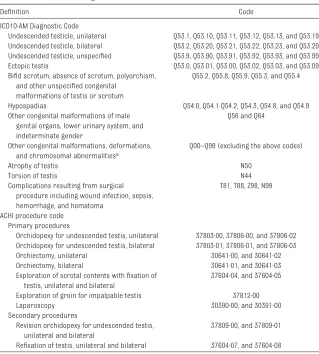
related ICD10-AM–coded diagnoses are presented in Table 1.
Study Outcomes and Data
The main study outcomes were primary surgical procedures, testicular atrophy, testicular torsion, procedures after failed orchidopexy, and readmissions for postsurgical wound-related complications. Primary surgical procedures were orchidopexy (including codes for fixation of testis) and orchiectomy. All surgical procedures were identified using ACHI procedure codes and are listed in Table 1. Procedures after failed orchidopexy included revisions of orchidopexy, refixation of testis, and repeat orchidopexy. We excluded repeat orchidopexy performed within 12 months after primary
orchidopexy for nonpalpable testis to avoid including routine second-stage orchidopexy.14 Postsurgical
complications were defined as hospital readmissions occurring within 28 days if caused by surgery-related wound infections or hematomas.
Study factors included timing of diagnosis, coexistent congenital anomalies, preterm birth (<37 weeks’ gestation), age at primary surgery, public or private health insurance status, area of residence, and socioeconomic disadvantage. Age at primary surgery and time at first recorded diagnosis were categorized into 6 groups: birth, <12, 12 to <18, 18 to <24, 24 to <36, and
≥36 months. The area of residence was dichotomized into major cities versus regional/remote areas using
the Accessibility/Remoteness Index of Australia,15 and socioeconomic
disadvantage was determined using the Socioeconomic Indexes for Areas relative disadvantage scores developed by the Australian Bureau of Statistics16 and classified as
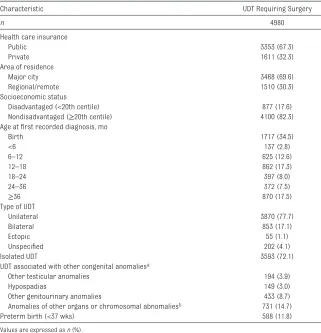
disadvantaged (<20th centile) versus nondisadvantaged (≥20th percentile) (Table 2).
Statistical Analysis
The proportion of UDTs diagnosed and the prevalence of surgery was examined as total number of reported cases per 1000 male births in NSW, 2001 to 2011. The trend in annual prevalence was evaluated including only boys with similar follow-up time, ie, born up to 2010 and with corrective surgery performed before 36 months of age. Descriptive statistics were calculated to assess characteristics of boys undergoing surgery, and association between study factors, procedures, and age at surgery were assessed by using χ2 tests and Cochran–Armitage
test for trend. Spearman coefficient was used to determine correlation between date of birth and date at surgery, and multivariate logistic regression was applied to examine the association between risk factors for primary corrective surgery performed before or later than the recommended 12 months of age.9,10
Characteristics of boys and age of subsequent surgery by timing of first recorded diagnosis (birth or later) was also investigated. A P value <.05 was considered statistically significant, and all analyses were performed by using SAS version 9.3 (SAS Institute, Cary, NC).
RESULTS
There were 518 846 boys born live in NSW from 2001 to 2011; of these, 10 875 (2.1%) had a recorded diagnosis of UDT. Overall, 4980 (45.7%) boys with a recorded diagnosis of UDT had
TABLE 1 Defi nitions and Diagnostic and Procedures Codes Related to UDT
Defi nition Code
ICD10-AM Diagnostic Code
Undescended testicle, unilateral Q53.1, Q53.10, Q53.11, Q53.12, Q53.13, and Q53.19 Undescended testicle, bilateral Q53.2, Q53.20, Q53.21, Q53.22, Q53.23, and Q53.29 Undescended testicle, unspecifi ed Q53.9, Q53.90, Q53.91, Q53.92, Q53.93, and Q53.99 Ectopic testis Q53.0, Q53.01, Q53.00, Q53.02, Q53.03, and Q53.09 Bifi d scrotum, absence of scrotum, polyorchism,
and other unspecifi ed congenital malformations of testis or scrotum
Q55.2, Q55.8, Q55.9, Q55.3, and Q55.4
Hypospadias Q54.0, Q54.1 Q54.2, Q54.3, Q54.8, and Q54.9
Other congenital malformations of male genital organs, lower urinary system, and indeterminate gender
Q56 and Q64
Other congenital malformations, deformations, and chromosomal abnormalitiesa
Q00–Q99 (excluding the above codes)
Atrophy of testis N50
Torsion of testis N44
Complications resulting from surgical procedure including wound infection, sepsis, hemorrhage, and hematoma
T81, T88, Z98, N99
ACHI procedure code Primary procedures
Orchidopexy for undescended testis, unilateral 37803-00, 37806-00, and 37806-02 Orchidopexy for undescended testis, bilateral 37803-01, 37806-01, and 37806-03
Orchiectomy, unilateral 30641-00, and 30641-02
Orchiectomy, bilateral 30641-01, and 30641-03
Exploration of scrotal contents with fi xation of testis, unilateral and bilateral
37604-04, and 37604-05
Exploration of groin for impalpable testis 37812-00
Laparoscopy 30390-00, and 30391-00
Secondary procedures
Revision orchidopexy for undescended testis, unilateral and bilateral
37809-00, and 37809-01
Refi xation of testis, unilateral and bilateral 37604-07, and 37604-08
corrective surgery (in 65 hospitals), representing a prevalence of 9.6 per 1000 male births. Of these, 80% (n = 3987) had surgery before 36 months of age, with the prevalence of these cases decreasing from 11.6 in 2001 to 7.8 per 1000 male births in 2010.
Of boys undergoing surgery, more than three-quarters (78%) had unilateral and 17% bilateral UDT, whereas 5% were either ectopic or unspecified. Most cases were isolated (72%), with 8.7% having other genitourinary anomalies and 14.7% anomalies of other organs. Although the majority of boys had an orchidopexy (97.8%), 589 (11.8%) required surgery for impalpable testis and 223 (4.5%) had an orchiectomy. As such, a small proportion of boys (n = 92, 1.8%) were diagnosed with testicular atrophy, and 58 (1.2%) had an
associated diagnosis of testicular torsion. Overall, 26 (0.5%) boys were readmitted to the hospital within 28 days after surgery with postprocedural complications. Almost 10% (n = 446) required revision procedures after 1 year for failed primary surgery, and of these, 16 (3.6%) had a recorded diagnosis of testicular atrophy.
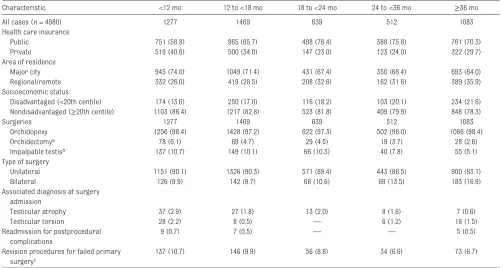
Among boys undergoing surgery, 78% were aged <36 months and 22% were >36 months (Table 3), with an overall median age at primary surgery of 16.6 months (interquartile range 11.8 to 31.0 months). As age of surgery increased, there was a decreasing trend in rates of orchiectomy and surgery for impalpable testis, unilateral UDT, and testicular atrophy (P < .01) but an increasing trend in surgery for bilateral UDT (P < .01) (Table 3).
For those with complete follow-up to 36 months (n = 3897), one-third had surgery at age <1 year and 54% at 12 to 24 months. The trend in the median age at surgery for these boys decreased from 14.7 months in 2001 to 12.7 months in 2010 (r
= −0.05; P < .01). Primary surgery was more likely to be performed after 12 months of age for boys from socioeconomically disadvantaged backgrounds (adjusted odds ratio [aOR] 1.37; 95% confidence interval [CI] 1.13–1.67) and living in regional/ remote areas (aOR 1.27; 95% CI 1.08–1.49), and less likely among boys from families with private health insurance (aOR 0.61; 95% CI 0.53–0.71). There was no association between preterm birth or coexistent congenital anomalies and surgery after 12 months of age.
When age at surgery was examined by timing of diagnosis, only one-third of boys (35%) had a recorded diagnosis of UDT at birth, with the remaining diagnosed in later health checks but first identified in this study at the time of surgery. Even for boys undergoing surgery at <12 months, less than half (44%) had UDT recorded at birth (Fig 1). However, there was no difference in the characteristics of boys and timing of reported diagnosis by socioeconomic or health insurance status, area of residence, preterm birth status, or type of surgery; those with other congenital anomalies were more likely to have UDT recorded at birth (Supplemental Table 4). For boys undergoing surgery after 36 months, 4.1% (n = 206 of 4980) had a recorded diagnosis at birth, and 18% (n = 877) did not.
DISCUSSION
This is one of the largest population-based cohort studies examining the diagnosis and treatment of UDT with long-term follow-up of ≤12 years. We found that >1 in 50 boys had a recorded diagnosis of UDT, and
TABLE 2 Infant Characteristics of Cases of UDT in NSW, 2001–2011
Characteristic UDT Requiring Surgery
n 4980
Health care insurance
Public 3353 (67.3)
Private 1611 (32.3)
Area of residence
Major city 3468 (69.6)
Regional/remote 1510 (30.3)
Socioeconomic status
Disadvantaged (<20th centile) 877 (17.6)
Nondisadvantaged (≥20th centile) 4100 (82.3)
Age at fi rst recorded diagnosis, mo
Birth 1717 (34.5)
<6 137 (2.8)
6–12 625 (12.6)
12–18 862 (17.3)
18–24 397 (8.0)
24–36 372 (7.5)
≥36 870 (17.5)
Type of UDT
Unilateral 3870 (77.7)
Bilateral 853 (17.1)
Ectopic 55 (1.1)
Unspecifi ed 202 (4.1)
Isolated UDT 3593 (72.1)
UDT associated with other congenital anomaliesa
Other testicular anomalies 194 (3.9)
Hypospadias 149 (3.0)
Other genitourinary anomalies 433 (8.7)
Anomalies of other organs or chromosomal abnomaliesb 731 (14.7)
Preterm birth (<37 wks) 588 (11.8)
Values are expressed as n (%).
a Not mutually exclusive.
the prevalence of boys undergoing surgery was 1% in NSW. Both the prevalence and the age at surgery decreased over the past decade; however, nearly two-thirds of cases still underwent surgery later than the recommended age of 12 months. We also found that almost 1 in 10 boys required subsequent revision.
The proportion of UDTs diagnosed at birth (1.9%) and those subsequently treated (1%) in NSW is similar to that published by a recent Danish population-based study.17 We found
a decrease in prevalence of treated UDT over the past decade, which appears consistent with worldwide reported trends in Germany, New Zealand, Norway, and Russia18 and
the Australian states of Victoria and Western Australia.19,20
To our knowledge, this is the first population-based study (n = 4980, 65 sites) reporting rates for testicular atrophy (1.8%), torsion (1.2%), and subsequent outcomes
of orchidopexy, with 9% of patients requiring revision surgery and a rate of testicular atrophy at second surgery of 3.6%. To date, the only other published multicenter study (10 sites, n = 281 patients) reported
overall 7.2% and 6.1% rates of failure and atrophy, respectively, in patients undergoing laparoscopic orchidopexy.21
We found that at least two-thirds of corrective surgeries for UDT were
TABLE 3 Characteristics of Treated UDT by Age at Surgery in NSW, 2001–2011
Characteristic <12 mo 12 to <18 mo 18 to <24 mo 24 to <36 mo ≥36 mo
All cases (n = 4980) 1277 1469 639 512 1083
Health care insurance
Public 751 (58.8) 965 (65.7) 488 (76.4) 388 (75.8) 761 (70.3)
Private 519 (40.6) 500 (34.0) 147 (23.0) 123 (24.0) 322 (29.7)
Area of residence
Major city 945 (74.0) 1049 (71.4) 431 (67.4) 350 (68.4) 693 (64.0)
Regional/remote 332 (26.0) 419 (28.5) 208 (32.6) 162 (31.6) 389 (35.9)
Socioeconomic status
Disadvantaged (<20th centile) 174 (13.6) 250 (17.0) 116 (18.2) 103 (20.1) 234 (21.6)
Nondisadvantaged (≥20th centile) 1103 (86.4) 1217 (82.8) 523 (81.8) 409 (79.9) 848 (78.3)
Surgeries 1277 1469 639 512 1083
Orchidopexy 1256 (98.4) 1428 (97.2) 622 (97.3) 502 (98.0) 1066 (98.4)
Orchidectomya 78 (6.1) 69 (4.7) 29 (4.5) 19 (3.7) 28 (2.6)
Impalpable testisb 137 (10.7) 149 (10.1) 66 (10.3) 40 (7.8) 55 (5.1)
Type of surgery
Unilateral 1151 (90.1) 1326 (90.3) 571 (89.4) 443 (86.5) 900 (83.1)
Bilateral 126 (9.9) 142 (9.7) 68 (10.6) 69 (13.5) 183 (16.9)
Associated diagnosis at surgery admission
Testicular atrophy 37 (2.9) 27 (1.8) 13 (2.0) 8 (1.6) 7 (0.6)
Testicular torsion 28 (2.2) 8 (0.5) — 6 (1.2) 16 (1.5)
Readmission for postprocedural complications
9 (0.7) 7 (0.5) — — 5 (0.5)
Revision procedures for failed primary surgeryc
137 (10.7) 146 (9.9) 56 (8.8) 34 (6.6) 73 (6.7)
Values are expressed as n (%).
a Some simultaneous orchidopexy and orchiectomy. - Numbers <5 not presented. b Includes record of surgical exploration of groin or laparoscopy.
c Including subsequent revision of orchidopexy, refi xation of testis, or repeat orchidopexy.
FIGURE 1
performed later than recommended guidelines. This is of concern, as late orchidopexy may be associated with increased risk of testicular cancer and diminished fertility potential in boys.22–26 Two recent systematic
reviews reported a 2- to 32-fold increased risk of testicular cancer in men with a history of UDT, with the risk lower for younger age at orchidopexy but higher for previous bilateral UDT.8,27 Such findings have
prompted a significant reduction in the recommended age to perform orchidopexy in the past decades, to its current 12 months of age.28
Although we found an encouraging trend of decreasing age at surgery, consistent with recent reports from different settings,11,29 the current
rates of late surgery are particularly concerning, especially for those with bilateral UDT. We found that the overall proportion of primary surgery performed after 12 months was 74%. But, when limited to complete follow-up of 36 months, it was 67%. Two studies that were limited to congenital cases have reported 70% to 82% of cases having surgery after 12 months.11,30 Other
studies have also reported a high proportion of orchidopexy performed later than the recommended age, but most potentially included cases of acquired UDT, which are diagnosed and treated at later ages.11 To date, there are no current
Australian guidelines that specify the importance of the timing of early surgery.
One of the motivations of our study was to try and differentiate congenital from late diagnosed and potentially acquired cases. Although we had information on recorded diagnosis at birth, we found identification of congenital cases to be difficult because of the underreporting of cases at birth (only 35%) and a majority reported at time of surgery, with no information on previous testis position. Our findings suggest that the characteristics of
boys undergoing surgery before 36 months of age without diagnosis at birth are similar to those diagnosed at birth and may potentially be congenital cases. The 18% having surgery after 36 months (without a recorded UDT diagnosis at birth) may be more likely to be acquired cases. A previous longitudinal cohort study (n = 1072) with examination of testicular position at 0, 3, 18, 36, and 54 months of age reported an 18% rate of acquired UDT31; however,
the proportion of acquired UDT may have been overestimated because of a 45% loss of follow-up.
Strategies to reduce the age at orchidopexy require the identification of factors that may delay surgery. These may involve missed diagnosis at birth, delays in follow-up by parents, missed diagnosis or lack of timely referral by general practitioners, or limited availability of hospital resources to conduct surgery.32,33 Missed
diagnosis at birth may have occurred because infants were not examined or UDT was missed owing to a lack of experience or training of maternity care providers. Previous studies reveal that when examination is performed by trained experts, the prevalence of UDT detected at birth is higher, as reported in cohorts from Denmark (9%)2 and Lithuania
(5.4%),34 compared with the 2.1%
reported here. After birth, delays in diagnosis may also occur and be due to lack of parental awareness or limited attendance to routine health visits in the child’s first year of life. Lack of assessment, follow-up, or timely referral by general practitioners may also be a contributing factor. Thus, adherence to monitoring during routine health checks is essential to ensure timely intervention. This is particularly important because testicular position may vary in early life.
Given that interventions providing advice to general practitioners and parents in the UK have been
shown to be effective at reducing age at orchidopexy,35 our results
suggest that these may need to be implemented for future improvements in practice in Australia. This necessity is further confirmed by results from a recent survey reporting that 75% of UK general practitioners still consider 2 years to be the optimal age for performing orchidopexy.36 Another
potential influence on the age at surgery remains the limited capacity and availability of NSW hospitals to perform orchidopexy before 1 year of age, with NSW health policy considering this a major surgical procedure to be performed only by surgeons credentialed in pediatric surgery, and with specialist anesthetists involved.37
Given more urgent cases and limited resources, delays in surgery may occur in the public hospital system. Therefore, increasing availability and access to surgery in more NSW hospitals would reduce demand and redistribute the burden and access to surgery.38 One alternative is for
surgery to be undertaken in private hospitals, which do not have the same demands on limited resources. In Australia, patients without private health insurance are treated in the public health system and placed on a waiting list, which is determined by urgency, whereas those with private health insurance are managed more immediately according to the availability of the pediatric surgeon. This issue is supported by our findings that boys with private health insurance had earlier primary surgery, compared with those publicly insured and those from lower socioeconomic background or living in rural areas.
reliable, with validation studies reporting high levels of agreement with medical records39 and
congenital anomaly registers.40 One
limitation of our study was that 65% of cases undergoing surgery did not have a recorded UDT diagnosis at birth, and we did not have
information as to whether these were missed diagnoses at birth, delayed diagnoses, or acquired cases. To overcome this issue, we categorized cases according to the time of the first recorded diagnosis of UDT and age at surgery to identify potential cases of acquired UDT. Another limitation was that we could not stratify our analysis by the presurgical position of the testis (canalicular/inguinal/ intraabdominal), the surgical approach of orchidopexy (inguinal canal/abdominal cavity), or the type of surgery (single-stage versus staged Fowler–Stephens orchidopexy). Although there are ICD-10-AM codes to identify the position of the undescended testis and ACHI codes for the surgical approach, we were
unable to report these because a majority of records had unspecified information. Therefore, our results for testicular atrophy, testicular torsion, and outcomes after surgery represent overall rates and may not correspond to a specific case-mix or type of corrective surgery.
CONCLUSIONS
In conclusion, 1 in 48 boys is born with UDT; however, two thirds of cases had no report of corrective surgery. The prevalence of treated UDT was 1%, with almost 1 in 10 requiring subsequent revision. The median age at surgery is decreasing; however, two-thirds of cases were still performed after the recommended age of 12 months. Further interventions are needed to improve detection of UDT at birth and increase understanding of the diagnosis by parents and management of UDT by primary health care providers. Importantly, the significance of early diagnosis and
surgical correction before 12 months of age should be implemented in Australian guidelines, and changes should be made in health policy to increase health care resources to perform surgery at earlier ages.
ACKNOWLEDGMENTS
The authors thank the NSW Ministry of Health for access to the population health data and the NSW Centre for Health Record Linkage for record linkage.
REFERENCES
1. Ghirri P, Ciulli C, Vuerich M, et al. Incidence at birth and natural history of cryptorchidism: a study of 10,730 consecutive male infants. J Endocrinol Invest. 2002;25(8):709–715
2. Boisen KA, Kaleva M, Main KM, et al. Difference in prevalence of congenital cryptorchidism in infants between two Nordic countries. Lancet. 2004;363(9417):1264–1269
3. Hack WW, Goede J, van der Voort-Doedens LM, Meijer RW. Acquired undescended testis: putting the pieces together. Int J Androl. 2012;35(1):41–45
4. Yiee JH, Saigal CS, Lai J, Copp HL, Churchill BM, Litwin MS; Urologic Diseases in America Project. Timing of orchiopexy in the United States:
a quality-of-care indicator. Urology. 2012;80(5):1121–1126
5. Taran I, Elder JS. Results of orchiopexy for the undescended testis. World J Urol. 2006;24(3):231–239
6. Lip SZ, Murchison LE, Cullis PS, Govan L, Carachi R. A meta-analysis of the risk of boys with isolated cryptorchidism developing testicular cancer in later life. Arch Dis Child. 2013;98(1):20–26
7. Ong C, Hasthorpe S, Hutson JM. Germ cell development in the descended and cryptorchid testis and the effects of hormonal manipulation. Pediatr Surg Int. 2005;21(4):240–254
8. Chan E, Wayne C, Nasr A; FRCSC for Canadian Association of Pediatric
Surgeon Evidence-Based Resource. Ideal timing of orchiopexy: a systematic review. Pediatr Surg Int. 2014;30(1):87–97
9. Kolon TF, Herndon CD, Baker LA, et al; American Urological Assocation. Evaluation and treatment of cryptorchidism: AUA guideline. J Urol. 2014;192(2):337–345
10. European Association of Urology. Guidelines of Pediatric Urology. Available at uroweb. org/ wp- content/ uploads/ 22- Paediatric- Urology. pdf. Accessed November 2014
11. Hrivatakis G, Astfalk W, Schmidt A, et al. The timing of surgery for undescended testis: a retrospective ABBREVIATIONS
ACHI: Australian Classification of Health Interventions aOR: adjusted odds ratio CI: confidence interval ICD10-AM: International
Classification of Diseases, 10th Revision, Australian Modification
NSW: New South Wales UDT: undescended testis
FINANCIAL DISCLOSURE: The authors have indicated they have no fi nancial relationships relevant to this article to disclose.
FUNDING: Supported by the National Health and Medical Research Council (NHMRC) grant #1047263. Dr Nassar is supported by NHMRC Career Development Fellowship #632955. Dr Pereira is supported by NHMRC Early Career Fellowship (Sidney Sax) #1052236. Dr Bower is supported by NHMRC Principal Research Fellowship #634341.
multicenter analysis. Dtsch Arztebl Int. 2014;111(39):649–657
12. Cortes D, Thorup JM, Visfeldt J. Cryptorchidism: aspects of fertility and neoplasms. A study including data of 1,335 consecutive boys who underwent testicular biopsy simultaneously with surgery for cryptorchidism. Horm Res. 2001;55(1):21–27
13. Australian Bureau of Statistics. Health Care Delivery and Financing. Available at http:// www. abs. gov. au/ ausstats/ abs@. nsf/ Lookup/ by Subject/1301.0~2012~Main Features~Health car. Accessed November 2014
14. Ransley PG, Vordermark JS, Caldamone AA, Bellinger MF. Preliminary ligation of the gonadal vessels prior to orchidopexy for the intra-abdominal testicle: a staged Fowler-Stephens procedure. World J Urol. 1984;2(4):266–268
15. Australian Government Department of Health. Measuring Remoteness: Accessibility/Remoteness Index of Australia (ARIA). Available at http:// www. health. gov. au/ internet/ main/ publishing. nsf/ Content/ health- historicpubs- hfsocc- ocpanew14a.. Accessed November 2014
16. Australian Bureau of Statistics. Census of Population and Housing: Socio-Economic Indexes for Areas (SEIFA). Available at www. abs. gov. au/ websitedbs/ censushome. nsf/ home/ seifa. Accessed November 2014
17. Jensen MS, Olsen LH, Thulstrup AM, Bonde JP, Olsen J, Henriksen TB. Age at cryptorchidism diagnosis and orchiopexy in Denmark: a population based study of 508,964 boys born from 1995 to 2009. J Urol. 2011;186(4 Suppl):1595–1600
18. International Clearinghouse for Birth Defects Surveillance and Research. Annual Report (with data for 2009). Available at www. icbdsr. org/ fi lebank/ documents/ ar2005/ Report2011. pdf. Accessed November 2014
19. Bonney T, Southwell B, Donnath S, Newgreen D, Hutson J. Orchidopexy trends in the paediatric population of Victoria, 1999-2006. J Pediatr Surg. 2009;44(2):427–431
20. Western Australian Register of Developmental Anomalies (WARDA). Report of the Western Australian Register of Developmental Anomalies 1980-2013. Available at www. kemh. health. wa. gov. au/ services/ register_ developmental_ anomalies/ documents/ 2014_ Annual_ Report_ of_ the_ WA_ Register_ of_ Developmental_ Abnormalities. pdf. Accessed November 2014
21. Baker LA, Docimo SG, Surer I, et al. A multi-institutional analysis of laparoscopic orchidopexy. BJU Int. 2001;87(6):484–489
22. Carson JS, Cusick R, Mercer A, et al. Undescended testes: does age at orchiopexy affect survival of the testis? J Pediatr Surg. 2014;49(5):770–773
23. Banks K, Tuazon E, Berhane K, et al. Cryptorchidism and testicular germ cell tumors: comprehensive meta-analysis reveals that association between these conditions diminished over time and is modifi ed by clinical characteristics. Front Endocrinol (Lausanne). 2012;8(3):182
24. Feyles F, Peiretti V, Mussa A, et al. Improved sperm count and motility in young men surgically treated for cryptorchidism in the fi rst year of life. Eur J Pediatr Surg. 2014;24(5):376–380
25. Kollin C, Karpe B, Hesser U, Granholm T, Ritzén EM. Surgical treatment of unilaterally undescended testes: testicular growth after randomization to orchiopexy at age 9 months or 3 years. J Urol. 2007;178(4 Pt 2):1589– 1593, discussion 1593
26. Trsinar B, Muravec UR. Fertility potential after unilateral and bilateral orchidopexy for cryptorchidism. World J Urol. 2009;27(4):513–519
27. Lee PA, Coughlin MT. Fertility after bilateral cryptorchidism. Evaluation by paternity, hormone, and semen data. Horm Res. 2001;55(1):28–32
28. Barthold JS, González R. The epidemiology of congenital cryptorchidism, testicular ascent and orchiopexy. J Urol. 2003;170(6 Pt 1):2396–2401
29. Springer A, Subramaniam R, Krall C, Fülöp G. Orchidopexy patterns in Austria from 1993 to 2009. J Pediatr Urol. 2013;9(5):535–541
30. Nah SA, Yeo CS, How GY, et al. Undescended testis: 513 patients’ characteristics, age at orchidopexy and patterns of referral. Arch Dis Child. 2014;99(5):401–406
31. Wohlfahrt-Veje C, Boisen KA, Boas M, et al. Acquired cryptorchidism is frequent in infancy and childhood. Int J Androl. 2009;32(4):423–428
32. Beasley SW. Are changes in referral patterns always justifi ed? ANZ J Surg. 2012;82(9):572–573
33. Wilson BE, Cheney L, Patel B, Holland AJ. Appendicectomy at a children’s hospital: what has changed over a decade? ANZ J Surg. 2012;82(9):639–643
34. Preiksa RT, Zilaitiene B, Matulevicius V, et al. Higher than expected prevalence of congenital cryptorchidism in Lithuania: a study of 1204 boys at birth and 1 year follow-up. Hum Reprod. 2005;20(7):1928–1932
35. Brown JJ, Wacogne I, Fleckney S, Jones L, Ni Bhrolchain C. Achieving early surgery for undescended testes: quality improvement through a multifaceted approach to guideline implementation. Child Care Health Dev. 2004;30(2):97–102
36. Bradshaw CJ, Corbet-Burcher G, Hitchcock R. Age at orchidopexy in the UK: has new evidence changed practice? J Pediatr Urol. 2014;10(4):758–762
37. NSW Government Health. Guide to the Role Delineation of Health Services. Third edition. Available at www. health. nsw. gov. au/ services/ Publications/ guide- role- delineation- health- services. pdf. Accessed November 2014
38. Bruijnen CJ, Vogels HD, Beasley SW. Age at orchidopexy as an indicator of the quality of regional child health services. J Paediatr Child Health. 2012;48(7):556–559
39. Lain SJ, Hadfi eld RM, Raynes-Greenow CH, et al. Quality of data in perinatal population health databases: a systematic review. Med Care. 2012;50(4):e7–e20
DOI: 10.1542/peds.2015-2768 originally published online January 22, 2016;
2016;137;
Pediatrics
Carol Bower and Natasha Nassar
Francisco Javier Schneuer, Andrew J.A. Holland, Gavin Pereira, Sarra Jamieson,
Age at Surgery and Outcomes of an Undescended Testis
Services
Updated Information &
http://pediatrics.aappublications.org/content/137/2/e20152768
including high resolution figures, can be found at:
References
http://pediatrics.aappublications.org/content/137/2/e20152768#BIBL
This article cites 33 articles, 2 of which you can access for free at:
Subspecialty Collections
s_sub
http://www.aappublications.org/cgi/collection/genitourinary_disorder Genitourinary Disorders
http://www.aappublications.org/cgi/collection/urology_sub Urology
http://www.aappublications.org/cgi/collection/birth_defects_sub Birth Defects
sub
http://www.aappublications.org/cgi/collection/fetus:newborn_infant_ Fetus/Newborn Infant
following collection(s):
This article, along with others on similar topics, appears in the
Permissions & Licensing
http://www.aappublications.org/site/misc/Permissions.xhtml
in its entirety can be found online at:
Information about reproducing this article in parts (figures, tables) or
Reprints
http://www.aappublications.org/site/misc/reprints.xhtml
DOI: 10.1542/peds.2015-2768 originally published online January 22, 2016;
2016;137;
Pediatrics
Carol Bower and Natasha Nassar
Francisco Javier Schneuer, Andrew J.A. Holland, Gavin Pereira, Sarra Jamieson,
Age at Surgery and Outcomes of an Undescended Testis
http://pediatrics.aappublications.org/content/137/2/e20152768
located on the World Wide Web at:
The online version of this article, along with updated information and services, is
http://pediatrics.aappublications.org/content/suppl/2016/01/20/peds.2015-2768.DCSupplemental
Data Supplement at:
by the American Academy of Pediatrics. All rights reserved. Print ISSN: 1073-0397.