Decrease of Invasive Pneumococcal Infections in Children Among
8 Children’s Hospitals in the United States After the Introduction of the
7-Valent Pneumococcal Conjugate Vaccine
Sheldon L. Kaplan, MD*; Edward O Mason, Jr, PhD*; Ellen R. Wald, MD‡; Gordon E. Schutze, MD§; John S. Bradley, MD储; Tina Q. Tan, MD¶; Jill A. Hoffman, MD#; Laurence B. Givner, MD**;
Ram Yogev, MD¶; and William J. Barson, MD‡‡
ABSTRACT. Objective. To monitor clinical and mi-crobiologic features including antimicrobial susceptibil-ity and serogroup distribution of invasive infections caused byStreptococcus pneumoniaeamong children be-fore and after the introduction of routine administration of the 7-valent pneumococcal conjugate vaccine (PCV7). Design. A 9-year (January 1, 1994 through December 31, 2002) prospective surveillance study of all invasive pneumococcal infections in children.
Patients. Infants and children cared for at 8 chil-dren’s hospitals in the United States with culture-proven invasive infections caused byS pneumoniae.
Results. When compared with the mean of the years 1994 to 2000, the annual number of invasive pneumococ-cal infections for children<24 months of age declined 58% in 2001 and 66% in 2002. If only the serogroups in the PCV7 are considered, the number of cases in children <24 months old declined 63% and 77% in 2001 and 2002, respectively. The greatest decrease was observed for se-rogroup-14 isolates. The number of isolates in nonvac-cine serogroups increased 28% in 2001 and 66% in 2002 for children <24 months old. Nonvaccine serogroup-15 and -33 isolates had the greatest increase in number. The proportion of all isolates nonsusceptible to penicillin increased yearly from 1994 to 2000, reached a plateau in 2001 at 45%, and declined to 33% in 2002. Decrease in nonsusceptibility to penicillin occurred entirely in the isolates with penicillin minimum inhibitory concentra-tion>2g/mL. Nonsusceptibility to penicillin increased slightly among nonvaccine-serotype isolates. Most infec-tions after at least 2 doses of PCV7 were caused by nonvaccine-serotype isolates.
Conclusions. Since the introduction of the PCV7, the number of invasive pneumococcal infections caused by vaccine-serogroup isolates among 8 US children’s
hospi-tals has decreased >75% among children <24 months old. In addition, penicillin resistance decreased in 2002 for the first time since our surveillance began in 1993– 1994. However, we have noted that replacement may be developing with serogroups 15 and 33. Furthermore, pen-icillin resistance seems to be increasing among nonvac-cine serogroups. Surveillance must be continued to de-tect the emergence of changes in the distribution of serotypes as well as antibiotic susceptibility.Pediatrics 2004;113:443– 449; Streptococcus pneumoniae, conjugate vaccine, surveillance.
ABBREVIATIONS. PCV7, 7-valent pneumococcal conjugate vac-cine; CDC, Centers for Disease Control and Prevention; ABC, Active Bacterial Core; HIV, human immunodeficiency virus.
I
n the United States, Streptococcus pneumoniaehas long been the most common organism associated with bacteremia and bacterial pneumonia in chil-dren. It became the most common cause of bacterial meningitis in children⬍2 years of age after the Hae-mophilus influenzaetype b conjugate vaccine was in-troduced for universal administration to infants.1,2The 7-valent pneumococcal conjugate vaccine (PCV7) contains the 7 most common pneumococcal serotypes causing invasive infections in children in North America. These 7 serotypes also are the most likely to be resistant to antimicrobials. PCV7 was licensed in February 2000 in the United States for routine administration to young infants and children based on the large efficacy study conducted in north-ern California that demonstrated an estimated 97% efficacy of PCV7 for preventing invasive pneumococ-cal infection caused by the 7 serotypes included in the vaccine.3
Surveillance in the northern California Kaiser Per-manente population postlicensure of PCV7 found the incidence of invasive disease caused by serotypes of pneumococci contained in the vaccine to have de-clined from a range of 51.5 to 98.2 cases per 100 000 person-years to 9.4 cases per 100 000 person-years for children⬍1 year old.4For children⬍2 years old, the
incidence decreased from between 81.7 and 113.8 cases per 100 000 person-years to 38 cases per 100 000 person-years. This corresponds to an 87% and 58% reduction in disease caused by vaccine serotypes in the⬍1- and⬍2-year-old age groups, respectively.
The Centers for Disease Control and Prevention From the *Pediatric Infectious Diseases Sections of the Baylor College of
Medicine, Houston, Texas; ‡University of Pittsburgh School of Medicine, Pittsburgh, Pennsylvania; §University of Arkansas for Medical Sciences, Little Rock, Arkansas;储Children’s Hospital San Diego, San Diego, Califor-nia; ¶Northwestern University Medical School, Chicago, Illinois; #Univer-sity of Southern California School of Medicine, Los Angeles, California; **Wake Forest University School of Medicine, Winston-Salem, North Caro-lina; and ‡‡Ohio State University College of Medicine and Public Health, Columbus, Ohio.
Received for publication Sep 15, 2003; accepted Nov 6, 2003.
Dr Kaplan has received honoraria from Wyeth Laboratories or their vendor for Satellite Vaccine Symposia presented at the American Academy of Pediatrics Meetings within the past 3 years.
Address correspondence to Sheldon L. Kaplan, MD, Texas Children’s Hospital, 6621 Fannin MC 3–2371, Houston, TX 77030. E-mail: skaplan@ bcm.tmc.edu
(CDC) track invasive pneumococcal infections in 12 states in the national Active Bacterial Core (ABC) surveillance. Whitney et al5 reported that, when
compared with the years before licensure of PCV7, the number of cases of invasive pneumococcal infec-tions in children⬍24 months old were reduced sig-nificantly in 2001. In addition, the absolute number of infections caused by penicillin-nonsusceptible iso-lates declined significantly, although a reduction in the proportion of penicillin-nonsusceptible isolates had not yet occurred.
The US Pediatric Multicenter Pneumococcal Sur-veillance Group has been monitoring invasive pneu-mococcal infections since September 1993.6 We
re-port our findings for the years 1994 –2000 (prevaccine) compared with the years 2001 and 2002, when the PCV7 was generally available to the pop-ulation of children served by these hospitals.
METHODS
The US Pediatric Multicenter Pneumococcal Surveillance Group consists of investigators from 8 children’s hospitals who have been identifying children prospectively treated as inpatients or outpatients at their centers for invasive infections caused byS pneumoniae. The dates of surveillance for this report include the 9-year period from January 1, 1994 through December 31, 2002. Systemic infections were documented by positive cultures from a normally sterile site (blood, cerebrospinal fluid, pleural fluid, sy-novial fluid, peritoneal fluid, etc). A chest radiograph showing pulmonary infiltrates in addition to a positive culture from blood, pleural fluid, or lung was required for the diagnosis of pneumo-coccal pneumonia. For children with mastoiditis, isolates were obtained from either middle-ear fluid or mastoid bone. Demo-graphic and clinical information including antibiotics adminis-tered within 30 days before the invasive infection occurred was collected retrospectively and recorded on a standard case-report form for each episode of infection. Documentation of administra-tion of PCV7 was sought after February 2000.
The database was maintained in a central office (Baylor College of Medicine, Houston, TX). All pneumococcal isolates were iden-tified by standard methods in the microbiology laboratories of each hospital and then sent to a central laboratory (Infectious Disease Research Laboratory, Texas Children’s Hospital, Houston, TX). Antimicrobial susceptibility testing for penicillin and ceftri-axone was performed by standard microbroth dilution with Mueller-Hinton media supplemented with 3% lysed horse blood. Susceptibility categories were “susceptible,” “intermediate,” or “resistant” as defined for penicillin or ceftriaxone by the 2003 National Committee for Clinical Laboratory Standards.7For
ceftri-axone, susceptibility categories were based on the site of infection, ie, meningitis versus a non– central nervous system infection. Iso-lates in the intermediate or resistant categories were considered together as nonsusceptible. Penicillin and ceftriaxone susceptibil-ity results from the hospital microbiology laboratories of the in-dividual investigators were used for 109 isolates unavailable for susceptibility testing in the central laboratory. The antibiotic-sus-ceptibility testing for 6 isolates was not performed. Isolates were serotyped or serogrouped by the capsular swelling method using commercially available antisera (Statens Seruminstitut, Copenha-gen, Denmark; Daco, Inc, Carpinteria, CA).6For purposes of
anal-ysis, all isolates in a vaccine serogroup are included as a vaccine serotype.
Dichotomous variables were analyzed by using the2test or2
test for trend. True Epistat (Epistat [Sigma] Services, Richardson, TX) was the statistical program used.
RESULTS Decline in Invasive Infections
The mean number of invasive infections occurring from 1994 to 2000 has been compared with the years 2001 and 2002 for most of the analyses. For children
ⱕ24 months old, the overall number of invasive pneumococcal infections declined 58% in 2001 and 66% in 2002, when compared with the mean of the years 1994 –2000 (Fig 1). If only the serogroups in the PCV7 are considered, the number of cases in children
ⱕ24 months old declined 63% and 77% in 2001 and 2002, respectively. As expected, the overall decline of cases in children⬎24 months old was substantially less: 36% in 2001 and 38% in 2002. Over the 9-year period, the number of cases in the ⱕ24-month-old group declined significantly when compared with the number of cases occurring in children ⬎24 months old (P⫽.000005). Using the number of cases among 4-year-olds each year as the baseline value, the number of cases for children ⬍12 months old (P ⫽ .0068), 12 to 24 months old (P ⫽ .0024), and those ⬎24 to 36 months old (P ⫽ .0084) decreased significantly over the 9 years of the study. The num-ber of cases of invasive disease caused by S pneu-moniaeby age group is shown in Fig 2. There was no substantial decline in the number of cases of invasive pneumococcal disease observed in children 3 and 4 years old, compared with baseline.
Fig 1. The number of pneumococcal isolates associated with
in-vasive infections per year among 8 children’s hospitals for cases based on age⬍or⬎24 months old and for serotypes contained or not contained in the PCV7 (1994 –2002).
Fig 2. The number of pneumococcal isolates by age associated
Increase in Infections Due to Serogroups of S pneumoniaeNot in PCV7
Before the licensure of PCV7, nonvaccine sero-groups accounted for 6.0%, on average, of the iso-lates recovered from children ⱕ24 months old. In 2002, nonvaccine-serogroup isolates were 37.6% of the total isolates (35 of 93) in this age group. The number of isolates in nonvaccine serogroups among childrenⱕ24 months old increased 28% in 2001 and 66% in 2002, but this still accounted for only 35 isolates in 2002.
Decline in Cases by Site of Infection
When considered by the site of infection, the great-est reduction in 2002 was observed for bacteremia alone (66%), followed by meningitis (56%) and pneu-monia (39%). The differences in the rate of decline among these 3 sites were not significant by trend analysis when compared with each other (Fig 3). When other sites of infection (peritonitis, bone and joint, cellulitis, and other) are combined there was a 25% decline in 2001 and a 50% decline in 2002. In the years 1994 –2000, the average number of cases of mastoiditis per year was 7.4, and in all but 1 year, at least 5 cases were identified (range: 1–12 per year). There were 9 cases of mastoiditis in 2001 and 1 case in 2002. Comparable declines in invasive cases oc-curred in all 8 centers and in children of white, African American, and Hispanic ethnicities. The pro-portion of children with underlying conditions did
not change in the years 2001 (29%) and 2002 (36%), compared with the previous 7 years (28%–36%).
Antibiotic Susceptibilities
Between 1994 and 2000, the proportion of invasive pneumococcal isolates that were nonsusceptible to penicillin increased each year and reached 44% in 2000. In 2001, 45% of isolates were nonsusceptible to penicillin; the rate declined to 33% in 2002 (P⫽.018 for 2001 vs 2002) (Fig 4). Furthermore, the decline in the penicillin-nonsusceptible isolates occurred al-most entirely among the isolates resistant to penicil-lin (minimum inhibitory concentrationⱖ2g/mL), with a 46% decrease in 2002 (13% penicillin resistant) compared with the rate in 2001 (24% penicillin-resis-tant). A similar pattern for decline in nonsusceptibil-ity to ceftriaxone was observed; the proportion of isolates nonsusceptible to ceftriaxone was 4% in 2000, 6% in 2001, and 3% in 2002.
Among the isolates of S pneumoniaebelonging to the serogroups contained in PCV7, the proportion that were nonsusceptible to penicillin increased yearly from 17% in 1994 to 54% in 2001. However, this proportion declined to 43% in 2002 (a 20% re-duction). In contrast, among isolates ofS pneumoniae with serogroups not contained in PCV7, the propor-tion nonsusceptible to penicillin varied from a low of zero in 1994 to a peak of 16% in 1996 and 1997 and then was between 6% and 12% through 2000. In 2001 and 2002, the proportions were 13% and 15%,
respec-Fig 3. The number of pneumococcal
isolates per year associated with spe-cific sites of infection among 8 chil-dren’s hospitals (other category in-cludes bone and joint infections, cellulitis, peritonitis, and other sites) (1994 –2002).
Fig 4. Susceptibilities of penicillin and ceftriaxone
tively. The proportion of children who had received an antibiotic in the 30 days before invasive pneumo-coccal disease did not change in 2001 (32%) or 2002 (35%), compared with the years 1994 –2000 (28%– 33%).
Changes in the Prevalence of Specific Serogroups Among the vaccine serogroups, the greatest de-cline occurred for serogroup-14 isolates: 65% in 2001 and 89% in 2002 (Table 1). The least decline was observed for serogroup-19 isolates: 19% in 2001 and 31% in 2002. The decline in the number of isolates among the other serogroups in the PVC7 ranged from 60% to 81% in 2002, compared with the years 1994 to 2000.
The numbers of non-PCV7 serogroup isolates for 1994 –2002 are shown in Table 2. The average num-ber of nonvaccine-serogroup isolates (including those that could not be serogrouped) for the years 1994 –2000 was 49 (range: 33– 68 per year). In 2001, the number of nonvaccine-serogroup isolates was 48; this increased by 37% to 67 in 2002. Although the numbers are small, the major contributors to the increase in nonvaccine-serogroup isolates were sero-groups 15 and 33. The total number of serotype-15 isolates encountered from 1994 to 2000 was 34 (mean: 5 per year; range: 2–7 isolates per year). In 2002, 14 serogroup-15 isolates were identified. A total of 5 isolates were serogroup 33 for the years 1994 –2000, but 11 such isolates occurred in 2002 (P⫽.003). The average number of serotype-3 isolates was 6 per year (range: 2–10), but in 2002, 12 serotype-3 isolates were encountered. Similar increases were not evident for other non-PCV7 serogroups.
Breakthrough Infections
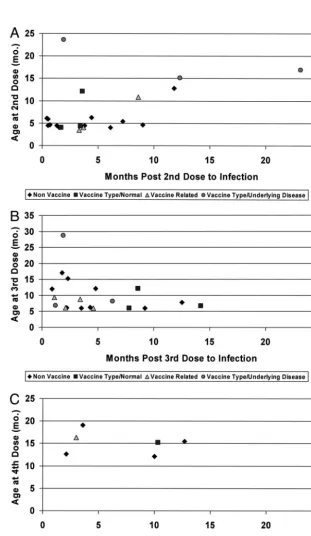
Forty-seven children developed invasive pneumo-coccal infection after having receivedⱖ2 doses of the PCV7; 21 occurred after 2 doses, 20 after 3 doses, and 6 after 4 doses. Underlying conditions were identi-fied in 14 children including hemoglobinopathy (3), congenital heart disease (3), human immunodefi-ciency virus (HIV) (2), 1 each with malignancy, ge-netic defect, or central nervous system defect, and 3 with other conditions. The remaining 33 children were considered normal, but a formal immunologic evaluation was not part of the study; thus, subtle immunologic abnormalities may not have been rec-ognized. One child with HIV infection developed 2 invasive infections after 2 doses and a third episode
6 days after the third dose. The most common sites of infection were bacteremia (n⫽ 27), meningitis (n⫽ 6), and pneumonia (n ⫽ 6). Among the 49 invasive isolates, 13 isolates (27%) were among the PCV7 serotypes (19F [6], 6B including 1 with mastoiditis [6], and 23F [1]). An additional 8 isolates were vac-cine-related serotypes (19A [5], 6A [2], and 23B [1]). The majority of isolates were non-PCV7 serotypes (15 [7], 33 [5], 7 [2], 10 [2], 11 [2], 38 [2], 1 [1], 3 including 1 with mastoiditis [2], 12 [1], 22 [1], pool G [1], and 2 could not be typed).
The age of the patients at the time of the PCV7 dose after which the invasive infection occurred, the time after the PCV7 dose that the infection occurred, and host and serotype status are shown in Fig 5. Six invasive infections were recognized after 4 doses of the PCV7; only 1 presumably normal child had a vaccine-serotype isolate.
The number of deaths (percentage) of children who died in association with an invasive pneumo-coccal infection had a range from 5 to 8 (1.2%–1.6%) per year, respectively, for the years 1994 –1998 but increased to 13 for both 1999 (2.9%) and 2000 (3.3%). Five deaths occurred in both 2001 (2.3%) and 2002 (2.6%).
DISCUSSION
The number of invasive infections caused by S pneumoniae seen at 8 children’s hospitals in the United States has declined by 66% for children⬍24 months of age within 2 years after recommendations for routine administration of the PCV7 to infants and
TABLE 1. Decline in Invasive Pneumococcal
Vaccine-Associ-ated Isolates by Serogroup/Serotype Among 8 Children’s Hospi-tals: 1994 –2000 Versus 2001 and 2002
Serogroup/ Serotype Mean 1994–2000, n 2001, n Decline, % 2002, n Decline, %
4 18 5 73 5 73
6 74 25 66 24 68
9 29 14 52 11 62
14 111 39 65 12 89
18 30 13 57 12 60
19 60 48 19 41 31
23 37 16 57 7 81
TABLE 2. The Number of Pneumococcal Isolates for
Non-PCV7 Serogroups per Year Associated With Invasive Infections Among 8 Children’s Hospitals: 1994 –2002
Serogroup/ Serotype Mean 1994–2000 Range 2001, n 2002, n
1 8 3–13 3 8
3 6 2–10 9 12
5 2 1–4 0 0
7 4 0–7 4 3
8 0 0–1 0 0
10 3 0–7 2 1
11 1 0–2 2 3
12 2 0–4 5 3
13 0 1–1 0 1
15 5 2–7 6 14
16 1 0–3 0 1
17 1 0–3 0 0
20 1 0–1 0 0
21 0 0–1 0 0
22 2 0–3 4 3
24 0 0–1 0 0
27 0 0–1 0 0
28 0 0–1 0 0
29 1 0–1 0 0
31 0 0–1 0 0
33 1 0–2 2 11
34 0 0–1 1 1
35 2 1–3 1 1
38 0 0–1 1 1
Pool G 0 0 1 2
Non-typeable 9 2–14 7 2
Total 49 33–68 48 67
(12.1)* (7.9–14.1) (23) (37.4)
children. If only the serogroups contained in the PCV7 are considered, an almost 80% reduction was noted in this age group. Our findings extend those of Whitney et al,5who reported that, among the
popu-lation included in the ABC network of the CDC, the rate of invasive pneumococcal infections for children ⬍2 years old declined by 69% in 2001, compared with prevaccine rates; the decline for infection caused by serotypes included in the vaccine was 78%. In a separate analysis from the Children’s Hos-pital of Pittsburgh, for children 3 to 36 months old, the number of invasive pneumococcal infections de-creased from 45 to 57 per 100 000 for the years 1997– 2000 to 9 per 100 000 in 2002.8Hsu et al9have been
performing surveillance of invasive pneumococcal infections throughout Massachusetts and found a 69% decline in invasive pneumococcal disease for children ⬍5 years old for the period of October 1, 2001 through April 19, 2002, when compared with historical data. Thus, in many areas of the United States, substantial reductions in invasive pneumo-coccal infections have occurred despite the shortage of PCV7 beginning in the fall of 2001–2002, which may have modified the reduction in cases.
The greatest percentage decline occurred for bac-teremia, followed by meningitis and pneumonia. In the CDC study, the rate of pneumococcal meningitis was reduced 59% in 2001 (similar to the 56%
reduc-Fig 5. Invasive infections occurring in
tion we found in 2002). Complicated pneumococcal pneumonia in older children frequently is caused by isolates of S pneumoniae with serogroups not con-tained in the PCV7, especially serotypes 1 and 3.10
Infection caused by serotypes not contained in the PCV7 occurs in pneumonia more so than for bacte-remia alone and meningitis, which may, in part, explain the lower rates of reduction for bacteremic pneumococcal pneumonia compared with the other sites of invasive infection in our study.10 In the
Kaiser Permanente studies of PCV7, the risk of pneu-monia with a positive chest radiograph was reduced by 32% in the first year of life and 23% in the first 2 years of life.11
Antibiotic resistance occurs most commonly in pneumococcal serotypes that are the most frequent cause of invasive infections in children, and these serotypes are components of the PCV7. It was hy-pothesized that the PCV7 would lead not only to a reduction in invasive disease but also that the pneu-mococcal isolates recovered would more likely be susceptible to antibiotics. The proportion of pneumo-coccal isolates from systemic infections that were nonsusceptible to penicillin increased steadily each year of our study since it was initiated in September 1993. After the introduction of the PCV7, the propor-tion of nonsusceptible isolates reached a plateau in 2001. In 2002, there was a significant reduction in the proportion of penicillin-nonsusceptible strains, com-prised almost entirely of those resistant to penicillin. In addition, the proportion of isolates nonsusceptible to ceftriaxone using the 2003 National Committee for Clinical Laboratory Standards breakpoint criteria reached a high of 6% in 2001 but decreased to 3% in 2002. Although we do not know the overall use of antibiotics among the children in the communities from which our patients are derived has changed, the proportion of children receiving an antibiotic in the month before the systemic pneumococcal infec-tion was no different in 2001 or 2002 compared with the previous 7 years. This suggests that the decline in antibiotic resistance is related less to any possible decrease in antibiotic use than to the decrease in invasive disease due to the antibiotic-resistant sero-types attributable to use of PCV7. In contrast, the proportion of nonvaccine-serotype isolates not sus-ceptible to penicillin increased slightly in 2001 and 2002 compared with 2000. The number of iso-lates is relatively low, and continued surveillance will be important to determine whether penicillin resistance will increase among the nonvaccine-sero-type isolates that have been generally susceptible to penicillin.
The estimated rate of invasive disease for each vaccine serotype decreased from 63% to 83% (78% overall) for children ⬍2 years old in the CDC ABC study.5 For all vaccine-related serotypes of S
pneu-moniae, the estimated decline was 50%. In our study, only the serogroup of the isolate was determined. For the serogroups in the vaccine, the decline for 2002 was between 31% for serogroup 19 (as the low) and 89% for serogroup 14 for all age groups and 77% overall for the vaccine serogroups among the
chil-dren up to 24 months of age. The CDC study found the rate of disease due to nonvaccine serotypes in 2001 had increased 27% over baseline for children⬍2 years old, although this was not a significant change. We found a 37% increase for nonvaccine serogroups in 2002 when compared with the years 1994 –2000, but the number of isolates in this group remained relatively low: 67 isolates for 8 children’s hospitals in 2002.
Several studies have found an increase in nasopha-ryngeal colonization by nonvaccine or replacement serotypes of S pneumoniae among children who re-ceived a conjugate pneumococcal vaccine.12–15In the
randomized study of the efficacy of PCV7 for acute otitis media in Finland, episodes of acute otitis media caused by nonvaccine serotypes increased 33% for children receiving PCV7 versus placebo.16
The nonvaccine serogroups with the greatest in-crease were 11, 33, 35, and 38. We found inin-creases in the number of isolates for serogroups 15 and 33 in 2002, compared with the prevaccine years; these se-rogroups also were relatively common causes of in-vasive disease among children who received at least 2 doses of PCV7. Serogroups 15 and 33 may be emerging as replacement serotypes/serogroups, but the absolute numbers of isolates for these serotypes are quite low.
Among the 8 children’s hospitals, 47 children were identified as having an invasive pneumococcal in-fection after receiving at least 2 doses of PCV7. Thir-teen episodes were caused by vaccine serotypes (19F and 6B caused 6 each); 7 occurred in children with-out known underlying conditions predisposing them to systemic pneumococcal disease. Twenty-eight episodes were caused by nonvaccine-serotype isolates, and 8 episodes were caused by vaccine-related serotype isolates. Serotypes 15, 19A, and 33 were the most common nonvaccine serotypes and accounted for almost half of nonvaccine isolates re-covered from vaccinated patients. Hsu et al17
con-ducted surveillance of breakthrough invasive pneu-mococcal disease in Massachusetts from October 1, 2001 through September 30, 2002. They found 13 children with vaccine failure defined as an isolate with a vaccine serotype (serogroups 6 and 19 respon-sible for 11) in a child who completed the primary series or who was at least 1 year old and appropri-ately immunized. Disease caused by nonvaccine se-rotypes (serogroups 3 and 7 accounted for 11) was identified in another 28 children. Decreased immu-noglobulin G4levels were found in 9 of 21 children
CONCLUSIONS
The number of invasive cases of pneumococcal infection among 8 children’s hospitals declined in 2002 by 66% for children ⬍2 years old, when com-pared with the years 1994 –2000. The proportion of isolates resistant to penicillin has decreased by al-most 50%, the first time a decrease in resistance has been noted since surveillance began in September 1993. Serotype replacement with serogroup-15 and -33 isolates may be occurring. PCV7 has been suc-cessful in preventing invasive pneumococcal disease in children and has resulted in the added benefit of a decrease in penicillin resistance among invasive pneumococcal isolates despite the suboptimal avail-ability of the vaccine. Continued surveillance of pneumococcal disease is critical to detect additional evidence of serotype replacement as well as to assess antibiotic susceptibility of the isolates, especially among nonvaccine serotypes.
ACKNOWLEDGMENTS
This study was funded in part by a grant from Roche Labora-tories.
We thank Linda Lamberth for technical support and also ac-knowledge the following individuals for their participation in the study: Andrea Forbes, RN, Nancy Tucker, RN, Michelene Or-tenzo, Bev Petrites, RN, CCRC, Susana Aragon Gettinger, RN, and Mirna Sweeney, RN
REFERENCES
1. Peter G, Klein JO.Streptococcus pneumoniae. In SS Long, LK Pickering, CG Prober, eds.Principles and Practice of Pediatric Infectious Diseases. New York, NY: Elsever Science; 2003
2. Schuchat A, Robinson K, Wenger JD, et al. Bacterial meningitis in the United States in 1995.N Engl J Med. 1997;337:970 –976
3. Black S, Shinefield H, Fireman B, et al. Efficacy, safety and immunoge-nicity of heptavalent pneumococcal conjugate vaccine in children. Pe-diatr Infect Dis J. 2000;19:187–195
4. Black SB, Shinefield HR, Hansen J, et al. Postlicensure evaluation of the
effectiveness of seven valent pneumococcal conjugate vaccine.Pediatr Infect Dis J. 2001;20:1105–1107
5. Whitney CG, Farley MM, Hadler J, et al. Decline in invasive pneumo-coccal disease after the introduction of protein-conjugate polysaccha-ride conjugate vaccine.N Engl J Med. 2003;348:1737–1746
6. Kaplan SL, Mason EO Jr, Barson WJ, et al. Three-year multicenter surveillance of systemic pneumococcal infections in children.Pediatrics. 1998;102:538 –545
7. National Committee for Clinical Laboratory Standards. Performance Standards for Antimicrobial Susceptibility Testing. 13th Informational Sup-plement (Aerobic Dilution). Wayne, PA: National Committee for Clin-ical Laboratory Standards; 2003;44 – 46
8. Lin PL, Michaels MG, Janosky J, Ortenzo M, Wald ER, Mason EO Jr. Incidence of invasive pneumococcal disease in children 3 to 36 months of age at a tertiary care pediatric center 2 years after licensure of the pneumococcal conjugate vaccine.Pediatrics. 2003;111:896 – 899 9. Hsu KK, Pelton SI, Heisey-Grove DM, Hashemi S, Klein JO.
Serotype-specific surveillance for childhood invasive pneumococcal disease. Pre-sented at: 42nd Interscience Conference on Antimicrobial Agents and Chemotherapy; September 28, 2002; San Diego, CA
10. Tan TQ, Mason EO Jr, Wald ER, et al. Clinical characteristics of children with complicated pneumonia caused byStreptococcus pneumoniae. Pedi-atrics. 2002;110:1– 6
11. Black SB, Shinefield HR, Ling S, et al. Effectiveness of heptavalent pneumococcal conjugate vaccine in children younger than five years of age for prevention of pneumonia.Pediatr Infect Dis J. 2002;21:810 – 815 12. Obaro SK, Adegbola RA, Banya WAS, Greenwood BM. Carriage of
pneumococci after pneumococcal vaccination.Lancet. 1996;348:271–272 13. Mbelle N, Hebner RE, Wasas AD, Kimura A, Chang I, Klugman KP. Immunogenicity and impact on nasopharyngeal carriage of a non-avalent pneumococcal conjugate vaccine. J Infect Dis. 1999;180: 1171–1176
14. Dagan R, Givon-Lavi N, Zamir O, et al. Reduction of nasopharyngeal carriage ofStreptococcus pneumoniaeafter administration of a 9-valent pneumococcal conjugate vaccine to toddlers attending day care centers. J Infect Dis. 2002;185:927–936
15. Whitney CG. The potential of pneumococcal conjugate vaccines for children.Pediatr Infect Dis J. 2002;21:961–970
16. Eskola J, Kilpi T, Palmu A, et al. Efficacy of pneumococcal conjugate vaccine against acute otitis media.N Engl J Med. 2001;344:403– 409 17. Hsu KK, Pelton SI, Heisey-Grove DM, Hashemi S, Klein JO, Members of
the Massachusetts Department of Public Health. Risk factors for child-hood invasive pneumococcal disease in PCV7 era [abstract 1758].Pediatr Res. 2003;53:308A
UNTREATED CONTROLS
“A very important surgeon delivered a talk on the large number of successful procedures for vascular reconstruction. At the end of the lecture, a young student at the back of the room timidly asked, ‘Do you have any controls?’ The great man hit the podium and said, ‘Do you mean, “Did I not operate on half the patients?”’ . . . The hall grew very quiet and the voice at the back of the room very hesitantly replied, ‘Yes, that’s what I had in mind.’ The surgeon’s fist really came down as he thundered, ‘Of course not, that would have doomed half of them to their death!’ . . . The room was then quiet, and one could scarcely hear the small voice ask, ‘Which half?’”
Earl Peacock, quoted in: Gordis L.Epidemiology. Saunders; 1996
DOI: 10.1542/peds.113.3.443
2004;113;443
Pediatrics
J. Barson
Bradley, Tina Q. Tan, Jill A. Hoffman, Laurence B. Givner, Ram Yogev and William
Sheldon L. Kaplan, Edward O Mason Jr, Ellen R. Wald, Gordon E. Schutze, John S.
Pneumococcal Conjugate Vaccine
Hospitals in the United States After the Introduction of the 7-Valent
Decrease of Invasive Pneumococcal Infections in Children Among 8 Children's
Services
Updated Information &
http://pediatrics.aappublications.org/content/113/3/443
including high resolution figures, can be found at:
References
http://pediatrics.aappublications.org/content/113/3/443#BIBL
This article cites 14 articles, 3 of which you can access for free at:
Subspecialty Collections
b
http://www.aappublications.org/cgi/collection/infectious_diseases_su
Infectious Disease
http://www.aappublications.org/cgi/collection/hospital_medicine_sub
Hospital Medicine
following collection(s):
This article, along with others on similar topics, appears in the
Permissions & Licensing
http://www.aappublications.org/site/misc/Permissions.xhtml
in its entirety can be found online at:
Information about reproducing this article in parts (figures, tables) or
Reprints
http://www.aappublications.org/site/misc/reprints.xhtml
DOI: 10.1542/peds.113.3.443
2004;113;443
Pediatrics
J. Barson
Bradley, Tina Q. Tan, Jill A. Hoffman, Laurence B. Givner, Ram Yogev and William
Sheldon L. Kaplan, Edward O Mason Jr, Ellen R. Wald, Gordon E. Schutze, John S.
Pneumococcal Conjugate Vaccine
Hospitals in the United States After the Introduction of the 7-Valent
Decrease of Invasive Pneumococcal Infections in Children Among 8 Children's
http://pediatrics.aappublications.org/content/113/3/443
located on the World Wide Web at:
The online version of this article, along with updated information and services, is
by the American Academy of Pediatrics. All rights reserved. Print ISSN: 1073-0397.