Implementing Developmental Screening and
Referrals: Lessons Learned From a National Project
abstract
OBJECTIVES:To assess the degree to which a national sample of pe-diatric practices could implement American Academy of Pepe-diatrics (AAP) recommendations for developmental screening and referrals, and to identify factors that contributed to the successes and shortcom-ings of these efforts.
BACKGROUND:In 2006, the AAP released a policy statement on devel-opmental surveillance and screening that included an algorithm to aid practices in implementation. Simultaneously, the AAP launched a 9-month pilot project in which 17 diverse practices sought to imple-ment the policy stateimple-ment’s recommendations.
METHODS:Quantitative data from chart reviews were used to calcu-late rates of screening and referral. Qualitative data on practices’ im-plementation efforts were collected through semistructured tele-phone interviews and inductively analyzed to generate key themes.
RESULTS:Nearly all practices selected parent-completed screening instruments. Instrument selection was frequently driven by concerns regarding clinic flow. At the project’s conclusion, practices reported screening more than 85% of patients presenting at recommended screening ages. They achieved this by dividing responsibilities among staff and actively monitoring implementation. Despite these efforts, many practices struggled during busy periods and times of staff turn-over. Most practices were unable or unwilling to adhere to 3 specific AAP recommendations: to implement a 30-month visit; to administer a screen after surveillance suggested concern; and to submit simulta-neous referrals both to medical subspecialists and local early-intervention programs. Overall, practices reported referring only 61% of children with failed screens. Many practices also struggled to track their referrals. Those that did found that many families did not follow through with recommended referrals.
CONCLUSIONS:A diverse sample of practices successfully imple-mented developmental screening as recommended by the AAP. Prac-tices were less successful in placing referrals and tracking those re-ferrals. More attention needs to be paid to the referral process, and many practices may require separate implementation systems for screening and referrals.Pediatrics2010;125:350–360
AUTHORS:Tracy M. King, MD, MPH,aS. Darius Tandon,
PhD,aMichelle M. Macias, MD,bJill A. Healy, MS,cPaula M.
Duncan, MD,dNancy L. Swigonski, MD, MPH,eStephanie M.
Skipper, MPH,cand Paul H. Lipkin, MDa,f
aDepartment of Pediatrics, Johns Hopkins School of Medicine,
Baltimore, Maryland;bDepartment of Pediatrics, Medical
University of South Carolina, Charleston, South Carolina;
cAmerican Academy of Pediatrics, Elk Grove Village, Illinois; dDepartment of Pediatrics, University of Vermont College of
Medicine, Burlington, Vermont;eDepartment of Pediatrics,
Indiana University School of Medicine, Indianapolis, Indiana; and
fDepartment of Neurology and Developmental Medicine, Kennedy
Krieger Institute, Baltimore, Maryland
KEY WORDS
developmental screening, referrals, quality improvement, implementation, qualitative research
ABBREVIATIONS
AAP—American Academy of Pediatrics
D-PIP—Developmental Surveillance and Screening Policy Implementation Pilot
ASQ—Ages & Stages Questionnaires
PEDS—Parents’ Evaluation of Developmental Status The contents of this article are solely the responsibility of the authors and do not necessarily represent the official views of the AAP, Centers for Disease Control and Prevention, Maternal and Child Health Bureau, Commonwealth Fund, or National Center for Research Resources, National Institutes of Health. www.pediatrics.org/cgi/doi/10.1542/peds.2009-0388 doi:10.1542/peds.2009-0388
Accepted for publication Aug 4, 2009
Address correspondence to Tracy M. King, MD, MPH, Johns Hopkins School of Medicine, Division of General Pediatrics and Adolescent Medicine, 200 N Wolfe St, Room 2072, Baltimore, MD 21287. E-mail: [email protected]
PEDIATRICS (ISSN Numbers: Print, 0031-4005; Online, 1098-4275). Copyright © 2010 by the American Academy of Pediatrics
In July 2006, the American Academy of Pediatrics (AAP) released a revised policy statement on developmental surveillance and screening for chil-dren from birth to 3 years of age.1This
policy statement recommended that primary care providers conduct both developmental surveillance at all well-child visits, and structured develop-mental screening using a standard-ized instrument at 9, 18, and 30 (or 24) months of age. It also recommended that children judged to be at risk for developmental delays be referred for detailed developmental and medical evaluations and for early-intervention services. These recommendations were driven by evidence that (1) early identifi-cation of developmental disorders can lead to improved child and family out-comes2,3; (2) primary care providers
tend to underdetect developmental dis-orders among infants and young chil-dren4–6; and (3) adoption of standardized
screening instruments to improve rates of early identification is feasible in pedi-atric primary care settings.7,8
Considerable evidence shows that the publication of clinical guidelines is, by itself, insufficient to ensure their widespread adoption.9–15
There-fore, the AAP took several steps to accelerate the uptake of the policy statement’s recommendations. First, it developed a clinical algorithm in-tended to guide primary care prac-tices in implementing the policy statement’s recommendations dur-ing well-child visits. Second, it paired the release of the policy statement with an implementation project to assess the feasibility of implement-ing the policy statement in a variety of practice settings. In this project, the Developmental Surveillance and Screening Policy Implementation Pi-lot (D-PIP), staff members at 17 pedi-atric primary care practices sought to implement the policy statement over a 9-month period.
This study had 2 main objectives. The first objective was to assess, quantita-tively, the degree to which practices participating in the D-PIP could imple-ment the AAP recommendations for developmental screening and refer-rals. The second objective was to iden-tify, qualitatively, the factors that staff at participating practices felt contrib-uted to the successes or shortcomings of their efforts.
METHODS
Site Selection and Training
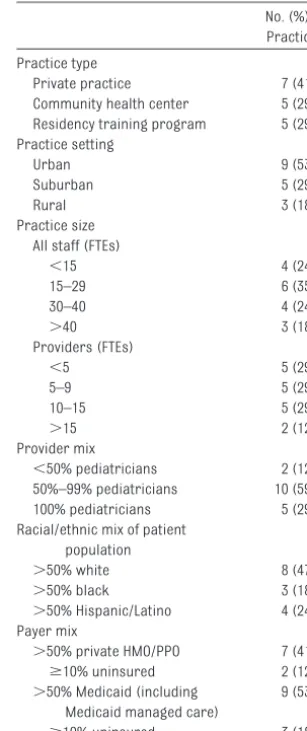
In March 2006, 54 pediatric primary care practices responded to a request for applications from the AAP to par-ticipate in a quality-improvement pilot focused on developmental surveillance and screening. Practices provided infor-mation on their location, size, practice type, practice setting, and patient popu-lation (including age distribution, ethnic makeup, and payer mix). Each site was required to propose a 3-member project team (a pediatrician leader, a clinic or office staff member, and a third individ-ual left to the discretion of the practice) and to express their commitment to practice change. On the basis of this in-formation, study investigators selected 17 practices from 15 states in an effort to maximize diversity in practice types, practice settings, and patient popula-tions. Table 1 lists the characteristics of selected practices.
All 17 practice teams participated in a 1-day orientation workshop that pro-vided an introduction to the policy state-ment’s recommendations. This orienta-tion included new terminology, avail-able screening instruments, approaches to practice change, data-collection tools, communication with payers, and collaboration with community-based programs were reviewed. Particular emphasis was placed on the use of stan-dardized developmental screening in-struments and the need for practice change. Project organizers were careful,
however, not to endorse any specific screen or recommend any specific ap-proaches to office-based implementa-tion of developmental surveillance and screening.
This project received institutional re-view board (IRB) approval from both the AAP and the Johns Hopkins School of Medicine. For practices affiliated with institutions with their own IRBs, approvals were also obtained from those institution-specific IRBs. Each practice received a total of $1800 in remuneration for participation in both the quantitative and qualitative com-ponents of this study.
TABLE 1 Characteristics of Selected Practices (N⫽17)
No. (%) of Practices Practice type
Private practice 7 (41) Community health center 5 (29) Residency training program 5 (29) Practice setting
Urban 9 (53)
Suburban 5 (29)
Rural 3 (18)
Practice size All staff (FTEs)
⬍15 4 (24)
15–29 6 (35)
30–40 4 (24)
⬎40 3 (18)
Providers (FTEs)
⬍5 5 (29)
5–9 5 (29)
10–15 5 (29)
⬎15 2 (12)
Provider mix
⬍50% pediatricians 2 (12) 50%–99% pediatricians 10 (59) 100% pediatricians 5 (29) Racial/ethnic mix of patient
population
⬎50% white 8 (47)
⬎50% black 3 (18)
⬎50% Hispanic/Latino 4 (24) Payer mix
⬎50% private HMO/PPO 7 (41)
ⱖ10% uninsured 2 (12)
⬎50% Medicaid (including Medicaid managed care)
9 (53)
ⱖ10% uninsured 3 (18)
Quantitative Study
Study Design
Quantitative assessment of each prac-tice’s implementation of screening and referrals was performed by using an interrupted time-series design. Practices reported their baseline sur-veillance, screening, and referral prac-tices and chose a screening instru-ment(s). Once project implementation began, they were asked to review a specified number of patient charts per month and report these results to the AAP for compilation and analysis. A 9-month implementation period was chosen because it was the longest pe-riod possible within the constraints imposed by project funding sources. To minimize reporting burdens, prac-tices were asked to report data in the aggregate; they did not provide infor-mation on specific children (such as age, ethnicity, or gender). At 3 prac-tices, some providers chose not to implement developmental screening; these practices were instructed to re-view charts only for patients of partic-ipating providers.
Procedures
At orientation, practices were pro-vided specific instructions on the num-ber of charts to be reviewed and data elements to be collected. Potential strategies for data collection were also reviewed, and standard monthly reporting forms were provided for uniform data reporting. AAP project staff members monitored these data-collection efforts and were available throughout the project to answer practices’ questions regarding data collection and reporting.
During the first (July 2006) and last (March 2007) months of the project, practices were asked to report on the first 30 well-child visits for children aged 8 to 36 months. In intervening months, practices were asked to re-port on the first 10 well-child visits
among children aged 8 to 36 months. The practices were instructed to re-view charts for all children within the target age range rather than select only children who presented at the recommended screening ages (9, 18, and 24/30 months).
The data elements requested included the number of children who presented at screening ages, the number with documentation of structured develop-mental screening, and the number re-ferred to any source for further evalu-ation or services.
Analysis
Rates of screening, failed screens, and referrals were calculated across sites on a monthly basis. Because practices reported data in the aggregate, strati-fied analyses could not be conducted for subgroups of children. Stratified analyses were only conducted for sub-groups of clinics that used certain screening instruments.
One site had multiple months of miss-ing or implausible data that could not be resolved despite the efforts of clinic and AAP project staff. This practice’s data were ultimately excluded from quantitative analyses.
Qualitative Study
Study Design
A longitudinal qualitative study was also conducted to characterize the experi-ences of practices in implementing the policy statement’s recommendations. Qualitative research is appropriate when little previous research has been conducted on a topic, the topic is com-plex, and there is a need to capture the viewpoints of multiple stakeholders with different views.16,17Each of these
was true for this study.
Participants
Each practice nominated 3 individuals for study participation—1 provider, 1 clinical support staff (eg, nurse, social
worker), and 1 practice support staff (eg, office manager, billing specialist)— who were most intimately involved with developmental screening. This re-sulted in 51 respondents for the first set of semistructured interviews. These respondents were often, but not always, the same individuals who attended the orientation workshop. Forty-four of the 51 respondents also completed a second semistructured interview. Because some first-round respondents had diminished involve-ment in the D-PIP over time or had left their practices, 6 new respondents completed only a second-round inter-view (1 provider, 2 clinical support staff, and 3 practice support staff).
Procedures
The first set of semistructured inter-views was conducted 4 to 5 months into the D-PIP implementation period. The second set of interviews was ducted shortly after the project’s con-clusion, which was approximately 5 months after the first set of interviews. All interviews were conducted by tele-phone by Dr King and audiorecorded.
Analysis
were then placed into matrices to facil-itate identification of emerging themes and patterns.
RESULTS
Quantitative Study
Screening and Referral Practices Before the D-PIP
Staff from 9 of the 17 practices re-ported that they conducted “struc-tured developmental screening” be-fore the D-PIP. Narrative descriptions of such screening, however, combined with clarifying questions during quali-tative interviews, revealed that none of these 9 practices had been imple-menting developmental screening as defined in the AAP policy statement. Five practices were using a struc-tured instrument (such as the Den-ver II) in an unstructured manner. One practice used “screening” to de-scribe its use of a clinic-specific checklist of milestones. Three prac-tices used a structured instrument in its intended fashion, but only for some patients, typically those for whom surveillance had already raised concerns for possible developmental delays.
Selection of Screening Instruments
Fifteen practices selected 1 or both of 2 parent-completed screening instru-ments: the Ages & Stages Question-naires (ASQ)19or the Parents’
Evalua-tion of Developmental Status (PEDS).20
At 1 practice, some providers used the Denver II,21 whereas others used the
Prescreening Developmental Ques-tionnaire (PDQ).22The remaining
prac-tice initially used the Denver II but later transitioned to the Bayley Infant Neuro-developmental Screener (BINS).23Some
practices also chose to use a struc-tured instrument for “surveillance,” separate from their “screening” activ-ities. In these practices, parent re-sponses on structured instruments were used primarily to inform the
pro-vider’s clinical assessment rather than as the main indicator of the need for a developmental referral.
Some practices used combinations of instruments. For example, 1 clinic ad-ministered the full Denver II for surveil-lance at all visits and the ASQ for screening at designated screening visits. Another practice conducted 2-stage screening, using the PEDS to screen all children and the ASQ to screen children with concerning re-sults on the PEDS before making final decisions about referrals.
Rates of Structured Developmental Screening
Practices screened a high proportion of children at the target ages (Fig 1). During the 9-month implementation period, monthly screening rates across practices increased from 68% to 86% of children who presented for recom-mended screening visits (9, 18, and 24/30 months). During the last 4 months of the project, practices con-sistently screened more than 85% of all target children. Over the entire project period, 80% of the children seen at screening ages underwent structured developmental screening. Considerable variability was seen among cumulative screening rates, however, which ranged from 33% to 100% across the practices.
Screening rates were also calculated separately for practices that used the 2 most commonly used screens (ASQ and PEDS). Overall, screening rates were not significantly different be-tween the 2 instruments (80% vs 77%; P⫽.10).
Rates of Failed Screens
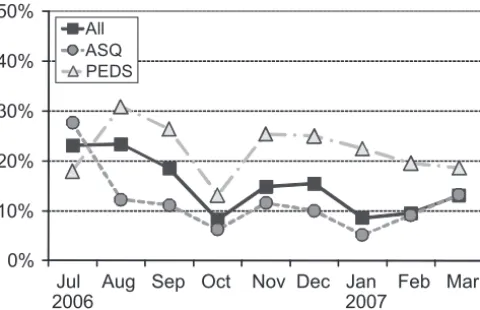
Fourteen percent of all children screened had a failed screen, which suggested a risk for developmental de-lays (Fig 2). As with screening, consid-erable variability was seen between practices, with cumulative failed-screen rates that ranged from 5% to 53% across practices. In contrast to screening, dramatic differences in rates of failed screens were seen be-tween instruments, with twice as many children having a concerning result on the PEDS than on the ASQ (22% vs 11%; P⬍.001).
Referral Rates Among Children With Failed Screens
The AAP policy statement recommends that every child with a failed screen be referred for further evaluation. As shown in Fig 3, however, the practices fell short of this target. Monthly refer-ral rates among children with failed screens ranged from a high of 78% in September 2006 to a low of 48% in Jan-uary 2007, averaging 61% over the
en-0% 20% 40% 60% 80% 100%
Jul Aug Sep Oct Nov Dec Jan Feb Mar
2006 2007
All ASQ PEDS
FIGURE 1
tire study. Once again, substantial vari-ability was seen between practices, with practice-specific referral rates that ranged from 27% to 100% of chil-dren with failed screens. In contrast to screening rates, referral rates did not increase over time; in fact, they were noticeably lower in later months than they were early in the project period.
Subgroup analyses according to in-strument revealed that most of this de-crease in referral rates occurred among practices that used the PEDS. During the last 4 months of the project, fewer than one third of the children with a failing result on the PEDS were referred to any source. Over the entire study, referral rates for children with a failed PEDS were far lower than those for a failed ASQ (43% vs 72%;P⬍.001).
Qualitative Study
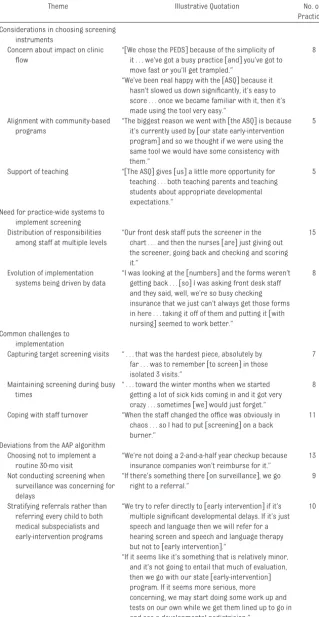
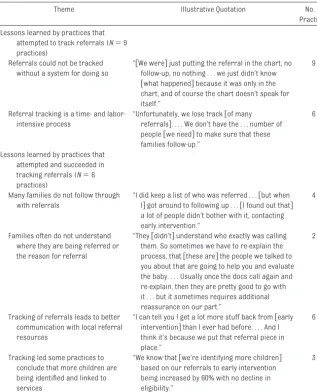
Several themes emerged from analy-sis of the qualitative data. These themes are described below. Illustra-tive quotations for each theme, as well as the number of practices that re-ported each theme, are provided in Ta-bles 2 and 3.
Considerations in Selecting Screening Instruments
The factor most commonly cited in se-lecting screening instruments was concern about clinic flow (Table 2). Eight of the 17 practices expressed concern that routine administration of a developmental screening instrument would slow the flow of patients through the clinic. Most of these prac-tices chose the PEDS, which comprises
10 items on a single page. Some prac-tices concerned with clinic flow did, however, select the longer 30-item ASQ and found it feasible to implement in their busy clinic settings.
Several practices selected the ASQ because it was used by a local out-reach program or their state’s early-intervention program, and they felt it would be advantageous to be aligned with these local programs. Some clin-ics chose the ASQ because they felt that its skill-based items better sup-ported their efforts to teach trainees and parents about typical child devel-opment than the PEDS, which contains items based on parent concerns.
Need for Practice-Wide Systems to Implement Screening
For nearly all practices, implementa-tion of developmental screening re-quired the creation of an office-wide implementation system. Although each clinic created a system tailored to its own needs, several features of these systems were common across sites. First, most clinics divided responsibil-ities among staff at multiple levels. For example, screening instruments might be distributed by front desk staff, scored by nurses or nursing assis-tants, and reviewed with the family by a provider. Then, if a referral is needed, it might be placed by a social worker or referral coordinator.
Second, implementation systems tended to evolve over time. Many clinics found early on that screening instruments were not being distributed consistent-ly; this finding led them to examine and restructure their implementation sys-tems. Importantly, most clinics identi-fied the need for change by reviewing systematically collected data on rates of screen distribution and completion. Although many clinics bemoaned the time and effort necessary to collect these data, most acknowledged that such data were critical to the effective-0%
10% 20% 30% 40% 50%
Jul Aug Sep Oct Nov Dec Jan Feb Mar
2006 2007
All ASQ PEDS
FIGURE 2
Children with failed screens.
0% 20% 40% 60% 80% 100%
Jul Aug Sep Oct Nov Dec Jan Feb Mar
2006 2007
All ASQ PEDS
FIGURE 3
ness of their quality-improvement efforts.
Common Challenges to Implementation
Despite their successes, practices iden-tified several common challenges in im-plementing developmental screening. Practices struggled, particularly at the outset, with distributing screening in-struments to children at screening ages but not to other children. The strat-egies that practices developed to ad-dress this issue were as numerous as the practices themselves. They ranged from typing notes in a computerized appointment system to paper-clipping screening instruments to charts at the beginning of the day. One practice, re-markably, even faxed screening instru-ments to parents in advance of the visit. Another practice opted to distribute screening instruments to children at all visits between 6 and 36 months of age, not just the 3 visits targeted by the AAP, because they felt that this would sub-stantially increase the likelihood of chil-dren undergoing screening on multiple occasions before the age of 3.
Many clinics found that it was more difficult to screen consistently when they were busy. Although busy periods occurred sporadically at all sites, they were seen simultaneously across mul-tiple sites with the onset of the winter viral season. This phenomenon was re-flected not only in qualitative interviews but also in the quantitative data, which showed a noticeable dip in screening rates during November 2006. Ongoing data-collection and monitoring efforts helped practices recognize these chal-lenges and adjust their implementation systems accordingly. As a result, screen-ing rates quickly returned to their previ-ous levels.
Finally, many clinics grappled with the challenges posed by staff turnover. When clinics lost staff members, they often saw screening rates decrease
TABLE 2 Common Themes in Implementation of Developmental Screening and Referrals Theme Illustrative Quotation No. of
Practices Considerations in choosing screening
instruments
Concern about impact on clinic flow
“关We chose the PEDS兴because of the simplicity of it . . . we’ve got a busy practice关and兴you’ve got to move fast or you’ll get trampled.”
8
“We’ve been real happy with the关ASQ兴because it hasn’t slowed us down significantly, it’s easy to score . . . once we became familiar with it, then it’s made using the tool very easy.”
Alignment with community-based programs
“The biggest reason we went with关the ASQ兴is because it’s currently used by关our state early-intervention program兴and so we thought if we were using the same tool we would have some consistency with them.”
5
Support of teaching “关The ASQ兴gives关us兴a little more opportunity for teaching . . . both teaching parents and teaching students about appropriate developmental expectations.”
5
Need for practice-wide systems to implement screening Distribution of responsibilities
among staff at multiple levels
“Our front desk staff puts the screener in the chart . . . and then the nurses关are兴just giving out the screener, going back and checking and scoring it.”
15
Evolution of implementation systems being driven by data
“I was looking at the关numbers兴and the forms weren’t getting back . . .关so兴I was asking front desk staff and they said, well, we’re so busy checking insurance that we just can’t always get those forms in here . . . taking it off of them and putting it关with nursing兴seemed to work better.”
8
Common challenges to implementation
Capturing target screening visits “ . . . that was the hardest piece, absolutely by far . . . was to remember关to screen兴in those isolated 3 visits.”
7
Maintaining screening during busy times
“ . . . toward the winter months when we started getting a lot of sick kids coming in and it got very crazy . . . sometimes关we兴would just forget.”
8
Coping with staff turnover “When the staff changed the office was obviously in chaos . . . so I had to put关screening兴on a back burner.”
11
Deviations from the AAP algorithm Choosing not to implement a
routine 30-mo visit
“We’re not doing a 2-and-a-half year checkup because insurance companies won’t reimburse for it.”
13
Not conducting screening when surveillance was concerning for delays
“If there’s something there关on surveillance兴, we go right to a referral.”
9
Stratifying referrals rather than referring every child to both medical subspecialists and early-intervention programs
“We try to refer directly to关early intervention兴if it’s multiple significant developmental delays. If it’s just speech and language then we will refer for a hearing screen and speech and language therapy but not to关early intervention兴.”
10
while they were short-staffed or while a new staff member was being trained. This was especially true when the new staff member was in a leadership po-sition, such as a nursing manager or office manager, because these individ-uals often played an integral role in the ongoing monitoring of developmental screening efforts.
All these implementation challenges were notable for the degree to which they were shared across participating practices. No major differences were seen between practice types or patient populations, or between practices that used parent-completed question-naires and those that used provider-administered screens.
Deviations From the AAP Algorithm
Practices generally adhered to the steps described in the algorithm included in the AAP policy statement on developmental surveillance and screening. However, there were 3 points at which practices tended to de-viate from this algorithm.
First, the AAP algorithm suggests that the third screening occur at a 30-month well-child visit. No practice, however, consistently implemented a 30-month visit unless such a visit was already routine in their practice be-fore the D-PIP. The most common rea-son cited for not implementing a 30-month visit was the lack of expected
insurance payment for the visit. It should be noted, however, that none of the 3 practices that routinely per-formed 30-month visits before the D-PIP reported difficulties collecting in-surance payments for these visits.
A second common deviation from the AAP algorithm involved provider actions when developmental surveillance at nonscreening visits raised concerns about possible delays. In these circum-stances, the algorithm calls for adminis-tration of a standardized screening in-strument before deciding whether to refer. Most providers, however, did not take this additional step. Instead, they tended to refer children for further eval-uation based solely on their surveillance.
Finally, the AAP algorithm recommends that children with failed screens be simultaneously scheduled for develop-mental/medical evaluations and re-ferred for early-intervention services. No clinic adhered strictly to this recom-mendation. Instead, providers tended to stratify their referrals. The manner in which practices stratified their re-ferrals, however, varied widely. For example, 2 practices referred children suspected of having isolated speech-language delays directly to a speech therapist but referred children thought to have more severe or global delays to public early-intervention programs. Three practices referred children thought to have mild delays to public early-intervention programs, but they sent those suspected of having more severe delays to medical subspecial-ists such as developmental pediatri-cians or pediatric neurologists. One practice referred all children younger than 1 year to medical subspecialists but referred older children primarily to early intervention.
Lessons Learned From Referral-Tracking Efforts
Although not explicitly addressed in the AAP policy statement, 9 of the 17
TABLE 3 Lessons Learned From Practices’ Referral-Tracking Efforts
Theme Illustrative Quotation No. of Practices Lessons learned by practices that
attempted to track referrals (N⫽9 practices)
Referrals could not be tracked without a system for doing so
“关We were兴just putting the referral in the chart, no follow-up, no nothing . . . we just didn’t know
关what happened兴because it was only in the chart, and of course the chart doesn’t speak for itself.”
9
Referral tracking is a time- and labor-intensive process
“Unfortunately, we lose track关of many referrals兴. . . . We don’t have the . . . number of people关we need兴to make sure that these families follow-up.”
6
Lessons learned by practices that attempted and succeeded in tracking referrals (N⫽6 practices)
Many families do not follow through with referrals
“I did keep a list of who was referred . . .关but when I兴got around to following up . . .关I found out that兴 a lot of people didn’t bother with it, contacting early intervention.”
4
Families often do not understand where they are being referred or the reason for referral
“They关didn’t兴understand who exactly was calling them. So sometimes we have to re-explain the process, that关these are兴the people we talked to you about that are going to help you and evaluate the baby. . . . Usually once the docs call again and re-explain, then they are pretty good to go with it . . . but it sometimes requires additional reassurance on our part.”
2
Tracking of referrals leads to better communication with local referral resources
“I can tell you I get a lot more stuff back from关early intervention兴than I ever had before. . . . And I think it’s because we put that referral piece in place.”
6
Tracking led some practices to conclude that more children are being identified and linked to services
“We know that关we’re identifying more children兴 based on our referrals to early intervention being increased by 60% with no decline in eligibility.”
practices attempted to track the out-comes of their referrals (Table 3). These practices found that such refer-ral tracking required a clinic-wide imple-mentation system distinct from their system for developmental screening. Without a separate tracking system, in-formation about which children had been referred and where they had been referred could be found only in individual charts, making clinic-wide tracking nearly impossible. Of the 9 practices that attempted to track re-ferrals, only 6 succeeded in putting a system in place. These clinics found re-ferral tracking to be a time- and labor-intensive effort that was difficult to maintain over the long-term.
Practices were not asked to report the number of children further eval-uated or ultimately identified as having delays. Quantitative data on these outcomes, therefore, are not available. In qualitative interviews, however, respondents described learning much from their referral-tracking efforts. Many found that a large number of families never fol-lowed through with the recom-mended referrals. Perhaps more im-portant was the realization among several respondents that families of-ten did not understand the reason for their referral.
All practices that tracked referrals found that they had better communi-cation with local referral resources and received more consistent feed-back about the children they re-ferred. Finally, 3 practices reported that their tracking efforts led them to conclude that a larger number of children were being identified and awarded services as a result of their developmental surveillance and screening efforts.
DISCUSSION
By the end of the 9-month D-PIP imple-mentation period, nearly all
participat-ing practices had successfully imple-mented the AAP’s recommendations on developmental surveillance and screening. They did so by selecting parent-completed screening instru-ments and developing practice-wide systems for implementation. These systems engaged staff at multiple lev-els, monitored performance through ongoing data collection, and used such data to drive changes in implementa-tion over time. In these respects, the experiences of D-PIP practices were similar to those of several recent projects that have aimed to improve the quality of pediatric preventive care.24–26
At the same time, this project revealed that many clinics chose not to imple-ment certain AAP recommendations: de novo implementation of a 30-month well-child visit; routine screening when surveillance had already sug-gested delays; and dual referral of all children, no matter what the concern, to both medical subspecialists and early-intervention programs.
Practices largely succeeded in imple-menting both of the 2 most commonly-used screens: the ASQ and the PEDS. However, children at practices that used the PEDS “failed” their screens twice as often as children at practices that used the ASQ. At the same time, practices that used the PEDS referred a far lower proportion of patients with failed screens for further evaluation.
There are a number of possible expla-nations for these findings. Clinics that used the PEDS may have had higher proportions of children with develop-mental delays. If this is true, lower re-ferral rates among these practices are concerning; they suggest that provid-ers are opting not to refer many chil-dren who might benefit from further evaluation. Alternatively, providers that used the PEDS may have been less likely to believe a failed screening re-sult and more likely, therefore, not to
refer a child with a failed screen. More studies are needed to determine if this is replicated in other settings and, if so, what factors underlie this unex-pected finding.
Among the policy statement’s recom-mendations, the greatest departures from previous practice were recom-mendations regarding routine ad-ministration of structured screening instruments. It is understandable, therefore, that implementation of screening was addressed in the great-est detail, both within the policy state-ment and by the D-PIP practices. The results of this study strongly suggest, however, that effective developmental screening requires 2 distinct imple-mentation systems: one for screening and another for referrals.
Implementation systems for screening govern the administration of screen-ing instruments and ongoscreen-ing monitor-ing of the screenmonitor-ing process. In this study, similar to a number of previous studies,27–29we found this to be
referrals or were successfully con-nected to needed services.
This study has several important limi-tations. First, although selected for their geographic and demographic di-versity, the 17 practices that partici-pated in the D-PIP were not typical of all primary care practices with regards to developmental surveillance and screening. Instead, their interests in developmental screening and quality improvement were so strong that they volunteered to participate in a time-and labor-intensive project with little tangible reward. The degree to which their experiences would be replicated in less motivated practices remains to be seen.
Second, the chart reviews that gener-ated the quantitative data for this project were collected by staff at each participating practice. Although all practices used the same data-collection forms and received the same instructions for their use, no ex-ternal verification was conducted to confirm that items were being inter-preted in the same way or that data were being collected in the same man-ner across all practices. To date, how-ever, screening rates reported by other recent studies of developmental screening have ranged from 53% to 81%,7,28,29which overlaps with average
screening rates among the D-PIP sites.
Finally, although it enhanced the feasi-bility of the project for participating practices, the small number of charts reviewed each month limited the pre-cision of monthly estimates for rates of screening, failed screens, and refer-rals. Confidence intervals around these monthly estimates were quite wide, with substantial overlap be-tween months and across subgroups of instruments. However, the cumula-tive rates that reflected the entire 9-month project period were much more precise. This facilitated the de-tection of statistically significant
dif-ferences in rates of failed screens and rates of referrals between screening instruments.
Despite these limitations, this study had a number of important strengths. As noted previously, the D-PIP prac-tices represented a range of geo-graphic regions, practice types, and patient populations. This diversity adds credibility to the findings that some themes, such as the challenges of capturing children at screening ages and tracking referrals, were con-sistent across a wide range of primary care settings.
We intentionally collected qualitative data from across categories of clinic staff. Although providers typically at-tract the most attention in discussions of developmental screening, this study clearly shows that ancillary staff as-sume most day-to-day responsibility for implementation. Thus, ongoing support for such ancillary staff is crit-ical to the continued success of these efforts.
CONCLUSIONS
The ultimate goal of developmental surveillance and screening is to im-prove outcomes for children with de-velopmental disorders.1To date,
how-ever, studies have failed to document a direct link between routine screen-ing30,31and improved child outcomes.
In fact, the US Preventive Services Task Force recently found insufficient evi-dence to recommend in favor of wide-spread screening of young children for speech-language delays.31Our findings
suggest that shortcomings in referral processes may partially account for this gap in evidence. Future studies on the potential benefits of developmen-tal screening, therefore, should clude robust referral systems that in-corporate the findings from this study. Specifically, such referral systems should provide better explanations to families of the reasons for
develop-mental referrals, as well as better monitoring of referral outcomes.
We identified a number of points at which an algorithm for an office-based process could not be consistently im-plemented in real-world practice set-tings. This highlights the utility of com-bining a policy statement with both a detailed algorithm and efforts to test the feasibility of its implementation. It also emphasizes the need for better mechanisms to revise policy state-ments as new knowledge becomes available. Currently, AAP policy state-ments “automatically expire 5 years af-ter publication unless reaffirmed, re-vised, or retired at or before that time.”32Without a mechanism for
dis-seminating new knowledge in a timely fashion, many practices that choose to implement developmental screening will not have the opportunity to avoid the common missteps identified by the D-PIP practices. A remaining challenge for the AAP and other organizations that develop clinical recommenda-tions is the creation of efficient mech-anisms for information dissemination that maximizes the opportunity for translation and adoption of new knowledge.
ACKNOWLEDGMENTS
Major support for the D-PIP was pro-vided by the AAP, the Centers for Dis-ease Control and Prevention/National Center on Birth Defects and Devel-opmental Disabilities (cooperative agreement U59/CCU521266), and the Maternal and Child Health Bureau (HRSA-04-056: CFDA 93.110). Additional support for the qualitative study was provided by the Commonwealth Fund (grant 20070181). Dr King also re-ceived support from the Johns Hop-kins Clinical Research Scholars Pro-gram (funded by grants K12RR017627 and KL2RR025006 from the National Center for Research Resources).
the 17 D-PIP practices who gave so gen-erously of their time and wisdom for this project. These 17 practices are: Alexandria-Lake Ridge Pediatrics (Alex-andria, VA); Boys Town Pediatrics (Omaha, NE); Charter Oak Health Cen-ter at Connecticut Children’s Medical Center (Hartford, CT); Children’s Clinic (Muskogee, OK): Children’s Clinic La Jolla (La Jolla, CA); Children’s Hospital of Pittsburgh Primary Care Center (Pittsburgh, PA); Hospital of Saint Ra-phael Pediatric Primary Care Center (New Haven, CT); Kids Clinic (Law-renceville, GA); Marshall University Pe-diatrics (Huntington, WV); Midland
Community Health care Services (Mid-land, TX); New Ulm Medical Center (New Ulm, MN); North Arlington rics (Arlington Heights, IL); Ohio Pediat-rics, Inc (Huber Heights, OH); South Valley Pediatrics (Hamilton, MT); Chil-dren’s Clinic, Serving Children & Their Families (Long Beach, CA); Wishard Pri-mary Care Center (Indianapolis, IN); and Ypsilanti Health Center (Ypsilanti, MI).
Our research assistants (Jenna Ros-soff, Chantel Priolo, Katherine Thorpe, Jennifer Dein, Samantha Ohmer, Sarah Mahon, Michael Levin, and Arthika Chandramohan) were invaluable in transcribing interviews and
organiz-ing the enormous amount of data gen-erated by this project. We thank the other members of the AAP’s policy re-vision committee (Paul Biondich, Carl Cooley, John Duby, Joseph Hagan, and Lynn Wegner) for their important con-tributions in crafting the revised de-velopmental surveillance and screen-ing policy statement. Finally, we thank Ginny Chanda and Holly Griffin in the offices of the Council on Children With Disabilities and the Medical Home Surveillance and Screening In-itiatives at the AAP for their enor-mous logistic support throughout this project.
REFERENCES
1. American Academy of Pediatrics, Council on Children With Disabilities, Section on Devel-opmental Behavioral Pediatrics, Bright Fu-tures Steering Committee, and Medical Home Initiatives for Children With Special Needs. Identifying infants and young chil-dren with developmental disorders in the medical home: an algorithm for develop-mental surveillance and screening [pub-lished correction appears in Pediatrics. 2006;118(4):1808 –1809].Pediatrics.2006; 118(1):405– 420
2. Shonkoff JP, Phillips D, eds.From Neurons to Neighborhoods: The Science of Early Childhood Development. Washington, DC: National Academy Press; 2000
3. Guralnick MJ.The Effectiveness of Early In-tervention. Baltimore, MD: Paul H. Brookes; 1997
4. Sand N, Silverstein M, Glascoe FP, Gupta VB, Tonniges TP, O’Connor KG. Pediatricians’ re-ported practices regarding developmental screening: do guidelines work? Do they help?Pediatrics.2005;116(1):174 –179 5. Smith RD. The use of developmental
screen-ing tests by primary-care pediatricians.
J Pediatr.1978;93(3):524 –527
6. Palfrey JS, Singer JD, Walker DK, Butler JA. Early identification of children’s special needs: a study in five metropolitan commu-nities.J Pediatr.1987;111(5):651– 659 7. Earls MF, Hay SS. Setting the stage for
success: implementation of developmental and behavioral screening and surveillance in primary care practice—the North Caro-lina Assuring Better Child Health and Devel-opment (ABCD) Project.Pediatrics.2006; 118(1). Available at: www.pediatrics.org/ cgi/content/full/118/1/e183
8. Glascoe FP, Foster EM, Wolraich ML. An economic analysis of developmental de-tection methods. Pediatrics.1997;99(6): 830 – 837
9. Cabana MD, Rand CS, Powe NR, et al. Why don’t physicians follow clinical practice guidelines? A framework for improvement.
JAMA.1999;282(15):1458 –1465
10. Davis DA, Taylor-Vaisey A. Translating guide-lines into practice: a systematic review of theoretic concepts, practical experience and research evidence in the adoption of clinical practice guidelines.CMAJ.1997; 157(4):408 – 416
11. Solberg LI. Guideline implementation: why don’t we do it?Am Fam Physician.2002; 65(2):176, 181–182
12. Flores G, Lee M, Bauchner H, Kastner B. Pe-diatricians’ attitudes, beliefs, and practices regarding clinical practice guidelines: a na-tional survey.Pediatrics.2000;105(3 pt 1): 496 –501
13. Hayward RS, Guyatt GH, Moore KA, McKibbon KA, Carter AO. Canadian physicians’ atti-tudes about and preferences regarding clinical practice guidelines.CMAJ.1997; 156(12):1715–1723
14. Tunis SR, Hayward RS, Wilson MC, et al. In-ternists’ attitudes about clinical practice guidelines.Ann Intern Med.1994;120(11): 956 –963
15. Wolff M, Bower DJ, Marbella AM, Casanova JE. US family physicians’ experiences with practice guidelines.Fam Med.1998;30(2): 117–121
16. Patton MQ. Enhancing the quality and cred-ibility of qualitative analysis.Health Serv Res.1999;34(5 pt 2):1189 –1208
17. Sofaer S. Qualitative methods: what are they and why use them?Health Serv Res.1999; 34(5 pt 2):1101–1118
18. Pett MA. Nonparametric Statistics for Health Care Research: Statistics for Small Samples and Unusual Distributions. Thou-sand Oaks, CA: Sage; 1997
19. Bricker D, Squires J. Ages & Stages Questionnaires: A Parent-Completed,
Child-Monitoring System. 2nd ed. Baltimore, MD: Paul H. Brookes; 1999
20. Glascoe FP.Parents’ Evaluations of Develop-mental Status. Nashville, TN: Ellsworth & Vandermeer; 1997
21. Frankenburg WK, Dodds J, Archer P, et al.
DENVER II Technical Manual. Denver, CO: Denver Developmental Materials, Inc; 1996
22. Frankenburg WK, Bresnick B.Prescreening Developmental Questionnaire (PDQ II). Den-ver, CO: Denver Developmental Materials, Inc; 1998
23. Aylward GP. Bayley Infant Neurodevelop-mental Screener (BINS). San Antonio, TX: Psychological Corporation; 1995
24. Lannon C, Dolins J, Lazorick S, Crowe VL, Butts-Dion S, Schoettker PJ. Partnerships for quality project: closing the gap in care of children with ADHD.Jt Comm J Qual Patient Saf.2007;33(12 suppl):66 –74
25. Lannon CM, Flower K, Duncan P, Moore KS, Stuart J, Bassewitz J. The bright futures training intervention project: implementing systems to support preventive and develop-mental services in practice. Pediatrics.
26. Margolis PA, McLearn KT, Earls MF, et al. As-sisting primary care practices in using office systems to promote early childhood develop-ment.Ambul Pediatr.2008;8(6):383–387 27. Schonwald A, Huntington N, Chan E, Risko W,
Bridgemohan C. Routine developmental screening implemented in urban primary care settings: more evidence of feasibility and effectiveness.Pediatrics.2009;123(2): 660–668
28. Hix-Small H, Marks K, Squires J, Nickel R. Im-pact of implementing developmental
screen-ing at 12 and 24 months in a pediatric prac-tice.Pediatrics.2007;120(2):381–389 29. Rydz D, Srour M, Oskoui M, et al. Screening
for developmental delay in the setting of a community pediatric clinic: a prospective as-sessment of parent-report questionnaires. Pedi-atrics. 2006;118(4). Available at: www. pediatrics.org/cgi/content/full/118/4/e1178 30. Law J, Boyle J, Harris F, Harkness A, Nye C.
Screening for speech and language delay: a systematic review of the literature.Health Technol Assess.1998;2:1–184
31. Nelson HD, Nygren P, Walker M, Panoscha R. Screening for speech and language delay in preschool children: systematic evidence review for the US Preventive Services Task Force [published correc-tion appears in Pediatrics. 2006;117(6): 2336 –2337]. Pediatrics. 2006;117(2). Available at: www.pediatrics.org/cgi/ content/full/117/2/e298
32. American Academy of Pediatrics. AAP policy. Available at: http://aappolicy.aappublications. org. Accessed July 28, 2009
Finding a Cause for Chronic Fatigue Syndrome: Never a Tiring Topic:A recent article in The New York Times(Grady D, October 12, 2009) discussed findings from a study reported in Sciencethat a newly discovered retrovirus may be associated with chronic fatigue syndrome. The virus is the xenotypic murine leukemia virus-related virus (XMRV), a descendant of a group of viruses that cause cancer in mice and has been linked to prostate cancer in men. According to Dr Judy Mikovits, a lead author for this study, 67% of patients had been infected with XMRV compared to 3.7% of controls and this percentage has subsequently been found to be as high as 98% in follow-up studies. Since the virus affects the immune system, it may be involved in the evolution of this syndrome when combined with other environmental triggers. The Centers for Disease Control and Prevention are already working on confirming the pilot findings published inScience.
DOI: 10.1542/peds.2009-0388 originally published online January 25, 2010;
2010;125;350
Pediatrics
Duncan, Nancy L. Swigonski, Stephanie M. Skipper and Paul H. Lipkin
Tracy M. King, S. Darius Tandon, Michelle M. Macias, Jill A. Healy, Paula M.
Services
Updated Information &
http://pediatrics.aappublications.org/content/125/2/350
including high resolution figures, can be found at:
References
http://pediatrics.aappublications.org/content/125/2/350#BIBL
This article cites 19 articles, 8 of which you can access for free at:
Subspecialty Collections
sub
http://www.aappublications.org/cgi/collection/quality_improvement_
Quality Improvement
_management_sub
http://www.aappublications.org/cgi/collection/administration:practice
Administration/Practice Management
following collection(s):
This article, along with others on similar topics, appears in the
Permissions & Licensing
http://www.aappublications.org/site/misc/Permissions.xhtml
in its entirety can be found online at:
Information about reproducing this article in parts (figures, tables) or
Reprints
http://www.aappublications.org/site/misc/reprints.xhtml
DOI: 10.1542/peds.2009-0388 originally published online January 25, 2010;
2010;125;350
Pediatrics
Duncan, Nancy L. Swigonski, Stephanie M. Skipper and Paul H. Lipkin
Tracy M. King, S. Darius Tandon, Michelle M. Macias, Jill A. Healy, Paula M.
National Project
Implementing Developmental Screening and Referrals: Lessons Learned From a
http://pediatrics.aappublications.org/content/125/2/350
located on the World Wide Web at:
The online version of this article, along with updated information and services, is
by the American Academy of Pediatrics. All rights reserved. Print ISSN: 1073-0397.