Infant Neurobehavioral Dysregulation: Behavior
Problems in Children With Prenatal Substance Exposure
WHAT’S KNOWN ON THIS SUBJECT: Follow-up studies relating prenatal cocaine and other substance exposures to behavioral problems during childhood typically use a behavioral teratology model, enabling us to determine not only whether there is a unique drug effect but also the magnitude of the effect.
WHAT THIS STUDY ADDS: We used SEM to test a developmental model relating prenatal cocaine and other substance exposure to later behavior problems. The findings demonstrate how prenatal substance exposure affects child outcome and have implications for early identification and prevention.
abstract
OBJECTIVE:The objective of this study was to test a developmental model of neurobehavioral dysregulation relating prenatal substance exposure to behavior problems at age 7.
METHODS:The sample included 360 cocaine-exposed and 480 unex-posed children from lower to lower middle class families of which 78% were black. Structural equation modeling was used to test models whereby prenatal exposure to cocaine and other substances would result in neurobehavioral dysregulation in infancy, which would pre-dict externalizing and internalizing behavior problems in early child-hood. Structural equation models were developed for individual and combined parent and teacher report for externalizing, internalizing, and total problem scores on the Child Behavior Checklist.
RESULTS:The goodness-of-fit statistics indicated that all of the models met criteria for adequate fit with 7 of the 9 models explaining 18% to 60% of the variance in behavior problems at age 7. The paths in the models indicate that there are direct effects of prenatal substance exposure on 7-year behavior problems as well as indirect effects, in-cluding neurobehavioral dysregulation.
CONCLUSIONS:Prenatal substance exposure affects behavior prob-lems at age 7 through 2 mechanisms. The direct pathway is consistent with a teratogenic effect. Indirect pathways suggest cascading effects whereby prenatal substance exposure results in neurobehavioral dys-regulation manifesting as deviations in later behavioral expression. Developmental models provide an understanding of pathways that de-scribe how prenatal substance exposure affects child outcome and have significant implications for early identification and prevention.
Pediatrics2009;124:1355–1362 AUTHORS:Barry M. Lester, PhD,aDaniel M. Bagner, PhD,a
Jing Liu, PhD,aLinda L. LaGasse, PhD,aRonald Seifer,
PhD,bCharles R. Bauer, MD,cSeetha Shankaran, MD,d
Henrietta Bada, MD,eRosemary D. Higgins, MD,fand Abhik
Das, PhDg
aDepartment of Pediatrics, Brown Center for the Study of
Children at Risk, Women and Infants’ Hospital, andbDepartment
of Psychiatry and Human Behavior, Bradley Hospital, Warren Alpert Medical School, Brown University, Providence, Rhode Island;cDepartment of Pediatrics, School of Medicine, University
of Miami, Miami, Florida;dDepartment of Pediatrics, School of
Medicine, Wayne State University Detroit, Michigan;eUniversity
of Kentucky Hospital, Lexington, Kentucky;fPregnancy and
Perinatology Branch, Eunice Kennedy Shriver National Institute of Child Health and Human Development, Bethesda, Maryland; andgStatistics Research Division, Research Triangle Institute,
Research Triangle Park, North Carolina
KEY WORDS
prenatal substance exposure, cocaine, neurobehavioral dysregulation, behavior problems
ABBREVIATIONS
SEM—structural equation modeling SES—socioeconomic status
NNNS—NICU Network Neurobehavioral Scale IBQ—Infant Behavior Questionnaire CBCL—Child Behavior Checklist
www.pediatrics.org/cgi/doi/10.1542/peds.2008-2898
doi:10.1542/peds.2008-2898
Accepted for publication Jun 5, 2009
Address correspondence to Barry M. Lester, PhD, Brown Center for the Study of Children at Risk, Women and Infants Hospital, 101 Dudley St, Providence, RI 02905. E-mail: [email protected]
PEDIATRICS (ISSN Numbers: Print, 0031-4005; Online, 1098-4275).
Copyright © 2009 by the American Academy of Pediatrics
FINANCIAL DISCLOSURE:The authors have indicated they have no financial relationships relevant to this article to disclose.
to behavioral problems during child-hood typically use a behavioral teratol-ogy model.1–4The goal here is to isolate
the effects of a teratogen by control-ling for effects of potential confound-ing variables through study design such as matching and/or statistics in which confounding variables are co-varied. The variance in outcome ex-plained by the confounding variables is essentially removed from the analy-sis, and the leftover unexplained vari-ance is attributed to the teratogen. For example, we found effects of prenatal cocaine exposure on trajectories of be-havior problems from 3 to 7 years in-dependent of the effects of prenatal ex-posure to alcohol and tobacco, as well as other potentially confounding vari-ables.5 The behavioral teratology
model is critically important because it enables us to determine not only whether there is a unique drug effect (ie, drugs affect outcome when con-founding factors are controlled) but also the magnitude of the drug effect (ie, variability in the outcome measure explained by the drug alone).
A limitation of the behavioral teratol-ogy approach, however, is that it does not lend itself to the study of the devel-opmental processes that lead from ex-posure to developmental outcome. In addition to direct drug effects, there may be indirect effects that suggest how factors mediate the relationship between teratogenic effects and devel-opmental outcome. In a develdevel-opmental model, effects that are removed as confounding variables can be studied as factors that explain more of the variability in developmental outcome in the presence of teratogenic effects. In other words, these factors are in-cluded rather than controlled or re-moved. In addition, other factors that are hypothesized to be involved in these developmental models can be
in-modeling (SEM) are often used to study these pathways. In previous
work, path models showed that
growth deficits associated with prena-tal cocaine exposure are mediated, in part, by gestational age.6In addition to
direct effects of prenatal cocaine expo-sure on IQ, indirect effects are medi-ated by head circumference, child be-havior, and the home environment.7In
our work, the relationship between prenatal cocaine exposure and hyper-tension was mediated by BMI.8
In this study, we used SEM to test a developmental model relating prena-tal cocaine and other substance expo-sure to behavior problems at age 7. The primary hypothesis was that pre-natal exposure to cocaine and other substances would result in neurobe-havioral dysregulation in infancy (ie, problems with arousal and reactivity), which would predict externalizing and internalizing behavior problems in childhood. Externalizing and internaliz-ing behavior problems are part of the neurobehavioral disinhibition profile that includes cognitive, emotional, and behavioral disturbances.9 This profile
reflects diminished inhibitory control and is related to early onset of sub-stance use.9–11In this study, we were
interested in the behavioral anteced-ents of neurobehavioral disinhibition; therefore, we predicted that children who showed signs of neurobehavioral dysregulation at 1 month would have a difficult temperament at 4 months, leading to behavior problems at 3 and 7 years of age. Our long-term goal is to delineate developmental pathways in which children with prenatal cocaine exposure are at increased risk for ad-olescent substance use.
METHODS
Mothers and their infants were en-rolled in the Maternal Lifestyle Study, a
centers (Wayne State University, versity of Tennessee at Memphis, Uni-versity of Miami, and Brown Univer-sity). Each participating center had approval for the study from the institu-tional review board and a certificate of confidentiality from the National Insti-tute on Drug Abuse. Between May 1993 and 1995, mothers at these centers were enrolled into the study within 24 hours after delivery. Initial screening included the mother’s labor and deliv-ery chart, newborn admission chart, and a meconium sample. A substance use questionnaire that addressed the mother’s use of nicotine, alcohol, mar-ijuana, cocaine, opiates, and other il-licit substances was administered by research staff who were trained and certified in the reliable administration of the interview. Exposure was deter-mined by mother’s verbal admittance of using cocaine during pregnancy and/or a positive meconium assay for cocaine metabolites including gas chromatography/mass spectrometry confirmation. Nonexposed children were born to mothers who denied co-caine use, confirmed by negative meconium test results. All demo-graphic data were collected at the time of the infant’s birth.
As previously reported,12participants
on demographic characteristics (data not shown). The final sample for this study included 360 cocaine-exposed and 480 unexposed children who were followed from 1 month to 7 years of age. There were no differences in neo-natal characteristics between infants who were included and excluded from the current sample except for differ-ences in Apgar scores at 1 minute among the cocaine-exposed group and more firstborn children in the compar-ison group excluded than included (Ta-ble 1). For maternal characteristics (Table 2), there were fewer black mothers in the cocaine-exposed ex-cluded than inex-cluded group, more mothers in the 26- to 36-year age range in the cocaine-exposed included group than excluded group, and a higher per-centage of families in the low socioeco-nomic status (SES) range in the in-cluded than the exin-cluded comparison group.
Measures
Medical characteristics were col-lected at birth (Table 1). Caregiver age, race, marital status, education level, and Medicaid insurance status were collected at 1 month. SES was mea-sured using the Hollingshead Index of Social Position13,14 at 7 years. Each of
the 4 exposure substances (cocaine, tobacco, alcohol, and marijuana) was converted to a categorical scale (yes/ no) to indicate use of the substance during pregnancy. The NICU Network Neurobehavioral Scale (NNNS)15
pro-vides an assessment of infant neuro-logic, behavioral, and stress/absti-nence function. The NNNS includes 13 summary scales with adequate psy-chometric properties.16The NNNS was
administered at 1 month in the hospi-tal by a certified examiner who was masked to exposure status of the new-born. A modified version of the Infant
Behavior Questionnaire (IBQ)17was
ad-ministered as a caregiver-report mea-sure of infant temperament at 4 months.* The IBQ summary scales in-cluded distress to novelty and distress to limitations to represent difficult temperament.
The Child Behavior Checklists (CBCL) for ages 2 to 3 and 4 to 18 are 99-and 118-item questionnaires, respec-tively, that assess child behavior by us-ing caregiver report.18,19 Broadband
scales for internalizing, externalizing, and total problems are derived. Test– retest reliability ranged from .74 to .96, and construct validity ranged from .84 to .90. The CBCL was administered to the caregiver at 3 and 7 years as well as the child’s teacher, who was un-aware of the child’s drug exposure sta-tus, at 7 years.
Statistical Analysis
The statistical analysis was a 2-step process using Mplus SEM software.20
First, latent variables, which are unob-served constructs that represent sta-tistically related observed variables, were developed to measure prenatal substance exposure, neurobehavioral dysregulation on the NNNS, difficult temperament on the IBQ, and behavior problems on the CBCL. Second, SEM was used to develop models that help examine the relationship between the latent variables, and goodness-of-fit statistics were used to test the ade-quacy of each model. The primary model tested was that prenatal sub-stance exposure results in disorgani-zation at 1 month (NNNS), which, in turn predicts difficult temperament at 4 months (IBQ), behavior problems at ages 3 and 7 (CBCL). SES was included in the model, and study site, birth weight, and out-of-home placement were tested for inclusion. Models were
*Modifications, approved by M.K. Rothbart, in-cluded simplification of language for the Maternal Lifestyle Study population and reduction of re-sponse scale to 5 points.
TABLE 1 Neonatal Characteristics of Infants Included and Excluded From the Study by Cocaine Exposure
Characteristic Cocaine Exposed Comparison
Included (n⫽360)
Excluded (n⫽183)
P Included (n⫽480)
Excluded (n⫽250)
P
Gestational age, mean (SD), wk 36.0 (4.1) 36.2 (3.7) .640 36.3 (4.1) 36.4 (4.0) .663 Birth weight, mean (SD), g 2546 (780) 2587 (656) .544 2675 (881) 2699 (835) .719 Length, mean (SD), cm 46.3 (5.0) 46.6 (3.8) .385 44.0 (5.3) 47.20 (5.1) .547 Head circumference, mean (SD), cm 31.9 (2.9) 32.1 (2.7) .513 32.2 (3.2) 32.3 (3.0) .547 Apgar at 1 min, median (range) 8 (1–10) 8 (1–10) .033a 8 (0–9) 8 (1–9) .269 Apgar at 5 min, median (range) 9 (3–10) 9 (2–10) .441 9 (4–10) 9 (1–10) .118 Male, mean (SD), % 190 (52.8) 98 (53.6) .864 231 (48.1) 114 (45.6) .517 Firstborn, mean (SD), % 31 (8.6) 19 (10.4) .500 134 (27.9) 89 (35.6) .032a
TABLE 2 Characteristics of Mothers Included and Excluded From the Study by Cocaine Exposure
Characteristic Cocaine Exposed,n(%) Comparison,n(%)
Included (n⫽360)
Excluded (n⫽183)
P Included (n⫽480)
Excluded (n⫽250)
P
Black race 299 (83.1) 136 (74.3) .016a 381 (79.4) 189 (75.6) .242 Age 26–36 y 255 (70.8) 111 (60.7) .017a 204 (42.5) 90 (36.0) .089 Marital status: single 326 (90.8) 158 (86.3) .111 356 (74.2) 185 (74.3) .970 Insurance: Medicaid 313 (86.9) 158 (86.3) .844 374 (77.9) 193 (77.2) .825 Education less than high school 181 (50.3) 92 (50.3) .999 155 (32.4) 72 (28.8) .325 Hollingshead SES: low-V 93 (27.6) 50 (29.2) .697 109 (22.9) 37 (15.2) .015a Prenatal drug use
Alcohol 274 (76.1) 135 (73.8) .550 234 (48.8) 128 (51.2) .530 Tobacco 293 (81.4) 157 (85.8) .198 143 (29.8) 68 (27.2) .464 Marijuana 143 (39.7) 82 (44.8) .255 45 (9.4) 26 (10.4) .657
tested individually for caregiver and teacher reports as well as combined caregiver and teacher reports on the CBCL. Additional models were tested for each CBCL broadband scale. A total of 9 models were examined for this study. In these models, a direct effect exists when 1 latent variable predicts another latent variable, whereas an in-direct effect occurs when a third variable meditates the relationship be-tween 2 latent variables. A path coeffi-cient is a measure of the magnitude of the effect between latent variables, and the total variance of a model indi-cates how much of an effect is attrib-utable to all variables in the model.
RESULTS
Development of Latent Variables
Latent variables were successfully de-veloped for the 9 models. A single la-tent prenatal exposure variable that included all 4 substances (cocaine, to-bacco, alcohol, and marijuana) was de-veloped. On the NNNS, the latent vari-able was composed of 2 summary scales, including arousal and the num-ber of stress abstinence signs. A
posi-tive score indicates infants who were highly aroused and stressed during the examination. The IBQ latent vari-able was composed of distress to nov-elty and distress to limits. A positive score describes infants who become upset in novel situations or when lim-its are set. A latent variable was not necessary for the 3- or 7-year care-giver or teacher CBCL because we de-veloped separate models for the broadband scales; however, a latent variable was developed for the 3 mod-els in which caregiver and teacher CBCL scores were used together. Posi-tive scores indicated that both parents and teachers rated the child as having more externalizing, internalizing, or to-tal behavior problems. The variables that were included in these factors were determined by the results of the exploratory and confirmatory factor analysis. Both factor loadings, the cor-relation between a variable and a la-tent variable, and root mean square residuals, a statistic that is used to measure the appropriateness of a model, were adequate for each latent variable. For example, root mean square
residuals for the polydrug factor was 0.027, and the factor loadings were .874 for cocaine, .810 for tobacco, .539 for al-cohol, and .669 for marijuana.
SEM Findings
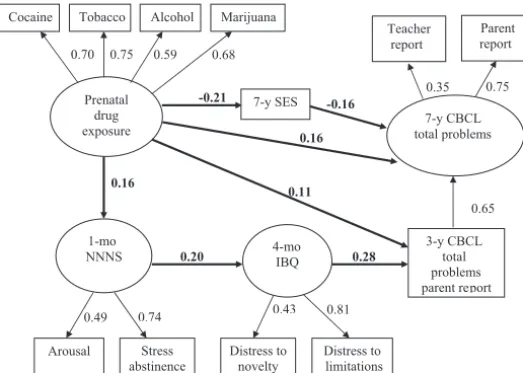
Goodness-of-fit results indicated that all 9 models met statistical criteria for an adequate fit (Table 3). For ease of interpretation, Fig 1 is a schematic of the model that uses combined care-giver and teacher report. Latent ables are in circles and observed vari-ables are in squares. Figure 1 shows 4 pathways (bolded) from prenatal drug exposure to behavior problems on the CBCL at 7 years: (1) prenatal substance exposure is related to lower SES (⫽
⫺.21) and, in turn, predicts behavior problems at 7 (⫽ ⫺.16); (2) direct effect of prenatal substance exposure on behavior problems at 7 (⫽.16); (3) direct effect of prenatal substance exposure on behavior problems at 3 (⫽.11), which is related to behavior problems at 7 ( ⫽.65); and (4) in-fants with prenatal substance expo-sure show higher arousal and more stress abstinence signs at 1 month on
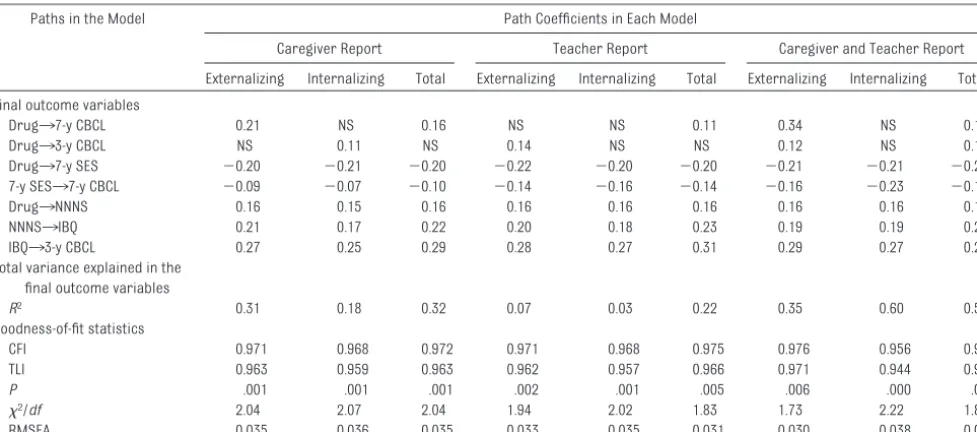
Paths in the Model Path Coefficients in Each Model
Caregiver Report Teacher Report Caregiver and Teacher Report
Externalizing Internalizing Total Externalizing Internalizing Total Externalizing Internalizing Total
Final outcome variables
Drug37-y CBCL 0.21 NS 0.16 NS NS 0.11 0.34 NS 0.16
Drug33-y CBCL NS 0.11 NS 0.14 NS NS 0.12 NS 0.11
Drug37-y SES ⫺0.20 ⫺0.21 ⫺0.20 ⫺0.22 ⫺0.20 ⫺0.20 ⫺0.21 ⫺0.21 ⫺0.21
7-y SES37-y CBCL ⫺0.09 ⫺0.07 ⫺0.10 ⫺0.14 ⫺0.16 ⫺0.14 ⫺0.16 ⫺0.23 ⫺0.16
Drug3NNNS 0.16 0.15 0.16 0.16 0.16 0.16 0.16 0.16 0.16
NNNS3IBQ 0.21 0.17 0.22 0.20 0.18 0.23 0.19 0.19 0.20
IBQ33-y CBCL 0.27 0.25 0.29 0.28 0.27 0.31 0.29 0.27 0.28
Total variance explained in the final outcome variables
R2 0.31 0.18 0.32 0.07 0.03 0.22 0.35 0.60 0.52
Goodness-of-fit statistics
CFI 0.971 0.968 0.972 0.971 0.968 0.975 0.976 0.956 0.975
TLI 0.963 0.959 0.963 0.962 0.957 0.966 0.971 0.944 0.968
P .001 .001 .001 .002 .001 .005 .006 .000 .004
2/df 2.04 2.07 2.04 1.94 2.02 1.83 1.73 2.22 1.80
RMSEA 0.035 0.036 0.035 0.033 0.035 0.031 0.030 0.038 0.031
the NNNS (⫽.16). Temperamentally, these infants showed distress to nov-elty and limitations at 4 months (⫽ .20). These temperamentally difficult infants showed behavior problems on the CBCL at 3 years (⫽.28), which, in turn, predicted behavior problems on the CBCL at 7 years ( ⫽ .65). The entire model explained approximately half (52%) of the variance in total be-havior problems at 7 years.
The standardized path coefficients for the models that predict externalizing, internalizing, and total behavior prob-lems all were statistically significant (P⬍ .05) unless otherwise indicated (Table 3). Overall, 63 (88%) of the 72 paths were statistically significant, and 7 of the 9 models explained be-tween 18% and 60% of the variance in behavior problems at age 7. This sug-gests that the relationships among these variables were relatively stable across types of behavior problems (ex-ternalizing, in(ex-ternalizing, and total) and reporters (caregiver, teacher, and combined caregiver and teacher). All of the path coefficients along the indi-rect (developmental) path from prena-tal substance exposure to NNNS, IBQ, 3-year CBCL, and 7-year CBCL were
sta-tistically significant. All path coeffi-cients that were not statistically signif-icant were direct paths from prenatal drug exposure to the 3- or 7-year CBCL (9 of the 18 possible paths), although the most robust finding was the direct path from substance exposure to care-giver and parent report of externaliz-ing behavior problems at age 7. This may suggest that in these models, the indirect drug effects of prenatal sub-stance exposure are more robust than the direct effects of prenatal sub-stance exposure.
Testing Alternative Models
For all models (Table 3), we examined model fit statistics and parameter co-efficients with and without the direct effects of poly substances on 3-year and/or 7-year CBCL outcomes and in-cluded only models with the best fit. We tested a number of alternative models, including models with cocaine as the only substance, models with cocaine excluded from the latent drug variable, models for level of prenatal drug expo-sure (eg, heavy expoexpo-sure), separate models for boys and girls, models with birth weight as a mediator of drug ef-fects on the CBCL, and models with
other measures of the postnatal care-giving environment (eg, quality of the home environment, parenting stress, maternal psychopathology). These al-ternative models were rejected be-cause there was no convergence, the model fit statistics did not meet crite-ria (Comparative fit index (CFI) ⱖ.95 and Tucker-Lewis index (TLI)ⱖ.95), or they showed poorer fit statistics.
DISCUSSION
We found evidence of a developmental model suggesting both direct and indi-rect effects of prenatal exposure to co-caine and other substances on behav-ior problems in childhood. The indirect effects show a sequence of connected behavioral alterations starting in the neonatal period that lead to later be-havior problems. Prenatal substance exposure predicted higher infant reac-tivity and stress at 1 month, which led to a more difficult temperament at 4 months. In turn, difficult temperament was associated with more behavior problems at 3 and 7 years. These indi-rect effects of prenatal substance ex-posure were observed in the presence of the direct effects of prenatal sub-stance exposure and effects of SES on these behavioral outcomes. In other words, the indirect effects remained after controlling for the direct effects of prenatal substance exposure and SES. This suggests multiple pathways, both direct and indirect, from prenatal substance exposure to behavioral out-comes in childhood and that the ef-fects are cumulative.
The direct paths may be thought of as teratogenic effects and support previ-ous findings relating prenatal sub-stance exposure to caregiver report of behavior problems in school-aged chil-dren.5,21,22 Our findings suggest that
these may be “true” teratogenic ef-fects because they remained when in-direct effects were also included. Con-versely, half of the direct path
Cocaine Tobacco Alcohol Marijuana
Parent report Teacher report Prenatal drug
exposure total problems 7-y CBCL
Distress to novelty
Distress to limitations Arousal
0.70 0.75 0.59 0.68
0.75 0.35 Stress abstinence 0.65 0.28 0.81 0.43 0.74 0.49 0.16 -0.16 0.20 -0.21 1-mo
NNNS 4-mo IBQ
3-y CBCL total problems parent report 0.11 7-y SES 0.16 FIGURE 1
Total problems at 7 years by parent and teacher report. CFI⫽0.975, TLI⫽0.968, RMSEA⫽0.031, 2/degree of freedom ratio⫽1.80. All indicator loadings and path coefficients are significant (P⬍ .05).
gesting that these effects are less ro-bust than when tested with more tra-ditional regression analysis. These findings also provide an alternative complementary model for studying unique (direct) effects of prenatal substance exposure. In addition, both direct and indirect effects were found in some models, indicating that they explain additive portions of the variance.
Our finding that SES mediates the ef-fects of prenatal substance exposure on childhood behavioral problems is consistent with previous findings.23–25
Clearly, this is not a “causal” model; prenatal substance exposure does not “cause” low SES. Rather, SES is a proxy for postnatal environmental factors that are associated with substance use during pregnancy related to childhood behavior problems. Other factors, including quality of the home environment,26,27maternal
psychopa-thology,28and parenting stress29that
are associated with the caregiving en-vironment of mothers who used sub-stances during pregnancy, were also examined, but these models did not meet statistical criteria or were weaker than models with SES.
We included teacher and caregiver re-port of behavior problems. In previous work, prenatal cocaine exposure has been related to behavior problems by using teacher report.30,31 In contrast,
we averaged teacher and caregiver re-port because the combination of 2 in-dependent reports of behavior in dif-ferent settings might provide a more complete assessment than either re-port alone. This may explain the higher total variance explained in the models
for the combined caregiver and
teacher report than for the separate report models.
Our results demonstrate a logical se-quence of cascading effects on
devel-posure to cocaine and other sub-stances. This pathway could explain some of the behavioral origins of neu-robehavioral disinhibition in later childhood related to adolescent sub-stance use.9–11Neurobehavioral
disin-hibition includes many of the behav-ioral dimensions that are reminiscent of the behaviors measured in our study, including emotional lability, irri-tability, difficult temperament in in-fancy, and externalizing and
internaliz-ing behavior problems. In older
children, these behaviors are sub-sumed under the broader categories of dysregulated emotion and behavior undercontrol. Neurobehavioral disin-hibition is thought to be attributable to dysfunction of the prefrontal cortex and also includes deficits in executive function that were not measured in this study. We need to continue to fol-low the children in our study to
deter-mine whether this developmental
pathway extends to the profile of neu-robehavioral disinhibition and later substance use in adolescence. None-theless, we demonstrated that some precursors of neurobehavioral disin-hibition have behavioral echoes in early infancy.
Study Limitations
The limitation of SEM is that alternative models that fit the data as well as or better than the model developed in this study could be developed. Although we examined alternative models (eg, us-ing measures of the caregivus-ing envi-ronment), it is possible that other
caregiving environment measures
would also result in adequate models. The model that we tested was theoret-ically based, and we acknowledge that it could be modified. In addition, we did not measure genetic influences that are potentially involved in the develop-ment of behavior problems.
teacher report and could have been strengthened with the addition of more objective measures. The path co-efficients between the 3- and 7-year CBCL scores were stronger when care-giver report was used at both ages than when caregiver report was re-lated to teacher report (Table 3), sug-gesting possible reporter bias. An alternative explanation is that the ob-servations of caregivers and teachers reflect the different contexts in which they interact with the children, sup-porting the decision to average care-giver and teacher scores.
Prenatal substance exposure was a single factor that was based on the presence or absence of each sub-stance examined, including nicotine, alcohol, marijuana, and cocaine. We tested models that included estimates for each individual substance and the amount of exposure to each sub-stance; however, these models did not have adequate goodness-of-fit statis-tics. The alternative would have been to use cocaine only and acknowledge the presence of other substances, but we thought that it was more accurate to include all substances in a single model. It is interesting that the path coefficients for the 4 substances in the latent substance factor (Fig 1) are sim-ilar in size, suggesting that the contri-bution of each substance to the factor is similar.
Implications
Early identification and prevention of behavior problems is in line with re-cent recommendations by the Ameri-can Academy of Pediatrics32and would
deter-mine whether altering behaviors that are measured by the NNNS (ie, reduc-ing arousal and stress) could prevent the development or reduce the magni-tude of later child behavior problems. Our findings are optimistic because although we may not be able to treat the children who show direct effects of prenatal substance exposure on childhood behavior problems, we were able to identify children who left in infancy behavioral tracks that may be amenable to treatment. In the long-term, altering the developmen-tal trajectory of these children could address more severe conduct prob-lems and substance use disorders in adolescence.
ACKNOWLEDGMENTS
This study was conducted with support from the National Institutes of Health, Eunice Kennedy Shriver National Insti-tute of Child Health and Human Devel-opment through cooperative agree-ments and interagency agreement with the National Institute on Drug Abuse; Administration on Children, Youth and Families; and Center for Substance Abuse Treatment. Partici-pating institutions, grant awards, in-vestigators, and key research person-nel include the following: Brown University, U10 HD 27904, N01-HD-2-3159 (Barry M. Lester, PhD, Cindy Lon-car, PhD, Linda LaGasse, PhD, and Jean Twomey, PhD); University of Miami, U10
HD 21397 (Charles R. Bauer, MD, Wendy Griffin, RN, and Elizabeth Jacque, RN); University of Tennessee, U10 HD 21415 (Henrietta S. Bada, MD, Charlotte Bursi, MSSW, Marilyn Williams, MSW, Deloris Lee, MSW, Lillie Hughey, MSW, and Kimberly Yolton, PhD), Wayne State University, U10 HD 21385 (Seetha Shan-karan, MD, Eunice Woldt, MSN, and Jay Ann Nelson, BSN); RTI, International, U01 HD 36790 (W. Kenneth Poole, PhD, Abhik Das, PhD, and Jane Hammond, PhD); Eunice Kennedy Shriver National Institute of Child Health and Human De-velopment (Linda L. Wright, MD, Rose-mary Higgins, MD); and National
Insti-tute on Drug Abuse (Vincent L.
Smeriglio, PhD).
REFERENCES
1. Lester BM, LaGasse LL, Seifer R. Cocaine expo-sure and children: the meaning of subtle
ef-fects.Science.1998;282(5389):633– 634
2. Tronick EZ, Messinger DS, Weinberg MK, et al.
Cocaine exposure is associated with subtle compromises of infants’ and mothers’
social-emotional behavior and dyadic features of their interaction in the face-to-face still-face
paradigm.Dev Psychol.2005;41(5):711–722
3. Schiller C, Allen PJ. Follow-up of infants
prena-tally exposed to cocaine.Pediatr Nurs.2005; 31(5):427– 436
4. Seifer R, LaGasse LL, Lester B, et al. Attachment status in children prenatally exposed to
co-caine and other substances.Child Dev.2004; 75(3):850 – 868
5. Bada HS, Das A, Bauer CR, et al. Impact of
pre-natal cocaine exposure on child behavior problems through school age.Pediatrics. 2007;119(2). Available at: www.pediatrics.org/ cgi/content/full/119/2/e348
6. Bandstra ES, Morrow CE, Anthony JC, et al.
In-trauterine growth of full-term infants: impact of prenatal cocaine exposure.Pediatrics. 2001;108(6):1309 –1319
7. Azuma SD, Chasnoff IJ. Outcome of children prenatally exposed to cocaine and other
drugs: a path analysis of three-year data. Pe-diatrics.1993;92(3):396 – 402
8. Shankaran S, Das A, Bauer C, et al.Prenatal Cocaine Exposure Predicts Increased Blood Pressure at 9 Years of Age. Washington, DC: PAS; 2005
9. Tarter RE, Kirisci L, Mezzich A, et al.
Neurobe-havioral disinhibition in childhood predicts
early age at onset of substance use disorder. Am J Psychiatry.2003;160(6):1078 –1085
10. Tarter RE, Kirisci L, Habeych M, Reynolds M, Vanyukov M. Neurobehavior disinhibition in childhood predisposes boys to substance use disorder by young adulthood: direct and medi-ated etiologic pathways.Drug Alcohol Depend. 2004;73(2):121–132
11. Tarter RE, Kirisci L, Reynolds M, Mezzich A. Neu-robehavior disinhibition in childhood predicts suicide potential and substance use disorder by young adulthood.Drug Alcohol Depend. 2004;76(suppl):S45–S52
12. Lester BM, Tronick EZ, LaGasse L, et al. The maternal lifestyle study: effects of substance exposure during pregnancy on
neurodevelop-mental outcome in 1-month-old infants. Pedi-atrics.2002;110(6):1182–1192
13. Holingshead A.A Four Factor Index of Social Status. New Haven, CT: Yale University; 1975
14. Cirino PT, Chin CE, Sevcik RA, Wolf M, Lovett M, Morris RD. Measuring socioeconomic status: reliability and preliminary validity for different approaches.Assessment.2002;9(2):145–155
15. Lester BM, Tronick EZ, Brazelton TB. The Neo-natal Intensive Care Unit Network
Neurobe-havioral Scale procedures.Pediatrics.2004; 113(3 Pt 2):668 – 675
16. Lester BM, Tronick EZ, LaGasse L, Seifer R, Bauer CR, Shankaran S, et al. Summary statis-tics of neonatal intensive care unit network neurobehavioral scale scores from the ma-ternal lifestyle study: a quasinormative sam-ple.Pediatrics.2004;113(3 Pt 2):668 –75
17. Rothbart MK. Measurement of temperament
in infancy.Child Dev.1981;52:569 –578
18. Achenbach TM.Manual for the Child Behavior Checklist/4 –18 and 1991 Profile. Burlington, VT: University of Vermont, Department of Psychiatry; 1991
19. Achenbach TM.Manual for the Child Behavior Checklist/2–3. Burlington, VT: University of Vermont, Department of Psychiatry; 1992
20. Muthen LK, Muthen BO.Mplus User’s Guide. 4th ed. Los Angeles, CA: Muthen & Muthen; 1998 –2006
21. Sood B, Delaney-Black V, Covington C, et al. Pre-natal alcohol exposure and childhood behav-ior at age 6 to 7 years: I. Dose-response ef-fect. Pediatrics.2001;108(2) Available at: www.pediatrics.org/cgi/content/full/108/2/e34
22. Linares TJ, Singer LT, Kirchner HL, et al. Mental
health outcomes of cocaine-exposed children at 6 years of age.J Pediatr Psychol.2006;31(1): 85–97
23. Arria AM, Derauf C, Lagasse LL, et al. Metham-phetamine and other substance use during pregnancy: preliminary estimates from the In-fant Development, Environment, and Lifestyle (IDEAL) study.Matern Child Health J.2006; 10(3):293–302
24. Bor W, Najman JM, Andersen MJ, O’Callaghan
M, Williams GM, Behrens BC. The relationship between low family income and psychological disturbance in young children: an Australian longitudinal study.Aust N Z J Psychiatry.1997; 31(5):664 – 675
25. Duncan GJ, Brooks-Gunn J, Klebanov PK. Eco-nomic deprivation and early childhood devel-opment.Child Dev. 1994;65(2 Spec No): 296 –318
26. Bendersky M, Bennett D, Lewis M. Aggression
27. Bennett DS, Bendersky M, Lewis M. Children’s intellectual and emotional-behavioral ad-justment at 4 years as a function of cocaine exposure, maternal characteristics, and en-vironmental risk.Dev Psychol.2002;38(5): 648 – 658
28. Warner TD, Behnke M, Hou W, Garvan CW,
atr.2006;27(2):83–92
29. Bagner DM, Sheinkopf SJ, Miller-Loncar C, et al. The effect of parenting stress on child behavior problems in high-risk children with prenatal drug exposure.Child Psychiatry Hum Dev.2009;40(1):73– 84
30. Delaney-Black V, Covington C, Templin T, et al.
DOI: 10.1542/peds.2008-2898 originally published online October 12, 2009;
2009;124;1355
Pediatrics
Das
Abhik
Charles R. Bauer, Seetha Shankaran, Henrietta Bada, Rosemary D. Higgins and
Barry M. Lester, Daniel M. Bagner, Jing Liu, Linda L. LaGasse, Ronald Seifer,
Prenatal Substance Exposure
Infant Neurobehavioral Dysregulation: Behavior Problems in Children With
Services
Updated Information &
http://pediatrics.aappublications.org/content/124/5/1355 including high resolution figures, can be found at:
References
http://pediatrics.aappublications.org/content/124/5/1355#BIBL This article cites 25 articles, 6 of which you can access for free at:
Subspecialty Collections
http://www.aappublications.org/cgi/collection/neurology_sub
Neurology
al_issues_sub
http://www.aappublications.org/cgi/collection/development:behavior
Developmental/Behavioral Pediatrics
following collection(s):
This article, along with others on similar topics, appears in the
Permissions & Licensing
http://www.aappublications.org/site/misc/Permissions.xhtml in its entirety can be found online at:
Information about reproducing this article in parts (figures, tables) or
Reprints
DOI: 10.1542/peds.2008-2898 originally published online October 12, 2009;
2009;124;1355
Pediatrics
Das
Abhik
Charles R. Bauer, Seetha Shankaran, Henrietta Bada, Rosemary D. Higgins and
Barry M. Lester, Daniel M. Bagner, Jing Liu, Linda L. LaGasse, Ronald Seifer,
http://pediatrics.aappublications.org/content/124/5/1355
located on the World Wide Web at:
The online version of this article, along with updated information and services, is
by the American Academy of Pediatrics. All rights reserved. Print ISSN: 1073-0397.