Elusive multiquark spectroscopy
Jean-Marc Richard12,a
1 Laboratoire de Physique Subatomique et Cosmologie, IN2P3-CNRS, Universit´e Joseph Fourier, INPG,
53, avenue des Martyrs, 38026 Grenoble, France,
2 Institut de Physique Nucl´eaire de Lyon, Universit´e de Lyon, IN2P3-CNRS-UCBL,
4, rue Enrico Fermi, 69622 Villeurbanne, France
Abstract. A review is presented of past and recent attempts to build multiquark states within current models already describing ordinary mesons and baryons. This includes: coherence in the chromomagnetic interaction, tetraquarks with two heavy quarks, Steiner-tree models of confinement, and hadronic molecules, in particular in the hidden-charm sector. Some emphasis is put on the difficulties encountered when extrapolating toward higher configurations the dynamics of confining forces, starting from the simple case of a quark and an antiquark, or three quarks in a colour singlet.
1 Introduction
In principle, especially in front of this audience of the In-ternational Few-Body Conference, the task of describing multiquark spectroscopy should be rather easy: a model is first tuned to fit the spectrum and properties of mesons and baryons, and then applied to multiquark configurations. The main effort would hence be on the subtleties of the few-quark problems, which might differ from other few-body systems by the confining character of the interaction. However, the procedure is not that straightforward, be-cause the quark dynamics governing mesons and baryons is not very well known, and, within any assumed model, the extrapolation towards multiquarks involves severe un-certainties.
This talk is organised as follows. In Sec. 2, some mile-stones in the multiquark history are reminded. In Sec. 3, binding mechanisms are discussed in the framework of quark dynamics, with emphasis on spin-independent forces. In Sec. 4, the Steiner-tree model of confinement is applied to multiquarks. Section 5 is devoted to some con-clusions.
Due to space limitations, the list of references will nec-essarily be limited. Apologies are presented to the many colleagues whose interesting work is implicitly taken into account, but not explicitly cited.
2 History
2.1 Brief survey
The search for exotic hadrons started even before the quark model, though the “exotic character” was not very pre-cisely defined. For instance, it was observed that hyperons
a e-mail:[email protected]
with baryon number B = +1 have a negative strangeness number S , once S = +1 is arbitrarily attributed to K+. Some indications came, however, on a baryon with S = +1, the so-called “Z” resonance. See, e.g., early issues of Review of particle properties, cited in the last one [1]. Eventually, the analysis of the KN data did not confirm the existence of the Z baryon. Regularly, indications have been reported about “dibaryon” resonances, but, again, no firm confirmation was ever reached.
Today, by “exotic”, one means a state whose quan-tum numbers and main properties cannot be matched by a quark–antiquark (q ¯q) or a three-quark (qqq) configura-tion. In explicit quark models, and in the data, the indi-cations are often in a sector of crypto-exotic states, with the same quantum numbers as for ordinary hadrons, but intriguing properties. For instance, a four-quark state with isospin I = 0 and spin-parity JP = 0+competes with an orbital excitation of (q ¯q) where a spin triplet couples to an orbital momentum L =1, to form JP =0+. The problem is whether there is evidence for supernumerary states. Oth-erwise, the dominant (q ¯q) structure is simply modified by higher Fock components.
The experimental situation had unfortunately ups and downs: baryonium, dibaryon, pentaquark or molecule can-didates have been reported, and usually not confirmed. Some scepticism tends thus to prevail among non-experts. On the theory side, also, the situation is seen by outsiders as rather confuse, with promising scenarios for multiquark binding often not confirmed by more detailed studies.
Diverse mechanisms have, indeed, been proposed for building hadrons beyond (q ¯q) or (qqq): chromomagnetism, chiral dynamics, favourable symmetry breaking, etc., but none of them has been fully successful and convincing, so far. There is also a recurrent problem attached to almost any idea about multiquark binding: once a state is pro-posed, with due caution, followers jump on the idea and DOI:10.1051/epjconf/20100301015
list dozens of “states”, most of them lying well above their lowest dissociation threshold, and thus likely falling apart immediately and not visible as peaks.
For example, beautiful mass formulas have been writ-ten in the late 70’s to describe hadrons made of clusters whose mass is shifted by colour-dependent hyperfine for-ces. These formulas were elaborated using sophisticated group-theoretical techniques. However, estimating hyper-fine effects does not address the problem of resisting spon-taneous fall-apart into two colour singlets. Hence any mul-tiquark above the dissociation threshold should be consid-ered with a lot of caution. Jaffe and Low [2] made this point more rigorous. Multiquark states with an artificial confine-ment constitutes a basis of “primitives” for describing the short-range hadron–hadron dynamics, and usually have lit-tle to do with candidates for new states in the spectrum.
2.2 Exchange of particles
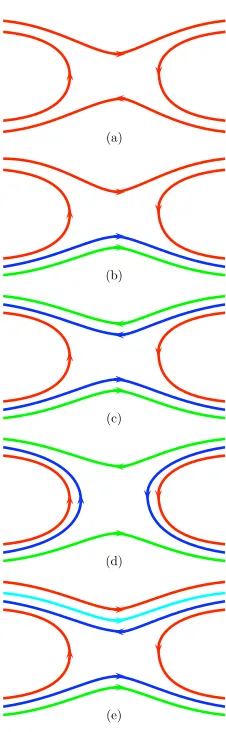
Fig. 1. s- and t-channel content for some hadronic
reac-tions: (a) meson–meson, (b) meson–baryon, (c) and (d) baryon– antibaryon, and (e) baryonium–baryon scattering.
We refer here to the review by Roy [3]. The con-ventional approach to the hadron–hadron interaction was
based on the Yukawa mechanism at low energy, and Regge poles at higher energy, i.e., the exchange of particles in the
t-channel. The hadronic reactions without actual particles
to be exchanged are thus expected to be suppressed. This is the case, for instance, of backwardπ+π−elastic scattering, seen as a forwardπ+π− → π−π+reaction, which involves charge Q=2 exchange.
On the other hand, hadronic reactions can be described by their s-channel content. The interaction is stronger in channels with resonances than without resonances. The consistency between these two pictures was named
dual-ity. The reactions with large cross sections must have
ac-tual particles exchanged in the t-channel and resonances in the s-channel. This concept was initiated before the quark model, but became more convincing when duality diagrams were drawn in term of quark lines, as illustrated in Fig. 1.
When considering the case of nucleon–antinucleon scattering, to which ordinary mesons contribute in the t-channel, Rosner pointed out the need for new type of mesons, preferentially coupled to baryon–antibaryon, as their partners in the s-channel, see Fig. 1. Later on, dy-namical models were invented to tentatively describe such “baryonium” states, as seen below. Note that if you now enforces an ordinary meson in the s-channel, you need a baryonium in the t-channel to satisfy the duality require-ments.
As pointed out in [3], duality does not escape the Pandora-box syndrome that is encountered in most ap-proaches to multiquarks. Once baryonium is accepted as a new hadron, the pentaquark automatically emerges. Con-sider, indeed, baryonium–baryon scattering, with ordinary mesons (quark–antiquark) exchanged in the t-channel. Then the partner s-channel consists of pentaquark, as seen in Fig. 1. Even more complicated structures appear if, in turn, a pentaquark enters a scattering with another hadron.
2.3 Baryonium
In the 70s, the baryonium states anticipated by duality ar-guments were tentatively seen as peaks in the antiproton cross section (M > 2 mp), or peaks in the annihilation at rest ¯pp → γ+ X (MX < 2 mp) [4]. They were not confirmed, unfortunately, in later experiments with higher statistics and better resolution, in particular at the LEAR facility of CERN.
A somewhat simple picture of baryonium is that of a deuteron-like NN bound state or resonance, benefiting from the attractive potential mediated by the exchange of mesons [5]. The authors, however, never agreed on the in-fluence of the very strong annihilation on the spectrum.
Another interpretation was named diquonium or quark-model baryonium, with two localised quarks and two lo-calized antiquarks separated by an orbital barrier. This [(qq)−( ¯q ¯q)] structure explains why the state is
A further speculation envisaged the possibility of a colour sextet for the diquark, this leading to an even nar-rower [(qq)−( ¯q ¯q)]. This “colour chemistry” was also
ex-tended to the baryon number B = 1 sector, with [( ¯qq−
(qqq)] states [7].
2.4 Scalar mesons
Within models available in the 70s (simple quark models, MIT bag), it was discovered that four quarks in S -wave, experiencing a favourable spin–spin interaction, have a mass which is comparable, or even lower, than an orbital excitation of (q ¯q) with a spin triplet S = 1 and an orbital momentum L=1 coupled to J=0 [8, 9].
At about the same time, KK molecules were suggested [10, 11], also candidates for scalar mesons near 1 GeV. This was the beginning of an intense activity, with mixing between these various (non-orthogonal!) configurations, and further complications due to glueball and hybrid states entering the game.
The main question is whether counting the states in the spectrum is compatible with pure (q ¯q) with higher Fock state corrections, or does require extra states. For instance, it is argued in [12] that the present data in the meson sector do not call for hybrid, glueballs or molecules, except as corrections to a main (q ¯q) component.
The scalar sector of light mesons is regularly revisited. In the framework of QCD sum rules, it is found that the states contain a large fraction of glueballs [13]. A realistic description of the scalar mesons and meson–meson inter-action requires the contribution of several channels [14].
2.5 Pentaquarks
Interesting reviews have been written on the pentaquark episode [15, 16]. The story started with a nice speculation based of chiral dynamics [17], leading Nakano and his col-leagues to attempt a measurement out of the stream of fash-ion at that time, and to get a positive signal [18]. The real surprise was the wave of positive evidences elsewhere, in-cluding experiments having already the data on tape for several years, that nobody had to curiosity to use to search for exotic baryons. However, the pentaquark was not con-firmed in high-statistics experiments using sophisticated and expensive detectors with good particle identification.
Some studies were also done in lattice QCD, but some-what hastily, with a variety of conclusion about the exis-tence of the pentaquark and about its plausible quantum numbers. Clearly, more time would have been required to better distinguish between a genuine bound state or res-onance and a state simply occurring from the discretisa-tion of the continuum in the finite volume of the lattice. The theoretical activity is much slowed down today, but not completely dead, in particular better studies are per-formed on multiquarks within the framework of QCD sum rules and lattice QCD, as seen in several contributions to this Conference, where references can be found.
2.6 Hadronic molecules
This is a very long history. In the 50s, the∆was described
asπN resonance, i.e., a kind of molecule. But this picture
was not easily extended to other meson and baryon reso-nances, and when the quark model came, it was very wel-come as a progress.
Today, the quark model is considered as too primitive, especially in the light-quark sector, and is given up by many authors, who describe most hadrons as molecules, again, but within the improved framework of effective the-ories. Many interesting contributions have been presented at this Few-Body Conference. Any new resonance, espe-cially in the hidden-charm sector, is almost immediately described as a new meson–meson molecule, and the Pan-dora box syndrome seemingly strikes again.
However, such a blame cannot be addressed to the
X(3872), since it was predicted before its discovery, on
the basis of the pion-exchange dynamics. See, e.g., [19] for references). If the X(3872) were not confirmed as a hadron–hadron molecule and eventually interpreted as be-ing mainly a (c¯c) state, we will feel like a hen sittbe-ing on a duck egg, and rather surprised when it hatches. We learned to be careful with the molecular interpretation of the hidden-charm states. When higherψresonances were found, theorists were puzzled by the anomalies in the rel-ative decay rates into DD, D∗D +c.c. and D∗D∗, and
a molecular interpretation was suggested [20] (see, also, [21]). But the branching ratios were later understood from the node structure of the decaying states [22–24].
As reported at this conference, the mass and the early-measured properties of the X(3872) are very indicative of a
DD∗+c.c.structure. However, the branching ratio of X→ ψ(2s)+γto X → J/ψ(1s)+γis large, a property that is natural for a radially excited P-state of (c¯c).
On the theory side, the problem is whether a satis-factory theory of nuclear forces can be built outside the nucleon–nucleon case. Is has been pointed out [25] that due to the D−D∗ mass difference, the pion propagator carries energy transfer together with momentum transfer, and thus that the resulting interaction is non local, and per-haps less effective. In fact, the X(3872) in this approach looks like a D−D−πthree-body system, with the pion oscillating back and forth between the two heavy mesons, and resonating with each of them. Another problem is that there is a hard core in the nucleon–nucleon interaction, pre-venting them to merge their constituents. No such core ex-ists for DD∗ and other meson–meson systems. Hence the short-range dynamics always plays a role. Of course, at very low binding energy, the meson–meson wave function is very extended, but the strength of the attraction is not given solely by pion exchange. the exchange of heavier mesons (ω, . . .) has been introduced (see, e.g., [19]), and this can be seen as a parametrisation of the direct interac-tion between the quarks of each flavoured meson.
2.7 Mixing mania
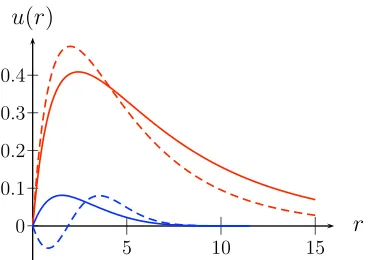
Fig. 2. Mixing of (D ¯D) and (c¯c) in a simple local model. The
solid lines represent the reduced radial wave function for the main (D ¯D) and the small (c¯c) components, as obtained from an actual
coupled-channel calculation. The dashed lines correspond to the naive mixing scheme of Eq. (1), with neighbouring unperturbed states, andθadjusted to reproduce the same normalisation for (c¯c). Note that the coupled-channel calculation does not produce any node in the (c¯c) sector. Units are GeV1/2for u(r) and GeV−1
for r.
but fails for others that are accounted for by a second model, a tantalising improvement of the picture consists of writing the wave function as
ψ=cosϑ ψ1+sinϑ ψ2, (1)
and this can be extended as to include more components. This game has been played endlessly for scalar sates in-volving radial excitations, hidden strangeness, glueballs and hybrids. In the case of the X(3872), ψ1 could be a
DD∗+c.c.molecule, andψ2a charmonium c¯c(2P) with the same quantum numbers and a radial excitation. However, the dynamics of coupled channels dictates that if cosϑ ψ1 is the leading term, the small admixture sinϑ ψ2is not very much governed by the diagonal interaction in the second channel. Instead it is given by a folding of the leading com-ponent and the transition operator. In particular, if the latter is nodeless and the former smooth, a node hardly appears inψ2.
A toy model illustrating this property is an S-wave ana-logue of the X(3872) system, with a (DD) (the difference between D and D∗ is ignored) channel weakly bound by a Yukawa potential, and a (c¯c) channel with a standard Coulomb-plus-linear potential, such that before mixing, the threshold is at 3.8 GeV, (DD) at 3.77 GeV andψ(2S ) at 3.57 GeV. The mixing is crudely mimicked by a local interaction with a Gaussian shape; The mass of the (DD) is slightly shifted (more details will be given elsewhere), and the wave function acquires a (c¯c) component, displayed in Fig. 2, which is nodeless.
The current belief is that the eigenstates mix un-changed, dominantly by affinity of neighbouring unper-turbed energies, once a gate is open between the two chan-nels. This is inspired by the denominator in the first order correction to a wave function within perturbation theory,
namely, in a obvious notation,
φi=φ(0)i +
X
j,i
hφ(0)i |V|φ(0)i i
E(0)i −E(0)j φ
(0)
i +· · · (2)
However, the node structure of theφ(0)i often gives more drastic constraints. Another example is S−D mixing in
or-dinary charmonium dynamics. It is almost ever considered thatψ(1D) preferentially mixes withψ(2S ) which is very close. But when one actually computes the small S -wave admixture inψ(1D) using an explicit tensor force with suit-able regularisation, one finds a nodeless radial function for the admixed S-component in the ψ(3770). Note that S– D mixing can be calculated analytically for the muonium (µ+e−) and the approximations can be tested there.
Back to X(3872), theψ(2S ) toψ(1S ) ratio of radiative decays has to be studied within a consistent picture involv-ing probably several Fock-space components, c¯c, c¯cq ¯q, etc. This requires a modelling of the transition operator creat-ing of annihilatcreat-ing a pair of light quarks, and a few calcu-lations.
A consistently-managed mixing scheme can give inter-esting results. An example is the celebrated Cornell pic-ture of (c¯c), supplemented by coupling to real of virtual
D(∗)D(∗)(including D
s) decay channels [24]. It was possi-ble, using this model, to predict before the discovery of the
ηc(2s) a substantial reduction of theψ(2s)−ηc(2s) split-ting [26], as compared to simple potential models. The same effect probably explains why theΥ−ηb splitting is slightly larger than estimated by most authors: the reduc-tion due the meson–meson channels is weaker here than for J/ψ−ηc. Other interesting treatments of the configura-tion mixing can be found, e.g., in [27–29].
2.8 Diquark clustering
The concept of diquark is very useful in several branches of particle physics, for instance to analyse the baryon-to-meson ratio in multiparticle production. It has been intro-duced rather early in spectroscopy, see, e.g., Ref. [30] for a review. However, some of the pioneering works are some-times ignored in recent rediscoveries of the diquarks. A first problem to which diquarks provide a sufficient solu-tion, is why Regge trajectories (squared mass M2 vs. spin
J) are linear with the same slope for baryons as for mesons.
For two-body systems, the linear character is reproduced in many pictures, e.g., H2 = P(m2+pi2)1/2+λr12. Thus the equality of slopes comes automatically if the quark– diquark baryons, [q−(qq)], are the partners of the quark– antiquark mesons, [q−¯q].
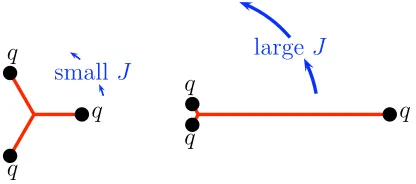
However, it is not necessary to introduce diquarks by hand to obtain the equality of slopes. In the symmet-ric quark model, the baryon analogue of H2 reads H3 = P(m2+p2
i) 1/2+V
Fig. 3. Schematic picture of a rotating baryon at low angular momentum J and higher J.
The best argument in favour of the quark–diquark model perhaps lies in the problem of missing resonances. In a recent review on baryons[32], very few states are ten-tatively interpreted with both degrees of freedom (i.e., Ja-cobi variablesxandy) excited. On the other hand, many states predicted in the three–quark model are not observed, and this was the subject of contributions to this Confer-ence. The most striking state with double excitation in the three-quark model is
Ψ =x×y exp[−a (x2+y2)/2], (3)
(here in the case of harmonic interaction, but a state with the same symmetry exists for other confining potentials). For experts, it is named the [20,1+] multiplet. Its fully an-tisymmetric orbital function, with N = 2 degrees of ex-citation, is associated with an antisymmetric spin–isospin wave function, and an antisymmetric colour wave function. It is absent in the quark–diquark picture. Experimentally, it is not (yet?) seen.
If the diquark model is taken seriously, it can be ex-trapolated outside the framework of baryon spectroscopy. We have seen that the late baryonium states have been de-scribed as a diquark and an antidiquark. More recently, cq or cs diquarks and the associated antidiquarks were intro-duced to describe the X, Y or Z states seen in the hidden-charm spectrum. See, e.g., [33]. The light pentaquark was also described as [(qq)−(qq)−¯q] [34].
Obviously, the Pandora box syndrome becomes threat-ening here too. In particular, three diquarks can well build a dibaryon. It should be checked whether in models describ-ing the Y mesons as (cs)−(¯c ¯s), the configuration (cs)3is not below the threshold for (sss)+(ccc), since it would be embarrassing to pay the price of a very exotic dibaryon to explain the Y meson. Years ago, a light dibaryon (or “de-mon deuteron” ) was shown to be a consequence of the diquark model [35].1
1 There is an error in [35] about the quantum numbers of
the orbital wave function, but this does not remove the issue of dibaryons in diquark models.
3 Binding mechanisms in simple quark
models
3.1 Chromomagnetic binding
In the 70s, the chromomagnetic interaction,
VS S =−A
X
i<j
δ(3)(ri j)
mimj
λ(c)i .λ(c)j σi.σj, (4)
inspired by the Breit–Fermi interaction in atoms, was shown to account for the observed hyperfine splittings in ordinary hadrons, including the Σ − Λ mass diff er-ence. There is an analogue in the bag model. In [36], Jaffe pointed out the H(uuddss) in its ground state has a chromomagnetic interaction whose cumulated (attractive) strength is larger than for the lowest thresholdΛ(uds)+
Λ(uds). Note the non-trivial colour–spin algebra. In a model with pure spin–spin, VS S ∝ Pσi.σj, a J = 0 tetraquark receives a cumulated strengthP
i<jσi.σj =−6, whereas each scalar meson of its threshold experiences P
i<jσi.σj = −3, and thus there is no obvious excess of attraction. At best a small gain from a favourable spa-tial distortion. Remember also the positronium molecule, governed by V = P
i<jgi j/ri j: its binding is not obvi-ous because the cumulated strength isPg
i j = −2 for the molecule, andPg
i j =−2 also for the threshold made of two atoms. The miracle in (4) is that
D
λ(c)i .λ(c)j σi.σj E
H=2 D
. . .E
threshold (5)
If the quark masses mi are identical (SU(3)f symme-try) and if the short-range correlation factors hδ(3)(ri j)i are assumed to be the same in multiquarks as in ordinary baryons, then the H is predicted about 150 MeV below the threshold. The H was searched for in more than 15 experi-ments, with negative results, including double-Λ hypernu-clei.
In 1987, Lipkin, and independently Gignoux et al. [37– 39] pointed out that the same mechanism would bind an exotic pentaquark (the word was invented in this context)
P(Qqqqq)<(Qq)+(qqq), (6)
where Q =c,b and (qqqq) is a combination of u, d, s, in
a SU(3)f flavour triplet. The same binding of−150 MeV is found if Q becomes infinitely heavy. A search for the P r in an experiment at Fermilab turned out not conclusive [40, 41]. Silvestre-Brac and Leandri listed other candidates [42].
However, further studies of the chromomagnetic model [43–46] indicated that the corrections tend to moderate and even to cancel the binding effect due to the group-theoretical result (5). In particular:
– There is more kinetic energy in a dibaryon than in two baryons (5 Jacobi variables vs. 4),
– SU(3)fbreaking is not favourable. TheΛresists much better than H.
Nevertheless, the simple chromomagnetic Hamiltonian (4) might still reveal some surprises. For instance, if di-agonalised with realistic values for the flavour dependent strength factorshδ(ri ji/(mimj), it provides the (c¯cq ¯q) low-est configuration with JPC = 1++ the main features re-quired to describe the X(3872) [47, 48].
3.2 Chromoelectric binding
We adopt here the language of potential models but we be-lieve that the results are much more general. The main ad-vantage of potential models is the possibility of switching on or offsome contributions to single out the most effective one for binding.
A remarkable property of the spin-independent interac-tion among quarks is flavour independence, which induces interesting symmetry breaking effects.
Remember that symmetry breaking tends to lower the ground-state energy. The simplest example is h=p2+x2+
λx in one-dimensional quantum mechanics, with a ground
state energy e(λ) =1−λ2/2 which is always below e(0). But this is very general. If
H(λ)=Heven+λHodd, (7)
the variational principle applied to H(0) with the even ground stateΨ(0) of Hevenas trial wave function gives
E(λ)≤ hΨ(0)|H(λ)|Ψ(0)i=E(0). (8)
One can apply this result to few-body systems with a va-riety of symmetries for which the labels “odd” and “even” make sense, in particular particle identity and charge
con-jugation. But stability is a competition between a
config-uration with collective binding and another configconfig-uration where the system is split into separate decay products. The threshold also benefits from the symmetry breaking, and very often more! In this case, stability deteriorates, though the energy of the compound configuration decreases.
For instance, consider the barely bound (e+,e+,e−,e−)
molecule, or any rescaled version with the electron mass replaced by another mass µ, and move to configurations involving two different masses. Then it is observed, and proved, that:
– for (M+,m+,M−,m−): binding deteriorates and is lost
for M/m&2.2 [49],
– for (M+,M+,m−,m−): the binding is improved.
But the Coulomb character matters little. What is impor-tant, is that the potential does not change when the masses are varied. Hence, a similar behaviour is observed for any four-body problem with flavour independence. The split-ting (the potential V is assumed to be symmetric under charge conjugation, and independent of the masses)
H(M,M,m,¯ m)¯ = p
2 1 2M+
p2
2 2M+
p2
3 2m+
p2
4
2m+V, (9)
=H(µ, µ,µ,¯ µ¯)+ " 1
4M − 1 4m
#
(p21−p22+p23−p24),
implies for the ground state
E(M,M,m,¯ m)¯ ≤E(µ, µ,µ,¯ µ¯), 2µ−1=M−1+m−1,
(10) but, meanwhile, the threshold energy remains constant, as
(M,m) and (µ,¯ µ¯) have the same reduced mass. So the
sta-bility is improved.
Explicit quark-model calculations have been carried out to illustrate how this favourable symmetry break-ing works with flavour-independent potentials. The cor-responding four-body problem is rather delicate, as most other four-body problems. Remember that when Wheeler proposed in 1945 (the paper paper was published some-what later [50]) that the positronium molecule might be stable, a first numerical investigation by Ore [51] con-cluded that the system is likely unstable, but the follow-ing year, Hylleraas and the same Ore published a beautiful analytic proof of the stability [52].
In current quark models, the main conclusion is that binding a doubly-flavoured tetraquark requires a large mass ratio, usually (bb ¯q ¯q) or (bc ¯q ¯q). However, a more sophisticated calculation by Janc and Rosina [53] found (cc ¯q ¯q) barely bound. See, e.g., [54] for a detailed survey of
the situation.
4 Steiner-tree model of confinement
It should be acknowledged, however, that these early con-stituent-model calculations suffer from a basic ambiguity: how to extrapolate from mesons towards multiquarks. The usual recipe is
V=−3
16 X
i<j ˜
λ(c)i .λ˜(c)j v(ri j), (11)
which is presumably justified for the short-range part, but not for the long-range part, except for very peculiar spatial configurations. In (11), the normalisation is such that v(r) is the quark–antiquark interaction in ordinary mesons. Strictly speaking, (11) holds for a pairwise inter-action with colour-octet exchange. Clearly colour-singlet exchange cannot contribute to confinement, otherwise ev-erything would be confined together, but colour-singlet exchange can contribute to short-range terms. Moreover, there are very likely three-body and multi-body forces in baryons and multiquarks.
In the case of baryons, it was suggested very early [55, 56] that the potential generalising the linear confinement of mesons is
VY=σmin
J 3 X
i=1
riJ. (12)
Fig. 4. Confinement of mesons and baryons. The minimum over the quark permutations gives the flip–flop potential.
from these obtained using the colour-additive rule, which for baryons reduces to the “1/2” rule, namely
V3=
σ
2 (r12+r23+r31) . (13)
This Y-shape interaction has been generalised to tetraquarks. At first, this looks as an astute guess, but it was later endorsed by detailed lattice QCD [58], including the interplay between flip–flop and connected Steiner tree. See, also, [59] for a study within AdS/QCD. The confining potential reads
U =min{d13+d24,d14+d23,V4} , (14)
V4 =min
s1,s2
(kv1s1k+kv2s1k+ks1s2k+ks2v3k+ks2v4k) ,
corresponding schematically to the flux tubes in Fig. 5
Fig. 5. Generalisation of the linear potential of mesons to tetraquarks: the minimum is taken of the flip–flop (left) and Steiner tree (right) configurations.
A first study of the tetraquark spectrum with this po-tential concluded to the “absence of exotics” [60], but a re-analysis by Vijande et al. [61] with a better wave function, indicated that this potential, if alone, and free of constraints due to the Pauli principle, gives stability for the equal-mass case (qq ¯q ¯q), and improved stability for the flavour asym-metric (QQ ¯q ¯q). It remains to analyse how this stability survives antisymmetrisation, short-range terms in the po-tential, relativistic effects and spin-dependent corrections. This is however, very encouraging.
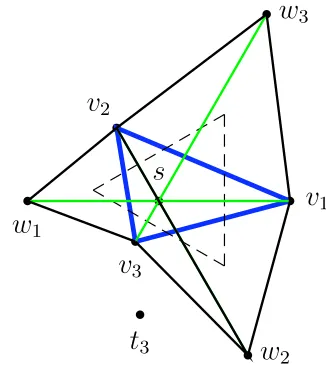
Two developments came. First, a better understand-ing (at least by physicists) of the Steiner trees, with effi -cient algorithms [62] to compute them, and novel inequal-ities [63]. For instance, in a Steiner tree, a set of point can be replaced by its associated torro¨ıdal domain, For instance, in the baryon Y-problem, the continuous min-imisation over the location of the Steiner point s can be replaced by a discrete maximisation: the desired Y-shape length,ksv1k+ksv2k+ksv3kin Fig. 6 is the largest of the two distancesksw3kandkst3k, where the pointsw3and t3, named the Melznak points or torro¨ıdal domain of{v1, v2}, form an equilateral triangle withv1andv2.
Fig. 6. The continuous minimisation over the location of s is replaced by the discrete maximum max{ksw3k,kst3k}, wherew3
and t3make an equilateral triangle with the quarksv1andv2. Here, V3=ksv1k+ksv2k+ksv3k=kv3w3k.
Fig. 7. Baryon potential and Napoleon’s theorem.
This property, and the interesting symmetry restoration (even for an asymmetric triangle, the flux tubes from the junction to the quarks make 120◦angles in Fig. 4) are re-lated to the theorem by Napoleon (see Fig. 7): if one starts from an asymmetric trianglev1v2v3and builds an external equilateral triangle such asv1v2w3along each side, the cen-tres of these auxiliary triangles form an equilateral triangle.
The analogue for a planar tetraquark is
VS =ks1v1k+ks1v2k+ks2v3k+ks2v4k=kw12w34k, (15)
and is illustrated in Fig. 8: the length of Steiner tree linking the quarks v1 andv2 to the antiquarks v3 and v4 via the junctions s1and s2is he distance between the two Melznak pointsw12andw34.
In space, one gets the problem pictured in Fig. 9: the auxiliary pointsw12andw34are located on a circle of axis
prob-Fig. 8. The length of the Steiner tree is the distance between the vertices making an external triangle in the quark and in the antiquark sector.
Fig. 9. The length of the Steiner tree is the maximal distance between the quark and antiquark Melznak circles.
lem in computer-assisted geometry, as applied, e.g., in the cartoon industry.
Then you can derive inequalities on the Hamiltonian, and recover rigorously in some limiting cases the stability established by numerical methods.
The disappointing observation, however, is that the dy-namics is dominated by the simple flip–flop term, and the most interesting connected Steiner tree plays a relatively minor role.
The exercise can be repeated for the pentaquark, using the linear model with minimal cumulated length,
VP =min(Vff,VSt),
Vff =min
i h
r1i+VY(rj,rk,rℓ) i
, (16)
VSt=connected Steiner tree,
i.e., the configurations in Fig. 10.
Fig. 10. Pentaquark confining potential: flip–flop (up) and con-nected (down).
A simple variational calculation gives stability at least for ( ¯qqqqq), and (Qqqqq) and ( ¯qqqqQ) where m(Q) ≫ m(q) [64]. The other mass configurations remain to be
studied.
This proliferation of stable states in the minimal-length model becomes embarrassing. Very likely, the dibaryon will also be found stable. If one believes into this con-finement, this means that the role of the neglected effects should be investigated with care, in particular:
– Coulomb forces, perturbative and non perturbative, – antisymmetrisation.
If the constraints of antisymmetrization turn out the main obstacle to multiquark stability, then exotic hadrons have to be searched in configurations with quarks of different flavours.
5 Conclusions
The problem of multiquark binding is now addressed very seriously with QCD sum rules, Lattice QCD and even AdS/QCD. These ambitious but delicate approaches have first confirmed some results that were previously obtained empirically, such as the Steiner-tree structure of the linear term of the confining interaction.
On the experimental side, it is hope that the future col-lider experiments will devote a reasonable amount of time to search for exotics with heavy flavour. As shown by B factories, there is a very good potential of discoveries in hadron physics within experiments primarily designed for studying other aspects of particle physics.
Acknowledgments
It is a pleasure to thank the organisers of this beautiful Con-ference for giving us the opportunity of many stimulating discussions.
References
1. C. Amsler et al., Phys. Lett.B667, 1 (2008) 2. R.L. Jaffe, F.E. Low, Phys. Rev.D19, 2105 (1979) 3. D.P. Roy, J. Phys.G30, R113 (2004)
4. L. Montanet, G.C. Rossi, G. Veneziano, Phys. Rept. 63, 149 (1980)
5. I.S. Shapiro, Phys. Rept.35, 129 (1978) 6. H.M. Chan et al., Phys. Lett.B76, 634 (1978) 7. M. de Crombrugghe, H. Hogaasen, P. Sorba, Nucl.
Phys.B156, 347 (1979)
8. R.L. Jaffe, Phys. Rev.D15, 267 (1977) 9. R.L. Jaffe, Phys. Rev.D15, 281 (1977)
10. J.D. Weinstein, N. Isgur, Phys. Rev. Lett. 48, 659 (1982)
11. J.D. Weinstein, N. Isgur, Phys. Rev.D41, 2236 (1990) 12. E. Klempt, A. Zaitsev, Phys. Rept.454, 1 (2007) 13. R. Kaminski, G. Mennessier, S. Narison, Phys. Lett.
B680, 148 (2009)
14. G. Rupp, S. Coito, E. van Beveren (2009), ArXiv: 0905.3308 (hep-ph)
15. A.S.B. Tariq, PoSLAT2007, 136 (2007) 16. C.G. Wohl, Pentaquarks, in [1] (2008)
17. D. Diakonov, V. Petrov, M.V. Polyakov, Z. Phys. A359, 305 (1997)
18. T. Nakano et al. (LEPS), Phys. Rev. Lett.91, 012002 (2003)
19. E.S. Swanson, Phys. Rep.429, 243 (2006)
20. A. De Rujula, H. Georgi, S.L. Glashow, Phys. Rev. Lett.38, 317 (1977)
21. M.B. Voloshin, L.B. Okun, JETP Lett.23, 333 (1976) 22. A. Le Yaouanc, L. Oliver, O. Pene, J.C. Raynal, Phys.
Lett.B71, 397 (1977)
23. A. Le Yaouanc, L. Oliver, O. Pene, J.C. Raynal, Phys. Lett.B72, 57 (1977)
24. E. Eichten, K. Gottfried, T. Kinoshita, K.D. Lane, T.M. Yan, Phys. Rev.D21, 203 (1980)
25. M. Suzuki, Phys. Rev.D72, 114013 (2005)
26. A. Martin, J.M. Richard, Phys. Lett.B115, 323 (1982) 27. D. Gamermann, J. Nieves, E. Oset, E.R. Arriola
(2009), ArXiv:0911.4407 (hep-ph). 28. G. Bali, C. Ehmann (2009),0911.1238
29. R.D. Matheus, F.S. Navarra, M. Nielsen, C.M. Zanetti, Phys. Rev.D80, 056002 (2009)
30. M. Anselmino, E. Predazzi, S. Ekelin, S. Fredriksson, D.B. Lichtenberg, Rev. Mod. Phys.65, 1199 (1993) 31. A. Martin, Z. Phys.C32, 359 (1986)
32. E. Klempt, J.M. Richard (2009), to appear in Rev. Mod. Phys.,0901.2055
33. N.V. Drenska, R. Faccini, A.D. Polosa, Phys. Rev. D79, 077502 (2009)
34. R.L. Jaffe, F. Wilczek, Phys. Rev. Lett. 91, 232003 (2003)
35. S. Fredriksson, M. J¨andel, Phys. Rev. Lett. 48, 14 (1982)
36. R.L. Jaffe, Phys. Rev. Lett.38, 195 (1977) 37. H.J. Lipkin, Phys. Lett.B195, 484 (1987)
38. C. Gignoux, B. Silvestre-Brac, J.M. Richard, Phys. Lett.B193, 323 (1987)
39. H.J. Lipkin, Nucl. Phys.A625, 207 (1997)
40. E.M. Aitala et al. (E791), Phys. Rev. Lett. 81, 44 (1998)
41. E.M. Aitala et al. (E791), Phys. Lett.B448, 303 (1999) 42. B. Silvestre-Brac, J. Leandri, Phys. Rev. D45, 4221
(1992)
43. J.L. Rosner, Phys. Rev.D33, 2043 (1986)
44. G. Karl, P. Zenczykowski, Phys. Rev. D36, 2079 (1987)
45. S. Fleck, C. Gignoux, J.M. Richard, B. Silvestre-Brac, Phys. Lett.B220, 616 (1989)
46. T. Sakai, K. Shimizu, K. Yazaki, Prog. Theor. Phys. Suppl.137, 121 (2000)
47. H. Hogaasen, J.M. Richard, P. Sorba, Phys. Rev.D73, 054013 (2006)
48. F. Buccella, H. Hogaasen, J.M. Richard, P. Sorba, Eur. Phys. J.C49, 743 (2007)
49. D. Bressanini, M. Mella, G. Morosi, Phys. Rev. A 57(6), 4956 (1998)
50. J.A. Wheeler, Ann. N.Y. Acad. Sci.48(1946) 219. 51. A. Ore, Phys. Rev.70(1-2), 90 (1946)
52. E.A. Hylleraas, A. Ore, Phys. Rev.71(8), 493 (1947) 53. D. Janc, M. Rosina, Few Body Syst.35, 175 (2004) 54. J. Vijande, A. Valcarce, N. Barnea, Phys. Rev.D79,
074010 (2009)
55. X. Artru, Nucl. Phys.B85, 442 (1975)
56. H.G. Dosch, V.F. Muller, Nucl. Phys. B116, 470 (1976)
57. T.T. Takahashi, H. Matsufuru, Y. Nemoto, H. Sug-anuma, Phys. Rev. Lett.86, 18 (2001)
58. F. Okiharu, H. Suganuma, T.T. Takahashi, Phys. Rev. D72, 014505 (2005)
59. O. Andreev, Phys. Rev. D78, 065007 (2008),
0804.4756
60. J. Carlson, V.R. Pandharipande, Phys. Rev.D43, 1652 (1991)
61. J. Vijande, A. Valcarce, J.M. Richard, Phys. Rev.D76, 114013 (2007)
62. P. Bicudo, M. Cardoso, Phys. Lett.B674, 98 (2009) 63. C. Ay, J.M. Richard, J.H. Rubinstein, Phys. Lett.
B674, 227 (2009),0901.3022
64. J.M. Richard (2009), Phys. Rev. C (in press), ArXiv: 0908.2944 (hep-ph)