INTRODUCTION
Drug deliver y systems (DDSs) are regarded as a promising means to control post-operative inflammation1, although design improvements are needed to increase biocompatibility and effectiveness, as well to prolong controlled release of the drug2. Interest in biodegradable polymers, and specifically in a DDS matrix, has been growing. The main reason for this is that delivery systems based on biodegradable polymers do not require removal of the polymers from the body at the end of the treatment period, as they degrade into physiologically occurring compounds that can be readily excreted from the body3.
Controlled Release of Acetaminophen from
CMC-Based Hydrogels
MOHAMMAD SADEGHI¹, FATEMEH SOLEIMANI¹ and MOJGAN YARAHMADI²
¹Department of Chemistry, Science Faculty, Islamic Azad University, Arak Branch, Arak (Iran). ²Deaprtment of Enghlish, Faculty of Humanities, Ialamic Azad University, Arak Branch, Arak (Iran).
*Corresponding author: E-mail: [email protected] (Received: July 23, 2011; Accepted: August 25, 2011)
ABSTRACT
The purpose of this study was to produce intelligent CMC-based superabsorbent polymers (SAP) to be used as pH-sensitive carriers for the controlled delivery of Acetaminophen drug. Acrylamide (AAm) monomer was graft copolymerized onto CMC backbones by a free radical polymerization technique using ammonium persulfate (APS) as initiator and methylene bisacrylamide (MBA) as a crosslinker. Hydrogel formation was confirmed by FTIR spectroscopy. Results from scanning electron microscopy (SEM) observation also showed a porous structure with smooth surface morphology of the hydrogel. the drug, Acetaminophen, was successfully loaded into the hydrogels and in vitro release studies were performed in SGF for the initial 150 min, followed by SIF until complete dissolution. The release profiles of Astaminophen from the hydrogel were determined by UV–Vis absorption measurement at lmax 266 nm.
Key words: CMC, hydrogel, acrylamide monomer, Acetaminophen, releasing drug.
Hydrogels are hydrophilic polymer networks which may absorb from 10 to 20% (within arbitrary limit) up to thousands times their dry weight in water4. Stimuli-responsive smart hydrogels that can respond to environmental physical and chemical stimuli, such as temperature5, pH 6, light, electric field7, and magnetic field11 have attracted great interests in recent years due to their versatile applications such as controlled drug and gene delivery systems, chemical-/bio-separations12, and sensors and/or actuators . Among those smart hydrogels, pH-responsive hydrogels have been extensively investigated for potential use in site-specific delivery of drugs to site-specific regions of the gastrointestinal tract and have been prepared for delivery of low molecular weight drugs.
www.orientjchem.org
CODEN: OJCHEG 2011, Vol. 27, No. (3): Pg. 895-902 An International Open Free Access, Peer Reviewed Research Journal
The target of the current study was to exploit novel pH-sensitive collagen-based hydrogels for the effective ephedrine controlled release system. Drug absorption and release capacities of hydrogel systems were also examined.
Superabsorbent can absorb tremendous amounts of water without dissolving in water because they contain considerable amounts of hydrophilic groups and have a three-dimensional structure. In fact, the network can swell in water and hold a large amount of water while maintaining the structure. Superabsorbent hydrogels are useful for many applications, such as disposable pads, sheets, and towels for surgery, adult incontinence, and female hygiene products, even through they were originally developed for agricultural applications to improve the water-holding capacity of soils to promote the ger mination of seeds and plant growth10.
Considerable interest has been focused on chemical modification by grafting synthetic polymers onto natural polymers such as CMC, chitosan, chitin, Na-Alginate, carrageenane and starch. Graft copolymerization with various vinyl monomers can be carried out with different initiator systems and by different mechanisms. CMC is an important derivative of cellulose and comprises carboxylate functional groups in its structure. This natural polymer is a hydrophilic polymer that dissolving of this polymer in water causes a viscose solution. Crosslinking of CMC backbones are an important rout to preparation of CMC based hydrogels. An others efficient approach to modify swelling behaviour of CMC hydrogels is graft polymerization of vinylic monomers onto CMC. Graft copolymerization of vinyl monomers onto CMC to preparation of hydrogels have been reported10-12. The present work reveals graft copolymerization of acryl amide monomer onto CMC in the presence of methylenebisacrylamide (MBA) as a crosslinking agent. The reaction variables affected the swelling capacity of CMC-g-PAAM Superabsorbent hydrogels was studied.
EXPERIMENTAL Materials
CMC sample (DS 0.52) was purched from
Merch Co. Acrylamide (AAm, Fluka), was used after crystallization in acetone. Potassium persulfate (KPS, Merck) was used without purification. Methylenebisacrylamide (MBA, Fluka), was used as recieved. All other chemicals were of analytical grade. The drug, Acetaminophen, was obtained from Jaberebne Hayan Pharmaceutical Co. (Tehran, Iran). The chemical structure of Acetaminophen is shown in Figure 1. Double distilled water was used for the hydrogel preparation and swelling measurements.
Fig. 1: Chemical structure of drug Acetaminophen
Preparation of hydrogel
CMC solution was prepared in a one-liter reactor equipped with mechanical stirrer and gas inlet. CMC was dissolved in degassed distillated water. In general, 0.50 g of CMC was dissolved in 30.0 mL of distillated degassed water. The reactor was placed in a water bath preset at 60 oC. Then 0.10 g of KPS (dissolved in 5 mL water) as an initiator was added to CMC solution and was allowed to stir for 10 min at 60 oC. After adding KPS, variable amounts of AAm were added to the CMC solution. MBA as a crosslinker (0.050 g in 2 mL water) was added to the reaction mixture after the addition of monomer and the mixture was continuously stirred for one hour under argon. The total volume of reaction was 40 mL. After 60 min., the reaction product was allowed to cool to ambient temperature and methanol (500 mL) was added to the gelled product. After complete dewatering for 24 h, the product was filtered, washed with fresh methanol (2×50 mL) and dried at 50 oC(9).
Infrared Analysis
Swelling Measurements
A CMC-g-PAAm sample (0.10 g) was put into a weighed teabag and immersed in 100 mL distilled water and allowed to soak for 2 h at room temperature. The equilibrated swollen gel was allowed to drain by removing the teabag from water and hanging until no drop drained (~30 min.). The bag was then weighed to determine the weight of the swollen gel. The absorbency (equilibrium swelling) was calculated using the following equation:
Absorbency = (Ws - Wd)/Wd ...(1) where Ws and Wd are the weights of the swollen gel and the dry sample, respectively. So, absorbency was calculated as grams of water per gram of resin (g/g). The accuracy of the measurements was ±2%.
Standard absorbance curve
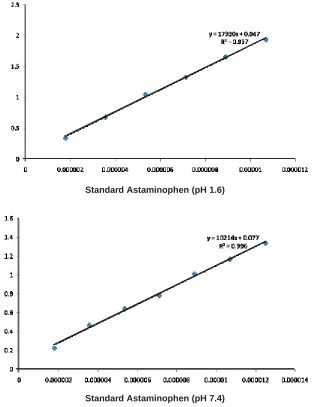
The standard calibration curve of the absorbance as a function of drug concentration was studied at 245 nm on the UV spectrophotometer.
Fig. 2: The standard calibration curve of the absorbance as a function of Acetaminophen concentration at 256 nm on the UV spectrophotometer at pH 1.6 (a) and pH 7.4 (b)
Standard Astaminophen (pH 1.6)
Encapsulation of model drug
Loading of Acetaminophen (25% w/w, based on the total weight of the hydrogel) was carried out by swelling (0.1g) polymeric hydrogel sample in phosphate buffer solution (pH 7.4) at 37oC. After immersing the hydrogel for 24 h, it was taken out, dried and reweighed. The increase in the weight of the hydrogel was taken as the amount of drug loaded, Acetaminophen encapsulation efficiency percentage, (EE%). The resulting polymer ic hydrogels were collected, dried and stored until further investigation13.
Spectrophotometric analysis of model drug A UV/visible spectrophotometer (Shimadzu, UV-2550) was used to determine the maximum spectra of the drug. Model drug in aqueous solution was prepared for determining the maximum absorption wavelength. The characteristic peak was observed. The absorbance value at the maximum wavelength of 256 nm of the model drug was read and the corresponding model drug concentrations were calculated from the calibration curve.
Determination of the amount of drug entrapped The amount of Acetaminophen entrapped into the hydrogels was calculated by measuring the absorbance of the gelling medium at 256 nm. The amount of Acetaminophen entrapped was estimated by the difference between the initial and the final amount of drug in gelling media. Encapsulation efficiency percentage was expressed as the weight of drug entrapped in the beads divided by the initial weight of ephedrine in solution. Moreover, it is important to notice that the drug exhibited the same λmax for whatever the release medium used in this study, as the free drug in water and the presence of dissolved polymers did not interfere with the absorbance of the drug at this wavelength14-15. Release studies
In vitro release studies were performed in
SGF and SIF at 37 oC. Accurately weighed amounts of dried drug-loaded beads (ranging from 0.1 to 0.2 g) were placed in beakers containing 1 L of the release medium at 37 oC. At periodic intervals 5 mL of aliquots were collected from the release medium, and the Acetaminophen concentrations were measured using a spectrophotometer at λmax 256
nm. The percentage of cumulative amount of released Acetaminophen, obtained from three experiments, was calculated and plotted against time.
RESULTS AND DISCUSSION Synthesis and Characterization
PAAm was simultaneously grafted onto CMC in a homogenous medium using KPS as a radical initiator and MBA as a crosslinking agent under an inert atmosphere.
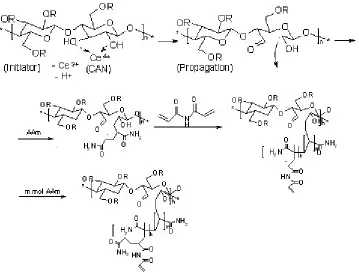
The crosslinker, initiator and the monomer concentration, as well as the reaction temperature four important variables affected on swelling capacity of hydrogel, were investigated. The mechanism of co polymerization of AAm onto chitosan in the presence of MBA is shown in Scheme 1. The persulfate initiator is decomposed under heating to generate sulfate anion-radical. The radical abstracts hydrogen from the hydroxyl group of the polysaccharide substrate to form alkoxy radicals on the substrate. So, this persulfate-saccharide redox system is resulted in active centers on the substrate to radically initiate polymerization of AAm led to a graft copolymer. Since a crosslinking agent, e.g. MBA, is presented in the system, the copolymer compr ises a crosslinked structure. The superabsorbency of this hydrogel in distilled water and various saline solutions were investigated(8-9). For identification of the hydrogel, infrared spectroscopy was used. Figure 3 shows the IR spectroscopy of CMC-g-PAAm hydrogel. The superabsorbent hydrogel product comprises a CMC backbone with side chains that carry carboxamide functional groups that are evidenced by peaks at 1660 cm-1. In fact, In the spectrum of the hydrogel (Fig. 3-b), new peaks are appeared at 3206 and 1660 cm-1 that may be attributed to amide NH stretching, asymmetric and symmetric amide NH bending, respectively.
In vitro release behavior of hydrogels
Scheme 1: General mechanism for CAN-initiated graft copolymerization of acrylamide onto CMC swells due to anion-anion repulsive electrostatic
forces, while at pH 1.2, it shrinks within a few minutes due to protonation of the carboxylate anions. This swelling behavior of the hydrogels makes them as suitable candidate for designing drug delivery systems.
The most challenging task in the development of drug pharmaceuticals is to deal with instabilities of drugs in the harsh environment of the stomach. Drug encapsulation processes that require the use of organic solvents or heating might potentially physically modify or denature the therapeutic proteins. Encapsulation processes that require chemical bond for mation among the encapsulation reagents might unintentionally chemically modify the therapeutic proteins. However, our drug loading process was desirable as the encapsulation of Acetaminophen was performed avoiding any organic solvent, high temperature, unfavorable pH and other harsh environmental conditions. The conditions were benign sufficiently as the resulting hydrogel physically entrapped the ephedrine drug. Fig. 5 shows the Acetaminophen release profile of the test hydrogels at pH 1.2 and
subsequently at pH 7.4. The amount of Acetaminophen released at pH 1.2 was low; only about 15% Acetaminophen was released from the test hydrogel, whereas that released at pH 7.4 increased significantly (56%). The favorable Acetaminophen release performance could be attributed to the pH-sensitivity of the hydrogel. Swelling of such hydrogel in the stomach was minimal and thus the drug release was also minimal. Due to increase in pH, the extent of swelling increased as the hydrogel passed down the intestinal tract, the hydrogel swelled and the controlled release of Acetaminophen was affected(15).
Fig. 3: FTIR spectra of pure CMC(a) and homopolymer-free CMC-g-PAAm copolymer (b)
Fig. 4: Effect of pH of solution on swelling of CMC-g-polyacrylamide hydrogel
Fig. 6: Schematic showing the effect of ON–OFF cycles of pH on swelling behavior. It shows the pH triggered collapse and resultant burst release due to squeezing effect
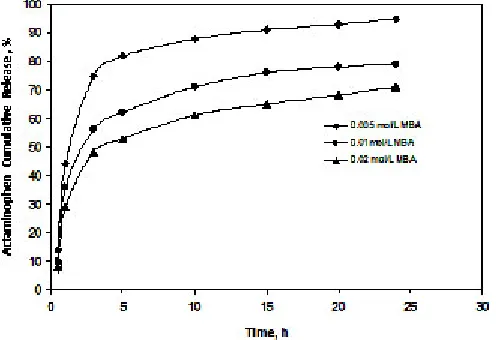
Fig. 6: In vitro cumulative release of Acetaminophen from the hydrogel with different crosslinker content at pH 7.4 and 37oC
The dependence of the extent of crosslinking on in vitro release was also displayed in Fig. 6. It is observed that release rates depend upon the amount of MBA used as crosslinking agent. The cumulative drug release of Acetaminophen from the hydrogels was decreased with increasing MBA content. This could be due to the fact that at higher crosslinking, free volume of the matrix will decrease, thereby hindering the transport of drug molecules through the matrix16-17.
CONCLUSION
The grafting of acrylamide onto CMC was carried out using CAN as an efficient initiator in the presence of methylenebisacrylamide (MBA) as a
1. Eddington, D.T., Beebe, D.J. Flow control with hydrogels. Adv. Drug Deliv. Rev. 56: 199-210 (2004).
2. Hamidi, M., Azadi, A., Raûei, P. Hydrogel nanoparticles in drug delivery. Adv. Drug
Deliv. Rev. 60: 1638-1649 (2008).
3. Koo, H., Jin, G., Kang, H., Lee, Y., Nam, H.Y., Jang, H., Park, G.S. A new biodegradable crosslinked polyethylene oxide sulûde (PEOS) hydrogel for controlled drug release.
International Journal of Pharmaceutics. 374:
58-65 (2009).
4. Kakinoki, S., Taguchi, T., Saito, H., Tanaka, J., Tateishi, T. Injectable in situ forming drug delivery system for cancer chemotherapy using a novel tissue adhesive: characterization and in vitro evaluation. Eur.
J. Pharm. Bio. 66: 383-90 (2007).
5. Kim, S.J., Spinks, G.M., Prosser, S., Whitten, P.G., Wallace, G.G., Kim, S.I., Surprising shrinkage of expanding gels under an external load. Nat. Mater. 5: 48-51 (2006). 6. Kranz, H., Bodmeier, R. Structure formation
and characterization of injectable drug loaded biodegradable devices: in situ implants versus in situ microparticles. Eur. J.
Pharm. Sci. 34: 164-72 (2008).
7. Sadeghi,M, Yarahmadi,M, Preparation and characterization of metronidazole loaded Carboxymethyl cellulose-base superabsorbent for drug delivery application,
Oriental Journal of Chemistry, 27(2):
417-427 (2011).
8. Sadeghi,M, Yarahmadi,M, Preparation and characterization of metronidazole loaded Carboxymethyl cellulose-base superabsorbent for drug delivery application,
Oriental Journal of Chemistry, 27(2):
417-427 (2011).
9. Sadeghi,M, Yarahmadi,M, Synthesis of a Novel pH- and Salt-Responsive Superabsorbent Hydrogel Based on Collagen-g-poly(AA-co-IA), Jour nal of
Chemistry, 27(2): 453-460 (2011).
10. Kwon, I.C., Bae, Y.H., Kim, S.W. Electrically erodible polymer gel for controlled release of drugs. Nature, 354: 291-293 (1991). 11. Oh, J.K., Drumright, R., Siegwart, D.J.,
Matyjaszewski, K. The development of microgels/nanogels for dr ug deliver y applications. Prog. Polym. Sci. 33: 448-77 (2008).
12. Siepmann, J., Peppas, N.A. Modeling of drug release from delivery systems based on hydroxypropyl methylcellulose (HPMC). Adv.
Drug Deliv. Rev. 48: 139-57 (2001).
13. Soppimath, K.S., Aminabhavi, T.M., Dave, A.M., Kumbar, S.G., Rudzinski, W.E.. Stimulus- responsive “smart” hydrogels as novel drug delivery systems. Drug Dev. Ind.
Pharm. 28: 957-974 (2002).
14. Tatsuma, T., Takada, K., Miyazaki, T. UV-light-induced swelling and visible-light-UV-light-induced shrinking of a TiO2-containing redox gel. Adv.
Mater. 19: 1249-1251(2007).
15. Thor nton, P.D., Mar t, R.J., Ulijn, R.V. Enzyme-responsive polymer hydrogel particles for controlled Release. Adv. Mater. 19: 1252-1256 (2007).
16. Wang, W., Liu, L., Ju, X.J., Zerrouki, D., Xie, R., Yang, L., Chu, L.Y.. A novel thermo-induced self-bursting microcapsule with magnetic-targeting property. Chem. Phys.
Chem. 10: 2405-2409 (2009).
17. Yang, M., Chu, L.Y., Wang, H.D., Xie, R., Song, H., Niu, C.H. A thermoresponsive membrane for chiral resolution. Adv. Funct.
Mater. 18: 652-663 (2008).