BioMedCentral
Page 1 of 16 (page number not for citation purposes)
BMC Medical Informatics and
Decision Making
Open Access
Software
The caCORE Software Development Kit: Streamlining
construction of interoperable biomedical information services
Joshua Phillips
1, Ram Chilukuri
2,4, Gilberto Fragoso
3, Denise Warzel
3and
Peter A Covitz*
3Address: 1Science Applications International Corporation, Annapolis, MD, USA, 2Oracle Corporation, Reston, VA, USA, 3National Cancer Institute Center for Bioinformatics, 6116 Executive Blvd., Rockville, MD 20852 USA and 4SemanticBits LLC, Baltimore, MD, USA
Email: Joshua Phillips - [email protected]; Ram Chilukuri - [email protected];
Gilberto Fragoso - [email protected]; Denise Warzel - [email protected]; Peter A Covitz* - [email protected] * Corresponding author
Abstract
Background: Robust, programmatically accessible biomedical information services that syntactically and semantically interoperate with other resources are challenging to construct. Such systems require the adoption of common information models, data representations and terminology standards as well as documented application programming interfaces (APIs). The National Cancer Institute (NCI) developed the cancer common ontologic representation environment (caCORE) to provide the infrastructure necessary to achieve interoperability across the systems it develops or sponsors. The caCORE Software Development Kit (SDK) was designed to provide developers both within and outside the NCI with the tools needed to construct such interoperable software systems.
Results: The caCORE SDK requires a Unified Modeling Language (UML) tool to begin the development workflow with the construction of a domain information model in the form of a UML Class Diagram. Models are annotated with concepts and definitions from a description logic terminology source using the Semantic Connector component. The annotated model is registered in the Cancer Data Standards Repository (caDSR) using the UML Loader component. System software is automatically generated using the Codegen component, which produces middleware that runs on an application server. The caCORE SDK was initially tested and validated using a seven-class UML model, and has been used to generate the caCORE production system, which includes models with dozens of classes. The deployed system supports access through object-oriented APIs with consistent syntax for retrieval of any type of data object across all classes in the original UML model. The caCORE SDK is currently being used by several development teams, including by participants in the cancer biomedical informatics grid (caBIG) program, to create compatible data services. caBIG compatibility standards are based upon caCORE resources, and thus the caCORE SDK has emerged as a key enabling technology for caBIG.
Conclusion: The caCORE SDK substantially lowers the barrier to implementing systems that are syntactically and semantically interoperable by providing workflow and automation tools that standardize and expedite modeling, development, and deployment. It has gained acceptance among developers in the caBIG program, and is expected to provide a common mechanism for creating data service nodes on the data grid that is under development.
Published: 06 January 2006
BMC Medical Informatics and Decision Making 2006, 6:2 doi:10.1186/1472-6947-6-2
Received: 19 August 2005 Accepted: 06 January 2006
This article is available from: http://www.biomedcentral.com/1472-6947/6/2
© 2006 Phillips et al; licensee BioMed Central Ltd.
BMC Medical Informatics and Decision Making 2006, 6:2 http://www.biomedcentral.com/1472-6947/6/2
Page 2 of 16 (page number not for citation purposes)
Background
caCORE is a framework for creating syntactically and semantically interoperable biomedical information serv-ices [1]. Systems developed using the caCORE methodol-ogy use the same approach to defining, registering, and adopting data and representation standards. Clients of those systems can therefore draw upon multiple sources using similar API calls, and can rely on semantic equiva-lence of the data retrieved. caCORE consists of several components. Enterprise Vocabulary Services (EVS), a description-logics based thesaurus and ontology manage-ment system, provides terminology developmanage-ment and hosting services. The cancer Data Standards Repository (caDSR), an ISO/IEC 11179 metadata registry [2], pro-vides for reference metadata management and distribu-tion. The Cancer Bioinformatics Infrastructure Objects (caBIO) module provided the model-driven architecture for data interfaces that has since been adopted by all caCORE components. The Common Security Module (CSM) provides for highly granular access control and authorization schemes. Complete documentation and updated information on caCORE can be found on the NCICB web site[3]. A number of biomedical informatics groups use caCORE for the management of data standards and to create interoperable genomic, translational, and clinical research applications. Examples of such applica-tions include the Cancer Models Database[4], caWork-bench[5], Cancer Molecular Analysis Project[6], and Cancer Centralized Clinical Database[7].
One of the primary incentives for making the caCORE development tools and methodology available to the broader community was the advent of caBIG[8]. The caBIG program was launched in 2003 as a federated pro-gram of biomedical information system and tool develop-ment. caBIG spans multiple research domains, including basic biology, genomics, proteomics, clinical trials, tissue banking and pathology, and imaging. caBIG presently includes participants from 50 cancer centers as well as other government, commercial, and non-profit institu-tions enaged in cancer research and patient advocacy.
In order for the tools developed by different development groups in caBIG to become interoperable, members of the caBIG program defined several different levels of system compatibility and interoperability that can be achieved by meeting certain sets of requirements[9]. The requirements are grouped into four major categories of standards: Infor-mation Models; Common Data Elements; Terminology; and Programming Interfaces. By meeting the require-ments in all four categories, a system is said to have achieved a particular level of compatibility. The levels have been defined and labeled, in ascending order of stringency, as "Bronze", "Silver", and "Gold". As of the writing of this article caBIG developers are aiming for
Sil-ver-level compatibility in their projects, as the Gold level is still being defined by the program participants. There-fore, a toolkit that simplifies construction of a Silver-com-patible resource was needed.
caBIG Silver compatibility calls for data systems to pro-vide a documented API that serves up data objects derived from a domain object model that has been expressed as a UML class diagram. All data elements described by the model must be registered in the NCI caDSR. Terminology used for the model and data elements must originate from a caBIG-approved vocabulary source.
We assessed the functionality provided by the caCORE system with respect to caBIG compatibility and deter-mined that it meets Silver level compatibility itself. We further determined that caCORE resources combined with other open-source components could be leveraged to assist other caBIG developers in with constructing their own Silver-compatible information systems. We therefore set about to upgrade and package the tools we had used to create caCORE itself. The product of this effort, the caCORE SDK, now enables any group to reproduce our methodology for implementing a caBIG Silver-compliant resource.
Implementation
We analyzed and compared a number of open-source and low-cost tools and utilities that would support the con-struction of a model-driven system that was grounded in a solidly defined semantic foundation. The caCORE 3.0 information architecture formed the basis for our approach, but we selected components from external sources in addition to those developed at the NCI. The components were assembled and documented to support a streamlined workflow that accepts an information model expressed in the Unified Modeling Language (UML) as a starting point[10]. The model is semantically annotated using concepts from EVS terminology services and registered in the caDSR metadata registry for retrieval as needed by applications. The model is then fed into a Java code and database generator that creates fully func-tioning middleware connected to back-end data storage services. The resulting APIs are uniform across all data classes in the model, and provide for runtime access to structured research data as well as the associated metadata describing the semantics and information model.
UML modeling tool
BMC Medical Informatics and Decision Making 2006, 6:2 http://www.biomedcentral.com/1472-6947/6/2
Page 3 of 16 (page number not for citation purposes)
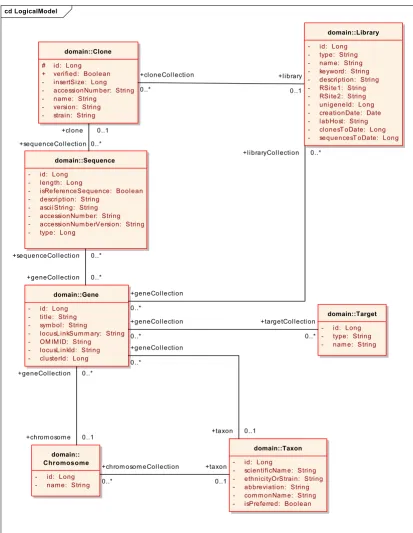
Example UML domain model, shown as a class diagram Figure 1
Example UML domain model, shown as a class diagram. The model shown here, a subset of the larger caBIO model used in the production caCORE system, includes several classes related to the class Gene. This model was used for initial testing and vali-dation of kit components. After the kit was validated, the caCORE SDK was used with all the full-sized caCORE domain mod-els (not shown).
cd LogicalModel
domain:: Chromosome - i d: Long - nam e: Stri ng
domain::Clone # i d: Long + veri fi ed: Bool ean - i nsertSi ze: Long - accessi onNum ber: Stri ng - nam e: Stri ng
- versi on: Stri ng - strai n: Stri ng
domain::Gene - i d: Long - ti tl e: Stri ng - sym bol : Stri ng
- l ocusLi nkSum m ary: Stri ng - OM IM ID: Stri ng - l ocusLi nkId: Stri ng - cl usterId: Long
domain::Library - i d: Long - type: Stri ng - nam e: Stri ng - keyword: Stri ng - descri pti on: Stri ng - RSi te1: Stri ng - RSi te2: Stri ng - uni geneId: Long - creati onDate: Date - l abHost: Stri ng - cl onesT oDate: Long - sequencesT oDate: Long
domain::Sequence - i d: Long
- l ength: Long
- i sReferenceSequence: Bool ean - descri pti on: Stri ng
- asci i Stri ng: Stri ng - accessi onNum ber: Stri ng - accessi onNum berVersi on: Stri ng - type: Long
domain::Target - i d: Long - type: Stri ng - nam e: Stri ng
domain::Taxon - i d: Long
- sci enti fi cNam e: Stri ng - ethni ci tyOrStrai n: Stri ng - abbrevi ati on: Stri ng - com m onNam e: Stri ng - i sPreferred: Bool ean
0..* +l i braryCol l ecti on
0..*
+geneCol l ecti on 0..*
+sequenceCol l ecti on
0..* +geneCol l ecti on
0..* +targetCol l ecti on
0..*
+geneCol l ecti on
0..*
+geneCol l ecti on
0..1 +taxon 0..*
+geneCol l ecti on
0..1 +chrom osom e
0..*
+chrom osom eCol l ecti on
0..1 +taxon
0..1 +l i brary
0..*
+cl oneCol l ecti on
0..* +sequenceCol l ecti on
BMC Medical Informatics and Decision Making 2006, 6:2 http://www.biomedcentral.com/1472-6947/6/2
Page 4 of 16 (page number not for citation purposes) open-source – are available in the market today. To select
a UML modeling tool we conducted an extensive evalua-tion process based on a wide variety of selecevalua-tion criteria. The criteria included: ability to import/export UML mod-els to and from XML Metadata Interchange (XMI) specifi-cation; support for all types of UML diagrams, for tagged values, and for stereotypes; performance; and cost. UML models must be exported to XMI format in order to be used in the subsequent steps in the caCORE SDK work-flow[11]. Any UML 1.3 modeling tool that produces XMI 1.1 output should in principle be serviceable, though slight variations in XMI implementation may require some processing of the XMI files prior to usage with the caCORE SDK. Figure 1 shows an example class diagram from Enterprise Architect (EA), our first choice due to its relatively low cost and high performance[12].
Semantic connector
Proper semantic integration requires that each class and class attribute from the UML model gets mapped to appropriate concepts in a controlled terminology. The caCORE SDK utilizes the NCI Thesaurus (NCIT) as its pri-mary terminology source. The NCIT contains terms in use by the NCI and the cancer community, and is intended to facilitate interoperability, data sharing, and semantic inte-gration between systems by mapping terms to unique concepts, providing codes, and providing base semantics and relations [13,14]. The NCIT is built in a description logics (DL) environment [13]. In the DL, concepts are compositionally defined by their placement in a sub-sumption hierarchy based on an agreed classification principle, and the role expressions asserted on the con-cept. Classification of the DL terminology by a reasoner can be considered a debugging step, and is utilized to val-idate defined concepts as well as identifying conflicting and inconsistent concepts. Although other terminology authoring systems can prove equally useful, we consider DL an integral part of terminology development because it helps to enforce the base semantics of the terminology. The rigour and consistency of the resulting product is deemed necessary to support the creation of metadata describing data that must be shared across disparate sys-tems. In the future, other DL terminology sources in addi-tion to the NCIT may be integrated with the caCORE SDK.
The concept selection process can be entirely manual, or it can be partially automated using the Semantic Connector, a tool supplied by the caCORE SDK. The Semantic Con-nector uses the UML Model expressed in XMI as input and uses the caCORE EVS APIs hosted at the NCI to search the NCI Thesaurus for appropriate concepts. The search algo-rithm specifically takes class and attribute names as input. String matching is conducted against the Preferred_Name and Synonym properties of the NCI Thesaurus. If an ini-tial query with the whole UML class or attribute name fails
to return results, the names are processed into component tokens based on underscores or case changes. For exam-ple, first_name or firstName would be split into the terms 'first' and 'name', and the semantic connector uses these component tokens to query the NCI Thesaurus.
The Semantic Connector returns a report as a comma-sep-arated value file, listing possible matching concepts where found. This report is reviewed by developers and subject matter experts to ensure that the correct mapping of UML classes and attributes to semantic concepts. The report is edited manually to correct any errors in the automated output. In the cases where the automated matching fails to return a match, or returns more than one match to an existent concept, the assignment is made manually. Fur-ther, if the search and subsequent manual review reveals that no NCI Thesaurus concept (or combination of cepts) adequately represents the UML entity, suitable con-cepts are created. If a combination of concon-cepts is required to adequately represent the class or attribute, they are explicitly ordered to preserve the intended semantics. The validated report containing mapped entities is then used to automatically insert tagged values for the semantic con-cepts back into the XMI representation of the UML model. The final product is thus an annotated UML model that includes all the semantic concept codes for each class and attribute. The model and the additional tagged values rep-resenting the semantic annotations can be viewed in the UML modeling tool.
UML loader
The UML model, annotated with semantic concept codes, contains a considerable amount of metadata about the ultimate system that will be deployed. However, it is not in a form that is amenable to query and retrieval in a runt-ime environment nor easily queried by humans to make use of this information for other purposes such as creating forms to collect data. To address these limitations, we developed a strategy for transforming and loading the models into the caDSR, which provides APIs that support runtime access to metadata.
BMC Medical Informatics and Decision Making 2006, 6:2 http://www.biomedcentral.com/1472-6947/6/2
Page 5 of 16 (page number not for citation purposes) Data Element Concept, when joined to a Value Domain,
forms an ISO/IEC 11179 Data Element.
Recognizing that UML modeling tools can export a model as an XMI file, we created the UML Loader, a utility that takes an XMI file as input. UML Loader uses mapping rules to convert UML Classes, Attributes, associations, and cardinality relationships into the corresponding ISO/IEC 11179 constructs: Object Class, Property, Data Element Concept, and Data Element. UML Loader then inserts these constructs into the caDSR. The insertion rules include a harmonization step in which the model compo-nents are compared to existing metadata compocompo-nents in the caDSR. Wherever an exact match to the same concept codes is found, the model component is not duplicated in the caDSR, and the existing component is re-used. In this way components of new models are automatically harmo-nized with those of existing models. We refer to the re-usa-ble data element components as Common Data Elements (CDEs).
Curation and specification of data standard constraints The binding of specific thesaurus concepts to the UML model components and subsequent loading into the caDSR is necessary, but not entirely sufficient, to specify an interoperable system. The UML Loader automatically creates a default non-enumerated Value Domain for each Data Element. This default is sufficient for those Data Ele-ments that do not need further specification beyond one of a general or primitive data type. However, for many fields, a crucial additional requirement is the specification of data standards that are to be used to constrain the allowable data entries in the final data management sys-tem. A list of enumerated permissible values or specific rules for values for a given Data Element needs to be explicitly defined such that values or rules can be retrieved and checked as needed during system instantiation or data validation.
UML provides the Object Constraint Language extension that could, in principle, be used this purpose. However, due to the level of interactive integration with EVS and existing caDSR content that is required to support con-struction of Value Domains, we have found that, in prac-tice, it is more efficient to edit the Value Domains directly in the caDSR after UML model loading. For those Data Elements that require constraint by an enumerated list of values, data standards, or specific rules, further refinement of the model's metadata must be performed. The caDSR's CDE Curation Tool is a web application that enables a metadata curator with appropriate access permission to create or reuse existing Value Domains and insert or refer-ence a list of permissible values. When using the CDE Curation Tool, the values may be drawn from EVS termi-nologies or other externally defined value sets. The CDE
Curation Tool is not formally part of the caCORE SDK itself, but it is presently an essential auxiliary utility for this particular step in the workflow.
Final Curation of the model in caDSR includes a review using the caDSR tools and/or the APIs to ensure that all UML classes, attributes and associations have been prop-erly transformed. A caDSR classification scheme equating to the UML Model is used to facilitate retrieval of all the associated caDSR metadata. After the model metadata has been reviewed for completeness, ensuring that all classes and attributes and appropriate associations have been cre-ated in caDSR as expected, additional information can be entered directly into caDSR using the caDSR tools, such as attaching a copy of the UML diagram for reference. In the final step of model curation, the model owner or meta-data curator creates any necessary value enumerations or rules for Value Domains using the Curation Tool. The CDE Curation Tool is used to search for and incorporate EVS terminologies to build value lists based on existing data standards, thus allowing application owners to fur-ther disambiguate each Data Element.
Code generator
Code generation reduces the cost of producing and main-taining large, consistent, and intuitive data-access APIs. The caCORE SDK includes a code generation framework called Codegen. Codegen is a complete code generation framework that is independent of any modeling tool and it can be used independently of the rest of the caCORE SDK.
Several existing, open-source, code generation tools were considered before it was deemed necessary to build Code-gen. Among the tools considered were AndroMDA, AXgen, Eclipse Modeling Framework (EMF), and XDoclet [15-18]. The criteria used to evaluate these tools included the following: UML support; model API standardization; extent of model access; ease of extensibility; skill-set match; and extent of modeling constraints. While none of these tools, on their own, satisfied all the criteria, the com-ponents that some of these tools use can be combined in a way that does.
BMC Medical Informatic
s and Decision Making
20
06,
6
:2
http://www.bi
omedcen
tr
al
.co
m
/14
72-69
47/6/2
Pa
ge 6 of
1
6
(page number not for citation purposes)
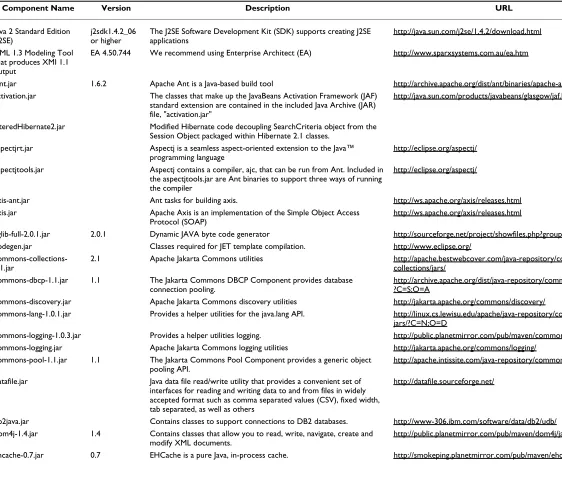
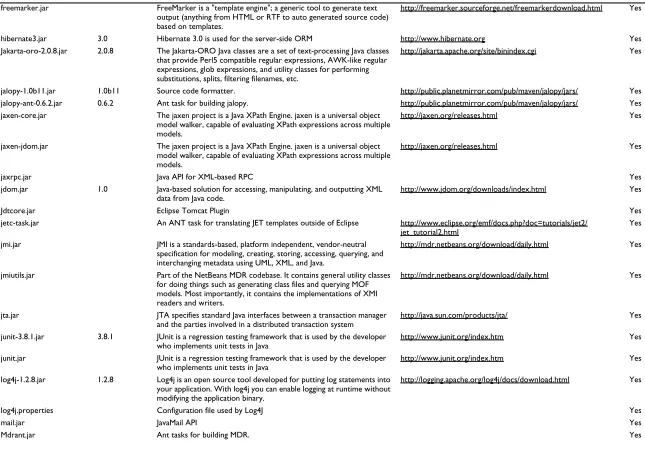
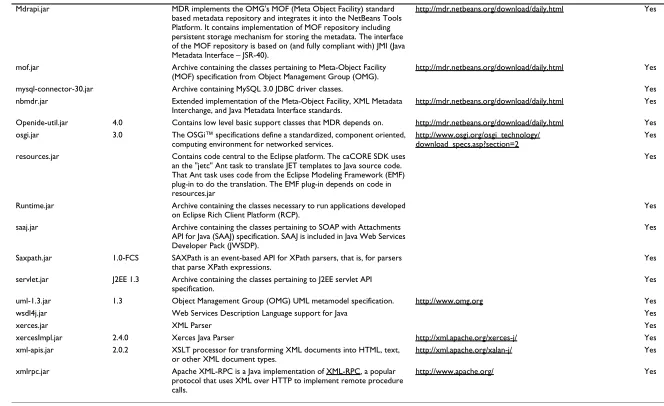
Table 1: Components of the caCORE SDK.
Component Name Version Description URL Incl.
Java 2 Standard Edition (J2SE)
j2sdk1.4.2_06 or higher
The J2SE Software Development Kit (SDK) supports creating J2SE applications
http://java.sun.com/j2se/1.4.2/download.html No
UML 1.3 Modeling Tool that produces XMI 1.1 output
EA 4.50.744 We recommend using Enterprise Architect (EA) http://www.sparxsystems.com.au/ea.htm No
Ant.jar 1.6.2 Apache Ant is a Java-based build tool http://archive.apache.org/dist/ant/binaries/apache-ant-1.6.2-bin.zip Yes
activation.jar The classes that make up the JavaBeans Activation Framework (JAF) standard extension are contained in the included Java Archive (JAR) file, "activation.jar"
http://java.sun.com/products/javabeans/glasgow/jaf.html Yes
alteredHibernate2.jar Modified Hibernate code decoupling SearchCriteria object from the Session Object packaged within Hibernate 2.1 classes.
Yes
aspectjrt.jar Aspectj is a seamless aspect-oriented extension to the Java™ programming language
http://eclipse.org/aspectj/ Yes
aspectjtools.jar Aspectj contains a compiler, ajc, that can be run from Ant. Included in the aspectjtools.jar are Ant binaries to support three ways of running the compiler
http://eclipse.org/aspectj/ Yes
axis-ant.jar Ant tasks for building axis. http://ws.apache.org/axis/releases.html Yes
axis.jar Apache Axis is an implementation of the Simple Object Access Protocol (SOAP)
http://ws.apache.org/axis/releases.html Yes
cglib-full-2.0.1.jar 2.0.1 Dynamic JAVA byte code generator http://sourceforge.net/project/showfiles.php?group_id=56933 Yes
codegen.jar Classes required for JET template compilation. http://www.eclipse.org/ Yes
commons-collections-2.1.jar
2.1 Apache Jakarta Commons utilities http://apache.bestwebcover.com/java-repository/commons-collections/jars/
Yes
commons-dbcp-1.1.jar 1.1 The Jakarta Commons DBCP Component provides database connection pooling.
http://archive.apache.org/dist/java-repository/commons-dbcp/jars/ ?C=S;O=A
Yes
commons-discovery.jar Apache Jakarta Commons discovery utilities http://jakarta.apache.org/commons/discovery/ Yes
commons-lang-1.0.1.jar Provides a helper utilities for the java.lang API. http://linux.cs.lewisu.edu/apache/java-repository/commons-lang/ jars/?C=N;O=D
Yes
commons-logging-1.0.3.jar Provides a helper utilities logging. http://public.planetmirror.com/pub/maven/commons-logging/jars/ Yes
commons-logging.jar Apache Jakarta Commons logging utilities http://jakarta.apache.org/commons/logging/ Yes
commons-pool-1.1.jar 1.1 The Jakarta Commons Pool Component provides a generic object pooling API.
http://apache.intissite.com/java-repository/commons-pool/jars/ Yes
datafile.jar Java data file read/write utility that provides a convenient set of interfaces for reading and writing data to and from files in widely accepted format such as comma separated values (CSV), fixed width, tab separated, as well as others
http://datafile.sourceforge.net/ Yes
db2java.jar Contains classes to support connections to DB2 databases. http://www-306.ibm.com/software/data/db2/udb/ Yes dom4j-1.4.jar 1.4 Contains classes that allow you to read, write, navigate, create and
modify XML documents.
http://public.planetmirror.com/pub/maven/dom4j/jars/ Yes
BMC Medical Informatic
s and Decision Making
20
06,
6
:2
http://www.bi
omedcen
tr
al
.co
m
/14
72-69
47/6/2
Pa
ge 7 of
1
6
(page number not for citation purposes)
freemarker.jar FreeMarker is a "template engine"; a generic tool to generate text output (anything from HTML or RTF to auto generated source code) based on templates.
http://freemarker.sourceforge.net/freemarkerdownload.html Yes
hibernate3.jar 3.0 Hibernate 3.0 is used for the server-side ORM http://www.hibernate.org Yes
Jakarta-oro-2.0.8.jar 2.0.8 The Jakarta-ORO Java classes are a set of text-processing Java classes that provide Perl5 compatible regular expressions, AWK-like regular expressions, glob expressions, and utility classes for performing substitutions, splits, filtering filenames, etc.
http://jakarta.apache.org/site/binindex.cgi Yes
jalopy-1.0b11.jar 1.0b11 Source code formatter. http://public.planetmirror.com/pub/maven/jalopy/jars/ Yes
jalopy-ant-0.6.2.jar 0.6.2 Ant task for building jalopy. http://public.planetmirror.com/pub/maven/jalopy/jars/ Yes jaxen-core.jar The jaxen project is a Java XPath Engine. jaxen is a universal object
model walker, capable of evaluating XPath expressions across multiple models.
http://jaxen.org/releases.html Yes
jaxen-jdom.jar The jaxen project is a Java XPath Engine. jaxen is a universal object model walker, capable of evaluating XPath expressions across multiple models.
http://jaxen.org/releases.html Yes
jaxrpc.jar Java API for XML-based RPC Yes
jdom.jar 1.0 Java-based solution for accessing, manipulating, and outputting XML data from Java code.
http://www.jdom.org/downloads/index.html Yes
Jdtcore.jar Eclipse Tomcat Plugin Yes
jetc-task.jar An ANT task for translating JET templates outside of Eclipse http://www.eclipse.org/emf/docs.php?doc=tutorials/jet2/ jet_tutorial2.html
Yes
jmi.jar JMI is a standards-based, platform independent, vendor-neutral specification for modeling, creating, storing, accessing, querying, and interchanging metadata using UML, XML, and Java.
http://mdr.netbeans.org/download/daily.html Yes
jmiutils.jar Part of the NetBeans MDR codebase. It contains general utility classes for doing things such as generating class files and querying MOF models. Most importantly, it contains the implementations of XMI readers and writers.
http://mdr.netbeans.org/download/daily.html Yes
jta.jar JTA specifies standard Java interfaces between a transaction manager and the parties involved in a distributed transaction system
http://java.sun.com/products/jta/ Yes
junit-3.8.1.jar 3.8.1 JUnit is a regression testing framework that is used by the developer who implements unit tests in Java
http://www.junit.org/index.htm Yes
junit.jar JUnit is a regression testing framework that is used by the developer who implements unit tests in Java
http://www.junit.org/index.htm Yes
log4j-1.2.8.jar 1.2.8 Log4j is an open source tool developed for putting log statements into your application. With log4j you can enable logging at runtime without modifying the application binary.
http://logging.apache.org/log4j/docs/download.html Yes
log4j.properties Configuration file used by Log4J Yes
mail.jar JavaMail API Yes
Mdrant.jar Ant tasks for building MDR. Yes
BMC Medical Informatic
s and Decision Making
20
06,
6
:2
http://www.bi
omedcen
tr
al
.co
m
/14
72-69
47/6/2
Pa
ge 8 of
1
6
(page number not for citation purposes)
Mdrapi.jar MDR implements the OMG's MOF (Meta Object Facility) standard based metadata repository and integrates it into the NetBeans Tools Platform. It contains implementation of MOF repository including persistent storage mechanism for storing the metadata. The interface of the MOF repository is based on (and fully compliant with) JMI (Java Metadata Interface – JSR-40).
http://mdr.netbeans.org/download/daily.html Yes
mof.jar Archive containing the classes pertaining to Meta-Object Facility (MOF) specification from Object Management Group (OMG).
http://mdr.netbeans.org/download/daily.html Yes
mysql-connector-30.jar Archive containing MySQL 3.0 JDBC driver classes. Yes
nbmdr.jar Extended implementation of the Meta-Object Facility, XML Metadata Interchange, and Java Metadata Interface standards.
http://mdr.netbeans.org/download/daily.html Yes
Openide-util.jar 4.0 Contains low level basic support classes that MDR depends on. http://mdr.netbeans.org/download/daily.html Yes
osgi.jar 3.0 The OSGi™ specifications define a standardized, component oriented, computing environment for networked services.
http://www.osgi.org/osgi_technology/ download_specs.asp?section=2
Yes
resources.jar Contains code central to the Eclipse platform. The caCORE SDK uses an the "jetc" Ant task to translate JET templates to Java source code. That Ant task uses code from the Eclipse Modeling Framework (EMF) plug-in to do the translation. The EMF plug-in depends on code in resources.jar
Yes
Runtime.jar Archive containing the classes necessary to run applications developed on Eclipse Rich Client Platform (RCP).
Yes
saaj.jar Archive containing the classes pertaining to SOAP with Attachments API for Java (SAAJ) specification. SAAJ is included in Java Web Services Developer Pack (JWSDP).
Yes
Saxpath.jar 1.0-FCS SAXPath is an event-based API for XPath parsers, that is, for parsers that parse XPath expressions.
Yes
servlet.jar J2EE 1.3 Archive containing the classes pertaining to J2EE servlet API specification.
Yes
uml-1.3.jar 1.3 Object Management Group (OMG) UML metamodel specification. http://www.omg.org Yes
wsdl4j.jar Web Services Description Language support for Java Yes
xerces.jar XML Parser Yes
xercesImpl.jar 2.4.0 Xerces Java Parser http://xml.apache.org/xerces-j/ Yes
xml-apis.jar 2.0.2 XSLT processor for transforming XML documents into HTML, text, or other XML document types.
http://xml.apache.org/xalan-j/ Yes
xmlrpc.jar Apache XML-RPC is a Java implementation of XML-RPC, a popular protocol that uses XML over HTTP to implement remote procedure calls.
http://www.apache.org/ Yes
BMC Medical Informatics and Decision Making 2006, 6:2 http://www.biomedcentral.com/1472-6947/6/2
Page 9 of 16 (page number not for citation purposes)
Results
Overview of the caCORE SDK
caCORE systems are built using the model-driven archi-tecture paradigm, with substantial extensions added to support the incorporation of a much richer semantic framework. The development methodology is a modified version of the Rational Unified Process embedded within a lightweight version of the traditional waterfall approach[21]. Therefore, usage of the SDK follows a par-ticular workflow pattern that mirrors our approach to constructing caCORE-type resources. The steps in the workflow include: Use case development; information modeling; semantic annotation; metadata registration; code generation; system deployment.
The result is a fully functioning multi-tiered system with a middleware layer that provides well defined APIs. The data classes, their attributes, and the data itself are tagged with appropriate concepts from a description-logics ontology. The ontology tags, associated definitions, and semantic relationships are all available in the runtime programming environment from the caCORE metadata registry, the caDSR.
The caCORE SDK includes numerous components (Table 1). Most are included with the kit download, including those open-source components that are from other projects. The kit also includes a comprehensive Program-mer's Guide. Users must obtain their own UML 1.3-com-pliant UML modeling tool that can export XMI 1.1 or 1.2. And at present, the UML Loader utility that registers the model in the caDSR metadata registry can only be run in consultation with the caDSR support team. Future
ver-sions of the kit are expected to provide direct access to UML Loader.
Use cases
A use case is a structured textual representation of how users interact with a computer application. Use cases typ-ically define one or more actors, a workflow, pre-condi-tions, post-condipre-condi-tions, and alternate scenarios. The caCORE software development process begins with use case development, using whatever tool the team prefers. The level of formality, granularity, and depth of the use cases can be adjusted based upon the needs and con-straints of the project team. We stress that use case devel-opment should not be skipped, as use cases provide tangible, stable indicators for project requirements and thus help avoid drift and scope creep. Example use cases for a number of projects can be found on the NCICB web site.
Information modeling and semantic annotation
Once a sufficiently comprehensive set of use cases has been collected, the next step is to create a domain model in UML. This model will serve as the primary determinant of the information and programming interfaces that are produced, and is also the basis for generation of the actual software code. Classes in the model should represent dis-crete scientific entities, and attributes of the classes should represent specific characteristics of the entities. The attributes become Data Elements in a software system. For example, a class might be defined as 'Gene', and an attribute of that class defined as 'Symbol' (Figure 1). In addition to classes and attributes, the model also specifies class-class associations including cardinality and
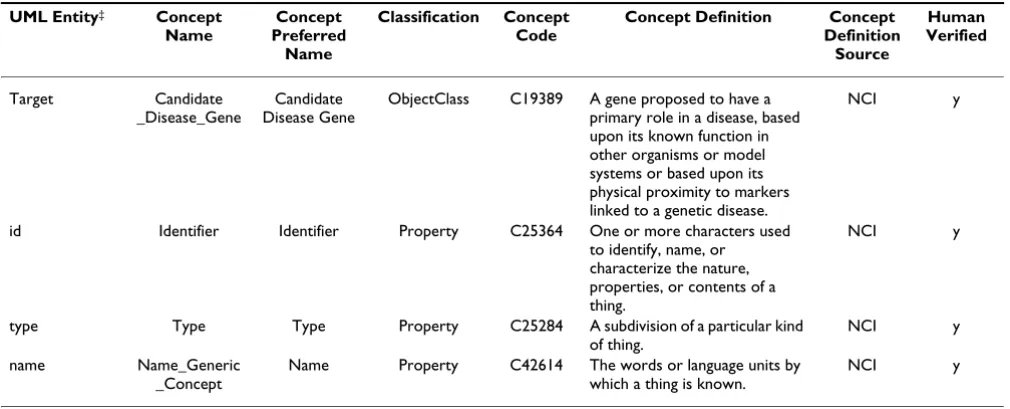
direc-Table 2: Semantic Connector report for the Target class and its attributes.
UML Entity‡ Concept Name
Concept Preferred
Name
Classification Concept Code
Concept Definition Concept Definition
Source
Human Verified
Target Candidate _Disease_Gene
Candidate Disease Gene
ObjectClass C19389 A gene proposed to have a primary role in a disease, based upon its known function in other organisms or model systems or based upon its physical proximity to markers linked to a genetic disease.
NCI y
id Identifier Identifier Property C25364 One or more characters used to identify, name, or characterize the nature, properties, or contents of a thing.
NCI y
type Type Type Property C25284 A subdivision of a particular kind of thing.
NCI y
name Name_Generic _Concept
Name Property C42614 The words or language units by which a thing is known.
NCI y
BMC Medical Informatics and Decision Making 2006, 6:2 http://www.biomedcentral.com/1472-6947/6/2
Page 10 of 16 (page number not for citation purposes) tion. It is imperative that the UML model be annotated
with descriptions; this facilitates the subsequent semantic integration, where UML entities (classes and attributes) are matched to vocabulary concepts, and the matches require review by a subject matter expert.
After the classes and attributes in the UML model are defined, but before it is finalized, the modeler undertakes the process of semantic integration, which results in the annotation of the UML entities with concept codes from a controlled terminology system. In practice this involves using the Semantic Connector utility, included with the caCORE SDK, to tag data classes and attributes with con-cepts the NCI Thesaurus. This utility accon-cepts an XMI rep-resentation of a UML class diagram as input, compares the class and attribute names to the NCI Thesaurus, and returns a report of matches between the class and attribute
names and NCI Thesaurus concepts, along with concept names, codes, preferred terms and definitions.
The report is reviewed by a subject matter expert who makes appropriate edits and selections for the final con-cept associations using a text editor or spreadsheet soft-ware. Table 2 shows a portion of the Semantic Connector report for the Target class and its attributes after manual review and annotation. In many cases the expert will assess whether a UML entity is best represented by a single concept or a combination of concepts. Consultation with an authorized editor of the terminology source may be warranted. Once the report has been appropriately edited to contain the correctly ordered concept mappings, including names and codes and definitions, it is fed back into the Semantic Connector utility, along with the origi-nal model, to produce a revised XMI file that now includes all of the relevant ontology concept information from the
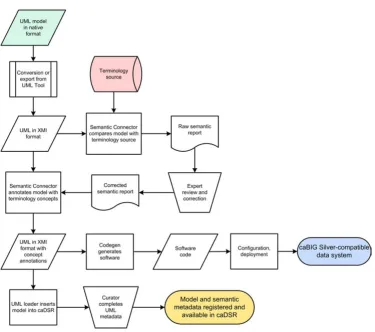
caCORE SDK Workflow Figure 2
BMC Medical Informatics and Decision Making 2006, 6:2 http://www.biomedcentral.com/1472-6947/6/2
Page 11 of 16 (page number not for citation purposes) terminology source. This modified file can be re-loaded
into the UML modeling tool as needed. Once the model has been finalized, it is fed into the next steps in the work-flow (Figure 2).
UML model loading
The semantically annotated version of the model is exported in XMI and used as an input to UML Loader, a Java application that performs the transformation of metadata from the model into caDSR metadata (Figure 2). UML model metadata corresponding to various elements of a class diagram is transformed into caDSR metadata by creating, or finding and reusing, the different types of caDSR metadata components. A high level ISO/IEC 11179 Classification Scheme is created for each UML model and used to classify and group all the model meta-data, simplifying identification and retrieval via caDSR tools and APIs.
We used the UML Loader to insert components from a semantically annotated version of the model shown in Figure 1 into the caDSR. In the case of the UML class "Chromosome", the following caDSR entities are created: an Object Class with a long name of "Chromosome"; Properties "Identifier" and "Name" corresponding to attributes "id" and "name"; Data Element Concepts "Chromosome Identifier" and "Chromosome Name" ; Data Elements "Chromosome Identifier java.lang.Long" and "Chromosome Name java.lang.String", which include the default Value Domains for the Long and String data types, respectively. In the case of this example, the default Value Domains were left unmodified.
Details of the class-class associations are recorded as rela-tionships between caDSR Object Classes, including cardi-nality and direction. Inheritance associations are treated as an "IS_A" relationship and transformed in a manner such that the class attributes associated with the target class are inherited by the source class. The resulting loaded metadata can be retrieved from the caDSR APIs or viewed interactively with the CDE Browser web application. The UML model shown in Figure 1 was loaded in this manner and can be viewed in the CDE Browser web application in the caCORE Context.
Code generation
After the UML model has been curated, Codegen is used to produce code and other artifacts from elements of the model. The code generation process is an automated workflow that is directed by an XML control file. The two steps in that process include first selecting elements of the model using a 'filter-chain' and then generating artifacts from those elements using a 'transformer-chain'. A filter-chain can select model elements that, for example, have names that will match a given regular expression or that
are members of a class hierarchy. A transformer-chain consists of one or more 'transformers' that will generate some artifact from each model element that is selected by a filter-chain. The type of transformer used depends on the type of artifact desired. The caCORE SDK supplies JET templates as the transformers that produce Java code. The syntax of JET templates is a subset of Java Server Pages (JSP) syntax, which makes writing templates easy for those with Java skills.
When a template is executed, Codegen passes it a refer-ence to the selected model element. The template code can then inspect the properties of that element to deter-mine how to generate code from it. For example, the code can determine the element's name, attributes, or any ontological information added by the Semantic Connec-tor utility. The references passed to templates are Java objects that implement standard interfaces, as specified by the Java Metadata Interface (JMI) standard. For example, if the model element is a UML 1.3 class, then the object would implement the 'org.omg.uml.founda-tion.core.UmlClass' interface. From any model element reference, the transformer code can navigate to all other information in the model by using the JMI interfaces alone, but Codegen provides utility classes for performing common operations, such as retrieving all classes associ-ated with a particular class. Out of the box, the caCORE SDK provides transformers to generate Java Bean imple-mentations of UML class elements; Hibernate Object-Relational mapping files; and other configuration files needed by the caCORE architecture.
Object to relational mappings
The caCORE SDK generates the implementation of an object-oriented API to a relational data source. Object-ori-ented queries created by clients are sent to the persistence layer, where they are mapped into equivalent SQL state-ments. The resulting database records are used to populate the caCORE domain objects that are sent back to the cli-ent. The translation of domain objects to database records, and back, is handled by the open-source object-relational mapping tool Hibernate[22]. To perform this translation, Hibernate needs XML files containing the metadata that describes how classes map to tables, how attributes map to columns, and how associations between classes map to relations between tables. Codegen gener-ates these XML files from the UML model.
map-BMC Medical Informatics and Decision Making 2006, 6:2 http://www.biomedcentral.com/1472-6947/6/2
Page 12 of 16 (page number not for citation purposes) ping, each with its own trade-offs and implications for
physical database structure. Hibernate can accommodate most approaches. However, the Codegen transformers that generate the Hibernate XML metadata files follow a single approach which places constraints on the database structure. For example, it is assumed that all tables will use a surrogate primary key. The details of these constraints are explained in the caCORE SDK's Programmers Guide.
Database creation
After the data model containing the mapping between object model and physical relational schema is created, data definition language (DDL) scripts containing SQL commands for creating database schema could optionally be generated using the "Generate DDL" utility in EA. These SQL scripts have to be executed in the chosen RDBMS environment to actually create the necessary base schema objects such as: tables and views, and data-base constraints such as: primary keys, unique keys, and foreign keys. This exercise can totally be skipped when using an existing/legacy database. Essentially, caCORE SDK supports creation of object-oriented data access API
for two types of systems: systems with existing databases and brand new systems.
During model transformation the UML Loader creates an alternate name for each Data Element in caDSR corre-sponding to the fully qualified attribute name. If the caCORE SDK naming convention is followed, these alter-nate names will match the mapping attribute names used to associate data model tables and fields with domain object model classes and attributes, forming the basis for easily identifying the caDSR Data Elements associated with the data model. For example, if the data model describes a table and field mapped to the attribute "name" of the "Chromosome" class of the domain object model, the alternate name "gov.nih.nci.cabio.domain.Chromo-some.name" is created and can be used as a search term to find the Value Domain list or rules associated with this Data Element.
System architecture and deployment
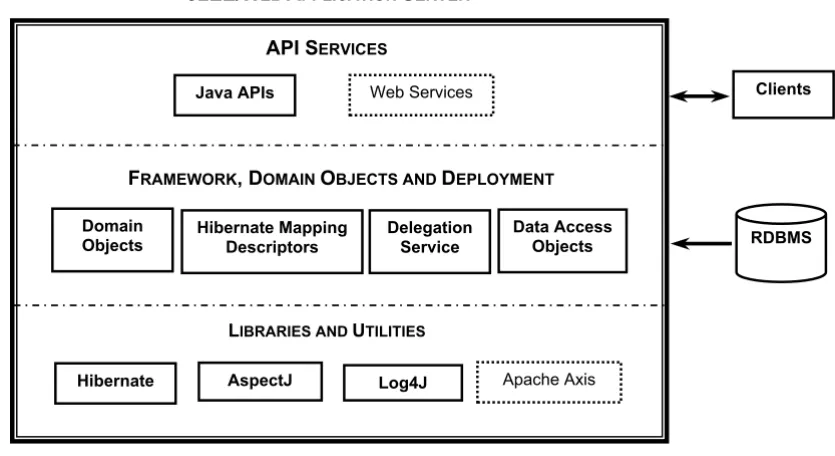
The default output of the caCORE SDK is a fully func-tional, data-access system that is similar to the caBIO
Architecture of caCORE SDK-generated system Figure 3
Architecture of caCORE SDK-generated system. Systems developed using caCORE SDK are deployed as a Web Application Archive (WAR) to a J2EE application server such as JBoss or a web application server such as Tomcat. Contents of the WAR file can be logically grouped into three categories. Libraries and Utilities are typically packaged as JAR files, and include AspectJ for auditing, Log4J for logging, and Hibernate for object-relational mapping. Framework, Domain Objects and Deployment Descriptors include caCORE SDK classes needed at runtime, domain objects with corresponding hibernate mapping files gen-erated by caCORE SDK, and property files containing configuration parameters. API Services function as a façade or an entry point to the system. Client requests are processed by the interface proxy in the application server and mapped to the appro-priate data source by the delegation service. In version 1.0.2 of caCORE SDK, described in this article, only Java APIs are gen-erated; in subsequent versions Web Services APIs can also be generated, with Apache Axis providing SOAP message support.
J2EE/WEBAPPLICATIONSERVER
AspectJ Hibernate
API SERVICES
Java APIs
RDBMS Web Services
FRAMEWORK, DOMAINOBJECTS ANDDEPLOYMENT
LIBRARIES ANDUTILITIES
Data Access Objects Delegation
Service
Apache Axis
Clients
Log4J Hibernate Mapping
Descriptors Domain
BMC Medical Informatics and Decision Making 2006, 6:2 http://www.biomedcentral.com/1472-6947/6/2
Page 13 of 16 (page number not for citation purposes) module of caCORE 3.0 (Figure 3). The system is
com-posed of six components that function on three tiers. The components include domain objects, a query API, the interface proxy, a delegator/service locator, internal data source, and external data source.
The domain objects are Java classes representing biomed-ical concepts, like Gene or Protein. Instances of these classes are populated with data by components in the data source tier and then sent by components in the server tier to the client tier. These classes follow a Java Bean-like pat-tern, which means that the properties of each object are accessible through operations whose names begin with "get". For example, to retrieve the collection of Library objects associated with a Gene object, the client invokes the getLibraryCollection operation on the Gene object.
The query API provides both a simple, query-by-example metaphor and a more powerful search criteria model. In the query-by-example approach, the client constructs a domain object and populates it with property values that are similar to those of objects that should be retrieved. The search criteria model provides a 'detached' version of the popular Hibernate 2 Criteria API, which enables expres-sion of complex query constraints. The implementation of the Hibernate 2 Criteria API has been modified (detached) to allow it to run on the client tier without making database connections to the data source tier. The query API includes a utility class, called ApplicationServ-ice, which sends queries to the caCORE server tier.
The interface proxy component provides a common entry-point into the caCORE server-tier for all types of caCORE clients. The implementation of the interface proxy that is provided with the caCORE SDK is a Java Servlet that serv-ices clients using HTTP tunneling. The client, for example, ApplicationService, packages a query within a caCORE Request object and writes it (using Java Object Serializa-tion) over an HTTP connection to the interface proxy serv-let, which deserializes the HTTP request payload back into a caCORE Request object. The results of a query are writ-ten back to the connection and deserialized by the client.
The delegator passes query requests from the interface proxy, to the logical data source that is responsible for the set of domain objects being queried. The service locator uses service metadata to map data sources to a particular implementation of a logical data source. The caCORE SDK comes with implementations for two data sources: ORM and ExternalSystem. The ORM implementation uses Hibernate to translate object criteria into SQL statements, execute those statements in a relational database, and populate domain objects from the returned records. The ExternalSystem implementation simply forwards the request to another interface proxy.
Client tier components run as (or within) standalone Java applications. The client installation involves only putting the client jar (Java Archive) file, and a few other jar files, on the Java runtime classpath. Server- and data source tier components run within an application server. Since the interface proxy component of the system is implemented as a Java Servlet, the server can be installed in any applica-tion server that supports the Java Servlet 2.3 specificaapplica-tion. By default, the caCORE SDK will download and deploy the server to Tomcat, which is a free and open-source application server that is also the reference implementa-tion of the Java Servlet specificaimplementa-tion.
Systems built using caCORE SDK
A number of biomedical research information systems have been constructed or extended using caCORE SDK. The caCORE 3.0 suite of components was built using caCORE SDK to create the object-oriented middleware and API interfaces to the various underlying data resources [3]. caCORE 3.0 provides runtime data services for terminology, metadata, and biomedical data. The SNP500Cancer project is specifically designed to generate resources for the identification and characterization of genetic variation in genes important in cancer [23]. SNP500Cancer has used the caCORE SDK to add publicly accessible object-oriented APIs to their database resource. The Protein Information Resource (PIR), an integrated public resource of protein informatics that supports genomic and proteomic research and scientific discovery, created a new object model in UML to represent their information structures, and then used the caCORE SDK to provide interoperable APIs [24]. The in vivo Image Repos-itory (I3) aims to provide access to imaging resources that will improve the use of imaging in today's cancer research and practice by: increasing the efficiency and reproduci-bility of imaging to support cancer detection and diagno-sis, leveraging imaging to provide an objective assessment of therapeutic response, and ultimately enabling the development of imaging resources that will lead to improved clinical decision support [25]. I3 used the caCORE SDK to construct its entire back-end and middle-ware. Development using caCORE SDK is currently underway in several other projects affiliated with caBIG.
Discussion
fed-BMC Medical Informatics and Decision Making 2006, 6:2 http://www.biomedcentral.com/1472-6947/6/2
Page 14 of 16 (page number not for citation purposes) erated interoperability across all sites that use the same
semantic model and APIs.
The caCORE SDK relies on UML to represent its domain information models. UML is a maturing standard that has gained widespread acceptance in the software industry. Its provision for graphical representations of models makes it a fine choice for working with biomedical subject matter experts. Since every UML model conforms to the same underlying meta-model, these models are readily lever-aged to generate consistent, well-structured software. Thus the caCORE SDK provides a full realization of the model-driven architecture paradigm. The model is the code, the code is the model.
For many years the only available UML modeling tool was a costly product that was not widely accessible to mod-estly funded developers in the biomedical informatics community. There are now several low cost choices and an open-source alternatives. We selected Enterprise Archi-tect for use with the caCORE SDK due to its combination of low cost and high performance. Poseidon for UML and ArgoUML are notable alternatives[26,27]. Processing the XMI that is exported from a given tool is necessary, as each vendor implements the XMI standard slightly differently. The XMI processor for EA-exported models is included in the caCORE SDK.
Our requirements for semantic expressiveness and runt-ime services demanded that we extend the basic UML modeling process typically used in business software development. We were able to ground the models in a richer DL semantic structure without sacrificing the bene-fits of the model-driven architecture paradigm by map-ping each UML data class and attribute to concepts in the NCI Thesaurus, a concept oriented thesaurus with ontol-ogy-like properties. The Semantic Connector provides a modest degree of automation to this added procedure, minimizing the burden on the software development team. The UML loader captures the resulting annotated model and registers it as metadata in the caDSR. The caDSR provides tools to specify permissible value con-straints for the Data Elements in the model. The caDSR also provides runtime access to metadata that can be used to satisfy a variety of discovery, semantic comparison, and data validation use cases.
Automated code generation tools have been available for a variety of programming languages for a number of years. The quality and ease of use of such tools has varied widely. Until recently the best alternatives were often quite costly. Our approach couples the meta-model structures in the XMI representation of a UML model with a template that dictates what the final code will look like. Crucial to this our approach was the availability of a number of
open-source utilities, in particular the NetBeans MDR, that made it straightforward to programmatically manipulate UML object models. We were able to efficiently couple and synchronize the model with the resulting software. The code generation itself takes only minutes, freeing the development team to focus on the scientific issues and associated semantics that impact the model structure.
The semantically connected UML models in their native and XMI formats are sufficient to support the software development team that is using the SDK for its own pur-poses. However, these file formats are not optimal to sat-isfy use cases that demand model query and retrieval services. Developers that wish to query and retrieve infor-mation about specific data classes, attributes, relation-ships and definitions within the models need a runtime model management environment that supports such functionality. We found the most straightforward way to satisfy such requirements was to map the UML meta-model components to ISO/IEC 11179 and create a spe-cialized loading utility that implements these mappings and loads models as metadata components in the caDSR. Thus the caDSR supports granular query and retrieval functions that enable application developers to present the definitional metadata about the model in appropriate user interface components.
The caCORE SDK has been used successfully by a number of projects at the NCI and in the broader community affil-iated with the caBIG program. We are presently tying these various caCORE SDK-generated systems together in a common data and analysis grid framework[28]. In this way we expect to provide a single point of entry for the advertising, discovery, and invocation of caBIG-compati-ble resources.
Conclusion
The caCORE SDK was constructed to support both inter-nal development at the NCICB as well as community developers in the caBIG program. The caBIG Vocabulary and Common Data Elements workspace has decided that UML modeling, caDSR metadata registration, and termi-nology standards must be implemented in caBIG 'Silver' compatible systems. Thus the caCORE SDK provides a rel-atively straightforward development path towards Silver-level compatibility.
BMC Medical Informatics and Decision Making 2006, 6:2 http://www.biomedcentral.com/1472-6947/6/2
Page 15 of 16 (page number not for citation purposes) compliance to add the necessary adaptors and extensions
to enable them to advertise their services and become part of the caGrid federation.
As this manuscript was being completed, the next version of the caCORE SDK was released, and included support for integrating the caCORE 3.0 Common Security Module into the target architecture. This feature enables secure access control to systems generated by the caCORE SDK, and adds a standardized write-API that permits applica-tions using the system to insert and persist data objects in addition to reading them. The new version also supports the generation of a SOAP web services API in addition to the Java API.
While the motivation behind the caCORE SDK originated in the area of cancer informatics, the approach and tools can be applied to any domain of biomedical research. We expect that the caCORE SDK will lower the barrier to developing and deploying model-driven systems that are integrated with structured semantics in many different areas.
Availability and requirements
• Project name: caCORE Software Development Kit
• Project home page: http://ncicb.nci.nih.gov/core/SDK. This page has links to the latest version, which readers are encouraged to use. Version 1.0.2, described in this article, can be found at ftp://ftp1.nci.nih.gov/pub/cacore/SDK/ v1.0.2.
• Operating system: Platform independent
• Programming language: Java, JET
• Other requirements: Tomcat 4.1.31, mySQL 4.1.9, Ant 1.6.2, UML 1.3/XMI 1.1-compliant modeling tool. Other software components, most included with SDK, that are listed in Table 1.
• License: caCORE Software Development Kit License, Version 1.0, which applies equally to academic and non-academic users, and can be found at http:// ncicb.nci.nih.gov/NCICB/core/SDK/
caCORE_SDK1.0_license.doc.
The following are the system requirements for deploying and running an application generated using caCORE SDK:
• Operating system: Platform independent
• JDK 1.4.2_06 tested.
• Web container such as Tomcat 4.1.31 or J2EE applica-tion server such as JBoss 4.0.
• caCORE SDK comes configured to use mySQL for auto-mated database generation. Oracle, DB2 and other data-bases can also be used with several configuration adjustments.
Competing interests
The author(s) declare that they have no competing inter-ests.
Authors' contributions
JP was responsible for the overall design and construction of Codegen, and wrote the Codegen sections of this arti-cle. DW and RC conceived of the design to transform UML metamodel structures expressed in XMI into ISO/IEC 11179 metadata, and contributed to the UML Loader sec-tion of this article. RC was the lead developer and architect for the UML Loader. DW is the technical manager and RC the lead developer for the caDSR system. GF lead the development of the format and content of semantic nector report for EVS review and helped work out the con-ventions for naming and ordering the mapped concepts. DW contributed to the design of the semantic connector report format so that the entities could be properly anno-tated and ordered for processing by the UML Loader. PC conceived of the high-level design of the caCORE SDK and wrote and edited most of this article. All authors read and approved the final manuscript.
Acknowledgements
M. Connolly and S. Thangaraj made major technical contributions and pro-vided leadership to the creation and packaging of the overall caCORE SDK framework. They were assisted by J. Zeng, S. Mashetty, S. Mushin, and A. Tibriwal. Y. Wu led the testing and validation team, which included Y. Long and A. Shinohara. C. Ludet's technical contributions led to the successful development of UML Loader. P. Arggawal implemented changes and tools to support searching and retrieval of UML Model metadata from the caDSR. S. Kakkodi developed the CDE Browser that allows model owners to view and browse caDSR metadata from a UML Model perspective. E. Lucchesi, with assistance from J. Hadfield, wrote and edited the caCORE SDK Programmer's Guide. Other contributors to that Guide include M. Connolly, G. Komatsoulis, K. Shanbhag, S. Thangaraj and N. Zebarjadi. N. Thomas is the primary EVS reviewer coordinating the mapping of UML enti-ties to EVS concepts. T. Curtis and B. Maeske conducted the post-loading curation of UML metadata in the caDSR. G. Komatsoulis, K. Shanbhag, F. Hartel, E. Mulaire, K. Gundry and T. Akhavan were critical project and pro-gram managers on components of the caCORE SDK. The work described here was supported entirely by the U.S. National Cancer Institute, National Institutes of Health, Department of Health and Human Services.
References
1. Covitz PA, Hartel F, Schaefer C, De Coronado S, Fragoso G, Sahni H, Gustafson S, Buetow KH: caCORE: a common infrastructure for cancer informatics. Bioinformatics 2003, 19:2404-2412. 2. ISO/IEC 11179, Information Technology -- Metadata
Publish with BioMed Central and every scientist can read your work free of charge "BioMed Central will be the most significant development for disseminating the results of biomedical researc h in our lifetime."
Sir Paul Nurse, Cancer Research UK
Your research papers will be:
available free of charge to the entire biomedical community
peer reviewed and published immediately upon acceptance
cited in PubMed and archived on PubMed Central
yours — you keep the copyright
Submit your manuscript here:
http://www.biomedcentral.com/info/publishing_adv.asp
BioMedcentral BMC Medical Informatics and Decision Making 2006, 6:2 http://www.biomedcentral.com/1472-6947/6/2
Page 16 of 16 (page number not for citation purposes) 4. The NCI Cancer Models Database 2005 [http://cancermod
els.nci.nih.gov].
5. caWorkbench - A Platform for Integrated Genomics 2005 [http://amdec-bioinfo.cu-genome.org/html/caWorkBench3.htm]. 6. Buetow KH, Klausner RD, Fine H, Kaplan R, Singer DS, Strausberg RL:
Cancer Molecular Analysis Project: weaving a rich cancer research tapestry. Cancer Cell 2002, 1:315-318.
7. Cancer Central Clinical Database (C3D) 2005 [http://tri als.nci.nih.gov/projects/trialmanagement/c3ds_project/c3d]. 8. The Cancer Biomedical Informatics Grid (caBIG) 2005 [http:/
/cabig.nci.nih.gov].
9. The caBIG Compatibility Guidelines, Revision 2 2005 [https:/ /cabig.nci.nih.gov/guidelines_documentation].
10. Unified Modeling Language 2005 [http://www.uml.org]. 11. XML Metadata Interchage (XMI) 2005 [http://www.omg.org/
technology/documents/formal/xmi.htm].
12. Enterprise Architect 2005 [http://www.sparxsystems.com.au/ ea.htm].
13. Hartel FW, De Coronado S, Dionne R, Fragoso G, Golbeck J: Mod-eling a description logic vocabulary for cancer research. J
Biomed Inform 2005, 38:114-129.
14. De Coronado S, Haber MW, Sioutos N, Tuttle MS, Wright LW: NCI Thesaurus: using science-based terminology to integrate cancer research results. Medinfo 2004, 11:33-37.
15. AndroMDA 2005 [http://www.andromda.org/].
16. Axgen: Anything from XMI Generator 2005 [http:// axgen.sourceforge.net/].
17. Eclipse Modeling Framework 2005 [http://www.eclipse.org/emf/ ].
18. Xdoclet 2005 [http://xdoclet.sourceforge.net/xdoclet/index.html]. 19. NetBeans Metadata Repository 2005 [http://mdr.netbeans.org/]. 20. FreeMarker 2005 [http://freemarker.sourceforge.net/].
21. Kruchten P: The Rational Unified Process: An Introduction 2nd edition. Boston, MA, Addison-Wesley; 2000.
22. Hibernate 2005 [http://www.hibernate.org/].
23. Packer BR, Yeager M, Staats B, Welch R, Crenshaw A, Kiley M, Eckert A, Beerman M, Miller E, Bergen A, Rothman N, Strausberg R, Chanock SJ: SNP500Cancer: a public resource for sequence validation and assay development for genetic variation in candidate genes. Nucleic Acids Res 2004, 32:D528-D532. 24. Wu CH, Yeh LS, Huang H, Arminski L, Castro-Alvear J, Chen Y, Hu
Z, Kourtesis P, Ledley RS, Suzek BE, Vinayaka CR, Zhang J, Barker WC: The Protein Information Resource. Nucleic Acids Res 2003, 31:345-347.
25. The in vivo Imaging Repository 2005 [http://imaging.nci.nih.gov]. 26. Poseidon for UML 2005 [http://www.gentleware.com].
27. ArgoUML 2005 [http://argouml.tigris.org/].
28. caGrid: Tying interoperable resources together in a caBIG Gold-compatible grid architecture 2005 [https:// cabig.nci.nih.gov/workspaces/Architecture/caGrid/].
Pre-publication history
The pre-publication history for this paper can be accessed here: