R E V I E W
Open Access
The STarT back tool in chiropractic practice:
a narrative review
Yasmeen Khan
Abstract
Background:The Keele STarT Back Tool was designed for primary care medical physicians in the UK to determine
the risk for persistent disabling pain in patients with musculoskeletal pain and to tailor treatments accordingly. In medical and physical therapy settings, STarT Back Tool’s tailored care plans improved patients’low back pain outcomes and lowered costs.
Objective:Review studies using the STarT Back Tool in chiropractic patient populations.
Methods:PubMed, The Cochrane Library, Index to Chiropractic Literature, and Science Direct databases were searched. Articles written in English, published in peer-reviewed journals, that studied the STarT Back Tool in patients seeking chiropractic care were included.
Results:Seven articles were selected based on inclusion and exclusion criteria. The STarT Back Tool was feasibly incorporated into 19 chiropractic clinics in Denmark. Total STarT Back 5-item score correlated moderately with total Bournemouth Questionnaire score. Two studies reported that the STarT Back Tool’s predictive ability was poor, while another reported that the tool predicted outcomes in patients scoring in the medium and high risk categories who completed the STarT Back 2 days after their initial visit. A study examining Danish chiropractic, medical and physical therapy settings revealed that only baseline episode duration affected STarT Back’s prognostic ability across all care settings. The tool predicted pain and disability in chiropractic patients whose episode duration was at least 2 weeks, but not in patients with an episode duration <2 weeks.
Conclusion:While the STarT Back Tool can be incorporated into chiropractic settings and correlates with some elements of the Bournemouth Questionnaire, its prognostic ability is sometimes limited by the shorter low back pain episodes with which chiropractic patients often present. It may be a better predictor in patients whose episode duration is at least 2 weeks. Studies examining outcomes of stratified care in chiropractic patients are needed.
Keywords:STarT back tool, Chiropractic, Psychosocial, Stratified care, Prediction, Care setting
Background
In the past 2 decades, health professionals have become increasingly aware of the biopsychosocial nature of sickness and disease, and more specifically, the biopsycho-social nature of pain [1–4]. Screening for specific biopsy-chosocial predictors of long-term disability is valuable to both clinicians and patients [5].
A tool known for its brevity, ease of use, and ability to detect multiple predictors of persistent disabling back pain is the Keele STarT Back Screening tool (SBT) [6, 7]. It was initially created to inform clinical care pathways
and referral routes for patients with low back pain (LBP) seeking care from primary medical physicians [7, 8]. It was developed and validated within a cohort of patients with acute, subacute or chronic pain, with or without referred pain to the lower extremity [8]. The SBT contains 9 questions that detect musculoskeletal pain symptoms, function, fear avoidance behavior, catastro-phization, anxiety, and depression [7]. The SBT appeals to clinicians and patients because it takes 2–5 min to complete, yet captures information about potentially modifiable risk factors [9]. The SBT is valid and reliable in detecting multiple factors that place acute back pain patients at risk for persistent disabling pain [4, 9].
Correspondence:[email protected]
Palmer College of Chiropractic Center for Chiropractic Research, 741 Brady Street, Davenport, IA 52803, USA
The SBT score categorizes patients into 3 risk levels for persistent symptoms: low, medium, and high [7, 8]. The goal of this tool—and its accompanying tailored treatment strategies—is to identify patients at risk for persistent symptoms and to define management proto-cols tailored to each risk subgroup. Matching patient management to subgroup classification is referred to as
a“stratified care”approach [5].
The STarT Back protocol for patients with low risk en-tails educating the patient about pain, encouraging movement and functional activities, reassuring the pa-tient that the prognosis is good, and not providing any further treatment at that time. Patients with medium risk are referred for a course of physiotherapy that might include manual therapy, specific exercises, or general functional activities to prevent disability. Patients with high risk are referred to a physiotherapist for a combin-ation of manual therapy or exercises, and a cognitive behavioral approach to overcoming psychosocial barriers to recovery [5, 7, 9–13].
Participants in primary care medical and physical ther-apy settings who received care according to STarT Back stratified care plans incurred lower medical costs and better clinical outcomes than those receiving usual care for nonspecific low back pain [5, 12, 13]. The savings of using stratified care in UK physical therapy settings was approximately £34 per patient (21 US dollars in 2009), and the savings to society was £675 per patient (425 US dollars in 2009) [5].
Thus far, evidence is inconclusive for the benefit of using formal instruments or less formal clinical predic-tion rules to predict who will benefit from spinal manipulative therapy [14–16]. It’s also unclear whether the SBT would be useful in predicting future outcomes or if stratified care approaches would improve outcomes in patients seeking care from a doctor of chiropractic. Therefore, the purpose of this narrative review was to examine literature on the use of the SBT in chiropractic settings to gain insight about its ability to predict future pain and disability, as well as its ability to inform treat-ment plans in people presenting for chiropractic care.
Methods
Search strategy
A search of PubMed, The Cochrane Library, Index to Chiropractic Literature (ICL), and Science Direct data-bases was conducted without limits through March 29th, 2016. Preliminary searching of the terms start back tool on PubMed was done to gauge the number of studies conducted on the SBT across disciplines. This prelimin-ary search yielded 78 articles. The search terms used in PubMed, The Cochrane Library and Index to Chiroprac-tic Literature werestart back screening toolAND
chiro-practic. This same strategy executed in Science Direct
yielded 323 papers, with a more targeted search (“start back screening tool” AND chiropractic) narrowing the yield to 11 articles. On April 2, 2017, the following add-itional search terms were used in PubMed to ensure rigor: (“start back screening tool” AND chiropractic; yield = 4, no new articles meeting inclusion criteria), (start back tool AND chiropractic; yield = 11; no new articles), (“start back tool” AND chiropractic; yield = 8, no new articles meeting inclusion criteria), and (“start back tool” AND chiropract*; yield = 8, no new articles meeting inclusion criteria).
Article selection
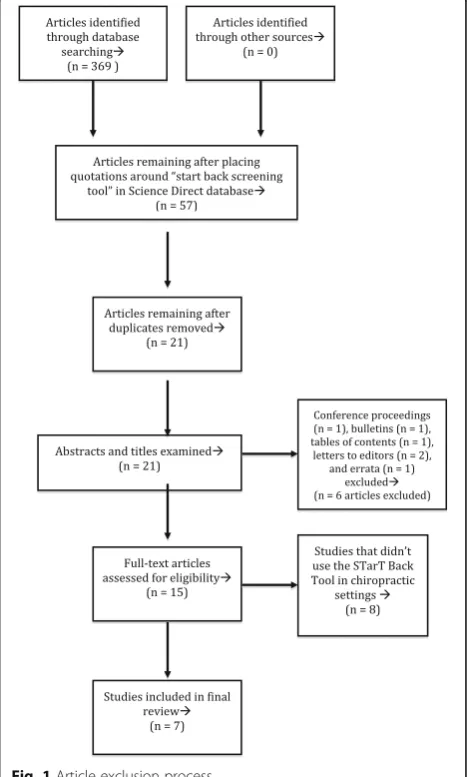
After the 4 databases were searched, yields were exam-ined. Figure 1 summarizes the article selection process. Articles were first screened by reading the abstracts to ensure studies were conducted in chiropractic settings and that the terms STarT Back Tool or STarT Back
Screening Tool were mentioned as a part of the study
design. If those terms weren’t found in the abstract, the full manuscripts were retrieved, and the methods sec-tions were analyzed for the same SBT terms. Articles that met the inclusion criteria were analyzed. Inclusion and exclusion criteria are described in Table 1.
Data synthesis
This narrative review did not systematically synthesize the data, nor appraise the quality of the included studies prior to inclusion. Rather, the titles, authors, respective years of publication, objectives, study designs, number of participants, settings and locations, sample characteris-tics, primary outcomes, main results, and limitations were extracted.
Results
Search results
PubMed (5 searches yielding 41 articles), Cochrane Library (1 article), Index to Chiropractic Literature (4 articles), and the modified Science Direct (11 articles) searches yielded 57 articles. Seven articles were chosen for review after removing duplicate articles (n= 36) and those that didn’t fit inclusion criteria (n= 14). Table 1 details inclusion and exclusion criteria and Fig. 1 sum-marizes the article exclusion process.
Main outcomes
Table 2 describes the main outcomes of each study in order of publication year. Four of the 7 studies examined aspects of the SBT’s construct validity (Kongsted et al. [17], Field and Newell [18], Irgens et al. [19], and Newell et al. [20]). Four of the studies evaluated the SBT’s prog-nostic capacity (Field and Newell [18], Newell et al. [20], Kongsted et al. [9], and Morso et al. [21]). Two used a cross sectional study design (Kongsted et al.[17], Irgens et al. [19]), 4 used a prospective cohort design (Field and Newell [18], Newell et al. [20], Field and Newell [22], and Kongsted et al. [9]) and 1 was a secondary analysis (Morso et al. [21]).
The Kongsted et al. [17] study demonstrated that the SBT was feasibly incorporated into Danish chiropractic clinics and identified patients in each of the 3 risk cat-egories. The SBT score correlated with the Major Depression Inventory, Fear-Avoidance Belief Questionnaire, and Coping Strategies Questionnaire scores, indicating that
the SBT risk groups correlated with participants’ psycho-logical distress.
The Irgens et al. [19] study demonstrated that overall SBT score correlated moderately with overall Bourne-mouth Questionnaire (BQ) score and higher BQ scores were associated with being distressed by the condition, indicated by a SBT psychological subscore >4. This study also described various correlations between elements of the SBT and BQ (Table 2).
In the Field and Newell [18] study, baseline SBT score correlated positively with baseline pain score (Numerical Rating Scale and Bournemouth Questionnaire); the low risk group had the lowest pain and disability at baseline while the high-risk group had the highest. However, the outcome differences between the 3 risk groups receiving chiropractic care disappeared by 30 days follow up. By the 30-day follow-up, the high risk group had improved so substantially that there was no longer a statistically significant difference between their outcomes and those in the low and medium risk groups.
The Newell et al. [20] study reported that the SBT was prognostic of future outcomes in medium and high risk patients whose scores were collected 2 days after the ini-tial chiropractic treatment visit, suggesting that the timing of stratification plays a role in the SBTs prognos-tic ability. Patients in the medium risk groups showed greater improvement than the low and high risk groups at the 14 and 30 day follow ups, but not at the 90 day follow up. One-third of the sample changed SBT risk categories in the 2 days between the initial chiropractic visit and 2 days after the initial visit.
The Field and Newell [22] study compared patients who were referred by the National Health Service (NHS) in the UK to those who were self-referring for chiroprac-tic care. Results indicated that the NHS-funded patients were more likely to score in the high risk SBT group than self-referred patients, but both groups had roughly the same percentage of patients scoring in the medium risk group. Self-referred patients were more likely to score in the low-risk group.
The Kongsted et al. [9] results suggested that both clinicians and the SBT have a relatively low ability to predict future pain outcomes [9]. Both accuratedly predicted a low percentage of patients who would be pain free (0/10 on a pain scale) at 2 weeks, but clinician
Table 1Summary of inclusion and exclusion criteria
Inclusion criteria Exclusion criteria
Articles were published in English Articles not published or translated into English
Articles from peer reviewed journals Conference proceedings
All methodological designs were accepted Letters to the editor or erratum
Studied were done in chiropractic settings
Table 2 Summary of results ( n =5 ) (Continued) improve men t at 90 day
follow-up. ->
Table 2 Summary of results ( n =5 ) (Continued) Morso et al. 2016 [ 21 ]. The prognos tic ability of the StarT Back Tool was affe cted by episode d ura tion To dete rmine wh ether the SBT ’ s progno stic ability was affe cted by care se tting, baseline episode duratio n, and outcom e time point being pre dicted . Sec ondary analy sis of prospective cohort data 17 chiro practic clinics in Denm ark n = 265 (Ge neral medi cal practic e) Take n from a Danis h audit proje ct n = 974 (secon dary care out patient medi cal setting ) Spine Centre in Denm ark n = 200 (phys iotherap y) 27 physiot herapy offices in D enm ark Medium : 39% High: 10% -The re were statistically sign ificant diff erences acr oss care setting s for mo st ba seli n e ch ar acte ris tics (age ,g en de r, cu rrent ep is od e du rati on, pr evi o us LB P ep isod es ,p ain int ens ity , acti vity limitation, and SBT sc o re). -Mos t chiro practic patie nts were younger, male, p res ent in g w ith very short ep isod e d urat ion (across al l SB T ris k g roups ), and most like ly to score in low risk SB T group. In co ntrast, those at the Spine Centre had the long es t epi so de du ra tion. -The prognos tic abi lity of the high risk versus low risk SB T group was stro nger for thos e who se episod e durati on was 2 we eks or longe r. The prognos tic ability of the medi um risk group versus the low ris k group was diff erent for peo ple wh ose episod e durati on was greater than 12 weeks. -low ris k SBT groups had the lowest activ ity limitat ion scores. -Acro ss all care se ttings, the SBT ’ s prognos tic ability is we akes t for thos e whose ep isode dur ation is < 2 we eks. -Chiropractic setting s ha d the gre atest percen tage of pat ients with this short ep isode durati on. -S econdar y da ta analysis; there m ay have been o ther varia bles th at ha d an in fluence o n
outcomes. -Meas
predications were more likely than SBT to be associated with long-lasting LBP outcomes (83% of clinician predic-tions were associated with long-lasting outcomes versus 60% of SBT’s predictions). Clinician predictions were statistically associated with mean outcomes at all follow-up points, but not associated with accurate prediction of individuals’outcomes. Combining the SBT with clinician predictions only slightly improved predictive accuracy.
The Morso et al. [21] study examined multiple vari-ables across chiropractic, physiotherapy, and primary and secondary medical settings to determine which vari-ables were related to the predictive utility of the SBT [21]. Current episode duration <2 weeks at care onset was the only variable that lowered the predictive ability of the SBT in all care settings. The chiropractic cohort had the greatest percentage of patients with short epi-sode duration (chiropractic cohort = 62.1%, general prac-titioner cohort = 38.1%, physiotherapy cohort = 22.8%, secondary care cohort = 1.6%).
Across all reviewed studies, 26–59% of patients scored in the low risk category, 29–39% in the medium risk, and 10–39% in the high risk (Table 2). Relative to the studies conducted in primary care medical settings [8, 13], the study samples in the chiropractic settings reported greater percentages of patients whose episode dur-ation was < 1 month.
Discussion
The goal of this narrative review was to describe the findings of studies using the SBT in chiropractic settings. To date, no other reviews of this nature have been conducted. The findings suggest that it’s feasible to in-corporate the SBT into chiropractic clinical settings [17] but that the short episode duration at onset of care (<2 weeks) with which many chiropractic patients present may be a barrier to the SBT’s predictive ability in some patients [9, 18, 21].
The Field and Newell [18] results indicate that high risk chiropractic patients may improve so quickly that there aren’t strong associations with SBT risk and poor outcomes. These results also suggest that there may be differences in patients with high risk in chiropractic set-tings compared to patients with high risk in primary care medical settings.
The Kongsted et al. [9] study revealed statistical asso-ciation between the SBT score and long-lasting symp-toms, but both clinicians’and SBT predicted only 11 and 10% of patients, respectively, who would be pain free within 2 weeks of chiropractic care. This indicated poor predictive ability in both clinicians and SBT for short-term outcomes. The researchers in this study dichoto-mized the pain and disability variables, designating anything greater than 0 out of 10 on a pain scale or 8 out of 100 activity limitation as“poor outcomes.”This is
quite a stringent standard, particularly in studying LBP; being completely pain free after 2 weeks of care isn’t a pragmatic goal and is beyond what is considered a clinically important improvement according to these outcome measures (the minimal clinically important dif-ference ranges from 1.5 to 3.5 points of change for the NRS and 2.5 to 5 points of change for the RMDQ) [23–26]. Some patients in this study may have had clinically import-ant improvements within 2 weeks (or later) but that data would have been lost in dichotomizing the outcome variables. Furthermore, though a greater percentage of clinicians compared to SBT accurately predicted which patients would have a long-lasting duration of symptoms, both predicted accurately more than 50% of the time for that variable. The SBT was weakest at predicting outcomes in participants who had a short duration of the LBP episode at onset of care, which describes a large percentage of the participants in this study.
The Morso et al. study results [21] suggest that short episode duration (<2 weeks) limits the SBT’s predictive ability across multiple care settings. The association between short duration and weak SBT prognostic accur-acy may have played a role in the low prognostic utility in the Field and Newell [18] and Kongsted et al. [9] studies as well [9, 21, 18], although further studies are needed to better elucidate this phenomenon.
Since chiropractic settings showed the greatest percent-age of short-duration episodes relative to other health care settings [21], chiropractors should be cautious when using the SBT on short episode duration patients. However, caution must also be exercised when interpreting mean group correlations, because the SBT may still be predictive in some short episode duration patients, as seen in the Newell et al. [20] study, despite not being associated with mean group outcomes.
Factors other than episode duration may also affect the SBT’s predictive ability. The Newell et al. [20] study demonstrated that the SBT was predictive in some patients who completed it 2 days after their initial treat-ment visit instead of at baseline. A study by Beneciuk et al. [27] also demonstrated that socioeconomic status, education level, and number of pain medications may affect the SBT’s predictive ability in medical care settings [28]. Research conducted in countries and subpopula-tions that differ from the 7 reviewed care settings will be important in better understanding the SBT’s predictive ability and utility for improving outcomes in patients seeking chiropractic care.
A limitation of the Field and Newell [18], Newell et al. [20], Kongsted et al. [9] and Morso et al. [21] studies is that the patients self-selected clinics in which they were treated. Self-selection may have ruled out many psycho-logical barriers to improvement at the outset. Also, in the Field and Newell [18] study, roughly 41% of patients had been to the treating chiropractor in the past, which may have lead to greater expectation of improvement [18, 29, 30]. Future studies using the SBT might evaluate patients’previous experience with manual therapy for their back pain and how expectations may affect outcomes.
Attending a course of manipulation may reduce psycho-logical outcomes such as depression and mental compo-nent scores [19]. It’s possible that the inherent overlap between chiropractic treatment and the stratified care approach used in the STarT Back protocol altered out-comes in the studies examined in this review. Though the chiropractors in these studies were treating patients as usual and weren’t privy to patients’SBT score, they may have altered or tailored their care based on clinical expert-ise and cues from patients about their psychological state, which is a stratification of sorts. This may have affected outcomes in ways that warrant further study.
All 7 reviewed studies were conducted in European populations (Denmark, Norway, and the UK) [9, 18–21, 22]. In the UK, it is unusual for chiropractic to be included in the state-funded health care system [27] and in Denmark only about 20% of costs are covered by the national health insurance [9]. Patients who seek chiroprac-tic care in these countries may be in different socioeco-nomic strata than those in the general LBP population, or may have a different psychosocial risk profile from other countries [22, 27], which may affect the SBT’s predictive utility [28]. As demonstrated in the Field and Newell (2016) study [22], there also may be significant differences in patients who are self-referring for chiropractic care compared to those referred by general practitioners [27].
Furthermore, in the Irgens study [22], there was a statistically significant difference between the psycho-social risk profile in English versus Norwegian patients. Norwegian participants were younger, less distressed by their condition, and had lower catastrophization and de-pression, but were slightly more anxious than the UK participants studied. This lends further credence to the idea that the results of the reviewed studies may not be generalizable to patients in other countries where parallel analyses haven’t been conducted. Psychosocial risk profiles in other populations may differ enough to change the predictive ability of the SBT, or the outcome effects of stratified care pathways [22, 27].
However, none of the studies in this review imple-mented or examined STarT Back stratified care path-ways. For patients who score in the low risk category, The STarT Back Protocol provides nothing more than a
session of home advice, education about pain, and encouragement to continue physical activity [6]. Specific chiropractic treatment duration wasn’t described in these studies, except that treatment plans were unaffected by SBT categorization. It’s possible that some patients received minimal care, but it’s unknown. It’s not possible at this time to compare outcomes of usual chiropractic care to the SBT care pathway for low risk patients seeking chiropractic care. At present, the SBT remains a valuable tool for detecting low risk patients who may achieve comparable outcomes from one session of patient education and home exercises, instead of a course of spinal manipulation [5, 6, 12, 13].
Although the SBT was first developed to aid primary care medical physicians in determining best care path-ways for patients with LBP, the SBT may be useful in stratifying care pathways for chiropractic clinicians. In many countries such as the US, Canada, and Great Britain, doctors of chiropractic are primary-contact providers [22, 31, 32]. Patients seeking care in chiroprac-tic settings may benefit from stratified care in similar ways to those seeking medical care [5, 13] but, as demonstrated in this review, stratified care hasn’t yet been studied in chiropractic settings.
This review offers an assimilation of studies using the SBT in a chiropractic setting, but a number of limita-tions exist. First, this was a narrative review, so system-atic methods of quality appraisal were not applied when selecting and reviewing manuscripts, and some articles may have been missed. One study was a secondary analysis, and no randomized controlled trials were avail-able at the time of review. Therefore the strength of available evidence was low. Finally, letters to editors, conference proceedings, and other non-peer reviewed articles were excluded, which may have resulted in neglecting relevant information and discourse.
Future research
Although the SBT lacked strong predictive value in short episode duration patients, perhaps a better focus for future research would be to explore the outcomes of stratified care in a broad range of chiropractic settings, particularly in light of the stratified care benefits reported in primary care medical settings [5, 13]. As the Morso et al. [21] study concluded,“the real potential of the SBT is as a tool for stratifying care pathways and therefore clinical trials are required to determine if the SBT is useful in chiropractic and secondary settings.”
Conclusion
within medical and physiotherapy settings, stratification resulted in improved outcomes such as pain, disability, fear avoidance beliefs, and depression [5, 12, 13], but parallel studies in chiropractic settings have not been conducted. For that reason, regardless of the SBT’s ques-tionable prognostic ability in the chiropractic patient pop-ulations studied, research examining the relationship between care stratification and outcomes in a chiropractic population would be valuable.
Abbreviations
BQ:Bournemouth questionnaire; CSQ: Coping strategies questionnaire; FABQ: Fear avoidance beliefs questionnaire; LBP: Low back pain; MDI: Major depression inventory; NRS: Numerical rating scale; PGIC: Patient global impression of change; RMDQ: Roland morris disability questionnaire; SBT: STarT back tool
Acknowledgements
I would like to acknowledge Stacie Salsbury, PhD, RN and Dana Lawrence, DC, MA, MMedEd for their valuable time and insight in developing and editing this work.
Funding
No funding was provided for this review.
Availability of data and materials
Not applicable (data sharing not applicable as no data sets were generated or analyzed for this review).
Author’s contributions
YK was in charge of all aspects of this project and preparing this manuscript. The author read and approved this final manuscript.
Author’s information
YK is a is a chiropractor with 7 years of private practice experience and is currently a full-time graduate fellow in the Masters of Science in Clinical Research program at the Palmer Center for Chiropractic Research.
Competing interests
The author declares that there are no competing interests.
Consent for publication Not applicable.
Ethics approval and consent to participate Not applicable.
Publisher’s Note
Springer Nature remains neutral with regard to jurisdictional claims in published maps and institutional affiliations.
Received: 1 September 2016 Accepted: 12 April 2017
References
1. Waddell G. The back pain revolution. 1st ed. New York: Churchill Livingstone; 1999.
2. Waddell G. Biopsychosocial analysis of low back pain. Baillieres Clin Rheumatol. 1992;6:523–57.
3. Hasenbring M, Hallner D, Klasen B. Psychological mechanisms in the transition from acute to chronic pain: over- or underrated? Schmerz. 2001;15:442–7.
4. Beneciuk JM, Bishop MD, Fritz JM, Robinson ME, Asal NR, Nisenzon AN, et al. The STarT back screening tool and individual psychological measures: evaluation of prognostic capabilities for low back pain clinical outcomes in outpatient physical therapy settings. Phys Ther. 2013;93:321–33.
5. Foster NE, Mullis R, Hill JC, Lewis M, Whitehurst DGT, Doyle C, et al. Effect of stratified care for low back pain in family practice (IMPaCT Back): a
prospective population-based sequential comparison. Ann Fam Med. 2014;12:102–11.
6. Hay EM, Dunn KM, Hill JC, Lewis M, Mason EE, Konstantinou K, et al. A randomised clinical trial of subgrouping and targeted treatment for low back pain compared with best current care. The STarT Back Trial Study Protocol. BMC Musculoskelet Disord. 2008;9:58.
7. Keele University-STarT Back Screening Tool. [cited 2016 Oct 20]. Available from: https://www.keele.ac.uk/sbst/startbacktool/.
8. Hill JC, Dunn KM, Lewis M, Mullis R, Main CJ, Foster NE. A primary care back pain screening tool: identifying patient subgroups for initial treatment. Arthritis Rheum. 2008;59:632–41.
9. Kongsted A, Andersen CH, Hansen MM, Hestbaek L. Prediction of outcome in patients with low back pain–A prospective cohort study comparing clinicians’predictions with those of the start back tool. Man Ther. 2016;21:120–7.
10. Ailliet L, Rubinstein SM, Knol D, van Tulder MW, de Vet HCW. Somatization is associated with worse outcome in a chiropractic patient population with neck pain and low back pain. Man Ther. 2016;21:170–6.
11. Pincus T, Anwar S, McCracken LM, McGregor A, Graham L, Collinson M, et al. Delivering an Optimised Behavioural Intervention (OBI) to people with low back pain with high psychological risk; results and lessons learnt from a feasibility randomised controlled trial of Contextual Cognitive Behavioural Therapy (CCBT) vs. Physiotherap. BMC Musculoskelet Disord. 2015;16:147.
12. Whitehurst DGT, Bryan S, Lewis M, Hill J, Hay EM. Exploring the cost-utility of stratified primary care management for low back pain compared with current best practice within risk-defined subgroups. Ann Rheum Dis. 2012;71:1796–802. 13. Hill JC, Whitehurst DG, Lewis M, Bryan S, Dunn KM, Foster NE. Comparison of stratified primary care management for low back pain with current best practice (STarT Back): a randomised controlled trial. Lancet. 2011;378. Available from: http://dx.doi.org/10.1016/S0140-6736(11)60937-9. 14. Childs JD, Fritz JM, Flynn TW, Irrgang JJ, Johnson KK, Majkowski GR, et al. A
clinical prediction rule to identify patients with low back pain most likely to benefit from spinal manipulation: a validation study. Ann Intern Med. 2004;141:920–8.
15. May S, Rosedale R. Prescriptive clinical prediction rules in back pain research: a systematic review. J Man Manip Ther. 2009;17:36–45. 16. Dougherty PE, Karuza J, Savino D, Katz P. Evaluation of a modified clinical
prediction rule for use with spinal manipulative therapy in patients with chronic low back pain: a randomized clinical trial. Chiropr Man Therap. 2014;22:41. 17. Kongsted A, Johannesen E, Leboeuf-Yde C. Feasibility of the STarT back
screening tool in chiropractic clinics: a cross-sectional study of patients with low back pain. Chiropr Manual Ther. 2011;19:10.
18. Field J, Newell D. Relationship between STarT back screening tool and prognosis for low back pain patients receiving spinal manipulative therapy. Chiropr Manual Ther. 2012;20:1–8.
19. Irgens P, Lothe LR, Kvammen OC, Field J, Newell D. The psychometric profile of chiropractic patients in Norway and England: using and comparing the generic versions of the STarT back 5-item screening tool and the Bournemouth questionnaire. Chiropr Man Therap. 2013;21:41. 20. Newell D, Field J, Pollard D. Using the STarT back tool: does timing of
stratification matter? Man Ther. 2015;20:533–9.
21. Morso L, Kongsted A, Hestbaek L, Kent P. The prognostic ability of the STarT back tool was affected by episode duration. Eur Spine J. 2016;25:936–44. 22. Field J, Newell D. Clinical outcomes in a large cohort of musculoskeletal
patients undergoing chiropractic Care in the United Kingdom: a comparison of self- and national health service-referred routes. J Manipulative Physiol Ther. 2016;39:54–62.
23. Ostelo RWJG, de Vet HCW. Clinically important outcomes in low back pain. Best Pract Res Clin Rheumatol. 2005;19:593–607.
24. Salaffi F, Stancati A, Silvestri CA, Ciapetti A, Grassi W. Minimal clinically important changes in chronic musculoskeletal pain intensity measured on a numerical rating scale. Eur J Pain. 2004;8:283–91.
25. Maughan EF, Lewis JS. Outcome measures in chronic low back pain. Eur Spine J. 2010;19:1484–94.
26. Kovacs FM, Abraira V, Royuela A, Corcoll J, Alegre L, Cano A, et al. Minimal clinically important change for pain intensity and disability in patients with nonspecific low back pain. Spine. 2007;32:2915–20.
28. Pagé I, Abboud J, O Shaughnessy J, Laurencelle L, Descarreaux M. Chronic low back pain clinical outcomes present higher associations with the STarT back screening tool than with physiologic measures: a 12-month cohort study. BMC Musculoskelet Disord. 2015;16:201.
29. Bishop MD, Mintken PE, Bialosky JE, Cleland JA. Patient expectations of benefit from interventions for neck pain and resulting influence on outcomes. J Orthop Sports Phys Ther. 2013;43:457–65.
30. Williams N, Hendry M, Lewis R, Russell I, Westmoreland A, Wilkinson C. Psychological response in spinal manipulation (PRISM): a systematic review of psychological outcomes in randomised controlled trials. Complement Ther Med. 2007;15. Available from: http://dx.doi.org/10.1016/j.ctim.2007.01.008. 31. Blanchette M-A, Rivard M, Dionne CE, Hogg-Johnson S, Steenstra I. Workers’
characteristics associated with the type of healthcare provider first seen for occupational back pain. BMC Musculoskelet Disord. 2016;17. Available from: http://www.ncbi.nlm.nih.gov/pmc/articles/PMC5069865/.
32. Hurwitz EL, Chiang L-M. A comparative analysis of chiropractic and general practitioner patients in North America: findings from the joint Canada/ United States Survey of Health, 2002–03. BMC Health Serv Res. 2006;6:49.
• We accept pre-submission inquiries
• Our selector tool helps you to find the most relevant journal • We provide round the clock customer support
• Convenient online submission • Thorough peer review
• Inclusion in PubMed and all major indexing services • Maximum visibility for your research
Submit your manuscript at www.biomedcentral.com/submit