The Health and Safety Impact of Construction Project Features
Patrick Manu, Nii Ankrah, David Proverbs and Subashini Suresh
DOI:10.1108/ECAM-07-2012-0070
‘This article is (c) Emerald Group Publishing and permission has been granted for this version to appear here (http:http://eprints.uwe.ac.uk/22144/). Emerald does not grant
Abstract
Purpose - Despite the established significance of underlying accident causes to health and safety (H&S), and the persistent reporting of the underlying accident causal influence of construction project features (CPFs) which emanate from pre-construction decisions, no empirical research has focussed on CPFs in terms of assessing their degree of potential to influence accident occurrence. This study therefore investigates this facet of the accident causal influence of CPFs. Design/methodology/approach - A mixed method design was used involving semi-structured interviews, and a questionnaire survey of UK construction professionals.
Findings - CPFs generally have a moderate or a high potential to influence accident occurrence, implying a fair or severe potential to cause harm in terms of the H&S of workers. The degree of potential of CPFs to influence accident occurrence is influenced by: the extent to which certain proximate causes of accidents are common/prevalent within CPFs; and the degree of potential of those proximate causes to influence accident occurrence.
Originality/value - These findings provide insight into the H&S consequences of CPFs, awareness of which is essential if pre-construction project participants are to implement appropriate risk control measures especially in the early phases of projects to mitigate the accident causal influence of CPFs. The findings reinforce the contribution of clients and their design and project management teams to accident causation, the significance of the early planning of H&S in construction project delivery, and the importance of driving mechanisms such as the Construction (Design and Management) Regulations 2007.
Keywords - accident, construction industry, health and safety, project features.
Introduction
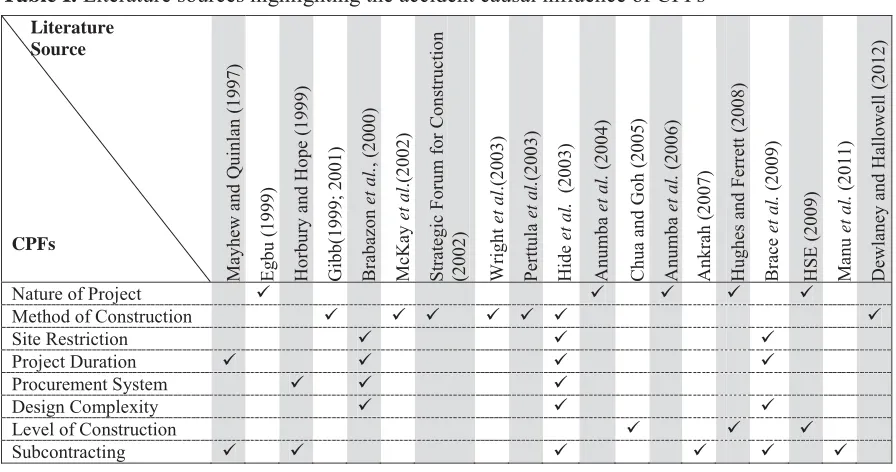
Construction project features (CPFs) being organisational, physical and operational attributes of construction projects, fall in this category of underlying causal factors as they emanate from pre-construction decisions by clients, designers and project managers/planners and contribute to accident causation. Despite the persistent reporting of the accident causal influence of CPFs such as nature of project, method of construction, project duration, level of construction, subcontracting, design complexity, site restriction and procurement system (as summarised by Table I), not much detailed empirical research has focused on understanding the extent of their causal influence.
[Insert Table I]
Even among the studies which have examined underlying causes of accidents in construction, no specific focus has been accorded to examining the accident causal phenomenon of CPFs (cf. Haslam et al., 2005; Cooke and Lingard, 2011; Behm and Schneller, 2012). This could be attributed to the inherent difficulties in examining underlying causes of accidents whose influence tends to be latent (cf. Haslam et al., 2005; Bomel Limited et al., 2006; Cooke and Lingard, 2011). This study therefore assesses the degree of potential of CPFs to influence accident occurrence (i.e. their potential to cause accident/harm in respect of the H&S of worker). In the sections that follow, a review of the accident causal influence of CPFs is presented leading to the posing of hypotheses relating to the degree of potential of CPFs to influence accident occurrence. The methodological approach for testing the hypotheses is then presented together with the arguments in support of the approach. The findings emerging from the data analysis are subsequently presented and discussed followed by the implications of the findings and concluding remarks.
The degree of potential of CPFs to influence accident occurrence
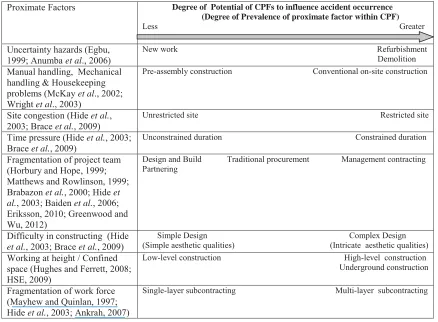
Manu et al. (2010) through an extensive review of H&S literature within the construction industry built a robust case to show that CPFs are inherently associated with certain site-based accident causal factors. Based on the systems view of accident causation (e.g. the Constraint-Response model (Suraji et al., 2001) and the ConCA model (Haslam et al., 2005)) these factors can be considered as being proximate accident factors which are inherently introduced by CPFs to give rise to accidents. From the review by Manu et al. (2010), it is seen that CPFs have varying degrees of potential to influence accident occurrence. The review also suggests that this is due to a varying extent to which the proximate accident factors associated with CPFs are common/prevalent within CPFs. This implies that the more common/prevalent a proximate factor is within a CPF, the greater the degree of potential of the CPF to influence accident occurrence. This understanding has informed the development of a conceptual assessment of the degree of potential of CPFs to influence accident occurrence as given in Table II. From Table II, for instance, a complex design has greater potential to influence accident occurrence than a simple design due to the greater extent to which difficulty in constructing (i.e. buildability) is common within a complex design than within simple design.
having less harmfulness. Conversely the CPF with the comparatively greater harmfulness may even not pose any danger as its actual measure of harmfulness may not be dire. Apart from this limitation, the assessment provided by literature (as summarised by Table II) is only confined to CPFs of the same kind (e.g. comparing pre-assembly construction to traditional method of construction) with no mechanism for comparing across different categories (e.g. comparing pre-assembly to low-level construction). These limitations constitute a gap in H&S literature which requires addressing. Despite these limitations, the insight from Table II can be instrumental in facilitating further empirical studies to augment current understanding of the degree of potential of CPFs to influence accident occurrence, particularly the view that the degree of potential of a CPF to influence accident occurrence is influenced by the extent to which its proximate factor(s) is common/prevalent within it. Taking the conceptualisation a step further, it is argued in Manu et al. (2010; 2012) that the degree of potential of a CPF to influence accident occurrence is also influenced by the degree of potential of its proximate factor(s) to influence accident occurrence. This is based on the logic that it is by reason of the proximate factor influencing accident occurrence (i.e. having the potential to cause accidents) that the CPF also influences accident occurrence as a result of its inherent introduction of that proximate factor. This can be likened to the argument by Duffus and Worth (2001) in support of the influence of exposure on risk (Chicken and Posner, 1998; Duffus and Worth, 2001) that, regardless of the degree of a hazard if there is no exposure there will be no risk. Synthesising all these arguments, it can generally be conceptualised that the degree of potential of a CPF to influence accident occurrence (represented by ‘C’) is a combined effect of:
x the extent to which its proximate factor(s) is prevalent/common within the CPF (represented by ‘r’); and
x the degree of potential of its proximate factor(s) to influence accident occurrence (represented by ‘R’).
[Insert Table II]
Unlike the degree of prevalence of proximate factor (i.e. ‘r’) which allows for relative comparison among CPFs of the same kind in terms of their degree of potential to influence accident occurrence (as shown in Table II), the combined effect of ‘r’ and ‘R’ could allow for relative comparison across all CPFs as the combined effect would take into account the direness (in other words the harmfulness) of the proximate factors. This conceptualisation coherently unifies the above arguments and provides the way forward for the empirical verification of the espoused relationships between ‘C’, ‘r’, and ‘R’. To advance the verification of these relationships two hypotheses can be put forward for testing.
Based on the suggestion in the literature that greater degree of potential of a CPF to influence accident occurrence is due to greater prevalence of proximate factor within a CPF (as summarised by Table I), it is thus expected that:
H1: The degree to which a proximate factor(s) is common/prevalent within a CPF will be significantly and positively related to the degree of potential of the CPF to influence accident occurrence.
In line with the argument that if a proximate factor has no potential to influence accident
H2: The relationship between the degree to which a proximate factor(s) is common/prevalent within a CPF and the degree of potential of the CPF to influence accident occurrence will be moderated by the degree of potential of the proximate factor(s) to influence accident occurrence such that the relationship becomes more positive as the degree of potential of the proximate factor(s) to influence accident occurrence becomes more positive.
Research methodology
A mainly quantitative approach was adopted as this kind of inquiry is well noted for its appropriateness for testing prior formulations (Fellows and Liu, 2008; Creswell, 2009). Construction accident causation studies have often involved analysis of accident records (cf. Arboleda and Abraham, 2004; Behm, 2005; Hinze et al., 2005; Ling et al., 2009). However, in the case of this study, the acknowledgement by several researchers that investigating underlying/root causes of accidents (which are upstream of project procurement) using accident records poses difficulties (cf. Suraji et al., 2001; Bomel Limited et al., 2006; Cooke and Lingard, 2011) meant that using accident records was not considered ideal in this study. In order therefore to get reliable data for diagnosing the degree of potential of CPFs to influence accidents, contractor personnel were deemed a potential source of data given that they often witness and/or experience accidents on site. Contractor personnel such as project managers, construction managers, H&S managers, and site managers, commonly work on project sites in management roles and also from their wide industrial experience in construction are likely to be aware of the CPFs being investigated as well as any impact they have on H&S. These professionals were thus targeted in a questionnaire survey to elicit their views on the accident causal influence of CPFs. The use of questionnaires is not uncommon in construction H&S studies (cf. Langford et al., 2000; Kheni et al., 2008; Frontline Consultants, 2011) and in particular construction accident causation studies (cf. Whittington et al., 1992; Hide, 2003). To aid the development of the questionnaire, an initial phase of semi-structured interviews was conducted. The preliminary use of interviews in this study is similar to the sequential application of interviews and a survey by Langford et al. (2000) in their H&S study. Creswell (2009) hails the utility of such mixed method approach for the development of an instrument to be administrated in a survey.
Phase 1: Interview
11 experienced construction professionals comprising H&S managers, project managers, site managers, a construction manager and a construction H&S consultant were interviewed. Averagely the practitioners have 26 years of experience in construction. The interviews explored
the practitioners’ experiences and perspectives of the accident causal influence of CPFs thus providing the opportunity to draw out important aspects of this causal phenomenon such as the proximate factors associated with CPFs. The interviews were audio taped and on the average took 60 minutes. The interviews were transcribed verbatim and the transcripts were systematically analysed through iterative re-reading and colour coding of the transcripts using a qualitative codebook derived from the literature (Creswell, 2009).
The analysis confirmed that nature of project, method of construction, site restriction, project duration, procurement system, design complexity, level of construction, and subcontracting have accident implications as has been previously reported in literature (summarised in Table I). Commenting on some of these features, one interviewee for instance emphasized that, “A complex project brings more risk, a restricted site brings more risk, a tight duration brings more
risk and a high rise also brings more risk but you’ve got to manage those risks by putting in
In addition to the above project features, another feature which emerged as having accident implications is restriction of site locality as revealed by the narrative below.
“It was a refurbishment and we were putting a new roof on the podium roof and it was right in the centre of Nottingham City Centre…Inner city jobs are usually more dangerous with H&S because they are very tight” [Project Manager].
The project features were considered as being underlying accident causal factors with one interviewee (a H&S manager) even referring to them as, “…something that sits behind
everything…they are underlying and quite deep underlying root causes”. The analysis further
revealed that the project features are associated with certain site-based H&S issues which as a result make the project features influence the occurrence of accidents. With regards to restriction of site locality this was associated with difficulty in traffic (pedestrian and vehicle) control around site vicinity. Regarding nature of project, method of construction, site restriction, project duration, procurement system, design complexity, level of construction, and subcontracting, there was congruence between the associated H&S issues drawn from the interviews and the proximate factors identified in the literature (given in Table II). The interviews thus provided preliminary confirmation of the prior formulations and in conjunction with the literature constituted the basis for the development of the questionnaire for the survey phase.
Phase 2: Questionnaire Survey
From the hypotheses, the questionnaire was designed to measure three variables: 1. the degree of potential of CPFs to influence accident occurrence;
2. the degree of potential of proximate factors to influence accident occurrence; and 3. degree to which proximate factors are common within CPFs.
The variables were measured using a Likert-type 5-point scale similar to that used in a previous accident causation study (cf. Hide, 2003). The questionnaire captured the judgment of practitioners regarding the above three variables using close-ended questions/statements (e.g. rate the potential of the listed project features to influence accident occurrence). An open-ended question was also included to solicit general comments on the accident causal influence of CPFs. To be able to gauge the expertise and experience of the practitioners which is important to the credibility of their judgement and hence the research findings, the questionnaire also requested relevant background information relating to the practitioners’ expertise and experience in construction (cf. Hallowell and Gambatese, 2009). Contractor personnel, especially those in construction management roles (e.g. H&S manager, project manager, construction manager and site manager), were the target source of data. As there is no organised record/database for these professionals, it was considered that a viable means of reaching them would be through their
construction management surveys (e.g. 12.2 % response rate recorded by Li et al. (2005) and 5.14% effective response rate recorded by Sutrisna et al., 2005)).
Analysis: The ratings by the respondents were aggregated by mean calculation. In order for the
mean ratings to be interpreted with any confidence, evidence of significant agreement among the raters/respondents is essential hence the estimation of inter-rater agreement using James et al. (1984) single item inter-rater agreement index (rWG). Following the recommendation by Cohen et al. (2001, 2009) the rWG values for significant agreement were estimated by running simulations
based on a uniform null distribution using a sample size (i.e. group size) of 184 and a number of response items of 5 (i.e. the 5-point scale). To test the hypotheses, regression analysis (ordinary least square) was undertaken given its appropriateness for investigating the existence and nature of relationships between variables (Hair et al., 2010). In testing hypothesis H1, degree of potential of CPFs to influence accident occurrence (i.e. the outcome variable) and degree of prevalence of proximate factors within CPFs (i.e. the predictor variable) were applied in the regression. To test hypothesis H2, degree of potential of CPFs to influence accident occurrence (i.e. the outcome variable), degree of prevalence of proximate factors within CPFs (i.e. the predictor variable), degree of potential of proximate factors to influence accident occurrence (i.e. the moderator variable) and the product of the predictor and moderator variables (i.e. the moderator effect/interaction term- R x r) were applied in step-wise multiple regression, with the test of moderation being the significance of the interaction term (Baron and Kenny, 1986; Hair et al., 2010). SPSS v 16 and the R Software were used to aid the analysis. The analysis of the general comments was undertaken inductively using emerging codes (cf. Creswell, 2009).
Results
Demographic information
The respondents’ roles were: H&S manager (56.52%), construction manager (15.76%), project manager (7.61%), site manager (2.17%), and other construction management roles (17.94%). Averagely, the respondents have 16.30 years of experience (Std. Dev. = 10.45) and 24.31 years of experience (Std. Dev. = 11.97) in their current role and in construction respectively. A banded breakdown of the experience of the respondents (i.e. <5 years, 5-10 years, 11-15 years, 16-20 years, and over 20 years) indicates that approximately 90% of the respondents have at least 5 years of experience in their role and approximately 80% have over 10 years of experience in construction. Approximately 70% of the respondents are members of at least one industrial professional body. The professional bodies include: Institution of Occupational Health and Safety, International Institution of Risk and Safety Management, Institution of Civil Engineers, Chartered Institute of Building, The Institution of Royal Engineers, Institution of Engineers-Ireland, Association of Professional Safety and the Royal Institute of Chartered Surveyors. In terms of highest educational attainment, approximately 50% of the respondents have a Diploma or higher (i.e. Bachelors, Masters Degree or PhD) in a construction related discipline. From the
respondents’ demographic information, it is evident that the experience and expertise of the respondents is respectable and they are well placed to adequately respond to the subject being studied. Their responses can thus be regarded as important and reliable, and findings drawn from their responses a sound and credible representation of the accident causal influence of CPFs.
The degree of potential of CPFs to influence accident occurrence
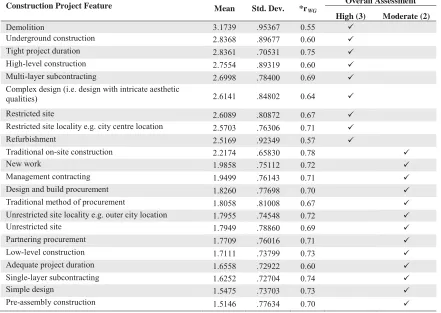
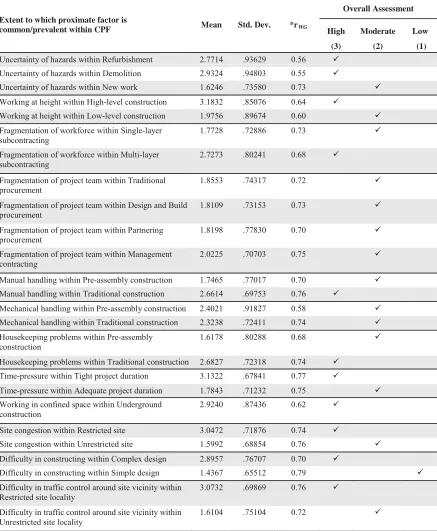
Table III indicates a summary of the assessment of the degree of potential of the CPFs to influence accident occurrence. The rWG indices indicate significant consensus amongst the
can be considered as being a “good” representation of the respondents’ professional judgement
of the degree of potential of the CPFs to influence accident occurrence. When the mean ratings are rounded to the nearest point on the assessment scale to ensure conformity with the scale so as to aid interpretation, the eventual overall assessment shows that the CPFs are generally considered as having a high or moderate potential to influence accident occurrence, implying that CPFs generally have a severe or fair potential to cause harm in terms of the H&S of workers.
[Insert Table III]
Hypotheses testing
Descriptive statistics and rWG indices calculated for the respondents’ rating of the degree of
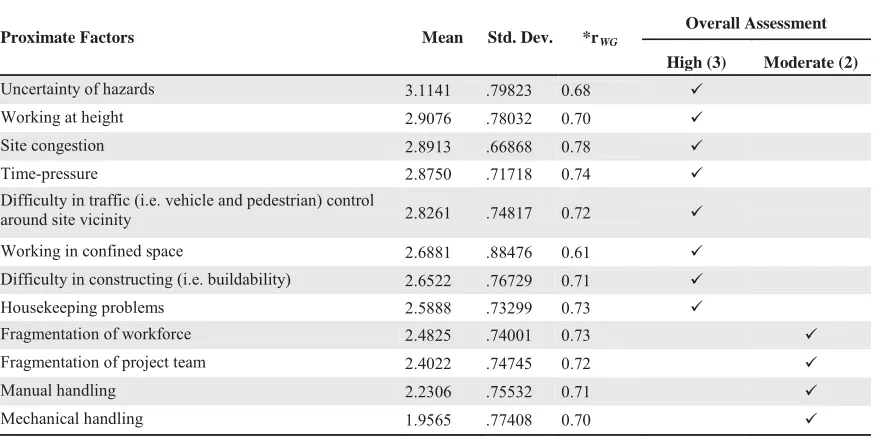
potential of the proximate factors to influence accident occurrence and also the degree to which the proximate factors are common/prevalent within CPFs are given in Tables IV and V. The tables also show overall assessments by approximation of the mean ratings to the nearest scale point to aid their interpretation in conformity with the 5-point scales. From this approximation, it is seen that generally the proximate factors have a high or moderate potential to influence accident occurrence (see Table IV), and the degree of prevalence of proximate factors within the CPFs is low, moderate or high (see Table V). More importantly, the rWGindices are evidence of
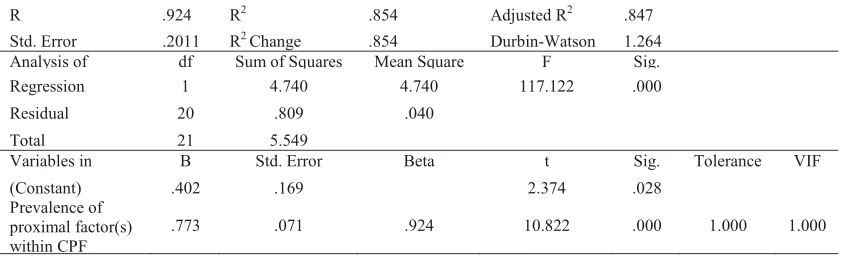
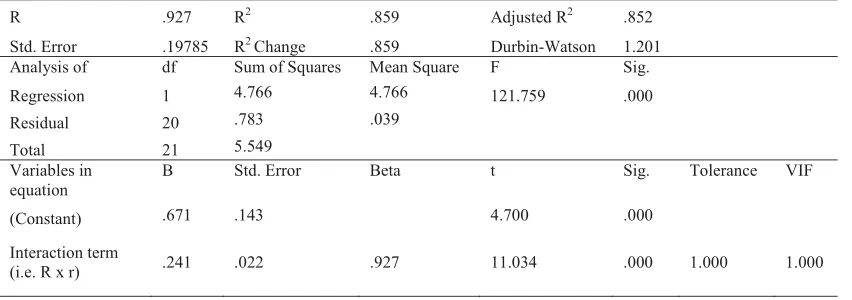
significant consensus amongst the respondents and were therefore an indication that the regression analysis using the mean ratings would yield trustworthy results. The output of the regression analysis for hypothesis H1 is given in Table VI. It shows that prevalence of proximate factor within CPF is significantly and positively related to degree of potential of CPF to influence accident occurrence (ß = 0.77, p < 0.001). Prevalence of proximate factor within CPF accounts for 85% of the variance in potential of CPF to influence accident occurrence. In all, the results thus support hypothesis H1 as being true. The output of the regression analysis for hypothesis H2 is given in Table VII. From the step-wise regression only the interaction term was selected for inclusion in the model. The value of R2for the model generated is .859, implying
that the interaction term accounts for 85% of the variation in potential of CPF to influence accident occurrence. The ß-value of the interaction term being significant (ß = 0.241, p < 0.001) gives evidence of moderation (Baron and Kenny, 1986; Hair et al., 2010). Also the ß-value being positive indicates a positive relationship as hypothesised. The results therefore support hypothesis H2 as being true.
For the two regression models, four diagnostic checks were run: linearity of the phenomenon measured, constant variance of the error terms, independence of the error terms, and normality of the error term (Field, 2005; Hair et al., 2010). Linearity of phenomenon and constant variance of error terms were checked by scatter plots of the standardized residuals against the predicted values, and normality of error term was checked by histogram plots and normal probability plots (Field, 2005; Hair et al., 2010). These plots showed no signs of violation of their respective assumptions. To test for the independence of the error terms, the Durbin-Watson test was used. The Durbin-Watson statistics obtained (as given in Tables VI and VII) are between 1 and 3 indicating that this assumption was also not violated (Field, 2005).
[Insert Table IV]
[Insert Table VI]
[Insert Table VII]
Comments on the accident causal influence of CPFs
A third of the participants provided brief comments which mainly reflected some of the views expressed in the interview phase. Two CPFs were frequently mentioned as being a major concern within the industry. These are tight project schedules and designs with features which impinge on buildability. Respondents were of the view that quite often little consideration is given by clients and their design and project management teams as to the H&S impact of these features despite relevant requirements under the CDM 2007. In connection to this, CDM Coordinators were portrayed as not being of much influence in advising clients and their design and project management teams on these matters. Some extracts indicating these concerns are:
“In my experience the two greatest factors that influence accidents on site are time constraints-programme, and design buildability.” [H&S Manager]
“The CDM Regs. stipulates that time is a resource. It is my experience that CDM- Coordinators do not challenge project timescales, and contractors due to scarcity of work are willing to take on the challenge and increased risk factors.” [H&S Manager]
“Many projects have short timescales.” [Health, Safety, Environmental and Quality Manager]
Discussion
The generic assessment of the potential of CPFs to influence accident occurrence (given in Table III) reveals both expected and unexpected results. The overall assessment of a moderate or a high potential to influence accident occurrence, confirms that CPFs have varying degrees of potential to influence accident occurrence. The overall assessments of: demolition and refurbishment (high) relative to new work (moderate); high level construction and underground construction (high) relative to low level construction (moderate); tight project duration (high) relative to adequate project duration (moderate); multi-layer subcontracting (high) relative to single-layer subcontracting (moderate); complex design (high) relative to simple design (moderate); restricted site (high) relative to unrestricted site (moderate); and restricted site locality (high) relative to unrestricted site locality (moderate), converge with the comparative assessments in the literature (given in Table II) and also reflect comments from the interviews such as:
“…A complex project brings more risk, a restricted site brings more risk, a tight duration brings more risk and a high rise also brings more risk…” [Project Manager]
Surprisingly, the procurement methods all generally have moderate potential to influence accident occurrence despite reports in literature which suggest that design and build and partnering improve H&S as they allow for collaborative working among project team members and hence foster better H&S management (cf. Matthews and Rowlinson, 1999; Brabazon et al., 2000; Hide et al., 2003). This also contradicts views from the interview phase such as the quote below which support the notion that collaborative procurement methods offer better health and safety outcomes.
“…without doubt, design and build is the safest way to build than tradition contract.” [Senior Site
Another surprising assessment from Table III is that despite the reported H&S benefits of pre-assembly construction (cf. Wright et al., 2003; McKay, 2010), it is generally judged as having the same moderate potential to influence accident occurrence as traditional method of construction. This also contradicts views from the interview phase such as the quote below which express that pre-assembly is better than traditional method of construction in terms of achieving good H&S outcomes.
“The more that can be done off-site the less the risk. I’ve done modular student accommodation where everything comes fitted out in a complete box and you stack one box on top of another. It’s a very quick operation and very safe.” [Project Manager]
The results from the hypotheses testing provide evidence that the degree of potential of a CPF to
influence accident occurrence (denoted by ‘C’) is influenced by: the extent to which its proximate factor(s) is prevalent/common within the CPF (denoted by ‘r’); and the degree of
potential of its proximate factor(s) to influence accident occurrence (denoted by ‘R’). This is supported by the substantial variance (i.e. 85%) that prevalence of proximate factor and the interaction term (i.e. r x R) accounted for in potential of CPF to influence accident occurrence. The results imply that, greater prevalence of a proximate factor within a CPF (i.e. r) coupled with greater potential of the proximate factor to influence accident occurrence (i.e. R) yields greater potential of the CPF to influence accident occurrence (i.e. C). However, a lesser ‘r’ coupled with a greater ‘R’, and conversely, alesser ‘R’ coupled with agreater ‘r’, yields a lesser
‘C’. Also a lesser ‘r’ coupled with a lesser ‘R’, yields a lesser ‘C’.
The findings of the hypotheses testing provide some scope for explaining the surprising generic assessments relating to procurement methods and methods of construction. From the overall assessment, it was found that the procurement methods generally have similar potential to influence accident occurrence (i.e. moderate). From Table V, it can also be seen that the degree of prevalence of fragmentation of project team within the procurement methods is also generally assessed as being similar (i.e. moderate) and this conforms with the suggestion that the real cultural change from adversarial relationships to collaborative relationships heralded by approaches like partnering is not being fully embraced (Bresnen and Marshall, 2000; Sullivan, 2006). A comments from the survey which also reflects this view is that: “Partnering and collaborative working has collapsed. This is having a significant effect on site H&S
performance.” In view of the supported hypothesis H1 it is thus only consequential that the
procurement methods generally have a similar potential to influence accident occurrence as the degree of prevalence of fragmentation of project team within them is also generally similar. Therefore, a plausible reason for the procurement systems having similar potential to influence accident occurrence is that there is also a similar degree of fragmentation of project team within the procurement systems.
Also concerning the surprising generic assessment regarding traditional construction and pre-assembly, in view of the supported hypothesis H2, one plausible explanation is that it is due to manual handling and mechanical handling generally having similar degree of potential to influence accident occurrence (i.e. moderate) as shown from the overall assessment in Table IV. Given industry-wide mechanisms to address manual handling such as The Manual Handling Operations Regulations 1992 (amended in 2002) and supporting revised industry guidance such
within traditional construction and pre-assembly is generally similar (i.e. moderate). Therefore, in view of the supported Hypothesis H1, another plausible explanation for the surprising finding is that it is due to similar extent of mechanical handling within both methods of construction, which perhaps is the result of increasing construction technologies requiring more mechanical means of handling for in-situ construction.
From the general comments, it appears there is concern from some members of the industry (i.e. contractors) that more still needs doing in addressing the H&S impact of CPFs especially during the pre-construction stages. The recurring view that unrealistic project schedules and intricate designs are commonplace raises concern, especially when there are regulations such as the CDM 2007 which place legal obligation on clients to allow sufficient time for all the stages of a project, and also impose legal obligation on designers to take into account the buildability of design.
Overall, despite the emergence of both expected and unexpected findings, a new perspective provided by the study is the specific measure/degree of potential to influence accident occurrence (i.e. moderate or high) resulting from CPFs, and in addition, the insight into the factors which influence this potential. The overall assessment given by this study thus allows for comparison across all CPFs which represents a step forward in understanding the H&S impacts of CPFs. These insights have implications for pre-construction H&S planning and these are considered in the subsequent section.
Implications of findings for pre-construction H&S planning
Seeing that pre-construction H&S planning has a significant influence on the H&S outcomes of projects (Szymberski, 1997; Brabazon et al., 2000) and given that CPFs emanate from pre-construction decisions, the insights given by this study could be useful to pre-pre-construction decision-makers (i.e. client, designers and project planners/managers) in terms of informing decisions which determine CPFs. CPFs which have moderate potential to influence accident occurrence could thus be chosen over those with a high potential to influence accident occurrence. The findings on the degree of potential of CPFs to influence accident occurrence could also provide the necessary stimulus for the industry as a whole to place greater emphasis on addressing CPFs which have a high potential to influence accident occurrence while giving due attention to CPFs which have moderate potential to influence accident occurrence. To this end, the findings could thus inform the allocation of resources and efforts towards devising accident prevention strategies. For example, tight project timescale which has been shown to have a high potential to influence accident occurrence and has been suggested to be commonplace within the industry despite relevant legal requirements should attract the attention of industry stakeholders.
which would make it safe for workers to operate within conditions imposed by proximate factors.
In a broader perspective, the findings reinforce the contribution made by pre-construction project participants to the causation of accidents and thereby also reinforce the importance of mechanisms such as the CDM 2007 which places H&S legal obligations on these project participants in the design, planning and management of projects from the early stage.
Conclusions
Against the background of limited studies on underlying causes of accidents, this study has been undertaken in an effort to close the gap in knowledge regarding the degree of potential of CPFs to influence accident occurrence. Through the application of a mixed method design, this study has provided an assessment of the degree of potential of CPFs to influence accident occurrence which goes beyond the simple comparative assessments among CPFs of the same kind. The assessment given by this study indicates that CPFs generally have a moderate or a high potential to influence accident occurrence meaning they have a fair or severe potential to cause harm in terms of the H&S of workers (and in some cases members of public). It is clearly evident that the accident causal influence of CPFs cannot be underestimated or ignored. From the results of the hypotheses testing, the study has also provided empirical evidence that the degree of potential of a CPF to influence accident occurrence is influenced by: the extent to which its proximate factor(s) is common/prevalent within the CPF; and the degree of potential of the proximate factor(s) to influence accident occurrence. These findings have implications for pre-construction H&S planning in terms of making decisions which determine CPFs and also in terms of devising/implementing appropriate risk control measures. The findings reinforce the contribution of clients and their design and project management teams to accident causation and hence the significance of the early planning of H&S in construction project delivery and the importance of driving mechanisms such the CDM 2007. Considering that the opportune period to influence safety on projects is the pre-construction stage, the insight provided by this research presents an early opportunity for pre-construction project participants, and indeed construction phase participants, to positively influence H&S on projects by effectively managing the accident causal influence of CPFs through pre-construction H&S planning and decision-making which determines CPFs.
Limitations and future work
terms of, for example informing the selection or avoidance of certain combinations of CPFs. To this end, it is worth proposing further studies into the accident causal influence of CPFs to explore inter-causal relationships which could transpire in the process of accident causation by CPFs.
References
Abdelhamid and Everett (2000), “Identifying root causes of construction accidents”, Journal of Construction Engineering and Management, Vol. 126 No. 1, pp.52-60.
Ankrah, N.A. (2007), “An investigation into the impact of culture on construction project performance”, PhD Thesis, University of Wolverhampton, Wolverhampton.
Anumba, C., Egbu, C. and Kashyap, M. (2006), Avoiding structural collapses in refurbishment - A decision support system, HSE Books, Suffolk.
Anumba, C., Marino, B., Gottfried, A. and Egbu, C. (2004), Health and safety in refurbishment involving demolition and structural instability, HSE Books, Suffolk.
Arboleda, C.A. and Abraham, D.M. (2004), “Fatalities in trenching operations-Analysis using models of accident causation”, Journal of Construction Engineering and Management, Vol. 130 No. 2, pp.273-280.
Aulin, R. and Ågren, R. (2012), “Occupational accidents profile of the construction industry in
Sweden”, in Tjandra, I.K. (ed) Proceeding of CIB W099 Conference, September 2012, Singapore.
Baiden, B., Price, A. and Dainty, A. (2006), “The extent of team integration within construction projects”,International Journal of Project Management, Vol. 24 No. 1, pp.13-23.
Baron, R.M. and Kenny, D.A. (1986), “The moderator-mediator variable distinction in social
psychological research: Conceptual, strategic, and statistical considerations”, Journal of Personality and Social Psychology, Vol. 51 No. 6, pp.1173-1182.
Behm, M. (2005), “Linking construction fatalities to the design for construction safety concept”,
Safety Science, Vol 43 No. 8, pp.589-611.
Behm, M. and Schneller, A. (2012), “Application of the Loughborough construction accident
causation model: a framework for organizational learning” Construction Management and Economics, doi:10.1080/01446193.2012.690884, pp. 1-16.
Bomel Limited, Glasgow Caledonian University and The Institute for Employment Research (2006), An analysis of the significant causes of fatal and major injuries in construction in Scotland- Factors influencing Scottish construction accidents-FISCA, HSE Books, Suffolk. Brabazon, P., Tipping, A. and Jones, J. (2000), Construction health and safety for the new
Millennium, HSE Books, Suffolk.
Brace, C., Gibb, A., Pendlebury, M. and Bust, P. (2009), Phase 2 Report:Health and safety in the construction industry: Underlying causes of construction fatal accidents –External research,Her Majesty’s Stationery Office, Norwich.
Bresnen, M. and Marshall, N. (2000), “Partnering in construction: a critical review of issues, problems and dilemmas”, Construction Management and Economics, Vol. 18 No. 2, pp.229-237.
Chi, C.F., Chang, T.C. and Ting, H.I. (2005), “Accident patterns and prevention measures for
fatal occupational falls in the construction industry”, Applied Ergonomics, Vol. 36 No. 4, pp.391-400.
Chicken, J.C. and Posner, T. (1998), The philosophy of risk, Thomas Telford, London.
Choudhry, R.M. and Fang, D. (2008), “Why operatives engage in unsafe work behavior:
Chua, D.K.H. and Goh, Y.M. (2005), “Poisson model of construction incident occurrence”,
Journal of Construction Engineering and Management, Vol. 131 No.6, pp.715-722.
Cohen, A., Doveh, E. and Eick, U. (2001), “Statistical properties of the rwg(j) index of agreement”,Psychological Methods, Vol. 6 No. 3, pp.297-310.
Cohen, A., Doveh, E. and Nahum-Shani, I. (2009), “Testing agreement for multi-item scales
with the indices rwg(j) and ADm(j)”, Organizational Research Methods, Vol. 12 No. 1, pp.148-164.
Cooke, T. and Lingard, H. (2011), “A retrospective analysis of work-related deaths in the
Australian construction industry”, in Egbu, C. and Lou, E. C. W. (eds.) Proceedings of 27th Annual ARCOM Conference, 5-7 September 2011, Bristol, Association of Researchers in Construction Management, pp.279-288.
Creswell, J.W. (2009), Research design: qualitative, quantitative, and mixed method approaches,3rd ed., Sage Publications, California.
Dewlaney, K.S. and Hallowell, M. (2012), “Prevention through design and construction safety management strategies for high performance sustainable building construction”,
Construction Management and Economics, Vol. 30 No. 2, pp. 165-177.
Duffus, J. and Worth, H. (2001), The science of chemical safety essential toxicology- An educational resource, International Union of Pure and Applied chemistry.
Egawa, Y. and Nakamura, T. (2000), Analysis and experimental study on labor accidents related to communication in construction work, Research Institute for Industrial Safety.
Egbu, C.O. (1999), “Skills, knowledge and competencies for managing construction refurbishment works”,Construction Management and Economics, Vol. 17 No. 1, pp.29-43. Eriksson, P.E. (2010), “Partnering: what is it, when should it be used, and how should it be
implemented?”,Construction Management and Economics, Vol. 28 No. 9, pp.905-917. Fellows, R., Langford, D., Newcombe, R. and Urry, S. (2002), Construction management in
practice, Wiley-Blackwell, Oxford.
Fellows, R. and Liu, A. (2008), Research methods for construction, Blackwell Pubishing, West Sussex.
Field, A. (2005), Discovering statistics using SPSS, 2nd ed., Sage Publications Ltd, London. Frontline Consultants (2011), Evaluation of Construction (Design and Management) Regulations
2007- Pilot study, HSE Books, Suffolk.
Gherardi, S., Nicolini, D. and Odella, F. (1998), “What do you mean by safety? Conflicting
perspectives on accident causation and safety management in a construction firm”, Journal of Contingencies and Crisis Management, Vol. 6 No. 4, pp.202-213.
Gibb, A.G.F. (1999), Priciples in off-site frabrication, Whittles, Caithness.
Gibb, A.G.F. (2001), “Standardization and pre-assembly-distinguishing myth from reality using case study research”, Construction Management and Economics, Vol. 19 No. 3, pp.307-315.
Gibb, A.G., Haslam, R.A., Gyi, D.E., Hide, S., Hastings, S. and Duff, R. (2002), “ConCA -Preliminary results from a study of accident causality”, inRowlinson, S. (ed.) Proceeding of Triennial Conference CIB W099, May 2002, University of Hong Kong, Hong Kong.
Greenwood, D and Wu, S. (2012), “Establishing the association between collaborative working
and construction project performance based on client and contractor perceptions”,
Construction Management and Economics, Vol. 30 No. 4, pp. 299-308.
Hair, J.F., Black, W.C., Babin, B.J., Anderson, R.E. and Tatham, R.L. (2010), Multivariate data analysis with readings, 7 ed., Pearson/Prentice Hall, Upper Saddle River.
Hamid, A., Rahim, A., Majid, A., Zaimi, M. and Singh, B. (2008), “Causes of accidents at construction sites”, Malaysian Journal of Civil Engineering, Vol. 20 No. 2, pp.242-259. Haslam, R.A., Hide, S.A., Gibb, A.G.F., Gyi, D.E., Pavitt, T., Atkinson, S. and Duff, A.R.
(2005),“Contributing factors in construction accidents”, Applied Ergonomics, Vol. 36 No. 4, pp.401–415.
Hide, S. (2003), Exploring accident causation in the construction industry, PhD Thesis, Loughborough University, Loughborough.
Hide, S., Atkinson, S., Pavitt, T., Haslam, R., Gibb, A., Gyi, D, Duff, R. and Suraji, A. (2003), Causal factors in construction accidents, HSE Books, Suffolk.
Hinze, J. (1996), “The distraction theory of accident causation”, in Alvez Diaz, L. M. and Coble,
R. J. (eds.) Proceeding of International conference on implementation of safety and health on construction sites, CIB Working Commission W099: Safety and health on Construction, 4-7 September, Lisbon, Portugal.
Hinze, J., Huang, X. and Terry, L. (2005), “The nature of struck-by accidents”, Journal of Construction Engineering and Management, Vol. 131 No. 2, pp.262-268.
Hinze, J., Pedersen, C. and Fredley, J. (1998), “Identifying root causes of construction injuries”,
Journal of Construction Engineering and Management, Vol. 124 No. 1, pp.67-71.
Horbury, C. and Hope, C. (1999), The impact of procurement and contracting practices on health and safety - A review of literature, HSL, Buxton.
HSE (2009), Construction intelligence report: Analysis of construction injury and ill-health intelligence, HSE.
HSE (2011a), Construction work related injuries and ill health, HSE.
HSE (2011b), Getting to grips with manual handling: A short guide. INDG143(rev2), HSE Books, Suffolk.
Hughes, P. and Ferrett, E. (2008), Introduction to health and safety in construction, 3rd ed., Elsevier Ltd, Oxford.
James, L.R., Demaree, R.G. and Wolf, G. (1984), “Estimating within-group interrater reliability with and without response bias”, Journal of Applied psychology, Vol. 69 No. 1, pp.85-98.
Kartam, N.A. and Bouz, R.G. (1998), “Fatalities and injuries in the Kuwaiti construction industry. Accident Analysis and Prevention”, Vol. 30 No. 6, pp.805-814.
Kheni, N.A., Dainty, A.R.J. and Gibb, A. (2008), “Health and safety management in developing countries: a study of construction SMEs in Ghana”, Construction Management and Economics, Vol. 26 No. 11, pp.1159-1169.
Lam, S.W. and Rowlinson, S. (1997), “Causes of accidents in the construction industry in Hong Kong”, Safety and Health Practitioner, Vol. 15 No. 7.
Langford, D., Rowlinson, S. and Sawacha, E. (2000), “Safety behaviour and safety management: its influence on the attitudes of workers in the UK construction industry”, Engineering Construction and Architectural Management, Vol. 7 No. 2, pp.133-140.
Li, B., Akintoye, A., Edwards, P. and Hardcastle, C. (2005), "Perceptions of positive and negative factors influencing the attractiveness of PPP/PFI procurement for construction projects in the UK: Findings from a questionnaire survey", Engineering, Construction and Architectural Management, Vol. 12 No. 2, pp. 125-148.
Ling, F.Y.Y., Liu, M. and Woo, Y.C. (2009), “Construction fatalities in Singapore”. International Journal of Project Management, Vol. 27 No. 7, pp.717-726.
Lubega, H., Kiggundu, B.M. and Tindiwensi, D. (2000), “An investigation into the causes of
Manu, P., Ankrah, N., Proverbs, D. and Suresh, S. (2010), “An approach for determining the
extent of contribution of construction project features to accident causation”, Safety Science, Vol. 48 No. 6, pp.687-692.
Manu, P., Ankrah, N., Proverbs, D. and Suresh, S. (2011), “Managing the adverse health and safety impact of subcontracting: findings of a qualitative inquiry”, in Laryea, S., Leiringer, R. and Hughes, W. (eds.) Proceedings of West Africa Built Environment Research (WABER) Conference, 19-21 July 2011,Accra, West Africa Built Environment Research (WABER) Conference.
Manu, P., Ankrah, N., Proverbs, D. and Suresh, S. (2012), “Investigating the multi-causal and
complex nature of the accident causal influence of construction project features”, Accident Analysis and Prevention, Vol. 48, pp. 126 - 133.
Matthews, J. and Rowlinson, S. (1999), “Partnering: incorporating safety management”,
Engineering, Construction and Architectural Management, Vol. 6 No. 4, pp.347–357. Mayhew, C. and Quinlan, M. (1997), “Subcontracting and occupational health and safety in the
residential building industry”,Industrial Relations Journal, Vol. 28 No. 3, pp.192-205. McKay, L.J. (2010), The effect of offsite construction on occupational health and safety, PhD
Thesis, Loughborough University, Loughborough.
McKay, L.J., Gibb, A.G.F., Haslam, R. and Pendlebury, M. (2002), “Implications for the effect
of standardization and pre-assembly on health, safety and accident causality- preliminary
results”, in Greenwood, D. (ed.) Proceedings of 18th Annual ARCOM Conference, 2-4 September 2002, Association of Researchers in Construction Management.
McVittie, D., Banikin, H. and Brocklebank, W. (1997), “The effect of firm size on injury frequency in construction”, Safety Science, Vol. 27 No. 1, pp.19-23.
Office of Government Commerce (2004), Achieving excellence in construction procurement guide 10: Health and Safety, Office of Government Commerce, London.
OSHA (1990), Analysis of construction fatalities, US Department of Labour, OSHA, Washington, D.C.
ONS (2011), Construction statistic annual 2011, ONS, Newport.
Pearce, D. (2003), The social and economic value of construction: The construction industry's contribution to sustainable development, nCRISP, London.
Perttula, P., Merjama, J., Kiurula, M. and Laitinen, H. (2003), “Accidents in materials handling at construction sites”, Construction Management and Economics, Vol. 21 No. 7, pp.729-736.
Strategic Forum for Construction (2002), Accelerating change- A report by the Strategic Forum for Construction, Chaired by Sir John Egan, Rethinking Construction, London.
Sullivan, M. (2006), “An open relationship”,Construction Journal, June, pp.9-10.
Suraji, A., Duff, A.R. and Peckitt, S.J. (2001), “Development of a causal model of construction accident causation”, Journal of Construction Engineering and Management, Vol. 127 No. 4, pp.337-344.
Sutrisna, M., Buckley, K., Potts, K. F., Proverbs, David G (2005) “A decision support tool for the valuation of variations on civil engineering projects”, RICS Research Paper Series, Vol. 5 No. 7, pp. 1-41.
Szymberski, R.T. (1997), “Construction project safety planning”. TAPPI Journal, Vol. 80 No. 11, pp.69-74.
Toole, T.M. (2002), “Construction site safety roles”, Journal of Construction Engineering and Management, Vol. 128 No. 3, pp.203-210.
Whittington, C., Livingston, A. and Lucas, D.A. (1992), Research into management organizational and human factors in the construction industry, HSE Books, Suffolk.
Wright, M., Bendig, M., Pavitt, T. and Gibb, A. (2003), The case for CDM: better safer design-a pilot study, HSE Books, Suffolk.
Literature Source
CPFs
Mayhew and Q
uinlan (199 7) Egbu (199 9) Horbur y and Hope (19 99) Gibb(19 99; 2001) Brabazon et al. , (20 00) McKay et al .(20 02)
Strategic Forum fo
r C ons truct ion (200 2) Wrigh t et al .(20 03) Perttula et al. (20 03) Hid e et al. (2 003 ) Anumba et al. (2 004) C hua and Go h (2 005 ) Anumba et al. (2 006) A nkrah (200 7) Hughes and Fer rett (20 08) Brace et al. (20 09) H SE (2009 ) M anu et al. (201 1) Dewlaney an d Hallowell (2 01 2)
Nature of Project 9 9 9 9 9
Method of Construction 9 9 9 9 9 9 9
Site Restriction 9 9 9
Project Duration 9 9 9 9
Procurement System 9 9 9
Design Complexity 9 9 9
Level of Construction 9 9 9
Proximate Factors Degree of Potential of CPFs to influence accident occurrence
(Degree of Prevalence of proximate factor within CPF)
Less Greater
Uncertainty hazards (Egbu, 1999; Anumba et al., 2006)
New work Refurbishment Demolition
Manual handling, Mechanical handling & Housekeeping problems (McKay et al., 2002;
Wright et al., 2003)
Pre-assembly construction Conventional on-site construction
Site congestion (Hide et al.,
2003; Brace et al., 2009)
Unrestricted site Restricted site
Time pressure (Hide et al., 2003;
Brace et al., 2009)
Unconstrained duration Constrained duration
Fragmentation of project team (Horbury and Hope, 1999; Matthews and Rowlinson, 1999; Brabazon et al., 2000; Hide et al., 2003; Baiden et al., 2006;
Eriksson, 2010; Greenwood and Wu, 2012)
Design and Build Traditional procurement Management contracting Partnering
Difficulty in constructing (Hide
et al., 2003; Brace et al., 2009)
Simple Design Complex Design (Simple aesthetic qualities) (Intricate aesthetic qualities)
Working at height / Confined space (Hughes and Ferrett, 2008; HSE, 2009)
Low-level construction High-level construction Underground construction
Fragmentation of work force (Mayhew and Quinlan, 1997; Hide et al., 2003; Ankrah, 2007)
Construction Project Feature Mean Std. Dev. *r
WG
Overall Assessment
High (3) Moderate (2)
Demolition 3.1739 .95367 0.55 9
Underground construction 2.8368 .89677 0.60 9
Tight project duration 2.8361 .70531 0.75 9
High-level construction 2.7554 .89319 0.60 9
Multi-layer subcontracting 2.6998 .78400 0.69 9
Complex design (i.e. design with intricate aesthetic
qualities) 2.6141 .84802 0.64 9
Restricted site 2.6089 .80872 0.67 9
Restricted site locality e.g. city centre location 2.5703 .76306 0.71 9
Refurbishment 2.5169 .92349 0.57 9
Traditional on-site construction 2.2174 .65830 0.78 9
New work 1.9858 .75112 0.72 9
Management contracting 1.9499 .76143 0.71 9
Design and build procurement 1.8260 .77698 0.70 9
Traditional method of procurement 1.8058 .81008 0.67 9
Unrestricted site locality e.g. outer city location 1.7955 .74548 0.72 9
Unrestricted site 1.7949 .78860 0.69 9
Partnering procurement 1.7709 .76016 0.71 9
Low-level construction 1.7111 .73799 0.73 9
Adequate project duration 1.6558 .72922 0.60 9
Single-layer subcontracting 1.6252 .72704 0.74 9
Simple design 1.5475 .73703 0.73 9
Pre-assembly construction 1.5146 .77634 0.70 9
Notes: *rWG indices are based on a uniform null distribution. Based on 10,000 simulation runs, rWGvalues of 0.08, 0.10 and
occurrence
Proximate Factors Mean Std. Dev. *rWG
Overall Assessment
High (3) Moderate (2)
Uncertainty of hazards 3.1141 .79823 0.68 9
Working at height 2.9076 .78032 0.70 9
Site congestion 2.8913 .66868 0.78 9
Time-pressure 2.8750 .71718 0.74 9
Difficulty in traffic (i.e. vehicle and pedestrian) control
around site vicinity 2.8261 .74817 0.72 9
Working in confined space 2.6881 .88476 0.61 9
Difficulty in constructing (i.e. buildability) 2.6522 .76729 0.71 9
Housekeeping problems 2.5888 .73299 0.73 9
Fragmentation of workforce 2.4825 .74001 0.73 9
Fragmentation of project team 2.4022 .74745 0.72 9
Manual handling 2.2306 .75532 0.71 9
Mechanical handling 1.9565 .77408 0.70 9
Notes: *rWG indices are based on a uniform null distribution. Based on 10,000 simulation runs, rWGvalues of 0.08, 0.10 and
Extent to which proximate factor is
common/prevalent within CPF Mean Std. Dev. *rWG
Overall Assessment
High
(3)
Moderate
(2)
Low
(1)
Uncertainty of hazards within Refurbishment 2.7714 .93629 0.56 9
Uncertainty of hazards within Demolition 2.9324 .94803 0.55 9
Uncertainty of hazards within New work 1.6246 .73580 0.73 9
Working at height within High-level construction 3.1832 .85076 0.64 9
Working at height within Low-level construction 1.9756 .89674 0.60 9
Fragmentation of workforce within Single-layer
subcontracting 1.7728 .72886 0.73 9
Fragmentation of workforce within Multi-layer
subcontracting 2.7273 .80241 0.68 9
Fragmentation of project team within Traditional
procurement 1.8553 .74317 0.72 9
Fragmentation of project team within Design and Build
procurement 1.8109 .73153 0.73 9
Fragmentation of project team within Partnering
procurement 1.8198 .77830 0.70 9
Fragmentation of project team within Management
contracting 2.0225 .70703 0.75 9
Manual handling within Pre-assembly construction 1.7465 .77017 0.70 9
Manual handling within Traditional construction 2.6614 .69753 0.76 9
Mechanical handling within Pre-assembly construction 2.4021 .91827 0.58 9
Mechanical handling within Traditional construction 2.3238 .72411 0.74 9
Housekeeping problems within Pre-assembly
construction 1.6178 .80288 0.68 9
Housekeeping problems within Traditional construction 2.6827 .72318 0.74 9
Time-pressure within Tight project duration 3.1322 .67841 0.77 9
Time-pressure within Adequate project duration 1.7843 .71232 0.75 9
Working in confined space within Underground
construction 2.9240 .87436 0.62 9
Site congestion within Restricted site 3.0472 .71876 0.74 9
Site congestion within Unrestricted site 1.5992 .68854 0.76 9
Difficulty in constructing within Complex design 2.8957 .76707 0.70 9
Difficulty in constructing within Simple design 1.4367 .65512 0.79 9
Difficulty in traffic control around site vicinity within
Restricted site locality 3.0732 .69869 0.76 9
Difficulty in traffic control around site vicinity within
Unrestricted site locality 1.6104 .75104 0.72 9
Notes: *rWG indices are based on a uniform null distribution. Based on 10,000 simulation runs, rWGvalues of 0.08, 0.10 and
R .924 R .854 Adjusted R .847
Std. Error .2011 R2Change .854 Durbin-Watson 1.264
Analysis of df Sum of Squares Mean Square F Sig.
Regression 1 4.740 4.740 117.122 .000
Residual 20 .809 .040
Total 21 5.549
Variables in B Std. Error Beta t Sig. Tolerance VIF
(Constant) .402 .169 2.374 .028
Prevalence of proximal factor(s)
R .927 R .859 Adjusted R .852
Std. Error .19785 R2Change .859 Durbin-Watson 1.201
Analysis of df Sum of Squares Mean Square F Sig.
Regression 1 4.766 4.766 121.759 .000
Residual 20 .783 .039
Total 21 5.549
Variables in
equation B Std. Error Beta t Sig. Tolerance VIF
(Constant) .671 .143 4.700 .000
Interaction term
Author Location of study
Method of study Causes of accident /findings Category of causal factors Occupational Safety and Health Administration (OSHA) (1990)
USA Analysis of construction fatalities.
33% of the investigated fatalities are due to falls, 22% are as a result of the victim being struck-by an object, 18% are caught-in between accidents, 17% are due to electrocutions, and 10% are caused by other conditions (e.g. toxic gases, drowning, and fire).
Proximate causes which do not extend upstream of project
procurement.
Whittington et al., (1992)
UK Analysis of 30 accidents, interviews, and survey
Three accident factors: headquarter issues (e.g. problems with selection of
subcontractors or workforce, and inadequate safety training of site management or supervisors); site management issues (e.g. failure to set up safe work, and failure to communicate safe system of work); and factors relating to the injured person or his immediate work colleagues (e.g. unsafe act/risk taking behaviour, and miscommunications between operatives on site).
Proximate causes which do not extend upstream of project
procurement.
Hinze (1996) USA Desk study. Proposed that accidents are caused by worker distraction either due to physical hazards or mental diversion.
Proximate causes which do not extend upstream of project
procurement.
McVittie et al.
(1997)
Canada Assessment of the influence of firm size on lost-time injury rates by reviewing records relating to injuries, man hours, payroll and firm size.
It was found that injury frequency increased consistently as firm size decreased. Factors responsible for this effect were suggested to include better organisation, greater awareness of health and safety, higher rates of unionisation and better training among larger firms.
Proximate causes which do not extend upstream of project procurement. Lam and Rowlinson (1997) Hong Kong Analysis of government statistics.
Causes of accident are: difficulties in adaptation for new immigrant workers, employment of unskilled workers,
overtime work, lack of leadership from top management, poor working attitudes, shortage of factory inspectors, low penalties for breaches of the safety law, inadequate safety education courses, inadequate authority of the Labour Department, and poor site supervision.
Proximate causes as well as underlying causes which extend upstream of project procurement.
Hinze et al.
(1998)
USA Analysis of 1,082 accidents.
34% of the investigated fatalities are due to falls, 18% are as a result of the victim being struck-by an object, 15% are caught-in between accidents, 20% are due to electrocutions, and 13% are caused by other conditions (e.g. toxic gases, drowning, and fire).
Proximate causes which do not extend upstream of project
procurement.
Kartam and Bouz (1998)
Kuwait Examined 148 accidents.
The causes of the accidents in the sample are: worker turnover and false acts; inadequate safety procedures; improper
Author Location of study
Method of study Causes of accident /findings Category of causal factors
cleaning and unusable materials; and destiny.
project procurement.
Gherardi et al. (1998)
Italy Interviewing of construction site engineers and site managers.
From the engineers’ perspective, an underlying cause of accident is human error whereas the site managers consider underlying causes of accidents to be difficulties in site coordination, lack of respect for safety norms, and lack of organisational control.
Proximate causes which do not extend upstream of project
procurement.
Abdelhamid and Everett (2000)
USA Desk study. Proposed three root causes: (1) failing to identify an unsafe condition that existed before an activity was started or that developed after an activity was started; (2) deciding to proceed with a work activity after the worker identifies an existing unsafe condition; and (3) deciding to act unsafely regardless of initial conditions of the work environment.
Proximate causes which do not extend upstream of project
procurement.
Egawa and Nakamura (2000)
Japan Examined accident reports.
Identified communication errors between workers to be responsible for a large number of accidents.
Proximate causes which do not extend upstream of project
procurement.
Lubega et al. (2000)
Uganda A case study involving interviews, and a questionnaire survey.
Reported causes of accidents include: lack of awareness of safety regulations; lack of enforcement of safety regulations; poor regard for safety by people involved in construction projects; engaging incompetent personnel; non-vibrant professionalism; mechanical failure of construction machinery/equipment; physical and emotional stress; and chemical impairment.
Proximate causes as well as underlying causes which extend upstream of project procurement.
Suraji et al.
(2001)
UK Partial validation of Constraint Response model by analysis of 500 accidents.
Causes of accidents are: inappropriate construction planning (e.g. inadequate method statement); inappropriate construction control (e.g. inadequate supervision of operative work); inappropriate site condition (e.g.
unsuitable weather or climatic conditions); and inappropriate operative action (e.g. improper or inadequate use of PPE).
Proximate causes which do not extend upstream of project
procurement.
Toole (2002) USA Desk study. Proposed that root causes of accidents are: lack of proper training; deficient
enforcement of safety by supervisors; safety equipment not provided; unsafe methods or sequencing; unsafe site conditions; not using provided safety equipment; poor attitude towards safety; and isolated, sudden deviation from prescribed behaviour.
Proximate causes which do not extend upstream of project
procurement.
Author Location of study
Method of study Causes of accident /findings Category of causal factors
Abraham (2004) fatal trenching accidents.
lack of proper training; deficient enforcement of safety by supervisors; safety equipment not provided; unsafe methods or sequencing; unsafe site conditions; not using provided safety equipment; poor attitude towards safety; and isolated, sudden deviation from prescribed behaviour.
which do not extend upstream of project
procurement.
Behm (2005) USA Investigated the link between 230 construction fatal accidents and the design for safety concept.
Found that 42% of the fatal accidents are associated with design factors.
Underlying causes which extend upstream of project procurement.
Hinze et al. (2005)
USA Examined 743 ‘struck by’ accident cases.
Causes of accidents include misjudgement of hazardous situation; malfunction of procedure for securing operation or warning of hazardous situation; and inappropriate procedure for handling materials for task.
Proximate causes which do not extend upstream of project
procurement.
Chi et al. (2005) Taiwan Examined 621 occupational fatal accidents.
Causes of accidents include: lack of complying scaffold/platform; unguarded openings; and lack of fixed barrier.
Proximate causes which do not extend upstream of project
procurement.
Haslam et al.
(2005)
UK Focus group interviews and analysis of 100 accidents.
Causal factors are: immediate accident circumstance (e.g. suitability and usability of materials and equipment); shaping factors (e.g. site conditions, site
layout/space, and work scheduling ); and originating influences (e.g. permanent works design and project management )
Proximate causes as well as underlying causes which extend upstream of project procurement. Bomel Limited
et al. (2006)
UK Examined 27 and 63 fatal
accidents.
Causal factors are: direct level factors; organisational level factors; and policy level factors.
Proximate causes which do not extend upstream of project procurement. Choudhry and Fang (2008) Hong Kong Interviews with seven operatives, two site engineers, two safety managers and one project manager.
Accident causes are inadequate supervision, inadequate training,
inadequate planning, employee error, and accident beyond ones control.
Proximate causes which do not extend upstream of project
procurement.
Hamid et al.
(2008)
Malaysia Analysis of 128 accident cases and a
questionnaire survey.
Causes of accidents are unsafe equipment , job site conditions, unique nature of industry (e.g. work at height, transient workforce, high energy required, limitation of working area), unsafe method, human element (e.g. negligence), and management (e.g. poor inspection).
Proximate causes which do not extend upstream of project
procurement.