Modeling of Compressive Strength Development of
High-Early-Strength-Concrete at Different Curing Temperatures
Chadon Lee
1),*, Songhee Lee
2), and Ngocchien Nguyen
2)(Received January 27, 2016, Accepted April 30, 2016, Published online May 19, 2016)
Abstract: High-early-strength-concrete (HESC) made of Type III cement reaches approximately 50–70 % of its design
com-pressive strength in a day in ambient conditions. Experimental investigations were made in this study to observe the effects of temperature, curing time and concrete strength on the accelerated development of compressive strength in HESC. A total of 210 HESC cylinders of 1009200 mm were tested for different compressive strengths (30, 40 and 50 MPa) and different curing regimes (with maximum temperatures of 20, 30, 40, 50 and 60°C) at different equivalent ages (9, 12, 18, 24, 36, 100 and 168 h). From a series of regression analyses, a generalized rate-constant model was presented for the prediction of the compressive strength of HESC at an early age for its future application in precast prestressed units with savings in steam supply. The average and standard deviation of the ratios of the predictions to the test results were 0.97 and 0.22, respectively.
Keywords:high-early-strength concrete, compressive strength, curing temperature.
List of symbols
A Frequency factor
E Activation energy in general
Eeq Activation energy (=33,500 J/mol) used in the estimation ofteq
fcd0 Design compressive strength k Rate constant of concrete
kr Rate constant at reference temperature,Tr R Universal gas constant (=8.314 J/mol/K) r Reaction coefficient
S Compressive strength of concrete atteq Su Limiting strength of concrete
Tc Temperature of concrete Tmax Desired maximum temperature Tr Reference temperature
t Real elapsed time
Dt Time interval teq Equivalent age
t0r Age at the start of strength development at the reference temperature
1. Introduction
Steam curing accelerates hydration of concrete and allows the concrete to reach prestress levels of compressive strength in a short time. For precast prestressed concrete industry, method of steam curing is widely applied to concrete members made of Type I cement on behalf of the massive production and accelerated production rate in response to demand (Erdogˇdu and Kurbetci 1998; Erdem et al. 2003; Hanson1963; Higginson1961).
In architectural construction industry, a typical 3-6-3 cur-ing regimes with a 24-h turnover period were typically exercised for the one unit of precast prestressed members made of Type I cement. It consists of 3-h preparation fol-lowed by 18 h of curing regime and 3-h cleaning periods. The 18-h curing regime is sequentially processed with a 3-h of delay followed by a 12-h of heat treatment, and a 3-h cooling period. The 12-h of steam curing comprises the temperature rise, constant maximum temperature, and descending temperature periods (ACI 517.2-2R-87 1992; Hanson1963; Ramezanianpour et al.2013). The prestressed strands are released at a partial completion of curing at about 15–18 h after concrete casting. At the release of prestressed strand, the concrete stresses induced by prestress transfer should be less than or equal to the allowable stresses (ACI 318-08 2008). That requires the compressive strength of concrete to reach approximately 70 % of the design com-pressive strength (fcd0 in MPa).
It has been known that the curing temperature and elapsed curing time have a significant effect on the strength devel-opment and its rate for concrete made of Type I (Oztekin 1984). In spite of the beneficial effects of steam curing on
1)
School of Architecture and Building Science, College of Engineering, Chung-Ang University, Seoul 156-756, Republic of Korea.
*Corresponding Author; E-mail: [email protected]
2)Architectural Engineering, Graduate School,
Chung-Ang University, Seoul 156-756, Republic of Korea. CopyrightÓThe Author(s) 2016. This article is published with open access at Springerlink.com
International Journal of Concrete Structures and Materials Vol.10, No.2, pp.205–219, June 2016
the acceleration of early strength development of concrete, steam curing can be regarded as costly and anti-eco-friendly as it consumes fuel and leaves carbon dioxide footprint during curing process by emitting.
The most beneficial effect of HESC made of Type III cement is its rapid development of compressive strength. About 50–70 and 100 % of itsfcd0 of HESC can be reached in 1 and 7 days after casting at ambient temperature, respectively. If HESC is used for precast prestressed mem-bers, the accelerated development of compressive strength in HESC, compared with normal concrete with Type I cement, would require less fuel consumption and lessen the amount of carbon dioxide emissions by enabling a reduced steam curing regime.
For a rational and economical scheduling of steam curing regime, an appropriate measure is needed for the develop-ment of compressive strength of HESC at different curing conditions with different curing temperatures and ages. In this research, experimental investigations were performed to examine the effects of curing temperature, age and some other influential factors on the development of compressive strength in HESC with an emphasis on its strength devel-opment within 7 days (168 h). A series of regression anal-yses were performed on the test data to develop a generalized model for the prediction of compressive strength in HESC.
2. Experiments
2.1 Mix Proportions
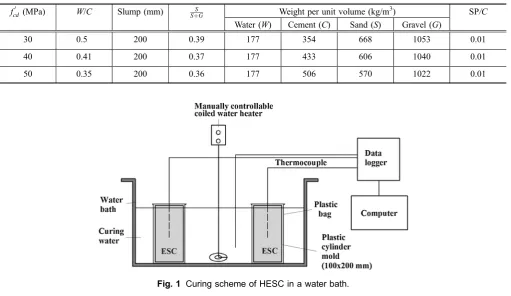
Table1 presents chemical compositions of Type III cement used in this study. A relatively higher chemical compositions of SO3, C3A and C3S in Type III cement with higher Blaine value than those in Type I cement contribute to a rapid development of concrete compressive concrete (Schindler and Folliard 2005). Mix proportions for the HESC used in this study were summarized in Table2. Three differentfcd0 of 30, 40, and 50 MPa were considered. Their target slump and air content were 200±20 mm and 3±1 %, respectively. Maximum size, specific gravity and fineness modulus of crushed gravel were 20 mm, 2.6 g/cm3 and 6.8, respectively. The specimens were first washed in order to minimize the effect of relative cleanliness on con-crete properties in both the fresh and hardened states. River sand was used as the fine aggregate, which had specific gravity of 2.6 g/cm3and a fineness modulus of 2.2. Super-plasticizer (SP) was used to increase workability.
2.2 Preparation of the Specimens
Mixing and specimen preparation were conducted at room temperature and 50±5 % relative humidity. Concrete is mixed by a 120-l capacity pan mixer. After 1 min of dry mixing with coarse aggregate, fine aggregate and cement, water and SP were added to the mixture in sequence and mixed for an additional 2 min. After mixing, the slump and air contents of the fresh concrete were measured according to the standard test specified in ASTM C143/C143M-10 (2010) and ASTM C231/C231M-14 (2014).
After obtaining the desired slump and air contents, the concrete was cast into 1009200 mm plastic cylindrical molds. In order to avoid agglutination between the mold and the concrete, the molds were cleaned in advance and brushed with a thin film of form oil. As illustrated in Fig.1, water temperature contained in a plastic water bath was controlled to adjust the curing temperature of the cylinder according to the predetermined curing regimes. The water temperature was monitored with a thermocouple placed in the water and manually adjusted using a coil-type water heater submerged in the water bath. Using a thermocouple inserted into the mid-depth of the cylinder, change of concrete temperature during the curing period was measured.
Each batch cast fourteen cylinders. Before submerging the cylindrical molds containing fresh HESC into the curing water, each mold was placed into a waterproof plastic bag, and the top surface was covered with a plastic sheet to prevent evaporation of the water in the mold. The cylindrical molds were then placed into the water bath at the reference temperature ofTr(=20°C in this study) for 3 h to allow the initial setting of HESC. After that, the water temperature was increased at a rate of 10°C/h from 20°C to the desired maximum temperature (Tmax).
Preliminary tests showed that HESC developed a com-pressive strength close to its fcd0 value in 5 days and exceeds fcd0 value in 7 days of curing in an ambient environment. Based on that observation, the compressive strength of HESC was measured to the equivalent age of 7 days (168 h). Five differentTmax of 20, 30, 40, 50 and 60°C were considered in order to observe the effect of maximum temperature on the development of compres-sive strength in HESC at 7 different equivalent ages, 9, 12, 18, 24, 36, 100 and 168 h. The equivalent age (teqin h) in Eq. (1), suggested by Freiesleben and Pedersen (1977), was used in this study. Equation (1) is also recommended in ASTM C 1074-04 (2004). It takes into account the ratio of the maturity at concrete temperature (Tc in °C) to the one atTr:
Table 1 Chemical and physical properties of Type III cement used in this study.
Chemical composition (%) Mineral composition (%) Density
(g/cm3)
Blaine (cm2/g) CaO SiO2 Al2O3 Fe2O3 MgO Na2O K2O SO3 C3S C2S C3A C4AF
teq¼
Xt
0
eEeqRðTcþ1273Trþ1273Þ Dt ð1Þ
where,tis the real elapsed time (h), Dt is the time interval (h),Eeqis the activation energy (=33,500 J/mol) used in the estimation of teq, R is the universal gas constant (=8.314 J/mol/K) andTcis the temperature of concrete (°C). Figure2a illustrates the typical curing regime adopted in this study, which is composed of 3-h delay at ambient temperature, followed by different periods of temperature increase, maximum constant temperature, temperature decrease, and cooling at ambient temperature. All curing regimes began with a 3-h delay at 20°C for initial setting of the fresh concrete before the application of any additional heat. The rates of temperature increase and decrease in the concrete were maintained at 10 and-10°C/h, respectively, to prevent undesirable porosity or cracking (AASHTO2004; Alexanderson1972; CSA-A23.4-092014).
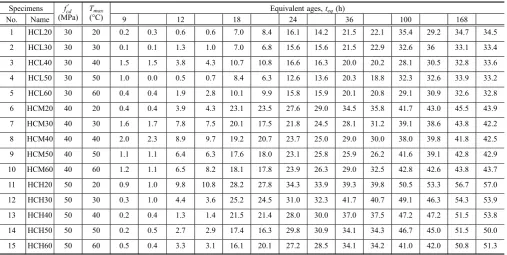
Table3lists 15 sets of test specimens. Test specimens are labeled using the form HCSn1n2, where HC stands for HESC cylinder, S for fcd0 value (S=L, M and H for fcd0 =30, 40 and 50 MPa, respectively) and n1n2 indicates Tmax. For each set for the identical conditions offcd0 andTmax, a total of 14 cylinders-7 sets of two replicas cast for the measurement of compressive strength at 7 different equiva-lent ages (9, 12, 18, 24, 36, 100 and 168 h)—were placed into the water. The time for a compression test was calcu-lated at a certainteqby referring to the concrete temperature measured from the embedded thermocouple. Figure2b presents the relationships betweenteqand real elapsed time (t) at strength measurement for each curing regime with a
Table 2 Mix proportions.
fcd0 (MPa) W/C Slump (mm) S
SþG Weight per unit volume (kg/m
3
) SP/C
Water (W) Cement (C) Sand (S) Gravel (G)
30 0.5 200 0.39 177 354 668 1053 0.01
40 0.41 200 0.37 177 433 606 1040 0.01
50 0.35 200 0.36 177 506 570 1022 0.01
Fig. 1 Curing scheme of HESC in a water bath.
Fig. 2 Curing regimes with 5 differentTmax:atypical curing
regime;bEquivalent age (teq) versus real elapsed time
specific Tmax. After the concrete reached the maximum temperature, the temperature was held constant until teqof 36 h, at which time the HESC was expected to reach 70 % of its fcd0 value. The temperature of the concrete was then reduced to 20°C at a rate of -10°C/h and maintained at 20°C until performing the additional compression tests at theteqof 100 and 168 h.
2.3 Development of Concrete Compressive Strength
A set of two replica cylinders were removed from the water bath at the predetermined teqand stripped from their molds. The both top and bottom surfaces were ground shortly before they were tested in compression with a hydraulic servo-controlled compressive testing machine of 1000 kN capacity. The rate of loading was within the range of 0.25±0.05 MPa/s (ASTM C39/C39M-14,2014).
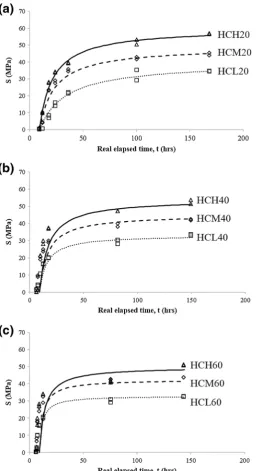
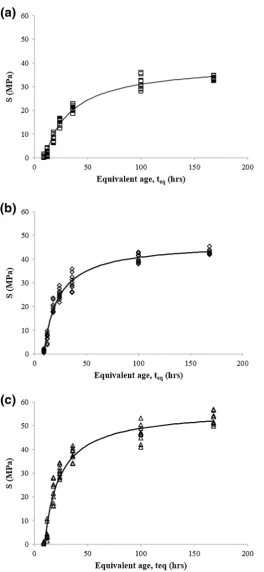
Table3tabulates the test results. Experimentally observed compressive strengths in Table3, measured for differentfcd0 and Tmax, show that a majority of HESCs reached 70 % or more of theirfcd0 values in 36 and 168 h in equivalent age, respectively. Figure3 illustrates a trend of compressive strength development of HESC with different fcd0 for the same Tmax. HESC with higher strength develops its com-pressive strength more rapidly at an early stage of curing than that with lower strength under the same Tmax. At the later stage of curing, however, all concrete with differentfcd0 values showed similar rates of strength increase. In general, concrete cured under higher Tmax showed a more rapid increase in strength development in the early stage of curing,
but its rate decreased more rapidly at the later stage of the curing period.
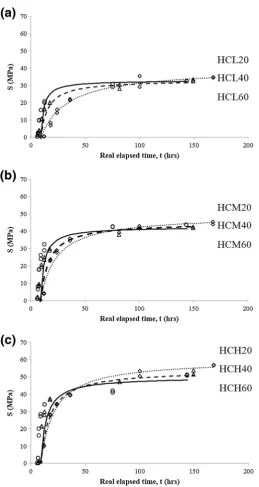
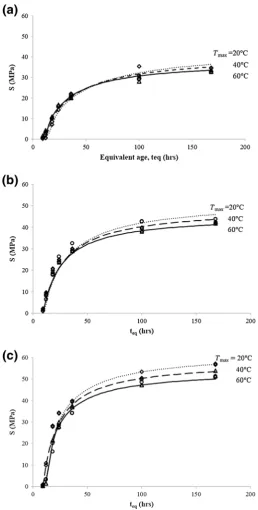
Figure4shows the effects ofTmaxon the development of compressive strength in HESC with differentTmax=20, 40 and 60°C for the same fcd0 value. For all cases, the rapid development of compressive strength was observed in the early stage of the curing period. The developing compressive strength, then, asymptotically approaches to the ultimate strength at the decreasing rate. Similar observations were also reported for concrete made of Type I cement.
When cured at a higherTmax, the compressive strength of HESC tended to develop at a higher rate in the early stage of curing. However, the rate of strength increase decreased more rapidly for the specimens cured under higher tem-peratures, resulting in an asymptotic approach of strength to a relatively lower limiting compressive strength with the increase in time compared with those cured under lower temperatures. This clearly shows that the curing tempera-ture has a significant effect on the rate of hydration for HESC and leads to a crossover effect, commonly reported for the concrete with Type I cement. Crossover effect was caused by complex mechanisms involving stiffer and thicker build-up of hydrate shells, low permeability hydration products around the cement grains, retarded diffusion of the hydrate in the secondary reaction of cement hydration, non-uniform dispersion of reaction products within the pores of the hardening paste at higher temper-ature (Alexander and Taplin1962; Carino and Lew1983; Kjellsen et al.1990; Kjellsen and Detwiler1993; McIntosh 1956; Yi et al.2005).
Table 3 Measured concrete strengths (Sin MPa) at different values ofTmaxandteq.
Specimens fcd0
(MPa)
Tmax
(°C)
Equivalent ages,teq(h)
No. Name 9 12 18 24 36 100 168
1 HCL20 30 20 0.2 0.3 0.6 0.6 7.0 8.4 16.1 14.2 21.5 22.1 35.4 29.2 34.7 34.5
2 HCL30 30 30 0.1 0.1 1.3 1.0 7.0 6.8 15.6 15.6 21.5 22.9 32.6 36 33.1 33.4
3 HCL40 30 40 1.5 1.5 3.8 4.3 10.7 10.8 16.6 16.3 20.0 20.2 28.1 30.5 32.8 33.6
4 HCL50 30 50 1.0 0.0 0.5 0.7 8.4 6.3 12.6 13.6 20.3 18.8 32.3 32.6 33.9 33.2
5 HCL60 30 60 0.4 0.4 1.9 2.8 10.1 9.9 15.8 15.9 20.1 20.8 29.1 30.9 32.6 32.8
6 HCM20 40 20 0.4 0.4 3.9 4.3 23.1 23.5 27.6 29.0 34.5 35.8 41.7 43.0 45.5 43.9
7 HCM30 40 30 1.6 1.7 7.8 7.5 20.1 17.5 21.8 24.5 28.1 31.2 39.1 38.6 43.8 42.2
8 HCM40 40 40 2.0 2.3 8.9 9.7 19.2 20.7 23.7 25.0 29.0 30.0 38.0 39.8 41.8 42.5
9 HCM50 40 50 1.1 1.1 6.4 6.3 17.6 18.0 23.1 25.8 25.9 26.2 41.6 39.1 42.8 42.9
10 HCM60 40 60 1.2 1.1 6.5 8.2 18.1 17.8 23.9 26.3 29.0 32.5 42.8 42.6 43.8 43.7
11 HCH20 50 20 0.9 1.0 9.8 10.8 28.2 27.8 34.3 33.9 39.3 39.8 50.5 53.3 56.7 57.0
12 HCH30 50 30 0.3 1.0 4.4 3.6 25.2 24.5 31.0 32.3 41.7 40.7 49.1 46.3 54.3 53.9
13 HCH40 50 40 0.2 0.4 1.3 1.4 21.5 21.4 28.0 30.0 37.0 37.5 47.2 47.2 51.5 53.8
14 HCH50 50 50 0.2 0.5 2.7 2.9 17.4 16.3 29.8 30.9 34.1 34.3 46.7 45.0 51.5 50.0
3. Prediction of ESC Compressive Strength
3.1 Previous Models: Review
A mathematical model for the rate of relative increase in concrete compressive strength with respect to its limiting compressive strength (Suin MPa) was suggested by Bern-hardt (1956) as given in Eq. (2). In Eq. (2), the reaction coefficient (r) reflects the retardation of continuous hydra-tion as curing time elapses, and its value is taken as greater than zero. Equation (2) assumes that the rate of relative strength increase with respect toSudecreases from its rate constant (k) to zero as the strength (S) approaches toSuwith the increase in elapsed curing time.
d S Su
dt ¼k 1 S Su
r
ð2Þ
where,kis the rate constant of concrete (h-1) andr is the reaction coefficient.
In Eq. (2), the rate constant, k, was adopted from the Arrhenius equation (Arrhenius 1889) for concrete. The k represents the number of collisions per unit time during the hydration reaction and is expressed as:
k¼AeE=½RðTcþ273Þ ð3Þ
Fig. 3 Effect of fcd0 on concrete strength development (open square 30 MPa; diamond 40 MPa; and open triangle 50 MPa): a
where,Ais the frequency factor (h-1) andEis the activation energy in general (J/mol).
By integrating Eq. (2) with respect to time t and applying initial condition of S(0)=0, two expressions for S corre-sponding to r=1 or 2 can be obtained as given in Eq. (4):
S¼ Su 1e
kt
if r¼1
Su 1 1
1þðr1Þkt
½ ½1=ðr1Þ
n o
if r6¼1 (
ð4Þ
Depending on the type of concrete, curing conditions or experimental parameters in consideration, different sugges-tions and modificasugges-tions of Eq. (4) were suggested by dif-ferent researchers (Carino and Tank1992; Kim et al. 1998, 2001; Kwon et al. 2014; Yi et al. 2005). Bernhardt
(1956) and Carino (1984) suggestedr=2 after empirically investigating the development of strength in ordinary con-crete exposed to different curing temperatures. Moon (1999) and Yi et al. (2005) suggested that a reaction coefficient requal to 3 would estimate later-age strength development more accurately than that equal to 2.
Based on the basic equation withr=2, the rate constant model given in Eq. (5) was proposed by Tank and Carino (1991) to estimate the relative strength gain of concrete based upon itsteq.
S ¼Su
krteqt0r 1þkr teqt0r
ð5Þ
Fig. 4 Effect ofTmaxon concrete strength development (diamond20°C;open triangle40°C; andopen circle60°C):aTmax¼20C;
where, kr is the rate constant at reference temperature, Tr (h-1) (¼AeE=½RðTrþ273Þ) and t
0r is the age at the start of strength development at the reference temperature (h).
In their work, quantitative information about the effect of temperature on the rate constant was obtained by curing specimens at various constant temperatures and through systematic analysis of the resulting strength gain data. Not onlyr, but alsoSuas well as EandAin Eq. (3) have been functionalized with some influential factors after experi-mental observations. Tank and Carino (1991) showed thatSu is a function of curing temperature, supposing that the Su decreases nearly linearly with curing temperature. Whereas Yi et al. (2005) observed thatSudepends mainly on curing temperature, Kwon et al. (2014) and Liao et al. (2008) suggestedSuas a function of temperature and humidity after their experimental observations. ‘‘Activation energy has been proposed as a function of temperatureTcby Freiesleben and Pedersen (1977) and Jonasson et al. (1995),Tcandtby Kim et al. (2001), the chemical components of the cementitious materials and Blaine value by Schindler (2004) and Poole (2006), the water–cement ratio (W/C), Tc, and degree of hydration by Abdel-Jawad (2006), andTc and concrete age by Yang et al. (2016). Frequency factor was suggested as a function of bothTcand humidity by Liao et al. (2008) and a function of humidity only by Kwon et al. (2014).’’
3.2 Development of the Model
In this study, the generalized model for the prediction of strength development of HESC was developed based on Tank and Carino’s model in Eq. (5). Firstly, a series of regression analyses were performed for each set of 70 test data obtained for eachfcd0 (=30, 40 or 50 MPa) cured under one of the 5 different curing regimes withTmaxof 20, 30, 40, 50 and 60°C. From the regression analyses, the best-fitting values of Su, kr and t0r in Eq. (5) were identified for each data set. Case I in Table4tabulates the best-fitting values as well as the average (l) and standard deviation (r) of the ratios of predicted strengths (Sthy) to experimentally observed ones (Sexp) forteq[t0r. It is interesting to observe that although the values ofSuandkrshow their dependency onfcd0 , the values oft0rdo not show their dependency onf
0 cd. The maximum difference in t0r was about 5.0 % at maxi-mum with respect to their average value of 9.3 h (0.39 days). However, the statistical parameters, Su and kr shown in Case I in Table4, suggest the need for more refinement via influential factors.
Figure5 shows comparisons between the model predic-tions and test results on the development of compressive strength of HESC with respect toteqfor Case I. In general, the predicted values showed the general trend of strength development as a function. However, they tended to over-estimate compressive strength development in the curing stage beforeteqless than 18 h with predicted strengths 1.64 times greater than the measured ones on average (Fig.6).
Previous experimental studies showed that Su, E and A were influenced by various factors, such as Tc, W=C;t, humidity, chemical components and Blaine. However,
relative humidity, chemical components and Blaine value were kept invariant during the test in this study. Conse-quently, these factors were excluded in this study when a general model was developed based on Eq. (5). A total of 15 separate regression analyses were performed for 5 different curing schemes applied to 3 differentfcd0 values in order to determine the best-fitting coefficients fort0randSuin Eq. (5) andA and Ein Eq. (3), with Tc¼Trð¼20C) as given in Eq. (6). A constant value of R¼8:314 J=mol=K was used throughout. Case II in Table4 tabulates the best-fitting values from 15 separate regression analyses.
kr¼AeE=½RðTrþ273Þ ð6Þ
3.2.1 Frequency Factor, A
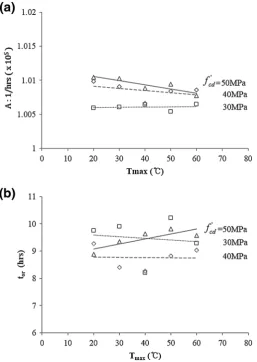
Regression analyses revealed that the maximum and minimum values ofAwere 1:005105h1for HCL50 and 1:010105h1for HCH20, respectively, as shown in Case II in Table4(Fig. 7a). The ratio of the maximum value ofA to the minimum one was only 1.01, which would suggest that the effects of concrete strength and maximum temper-ature on A are marginal. From this observation, the value of Awas determined to be constant at 1:0105h1.
3.2.2 Age at the Start of Strength Development
atTr, t0r
As observed in Case I in Table4, values oft0rfrom Case II in Table4 remained between 8.2 and 10.2 h and did not show any clear dependency on either fcd0 or Tmax(Fig.7b). This observation corresponds to the finding of Kim et al. (2001) thatt0rdoes not depend on concrete strength. Using a constant value of A¼1:0105h1 and assuming a con-stant value oft0rindependent off
0
cdandTmax, the best-fitting value oft0rwas found to be 9.02 h from regression analysis performed on 210 test data. From this observation, the constant values of 1:0105h1 and 9.02 h (0.38 days) were assigned toAin Eq. (6) andt0rin Eq. (5), respectively, in order to determine the factors that influence the remaining parameters in subsequent analyses.
3.2.3 Limiting Compressive Strength, Su
Figure8 shows the results of a regression analysis that obtained the ratios of the best-fitting value ofSuatTmaxto that ofSuatTr(Sur) for 15 different cases with 3 differentf
0 cd and 5 different Tmax values. Figure8 clearly demonstrates the crossover effect, that is, a decrease inSuwith an increase inTmax, for all concrete strengths. Figure8 also shows that, in general,Su/Sur is influenced byf
0
cd at a givenTmax. Test results showed that concrete strength obtained from different mix proportions resulted in differentSur. Based on the test results, Sur is expressed as a linear function of f
0
cd in this study. To reflect the dependency ofSu/Suron Tmaxand f
0 cd, the following regression equation is suggested to evaluateSu in Eq. (5):
Su¼Sur 0:0032Tmaxþ asf 0 cdþbs
h i
T able 4 Statistical parameters with the best-fitting values of Su , kr ,
t0r
, A and E and a function of b . Cases Specimens Eq. no. f 0 cd (MPa) Tmax ( ° C) No. of data Regression parameters and b Statistical parameters on Sthy / Sexp No. Name Su ( MPa ) kr (h -1)
t0r
where, Sur¼0:95f 0
cdþ16:0, as¼ 0:0005 and
bs¼1:0684.
Equation (7) is in accordance with previous models:Suas a function ofTmaxby Tank and Carino (1991);f
0
cd andTmax by Yi et al. (2005); andTmaxby Kwon et al. (2014) and Liao et al. (2008) if the relative humidity remains constant. Their models showed similar effects of Tmax and f
0
cd on S as experimentally observed in this study.
3.2.4 Activation Energy,E
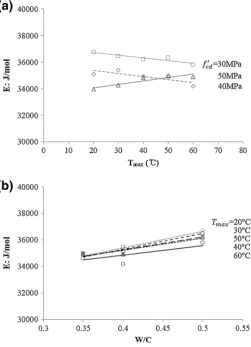
Figure9a exhibits that except for the cases when Tmax changed from 20 to 40°C forfcd0 =50 MPa,Edecreases in general with increasingTmax. Kim et al. (2001) and Jonasson et al. (1995) also observed thatEdecreased with increasing Tmax. Figure 9a also shows that in generalEdecreases with an increase in fcd0 at a specific Tmax. Those experimental results are also in accordance with previous observations
Fig. 5 Predictions of compressive strength development at differentteqby Eq. (5): Case I in Table4(open square30 MPa;diamond
made by Kim et al. (2001), Kwon et al. (2014) and Abdel-Jawad (2006). Figure9b illustrates that higher E was observed in general with lowerTmaxat a given value ofW/C. This observation also agrees with the finding reported by Abdel-Jawad (2006). Based on the experimental observa-tions, the following expression is suggested forEof HESC as a function of bothTmaxandW/C:
E Tmax;f 0 cd
¼aeTmaxþbeW=CþceEmax ð8Þ
where, ae= -47.29W/C ?9.3, be=10,541 and ce=31,308.
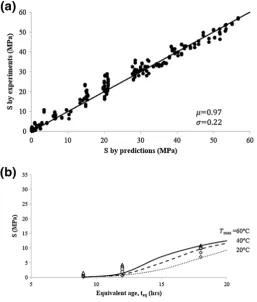
Equation (5) was modified by substituting E in Eq. (8) into Eq. (6) andSu in Eq. (7) intoSuin Eq. (5). Figure10a shows a comparison between the predictions made by the modified model and the 210 experimental results (Case III in Table3). The l and r of the ratios of the model pre-dictions to experimental results were 1.30 and 1.16, respectively.
Fig. 6 Comparisons with 210 experimental results: Case I in Table4.
Fig. 7 Effects ofTmaxonAandt0r: Case II in Table4 (open square30 MPa;diamond40 MPa; andopen triangle50 MPa):aTmax
The predictions made by the modified model were shown to have a relatively large value oflwith a significant scatter by a large value of r (=1.16). This was mainly due to overestimations on the compressive strengths of HESC at early equivalent ages less than or equal to 18 h as indicated in Fig.10b for fcd0 equal to 30 MPa. The same trends of overestimation were also observed from the models devel-oped for Case I. For fcd0 equal to 40 and 50, similar
overestimations were also observed, especially for the teq less than or equal to 18 h. In order to improve model pre-dictions at early age, a modification function for early age was introduced in Eq. (9) through regression analyses of the 210 test data. The function (b) is composed of a product of linearly decreasing and exponentially decaying functions with respect to the increase inteq.
b¼SexpSthy
Sexp
¼1ar24teqt0r e24brðteqt0rÞ ð9Þ
where,ar¼ab1Tmaxþbb1 andbr¼ab2Tmaxþbb2.
In Eq. (9),ab1andbb1have different fitting values of 0.37, and 0.006 for fcd0 =30 MPa, 0.0002 and 0.0001 for fcd0 =40 MPa, and 0.28 and 0 for fcd0 =50 MPa, respec-tively. The coefficients of ab2 and bb2 also have different values of 0.016 and 0.21 forfcd0 =30 MPa, 0.15 and 0.006 for fcd0 =40 MPa, and 0.005 and 0.62 for fcd0 =50 MPa, respectively. Including a corrective functionbin Eq. (9), the generalized predictive equation is presented in Eq. (10) for the development of compressive strength of HESC. In Eq. (10),A,Randt0rtake constant values of 1:0105hrs1; 8.314 J/mol/K and 9.02 h, respectively. The expressions for Sufrom Eq. (7) andEfrom Eq. (8) were used in Eq. (10).
Fig. 8 Effects ofTmaxandf
0
cdonSu/SurwithA¼1:0105h1
and t0r¼9:02h (open square: 30 MPa; diamond
40 MPa; andopen triangle50 MPa).
Fig. 9 Effects ofTmaxandW=ConEwithA¼1:0105h1andt0r¼9:02 h:aTmaxversusE(open square30 MPa;diamond40 MPa;
Fig. 10 Comparisons of predicted compressive strengths and experimental measured ones: Case III in Table3:aComparisons
with 210 experimental results;bOverestimation by the modified model in early age (fcd0 =30 MPa) (diamond: 20°C;open
triangle40°C; andopen circle60°C).
Fig. 11 Comparisons of predicted compressive strengths and experimentally measured ones: Case IV in Table4:aComparison
with 210 experimental results;bPredictions of compressive strength by Eq. (10) in early age (fcd0 =30 MPa) (diamond
S¼Su 1 1b
Ae½RðTrEþ273Þ t eqt0r
1:0þAe½RðTrEþ273Þ t eqt0r
ð10Þ
Statistical parameters resulting from the predictions by Eq. (10) are listed in Case IV in Table3. Thelandrfor the ratios of predicted values to experimentally observed values were 0.97 and 0.22, respectively. Comparisons between the predictions made by Eq. (10) and 210 test results are shown in Fig.11a. In Fig. 11b, model predictions for 18 test results for teqless than or equal to 18 h are presented. Compared with Figs.10a and10b, Figs.11a, and 11bshow improved predictions made by (Eq.10), especially for data values before 18 h inteq. The developed model was able to predict
the test results with reasonable accuracy for all values ofteq. Figure12illustrates comparisons between model predictions and 210 test results for differentfcd0 . The model could predict strength development of HESC for allfcd0 andTmaxvalues in a reasonable accuracy. The developed model can be used to find the optimum steam curing regime applied to HESC in future studies.
4. Conclusions
Application of HESC to steam-cured fabrication of precast prestressed units could reduce fuel consumption and carbon
Fig. 12 Predictions by Eq. (10) for differentfcd0: Case IV in Table4(diamond20°C;open triangle40°C; andopen circle60°C):a
dioxide emissions due to its early-strength-development. In order to maximize the beneficial effect of HESCS in steam curing process, it seems necessary to have a priori knowl-edge on the effects of curing temperature, age and other factors on the development of compressive strength in HESC. From experimental investigations, the following conclusions were made in this study.
1. HESC showed a general trend in strength development similar to that observed for normal concrete with Type I cement: a rapid increase during the early stage of curing followed by a gradual decrease in the rate in the later stage, with an asymptotic approach to the limiting compressive strength in the final stage.
2. Crossover effects were observed. Strength increased more rapidly at higherTmaxin the early stage of curing but its rate reduced more rapidly in the later stage. This resulted in an asymptotic approach of strength to a relatively lower limiting compressive strength than that obtained under a lowerTmax.
3. A majority of HESCs, regardless of differences in fcd0 and Tmax, reached about 70 and 100 % of their design compressive strengths in 36 and 168 h in equivalent age, respectively.
4. Separate regression analyses on 3 sets of 70 data for each fcd0 exhibited that values oft0r are independent of fcd0 orTmaxand remain almost constant. However, values of Su and kr showed that they needed to be function-alized with influential factors.
5. From additional separate regression analyses performed for 15 sets of data, the values of A and t0r were identified. Using these values,Suand Ewere function-alized as a decreasing function with decreasingfcd0 and increasingTmax, and a decreasing function with increas-ingTmaxand decreasingW/C, respectively.
6. A generalized model was presented after introducing a corrective function to better predict the strength devel-opment of HESC at an equivalent age of less than 18 h. The l and r for the ratios of predicted values by the generalized model to 210 experimentally measured data were 0.97 and 0.22, respectively.
5. Open Access
This article is distributed under the terms of the Creative Commons Attribution 4.0 International License (http:// creativecommons.org/licenses/by/4.0/), which permits unre-stricted use, distribution, and reproduction in any medium, provided you give appropriate credit to the original author(s) and the source, provide a link to the Creative Commons license, and indicate if changes were made.
Acknowledgments
This research was supported by the Basic Science Research Program through the National Research Foundation of
Korea (NRF) funded by the Ministry of Education, Science and Technology (NRF-2013R1A2A2A01011563).
References
AASHTO. (2004). A policy on geometric design of highways and streets. AASHTO 2004, Washington, DC.
Abdel-Jawad, Y. A. (2006). Estimating concrete strength using a modified maturity model.Proceedings of the Institution of Civil Engineers, Construction Materials, 159, 33–37. ACI 517.2-2R-87. (1992). Accelerated curing of concrete at
atmospheric pressure-state of the art., Farmington Hills, MI. ACI 318-08. (2008). Building code requirements for structural
concrete and commentary, Farmington Hills, MI.
Alexander, K. M., & Taplin, J. H. (1962). Concrete strength, paste strength, cement hydration and the maturity rule. Australian Journal of Applied Science, 13(4), 277–284. Alexanderson, J. (1972). Strength losses in heat cured concrete.
Swedish Cement Concrete Inst Procc.
Arrhenius, S. (1889). U¨ ber die reaktionsgeschwindigkeitbei der inversion von rohrzuckerdurchsauren. Zeitschrift fu¨r Physikalische Chemie, 4, 226–248.
ASTM C1074-04. (2004) Standard Practice for Estimating Concrete Strength by the Maturity Method, West Con-shohocken, PA.
ASTM C143/C143M-10. (2010). Standard test method for slump of hydraulic-cement concrete. West Conshohocken, PA. ASTM C231/231M-14 (2014). Standard test method for air
content of freshly mixed concrete by the pressure method, West Conshohocken, PA.
ASTM C39/C39M-14. (2014). Standard test method for com-pressive strength of cylindrical concrete specimens, West Conshohocken, PA.
Bernhardt, C. J. (1956). Hardening of concrete at different temperatures. RILEM Symposium on Winter Concreting, Copenhagen, Danish, Institute for Building Research, Session B-II.
Carino, N. J. (1984). Maturity method: Theory and application. Journal of Cement Concrete and Aggregates, 6(2), 61–73. Carino, N. J., & Lew, H. S. (1983). Temperature effects on the strength-maturity relations of mortars.ACI Journal, 80(3), 177–182.
Carino, N. J., & Tank, R. C. (1992). Maturity functions for concretes made with various cements and admixtures.ACI Materials Journal, 89(2), 188–196.
CSA (Canadian Standards Association). (2014). Precast con-crete—materials and construction. CSA-A23.4-09, Tor-onto, Canada.
Erdem, T. K., Turanli, L., & Erdogan, T. Y. (2003). Setting time: an important criterion to determine the length of the delay period before steam curing of concrete.Cement and Con-crete Research, 33(5), 741–745.
Freiesleben, H. P., & Pedersen, E. J. (1977). Maturity computer for controlled curing and hardening of concrete. Nordisk Betong, 1(19), 21–25.
Hanson, J. A. (1963). Optimum steam curing procedure in pre-casting plants.ACI Journal, 60(1), 75–100.
Higginson, E. C. (1961). Effect of steam curing on the impor-tant properties of concrete.ACI Journal, 58(9), 281–298. Jonasson, J. E., Groth, P. & Hedlund, H. (1995). Modeling of
temperature and moisture field in concrete to study early age movements as a basis for stress analysis. In Proceed-ings of the international RILEM symposium on thermal cracking in concrete at early ages(pp. 45–52).
Kim, J. K., Han, S. H., & Lee, K. W. (2001). Estimation of compressive strength by a new apparent activation energy function. Cement and Concrete Research, 31(2), 1761–1773.
Kjellsen, K. O., & Detwiler, R. J. (1993). Later-age strength prediction by a modified maturity model. ACI Materials Journal, 90(3), 220–227.
Kjellsen, K. O., Detwiler, R. J., & Gjorv, O. E. (1990). Pore structure of plain cement pastes hydrated at different tem-peratures.Cement and Concrete Research, 20(6), 927–933. Kwon, S. H., Jang, K. P., Bang, J. W., Lee, J. H., & Kim, Y. Y. (2014). Prediction of concrete compressive strength consid-ering humidity and temperature in construction of nuclear power plants.Nuclear Engineering and Design, 275, 23–29. Liao, W. C., Lee, B. J., & Kang, C. W. (2008). A humidity-adjusted maturity function for the early age strength prediction of concrete.Cement & Concrete Composites, 30, 515–523. McIntosh, J. D. (1956). The effects of low-temperature curing
on the compressive strength of concrete. RILEM
Symposium on Winter Concreting, Copenhagen, Danish, Institute for Building Research, Session BII.
Moon, Y. H. (1999). Prediction of concrete strength with dif-ferent curing temperature and time. Ph.D. Dessertation of Korea Advanced Institute of Science and Technology, Daejeon, Korea.
Oztekin, E. (1984). Determination of heat treatment cycle for cements.Association Cement Bulletin, 206(3), 24–26. Poole, J. L. (2006). Modeling temperature sensitivity and heat
evolution of concrete. Ph.D. Dissertation of University of Texas at Austin, TX.
Ramezanianpour, A. A., Khazali, M. H., & Vosoughi, P. (2013). Effect of steam curing cycles on strength and durability of SCC: A case study in precast concrete. Construction and Building Materials, 49, 807–813.
Schindler, A. K. (2004). Effect of temperature on hydration of cementitious materials. ACI Materials Journal, 101(1), 72–81.
Schindler, A. K., & Folliard, K. J. (2005). Heat of hydration models for cementitious materials. ACI Material Journal, 102, 24–33.
Tank, R. C., & Carino, N. J. (1991). Rate constant functions for strength development of concrete.ACI Materials Journal, 88(1), 74–83.
Yang, K. H., Mun, J. S., Kim, D. G., & Cho, M. S. (2016). Comparison of strength-maturity models accounting for hydration heat in massive walls.International Journal of Concrete Structures and Materials, 10(1), 47–60.