R E S E A R C H
Open Access
Content and buffer status aware packet
scheduling and resource management
framework for video streaming over LTE
system
Lijun He
*and Fan Li
Abstract
With the development of the video encoding and wireless communication technologies, DASH (Dynamic Adaptive Streaming over HTTP) services have an increasing and great share of all the mobile services. However, we find some problems which still need to be addressed for DASH service optimization: (1) the limitation of the video segment representations cannot keep pace with the change of wireless channel states; (2) the characteristics of the video transmission have been not fully utilized in current DASH services; and (3) long interruption time will yield poor QoE (Quality of Experience). To solve these problems, we build a new transmission architecture by modifying the traditional TCP transmission flow. We first add a TCP (Transmission Control Protocol) proxy responsible for discarding the expiry packets automatically before putting them into the TCP sending window and then build a “ACK (acknowledgement) reconstruction module” to reconstruct the received ACK for concealing the packets discarded by the packet scheduler. Based on the new framework, we explore the interdependence among all the packets from the encoder to indicate the importance of each packet and update the interdependence relationship of every scheduling period based on the feedback ACK information. At MAC (Media Access Control) layer, a buffer status estimation module is employed to estimate the client buffer and playback information, which can be used to calculate the packet urgency. Then, a cross-layer design, which consists of an application layer of media server and client, TCP layer, MAC layer, and physical layer, is formulated and the packet scheduling and resource allocation can be jointly optimized. At client, through the analysis of the status of client buffer and MAC queue, an adaptive segment request scheme is developed to determine how and when to send the segment request. Simulation results show that the proposed algorithms can efficiently improve the received video quality as well as the playback continuity compared with other existing algorithms.
Keywords: DASH service, Packet importance, Buffer status estimation, Packet scheduling and resource management, Adaptive segment request
1 Introduction
1.1 Motivation
With the development of the video compression technol-ogy and the wireless network, video streaming in wireless system has taken a growing part of mobile service and attracted more and more attention. Representing the next generation in mobile technology, LTE system based on OFDMA (orthogonal frequency division multiple access)
*Correspondence: [email protected]
School of Electronics and Information Engineering, Xi’an Jiaotong University, Xianning Road, 24105 Xi’an, China
and MIMO (multiple-input multiple-output) technologies can promise faster speed and better coverage. Therefore, it is crucial to investigate how to provide satisfactory multi-client video streaming services to mobile multi-clients by using this promising technology.
Researches have been carried out to enable high-quality video services like HTTP streaming over TCP (Trans-mission Control Protocol), where each video sequence is pre-encoded into many segments which cannot start to play until all the packets of it have been received [1, 2]. However, besides the high received video quality, contin-uous playback experience is also an important issue to
be addressed from the perspective of the end clients. In addition, due to the error concealment strategy employed in the decoding, some packet loss can be tolerated for video applications. Waiting for the arrivals of all the pack-ets inevitably leads to some unnecessary interruptions for the playback. There are some prior works [3–5] in which the playback time of each packet was fixed. Those algo-rithms can provide continuous playback but may result in large fluctuation of the packet loss rate because of the time-varying channel states. To get a better trade-off between the video quality and the playback continuity, we introduce a maximum allowed waiting time for the play-back of each frame. In our multi-client video streaming system, the packets whose arrival times expire the maxi-mum allowed playback time are discarded. Besides time-varying wireless channel states and the limited availability of resources, unique characteristics of video packets such as the packet priority and stringent playback deadline are also considered in our proposed packet scheduling and RB assignment scheme.
To improve the system performance of video streaming, it is equally important to keep the client buffer and MAC queue at a desired level. Conventional strategies usually request segment with fixed time interval [1] or only con-sider the status of client buffer [6]. All of those algorithms may result in a low level of client buffer but too many pack-ets accumulated in MAC queue due to the bad channel states. In a scenario with limited MAC queue buffer size, the packet loss rate would increase due to the overflow of the MAC queue. As a result, we propose a MAC (Medium Access Control) queue and client buffer aware segment request strategy to determine the appropriate time to send the segment request.
Since only the above two schemes cannot provide the best system performance, to make the packet scheduling more flexible, many prior works have been carried out to select the most appropriate video presentation or even code the video source to match the time-varying channel states [7–10] or control the client buffer length [1]. How-ever, none of them consider the status of MAC queue. Therefore, we propose a rate adaption strategy based on the MAC queue and the client buffer.
1.2 Related work
The MLWDF scheduling rule in [11] aimed at maxi-mizing the system throughput by considering the packet delay rather than the queue length. Considering both current channel conditions and the packet delay makes MLWDF more appropriate for real-time applications. The authors in [12–17] paid their attention to DASH ser-vice optimization by determining the segment adaptation and resource allocation scheme. The authors in [13] pre-sented a system framework description of DASH service and mentioned many key factors that we should consider
in DASH service optimization. The authors in [14] pro-posed a QoE-driven cross-layer optimization for wireless dynamic adaptive streaming of scalable videos over HTTP. They first designed a mapping scheme from scalable video coding layers to DASH layers. Then, they developed a cross-layer design to achieve the resource allocation by considering both the video content and the client buffer status. They also proposed a rate adaptation scheme based on the client buffer status. In general, these works are worthy to be referred and investigated. However, the lim-itation of the video segment representations cannot keep pace with the change of wireless channel states. Moreover, the characteristics of the video transmission have been not fully utilized in current DASH services and long inter-ruption time will yield poor QoE. Some recent research focused on packet importance and the delay require-ments. Our work [18] focused on the video content and estimated the packet importance based on the extracted information from the compressed video. Similarly, [19] employed the video compression characteristics to indi-cate the packet importance. The wireless channel condi-tion was also considered by using the queue length, input rate, and output rate. However, the packet urgency has not been considered in the above work. In [3–5, 20, 21], the delay requirement depended on the time interval during which the packets can be waiting to be scheduled in MAC queue. They can have a good effect on the video streaming over UDP because the clients experience continuous play-back all the time. For instance, the authors in [22] assumed that there is only one frame waiting in MAC queue and the packets of this frame which cannot be transmitted in a cer-tain time interval will be dropped. For the video streaming over TCP, the client will wait until all the packets are received. In this case, different clients will suffer different playback experiences and different playback buffer status. The previous playback experience will affect the follow-ing playback condition. Thus, it is inappropriate to use the waiting time in the MAC queue to determine the delay requirement. To accurately examine the packet urgency, the authors in [23–25] analyzed the distribution of the packet display time and proposed a playback control algo-rithm for real-time video services. In [24], the frame type and its corresponding playback time are considered to improve the received video quality and playback experi-ence. However, their proposed models cannot be adapted in wireless systems because of the varying channel state. Furthermore, since many error concealment strategies can be employed at the decoder and the loss of different video packets will have different effects on the received video quality, it is not necessary to transmit all the video packets for the video service especially in the system with limited wireless resource.
for IIS and around 3 s for Netflix in [1]) without con-sidering any information about client in the conventional mechanisms. This may result in some clients having too many frames stored at the client buffers while the oth-ers suffer playback buffer underflow. The authors in [6] developed the segment request strategy based on the play-back information. But they ignored the information of the MAC queue and the time-varying channel states. With the time when to send the segment request known, how to select the requested segment to adapt to the time-varying channel states becomes a crucial problem to be solved. H.264 SVC (Scalable Video Coding) technology is widely employed in many researches [26–29] to provide differ-ent video qualities by encoding each video sequence into many different layers. The authors in [26, 29] exploited the cross-layer design framework for a dynamic scalable video adaptation in varying network capacity. In order to increase the number of the clients that the system can support, the authors in [27] focused on the multi-client video transmission over OFDMA-based commu-nication system by combining the adaptive subcarrier allocation and bit loading with the transmission of the H.264 SVC encoded video sequences. Since scalable video usually consists of multiple scalable layers with different importance which brings high implementation complex-ity, most of the researches still focus on the pre-encoded video applications. In [7, 8], some studies have been car-ried out to determine the optimal coding rate that the server should provide. The authors in [7] first allowed the server to drop some unimportant frames by consid-ering the channel states. Then, according to the dropping strategy, the optimal coding rate can be determined by using a simple rate-distortion model. In [8], to aim for maximum QoE (Quality of Experience) for clients, maxi-mum system video throughput, and QoE fairness among clients, a cross-layer optimized coding rate adaptation scheme was proposed. However, both of them focus on the received video quality but neglect another important issue of video streaming: playback continuity. To improve the playback experience, [1] studied a no-reference QoE (quality of experience) monitoring module for adaptive HTTP streaming. The authors showed the playback inter-ruptions can be reduced by changing the QP (quantitative parameters) of the encoder to provide a presentation with a close coding rate to the estimation transmission rate. The authors in [9, 10, 30] formulated the video streaming process with multiple links. Gouache et al. [9] provided a method to estimate the transmission rate of the next scheduling period which can be used to determine the data distribution among the servers. In [10, 30], it is assumed that each client receive the video data from dif-ferent servers or the other clients in the system. The bit rate can be obtained based on the source node selection strategy. In those algorithms, the bit rate was determined
with the assumption that there is no packet in MAC queue waiting to be scheduled. In fact, when we send the next segment request, there may be some packets left in the MAC queue. And due to the different channel states of the end clients, their numbers of the remaining packets maybe different from each other. Since the remaining packets would affect the transmission of the next segment, the sta-tus of the clients’ MAC queue should be considered in the bit rate determination.
1.3 Approach
In summary, we find some problems which still need to be addressed for DASH services over TCP as follows: (1) the limitation of the video segment representations can-not keep pace with the change of wireless channel states; (2) the characteristics of the video transmission have been not fully utilized in current DASH services; (3) long inter-ruption time will yield poor QoE. Inspired by the above prior works, we propose a buffer status and content aware packet management framework in LTE system. Our work is novel in the following aspects.
• A new transmission framework for DASH services: We modify the transmission flow of the whole DASH service. With the purpose to transmit the packets which are really important to the received video quality as soon as possible and discard the ones that have little effect on the improvement of the QoE level of all the clients. We added a TCP proxy to control the main functions of the TCP layer. It is responsible for “Packet rearrange” which can discard the expiry packets automatically according to the feedback information from the packet urgency estimation at the MAC layer and the dropped packets will not be put into the “Packet sending window.” At the MAC layer, we build a “ACK reconstruction module” to reconstruct the received ACK for concealing the discarded packets. With the aim of maximizing the sum utility of the scheduled packets, some packets with little utility will be discarded instead of wasting lots of time for their arrival at the client. At the client, we introduce a maximum allowed waiting time for each segment. The client does not need to wait until all the video packets arrive at the client. Then, based on the new transmission architecture, we can improve the QoE of DASH service by jointly optimizing the application layer of media server and client, TCP layer, MAC layer, and PHY layer. The strategy of packet scheduling, resource allocation, and segment request can be obtained in our new framework.
the interdependence relationship between the packets waiting to be scheduled and the packets already transmitted or lost based on the feedback ACK information. This update mechanism makes the packet importance more close to the real
contribution that the packet can create. Moreover, we take into consideration the playback information to predict the packet urgency.
• A rate adaptation scheme based on both MAC queue and the client buffer status: We consider the MAC queue status in our rate adaptation scheme. We use the playback information of client to estimate the continuous playback time that the packets in MAC queue can support. Then, by considering the MAC queue, client buffer, and the estimated transmission rate, we can acquire the urgency of each client and determine when and how to send the new segment request.
The rest of the paper is organized as follows. Section 2.1 describes the system model, and Section 2.2 presents how to calculate the packet utility. Section 2.3 show the prob-lem formulation and solution to our proposed packet scheduling and resource management scheme. Section 2.4 presents a rate adaption scheme to derive when and which presentation should be requested and selected. Section 3 provides the discussion and the experimental results of the proposed algorithms. Finally, we draw the conclusion in Section 4. We provide a list of abbreviations used in this paper as shown in Table 1
Table 1A list of abbreviations
LTE Long Term Evolution
GoP Group of pictures
MAC Media Access Control
ACK Acknowledgement
AM Acknowledged mode
RB Resource block
OFDMA Orthogonal frequency division multiple access
MIMO Multiple-input multiple-output
TCP Transmission Control Protocol
SVC Scalable video coding
QoE Quality of Experience
CQIs Channel quality indicator
TTI Transmission time interval
MCS Modulation and coding scheme
NS3 Network Simulation 3
AR Adaptive request
PSNR Peak signal-to-noise ratio
RLC Radio link control
2 Methods
2.1 System Model
Figure 1 shows the framework of this paper. In this system,
Kvideo clients can request different video sequences they want. Each video sequence is pre-encoded into a series of video segments with different coding rates (different presentations) by employing the H.264/AVC encoder in advance. The segments are stored at the media server attached to eNodeB via a lossless wired network, and the clients can send the segment requests to the media server. The packet priority can be determined based on the infor-mation extracted from the encoder and the feedback ACK information.
We build a TCP proxy to control the main functions of TCP layer. It is responsible for “Packet rearrange,” “ACK receiving window,” and “Packet sending window.” The module “Packet rearrange” can discard the expiry pack-ets according to the feedback information from packet urgency estimation at the MAC layer automatically, and the dropped packets will not be put into the “Packet send-ing window.” In other words, these packets discarded by TCP have no chance to be scheduled and transmitted. The packets not expiry will be put into “Packet sending win-dow” according to the receiving ACK information from the “ACK receiving window.”
At the MAC layer, the playback information can be estimated based on the feedback information from the clients. Considering the estimated playback information and the packet priority, we can calculate the importance of each packet. Based on the packet importance and the feedback CQIs (channel quality indicator), different RBs are assigned to different clients to maximize the system performance. We build a “ACK reconstruction module” to reconstruct the received ACK for concealing the dis-carded packets at the MAC layer. It depends on the received ACK information from the “ACK sending win-dow” at the client and the packet scheduling strategy at the MAC layer. When we consider the packet utility dur-ing the resource allocation to maximize the sum utility of the scheduled packets, some packets with little utility will be discarded instead of wasting lots of time for their arrival at the client. The ACK of these discarded pack-ets will be constructed and integrated with the received ACKs by the “ACK reconstruction module” and then sent to the “ACK receiving window” at the TCP layer. And thus, the dropped packets at the MAC layer are con-cealed during the TCP flow. In addition, at the MAC layer of eNodeB, we focus on the estimation of the play-back time that the packets in MAC queue can support by using the estimated buffer status and the predicted transmission rate.
Fig. 1The proposed system framework
packets violate its deadline will be discarded by the MAC layer and TCP layer. The exact buffer information helps us to easily get how long the remaining buffered frames in client buffer can take. Based on the analysis of the client buffer and MAC queue, an adaptive segment request strat-egy is developed to send each segment request at an appropriate time. Knowing when to send the segment request, a rate adaption scheme is proposed based on the estimated transmission rate and the status of the client buffer and MAC queue to provide the presentation which should be selected.
2.2 Packet utility estimation
Packet utility in our work depends on two factors: the packet priority determined by the encoding information and the packet urgency determined by the playback infor-mation. In this paper, the packet priority is calculated in terms of the potential degradation caused in the video quality due to loss of the packet. Since the same method is applied to all the video sequences, we omit the client index in the following analysis. Letλdenote the number of
B frames inserted into two P frames. LetDlossf,p denote the distortion caused by the loss of the packetpof framef (fis the encoding index of the frame), which can be expressed by
Dlossf,p =Drecf,p+Dreff,p (1)
It consists of two parts:
(1)Drecf,p is the relative distortion caused by the recon-structed packet. Here, the distortionDrecf,pcan be obtained by using the method presented in [31].
(2)Dreff,pis the relative distortion caused by the packets dependent on the current one. As shown in Fig. 2, if we set the encoding parameter Number Reference Frames = 1, I or P frame will be directly referred according to the following principles:
• The following two B frames(f +1,· · ·,f +λ)refer the framef for backward prediction.
• The following P framef +λ+1refers the framef for forward prediction.
• The following two B frames(f+λ+2,· · ·,f+2λ+1) refer the framef for forward prediction.
Letγf,pbe the sum times that each of the pixels of packet
pof framef is referenced. To calculateγf,p, the informa-tion of each packet such as MB (macroblock) partiinforma-tion modes and MVs should be extracted from the encoder. H.264/AVC encoder supports the intra-coded and inter-coded prediction modes and also provides abundant MB partition modes. Intra-coded prediction has 16×16 and 4 × 4 partition modes, and the inter-coded prediction mode possesses seven MB partition modes, namely 16× 16, 16× 8, 8×16, 8 ×8, 8 ×4, 4× 8, and 4×4 as shown in Fig. 3. Letψηf,,fθ,pdenote the set of the pixels of packet p of frame f referenced by the SB θ of the MB
η of the framef. The calculation of ψηf,,θf,p is described in Table 2.
Note that I frame is directly referenced by its follow-ing P frame. If the P frame is not the last P frame in this GoP, it is also referenced by its following P frame. Except for the first P frame, other P frames refer I frame undi-rectly. Consequently, the loss of I or P frame will cause the quality degradation of all the following frames in the same GoP. For P frame, the smaller frame encoding index is the more important. In this paper, the referenced times of each packet is calculated by considering both direct and undirect reference modes. Letβspecify the total number of I and P frames in one GoP. Any I or P frame is given another index calledreference frame indexto indicate its index among all the I and P frames in a GoP. Letπf denote the reference frame index of framef, 0≤πf ≤β−1. Let ζ (•)denote the number of the elements of the input set. For the packetpof framef:
• Ifπf =β−1, framef is the last P frame in its GoP and it is only referenced by its following B frames in direct mode.γf,pcan be computed by
γf,p= f+2λ+1
f=f+1
η,θ ζ
ψηf,,fθ,p
(2)
• Ifπf < β−1, framef may be referenced by its following B frames and P frames in direct or undirect mode.γf,pcan be computed by
γf,p= f+2λ+1
f=f+1
η,θ ζ
ψηf,,fθ,p
direct reference mode
+
f+λ(β−πf)+β−πf−1
f=f+λ+2
η,θ ζ
ψηf,,θf,p
undirect reference mode
(3)
where ψηf,,fθ,pis the region of pixels of packetpof frame
f referenced undirectly by SBθ of MBηframef. To
cal-culate ψηf,,fθ,p, we need to calculate the reference region
of frame f directly referenced by frame f, φηf,,fθ first. Then, according to all the reference relationships between the undirect reference frames such as (f,f −λ−1),
· · ·,(f −λ−1,f),ψηf,,θf,pcan be obtained finally, where (f1,f2)is the set of the reference relationships for all the
SBs between framef1andf2, which can be easily acquired
Table 2Calculation ofψηf,,fθ,p
Step 1 Calculate the location of the starting point of theηthMB off×thframe,
mf
x(η),mfy(η)
.
Step 2 Obtain the position of the SBθof MBη,sfx(η,θ ),sfy((η,θ ))based on the extracted MB partition modes.
Step 3 With knowing the motion vector the SBθof MBηbetweenfandf,(MVxf,f(η,θ ),MVyf,f(η,θ )), the location of the starting point of the SB used as the reference of framefcan be derived by
⎧ ⎨ ⎩
lxf,f(η,θ )=sfx(η,θ )+MVx
f,f(η,θ )
lyf,f(η,θ )=syf(η,θ )+MVyf,f(η,θ )
Step 4 The region of the pixels of thefframe referenced by the SBθof the MBηof the framefcan be expressed by
φfη,,fθ=(x,y)|lfx,f(η,θ )≤x≤l
f,f
x (η,θ )+wf(η,θ )−1,l
f,f y ≤y≤l
f,f
y +hf(η,θ )−1
,
wherewf(η,θ )andhf(η,θ )are the width and the height of the SBθof MBη, respectively.
Step 5 Letϕf,pspecify the region of the pixels of packetpof framef. Eliminate the elements inφfη,,fθthat do not belong to the
setϕf,pand obtain the set of the pixels referenced by the SBθof the MBηof the framef,ψ
f,f,p
η,θ ,ψ
f,f,p
η,θ =φ
f,f
η,θ∩ϕf,p. Step 6 Repeat step 1–step 5 if there are unprocessed SBs of framef.
by using the method presented in Table 2. Based on the above analysis,Dreff,pcan be computed by
Dreff,p=
Drecf,pζ (ϕγf,p
f,p), ifAfˆ,pˆ=1
Dconf,p γf,p
ζ (ϕf,p), ifAˆf,pˆ =0
(4)
whereAˆf,pˆis a binary variable which indicates whether the
packetpˆof frameˆf is received or lost.Afˆ,pˆ =1 is equal to the successful delivery andAfˆ,pˆ =0 otherwise. The value ofAfˆ,pˆdepends on the feedback ACK information.Dconf,p is the distortion caused by the loss of its reference packetpˆ
of framefˆ. Finally,Dlossf,p can be obtained according to (1). In the following,Dlossf,p is regarded as the priority of packet
pof framef and at the RLC (radio link control) layer of LTE system, each video packet is fragmented into many small packets. It is assumed that the packets attributed to the same packet have the same priority. In MAC queue, we can acquire the packet priority from the packet header denoted by prik,m.
We use the feedback information such as ACKs of the received packets from the clients to predict the play-back information and then examine the packet urgency. LetFc(k)denote the estimated index of the frame being played of clientk. Since the frames of one segment should be decoded simultaneously, the packet urgency of all the video packets of the frames of the same segment should be the same. Thus, the packet urgencyμk,mcan be expressed by
μk,m=Pk,m−Fc(k) (5)
wherePk,m is the index of the first frame of the segment waiting in the MAC queue. For the packets of the same segment, the values ofPk,m are the same. By employing
the method proposed in [3], the scheduling probability of packetmfor clientk,ρk,m, can be defined asρk,m=e−μk,m.
Then, considering the packet priority and the packet urgency, the utility of packetmof clientk,Uk,m, can be calculated by
Uk,m=e−μk,m×prik,m (6)
2.3 Problem formulation and solution
2.3.1 Problem formulation
We formulate the packet scheduling and resource man-agement into a new mathematical model with the objec-tive to maximize the weighted sum of utilities of all the scheduled packets of all the clients:
max K
k=1 wk
Mk
m=1
Uk,mτk,m
s.t.
(c1) n∈ak,n
q(Nk)
j=1
bk,jrj≥ Mk
m=1
τk,mRk,m, 1≤k≤K
(c2)τk,m∈ {0, 1}, 1≤m≤Mk, 1≤k≤K
(c3) q(Nk)
j=1
bk,j=1, bk,j∈ {0, 1}, 1≤k≤K
(c4) K
k=1
ak,n=1, ak,n∈ {0, 1}, 1≤n≤N
(7)
where
• : the set of the total available RBs.
• N : the number of the available RBs in this system.
• wk: clientk ’s weight, a positive constant calculated by
wk= K
k=1
(Nb(k))/Nb(k), such that K
k=1
(wk)=1.
Nb(k)is the predicted number of frames waiting to be played at client buffer. The aim is to balance the playback continuity experience among the clients.
Nb(k)can be predicted by using the feedback ACK information with RLC mode AM. It can also be fedback from the client by employing the playback buffer status analysis module at client.
• τk,m:τm,k=1means the packetm of client k is selected to be scheduled andτm,k =0otherwise.
• ak,n:ak,n=1indicates the RBn is assigned to client k andak,n=0otherwise.
• Nk: the set of RBs assigned to clientk.
• q(Nk): the maximum MCS (Modulation and Coding Scheme) that clientk can support based onNk.
• bk,j:bk,j=1means clientk uses MCS j andbk,j=0 otherwise.
• rj: the transmission capacity of each RB by using MCSj.
• Rk,m: the size of the packetm of client k.
Constraint (c1) shows that the transmission capacity of clientkshould be enough to transmit its scheduled pack-ets. We assume that all the scheduled packets can be transmitted to the client successfully by advanced chan-nel coding. Constraint (c2) indicates that each packet can be scheduled or not at each scheduling period. Constraint (c3) means that each client can only choose one MCS. The last constraint implies that one RB can only be assigned to one client.
2.3.2 Packet scheduling and resource management scheme
From the mathematical expression in Eq. (7), the rela-tionship between the receive time and other parame-ters cannot be explicitly evaluated without restrictive assumptions on the arrival process and the time-varying channel states. Thus, we can not obtain a mathemat-ically optimal solution of the above problem in its most generic form. Due to this, we develop a heuristic suboptimal solution, which jointly performs RB assign-ment and packet scheduling by employing our proposed utility function.
To solve the problem (7), a cost functionCk,nis devel-oped to present the increment of the sum utilities of the clients brought by assigning RBnto clientk.Ck,n can be expressed by
Ck,n=f(τk,m,ak,n,bk,j,Nk∪ {n})−f(τk,m,ak,n,bk,j,Nk) (8)
whereNkis the set of the RBs already assigned to clientk. The functionf(•)can be expressed as
f(τk,m,ak,n,bk,j,Nk)=maxwk Mk
m=1
Uk,mτk,m
s.t.
(c1) n∈Nk
ak,n q(Nk)
j=1
bk,jrj≥ Mk
m=1
τk,mRk,m
(c2)τk,m∈ {0, 1}, 1≤m≤Mk
(c3) q(Nk)
j=1
bk,j=1, bk,j∈ {0, 1}
(9)
Achieving problem (7), we should assign RB nto the client with the maximumCk,n. To get Ck,n, we need to solvef(τk,m,ak,n,bk,j,Nk)first. Next, we will provide how to calculatef(τk,m,ak,n,bk,j,Nk).
For a certain client with fixed RB set, the utility is an increasing function of the transmission capacity. The maximum capacity these RBs can support can be calcu-lated by solving the following problem:
max
n∈Nk
ak,n q(Nk)
j=1 bk,jrj
s.t.
(c1) q(Nk)
j=1
bk,j=1, bk,j∈ {0, 1}
(c2) K
k=1
ak,n=1, ak,n∈ {0, 1},{n} ∈Nk
(10)
Then, we can get the optimala∗k,n,b∗k,j, and then the
transmission capacity n∈Nk
a∗k,n
q(Nk)
j=1
b∗k,jrjcan be obtained
according to [32]. Knowing the transmission capacity, the optimal packet scheduling strategy τk∗,m can be obtained by solving the following problem:
maxwk
Mk
m=1
Uk,mτk,m
s.t.
(1) n∈Nk
a∗k,n
q(Nk)
j=1
b∗k,jrj≥ Mk
m=1
τk,mRk,m
(2)τk,m∈ {0, 1}
(11)
Optimal τk∗,m can be easily acquired by our method proposed in [33]. Then, we can have
f
τk∗,m,a∗k,n,b∗k,j,Nk
= Mk
m=1
τk∗,m (12)
The detailed process of the packet scheduling and resource management scheme is described in Table 3.
2.4 Adaptive segment request scheme
Table 3Packet scheduling and resource management scheme
1 Initializethe total RB set= {1, ...,N}and the RBs determined to be assigned to clientk,Nk= ∅, for 1≤k≤K.ak,n=0,bk,j=0, for
1≤k≤K,n∈.
2 While( = ∅)
3 Forn∈
5 For1≤k≤K
6 UpdateNk=Nk∪ {n}andak,n=1.
7 Solve the problem (10), updatea∗k,n=1 andb∗k,j=1. 8 Solve the problem (11), getτk∗,m.
9 Calculatefτk∗,m,ak∗,n,b∗k,j,Nk
= Mk
m=1
τk∗,mandCk,n
10 Endfor For 11 k∗=argmax
1≤k≤K
Ck,n
12 UpdateNk=Nk\{n},ak,n=0 andbk,j∗=0 fork =k∗.=\{n} 13 Endfor For
14 Endfor while
15 Outputoptimal packet schedulingτk∗,mand RB assignmentN∗k.
2.4.1 Segment request time determination
The segment request time determination is carried out at the client side, so we can get the accurate number of the unplayed but successfully decoded frames stored in clientk’s playback bufferNb(k)and how long continuous playback these frames can supportTb(k) = Nb(k)/Fpr, where Fpr is the frame rate. Since some packets in the MAC queue can be transmitted to the client side during
Tb(k)and therefore can bring extra continuous playback time, immediately sending the new segment request can not bring benefit to the client but may occupy the wireless resource which is really needed by other clients. Letting the packets in MAC queue are the ones that are really needed by the clients is the most important.
LetTmac(k) denote how long the continuous playback
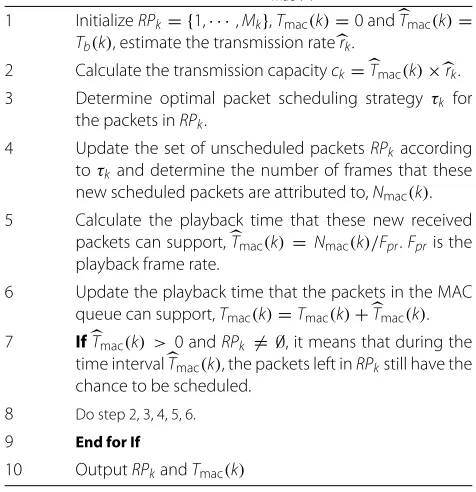
time interval that the packets in MAC queue can support andRPk denote the set of the packets in MAC queue of clientkafter the estimation. The estimation ofTmac(k)is
shown in Table 4.
IfRPk = ∅, it means that all the packets in the MAC queue can arrive at the client on time and the client can enjoyTmac(k)+Tb(k)continuous playback back at least. If RPk = ∅, it means that the clientk will suffer inter-ruption after the time intervalTmac(k)+Tb(k). LetTl(k) denote the playback time that the remaining packets in MAC queue will take, which can be calculated byTl(k)=
Nl(k)/Fpr, where Nl(k) is the number of the remaining frames in the MAC queue. The transmission time they will take can be estimated byTr(k)=SM(k)/rk, where SM(k) indicates the sum size of the left packets in the MAC queue. A guard time intervalTg(k)is introduced to pro-tect the client against suffering playback interruption. The
Table 4Procedure of estimation ofTmac(k)
1 InitializeRPk= {1,· · ·,Mk},Tmac(k)=0 andTmac(k)=
Tb(k), estimate the transmission raterk.
2 Calculate the transmission capacityck=Tmac(k)×rk. 3 Determine optimal packet scheduling strategyτk for
the packets inRPk.
4 Update the set of unscheduled packetsRPk according toτkand determine the number of frames that these new scheduled packets are attributed to,Nmac(k). 5 Calculate the playback time that these new received
packets can support,Tmac(k) =Nmac(k)/Fpr.Fpris the playback frame rate.
6 Update the playback time that the packets in the MAC queue can support,Tmac(k)=Tmac(k)+Tmac(k). 7 IfTmac(k) > 0 andRPk = ∅, it means that during the
time intervalTmac(k), the packets left inRPkstill have the chance to be scheduled.
8 Do step 2, 3, 4, 5, 6.
9 End for If
10 OutputRPkandTmac(k)
appropriate time interval needed to send the next segment request,Ti(k), can be computed by
Ti(k)=max(Tmac(k)+Tb(k)+Tl(k)+Tr(k)−Tg(k), 0) (13)
2.4.2 Rate adaption at client
With the time when to send the segment request known, we need to determine which presentation should be selected. To keep the continuous playback, the next requested segment should be transmitted to the client during the time we estimated above. Based on the esti-mated transmission rate, we can determine the optimal coding rate we should request. With the optimal coding rate known, we can select the segment with most clos-est coding rate. Using the metadata contained in MPD (Media Presentation Description), the unique URL of the requested segment can be constructed. Then, the request will be sent to the media server by HTTP GET command. The media server will pick the segment with the unique URL and send it to the DASH client.
LetSmac(k)denote the sum size of the packets in client
k’s MAC queue, Smac(k) =
Mk
m=1
Rk,m. The transmission
time taken by those packets,Tmac(k), can be estimated by
Tmac(k)=
Smac(k) rk
(14)
• IfTl(k)=0, all the packets in MAC queue can be transmitted to the client during the time interval
Tb(k)+Tmac(k). Therefore, to keep the continuous
playback of clientk, the next segment should be transmitted to client during the interval
Tb(k)+Tmac(k)−Tmac(k). LetTseg(k)be the duration
of a segment for clientk. Then, the coding rate that the client should recommend can be computed by
prk =rkTb(k)+Tmac(k)−Tmac(k) Tseg(k)
(15)
• IfTl(k) >0, clientk would suffer interruption after the time intervalTb(k)+Tmac(k). Since the left
packets also take some timeTl(k)to be transmitted and played, the next segment should arrive at client during the time intervalTl(k). Then, the
recommended coding rate can be acquired by
prk =rk
Tl(k)
Tseg(k)
(16)
In general, the recommended coding rate can be deter-mined by
prk =
⎧ ⎨ ⎩
rkTTsegl((kk)), if Tl(k) >0
rkTb(k)+TTmacseg((kk)−)Tmac(k), otherwise
(17)
Obviously, the recommended coding rate may be not equal to the real coding rate of the segments stored at the media server. Thus, the client should determine which segment should be selected based on the recommended rate. In this paper, we will pick the representation with the most close coding rate to prkfrom all the pre-encoded representations. The encoding information of the repre-sentation can be found in MPD.
Assume that there be εk representations of the video sequence requested by clientkand let PRkindicate the set of those representations, PRk = {PRk,1,· · ·, PRk,εk}with
PRk,i < PRk,i+1. If the recommended rate prk is lower or higher than the coding rates of all the encoded represen-tations, the DASH client will pick the representation with the lowest or the highest coding rate of PRk. The princi-ple of the final decision on the selected representation spk can be summarized as follows:
spk =
⎧ ⎨ ⎩
PRk,1, if prk <PRk,1
PRk,i, if PRk,i≤prk<PRk,i+1
PRk,εk, if prk ≥PRk,εk
(18)
From Eq. (18), we can determine which segment should be requested. As long as the segment going to be requested is obtained, the unique URL of the segment can be constructed by using the metadata contained in MPD. Then, the request will be sent to the media server by HTTP GET command and the media server will pick
the segment with the unique URL and send it to the DASH client.
3 Results and discussion
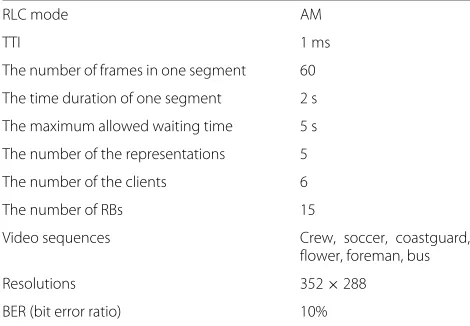
We provide our experimental results and discussion in this section. All the experiments are carried out in LTE system with the Network Simulation 3 (NS3) simulator [34]. eNodeB can obtain the CQIs through the feedback of all UEs. Each scheduling period called TTI (Transmission Time Interval) consists of two consecutive RBs and the time slot duration of each RB is 0.5 ms. Therefore, CQIs will be periodically updated and transmitted to eNodeB in the feedback information every 1 ms. It is assumed that the power be equally allocated among the RBs. Since we need the ACK information to predict the playback buffer status of the DASH client, the RLC mode is set to be AM (acknowledged mode). All the video sequence have been encoded into a series of the video segments with five dif-ferent coding rates (presentations). Each segment consists of 60 frames with the time duration of 2 s. The detailed system configuration is shown in Table 5. The encoding information about the average coding rate, PSNR, and the corresponding presentation is shown in Table 6. For each segment, there is no need to receive all the video pack-ets especially the packpack-ets with little effect on the received video quality. In our simulation, each video packet should be transmitted to the client before its deadline which depends on the maximum allowed waiting time of each video packet. We define Tak as the maximum allowed waiting time for the packet of clientk. It means that from the time the packet should be started to be played, the client only waitTak for the arrival of the video packet at most. In our simulation,Tak =5 s, 1≤k≤K. Using this parameter, we can determine which packet has the chance to be transmitted and which should be discarded auto-matically. The clients can dynamically switch their request
Table 5Description of the experimental environment
RLC mode AM
TTI 1 ms
The number of frames in one segment 60
The time duration of one segment 2 s
The maximum allowed waiting time 5 s
The number of the representations 5
The number of the clients 6
The number of RBs 15
Video sequences Crew, soccer, coastguard,
flower, foreman, bus
Resolutions 352×288
Table 6The encoding information of different video sequences
Sequence Client Presentations
index 1 2 3 4 5
Crew 1 Rate (kbps) 466.7208 608.524 711.7496 801.0336 923.3712
PSNR (dB) 34.8681 35.5819 36.2521 36.8612 37.5994
Soccer 2 Rate (kbps) 423.2584 551.7096 636.772 718.7632 829.6016
PSNR (dB) 33.952 34.6657 35.2741 35.9167 36.6319
Coastguard 3 Rate (kbps) 471.1336 672.8216 810.1552 940.3784 1123.4392
PSNR (dB) 32.3916 33.1998 33.871 34.5482 35.3562
Flower 4 Rate (kbps) 999.0232 1153.0616 1337.796 1490.62 1699.604
PSNR (dB) 31.8602 32.851 33.692 34.5294 35.5316
Foreman 5 Rate (kbps) 235.1504 365.7448 419.1232 476.512 554.4792
PSNR (dB) 34.2313 34.9516 35.5223 36.1295 36.8365
Bus 6 Rate (kbps) 671.0488 940.0936 1090.0216 1226.1664 1411.5
PSNR (dB) 32.3691 33.2327 33.9662 34.6956 35.5563
presentations at the times that they send their segment requests.
“PROPOSED” is the algorithm which consists of both the proposed packet scheduling and resource manage-ment scheme. “AR” (adaptive request) only indicates the adaptive segment request scheme. When AR is not used at the client, the clients will send the segment request with a fixed time interval and the rate adaption scheme is to request the segment whose rate is the most closest to the estimated transmission rate. The algorithm proposed in this paper will be compared with the following four algorithms:
• QTRMA in [15]: It investigated QoE optimization approaches for adapting the adaptive HTTP video delivery. They considered the client buffer status and proposed a novel playback buffer-dependent
approach that determines for each client the
streaming rate for future video segments according to its buffer time and the achievable QoE under current radio conditions.
• ADCLA in [18]: It developed a packet importance model based on the information extracted from the compressed video and proposed a content-aware scheduling scheme for resource allocation. The waiting time in MAC queue is used to calculate the packet urgency.
• MAXCI in [35]: It is a purely channel-dependent scheduling scheme, in which the clients with good channel states always occupy the channel most of time even if they are well ahead of their video decoding deadlines.
• PF in [36]: It allocates the limited network resources by considering both the experienced channel states and the past client throughput. Its goal is to
maximize the system throughput and to guarantee fairness among end clients.
In Fig. 4, we provide the average PSNR of each frame of all the clients for different algorithms respectively. From this figure, we can see that our proposed algorithm can outperform other existing algorithms for all the clients. This indicates that considering the packet importance and the packet urgency can make the packet schedul-ing and resource allocation strategy more reasonable. Due to taking into consideration the packet importance, ADCLA+AR has higher PSNR than MAXCI+AR and PF+AR. We can also observe that QTRMA has more sta-ble performance than other algorithms. This is because for QTRMA, there is no packet loss, the client will wait until all the video packets of each segment arrive at the client.
300 400 500 600 700 800 900 1000 1100 1200 Frame Number
10 15 20 25 30 35 40
PSNR(dB)
PF+AR QTRM MAXCI+AR ADCLA+AR PROPOSED
Fig. 5Playback time of each frame of each client for different algorithms
No packet loss means not so serious quality fluctuation during one segment. But transmitting all the video pack-ets may lead to requesting the segment with low bit rate which will also degrade the value of the average PSNR. In fact, the packet with little importance should be discarded not scheduled.
Figures 5 and 6 shows the corresponding playback time of each frame of each client and the average playback time of each frame of all the clients. In the simulation, each client should experience a rebuffering time interval until all the packets of two segments are received. From
0 100 200 300 400 500 600 700 800 900 1000
Video Frame Index
0 10 20 30 40 50 60 70 80 90
Playback Time (s)
PF+AR QTRMA MAXCI+AR ADCLA+AR PROPOSED
Fig. 6Average playback time of all the clients for each frame for different algorithms
the two figures, we can see that some continuous play-back can be guaranteed for all the clients with different algorithms. From Fig. 6, we can deserve that the client can finish the whole video in a shortest time among all the clients by employing our proposed method. It means that the clients suffer the fewest rebuffering events and shortest interruption time which brings most satisfactory playback experience to the clients. From Fig. 5, we can
0 100 200 300 400 500 600 700 800 900 1000
Frame Number
0 0.05 0.1 0.15 0.2 0.25 0.3
Packet Loss Rate
PF+AR MAXCI+AR ADCLA+AR PROPOSED
300 400 500 600 700 800 900 1000 1100 1200
Frame Number
20 30 40
PSNR(dB)
PROPOSED\AR PROPOSED
300 400 500 600 700 800 900 1000 1100 1200
Frame Number
0 20 40
PSNR(dB)
MAXCI MAXCI+AR
300 400 500 600 700 800 900 1000 1100 1200
Frame Number
0 20 40
PSNR(dB)
PF PF+AR
300 400 500 600 700 800 900 1000 1100 1200
Frame Number
0 20 40
PSNR(dB)
ADCLA ADCLA+AR
a
b
c
d
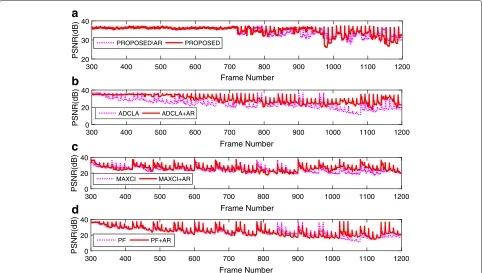
Fig. 8The comparison of the average PSNR of all the clients for each frame for different packet scheduling and resource management algorithms by employing our proposed segment request scheme AR or not.aAverage PSNR of all the clients for each frame for PROPOSED vs. PROPOSED-AR.
bAverage PSNR of all the clients for each frame for ADCLA+AR vs. ADCLA.cAverage PSNR of all the clients for each frame for MAXCI+AR vs. MAXCI.
dAverage PSNR of all the clients for each frame for PF+AR vs. PF
discover that the performance of our proposed method is not always the best among the algorithms for each frame. This is because the objective of our proposed algo-rithm is to maximize the sum of the utilities of all the clients not aiming at optimizing an individual client. We can also see that the algorithm QTRMA yields longer interruption time than the PROPOSED and ADCLA+AR. This is because QTRMA has to start to play until all the video packets of each segment arrive at the client while the former algorithms will wait for onlyTak. It is unrea-sonable to wait for the arrival of the packets with little importance especially in a wireless network with a bad channel state.
To examine the performance of the packet scheduling strategy of our proposed scheme, we present the average packet loss rate of the clients for each frame in Fig. 7. From the figure, we can see that the packet loss rate can be kept to zero for some time because a rebuffer-ing process exists for all the videos at the beginnrebuffer-ing of the playback. In addition, the packet loss rate can be restricted in a lowest range by using our proposed algo-rithm. The number of the frames with no packet loss is larger than other compared algorithms too. Lower packet loss is equal to the higher PSNR especially when we consider the packet utility in the packet scheduling
and resource management. The packet with higher utility will be scheduled with higher priority. Reasonable packet scheduling strategy can improve the received video qual-ity by allocating the limited resource to the clients who really need. Together with the results in Figs. 4 and 6, we can conclude that our proposed algorithm can acquire higher video quality as well as more continuous playback experience.
Fig. 9The comparison of interruption time experienced by each client for different packet scheduling and resource management algorithms by employing our proposed segment request scheme AR or not.aInterruption time experienced by each client for PROPOSED vs. PROPOSED-AR.
bInterruption time experienced by each client for ADCLA+AR vs. ADCLA.cInterruption time experienced by each client for MAXCI+AR vs. MAXCI.
dInterruption time experienced by each client for PF+AR vs. PF
the wireless channel can support. By using AR, the lim-ited resource can be allocated to the packets which are suitable to be transmitted. As shown in Fig. 9, AR can bring the playback experience improvement apparently for all the packet scheduling and resource management schemes. Different schemes earn different achievements. In summary, QoE of the clients can be improved by employing AR.
4 Conclusions
A content and buffer status aware packet scheduling and resource management framework is proposed for DASH video streaming over LTE system. We first modify the transmission flow to make the whole framework toler-ant of the loss of unimporttoler-ant packets. Then, depending on the encoding information extracted from the encoder, we calculate the priorities of the video packets. Based on the feedback information from the clients we can estimate the packet urgency. The priorities of the video packets, the feedback channel states and the packet urgen-cies are considered to optimize the packet scheduling and RB assignment. Instead of requesting the video segments with fixed time interval, we propose an adaptive segment request time determination strategy which can effectively
control the status of the client buffer and MAC queue so as to reduce the packet loss rate caused by the over-flow of the client buffer and MAC queue. To get a better trade-off between the received video quality and playback continuity, we further propose a novel rate adaption algo-rithm which depends on the status of the client buffer, the MAC queue and the predicted transmission rate. Numeri-cal simulation results show that our proposed client buffer and content aware packet scheduling framework can pro-vide superior performance in terms of the PSNR of the received video and playback continuity.
Funding
This work is supported by the National Natural Science Foundation of China, No.61701389.
Availability of data and materials Not applicable.
Authors’ contributions
LH and FL conceived and designed the research. LH performed the experiments and analyzed the data. LH and FL wrote and edited the manuscript. Both authors read and approved the final manuscript.
Ethics approval and consent to participate Not applicable.
Competing interests
The authors declare that they have no competing interests.
Publisher’s Note
Springer Nature remains neutral with regard to jurisdictional claims in published maps and institutional affiliations.
Received: 9 June 2017 Accepted: 27 October 2017
References
1. O Oyman, S Singh, Quality of experience for HTTP adaptive streaming services. IEEE Commun. Mag.50(4), 20–27 (2012)
2. LD Cicco, S Mascolo, An adaptive video streaming control system: modeling, validation, and performance evaluation. IEEE/ACM Trans. Netw. 22(2), 526–539 (2013)
3. Q Ai, P Wang, F Liu, Y Wang, F Yang, J Xu, QoS-guaranteed cross-layer resource allocation algorithm for multiclass services in downlink LTE system. Int. Conf. Wireless Commun. Signal Process, 1–4 (2010) 4. J Huang, W Lin, H Ko, inIEEE Region 10 Conf. A resource allocation
algorithm for maximizing packet transmissions in downlink lte cellular systems, (2011), pp. 445–449
5. H Ramli, K Sandrasegaran, R Basukala, R Patachaianand, X Minjie, L Chung, Resource allocation technique for video streaming applications in the LTE system. Wirel. Opt. Commun. Conf. 1–5 (2010)
6. T Kupka, P Halvorsen, C Griwodz, An evaluation of live adaptive HTTP segment streaming request strategies. IEEE Conf. Local Comput. Netw, 604–612 (2011)
7. M Kalman, B Girod, P Beek, Optimized transcoding rate selection and packet scheduling for transmitting multiple video streams over a shared channel. IEEE Int. Conf. Image Process.1, 165–168 (2005)
8. J Xing, W Fan, Z Lu, A cross-layer scheduling scheme for video streaming based on fuzzy decision-making. IEEE Int. Conf. Commun. Technol, 84–87 (2011)
9. S Gouache, G Bichot, A Bsila, C Howson, Distributed and adaptive HTTP streaming. IEEE Int. Conf. Multimedia Expo, 1–6 (2011)
10. M Xing, S Xiang, L Cai, Rate adaptation strategy for video streaming over multiple wireless access networks. IEEE Global Commun. Conf, 5745–5750 (2012)
11. M Andrews, K Kumaran, K Ramanan, A Stolyar, P Whiting, R Vijayakumar, Providing quality of service over a shared wireless link. IEEE Commun. Mag.39(2), 150–154 (2001)
12. T Cong, H Le, H Nguyen, A Pham, R Man, An evaluation of bitrate adaptation methods for HTTP live streaming. IEEE J. Sel. Areas Commun. 32(4), 693–705 (2014)
13. J Jiang, V Sekar, H Zhang, Improving fairness, efficiency, and stability in HTTP-based adaptive video streaming with festive. IEEE/ACM Trans. Netw. 22(1), 326–340 (2012)
14. M Zhao, X Gong, J Liang, W Wang, X Que, S Cheng, QoE-driven cross-layer optimization for wireless dynamic adaptive streaming of scalable videos over HTTP. IEEE Trans. Circ. Syst. Video Technol.25(3), 451–465 (2015) 15. A Essaili, D Schroeder, E Steinbach, D Staehle, M Shehada, QoE-based
traffic and resource management for adaptive HTTP video delivery in LTE. IEEE Trans. Circ. Syst. Video Techn.25(6), 988–1001 (2015)
16. V Ramamurthi, O Oyman, Video-QoE aware radio resource allocation for HTTP adaptive streaming. IEEE Int. Conf. Commun, 1076–1081 (2014) 17. N Bouten, S Latre, J Famaey, In-network quality optimization for adaptive
video streaming services. IEEE Trans. Multi.16(8), 2281–2293 (2014) 18. F Li, G Liu, L He, Application-driven cross-layer approaches to video
transmission over downlink OFDMA networks. IEEE Globecom Workshops, 1–6 (2009)
19. M Zhao, X Gong, X Que, et al, Context-aware adaptive active queue management mechanism for improving video transmission over IEEE 802.11E WLAN. J. China Univ. Posts Telecommun.19(11), 65–72 (2012) 20. G Liebl, M Kalman, B Girod, Deadline-aware scheduling for wireless video
streaming. IEEE Int. Conf. Multimedia Expo, 1–4 (2005) 21. R Seungwan, R Byunghan, S Hyunhwa, S Mooyong, Urgency and
efficiency based packet scheduling algorithm for OFDMA wireless system. IEEE Int. Conf. Communications.4, 2779–2785 (2005)
22. A Dua, C Chan, N Bambos, J Apostolopoulos, Channel, deadline, and distortion (CD2) aware scheduling for video streams over wireless. IEEE Trans. Wireless Commun.9(3), 1001–1011 (2010)
23. K Fujimoto, S Ata, M Murata, Playout control for streaming applications by statistical delay analysis. IEEE Int. Conf. Commun.8, 2337–2342 (2001) 24. S Wee, T tian, J Apostolopoulos, M Etoh, Optimized video streaming for
networks with varying delay. IEEE Int. Conf. Multimedia Expo.2, 89–92 (2002)
25. C Boutremans, J Boudec, Adaptive joint playout buffer and FEC adjustment for internet telephony. IEEE Int. Conf. Comput. Commun.1, 652–662 (2003)
26. E Piri, M Uitto, J Vehkapera, T Sutinen, Dynamic cross-layer adaptation of scalable video in wireless networking. IEEE Global Commun. Conf, 1–5 (2010)
27. S Islam, M Hossain, A wireless video streaming system based on OFDMA with multi-layer H.264 coding and adaptive radio resource allocation. Int. Conf. Intell. Inf. Process, 1–6 (2011)
28. K Tappayuthpijarn, T Stockhammer, E Steinbach, HTTP-based scalable video streaming over mobile networks. IEEE Int. Conf. Image Process, 2193–2196 (2011)
29. R Radhakrishnan, A Nayak, Cross layer design for efficient video streaming over LTE using scalable video coding. IEEE Int. Conf. Commun, 6509–6513 (2012)
30. W Pu, Z Zou, C Chen, Video adaptation proxy for wireless dynamic adaptive streaming over HTTP. Packet Video Workshop, 65–70 (2012) 31. F Li, G Liu, L He, A cross-layer scheduling algorithm for H.264 video
transmission over wireless networks. Int. Workshop Cross Layer Design, 1–6 (2009)
32. TS 36.213, Evolved Universal Terrestrial Radio Access (E-UTRA): physical layer procedures, https://portal.3gpp.org/desktopmodules/
Specifications/SpecificationDetails.aspx?specificationId=2427. Accessed 23 March 2017
33. L He, G Liu, Quality-driven cross-layer design for H.264/AVC video transmission over OFDMA system. IEEE Trans. Wirel. Commun.13(12), 6768–6782 (2014)
34. G Piro, L Grieco, G Boggia, F Capozzi, P Camarda, Simulating LTE cellular systems: an open-source framework. IEEE Trans. Veh. Technol.60(2), 498–513 (2011)
35. S Borst, User-level performance of channel-aware scheduling algorithms in wireless data networks. IEEE Int. Conf. Comput. Commun.1, 321–331 (2003)