O R I G I N A L A R T I C L E
Reaction behavior of wood in an ionic liquid, 1-ethylpyridinium
bromide
Teruaki Yokoo•Hisashi Miyafuji
Received: 25 December 2013 / Accepted: 21 May 2014 / Published online: 20 June 2014 ÓThe Japan Wood Research Society 2014
Abstract The reactions of Japanese cedar and Japanese beech in a pyridinium-based ionic liquid, 1-ethylpyridini-um bromide ([EtPy][Br]) were studied. Japanese beech was more easily liquefied than Japanese cedar. Hemicellulose is liquefied rapidly, lignin more slowly, while cellulose is partially liquefied. X-ray diffraction analyses on the [EtPy][Br]-insoluble residues revealed that the crystalline structure of cellulose is maintained even after treatment. The difference in liquefaction can be explained by chem-ical structural differences between softwood and hardwood lignins and hemicelluloses.
Keywords WoodIonic liquid1-Ethylpyridinium bromideLiquefaction Reaction behavior
Introduction
We have achieved a comfortable life by making advances in science and technology. Since the Industrial Revolution, use of fossil fuel resources such as oil and coal has enhanced our standard of living. However, mass con-sumption of fossil fuels affects the global environment and causes global warming. Serious energy problems are also associated with the depletion of fossil fuel resources.
Recently, increased attention has been focused on bio-mass resources as alternatives to fossil resources. Wood is thought to be a promising biomass resource for energy because of its huge stocks and inedible nature, which
means that its use poses no threat to food supply. Various studies have been performed so far with respect to chem-ical conversion of wood using techniques such as acid hydrolysis [1], enzymatic saccharification [2], hot-com-pressed water treatment [3], pyrolysis [4, 5], and super-critical fluid treatment [6].
In recent years, much attention has been focused on processing wood using ionic liquids. Ionic liquids are salts that have melting points near ambient temperature. They are regarded as novel green solvents because of their unique characteristics such as negligible vapor pressure, high thermal and chemical stability, nonflammability, and ability to dissolve many substances. In addition, some ionic liquids can be recycled several times when used as solvents [7]. Many studies have been conducted on chemical syn-thesis using ionic liquids as reaction media [8–10] or cat-alysts [11–13]. Ionic liquids have also been applied for the extraction of chemical substances [14–16].
Because some ionic liquids are reported to be able to dissolve cellulose [17], much attention has been focused on reactions between ionic liquids and wood (which is made up of cellulose, hemicellulose, and lignin) [18–28]. 1-Ethyl-3-methylimidazolium chloride ([C2mim][Cl]) was found to liquefy all the above-mentioned constituents of wood [29]. The polymers solubilized in [C2mim][Cl] are depolymerized to low-molecular-weight compounds such as glucose, mannose, levoglucosan, and 5-hydroxymeth-ylfurfural. It was also revealed that the atmosphere in the reaction system affects the reaction behavior of wood in ionic liquids [30]. Moreover, differences in reaction behavior between wood species have been reported [31].
Although many studies on the reaction of wood in ionic liquids have been conducted, imidazolium-based ionic liquids have been used in those studies. There are fewer reports on other ionic liquids. In this paper, therefore, we T. YokooH. Miyafuji (&)
Division of Environmental Sciences, Graduate School of Life and Environmental Sciences, Kyoto Prefectural University, Hangi-cho, Shimogamo, Sakyo-ku, Kyoto 606-8522, Japan e-mail: [email protected]
investigated the reaction behavior of wood in a pyridinium-based ionic liquid, 1-ethylpyridinium bromide. The dif-ferences in reactivity of cellulose, hemicellulose, and lignin were studied. In addition, we investigated the reaction behavior of two different wood species.
Materials and methods
Samples and chemicals
Wood flours from Japanese cedar (Cryptomeria japonica) and Japanese beech (Fagus crenata) were extracted with ethanol/benzene (1/2, v/v) for 8 h in a Soxhlet apparatus. The extracted wood flour was oven dried at 105°C for 24 h prior to use. The ionic liquid 1-ethylpyridinium bro-mide ([EtPy][Br], chemical structure shown in Fig.1), was purchased from Tokyo Chemical Industry. Dimethyl sulf-oxide (DMSO), acetonitrile, sodium hydrsulf-oxide aqueous solution, sulfuric acid, sodium sulfate, and potassium bro-mide were purchased from Wako Pure Chemical Indus-tries. N,O-bis-(trimethylsilyl)-trifluoroacetamide (BSTFA) was purchased from Sigma-Aldrich and pyridine was purchased from Nacalai Tesque.
Treatment with [EtPy][Br]
Three grams of [EtPy][Br] was heated at 120°C in a 100-mL flask. After melting the [EtPy][Br], 0.09 g of wood flour was added into the flask to start the reaction. The reaction media were gently stirred in the atmosphere. Evaluation methods
Thirty milliliters of DMSO was poured into the flask to stop the reaction at a predetermined time. After stirring for 24 h at room temperature, the solution was filtered. The obtained [EtPy][Br]-insoluble residue was washed with DMSO and then washed several times with distilled water. The washed [EtPy][Br]-insoluble residue was then dried in an oven at 105°C for 24 h and weighed to calculate yield. X-ray patterns of the [EtPy][Br]-insoluble residue were obtained with an Ultima IV diffractometer (Rigaku) using
Cu-Ka radiation (k =0.1524 nm) with a Kb filter,
operat-ing at 40 kV and 30 mA. The relative crystallinity of the [EtPy][Br]-insoluble residue at each treatment time was calculated from the obtained patterns.
Fourier transform infrared (FT-IR) spectra of the [EtPy][Br]-insoluble residue (in KBr pellets) were recorded using a Shimadzu 8200PC spectrophotometer over a spectral range of 4000–400 cm-1with 20 accumulations.
The lignin content in [EtPy][Br]-insoluble residue was determined as Klason lignin and acid-soluble lignin [32]. Based on these lignin contents, the total amount of cellu-lose and hemicellucellu-loses in the [EtPy][Br]-insoluble residue was calculated. Furthermore, the amounts of the constitu-ent monosaccharides in the [EtPy][Br]-insoluble residue were determined by high-performance liquid chromatog-raphy (HPLC) for the filtrate from the acid hydrolyzates in Klason lignin under the following conditions: column, Shodex Sugar KS-801; flow rate, 1 mL/min; eluent, H2O;
detector, refractive index detector (RID); column temper-ature, 80°C. The ratio of cellulose and hemicelluloses in the [EtPy][Br]-insoluble residue was calculated from the obtained amounts of constituent monosaccharides.
The molecular weight distributions of the compounds solubilized in [EtPy][Br] were analyzed during the treat-ment, by taking 150-lL aliquots of the reaction media at specified reaction times. These aliquots were mixed with 150 lL of DMSO until homogeneous and then filtered through a 0.45-lm filter. The filtrate was analyzed by gel permeation chromatography (GPC) under the following conditions: column, Shodex SB-803 HQ; flow rate, 0.3 mL/min; eluent, DMSO; detectors, RID and photodi-ode array detector set at 280 nm; column temperature, 60°C. Pullulan (Shodex standard P-82) was used as a molecular weight standard.
Gas chromatography mass spectrometer (GC–MS) ana-lysis was used to identify low-molecular-weight products solubilized in [EtPy][Br]. During the treatment of wood with [EtPy][Br], 20-lL aliquots of the reaction media were taken at specified reaction times. This sampled media was mixed with 240lL of acetonitrile homogeneously. After dehydration with sodium sulfate, 120lL of filtrate was si-lylated with 60lL of BSTFA mixed with 5lL of pyridine at room temperature. The obtained samples were analyzed by GC–MS under the following conditions: column, Shinwa HR-52; temperature program 60°C (0–1 min), 60°C?230°C (1–9.5 min), 230°C (9.5–24.5 min); carrier gas, He; column flow rate, 1 mL/min.
The compounds solubilized in [EtPy][Br] were also analyzed by HPLC. At specified reaction times, 20lL of the reaction media was taken and homogeneously mixed with 180lL of distilled water. These mixtures were then filtered through a 0.45-lm filter and the filtrates analyzed under the following conditions: column, Shodex Sugar
KS-N
Br
801; flow rate, 1 mL/min; eluent, H2O; detector, RID;
column temperature, 80°C.
Results and discussion
[EtPy][Br]-insoluble residue
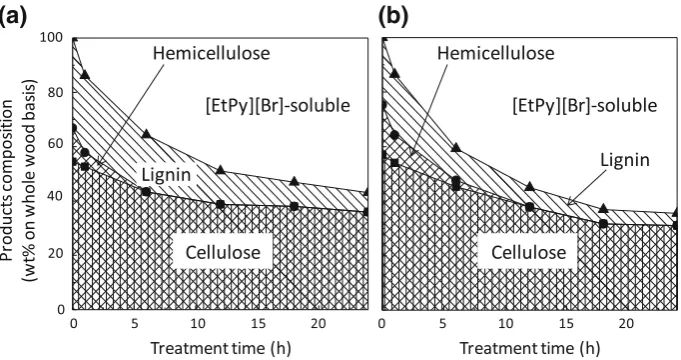
Figure2shows the changes in the chemical composition of Japanese cedar and Japanese beech as they are treated with [EtPy][Br]. After 24 h of treatment, the residual fractions for Japanese cedar and Japanese beech were 43 and 36 %, respectively. For both woods, the contents of cellulose, hemicellulose, and lignin decreased with treatment. In particular, during the early stages of treatment, for Japa-nese cedar and JapaJapa-nese beech hemicellulose was essen-tially removed from the residues after 6 and 12 h of treatment, respectively. Lignin was also materially reduced with treatment. However, cellulose decreases much less than hemicellulose and lignin, meaning that the decrease in yield of residue was caused mainly by decreases in the amounts of hemicellulose and lignin in the wood. These results indicate that more hemicellulose and lignin are easily liquefied than cellulose, although all components of wood can be liquefied in [EtPy][Br].
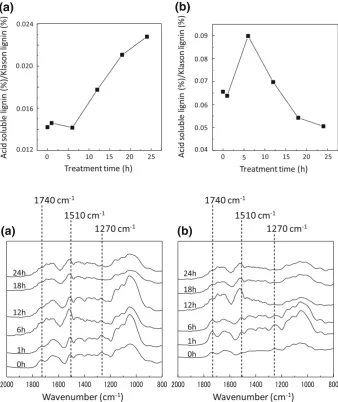
To investigate the denaturation of lignin, Fig.3 shows the ratios of acid-soluble lignin to Klason lignin in the [EtPy][Br]-insoluble residues for both wood samples. If denaturation of lignin does not occur, the ratio shown in Fig.3 is constant independently of treatment time. How-ever, the ratio for Japanese cedar increases with increasing treatment time, and the ratio for Japanese beech reaches a maximum at 6 h of treatment. From these results, the contents of acid-soluble lignin or Klason lignin (acid-insoluble lignin) in the residue are found to vary during [EtPy][Br] treatment, indicating the denaturation of lignin
occurs. This result means that reactivity of acid-soluble lignin to [EtPy][Br] is different from that of Klason lignin. Moreover, it is found that the denaturation behavior of Japanese cedar and Japanese beech is different. This must be because of the structural differences between softwood and hardwood lignin.
Figure4 shows infrared spectra for the [EtPy][Br]-insoluble residues. For the residue from Japanese cedar, as shown in Fig.4 a, The peak at 1740 cm-1, derived from the C=O of the acetyl group in hemicellulose, also becomes weaker as the [EtPy][Br] treatment continues. This is not caused by denaturation of hemicellulose from the [EtPy][Br]-insoluble residues but instead by the dissolution of hemicellulose (and thus its removal from the residues) by the [EtPy][Br]. The peaks at 1510 cm-1, derived from aromatic rings, are found in all residues. The peak at 1270 cm-1, derived from the methoxy groups in guaiacyl lignin and C=O stretch, becomes weaker as the treatment time is extended. Because lignin is present in the [EtPy][Br]-insoluble residues as shown in Fig.2, the weakening of this peak is not caused by reduction of lignin but instead by the chemical change of lignin by [EtPy][Br] treatment. Similar results were obtained for Japanese beech, as shown in Fig. 4 b. From the results shown in Figs. 3and4, it is clarified that [EtPy][Br] denatures lignin in wood.
To investigate the crystalline structure in wood after [EtPy][Br] treatment, X-ray diffractograms of the [EtPy][Br]-insoluble residues are shown in Fig.5. Untreated wood samples of both species show the typical two peaks of crystalline cellulose at around 15° and 22°
(2h). After 24 h of treatment, these two peaks are still detected in both species, which indicates that the crystal-line structure of cellulose in wood is maintained even after [EtPy][Br] treatment. Figure6 shows the changes in rela-tive crystallinity of cellulose in [EtPy][Br]-insoluble
(a)
(b)
residues. The relative crystallinity of the residues for both species increases with increasing treatment time. As shown in Fig.2, the amounts of hemicellulose and lignin, which are amorphous regions in wood, decrease with [EtPy][Br] treatment; this in turn causes the relative crystallinity to increase.
Solubilized compounds in [EtPy][Br]
From GC–MS analysis, glucose, mannose, xylose, gal-actose, and arabinose were determined as solubilized low-molecular-weight products in [EtPy][Br]. Levoglu-cosan, levomannosan, and 5-hydroxymethylfurfural (5-HMF) were also found in the [EtPy][Br] extract by HPLC. However, levomannosan was obtained only from Japanese cedar. This difference between Japanese cedar and Japanese beech is due to the difference in consti-tution of hemicelluloses. Although the main component
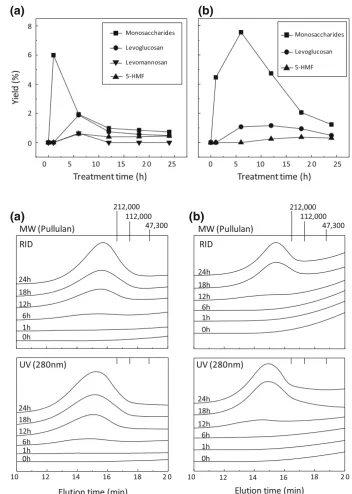
of hemicelluloses in Japanese beech is xylan, that in Japanese cedar is galactoglucomannan. Thus, levoman-nosan is thought to be produced by the decomposition of galactoglucomannan in Japanese cedar. Figure 7 shows changes in the yields of these compounds from wood treated with [EtPy][Br]. The ‘‘monosaccharides’’ in the figure are the total yield of glucose, mannose, xylose, galactose, and arabinose. For Japanese cedar, the yield of monosaccharides at 1 h was 6 %, which was the highest among the various compounds. The maximum yields of levoglucosan, levomannosan, and 5-HMF were found after 6 h. These compounds are thought to arise from decomposition of the hemicellulose, which was liquefied in the early stages of [EtPy][Br] treatment. For Japanese beech, similar trends can be seen. Monosac-charides reached their maximum at 6 h and showed much higher yields compared with those obtained for other compounds.
(a)
(b)
Fig. 3 Ratios of acid-soluble lignin to Klason lignin of [EtPy][Br]-insoluble residues fromaJapanese cedar and bJapanese beech
(a)
(b)
The molecular weight distributions of the compounds solubilized in [EtPy][Br] were studied by GPC, as shown in Fig.8. Peaks from [EtPy][Br] are not visible in this figure because of their long elution time (*40 min). In the chro-matogram for Japanese cedar obtained by the RID, a peak at molecular weight (MW)[212,000 is observed at a longer treatment time. This result indicates that some wood com-ponents that have not depolymerized are present in [EtPy][Br]. Similar peaks are observed in the chromatogram
obtained with the ultraviolet (UV) detector. Hemicellulose can be decomposed easily during the early stages of treat-ment with [EtPy][Br], as described above. Thus, these peaks in the chromatogram indicate the presence of lignin-derived polymers in [EtPy][Br]. For both RID and UV, the peaks are consistently found at MW[212,000, indicating that the lignin-derived polymers are stable in [EtPy][Br]. Japanese beech (Fig.8b) gave results similar to those obtained for Japanese cedar.
Comparison with results obtained using other ionic liquids
A previous paper on liquefaction of Japanese beech and Western red cedar by 1-ethyl-3-methylimidazolium chlo-ride ([C2mim][Cl]) reported that [C2mim][Cl] can liquefy polysaccharides such as cellulose and hemicellulose in priority. The crystalline structure of cellulose was also found to be destroyed by [C2mim][Cl] treatment [24,25]. The polymers solubilized in [C2mim][Cl] were depoly-merized to low-molecular-weight compounds such as glu-cose, mannose, xylose, levoglucosan, and 5-HMF [24,25]. Conversely, 1-ethyl-3-methylimidazolium acetate ([C2mim][Ac]) can completely liquefy wood flour of southern yellow pine and red oak, and lignin in those woods was liquefied before the polysaccharides [22]. Xie et al. [18] reported that dawn redwood can be rapidly liq-uefied by 3,30 -ethane-1,2-diylbis(1-methyl-1H-imidazol-3-ium) dichloride and 3,30 -ethane-1,2-diylbis(1-methyl-1H-imidazol-3-ium)dichloroaluminate treatment at 120°C in 25 min. It is also reported that 1-allyl-3-methylimidazo-lium chloride and 1-butyl-3-methylimidazo1-allyl-3-methylimidazo-lium chloride, methylimidazolium tetrafluoroborate, methylimidazolium hexafluorophosphate, and 1-butyl-3-methylimidazolium methylsulfate can extract lignin from maple wood flour [20,33,34].
In contrast to these ionic liquids, the [EtPy][Br] studied in this paper can liquify lignin and hemicelluloses in pri-ority. Cellulose was partially liquefied, and its crystalline structure is maintained in the residues after [EtPy][Br] treatment. It is reported that imidazolium-based ionic liquid disrupts crystalline structure of cellulose in euca-lyptus and sugarcane bagasse more efficiently than pyrid-inium-based ionic liquid [35]. Similar results are obtained in our research. The solubilized polysaccharides in [EtPy][Br] were partially depolymerized to low-molecular-weight compounds. Hemicellulose can be decomposed easily during the early stages of treatment. GPC chro-matograms indicate that lignin-derived polymers are stable in [EtPy][Br]. These findings are characteristics of [EtPy][Br] treatment. Consequently, the reaction behavior of wood in [EtPy][Br] is significantly different from that in several imidazolium-based ionic liquids, as described
(a)
(b)
Fig. 5 X-ray diffractograms of [EtPy][Br]-insoluble residues from aJapanese cedar andbJapanese beech treated for 24 h
above. These differences are assumed to be due to the reactivity of cations to wood although much further research is necessary.
Conclusions
In this study, Japanese cedar and Japanese beech were selected as representative of Japanese softwood and hard-wood, respectively. We demonstrated that 1-ethylpyridi-nium bromide, [EtPy][Br], can liquefy wood components.
Liquefaction of hemicellulose was rapid and complete, while lignin also liquefied rapidly. Cellulose and lignin were partially liquefied. Japanese beech was more easily liquefied than Japanese cedar. A significant difference was seen in the denaturation of lignins from Japanese beech and Japanese cedar, which is believed to be because of differ-ences in the chemical structures of softwood and hardwood lignins and hemicelluloses. The reaction behavior shown in this study is quite different from the results of previous studies of wood in imidazolium-based ionic liquids. We conclude that the combination of wood and ionic liquid is
(a)
(b)
Fig. 7 Changes in yield of various compounds from aJapanese cedar andbJapanese beech. 5-HMF;
5-hydroxymethyl furfural
(a)
(b)
Fig. 8 GPC chromatograms of the solubilized compounds in [EtPy][Br] fromaJapanese cedar andbJapanese beech for various treatment times.Top refractive index detector (RID), bottomUV detector
an important factor in the effective use of wood via liq-uefaction through treatment with ionic liquids.
References
1. Goldstein IS (1980) The hydrolysis of wood. Tappi J 63:141–143 2. Chang VS, Holtzapple MT (2000) Fundamental factors affecting biomass enzymatic reactivity. Appl Biochem Eng Biotechnol 38:53–87
3. Mok WS, Antal MJ Jr (1992) Uncatalyzed solvolysis of whole biomass hemicelluloses by hot compressed liquid water. Ind Eng Chem Res 31:1157–1161
4. Kwon GJ, Kuga S, Hori K, Yatagai M, Ando K, Hattori N (2006) Saccharification of cellulose by dry pyrolysis. J Wood Sci 52:461–465
5. Hosoya T, Kawamoto H, Saka S (2007) Influence of inorganic matter on wood pyrolysis at gasification temperature. J Wood Sci 53:351–357
6. Yamazaki J, Minami E, Saka S (2006) Liquefaction of beech wood in various supercritical alcohols. J Wood Sci 52:527–532 7. Zulfiqar F, Kitazume T (2000) One-pot aza-Diels–Alder reaction
in ionic liquids. Green Chem 2:137–139
8. Earle MJ, Seddon KR (2000) Ionic liquids. Green solvents for the future. Pure Appl Chem 72:1391–1398
9. Seddon KR (1997) Ionic liquids for clean technology. J Chem Technol 68:351–356
10. Sheldon R (2001) Catalytic reaction in ionic liquids. Chem Commun 23:2399–2407
11. Dupont J, Souza RF, Suarez PAZ (2002) Ionic liquid (molten salt) phase organometallic catalysis. Chem Rev 102:3667–3692 12. Sheldon RA, Lau RM, Sorgedrager MJ, Rantwijk F, Seddon KR
(2002) Biocatalysis in ionic liquids. Green Chem 4:147–151 13. Zhao D, Wu M, Kou Y, Min E (2002) Ionic liquids: applications
in catalysis. Catal Today 74:157–189
14. Visser AE, Swatloski RP, Griffin ST, Hartman DH (2001) Liquid/ liquid extraction of metal ions in room temperature ionic liquids. Scp Sci Technol 36:785–805
15. Nakashima K, Kubota F, Maruyama T, Goto M (2003) Ionic liquids as a novel solvent for lanthanide extraction. Anal Sci 19:1097–1098
16. Wei GT, Yang Z, Chen CJ (2003) Room temperature ionic liquid as a novel medium for liquid/liquid extraction of metal ions. Anal Chem Acta 488:183–192
17. Swatloski RP, Spear SK, Hobrey JD, Rogers RD (2002) Disso-lution of cellulose with ionic liquids. J Am Chem Soc 124:4947–4975
18. Xie H, Shi T (2006) Wood liquefaction by ionic liquids. Holzf-orschung 60:509–512
19. Fort DA, Remsing RC, Swatloski RP, Moyna P, Moyna G, Rogers RD (2007) Can ionic liquids dissolve wood? Processing
and analysis of lignocellulosic materials with 1-n -butyl-3-methylimidazolium chloride. Green Chem 9:63–69
20. Kilpela¨inen I, Xie H, King A, Granstrom M, Heikkinen S, Ar-gyropoulos D (2009) Dissolution of wood in ionic liquids. J Agric Food Chem 55:9142–9148
21. Sun N, Rahman M, Qui Y, Maxim M, Rodriguez H, Rogers R (2009) Complete dissolution and partial delignification of wood in the ionic liquid 1-ethyl-3-methylimidazolium acetate. Green Chem 11:646–655
22. Xie H, Shi T (2010) Liquefaction of wood (Metasequoia gly-ptostroboides) in allyl alkyl imidazolium ionic liquids. Wood Sci Technol 44:119–128
23. Li B, Asikkala J, Filpponen I, Argyropoulos DS (2010) Factors affecting wood dissolution and regeneration of ionic liquids. Ind Eng Chem Res 49:2477–2484
24. Ohno E, Miyafuji H (2013) Reaction behavior of cellulose dis-solution in 1-ethyl-3-methylimidazorium chloride. J Wood Sci 59:221–228
25. Kosan B, Michels C, Meister F (2008) Dissolution and forming of cellulose with ionic liquids. Cellulose 15:59–66
26. Fukuya Y, Sugimoto A, Ohno H (2006) Superior solubility of polysaccharides in low viscosity, polar, and halogen-free 1,3-dialkylimidazorium formats. Biomacromolecules 7:3295–3297 27. Peng X, Ren J, Sun R (2010) Homogeneous esterification of
xylan-rich hemicellulose with mareleic anhydride in ionic liquid. Biomacromolecules 11:3519–3524
28. Pu Y, Jiang N, Ragauskas AJ (2007) Ionic liquid as a green solvent for lignin. J Wood Chem Technol 27:23–33
29. Miyafuji H, Miyata K, Saka S, Ueda F, Mori M (2009) Reaction behavior of wood in an ionic liquid, 1-ethyl-3-methylimidazo-lium chloride. J Wood Sci 55:215–219
30. Nakamura A, Miyafuji H, Saka S (2010) Influence of reaction atmosphere on the liquefaction and depolymerization of wood in an ionic liquid, 1-ethyl-3-methylimidazolium chloride. J Wood Sci 56:256–261
31. Nakamura A, Miyafuji H, Saka S (2010) Liquefaction behavior of Western red ceder and Japanese beech in the ionic liquid 1-ethyl-3-methylimidazolium chloride. Holzforschung 64:289–294 32. Dence CW (1992) The determination of lignin. In: Lin SY, Dence
CW (eds) Methods in lignin chemistry. Springer, Berlin, pp 33–39
33. Lee SH, Doherty TV, Linhardt RJ, Dordick JS (2008) Ionic liquid-mediated selective extraction of lignin from wood leading to enhanced enzymatic cellulose hydrolysis. Biotechnol Bioeng 102:1368–1376
34. Doherty TV, Mora-Pale M, Foley SE, Linhardt RJ, Dordock JS (2010) Ionic liquid solvent properties as predictors of lignocel-lulose pretreatment efficacy. Green Chem 12:1967–1975 35. Shoda Y, Nakamoto A, Goto M, Tokuhara W, Noritake Y,
![Fig. 1 Thechemicalstructureof1-ethylpyridiniumbromide([EtPy][Br])](https://thumb-us.123doks.com/thumbv2/123dok_us/926940.1590873/2.595.98.240.620.686/fig-thechemicalstructureof-ethylpyridiniumbromide-etpy-br.webp)
![Fig. 5 X-ray diffractograms of [EtPy][Br]-insoluble residues froma Japanese cedar and b Japanese beech treated for 24 h](https://thumb-us.123doks.com/thumbv2/123dok_us/926940.1590873/5.595.82.258.58.333/diffractograms-etpy-insoluble-residues-froma-japanese-japanese-treated.webp)