R E S E A R C H
Open Access
A method for spectral image registration
based on feature maximum submatrix
Ke Wang
1,2*, Huiqin Wang
1,2, Meng Wu
2, Zhan Wang
3and Jialin Liu
2Abstract
In order to solve the geometric offset caused by replacing the filter during imaging of multichannel spectral image data, a multichannel spectral image registration method based on SURF feature merged with maximum submatrix is proposed. Firstly, the feature of multichannel spectral image is extracted by SURF. Then, a perspective transformation is performed to obtain a preliminary registration image. For the problem of invalid areas with zero pixel values appearing at the boundary of the image after registration, the largest submatrix is used to detect the maximum inscribed rectangle of the image to remove the invalid boundary region, and maximize the reserved effective region information. Experimented was processed with multichannel imaging data of murals. Experimental results agree with the theoretic analysis and verified that the proposed registration method is better adapted to image scale and brightness changing. At the same time, it can avoid the influence of invalid regions generated by other registration methods on subsequent spectral reconstruction and color restoration which has better performance.
Keywords:Geometric offset, SURF feature, Maximum submatrix, Registration
1 Introduction
Multichannel spectral imaging equipment needs to replace the filter to adjust the imaging channel parameters during data acquisition [1]. The operation of replacing the filter will cause the position of the multispectral camera to shift which resulting in geometric distortion and offset between the multichannel images. This situation will affect the subsequent spectral image pixel analysis and spectral reconstruction [2]. Therefore, it is necessary to perform registration pre-processing correction on multichannel spectral images.
Accurate image registration is a necessary pre-processing step for applications such as image fusion, target detection, and spectral reconstruction [3–5]. Common registration methods mainly include registration-based region and registration-based feature. The registration-based region method is sensitive to grayscale changes and difficult to process images with weak gray correlation. And its compu-tational complexity is relatively low. The registration-based feature method is relatively small in computation. It also
has good adaptability to changes in image offset and rota-tion. This method has gradually become the mainstream of image registration.
The key to registration-based feature is to find a better feature description method and feature matching algorithm. Currently, common feature point extraction methods are Harris feature extraction [6], scale invariant feature transform (SIFT) [7, 8], and smallest univalve segment assimilating nucleus (SUSAN) [9]. The SIFT pro-posed by D.G. Lowe has been widely concerned by scholars because of its invariance to illumination, rotation, scale, and other transformations. However, SIFT requires a 128-dimensional vector feature operation with a large amount of computation. The speeded up robust features (SURF) [10] proposed by Herbert Bay [11] simplifies the operation of image pyramid decomposition based on SIFT. SURF is also a scale and rotation invariant feature descrip-tion method which approximates the convoludescrip-tion of the image. The concept of the integral map introduced by SURF in the feature point positioning step greatly reduces the computational complexity of solving the Hessian matrix, and the computation time is reduced by more than three times compared with SIFT.
Multichannel spectral camera imaging is a grayscale image. Each channel reflects the spectral characteristics
* Correspondence:[email protected] 1
School of Management, Xi’an University of Architecture and Technology, Xi’an 710055, Shaanxi, China
2School of Information and Control Engineering, Xi’an University of Architecture and Technology, Xi’an 710055, Shaanxi, China Full list of author information is available at the end of the article
of different bands. And the gray value of the image changes significantly. SURF method can extract feature points bet-ter when the brightness changing greatly [12] which can better adapt to the characteristics of the spectral image. However, the multichannel spectral image after registration using the SURF method results in an invalid region with a pixel value of zero in the boundary region, which brings computational errors to subsequent spectral reflectance re-construction and color reproduction [13] based on multi-channel images. Regarding the issue above, a multimulti-channel spectral image registration method based on SURF feature fusion maximum submatrix is proposed in this paper. This method firstly uses SURF to perform preliminary registra-tion on multichannel spectral images. Then, the inscribed rectangle detection method based on maximum submatrix is used to segment the effective information area in the preliminary registration result. The information of irregu-larly aligned registration results is maximize retained, which can get a final higher precision registration result.
2 Method
2.1 SURF feature extraction
The SURF consists of two main parts: feature point tection and location and generating feature point de-scription operator.
1) Feature point detection and location
The Hessian matrix HM(x,σ) is the core of the SURF. In mathematics, the Hessian matrix is a square matrix of second-order partial derivatives of a multivariate function, describing the local curvature of the function. Before SURF detects feature points, the integral imageIis firstly calculated. Then, feature point selection and scale trans-formation have been done by using the Hessian matrix of
I. The value at any pixelp= (x,y) in imageIis the sum of the gray values of the corresponding rectangular area from the upper left corner of the original image to any point. Its mathematical formula is as follows:
I pð Þ ¼X
i≤x
i¼1
Xj≤y
i¼1
I ið Þ;j ð1Þ
On scale σ, the Hessian matrix HM(x,σ) of pointpis defined as follows:
HMðx;σÞ ¼ LxxLxyððxx;;σσÞÞLxyLyyððxx;;σσÞÞ
h i
ð2Þ
In HM(x,σ),xindicates feature point coordinates,σ in-dicates scale.Lxx(x,σ),Lxy(x,σ), andLyy(x,σ) is the
convolu-tion of image I at point P and Gaussian second-order partial derivative ∂2∂gxð2σÞ. g(σ) is a Gaussian function as shown below:
gð Þ ¼σ 1 2πσ2e
−ðx2þy2Þ=2σ2
ð3Þ
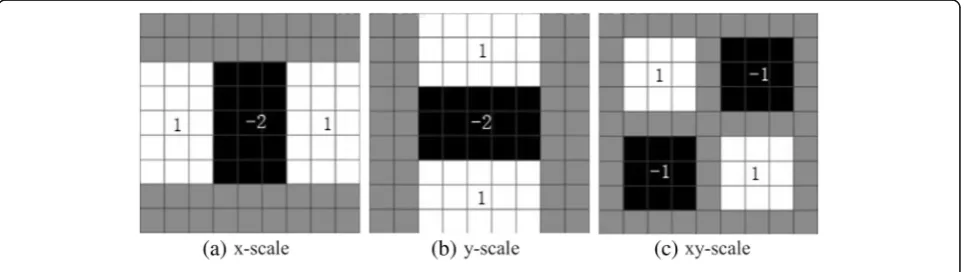
To simplify the calculation, SURF approximates the second-order Gaussian filter with a box filter which in-creases speed while maintaining performance. Take 9 × 9 box filter as an example, taking the scale σ= 1.2, the Gaussian second-order partial derivative can be approxi-mated as shown in Fig.1.
Assuming that the parameters in the Hessian matrix obtained by convolving the image with the above box filter are Dxx, Dxy, and Dyy, respectively, the matrix in Eq. (2)
can be approximated as:
Det Hessianð Þ ¼DxxDyy− wDxy
2
ð4Þ
where w is the box filter weight coefficient. Whenσ= 1.2, w can be approximated to 0.9. Establishing scale space, in the 3 × 3 × 3 domain of the scale space, the value of each point is compared with the adjacent position of the current scale and 26 fields around the adjacent scale, and the local maximum point is obtained. Through the interpolation calculation, the final feature points in the continuous space can be obtained.
2) Generating feature point description operator
In order to ensure the rotation invariance of the feature points, it is necessary to assign a main direction to the feature points. The Haar wavelet response is calculated in the x and y directions of each point in a circular region centered on the feature point and having a radius of 6 times. These responses are given Gaussian weights. Adding the horizontal responsedx and the vertical responsedyin
the sector area w every 60° to obtain the local direction vector (mw,θw).
mw¼
X
w
dxþX
w
dy
θ¼ arctan X
w
dx=X
w dy ! 8 > > > < > > > : 9 > > > = > > > ;
ð5Þ
where mw is the sum of horizontal and vertical Haar
wavelet features for all points in the w sector. θw is the
local direction angle of Haar wavelet feature in the
sec-tor of w. Compare all local direction vectors (mw,θw)
and use the longest vectorθas the main direction of the
feature points as follows:
θ¼fθwjmaxðmwÞg ð6Þ
The second step of generating a feature point descrip-tion operator is to create a feature descriptor for the fea-ture point. After obtaining the main direction of the feature point, the main direction is the x axis, and the rectangular area of 20s× 20sis selected in the neighbor-hood around the feature point. The Haar wavelet re-sponse value of the pixel points in each subdomain by dividing the rectangular area into 16 subdomains is cal-culated. ∑dx, ∑ ∣dx∣, ∑dy, and ∑ ∣dy∣ are separately
counted to form a feature vectorv= (∑dx, ∑|dy, ∑|dx| ,
∑|dy| ). Each feature vector has 4 dimensions with a
total of 16 subfields, so a 64-dimensional feature point description operator is finally obtained.
3) Feature point matching
After the feature description operator is generated, the similarity matching is performed by using the fea-ture description operator of the original image and the target image. The Hessian matrix traces corre-sponding to the feature points with the same contrast are the same number, and the Hessian matrix traces corresponding to different contrasts are different numbers. Firstly, the Hessian matrix trace is used to perform the preliminary matching of the feature points, and the feature pairs of the same number are selected. Secondly, the Euclidean distance matching method is used to judge the similarity of the selected feature pairs, and the one-to-one correspondence be-tween the target image and the feature points to be
matched in the source image is found. Assuming that (x1,x2…,xN), ðx01;x02…;x0NÞ is a pair of matching
fea-ture vectors, the Euclidean distance D between the two vectors is calculated as follows:
D¼
ffiffiffiffiffiffiffiffiffiffiffiffiffiffiffiffiffiffiffiffiffiffiffiffi XN
i¼1
xi−x0i
2
v u u
t ð7Þ
The Euclidean distance of all the feature points to be matched on the target image and the source image are calculated. The minimum Euclidean distance Dnear and the next smallest Euclidean distance Dsub _ near are selected. Let η¼ Dnear
Dsub near, comparing η with thresholdT, if η<T, the feature point on the target image matches the corresponding point on the source image Dnear. Otherwise, it does not match.
4) Perspective transformation
According to the matching point, the coordinate rela-tionship between the source image and the target image, that is, the perspective transformation matrixHbetween the two images, is as follows:
H¼
h0 h1 h2
h3 h4 h5
h6 h7 1
2 4
3
5 ð8Þ
Ifp= (u,v),q= (x,y) is feature point pair for matching, the projection transformation formula will be as follows:
x;y;w
ð ÞT ¼Hðu;v;1ÞT ð9Þ
where (u,v) is the original image coordinates andðwx;wyÞis the target image after the transformation. Each parameters hi(i= 0, 1, 2,…, 7) inHcan be calculated from Eq. (9). The
perspective transformation is used to complete the regis-tration of the original image to the target image.
method is used to filter feature points. The steps to use RANSAC are as follows.
Step 1: Four sets of feature point pairs are randomly extracted from the preliminary matching set P. The transformation matrix H is calculated and recorded as the modelM.
Step 2: The projection error of all data in P with model M is calculated. If the result is less than the threshold value t, add the inner point set I and record the statistical error errorminunder the model.
Step 3: The above steps are repeated. When calculat-ing a new model, the statistical error error is compared with theerrorminsize. If the error is smaller, update the modelManderrormin.
Step 4: The optimal modelMof maximum inner point setIis output.
The above four sets of feature point pairs are taken in step 1 because the geometric transformation model is selected as the perspective transformation model. There are eight unknowns in the model, and at least eight sets of linear equations are needed to solve. A set of feature point pairs can list two equations, so four sets of feature point pairs are selected. When the threshold is set to t= 0.7, a better matching correct rate can be obtained [15]. The optimal model M can be obtained in each parameter hi(i= 0, 1, 2,…, 7).
After the perspective transformation, the registered multichannel spectral image can be obtained. As can be seen from Eq. (9), the perspective transformation regis-tration is as follows:
x0 ¼ x w¼
h0uþh1vþh2
h6uþh7vþ1
y0¼ y w¼
h3uþh4vþh5
h6uþh7vþ1
ð10Þ
where (x′,y′) is the coordinate of the pixel point (u,v) on the original image converted to the target image by the Eq. (10). The effect of registering the spectral images of any three channels using SURF is shown in Fig. 2. Target is the target image. Channel 1, channel 2, and channel 3 are the images to be registered.
As can be seen from Fig. 2, because of perspective transformation, there are different degrees of black bor-ders on the boundaries of each channel image after SURF registration. Superimposing all channels, the resulting spectral cube image has irregular boundaries. Such spectral cube image data can have error effects on later pixel analysis, spectral reconstruction, and color reproduction. The irregular boundaries need to be intercepted.
2.3 Maximum inscribed rectangle detection
The treatment of irregular boundaries is mainly to solve the problem of the maximum enclosed rectangle (MER) [16–18] of the target object. After obtaining the mini-mum circumscribed rectangle of the target object, the largest inscribed rectangle of the object in the minimum circumscribed rectangle is found to obtain the maximum inscribed rectangle area. At present, the commonly used methods for obtaining the maximum inscribed rectangle
are the traversal method and the central diffusion method [19].
1) Traversal method
Given a coordinate point, all rectangular areas are cal-culating with the point as the upper right corner within the target object. Compare the rectangular area to get the largest area rectangle with the point as the upper right corner. The maximum inscribed rectangle of the target object can be obtained by calling this method at every point in the target object.
2) Central diffusion method
The minimum circumscribed rectangle center point
o(x,y) is calculating as follows:
x¼ðleftþrightÞ=2 y¼ðupþdownÞ=2
ð11Þ
where left and up are the vertices and ordinates of the upper left corner of the minimum circumscribed rect-angle, respectively, right and down are the ordinate and ordinate of the lower right corner of the minimum cir-cumscribed rectangle, respectively. Traversing up−1 rows on interval (left−1, right + 1), whether the pixel is 0 is de-termined. If the current line pixel is not 0, move the up− 1 line upward, that is up−2; otherwise, stop moving. Tra-versing down + 1 rows on interval (left−1, right + 1), if the current row pixel value is not 0, move the down + 1 line upward, that is down + 2; otherwise, stop moving; travers-ing right and left in the same way on interval (up−1, down + 1). When left, right, up, and down stop moving, the enclosed area is the largest inscribed rectangular area.
2.4 Spectral image registration based on proposed MSM-SURF
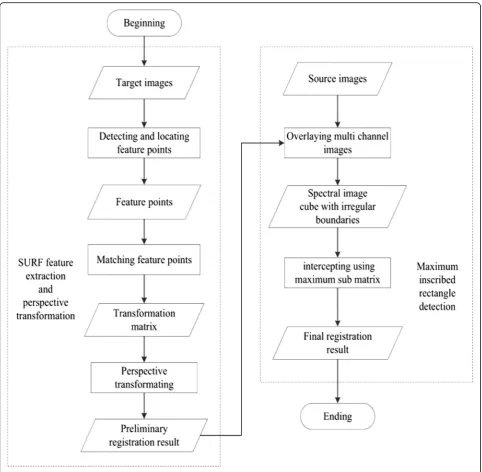
Aiming at the problems of SURF preliminary registration and maximum inscribed rectangle detection methods, this paper proposes a MSM-SURF (maximum submatrix-SURF) method that combines SURF feature extraction with the maximum submatrix to achieve more efficient multichannel spectral image registration. The algorithm flow chart of MSM-SURF is shown as in Fig.3.
The n channel spectral images Mq(q= 1, 2,…,n) after
the SURF preliminary registration are superimposed to obtain a matrixI. The superposition is as follows:
Iij¼
0 min k m k;ij
¼0 max k m k;ij
min k m k;ij
≠0
ð12Þ
where i, j respectively represent the rows and columns
of the matrixMq, mk, ijis the pixel value of the spectral
image matrixMkati, andjof thekth channel after
pre-liminary registration. The effect of the matrixIobtained
by superimposing the spectral image matrix Mq of the
three channels is shown as Fig.4.
As can be seen from Fig. 4, the superposition matrix obtained after SURF preliminary registration makes the invalid areas of the boundaries of each channel image cumulatively superimposed. The boundary of the image cube is irregular. For the binarization of the superpos-ition matrix I, the maximum inscribed rectangle detec-tion is performed. For the problems in the traversal method and the central diffusion method, this paper proposes the maximum submatrix (MSM) method for maximum inscribed rectangle detection. The main idea of the MSM method is that, in a given matrix, assuming that the matrix element contains only 0 and 1, all sub-matrices that do not contain any 0 elements have been found. The area of all submatrices is calculated. The submatrix with the largest area is the MSM.
The MSM method mainly includes the following steps: Step 1: Set the value of the point in matrix I whose value is greater than the threshold Q to 1, and the remaining points are all 0. The target matrix Iis binar-ized. Since the multichannel spectral images are gray-scale, the pixel value of the boundary invalid region is 0 after the perspective transformation. So set the threshold
Qto 0. Binarization matrixIis as follows:
Iij¼ 01 I Iij¼Q ij>Q
ð13Þ
Step 2: Matrix Nwith the same size as matrixIis cre-ated. Initializing N, let N1j=I1j. When i> 1, ifIij≠0,then
Nij=Iij+I(i-1)j.Nij=I(i-1)j; otherwise,Nij= 0.
Ni j¼
I1j i¼1
0 i>1 and Ii j¼0
Ii jþIði−1Þj i> and Ii j ≠ 0
2 6 4
3 7
5 ð14Þ
Step 3: Array arr[row] is created. Androw is the num-ber of columns of the matrixN. Array raw data is stored in arr. Traversing array arr is as follows:
a. Ifi= 0, the stack is empty at this time, put the array indexi= 0 onto the stack. Else ifi≠0, get the top elem-ent of the stack firstly. When arr[i]≥arr[pop], push i
onto the stack.
b. If arr[i] < arr[pop], pop up the top element pop, let
h= arr[pop], w=pop−popnext−1 where popnext is the new top element after p popping. Let Sk=h×w, repeat
step a until the array traversal is complete.
c. Compare the Sk size and find the maximum value
Smax= {k= 1, 2,…,n| max(Sk)}.
Step 4: Traversing matrix N by row, let arr[row] =Ni.
by Smaxin theith row is the largest submatrix MaxSiin
the first row to ith row of the matrixI. Let P= {i= 1, 2, …,n| max(MaxSi)},Pis the MSM of matrixI.
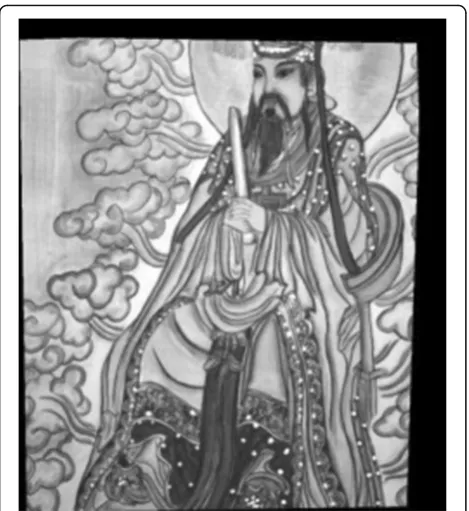
The calculated MSM is shown as Fig.5.
The MSM is used to intercept the spectral image of each channel after SURF preliminary registration, and the MSM-SURF method registration result of each chan-nel is obtained as shown in Fig.6.
As can be seen from Fig. 6, MSM-SURF method uses SURF feature extraction and projection transformation to initially register multichannel spectral images. Then, for the invalid region where the image boundary pixel
value of the initial registration is 0, the MSM is used for interception. MSM-SURF method maximizes the reten-tion of valid area informareten-tion while intercepting invalid regions of each channel spectral image, which improves the effect of registration.
3 Experimental results 3.1 Experimental data
Spectral images of six channels of three sets of murals were used as experimental data. The acquisition system includes Ocean Optics’ SpectroCam VIS model CCD multispectral camera, six narrowband interference filters
and CIE standard A illumination source. The spectral images of each set of murals in six different band chan-nels are collected as shown in Fig.7.
In Fig. 7, the spectral images of each channel in each group of murals have different degrees of offset geomet-ric distortion, and registration correction is needed.
3.2 Evaluation standard
In order to test the registration performance of methods, four criteria, feature point accuracy [20], registration accuracy [21], effective area pixel percentage [22], and operational time efficiency [23,24] are used for objective evaluation.
Registration accuracy is determined by the root mean square error (RMSE) of the coordinates between all
matching feature point pairs of the source image and the target image.
RMSE¼
ffiffiffiffiffiffiffiffiffiffiffiffiffiffiffiffiffiffiffiffiffiffiffiffiffiffiffiffiffiffiffiffiffiffiffiffiffiffiffiffiffiffiffiffiffiffiffiffiffiffiffiffiffiffiffiffi
1 n
Xn
i¼1
∥ðx;i;y;iÞ−f xi;yi
!
∥2
v u u
t ð15Þ
where (x′,y′) is the feature point coordinate on the target image, (x,y) is the coordinate of the feature point on the image to be registered, f represents coordinate transformation relationship, and n is the number of matching feature points after screening.
Feature point accuracyKis the ratio of the number of correctly matched feature point pairs to the number of all matching feature point pairs.
K¼ R
N100% ð16Þ
whereRis the final correct matching feature point pair num-ber,Nis the total number of matching feature point pairs.
Effective area pixel percentage Rate is the ratio of the number of pixels included in the region extracted by the largest inscribed rectangle to the number of pixels in the entire image.
Rate¼c
s100% ð17Þ
where c is the maximum inscribed rectangle containing
the number of pixels andsis the number of pixels in the
entire image.
3.3 Experimental results
The experiment firstly compares the time efficiency of SIFT and SURF merged with maximum inscribed rect-angle detection of MSM. The experimental data of murals A, B, and C is respectively processed with MSM-SIFT and MSM-SURF methods. The effect of the methods is com-pared as shown in the following Table1.
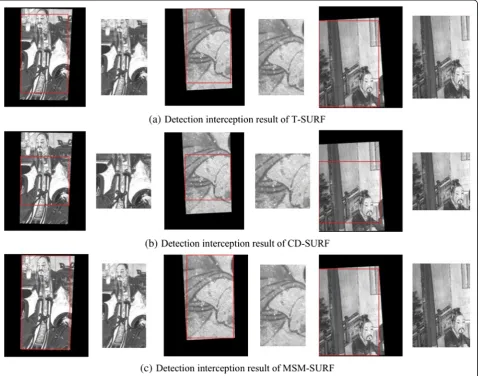
The data of the murals A, B, and C are respectively processed by traversing merged with SURF (T-SURF), center diffusion merged with SURF (CD-SURF), and MSM-SURF algorithms. The detection interception re-sults of the three methods for the superposition matrix after initial registration are shown in the Fig.8.
Quantitative analysis of the above detection intercep-tion results are performed by RMSE, K, time, and rate criterion as shown in Table2.
4 Discussion
The abilities of each registration methods for multichan-nel spectral images discussed in this paper are compared in this section. The scale invariance of SURF is better than Harris. The time complexity of SURF is lower than SIFT. And SURF is more robust to the image brightness Fig. 4The effect of matrixIobtained by superimposing
Fig. 6The result of MSM-SURF registration
changing. In the experiment, the perspective transform-ation of SIFT and SURF for feature point detection and matching are firstly compared. In order to get better ef-fect of maximum inscribed rectangle detection, both SURF and SIFT are merged with MSM. It can be seen from Table 1 that compared with the MSM-SIFT, the registration accuracy of MSM-SURF is a little better than MSM-SIFT. The value of RMSE is reduced by about 0.3. The feature point accuracy of MSM-SURF is much bet-ter than MSM-SIFT. The value of K is increased by an average of 21.5%. At the same time, due to the concept of introducing integral images, the runtime of SURF is greatly reduced by about 60% of SIFT. The result of
Table 1 shows that the overall performance of SURF is better than SITF. Therefore, the subsequent experiments mainly focus on SURF merging with different inscribed rectangle detection methods.
The abilities of T-SURF, CD-SURF, and MSM-SURF that SURF merged with different maximum inscribed rectangle detection methods of traversal, central diffu-sion, and maximum submatrix are compared. In the practical situation, the traversal method has strong robustness, but with high complexity which is not suitable for large area target object detection. The central diffusion method has low complexity, but with sensitive changing to irregular object edges which
Table 1Comparison of MSM-SIFT and MSM-SURF methods
Method RMSE K/% Time/ms
A B C A B C A B C
MSM-SIFT 1.754 1.741 1.738 54.70 42.00 30.80 2687 1615 2213
MSM-SURF 1.401 1.421 1.451 63.70 60.90 65.40 951 862 913
leads to low detection accuracy. It can be seen from Fig.8 that when the image offset after perspective transform-ation is a large amount, T-SURF and MSM-SURF all retain the same maximum information for the detection inter-ception results of the superposition matrix. But when the image offset is a small amount, only MSM-SURF retains the maximum information. MSM-SURF has better adapt-ability. Table 2 shows that since the three methods use SURF, the registration accuracy of RMSE is almost the same as feature point matching accuracy. Due to the ef-fective area that can be retained by MSM after intercep-tion, MSM-SURF has a slightly higher effective ratio than T-SURF. At the same time, the effective ratio of CD-SURF is only 60% of MSM-SURF. CD-SURF and MSM-SURF are similar in runtime. Due to the larger amount of global traversal calculation of traversal method, the complexity of T-SURF is much higher than CD-SURF and MSM-SURF. The time efficiency of T-SURF is about three times that of CD-SURF and MSM-SURF. Based on the above analysis, MSM-SURF not only has a higher effective ratio of detection, but also has lower algorithm time com-plexity, which is more suitable for registration of multi-channel spectral images.
5 Conclusions
In this paper, a MSM-SURF method merged SURF fea-tures with maximum submatrix is proposed based on the characteristics of multichannel spectral images, which improves the defects of existing matching and inscribed rectangle detection methods. Experiment with the multichannel spectral image data of the actual mu-rals was processed. Experimental results show that MSM-SURF can effectively combine SURF features with maximum submatrix detection. MSM-SURF can solve the problem of invalid boundary regions in SURF feature regis-tration and can maximize the effective region information. It has a good practical significance for the registration of multi-channel spectral images.
Abbreviations
CD-SURF:Center diffusion - SURF; MER: Maximum enclosed rectangle; MSM: Maximum submatrix; MSM-SURF: Maximum submatrix - speeded up robust features; RANSAC: Random sample consensus; RMSE: Root mean square error; SIFT: Scale invariant feature transform; SURF: Speeded up robust features; SUSAN: Smallest univalve segment assimilating nucleus; T-SURF: Traversing - SURF
Acknowledgements
The authors thank the editor and anonymous reviewers for their helpful comments and valuable suggestions.
Funding
This work has been supported in part by a grant from the National Natural Science Foundation of China (no. 61701388), the Natural Science Foundation of Shaanxi (nos. 2018JM5127 and no. 2018JM6080), the International Cooperation Funding Project of Shaanxi Provincial Science and Technology Department (no. 2017KW-036), the Think Tank Project of Shaanxi Provincial Department of Education Key Scientific Research Plan (no. 18JT006), and the Soft Science Project of Science and Technology Bureau of Xi’an (no. 2016043SF/RK06(3)).
Availability of data and materials
Please contact author for data requests.
About the authors’
Ke Wang received his master’s degree from Southwest Jiaotong University, Chengdu, China, in 2007. Currently, he is a Ph.D. candidate in School of Management at Xi’an University of Architecture and Technology. He is an instructor in School of Information and Control Engineering at Xi’an University of Architecture and Technology. His research interests include image processing, computational intelligence, and machine learning. Huiqin Wang received her Ph.D. degree from Xi’an Jiaotong University, Xi’an, China, in 2002. She engaged in postdoctoral research work in Xi’an Jiaotong University from 2002 to 2004. Currently, she is a professor in School of Information and Control Engineering at Xi’an University of Architecture and Technology. Her research interests include multimedia information security, digital image processing, information management, and information system. Meng Wu received her Ph.D. degree from Xi’an University of Architecture and Technology, Xi’an, China, in 2017. Currently, she is an associate professor in School of Information and Control Engineering at Xi’an University of Architecture and Technology. Her research interests include digital image restoration and cultural relics big data analysis.
Zhan Wang received his master’s degree from University of Bologna, Italy, in 2008. Currently, he is an associate researcher in Technology Analysis and Testing Center at Shaanxi Provincial Institute of Cultural Relics Protection, Xi’an, China. His research interests include cultural relics detection analysis and researching.
Jialin Liu is a master student in School of Information and Control Engineering at Xi’an University of Architecture and Technology. His research interests include multispectral images processing.
Authors’contributions
All authors take part in the discussion of the work described in this paper. The author KW wrote the first version of the paper. The author JL did part experiments of the paper. HW, MW, and ZW revised the paper in different versions of the paper, respectively. All authors read and approved the final manuscript.
Competing interests
The authors declare that they have no competing interests.
Publisher’s Note
Springer Nature remains neutral with regard to jurisdictional claims in published maps and institutional affiliations.
Author details
1School of Management, Xi’an University of Architecture and Technology, Xi’an 710055, Shaanxi, China.2School of Information and Control Table 2Comparison of registration results of T-SURF、CD-SURF, and MSM-SURF
Method RMSE K/% Time/ms Rate/%
A B C A B C A B C A B C
T-SURF 1.402 1.422 1.454 64.30 62.60 66.10 3251 3015 3147 46.87 43.76 45.33
CD-SURF 1.405 1.419 1.449 64.20 61.10 65.90 997 859 956 29.21 27.62 28.45
Engineering, Xi’an University of Architecture and Technology, Xi’an 710055, Shaanxi, China.3Shaanxi Provincial Institute of Cultural Relics Protection, Xi’an 710075, Shaanxi, China.
Received: 16 August 2018 Accepted: 12 November 2018
References
1. A. Cosentino, Multispectral imaging system using 12 interference filters for mapping pigments. Conservar Património21, 25–38 (2015)
2. S.G. Kim, T.G. Ahn, S.H. Park,Motion estimation algorithm for periodic pattern objects based on spectral image analysis(IEEE International Conference on Consumer Electronics (ICCE), Las Vegas, 2013), pp. 310–311.https://doi.org/ 10.1109/ICCE.2013.6486905
3. A. Nantes, R. Brown, F. Maire, Neural network-based detection of virtual environment anomalies. Neural Comput. & Applic.23(6), 1711–1728 (2013) 4. G. Liu, W. Fei, L. Zhonghua, Infrared aerial small target detection based on
digital image processing. Multimedia Tools Appl.76(19), 19809–19823 (2017) 5. K. Wang, H.Q. Wang, Z. Wang, et al. Study of spectral reflectance
reconstruction based on regularization matrix R method. Cluster Comput. https://doi.org/10.1007/s10586-017-1217-5, (2017)
6. J. Li, X. Xu, X. Lan, et al., Feature extraction and measurement of the human body based on Harris corner detection. Comp. Meas. Control22(2), 367–369 (2014) 7. J. Luo, O. Gwun, A comparison of SIFT, PCA-SIFT and SURF. Int. J. Image
Proc.3(4), 143–152 (2009)
8. P.E. Forssen, D.G. Lowe,Shape descriptors for maximally stable external regions (IEEE, International Conference on Computer Vision, IEEE, Rio de Janeiro, 2007), pp. 1–8.https://doi.org/10.1109/ICCV.2007.4409025
9. M. Ding, X. Zhang, Nonlocal-means-based smallest univalve segment assimilating nucleus edge detector. J. Electron. Imag.22(1), 3023 (2013) 10. H. Bay, T. Tuytelaars, L.V. Gool, SURF: speeded up robust features. Eur. Conf.
Comput. Vis.. Springer-Verlag110, 404–417 (2006)
11. H. Bay, A. Ess, T. Tuytelaars, et al., Speeded-up robust features (SURF). Comput. Vis. Image Underst.110(3), 346–359 (2008)
12. K. Ren, M. Hu, Color image registration algorithm based on improved SURF. J. Electron. Meas. Instrum.30(5), 748–756 (2016)
13. Q. Cao, X. Wan, J. Li, et al., Updated version of an interim connection space lapper for spectral color reproduction: lablab. J. Opt. Soc. Am. A Opt. Image Sci. Vis.33(9), 1860–1871 (2016)
14. T. Kim, Y.J. Im, Automatic satellite image registration by combination of matching and random sample consensus. IEEE Trans. Geosci. Remote Sens. 41(5), 1111–1117 (2003)
15. C.X. Liu, R.J. Zhao, E.H. Liu, et al., Estimate threshold of SIFT matching adaptively based on RANSAC. Comput. Sci.44(s1), 157–160 (2017) 16. M. Zhou, G. Zheng, S. Chen, The solution to determine the bounding rectangle
with maximum aspect ratio for 2D graphics. J. Graph.34(4), 46–53 (2013) 17. W.H. Lin, X.J. Tan, F.J. Liu, et al., A new directional query method for
polygon dataset in spatial database. Earth Sci. Inf.8(4), 775–786 (2015) 18. Z. Yuan, Y.Z. Wang, H.T. Shi, et al., Solution of graphics maximum enclosed
rectangle based on improved genetic algorithm. Control Eng. Chin.23(3), 400–404 (2016)
19. X.H. Xie, D. Liang, X.Q. Zhang, Detecting maximum inscribed rectangle area of target object based on image processing. Sci. Technol. Eng.15(17), 193– 197 (2015)
20. C.Y. Zhao, H.C. Zhao, Accuracy and robust estimation of homograph based on feature point location noise. Opt. Precision Eng.3(8), 2357–2368 (2015) 21. H. Zhong, J. Kim, I.J. Chetty, Analysis of deformable image registration
accuracy using computational modeling. Med. Phys.37(3), 970–979 (2010) 22. P. Sinha, L. Kumar, Independent two-step threshold of binary images in
inter-annual land cover change/no-change identification. Isprs J. Photogram. Remote Sensing81(81), 31–43 (2013)
23. W. Zhang, J. Yang, Y. Fang, et al., Analytical fuzzy approach to biological data analysis. Saudi J. Biol. Sci.24(3), 563–573 (2017)