Lifetime prevalence of concussion among
Canadian ice hockey players aged
10 to 25 years old, 2014 to 2017
Tian Renton, R.Kin, MSc
1Scott Howitt, DC, MSc, FRCCSS(C), FCCPOR
2Cameron Marshall, DC, FRCCSS(C)
31 University of Toronto, Rehabilitation Sciences Institute 2 Canadian Memorial Chiropractic College
3 Complete Concussion Management Inc.
Corresponding author:
Tian Renton, University of Toronto, Rehabilitation Sciences Institute, 160-500 University Avenue, Toronto, Ontario, M5G 1V7 Phone: 416 864 6060 ext. 7848
E-mail: [email protected] © JCCA 2019
Cameron Marshall is the Founder and President of Complete Concussion Management Inc (CCMI). The authors have no further disclaimers, competing interests, or sources of support or funding to report in the preparation of this manuscript.
Background: The primary objective of this study was
to identify the self-reported lifetime prevalence of diagnosed concussions among Canadian ice hockey players aged 10 to 25 years old.
Method: Medical records were identified for n=5223 athletes whom completed comprehensive baseline assessments with a Canada-wide network of private concussion management clinics. Variables extracted included: sex, age, diagnosed history of and number of prior concussions, diagnosed health condition(s), and Post-Concussion Symptom Scale scores.
Results: Approximately 22% of all athletes, 21.7% of females and 21.8% of males reported that they had sustained at least one diagnosed concussion. Age was significantly associated with history of concussion as was having an additional health condition. Sex was not significantly associated with a history of concussion. Conclusion: Lifetime history of concussion prevalence
Contexte : L’objectif principal de cette étude était de
déterminer la prévalence autodéclarée au cours de la vie des commotions cérébrales diagnostiquées chez les joueurs canadiens de hockey sur glace âgés de 10 à 25 ans.
Méthode : Des dossiers médicaux ont été identifiés
pour 5223 athlètes qui ont effectué des évaluations de base complètes avec un réseau pancanadien de cliniques privées de gestion des commotions cérébrales. Les variables extraites comprenaient : le sexe, l’âge, les antécédents diagnostiqués et le nombre de commotions cérébrales antérieures, le ou les problèmes de santé diagnostiqués et les scores de l’échelle des symptômes après la commotion cérébrale.
estimates aligned closely with estimates previously published. Future investigations should seek to establish the prevalence of concussions that occur during ice hockey games and practices alone.
(JCCA. 2019;63(2):80-91)
k e y w o r d s: concussion history, ice hockey,
prevalence, youth, young adult
antécédents de commotion cérébrale au cours de la vie concordent étroitement avec les estimations publiées antérieurement. Les enquêtes futures devraient chercher à établir la prévalence des commotions cérébrales qui surviennent uniquement pendant les parties et les pratiques de hockey sur glace.
(JACC. 2019;63(2):80-91)
m o t s c l é s : antécédents de commotion cérébrale,
hockey sur glace, prévalence, jeunes, jeunes adultes.
Introduction
Over the last 10 to 15 years, annual incidence rates of sport-related concussion (SRC) among youth athletes has increased dramatically. A recent article published by Zemek et al. indicated that the number of concussions treated in emergency departments and physician offices across the province of Ontario demonstrated a 5.5-fold in-crease (per 100 000 children) from 2003 to 2013.1 Zemek
attributed this steep increase to improvements in stake-holder concussion education and awareness, improved diagnostics, and stricter return to play medical clearance requirements. However, generating annual incidence and prevalence estimates of concussion based on emergency department visits may provide a gross underestimate of the actual number of concussions, as many athletes do not present to a hospital for diagnosis or follow-up treatment.2
To that extent, a large body of evidence suggests that head injuries often go unrecognized and underreported by adolescent aged athletes.3-7 Estimates suggest that
ap-proximately half of all suspected injuries go unreported in this population.8 Further investigation is required to
provide more accurate estimates of lifetime prevalence of concussion among young athletes.
Incidence of SRC by sport is well documented among youth athlete populations.9 Findings indicated that
ath-letes in certain sports face a greater risk for SRC than others, especially those athletes involved in high speed contact sports such as rugby, ice hockey, football and la-crosse.9, 10 Ice hockey is not only Canada’s national winter
sport, but also one of our most popular recreational ac-tivities for children and youth behind that of soccer and
swimming.11 In the 2017-18 Annual Report released by
Hockey Canada, over 340 000 individuals between the ages of 10 and 25 were enrolled in a hockey program at any given level.12 As such, the popularity of ice hockey
in Canada places a large number of athletes at risk for SRC. Examining athlete-reported histories of diagnosed concussions at the time of preseason baseline assessment may be useful in gauging cumulative injury prevalence. Despite being retrospective in nature, asking an athlete to recall their concussion history at a time when their current playing status is not at stake (i.e., when the athlete is not at risk to be removed from play due to a suspected SRC), may provide a more accurate assessment of concussion prevalence in this population.
Examining factors related to concussion history, such as age, sex and health history, may provide an indication as to those athletes at greater risk for an additional con-cussion. At present, younger age has yet to be clearly es-tablished as a risk factor for concussion.13 With respect
to recovery however, evidence suggests that younger ath-letes take longer to recover following concussion com-pared to older athletes.14-16 With respect to sex, evidence
suggests that the events surrounding concussion (i.e., incidence or risk for concussion by sport, initial symp-tom severity, time until functional recovery, etc.) diverge between males and females.17-19 Following concussion,
females typically take longer to achieve functional recov-ery than do males and are also more likely to experience persisting symptoms.20-23. A pre-morbid history of
The primary objective of this study was to identify the
lifetime prevalence of self-reported concussion diagnoses among Canadian ice hockey players aged 10 to 25 years old, whom presented to Complete Concussion Manage-ment Inc. (CCMI) clinics between 2014 and 2017, by age and sex. The secondary objective(s) were to: i) examine the relationship between history of concussions (includ-ing number of concussions), and an additional diagnosed health condition (i.e., learning exceptionality, history of psychiatric illness, sleep disorder, and history of head-ache) by age and sex, and ii) examine the relationship be-tween history of concussion and Post-Concussion Symp-tom Scale (PCSS) severity score at baseline (i.e., in the absence of injury), by sex.
Methods
Study design, participants and data extraction
This was a cross-sectional study that utilized a conven-ience sample of youth and young adult ice hockey play-ers aged 10 to 25 years old, involved in various levels of hockey (i.e., house league, rep, provincial, etc.). A retro-spective review of electronic medical records were iden-tified and extracted from athletes whom had participated in comprehensive preseason concussion baseline testing at any one of 107 CCMI clinics across Canada between October 2014 and October 2017. The CCMI comprehen-sive pre-season testing protocol consisted of a clinical interview regarding medical and concussion histories as well as the PCSS, Sport Concussion Assessment Tool 3 (SCAT3), oculomotor function testing, postural sway measuring centre of pressure area (COP), clinical reaction time, grip strength, and computerized neurocognitive test-ing (for athletes 13 or older). Each province had at least one clinic and clinic locations varied from urban to rural settings. Most clinics offered a myriad of clinical servi-ces beyond that of concussion management and compre-hensive baseline assessments (i.e., sport medicine [MD], physiotherapy [PT], chiropractic [DC], etc.). All clin-icians were licenced health care professionals (i.e., MD, PT, DC), and were trained by CCMI via the completion of a 36-hour continuing education training course for evi-dence-based concussion care. CCMI partnered clinics are also required to undergo a 15-hour recertification course every 24-months to retain certification. Any individual in need of assessment following a suspected concussion, or
whom was interested in obtaining a comprehensive base-line assessment, is eligible to visit a CCMI clinic. CCMI network clinics do not exclusively treat athletes.
At time of data extraction (October 2017), the CCMI database contained n=17 234 observations. First, an age filter was applied to include records from individuals aged
≤ 25.9 years old at time of record entry (n=3071 excluded;
age reported as ≥ 26 years old). Duplicate records for an
athlete were removed (n=2503 excluded); baseline assess-ments are conducted on an annual basis, and concussion assessments on an as needed basis. Only the first entry within an athlete’s medical record was included in analy-sis. Athletes who had sustained a concussion and then par-ticipated in a concussion baseline assessment < 90 days from day of injury were also removed (n=996 excluded). This criterion was applied to ensure that PCSS severity scores had returned to baseline (i.e., pre-injury levels) following a diagnosed concussion. Athletes who did not identify ice hockey as their primary sport were also re-moved (n=5423 excluded). Finally, athletes < 10 years old were removed (n=18 excluded). Refer to Figure 1 for
med-n=3,071 excluded Age reported as ≥ 26 years old n=17,234 total
observations included in CCMI database at time of data extraction
n=14,163 observations
n=2,503 excluded Not first observation and/ or not baseline 1 n=11,660 observations
n=996 excluded Previous concussion less than 90 days prior to baseline date entry n=10,664 observations
n=5,423 excluded Primary sport is not self-reported as ice hockey n=5,241 observations
n=18 excluded Age reported as <10 years old n=5,223 observations
included in statistical analyses
Figure 1.
ical record exclusions. All medical records identified for inclusion in this study were screened by a biostatistician (SHJ) with whom the authors consulted.
Medical records were generated and saved within the CCMI database for each athlete who participated in a baseline assessment or concussion assessment at the time of their appointment. Although clinicians collected health histories (i.e., presence of a diagnosed psychiatric illness or learning exceptionality, etc.) and concussion injury data across several domains (i.e., cognitive and oculo-motor functioning, reaction time, postural sway, hand-grip strength, etc.), only data pertaining to athlete age, sex, health and concussion history, and PCSS severity scores were extracted from medical records.
Health and concussion histories were self-reported by athletes during an in-person interview with a CCMI cer-tified clinician. Each athlete was asked to respond to the following questions: i) “have you ever been diagnosed with a concussion?” ii) “if yes, how many?”, iii) “when was the most recent?”, iv) “how long did it take you to recover from the most recent concussion?”, and v) “do you still experience symptoms from your most recent concussion?”. Only responses pertaining to questions i) and ii) were used within analyses. Data pertaining to the following health history variables were also extracted:
diagnosed learning exceptionality, ADD/ADHD,
depres-sion, anxiety, sleep disorder, and history of headache. Concussion-like symptom severity scores (as reported on the PCSS, a 22-item measure with a total possible score
of 132) were extracted and stratified by number of con-cussions for comparison between sex groups. The PCSS has been found to have a high internal consistency in both healthy (Cronbach’s a = 0.89-0.94) and concussed
samples (a = 0.92-0.93)25, and consists of a four factor
structure: somatic, cognitive, emotional and sleep-related symptoms26. For the purposes of age comparison, athletes
aged 10 to 12 years old were defined as “youth”, 13 to 18 years old as “adolescent” and 19 to 25 as “young adult”. Pre-participation consent was provided by athletes and/ or their guardians for the collection and use of de-iden-tified data for research purposes. This investigation was approved by the Research Ethics Board at the Canadian Memorial Chiropractic College, Toronto, Ontario (proto-col #162009).
Data analysis
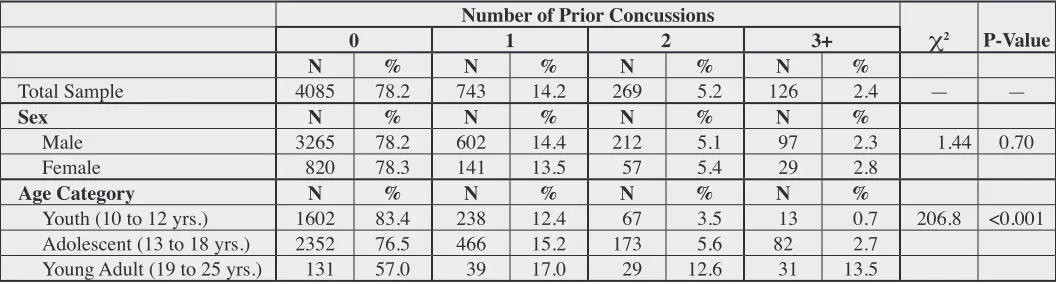
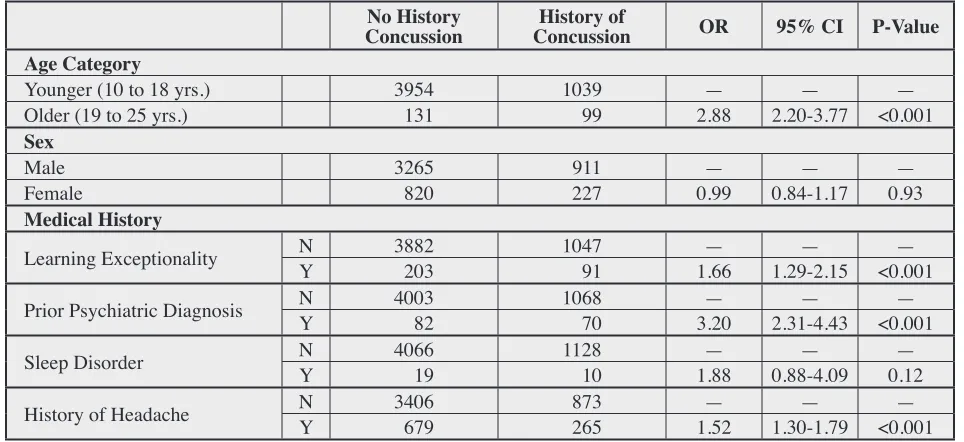
De-identified athlete medical records were extracted from the CCMI database and exported into an encrypted excel spreadsheet. The spreadsheet was then moved into Statis-tical Package for the Social Sciences software (SPSS) in January 2018. Mean age (SD) was calculated for the total sample and each sex group. Chi square statistics were cal-culated for the lifetime prevalence of concussion among sex and age groups (see Table 1). To allow for comparison of the effect size, odds ratios were calculated for a hist-ory of concussion for both sex and age groups (see Table 2; note that history of concussion was dichotomized as “yes” or “no”). Chi square statistics were also calculated
Table 1.
Lifetime prevalence of self-reported diagnosed concussions among Canadian ice hockey players aged 10 to 25 years old presenting to CCMI clinics between 2014 and 2017, by sex and age. Note: percentages reflect the proportion of the
row total.
Number of Prior Concussions
0 1 2 3+ χ2 P-Value
N % N % N % N %
Total Sample 4085 78.2 743 14.2 269 5.2 126 2.4 — —
Sex N % N % N % N %
Male 3265 78.2 602 14.4 212 5.1 97 2.3 1.44 0.70
Female 820 78.3 141 13.5 57 5.4 29 2.8
Age Category N % N % N % N %
Youth (10 to 12 yrs.) 1602 83.4 238 12.4 67 3.5 13 0.7 206.8 <0.001
Adolescent (13 to 18 yrs.) 2352 76.5 466 15.2 173 5.6 82 2.7
Table 2.
Association between history of self-reported diagnosed concussion (vs. none) by age, sex and select medical histories among Canadian ice hockey players aged 10 to 25 years old presenting to CCMI clinics between 2014 and 2017.
Legend: N= no, Y= yes, OR = odds ratio
No History
Concussion ConcussionHistory of OR 95% CI P-Value
Age Category
Younger (10 to 18 yrs.) 3954 1039 — — —
Older (19 to 25 yrs.) 131 99 2.88 2.20-3.77 <0.001
Sex
Male 3265 911 — — —
Female 820 227 0.99 0.84-1.17 0.93
Medical History
Learning Exceptionality NY 3882 203 1047 91 1.66— 1.29-2.15— <0.001—
Prior Psychiatric Diagnosis NY 4003 82 1068 70 3.20— 2.31-4.43— <0.001—
Sleep Disorder NY 4066 19 101128 1.88— 0.88-4.09— 0.12—
History of Headache NY 3406 679 873 265 1.52— 1.30-1.79— <0.001—
Figure 2.
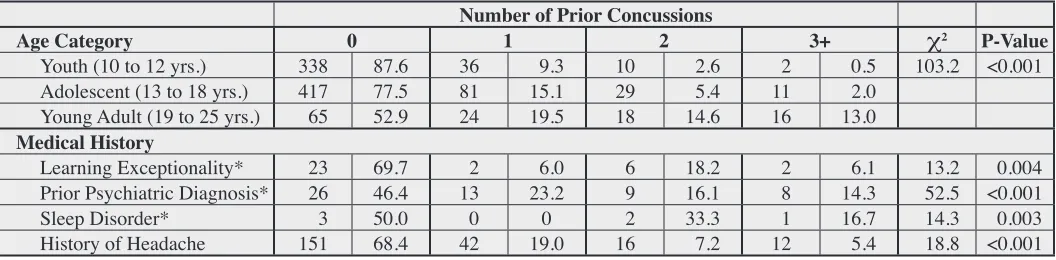
within each sex group for prevalence of concussion(s) by age and health history (see Tables 3 and 4). Lastly, box and whisker plots were used to compare PCSS severity scores for males and females by number of previous con-cussions (see Figure 2). Statistical significance was set at p=0.05 for all tests.
Results
A total of n=5223 medical records from ice hockey play-ers between the ages of 10 and 25 years old were included
in this study. This sample represented approximately 1.5% of the entire youth, adolescent and young adult population enrolled in Hockey Canada programs in the 2017-2018 season (approx. n= 345 000).12 Males (n=4176) comprised
79.9% of the entire sample. The mean age was 13.6 years old (SD 2.67) for the entire sample, 13.4 years old (SD 2.25) for males, and 14.3 years old (SD 3.81) for females. Approximately 22% of all athletes had indicated they had been diagnosed with at least one prior concussion. The number of males and females whom reported a history of
Table 3.
Cross tabulation of number of concussions by age and select medical diagnoses among male Canadian ice hockey players aged 10 to 25 years old presenting to CCMI clinics between 2014 and 2017.
Legend: learning exceptionality = aggregate variable containing athletes who self-reported a learning disability, ADD or ADHD diagnosis; prior psychiatric diagnosis = aggregate variable containing athletes self-reporting a
diagnosis of depression or anxiety; * cells had lower than expected counts – interpret p-value with caution. Note: percentages reflect the proportion of the row total.
Number of Prior Concussions
Age Category 0 1 2 3+ χ2 P-Value
Youth (10 to 12 yrs.) 1264 82.4 202 13.2 57 3.7 11 0.7 106.7 <0.001
Adolescent (13 to 18 yrs.) 1935 76.3 385 15.2 144 5.7 71 2.8
Young Adult (19 to 25 yrs.) 66 61.7 15 14.0 11 10.3 15 14.0
Medical History
Learning Exceptionality 180 69.0 38 14.5 21 8.1 22 8.4 52.6 <0.001
Prior Psychiatric Diagnosis* 56 58.3 13 13.6 14 14.6 13 13.5 75.7 <0.001
Sleep Disorder * 16 69.6 3 13.0 1 4.4 3 13.0 11.7 0.008
History of Headache 528 73.1 118 16.3 50 6.9 27 3.7 18.5 <0.001
Table 4.
Cross tabulation of number of concussions by age and select medical diagnoses among female Canadian ice hockey players aged 10 to 25 years old presenting to CCMI clinics between 2014 and 2017.
Legend: * cells had lower than expected counts – interpret p-value with caution. Note: percentages reflect the proportion of the row total.
Number of Prior Concussions
Age Category 0 1 2 3+ χ2 P-Value
Youth (10 to 12 yrs.) 338 87.6 36 9.3 10 2.6 2 0.5 103.2 <0.001
Adolescent (13 to 18 yrs.) 417 77.5 81 15.1 29 5.4 11 2.0
Young Adult (19 to 25 yrs.) 65 52.9 24 19.5 18 14.6 16 13.0
Medical History
Learning Exceptionality* 23 69.7 2 6.0 6 18.2 2 6.1 13.2 0.004
Prior Psychiatric Diagnosis* 26 46.4 13 23.2 9 16.1 8 14.3 52.5 <0.001
Sleep Disorder* 3 50.0 0 0 2 33.3 1 16.7 14.3 0.003
concussion declined as the number of prior concussions increased (i.e., fewer individuals reported multiple con-cussions compared to a single concussion). Sex and num-ber of prior concussions were not significantly associated with one another (
χ
2 (3) = 1.44, p=0.70). Stratified by age,a similar trend was identified; within each age group, few-er athletes reported multiple prior concussions compared to zero or one prior concussion. The association identified between age and number of prior concussions was signifi-cant (
χ
2 (6) = 206.8, p=<0.001).Calculated odds ratios provided an indication as to the effect size between age, sex, health history and history of concussion. Like above, athletes in the older age group were 2.88 times more likely (CI 95%, 2.20 to 3.77) to have had a history of concussion compared to younger athletes. The odds of having a history of concussion was not sig-nificantly associated with an athlete’s sex. Having had at least one prior concussion was significantly associated with a history of learning disorder (OR=1.66, p<0.001), a previously diagnosed psychiatric illness (OR=3.20, p<0.001) and a history of headache (OR=1.52, p<0.001). History of sleep disorder was the only health condition not found to increase an athlete’s odds of having a history of concussion (p=0.12).
Tables 3 (males only) and 4 (females only) stratify number of prior concussions by age and medical history. Among male athletes, number of prior concussions was significantly associated with an increase in age (
χ
2 (6) =106.7, p <0.001). Irrespective of age, fewer males reported a history of multiple concussions (i.e., two and three or more) compared to males who reported zero or one. One exception was noted among young adult males; a greater proportion of males reported three or more prior concus-sions (14.0%) as compared to two (10.3%). Significant associations between number of prior concussions and each health condition were also identified. Note the low cell counts for prior psychiatric diagnosis and sleep disor-der categories.
Similar to findings among males, data from female athletes indicated there was a significant association between number of prior concussions and age (
χ
2 (6) =103.2, p <0.001). Again, fewer females reported multiple concussions compared to zero or one. Significant asso-ciations between each health condition and number of concussions was identified, but due to low cell counts (except for a history of headache) findings should be
interpreted with caution. When comparing concussion histories across sex groups, a greater proportion of males reported a history of concussion (of any number) within each of the age categories. Two exceptions were noted; a greater percentage of females in the young adult age category reported one (19.5% vs. 14%) and two prior concussions (14.6% vs. 10.3%) compared to males in the same age category.
A positive association was identified between PCSS severity score and prior number of concussions as seen in Figure 2; symptom severities increased with each addi-tional concussion that was reported. Symptom severity score appeared to be similar among the sexes for zero and one prior concussion. However, male and female symp-tom severities diverged in the two and three or more con-cussion categories, with females having higher symptom severity scores than their male counterparts. Pairwise comparisons and tests of significance were not calculated.
Discussion
With respect to the entire sample, 21.8% of athletes re-ported that they had been diagnosed with a least one pri-or concussion. Estimates were comparable within each sex group (21.8% and 21.3% for males and females, respectively). Prevalence declined as number of con-cussions increased (i.e., fewer athletes reported two or three or more concussions as compared to one or none). A similar trend was identified within each sex group, with the exception of males in the young adult category where more athletes reported three or more concussions (14%) than two (10.3%). Sex was not significantly associated with number of prior concussions, but age was. Categor-ized as a young adult and having an additional health condition was associated with an increase in the odds of having a history of concussion. Similar trends of associ-ation were noted within each sex group. With respect to baseline PCSS severity scores, females with a history of two and three or more concussions reported greater symp-tom severities at baseline than did males with the same concussion histories.
hock-ey players aged 13 to 17.9 years old (n=615).27 Among
their total sample, 62.1% of athletes reported no history of concussion, 30.1% reported one (males = 32.9%; males = 20.4%), 5.9% reported two (males = 6.2%; fe-males = 4.1%), and 1.1% reported three prior concussions (males = 1.2%; females = 1.0%). Notably, the proportion of athletes within Brooks’ sample whom reported a hist-ory of at least one prior concussion was more than double that of our athletes in the same age group (i.e., 13 to 18 years old; 30.1% vs. 14.2%). Larger discrepancies in prevalence were also noted among Brooks’ athletes than ours when comparing number of previous concussions by sex. Kontos et al. also calculated prevalence of concus-sion among ice hockey players aged 12 to 18 years old (n=397), but included only American athletes.28 Findings
indicated that 73.5% of their athletes had no history of concussion, 18.6% reported one, 6.3% reported two and 0.8% reported three prior concussions; prevalence esti-mates for zero and one prior concussion were much closer to ours than Brooks’ were. In a 2018 multi-sport study conducted by Veliz et al. on American 8th, 10th and 12th
grade students (n=25 048), 81.6% of students reported no prior concussion and 18.4% reported at least one.29 Again,
this was similar to the prevalence for the same concussion categories within our investigation (15.2%). Looking ex-clusively at the students whom were ice hockey players (n=391), 23.0% reported one and 15.9% reported a his-tory of multiple concussions, both of which were much greater than the estimates generated from our sample of the same age. Overall, prevalence estimates generated from our investigation for the adolescent age group alone (i.e., 13 to 18 years old) were similar but slightly more conservative than those referenced above. For example, 15.2% athletes in our adolescent age group (i.e., 13 to 18 years old) reported one prior concussion as compared to 30.1%27, 18.6%28, and 23.0%29. When considering all
athletes included in our sample (regardless of age) who reported a least one prior concussion, our prevalence es-timates (~22%) come much closer to that of the eses-timates referenced above. One important consideration for read-ers to note here is that athletes with a history of concus-sion face an increased risk for subsequent concusconcus-sion.30, 31
In other words, once an athlete has sustained one concus-sion, they are more likely to sustain another.
The final study for comparison included college aged athletes. Katz et al. captured n= 15 681 National
Col-legiate Athletic Association (NCAA) athletes, of which
n=221 were ice hockey players.32 They found that 58%
of all players, 57% of males and 64% of females reported no prior concussion. Prevalence estimates declined with each additional concussion (i.e., one prior concussion; total sample: 28%, females: 25%, males: 29% vs. two prior concussions; total sample: 9%, females: 8%, males: 10% vs. three or more prior concussions; total sample: 5%, females: 4%, males: 5%), which was the same trend identified within our investigation and both Brooks’ and Kontos’. Prevalence estimates from our investigation were more conservative for athletes within the same age range (i.e., young adult; 19 to 25 years old) whom had zero (57.0%) or one prior concussion (17.0%), but inflat-ed for athletes with two (12.6%) or three or more concus-sions (13.5%). Similar to our findings, Katz’ prevalence estimates declined as the number of prior concussions increased. In general, prevalence of concussion (of any number) was greater among Katz’ collegiate aged athletes than our high-school aged athletes and those in the studies described above. This trend is likely explained by greater cumulative athletic exposure hours that accompany older age (i.e., a 21-year-old will have participated in and ac-cumulated a greater number of hours playing in ice hock-ey games and practices than a 15-year-old who started playing hockey at the same age).
Readers may wish to note that any discrepancies iden-tified with respect to lifetime concussion prevalence esti-mates between the referenced studies may be explained by methodological differences in how history of concussion was assessed and reported (i.e., diagnosed concussions as reported in a medical record vs. self-reported diagnosed concussions only vs. self-reported diagnosed and undiag-nosed concussions vs. parent and/or athlete self-reports); each of the above referenced studies, including our own, assessed athlete concussion histories in a slightly differ-ent manner. In the case that concussion histories were generated based on athlete self-report, poor memory re-call and limited knowledge of concussion and the associ-ated symptoms may also explain variability in prevalence estimates. Although each of the above studies included ice hockey players, concussions reported by athletes did not appear to be limited to only those that occurred whilst playing ice hockey.
were significantly more likely to have had a history of concussion than athletes who did not. However, timing of diagnosis in relation to the occurrence of concussion was not acquired from athletes. As such, definitive statements pertaining to if these conditions increased the athlete’s risk for concussion cannot be made. Health conditions, like those assessed within our investigation, may have important implications on recovery outcomes following a SRC. One systematic review summarizing predictors of clinical recovery following a SRC in athletes found sever-al pre-injury hesever-alth conditions (including but not limited to ADHD, a history of headache, familial and personal psychiatric history, as well as previous concussion) were associated with poor post-concussion outcomes (i.e., per-sisting post-concussive symptoms) 24. Refuting evidence
was also cited.
At time of baseline assessment, our athletes were also asked to report on the presence and severity of concus-sion-like symptoms via the PCSS. Both males and fe-males reported similar symptom severities when stratified by prior number of concussions (see Figure 2). This trend is both supported33, 34 and refuted35-37 by the existing
liter-ature. Findings from one large scale meta-analysis (n=42 493) on high school and college aged athletes (inclusive of ages 12 to 26 years old) indicated that females were 43% more likely to report at least one concussion-like symp-tom at baseline compared to males. Specifically, females had significantly higher odds of reporting: vision/ hearing problems, headache/migraine, difficulties concentrating, energy/sleep and emotional disturbances.38 Irrespective
of sex, a history of concussion has been associated with greater concussion-like symptom reports in the absence of injury (i.e., at baseline).27, 39 The take home message
here being that clinicians must consider the impact that single and multiple prior concussions have on the short and long-term health of young athletes.31
Examining injury reporting behaviours specific to young athletes is critical to interpreting prevalence trends. This is especially important given the lack of an object-ive test for diagnosing a concussion. Unless observed by a parent/coach/trainer/game official, athletes must come forward to seek medical attention if they suspect a con-cussion has occurred. As noted above, approximately half of all suspected concussions go unreported by youth ath-letes.8 Sex has also been shown to impact reporting
behav-iours; in one study, male high school aged athletes were 4
to 11 times more likely than females to not report a sus-pected concussion to their coach or parent.40 Despite sex
differences, athletes cited the following reasons for not reporting a SRC: 1) “I thought my coach would get mad”, 2) “I thought my teammates would think I’m weak”, 3) “I didn’t want to let my team mates down”, 4) “I thought my coach would think I’m weak”, and 5) “I thought my par-ents would get upset”.40 In a separate study, being female
was associated with an increase in SRC knowledge and improved concussion reporting behaviours as compared to males.41 With respect to age, younger athletes may not
be as familiar with concussion symptoms or the negative consequences associated with non-reporting behaviours, thus resulting in fewer injury reports. Clinicians should note that athletes who fail to report a SRC may face an increased risk for a subsequent concussion and poor long-term health outcomes.42
Strengths and limitations
To our knowledge, this study offers the largest sample of ice hockey players compared to the other prevalence studies referenced. However, athlete records included in our study represent a very small proportion (~1.5%) of all Hockey Canada registrants. As such, the sample captured and prevalence estimates generated may not be represent-ative of the population as a whole. Our study also offers comparison of concussion prevalence rates across a wide age range (i.e., middle school to collegiate aged athletes). Noting however that college aged athletes were large-ly underrepresented within our sample (4.4%). Caution should be used if generalizing study findings to a young adult age group. One unique aspect of our study was that we examined the association and calculated odds ratios between several health conditions and history of concus-sion. Due to the limited health history information that was collected from athletes, the identified relationships lack temporality; we do not know if a reported health condition occurred before or after a concussion occurred (if any). Furthermore, athletes were only asked to report
diagnosed health conditions. We did not cross reference
self-re-ports which can be problematic and subject to poor mem-ory recall. Athletes may have inflated or underreported their history of concussion due to any number of reasons, some of which are discussed above. Reported diagnosed concussions were not cross-referenced with official med-ical records.
Conclusions
Approximately 22% of ice hockey players presenting to CCMI clinics reported at least one prior concussion, which was similar to previously published prevalence es-timates. A smaller proportion of athletes (~7.6%) reported a history of two or more prior concussions.
Sex was not found to be significantly associated with an increase in the odds of having a history of concussion. Although young adults made up a very small percentage of the total sample, a greater proportion of these athletes reported a history of concussion (of any number) com-pared to younger age groups. Older age was significant-ly associated with having a history of concussion. This was attributed to a greater overall athletic exposure (i.e., greater cumulative number of hours spent in games, prac-tices and training) to injury. Athletes whom reported an additional health condition (other than a sleep disorder) were significantly more likely to have a history of con-cussion compared to those athletes without an additional diagnosis. Lastly, number of prior concussions appears to be positively associated with concussion-like symptoms reported via the PCSS in the absence of injury.
Although risk for SRC cannot be removed entirely from the sport of ice hockey, revision of player-to-player contact policies in youth hockey (such as barring body checking under the age of 13) has consistently demon-strated a protective effect in reducing athlete risk for SRC.31 Given the proportion of ice hockey players whom
reported a previous concussion, stakeholders are encour-aged to consider the availability of educational, injury management and injury prevention strategies that are in place and accessible at the athlete level. Moving forward, subsequent investigations should seek to establish preva-lence estimates of SRC that occur while playing ice hock-ey. Acquiring information from athletes with respect to timing of an additional health condition (i.e., present pre- or post-concussion) would help to better define any risk and recovery implications that may exist. In turn, clin-icians can offer a more informed approach to managing
and protecting athletes at risk for prolonged recovery and subsequent SRCs.
Acknowledgments
The authors wish to acknowledge Dr. Sheilah Hogg-John-son (SHJ) for her contributions to this manuscript, spe-cifically her assistance in developing the research ques-tion(s) and completing the preliminary data analysis. We would also like to thank the partnered clinics and clin-icians of the Complete Concussion Management network for their contribution to data collection.
References
1. Zemek RL, Grool AM, Rodriguez Duque D, DeMatteo C, Rothman L, Benchimol EI, et al. Annual and seasonal trends in ambulatory visits for pediatric concussion in Ontario between 2003 and 2013. J Pediatr. 2017;181:222-228.
2. Brown DA, Elsass JA, Miller AJ, Reed LE, Reneker JC. Differences in symptom reporting between males and females at baseline and after a sports-related concussion: a systematic review and meta-analysis. Sports Med. 2015;45(7):1027-1040.
3. Schatz P, Moser RS. Current issues in pediatric sports concussion. Clin Neuropsychol. 2011;25(6):1042-1057. 4. McCrea M, Hammeke T, Olsen G, Leo P, Guskiewicz
K. Unreported concussion in high school football players: implications for prevention. Clin J Sport Med. 2004;14(1):13-17.
5. Williamson IJS, Goodman D. Converging evidence for the under-reporting of concussions in youth ice hockey. Br J Sports Med. 2006;40(2):128-132.
6. Delaney JS, Lacroix VJ, Leclerc S, Johnston KM.
Concussions among university football and soccer players. Clin J Sport Med. 2002;12(6):331-338.
7. Valovich McLeod TC, Bay RC, Heil J, McVeigh SD. Identification of sport and recreational activity concussion history through the preparticipation screening and a symptom survey in young athletes. Clin J Sport Med. 2008;18(3):235-240.
8. Harmon KG, Drezner JA, Gammons M, Guskiewicz KM, Halstead M, Herring SA, et al. American Medical Society for Sports Medicine position statement: concussion in sport. Br J Sports Med. 2013;47(1):15-26.
9. Pfister T, Pfister K, Hagel B, Ghali WA, Ronksley PE. The incidence of concussion in youth sports: a systematic review and meta-analysis. Br J Sports Med. 2016;50(5):292-297.
10. Daneshvar DH, Nowinski CJ, McKee A, Cantu RC. The epidemiology of sport-related concussion. Sports Med. 2011;30(1):1-17.
14-year-olds in 2005. https://www150.statcan.gc.ca/ n1/pub/11-008-x/2008001/t/10573/5214759-eng.htm. Accessed December 2018.
12. Hockey Canada. Hockey Canada Annual Report (2017-2018). https://cdn.agilitycms.com/hockey-canada/ Corporate/About/Downloads/2017-18-hockey-canada-annual-report-e.pdf. Accessed December 2018. 13. Scopaz KA, Hatzenbuehler JR. Risk modifiers for
concussion and prolonged recovery. Sports Health. 2013;5(6):537-541.
14. Covassin T, Moran R, Elbin RJ. Sex differences in reported concussion injury rates and time loss from participation: an update of the National Collegiate Athletic Association Injury Surveillance Program from 2004-2005 through 2008-2009. J Athl Train. 2016;51(3):189-194. 15. Field M, Collins MW, Lovell MR, Maroon J. Does age
play a role in recovery from sports-related concussion? A comparison of high school and collegiate athletes. J Pediatr. 2003;142(5):546-553.
16. Nelson LD, Guskiewicz KM, Barr WB, Hammeke TA, Randolph C, Ahn KW, et al. Age differences in recovery after sport-related concussion: a comparison of high school and collegiate atheltes. J Athl Train. 2016;51(2):142-152. 17. Covassin T, Moran R, Elbin RJ. Sex differences in
reported concussion injury rates and time loss from participation: an update of the National Collegiate Athletic Association Injury Surveillance Program from 2004-2005 through 2008-2009. J Athl Train. 2016;51(3):189-194. 18. O’Connor KL, Dompier TP, Baker MM, Kerr ZY,
Dalton SL, Broglio SP. Epidemiology of sport-related concussions in high school athletes: national athletic treatment, injury and outcomes network (NATION), 2011-2012 through 2013-2014. J Athl Train. 2017;52(3):175. 19. Wasserman EB, Kerr ZY, Zuckerman SL, Covassin T.
Epidemiology of sports-related concussions in National Collegiate Athletic Association Athletes From 2009-2010 to 2013-2014: symptom prevalence, symptom resolution time, and return-to-play time. Am J Sports Med. 2016;44(1):226-233.
20. Neidecker JM, Gealt DB, Luksch JR, Weaver MD. First-time sports-related concussion recovery: the role of sex, age and sport. J Am Osteopath Assoc. 2017;117(10):635-642.
21. Kostyun RO, Hafeez I. Protracted recovery from a
concussion: a focus on gender and treatement interventions in an adolescent population. Sports Health. 2015;7(1):52-57.
22. Ewing-Cobbs L, Cox CS Jr, Clark AE, Holubkov R, Keenan HT. Persistent postconcussion symptoms after injury. Pediatrics. 2018;142(5):e20180939.
23. Ledoux AA, Tang K, Yeates KO, Pusic MV, Boutis K, Craig WR, et al. Natural progression of symptom change and recovery from concussion in a pediatric population. JAMA Pediatrics. 2018:e183820.
24. Iverson GL, Gardner AJ, Terry DP, Ponsford JL, Sills AK, Broshek DK, et al. Predictors of clinical recovery from concussion: a systematic review. Br J Sports Med. 2017;51(12):941-948.
25. Lovell MR, Iverson GL, Collins MW, Podell K,
Johnston KM, Pardini D, et al. Measurement of symptoms following sports-related concussion: reliability and normative data for the post-concussion scale. Applied Neuropsychology. 2006;13(3):166-174.
26. Pardini D, Stump J, Lovell M, Collins M, Moritz K, Fu F. The Post Concussion Symptom Scale (PCSS): a factor analysis. Br J of Sports Med. 2004;38:661-662. 27. Brooks BL, Mrazik M, Barlow KM, McKay CD,
Meeuwisse WH, Emery CA. Absence of differences between male and female adolescents with prior sport concussion. J Head Trauma Rehabil. 2014;29(3):257-264. 28. Kontos AP, Elbin RJ, Sufrinko A, Dakan S, Bookwalter K,
Price A, et al. Incidence of concussion in youth ice hockey players. Pediatrics. 2016;137(2):e20151633.
29. Veliz P, Eckner JT, Zdroik J, Schulenberg JE. Lifetime prevalence of self-reported concussion among adoelscents invovled in competitive sports: a national U.S. study. J Adolesc Health. 2018:S1054-139X(18)30407-5. 30. Abrahams S, Mc Fie S, Patricios J, Posthumus M,
September AV. Risk factors for sport concussion: an evidence-based systematic review. Br J Sports Med. 2014;48(2):91-97.
31. McCrory P, Meeuwisse W, Dvorák J, Aubry M, Bailes J, Broglio S, et al. Consensus statement on concussion in sport – the 5th international conference on concussion in sport held in Berlin, October 2016. Br J Sports Med. 2017;51(11):838-847.
32. Katz BP, Kudela M, Harezlak J, McCrea M, McAllister T, Broglio SP. Baseline performance of NCAA athletes on a concussion assessment battery: a report from the CARE Consortium. Sports Med. 2018;48(8):1971-1985. 33. Valovich McLeod T, Bay R, Lam K, Chhabra A.
Representative baseline values on the Sport Concussion Assessment Tool 2 (SCAT2) in adolescent athletes vary by gender, grade, and concussion history. Am J Sports Med. 2012;40(4):927-933.
34. Covassin T, Elbin RJ, Larson E, Kontos AP. Sex and age differences in depression and baseline sport-related concussion neurocognitive performance and symptoms. Clin J Sport Med. 2012;22(2):98-104.
35. Custer A, Sufrinko A, Elbin RJ, Covassin T, Collins M, Kontos A. High baseline postconcussion symptom scores and concussion outcomes in athletes. J Athl Train. 2016;51(2):136-141.
36. Lovell MR, Iverson GL, Collins MW, Podell K,
37. Schneider KJ, Emery CA, Kang J, Schneider GM,
Meeuwisse WH. Examining Sport Concussion Assessment Tool ratings for male and female youth hockey players with and without a history of concussion. Br J Sports Med. 2010;44(15):1112-1117.
38. Brown DA, Elsass JA, Miller AJ, Reed LE, Reneker JC. Differences in symptom reporting between males and females at baseline and after a sports-related concussion: a systematic review and meta-analysis. Sports Med. 2015;45(7):1027-1040.
39. Register-Mihalik JK, Mihalik JP, Guskiewicz KM. Association between previous concussion history and symptom endorsement during preseason baseline testing
in high school and collegiate athletes. Sports Health. 2009;1(1):61-65.
40. Wallace J, Covassin T, Beidler E. Sex differences in high school athletes’ knowledge of sport-related concussion symptoms and reporting behaviors. J Athl Train. 2017;52(7):682-688.
41. Kurowski B, Pomerantz W, Schaiper C, Gittelman MA. Factors that influence concussion knowledge and self-reported attitudes in high school athletes. J Trauma Acute Care Surg. 2014;77(3):S12-S27.