A computer Aided Sustainable Modelling and Optimization Analysis
of CNC Milling and Turning Processes.
Karmjit Singh
a* and Ibrahim Sultan
aaSchool of Science, Engineering and Information Technology, Federation University,
Mt Helen campus, Australia;
Correspondence Author e-mail: [email protected]*
A Computer Aided Sustainable Modelling and Optimization Analysis
of CNC Milling and Turning Processes.
The system design for Sustainable manufacturing is to consider both ecological and financial constraints. Manufacturing industry demands to advance in sustainable manufacturing by accounting in environment factors in it. All the factors that affect the environment need to be analyzed so that proper amendments or suggestions can be provided. To favour this, Computer aided life cycle inventory model has been presented for CNC milling and turning processes. Based on utilization of resources and stages, whole machining operation time can be divided into three phases named as process (milling or turning), idle and basic times. As parameters are different for evaluating the process times i.e. depth and width of cut in case of milling and initial and final diameters for turning, two different case studies has been presented one for each milling and turning process. Effect of material choice has been studied for different processes. Highly dense and hard materials takes more time in finishing the job due to low cutting speed and feed rates as compared to that of sot materials. In addition, face milling takes more time and consumes more power as compared to peripheral milling due to more retraction time caused by over travel distance and lower vertical transverse speeds than the horizontal transverse speed used in peripheral retraction process.
Keywords: manufacturing sustainability; milling process; turning process; energy consumption; power consumption.
1. Introduction
1.1 Overview
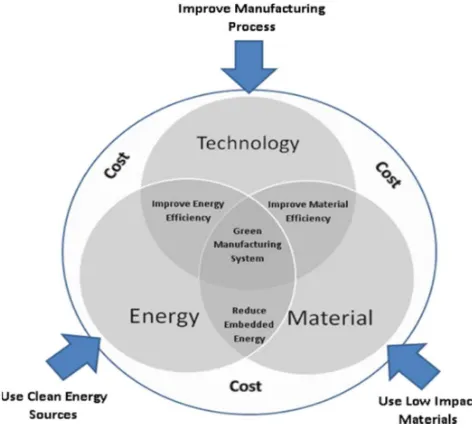
lifespan, more energy0 efficient solutions are essential to be used. The business benefits and the ecological execution can be improved by applying the Sustainability standards on machining forms (Deaib, 2014). Diverse means, for example, drop of carbon emissions, wastage supervision, and budget can be used to attain sustainability in a product’s lifespan cycle as shown in Figure 1. In the same way, it can be attained in manufacturing at three stages: the process stage, the product stage and the system stage.
Figure 1. Prospects for refining product life cycle (Deaib, 2014)
1.2 Process Planning for Sustainable Manufacturing
• Cost (Labor, machine apparatuses, cutting instruments—as capacity of machining time)
• Environment (Energy used, material and process emission from use of cutting solutions)
• Quality (Process capacity, scrap rate, in process control needs and so forth)
• Lead time (Material evacuation rates, diminished set-up times—consequently diminished standby circumstances)
• Flexibility (Routines, KBE, competence) it is vital to comprehend the interrelation between various machining factors, choices, imperatives and so forth and their separate effect on the machining result.
1.3 Manufacturing system design
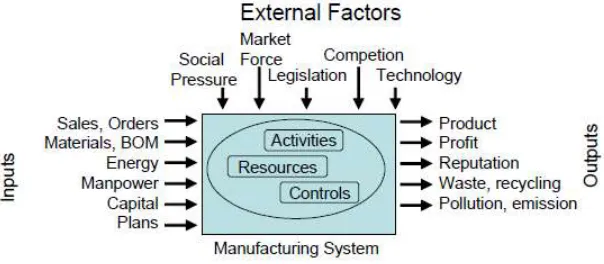
Method designed for manufacturing is formed of controls, resources, activities, entities controls (Tumay & Harrell, 1994). It incorporates processes yet also comprises the asset incomes and controls for completing them, as exposed in Figure 2.
Figure 2.A manufacturing system (Tumay & Harrell, 1994)
1.4 Factors affecting energy consumption in CNC machining
and greenhouse release seem more every now and again in the features of news and significant subjects of political or financial debates. The matter of sustainability has been broadly perceived as the need in the key manufacturing research. Successfully tending to this issue stays vital to the accomplishment of any manufacturer in the worldwide commercial center. Numerous new terminologies, for example, ecologically aware manufacturing, energy effective manufacturing, remanufacturing, and product lifespan engineering, have been recommended. An energy consumption model is essential for pretending energy consumption in an expansive number of various situations rapidly. CNC machine devices are the key player in present day machining industry. Its principle natural effect is recognized to energy consumption during the utilization stage, which represents over 95% of the life cycle energy use. CNC machines are involved various motors and helper segments whose energy utilization can fluctuate emphatically during production (Bhanot, Rao, & Deshmukh, 2016). The pattern towards higher level of automation of CNC will as needs be develop the energy bit of the aggregate cost. An unambiguous data format is desirable to simplify energy data exchange among dissimilar happenings of a production system. This is especially valid in a situation where these distinctive events, e.g. designing, plan, fabrication and data storage, are distributed geographically. Thus, to characterize and incorporate energy data, a standardized data model is considered as viable solution. The energy features of CNC machining have a tendency to be extremely composite, fluctuating meaningfully with respect to method design and variety of operative procedures. An examination of current writing concentrated on energy request displaying for CNC machining (Gutowski, Dahmus, & Thiriez, 2006). The primary gathering that concentrated the energy necessity of a machining procedure as a basic of steady energy utilization and a variable one. The static energy is required by the supplementary devices of machines to confirm its operative readiness, although the inconstant energy consumption is reliant on its processing rate. A comparable report was directed by (Kara, Qureshi, Li, & Herrmann, 2011) where the particular energy utilization of a machining procedure is assessed in light of a consistent and a variable segment with identified material removal rate. These mathematical models provided invaluable basis for in-depth energy analysis of CNC machining.
1.5 Problem statement
performance regarding how well products are produced in a sustainable manner. There have been many frameworks for sustainability assessment and indicators, which evaluate the sustainability performance of manufacturing industries. These indicators are categorized into social, economic and environmental indicators based on available data and commonly measured aspects of production like materials use, energy use, water consumption, products, waste, air emissions etc.
A manufacturing process generally consists of a number of unit processes. There are number of issues, which increase the level of complexity in the manufacturing processes. These issues are different types of energy resources, energy usage at various stages with variation in employed power, number of materials, wastage of material at different levels, labor cost, product manufacturing cost, and cost of tooling and equipment. Manufacturing industries are focusing on sustainability analysis of manufacturing processes. Present methods are used for determination of sustainability analysis for a product having following designs:
• complex mathematical relations are involved
• manual calculations need to be used that are prone to error
• a lot of literature needs to be referred for collecting the data
• lot of human effort are required at every stage
• this is an iterative and time-consuming process (Singh & Sultan, 2017)
Hence, there is a need for computer-aided system that automatically assesses sustainability of different process plans at early design stage and benefitting the industry. The system would help in minimizing the use of non-renewable sources, choosing energy efficient processes, minimizing waste, reduce product manufacturing cost, labor cost and reduce carbon emissions.
being implemented and thus reducing the usage of materials, energy consumption and emissions generated for the manufacturing process
Researchers had done many efforts in sustainability assessment, but there are still difficulties in evaluating the sustainability performance of manufacturing industries. Along with the increased concern to the social, environmental, economic and other important issues, all existing methodologies, and technologies for manufacturing systems are needed to be innovated in terms of sustainable manufacturing.
1.6 Objectives
To advance Sustainability assessment analysis, machining processes need reliable measurement methods to evaluate performance of the machining processes by considering the factors of production volume, elapsing time of the process energy consumption, power consumption wastage etc.
Objectives of the present study would be:
1. To determine performance metrics for a milling and turning process.
2. To propose a methodology for determining science based measurements for both machining processes.
3. To develop a LCI model that could evaluate sustainability of machining processes from process plan of the part with the help of MATLAB Software.
4. To verify the proposed methodology, compare output data obtained from the machining processes (face milling, peripheral milling and turning).
1.7 Work Methodology
Present work describes a system development for turning and milling processes in sustainable manner. Following systematic approach will be applied for undertaking this study:
Abstracting and collecting data of effected properties in concerned study.
Modelling of milling and turning process by using MATLAB software in Graphical user Interface module.
Compare the parameter values calculated in the study using different processes.
2. Literature survey
In this section, different types of energy models are reviewed which considers different elements of a CNC machine to calculate consumption of energy by CNC machines.
Gutowski et al. (2006) provided specific electricity consumption dependent needs for the manufacturing CNC operations. They found that these needs vary from process to process and depends upon the rate of machining processes and energy used operations are increasing day by day.
Diaz et al. (2011) studied the procedures for exemplifying and minimizing the consumption of electrical energy of CNC milling tools while the machining process. They measured the power demands and specific energy variables of a micro-machining tools in which they use low carbon steel for cutting under different material removing rates. Similar procedure has been adopted for cutting aluminum as well as poly-carbonate materials in order to do the comparison and finding difference for specific energy for individual materials with respect to the steel.
Rajemi et al. (2010) assessed ideal instrument life for least energy of a turning procedure by considering the energy spending plan in manufacturing an item. The basic parameters for the tool life for least energy are the power required to begin the machine instrument and place it in an idle condition, the energy impression for tool-manufacture, change time of tools and cutting speed types in the tool-life equations. The ideal condition for least expenses does not really fulfill the base energy objective. The cutting speed and machining process duration is firmly impacted by the way in which the energy of the cutting tools is represented. The study concludes the increase in tool-life and hence decreases in energy usage in order to get more value out of high energy tools.
detections: (1) utilization of power can be decreased for basic types of milling operations i.e. peripheral, face and end milling by setting the cutting conditions high still inside a range which do not compromise finishing of surface, life of tool which results in shorten of machining time. (2) utilization of power for machining deep holes can be lessened with a versatile pecking cycle, which executes pecking as required by detecting load of cutting. (3) utilization of power can be lessened further by synchronize the spindle accelerating/de-accelerating speed with the feed axis at rapid traversing operation.
Avram & Xirouchakis et al. (2011) proposed a method estimating variable energy requires of a machining tool system in part machining. They used cutter location and speed data. They also consider the specific parameters of the spindle and feed axis and cutting phases which are validated with different phase regimes. Less variations in both numerical and experimental values are must realistic estimations of the total energy consumed in machine operations. During the material removal processes, energy savings need to be considered in order to fix match between the efficiency requirements of machine to that of the proficiencies of the machine, hence magnitude and duration of machine running are taken into account.
Hu et al. (2012) proposes an on-line energy monitoring for developing the efficiency of energy of tools used in CNC machining process. The systems develop energy related information like tare power, ready-for-operation time, and idling time. They propose reduction in initial energy consumption using task scheduling in which, ready-for-operation time and idling time can be reduced and then provide some technology related measurements so that cutting parameters can be optimized so that cutting time for the processes can be reduced.
Calvanese et al. (2013) proposed energy consumption model for the machine tooling used in the milling CNC machining processes. Proposed method used the simple energy models for estimating consumption of energy by considering major functional modules of CNC tooling. They provide optimization about the cutting variables and conditions in order to minimize the energy consumption in the milling process. Different machine tool functional modules and productions phases were considered.
machining operation. They find out the possibilities of the statistic modeling efficiency of machine tools with the functions as working parameters by taking data from the experiments and that of Response Surface Methodology. The machine tool workload has a great influence which is equivalent to nominal power of machine tool.
Kara et al. (2011) presented an empirical approach for unit-process energy calculations used for material removal operations. For the particular machine tools, the derived approaches can give approximate prediction of energy consumed for material removals at particular fixed rates which assists in calculating energy involved in milling and turning operations. The proposed unit-process energy consumption model finds that that a higher MRR results less energy consumed in removing same amount of material volume as compared to lower MRR rates.
Guo et al. (2012) proposed two step methods in calculating the ideal cutting factors for finishing-turning processes in order to minimize the total energy consumption by achieving a quantified surface roughness. For this, they derived an energy and surface roughness model for a particular defined machine tool taken in study.
3. Methodology for Life Cycle Inventory Modeling for milling/turning process
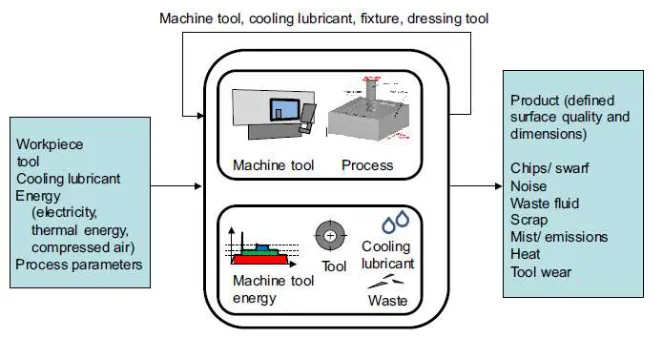
To evaluate a machining procedure productively with reusable methods as far as ecological effect, the idea of a unit task is taken. The unit-process comprises of the data sources or inputs, process, and yields of a task i.e. outputs. The unit-process outline of a milling/turning procedure is demonstrated Fig. 3. The chart incorporates a diagram of the ecological based elements that are reusable when these inventory devices are connected to an extensive variety of uses for processing tasks. For a given workpiece the life cycle inventory yields energy utilize and mass losing as wastage or bi products. Energy input is in the form of electricity, thermal or compress air etc. Production of final product from the input raw material takes following LCI attributes,
Input sources or materials
Energy requirements
Losses of material i.e. out for recycle or waste
The parameters involved in milling process has been in shown in LCI diagram below
Figure 3. Initial workpiece and finished product diagram of a milling/turning process producing the Life cycle inventory data (Parashar & Mittal, 2012)
3.1 LCI for milling operation
3.1.1 Calculation of Total energy
Total energy comprises all idle, basic and milling energies the equation used for calculating total energy can be written as following
𝐸𝑛𝑒𝑟𝑔𝑦 = (𝑃𝑜𝑤𝑒𝑟 × 𝑇𝑖𝑚𝑒 ) + (𝑃𝑜𝑤𝑒𝑟 × 𝑇𝑖𝑚𝑒 ) +
(𝑃𝑜𝑤𝑒𝑟 × 𝑇𝑖𝑚𝑒 ) (1)
3.1.2 Life cycle inventory for Material wastage or mass-loss in milling process
Work piece losses material in milling process which is named as chip mass. It contains metal chip material and the cut fluid used in process which is separated from one another. It can be calculated from the materials density, work piece length and depth and width of cut in mm.
𝑉𝑜𝑙𝑢𝑚𝑒 = 𝑙𝑒𝑛𝑔𝑡ℎ × 𝑤 × 𝑑 (2)
And
𝑀𝑎𝑠𝑠 = 𝑉𝑜𝑙𝑢𝑚𝑒 × 𝜌 × (1𝑚 /1𝐸 + 09 𝑚𝑚 ) (3)
3.2 LCI for turning operation
3.2.1 Calculation of Total turning energy
Total energy comprises all idle, basic and turning energies. The equation used for calculating total turning energy can be written as following
𝐸𝑛𝑒𝑟𝑔𝑦 = (𝑃𝑜𝑤𝑒𝑟 × 𝑇𝑖𝑚𝑒 ) + (𝑃𝑜𝑤𝑒𝑟 × 𝑇𝑖𝑚𝑒 ) +
(𝑃𝑜𝑤𝑒𝑟 × 𝑇𝑖𝑚𝑒 ) (4)
3.2.2 Life cycle inventory for Material wastage or mass-loss in turning process
Workpiece losses material in turning process which is named as chip mass. It contains metal chip material and the cut fluid used in process which is separated from one another. It can be calculated from the materials density, workpiece length and initial and final diameter in mm.
𝑉𝑜𝑙𝑢𝑚𝑒 = 𝜋 × × 𝑙𝑒𝑛𝑔𝑡ℎ (5)
And
𝑀𝑎𝑠𝑠 (𝑘𝑔) = 𝑉𝑜𝑙𝑢𝑚𝑒 × 𝜌 × (1𝑚 /1𝐸 + 09 𝑚𝑚 ) (6)
Where 𝜌 is density of the workpiece material.
3.3 Developing graphical user interface in MATLAB
3.3.1 Case study for milling process
An aluminum alloy has been assumed with workpiece of rectangular shape block of size Length = 600, Height = 150 and Width = 70 mm. The aim is to analyze the consumption of energy by milling a cut with diameter = 160 mm and depth = 4 mm. The workpiece has weight = 17.0856 kg.
Figure 4. Work piece dimensions assumed in milling case study
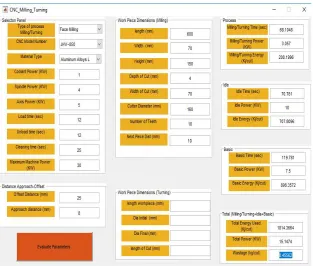
As showed in image above, a number of parameters need to be put through the GUI and some are read directly through excel sheets in the programming which contains Specific cutting energy Up (W/mm3 per sec), Cutting Speed (m/min), Feed per teeth (mm/rev), Density (kg/m3), X-Y transverse speeds while retracting step for different types of workpiece materials etc. The outputs comes in terms of time, power, energy and wastage in different sections of the processes.
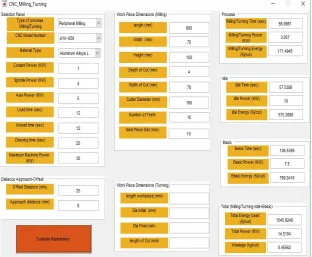
Similar process is repeated for peripheral milling in which there is a difference of one parameter, extent of cutting tool that goes away from the workpiece. The results for this operation has been shown as below figure.
Figure 6. A GUI showed both inputs (column first and second) and outputs (column 3) for peripheral milling process
3.3.2 Case study for turning process
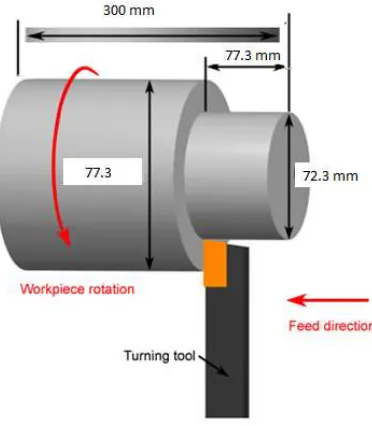
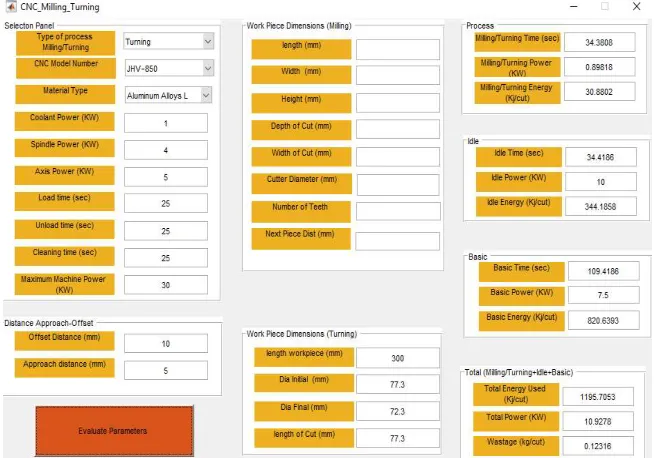
As turning process is different from milling, specific cutting energy, Cutting Speed, Feed are different in this process. As it eliminates the material from the outer diameter different parameters and type of job has been assumed for turning process.
Figure 7. Workpiece dimensions assumed in turning case study
Figure 8. A GUI showed both inputs (column first and second) and outputs (column 3) for turning process
4. Results and Discussion
4.1 Comparison of face and peripheral milling operations for different output parameters
Figure 9. Comparison of milling, idle and basic times for face and peripheral process
In face milling process as cutter needs to travel across the workpiece it has extra over travel time than peripheral process which results in taking more milling idle and basic times. As 12 seconds was over travel time for the cutting tool, it results in 68.1 sec process time for face milling and 56.1 sec process time for peripheral milling. Similarly other times i.e. idle basic times have similar differences as they have added process time in them.
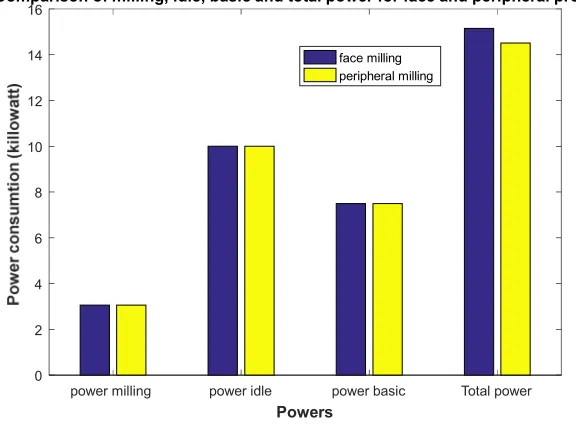
Figure 10. Comparison of milling, idle, basic and total power for face and peripheral
Comparison of milling, idle, basic and total power for face and peripheral process
power milling power idle power basic Total power Powers
0 2 4 6 8 10 12 14 16
process
Power consumption was similar for process idle and basic per unit times, but total power consumption is more in face milling as total power consumed depends upon total energy and total time taken by the process. Total power consumption per cut for face milling and peripheral processes is 15.15 and 14.51 kilowatt respectively.
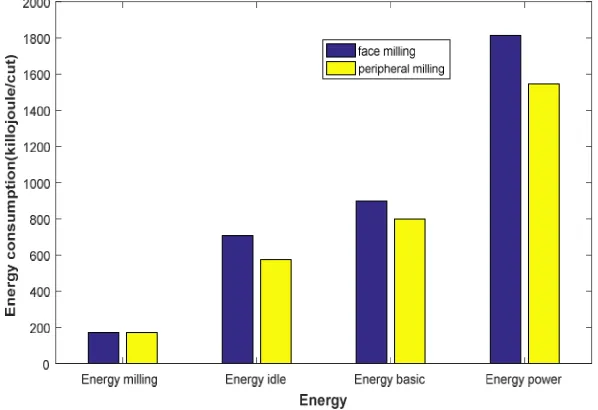
Figure 11. Comparison of milling, idle, basic and total energy consumption for face and peripheral process
As energy consumption depends upon elapsing time of the process, face milling consumes more power than peripheral process. Total energy consumption for face and peripheral processes is 1814 and 1546 kilojoule/cut respectively.
5. Conclusions
types of milling processes have been considered in LCI named as face and peripheral milling. Evaluation of results has been done by showing outputs in tabular and graphical forms by taking aluminium alloy as material of choice in both case studies. It is concluded that face milling takes more time in finishing the same process than peripheral milling and consumes more power and energy. For aluminium alloy workpiece, total time taken by face milling operation is 106.5389 sec as compared to 119.781 sec by peripheral milling. Case study has been extended by considering six different materials of workpiece in which Aluminium Alloy, Magnesium alloy, Titanium, Stainless steel alloy, hard steel and soft Cast Iron has been taken. It has been conclude that hard materials takes more time and consumes more power and energy than soft materials. For example in turning process moderate power consumption has been found for aluminium and magnesium alloys which is 14.510 and 13.5639 kilowatt respectively. Power consumption is high for Titanium (17.5979 kW), Stainless steel alloy (17.2051 kW), hard steel (17.4972 kW) and soft Cast Iron (16.7006 kW) work pieces. As hard steel needs to be cut with very lower cutter speeds and feed rate, it consumes far more energy as compared to other materials (451854.1776 kJ/mill). Aluminium and magnesium alloys show lower energy consumption which is 1545.924 and 1393.0544 kJ/mill respectively. Similar results have been shown for milling process as well.
In present work only shows electrical energy consumption, cutter fluid, lubricants, cutter tool, wastage/chip mass has been taken into account for LCI and hydraulic, air compression–decompression, labour cost or other costs are not considered, so more factors need to be taken into account in order to reach the approximate real attributes involved in the process. For materials taken in study, only lower and higher range of cutting speeds and feed rates has been considered and also effects on tool wear and type of finished surface are not considered in the evaluations for the taken speeds. Work can be extended to optimize the cutting speeds and feeds for a particular material so that maximum output can be produced with minimum tool-wear losses or other losses of the machine and with minimum energy consumptions.
References
Avram, O., & Xirouchakis, P. (2011). Evaluating the use phase energy requirements of a machine tool system. Journal of Cleaner Production, 19, 699-711.
Bhanot, N., Rao, P. V., & Deshmukh, S. G. (2016). An integrated sustainability assessment framework: a case of turning process. Clean Techn Environ Policy, 18, 1475– 1513.
Calvanese, M. L., Albertelli, P., Matta, A., & Taisch , M. (2013). Analysis of Energy Consumption in CNC Machining Centers and Determination of Optimal Cutting Conditions. CIRP International Conference o Life Cycle Engineering. Singapore: Springer.
Deaib, I. (2014). On Energy Efficient and Sustainable Machining through Hybrid Processes. Materials and Manufacturing Processes, 1338-1345.
DIaz, N., Redelsheimer, E., & Dornfeld, D. (2011). Energy Consumption Characterization and Reduction Strategies for Milling Machine Tool Use. Life Cycle Engineering. Germany: Springer, Berlin, Heidelberg.
Draganescu, F., Gheorghe, M., & Doicin, C. (2003). Models of machine tool efficiency and specific consumed energy. Journal of Materials Processing Technology, 141, 9-15.
Guo, Y., Loenders, J., Duflou, J., & Lauwers, B. (2012). Optimization of Energy Consumption and Surface Quality in Finish Turning. Procedia CIRP, 1, 512-517.
Gutowski, T., Dahmus, J., & Thiriez, A. (2006). Electrical energy requirements for manufacturing processes. In13th CIRP International Conference on Life Cycle Engineering,31May–2 June, 2006. Leuven, Belgium.
Hu, S., Liu, F., He, Y., & Hu, T. (2012). An on-line approach for energy efficiency monitoring of machine tools. Journal of Cleaner Production, 27, 133-140.
Kara, S., Qureshi, F., Li, W., & Herrmann, C. (2011). Unit process energy consumption models for material removal processes. CIRP Annals, 60, 37-40.
Li, Y.-F., Wang, Y.-L., He, Y., Wang, Y., & Lin, S.-l. (2018). Modeling Method for Flexible Energy Behaviors in CNC Machining Systems. Chinese Journal of Mechanical Engineering, 31.
Mori, M., Fujishima, M., Inamasu, M., & Y., O. (2011). A study on energy efficiency improvement for machine tools. CIRP Annals, 60, 145-148.
Parashar, N., & Mittal, R. (2012). Elements of manufacturing processes. New Delhi: Phi Learning.
Peng, T. (2017). An interoperable energy consumption analysis system for CNC machining. Journal of Cleaner Production,140, 1828-1841.
Rajemi, M., Mativenga, P., & Aramcharoen, A. (2010). Sustainable machining: selection of optimum turning conditions based on minimum energy considerations. Journal of Cleaner Production, 10-11.