Diagnostic and treatment methods used by
chiropractors: A random sample survey of
Canada’s English-speaking provinces
Aaron A. Puhl, MSc, DC
1Christine J Reinhart, PhD, DC
1H. Stephen Injeyan, PhD, DC
21 Private Practice; Able Body Health Clinic, Lethbridge, Alberta
2 Chair, Department of Pathology and Microbiology, Professor, Canadian Memorial Chiropractic College, Toronto, ON, M2H 3J1 Corresponding author: Aaron A. Puhl
T: 403-329-1300
Able Body Health Clinic,1212-3rd Avenue South, Lethbridge, Alberta, T1J 0J9 Funding Support: CMCC’s Research Division provided all funding.
© JCCA 2015
Objective: It is important to understand how
chiropractors practice beyond their formal education. The objective of this analysis was to assess the
diagnostic and treatment methods used by chiropractors in English-speaking Canadian provinces.
Methods: A questionnaire was created that examined practice patterns amongst chiropractors. This was sent by mail to 749 chiropractors, randomly selected and stratified proportionally across the nine English-speaking Canadian provinces. Participation was voluntary and anonymous. Data were entered into an Excel spreadsheet, and descriptive statistics were calculated.
Results: The response rate was 68.0%. Almost all (95.1%) of respondents reported performing differential diagnosis procedures with their new patients; most commonly orthopaedic testing, palpation, history taking, range of motion testing and neurological examination. Palpation and painful joint findings were the most commonly used methods to determine the appropriate
Objectif : Il est important de comprendre la pratique des
chiropraticiens qui dépasse le cadre de leur éducation formelle. L’objectif de cette analyse était d’évaluer les méthodes de diagnostic et de traitement utilisées par les chiropraticiens dans les provinces canadiennes anglophones.
Méthodologie : Un questionnaire a été créé pour
examiner les habitudes de pratique des chiropraticiens et a été envoyé par la poste à 749 d’entre eux, choisis au hasard et stratifiés proportionnellement entre les neuf provinces anglophones. La participation était volontaire et anonyme. Les données ont été saisies dans un tableur Excel, et les statistiques descriptives ont été calculées.
Résultats : Le taux de participation a été de 68,0 %.
Introduction
Doctors of Chiropractic (DC) focus on the evaluation and management of disorders of the musculoskeletal system1 and there is a movement towards adopting a role as pri-mary spine care providers2,3. The appropriate manage-ment of a patient requires the DC to diagnose the com-plaint, determine the best course of treatment and final-ly, provide that treatment, or refer to another healthcare provider for appropriate care. DCs are taught numerous diagnostic and therapeutic procedures during their under-graduate education and clinical internships and perhaps just as important, they are also able to obtain certifica-tions through seminars and continuing education courses to employ a diversity of assessment and treatment tech-niques that may not be introduced within the context of their formal educational settings. It is imperative that we understand how Canadian DCs diagnose and treat their patients in order to guide research, guide the undergradu-ate, post-graduate and continuing educational chiropractic curricula, as well as to inform all stakeholders, including the public, insurance companies and government agen-cies about chiropractic practice. While previous studies have investigated similar topics among Canadian DCs4-7,
those previous examinations are limited by the age of the analysis4, limited sampling5-7, or poor response rates6,7, resulting in poor reliability and generalizability. More-over, no previous study has specifically investigated what methods Canadian DCs are using in clinical practice to decide where to apply joint manipulation, which is the most notable treatment method used by chiropractors.8 The objectives of this descriptive analysis of DCs in Eng-lish-speaking Canadian provinces were to 1) determine if DCs are performing differential diagnosis procedures and describe the methods used for this purpose; 2) de-scribe the tests/procedures used to determine the site of joint manipulation and the frequency of their use; and 3) describe the treatment methods used and the frequency of their use.
Methods
Survey development and administration have been detailed in previous works.9,10 In short, a 16 item survey instrument was developed by the authors that included topics ran-ging from practice techniques to practice philosophy. This paper reports on the data from three questions (Figures 1-3), which specifically addressed approaches to
diagno-joint to apply manipulation. The most common treatment methods were manual joint manipulation/mobilization, stretching and exercise, posture/ergonomic advice and soft-tissue therapies.
Conclusions: Differential diagnosis is a standard part of the assessment of new chiropractic patients in English-speaking Canadian provinces and the most common methods used to determine the site to apply manipulation are consistent with current scientific literature. Patients are treated with a combination of manual and/or manipulative interventions directed towards the joints and/or soft-tissues, as well as exercise instruction and postural/ergonomic advice.
(JCCA. 2015; 59(3):279-287)
k e y w o r d s : chiropractic, survey, differential diagnosis, diagnostic testing, treatment methods
l’articulation appropriée à manipuler. Les méthodes de traitement les plus fréquentes étaient la manipulation ou la mobilisation manuelle des articulations, les étirements et les exercices, les conseils posturaux ou ergonomiques et la thérapie des tissus mous.
Conclusions : Le diagnostic différentiel fait partie de la
norme d’évaluation de nouveaux patients chiropratiques dans les provinces anglophones canadiennes, et les méthodes les plus couramment utilisées pour déterminer les points à manipuler concordent avec les publications scientifiques actuelles. Les patients sont traités par une combinaison d’interventions manuelles ou de manipulation axées sur les articulations ou tissus mous, ainsi que par des instructions d’exercice et des conseils posturaux et ergonomiques.
(JCCA. 2015; 59(3):279-287)
A) When a new patient presents to you, do you perform a differential diagnosis? q Yes q No
B) If yes, which of the following do you usually use to help make a differential diagnosis? Mark all that apply.
q Blood pressure q Leg length measurement q Posture analysis q Gait analysis q Motion/static palpation q Surface EMG
q Gross ROM analysis q Muscle testing q Thermography
q History (Complete health) q Neurological exam q X-ray
q History (Focused) q Orthopaedic testing q Other ____________________
Figure 1.
Survey item for assessing the differential diagnostic tests/procedures used by Canadian DCs.
On approximately what percentage of patients do you use the following methods to decide where to adjust?
0 = never 1 = 1-25% (rarely) 2 = 26-50% (often) 3 = 51-75% (usually) 4 = 76-100% (almost always)
____ Gross ROM analysis ____ Nerve conduction study ____ Surface EMG ____ Leg length analysis ____ Orthopaedic testing ____ Thermography ____ Motion/static palpation ____ Painful joint findings ____ X-ray measurements
____ Muscle testing ____ Posture analysis ____ Other___________________
Figure 2.
Survey item for assessing the clinical tests/procedures used by Canadian DCs to determine the most appropriate site to apply joint manipulation.
On approximately what percentage of your patients do you use the following methods of treatment?
0 = never 1 = 1-25% (rarely) 2 = 26-50% (often) 3 = 51-75% (usually) 4 = 76-100% (almost always)
____ Adjustments/Mobilization (manual) ____ Nutritional supplements ____ Adjustments (instrumented) ____ Orthotics
____ Acupuncture ____ Postural/ergonomic advice
____ Cold laser ____ Soft tissue therapy (e.g., thumper, ART, Graston) ____ Dietary advice ____ Stretches/Exercise (in clinic or prescribed) ____ Electrotherapy (e.g., TENS, IFC) ____ Traction/distraction (manual/mechanical)
____ Homeopathic remedies ____ Ultrasound
____ Hot/Ice packs ____ Other____________________________________
Figure 3.
sis and treatment. The survey instrument was tested by ten DCs and revisions were made to the survey instrument after interviewing the test subjects to identify any prob-lems. A list of all currently licensed DCs for each of the nine English-speaking Canadian provinces was developed from the online directories of the provincial chiropractic licensing bodies. A random sample was selected from each provincial list using a computerized random num-ber generator; the final sample included 749 DCs (12% of eligible DCs), stratified proportionally across the Eng-lish-speaking Canadian provinces. The survey was admin-istered by mail from August 2010 to December 2010 and used postage-paid, return addressed envelopes and two follow-up mailings to maximize response rates.11 Surveys were mailed with a personalized letter briefly explaining the purpose of the study, guaranteeing anonymity and pro-viding a means of avoiding future mailings if they did not wish to participate; informed consent was implied by par-ticipation. The CMCC Research Ethics Board approved the study protocol (REB Approval # 1006X02) and the CMCC Research Division provided all funding.
In order to determine the use of various diagnostic pro-cedures by DCs for the purposes of differential diagno-sis, subjects were asked to document, from alphabetized lists of tests/procedures, which procedures they
common-ly used (Figure 1). With regard to determining where to apply joint manipulation, subjects were asked to docu-ment, from an alphabetized list of diagnostic procedures, which tests/procedures they used and also to indicate the percentage of patients on whom they used each procedure (Figure 2). To determine which treatment methods are be-ing employed, participants were asked to document, from an alphabetized list, which treatment modalities they used and the frequency with which they are used (Figure 3).
All survey data were entered into an electronic
spread-sheet by two authors using the double data entry method to control for errors. Descriptive statistics were used to report the data.
Results
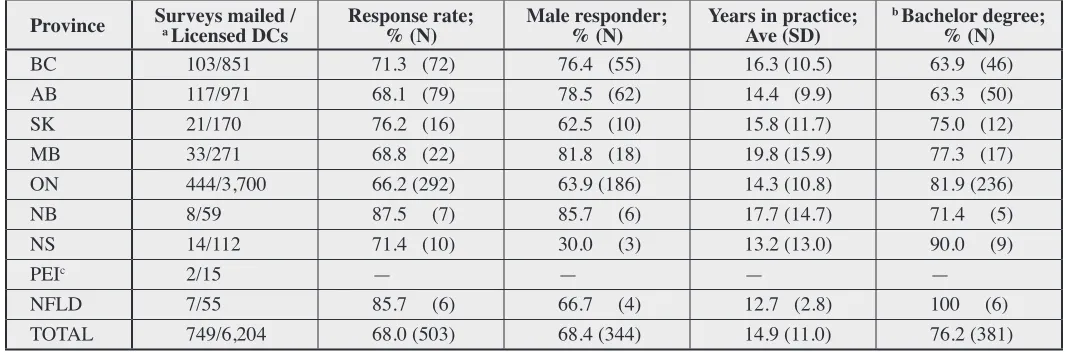
Of 740 deliverable surveys, 503 were returned, a response rate of 68.0%; seven respondents returned the cover page only, indicating they did not wish to participate; nine sur-veys were undeliverable. The majority of respondents were male (68.4%); had attained a Bachelor’s degree prior to attending chiropractic college (76.2%); and had attended chiropractic college at CMCC (62.6%). The average number of years in practice was 14.9 (standard deviation ±11.0). Table 1 contains the response rates and demographic information of respondents by province.
Table 1.
Response rates and respondent demographics by province.
Province Surveys mailed / a Licensed DCs Response rate; % (N) Male responder; % (N) Years in practice; Ave (SD)
b Bachelor degree; % (N)
BC 103/851 71.3 (72) 76.4 (55) 16.3 (10.5) 63.9 (46)
AB 117/971 68.1 (79) 78.5 (62) 14.4 (9.9) 63.3 (50)
SK 21/170 76.2 (16) 62.5 (10) 15.8 (11.7) 75.0 (12)
MB 33/271 68.8 (22) 81.8 (18) 19.8 (15.9) 77.3 (17)
ON 444/3,700 66.2 (292) 63.9 (186) 14.3 (10.8) 81.9 (236)
NB 8/59 87.5 (7) 85.7 (6) 17.7 (14.7) 71.4 (5)
NS 14/112 71.4 (10) 30.0 (3) 13.2 (13.0) 90.0 (9)
PEIc 2/15 — — — —
NFLD 7/55 85.7 (6) 66.7 (4) 12.7 (2.8) 100 (6)
TOTAL 749/6,204 68.0 (503) 68.4 (344) 14.9 (11.0) 76.2 (381)
a Total number of DCs listed in the online directories of the provincial chiropractic licensing body in 2010. b Earned a Bachelor’s degree prior to attending chiropractic college
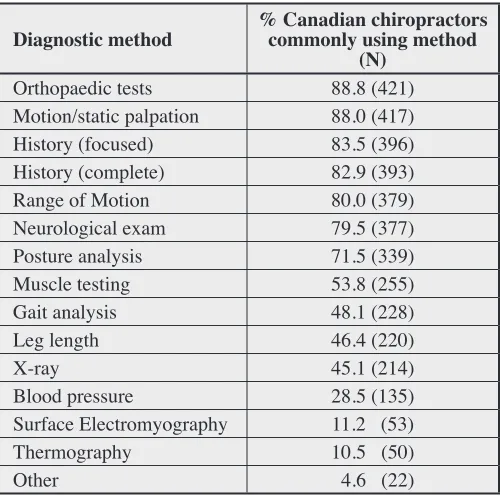
The vast majority (470/494; 95.1%) of respondents reported performing differential diagnosis procedures when a new patient presents to them for the first time. The prevalence of use of common diagnostic tests/pro-cedures for the purpose of differential diagnosis is de-tailed in Table 2. The most commonly used diagnostic tests/procedures were orthopaedic testing (88.8%), pal-pation (88.0%), history taking (83.5%), range of motion (80.0%) and neurological examination (79.9%); each of which were used by at least 80% of respondents. With regard to determining where to apply joint manipulation procedures, the prevalence of use of common diagnostic tests/procedures and the proportion of patients on which they are used is detailed in Table 3. The most common-ly used tests/procedures for determining where to appcommon-ly spine manipulation were palpation (98.4%) and painful joint findings (89.8%); both used by at least 90% of re-spondents and used on the majority of their patients. Also commonly used was analysis of posture, range of motion and leg length, as well as orthopaedic testing (each used by at least 80% of respondents).
Table 2.
Diagnostic tests/procedures used for the purpose of differential diagnosis. N=474.
Diagnostic method % Canadian chiropractors commonly using method (N)
Orthopaedic tests 88.8 (421)
Motion/static palpation 88.0 (417)
History (focused) 83.5 (396)
History (complete) 82.9 (393)
Range of Motion 80.0 (379)
Neurological exam 79.5 (377)
Posture analysis 71.5 (339)
Muscle testing 53.8 (255)
Gait analysis 48.1 (228)
Leg length 46.4 (220)
X-ray 45.1 (214)
Blood pressure 28.5 (135)
Surface Electromyography 11.2 (53)
Thermography 10.5 (50)
Other 4.6 (22)
Table 3.
Clinical tests/procedures used for the purpose of determining where to apply joint manipulation and frequency of use. N = 488.
Diagnostic method 76-100% Percentage of patients on which diagnostic technique is used (N)
(always) (usually)51-75% 26-50% (often) (rarely)1-25% (never)0%
Motion/static palpation 79.9 (390) 10.9 (53) 5.7 (28) 1.8 (9) 1.6 (8) Painful joint findings 52.3 (255) 20.9 (102) 12.9 (63) 3.7 (18) 10.2 (50) Posture analysis 29.9 (146) 20.7 (101) 18.9 (92) 14.3 (70) 16.2 (79) Range of motion 42.6 (208) 18.4 (90) 11.9 (58) 10.7 (52) 16.4 (80) Leg length analysis 31.1 (152) 13.3 (65) 18.4 (90) 20.1 (98) 17.0 (83) Orthopaedic testing 35.9 (175) 22.1 (108) 13.7 (67) 10.9 (53) 17.4 (85)
Muscle testing 13.7 (67) 13.7 (67) 17.8 (87) 21.3 (104) 33.4 (163)
X-ray measurements 9.4 (46) 6.1 (30) 8.4 (41) 15.6 (76) 60.2 (294) Nerve conduction 1.2 (6) 0.8 (4) 2.7 (13) 12.1 (59) 83.2 (406)
Surface EMG 5.3 (26) 1.4 (7) 1.8 (9) 5.1 (25) 86.3 (421)
Thermography 4.9 (24) 0.8 (4) 1.8 (9) 4.9 (24) 87.3 (426)
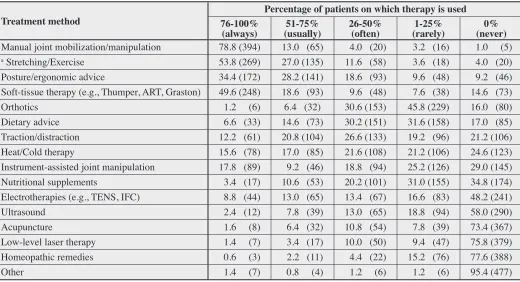
The prevalence of use of specific treatment methods by respondents is detailed in Table 4. The most commonly used methods of treatment were manual joint manipula-tion and/or mobilizamanipula-tion (99.0%), stretching and/or exer-cises (96.0%), posture and/or ergonomic advice (90.8%) and soft-tissue therapies (85.4%). These were each used by greater than 85% of respondents and used on the ma-jority of their patients. Also used by a significant mama-jority (>80%) of respondents, but used on only small proportion of their patients, were orthotics and dietary advice.
Discussion
While at least 65% of chiropractic patients have been shown to present for back pain12, several medical con-ditions, such as cancer, infections, and visceral disease, are known to mimic non-specific, low back pain condi-tions13-15. As such, appropriate and skilled examinations are imperative for the delivery of optimal patient care.
Indeed, the Canadian Chiropractic Association suggests that the chiropractic profession adheres to a patient-cen-tred, biopsychosocial approach to health care that encom-passes examination, diagnosis and treatment16 and clinic-al practice guidelines suggest that the accurate diagnosis of patient conditions is key to effective management and treatment17. DCs are taught numerous diagnostic proced-ures during their undergraduate education and clinical internships and analyses conducted by the National Board of Chiropractic Examiners in the United States (US) have suggested that US DCs develop differential diagnoses on a daily basis.18 However, to our knowledge only one re-cent investigation has assessed the use of diagnostic tests/ procedures by Canadian DCs.7 While the aforementioned study attempted a more specific assessment of the indi-vidual diagnostic tests and therapeutic procedures used by Canadian DCs than our current study, it had a num-ber of limitations, including a very low response rate and
Table 4.
Treatment methods used by Canadian chiropractors and frequency of use. N=500.
Treatment method 76-100% Percentage of patients on which therapy is used
(always) (usually)51-75% 26-50% (often) (rarely)1-25% (never)0%
Manual joint mobilization/manipulation 78.8 (394) 13.0 (65) 4.0 (20) 3.2 (16) 1.0 (5)
a Stretching/Exercise 53.8 (269) 27.0 (135) 11.6 (58) 3.6 (18) 4.0 (20)
Posture/ergonomic advice 34.4 (172) 28.2 (141) 18.6 (93) 9.6 (48) 9.2 (46) Soft-tissue therapy (e.g., Thumper, ART, Graston) 49.6 (248) 18.6 (93) 9.6 (48) 7.6 (38) 14.6 (73)
Orthotics 1.2 (6) 6.4 (32) 30.6 (153) 45.8 (229) 16.0 (80)
Dietary advice 6.6 (33) 14.6 (73) 30.2 (151) 31.6 (158) 17.0 (85)
Traction/distraction 12.2 (61) 20.8 (104) 26.6 (133) 19.2 (96) 21.2 (106)
Heat/Cold therapy 15.6 (78) 17.0 (85) 21.6 (108) 21.2 (106) 24.6 (123)
Instrument-assisted joint manipulation 17.8 (89) 9.2 (46) 18.8 (94) 25.2 (126) 29.0 (145)
Nutritional supplements 3.4 (17) 10.6 (53) 20.2 (101) 31.0 (155) 34.8 (174)
Electrotherapies (e.g., TENS, IFC) 8.8 (44) 13.0 (65) 13.4 (67) 16.6 (83) 48.2 (241)
Ultrasound 2.4 (12) 7.8 (39) 13.0 (65) 18.8 (94) 58.0 (290)
Acupuncture 1.6 (8) 6.4 (32) 10.8 (54) 7.8 (39) 73.4 (367)
Low-level laser therapy 1.4 (7) 3.4 (17) 10.0 (50) 9.4 (47) 75.8 (379)
Homeopathic remedies 0.6 (3) 2.2 (11) 4.4 (22) 15.2 (76) 77.6 (388)
Other 1.4 (7) 0.8 (4) 1.2 (6) 1.2 (6) 95.4 (477)
a Could include in-office, or prescribed stretches/exercises.
a pseudo-randomized sampling method, which reduces both the reliability and generalizability of the findings. The present study suggests that nearly all (95%) DCs in English-speaking provinces are performing some form of differential diagnosis procedures with their new pa-tients. The vast majority of respondents indicated using diagnostic methods consistent with standard assessment of musculoskeletal conditions19; that is, history taking, orthopedic testing, palpation, range of motion testing and neurological exams.
Notable is the fact that only a minority (28.5%) of DCs surveyed indicated using blood-pressure assessment as a common diagnostic test with new patients. Blood-pressure measurement can aid in the identification of cardiovascu-lar, or pulmonary problems that might affect prognosis and intervention, or require referral to another practitioner. In-deed, it has been argued that blood-pressure measurements can prove to be an appropriate objective test for assess-ment prior to manual therapy interventions and provide direction for risk assessment and/or the management of patients.20 That only a minority of respondents indicated assessing new patient’s blood-pressure makes us question whether they are aware of the relevance of hypertension to the clinical reasoning necessary for the optimal manage-ment of musculoskeletal patient populations.
In addition to the standard tests involved with the diagnosis of a musculoskeletal complaint, DCs and other professionals who use joint manipulation will often per-form supplementary physical examinations to determine whether dysfunctional joints are present that may be con-tributing to a patient’s condition. If dysfunctional joints are present and no contraindications are found, manipulative procedures are often applied with the intent of improving joint biomechanics and function, which in turn may ex-plain the efficacy of manipulative therapy for improving mobility and reducing pain. However, numerous reviews examining the validity and reliability of common exam-ination methods intended to identify dysfunctional spinal joint segments have, to date, suggested that many tests are relatively unreliable and/or invalid.21-26 Scientific in-vestigation seems most supportive of direct, mechanical methods of assessing and identifying the site of care, such as maneuvers that replicate the patient’s familiar pain.26 There is also some evidence suggesting that palpation and leg-length analysis may be useful for some applications and orthopedic maneuvers may help narrow the region
where treatment may be applied. On the other hand, the evidence is not supportive of less direct methods such as manual muscle testing for non-pathological states, radio-graphic measurements, thermography and surface elec-tromyography.26
The present study thus suggests that DCs in Eng-lish-speaking Canadian provinces are practicing con-sistently with the current scientific literature, as “palpa-tion” and “painful joint findings” were the most com-monly used methods for identifying spinal segments that could benefit from joint manipulation, used by nearly every respondent, on nearly every patient. Moreover, methods that are currently not supported by the scientific literature, such as radiographic measurements, thermog-raphy and surface electromyogthermog-raphy, were the least-com-monly used procedures. Nevertheless, it is a concern that there is a notable minority of DCs that reported regular-ly using methods not shown to be valid or reliable. Our data also suggests that DCs in Canada’s English-speaking provinces use a combination of examination findings to identify spinal segments that could benefit from joint ma-nipulation. While many clinical tests are of questionable diagnostic value, it has been suggested in the literature that improved diagnostic accuracy can be achieved by using combinations of clinical examination findings, as compared with individual physical examination tests.27 As such, the use of examination methods with only low to moderate reliability and validity may add some clinical value when used in conjunction with pain provocation; to our knowledge, no analysis has examined the use of combination tests for identifying levels of segmental dys-function in the spine.
the use of soft-tissue therapies. This finding is consistent with the previously suggested trend towards the use of proprietary soft tissue therapies (e.g., Active Release Therapy, Graston technique, etc.) for patient care.6,28 Our data suggest that the majority of chiropractors in Eng-lish-speaking Canadian provinces today use a combina-tion of manual and/or manipulative intervencombina-tions directed towards the joints and soft-tissues, as well as exercise in-struction and postural/ergonomic advice when they treat their patients.
Our study has some important strengths and
limit-ations. The relatively high response rate (68%) may be considered a strength that increases the validity of the findings, however we do recognize that this was a se-lect sample, and the chiropractors surveyed may not be representative of all Canadian DCs. The exclusion of French-speaking Canadian provinces and the Canadian territories means that our data might not be generalizable to those regions, but was necessary to avoid confounds re-lated to language and regulatory differences. Respondents may have been influenced by social-desirability bias. The survey did not provide an operational definition for the term ‘differential diagnosis’, thus it is possible that some respondents misinterpreted the meaning of this term. We acknowledge that although the survey items were con-structed using examples from the existing literature, the survey instrument used in this study was not previously tested or validated.
Conclusion
Differential diagnosis is a standard part of the assessment of new chiropractic patients in English-speaking Can-adian provinces and this is most commonly done using orthopaedic tests, palpation, history-taking, range of mo-tion testing and neurological examinamo-tion. The clinical tests/procedures used most commonly by these DCs to determine where to apply joint manipulation are palpation and painful joint findings. These methods are consistent with the current scientific literature. Chiropractic patients in Canada’s English-speaking provinces are treated with a combination of manual joint manipulation/mobilization, exercise, posture/ergonomic advice and soft-tissue ther-apies. These treatment methods are consistent with earlier analyses of Canadian DCs, but the data do suggest that chiropractors in Canada are increasingly using soft-tissue therapies as part of their therapeutic regimen.
References
1. Coulter ID, Hurwitz EL, Adams AH, Genovese BJ, Hays R, Shekelle PG. Patients using chiropractors in North America: who are they, and why are they in chiropractic care? Spine. 2002;27:291-296.
2. Nelson CF, Lawrence DJ, Triano JJ, et al. Chiropractic as spine care: a model for the professions. Chiropr Osteopathy. 2005;13:9.
3. Erwin WM, Korpela AP, Jones RC. Chiropractors as primary spine care providers: precedents and essential measures. J Can Chiropr Assoc. 2013;57(4):285-291. 4. Kopansky-Giles D, Papadopoulos C. Canadian
Chiropractic Resources Databank (CCRD): a profile of Canadian chiropractors. J Can Chiropr Assoc. 1997;41(3):155–191.
5. Waalen JK, Mior SA. Practice patterns of 692 Ontario chiropractors (2000–2001). J Can Chiropr Assoc. 2005;49(1):21–31.
6. Gleberzon B, Stuber K. Frequency of use of diagnostic and manual therapeutic procedures of the spine taught at the Canadian Memorial Chiropractic College: a preliminary survey of Ontario chiropractors. Part 1 – practice characteristics and demographic profiles. J Can Chiropr Assoc. 2013;57(1):32-41.
7. Gleberzon B, Stuber K. Frequency of use of diagnostic and manual therapeutic procedures of the spine
currently taught at the Canadian Memorial Chiropractic College: a preliminary survey of Ontario chiropractors. Part 2 – procedure usage rates. J Can Chiropr Assoc. 2013;57(2):165-175.
8. Kaptchuk TJ, Eisenberg DM. Chiropractic: origins, controversies, and contributions. Arch Intern Med. 1998;158(20):2215-2224.
9. McGregor M, Puhl AA, Reinhart C, Injeyan HS, Soave D. Differentiating intraprofessional attitudes toward
paradigms in health care delivery among chiropractic factions: results from a randomly sampled survey. BMC Complement Altern Med. 2014;14:51. 10. Puhl AA, Reinhart CJ, Doan JB, McGregor M,
Injeyan HS. Relationship between chiropractic teaching institutions and practice characteristics among Canadian doctors of chiropractic: a random sample survey. J Manipulative Physiol Ther. 2014;37(9):709–718. 11. Russell ML, Verhoef MJ, Injeyan HS, McMorland DG.
Response rates for surveys of chiropractors. J Manipulative Physiol Ther. 2004;27(1):43-48. 12. Hurwitz EL, Coulter ID, Adams AH, Genovese BJ,
Shekelle PG. Use of chiropractic services from 1985 through 1991 in the United States and Canada. Am J Public Health. 1998;88(5):771-775.
physical examination tell us about low back pain? JAMA. 1992;268:760–765.
15. Patel AT, Ogle AA. Diagnosis and management of acute low back pain. Am Fam Phys. 2000;61(6):1779–1786. 16. Canadian Chiropractic Association. Position Statements:
The Chiropractic Profession Within the Health Care Framework. Accessed 07/13. http://www.chiropractic.ca/ about-cca/code-of-ethics/chiropractic-profession-within-health-care-framework/
17. Bryans R, Descarreaux M, Duranleau M, Marcoux H, Potter B, Ruegg R, Shaw L, Watkin R, White E.
Evidence-based guidelines for the chiropractic treatment of adults with headache. J Manipulative Physiol Ther. 2011;34(5):274-289.
18. Christenson M, Kerkhoff D, Kollasch MW, et al. The 1993 National Board of Chiropractic Examiners. Job Analysis of Chiropractic. A project report, survey analysis and summary of practice of chiropractic within the United States. Greely, USA: National Board of Chiropractic Examiners; p. 84.
19. Souza T. Differential Diagnosis and Management for the Chiropractor: Protocols and Algorithms. Jones & Bartlett Publishers; 2009. Mississauga, ON.
20. Taylor AJ, Kerry R. Vascular profiling: should manual therapists take blood pressure? Man Ther. 2013;18(4):351-353.
21. Walker BF. The reliability of chiropractic methods used for the detection of spinal subluxation. An overview of the literature. Australas Chiropr Osteopathy. 1996;5(1):12-22.
22. Najm WI, Seffinger MA, Mishra SI, et al. Content validity of manual spinal palpatory exams – a systematic review. BMC Complement Altern Med. 2003;3:1.
23. Haneline MT, Young M. A review of intraexaminer and interexaminer reliability of static spinal palpation: a literature synthesis. J Manipulative Physiol Ther. 2009;32(5):379-386.
24. Seffinger MA, Najm WI, Mishra SI, Adams A, Dickerson VM, Murphy LS, Reinsch S. Reliability of spinal palpation for diagnosis of back and neck pain: a systematic review of the literature. Spine (Phila Pa 1976). 2004;29(19):E413-E425.
25. Laslett M. Evidence-based diagnosis and treatment of the painful sacroiliac joint. J Man Manip Ther. 2008;16(3):142-152.
26. Triano JJ, Budgell B, Bagnulo A, et al. Review of methods used by chiropractors to determine the site for applying manipulation. Chiropr Man Therap. 2013;21(1):36. 27. Miller KJ, Sittler MD, Corricelli DM, DiMura DN,
Comerford JS. Combination testing in orthopedic and neurologic physical examination: a proposed model. J Chiropr Med. 2007;6(4):163–171.