Volume 2007, Article ID 51368,10pages doi:10.1155/2007/51368
Research Article
Secure Multiparty Computation between Distrusted
Networks Terminals
S.-C. S. Cheung1and Thinh Nguyen2
1Center for Visualization and Virtual Environments, Department of Electrical and Computer Engineering, University of Kentucky,
Lexington, KY 40507, USA
2School of Electrical Engineering and Computer Science, Oregon State University, 1148 Kelley Engineering Center Corvallis, Oregon,
OR 97331-5501, USA
Correspondence should be addressed to S.-C. S. Cheung, [email protected]
Received 7 May 2007; Accepted 12 October 2007
Recommended by Stefan Katzenbeisser
One of the most important problems facing any distributed application over a heterogeneous network is the protection of pri-vate sensitive information in local terminals. A subfield of cryptography called secure multiparty computation (SMC) is the study of such distributed computation protocols that allow distrusted parties to perform joint computation without disclosing private data. SMC is increasingly used in diverse fields from data mining to computer vision. This paper provides a tutorial on SMC for nonexperts in cryptography and surveys some of the latest advances in this exciting area including various schemes for reducing communication and computation complexity of SMC protocols, doubly homomorphic encryption and private information re-trieval.
Copyright © 2007 S.-C. S. Cheung and T. Nguyen. This is an open access article distributed under the Creative Commons Attribution License, which permits unrestricted use, distribution, and reproduction in any medium, provided the original work is properly cited.
1. INTRODUCTION
The proliferation of capturing and storage devices as well as the ubiquitous presence of computer networks make shar-ing of data easier than ever. Such pervasive exchange of data, however, has increasingly raised questions on how sensitive and private information can be protected. For example, it is now commonplace to send private photographs or videos to the hundreds of online photoprocessing stores for storage, development, and enhancement like sharpening and red-eye removal. Few companies provide any protection of the per-sonal pictures they receive. Hackers or employees of the store may steal the data for personal use or distribute them for per-sonal gain without consent from the owner.
There are also security applications in which multiple parties need to collaborate with each other but do not want any of their own private data disclosed. Consider the fol-lowing example: a law-enforcement agency wants to search for possible suspects in a surveillance video owned by pri-vate company A, using a proprietary software developed by another private company B. The three parties involved all have information they do not want to share with each other:
the criminal biometric database from law enforcement, the surveillance tape from company A, and the proprietary soft-ware from company B.
Encryption alone cannot provide adequate protection when performing the aforementioned applications. The en-crypted data needs to be deen-crypted at the receiver for pro-cessing and the raw data will then become vulnerable. Al-ternatively, the client can download the software and pro-cess her private data in a secure environment. This, however, runs the risk of having the proprietary technology of the soft-ware company pirated or reverse-engineered by hackers. The Trusted Computing (TC) Platform may solve this problem by executing the software in a secure memory space of the client machine equipped with a cryptographic coprocessor [1]. Be-sides the high cost of overhauling the existing PC platform, the TC concept remains highly controversial due to its un-balanced protection of the software companies over the con-sumers [2].
called a secure multiparty computation (SMC) protocol and has been an active research area in cryptography for more than twenty years [3]. Recently, researchers in other disci-plines such as signal processing and data mining have begun to use SMC to solve various practical problems. The goal of this paper is to provide a tutorial on the basic theory of SMC and to survey recent advances in this area.
2. PROBLEM FORMULATION
The basic framework of SMC is as follows: there aren par-tiesP1,P2,. . .,Pnon a network who want to compute a joint function f(x1,x2,. . .,xn) based on private dataxiowned by partyPi fori = 1, 2,. . .,n. The goal of the SMC is thatPi will not learn anything aboutxjforj=ibeyond what can be inferred from her private dataxiand the result of the com-putation f(x1,x2,. . .,xn). SMC can be trivially accomplished if there is a special server, trusted by every party with its pri-vate data, to carry out the computation. This is not a practical solution as it is too costly to protect such a server. The objec-tive of any SMC protocol is to emulate this ideal model as much as possible by using clever transformations to conceal the private data.
Almost all SMC protocols are classified based on their models of security and adversarial behaviors. The most com-monly used security models are perfect security and compu-tational security, which will be covered in Sections3and4, respectively. Adversarial behaviors are broadly classified into two types: semihonest and malicious. A dishonest party is called semihonest if she follows the SMC protocol faithfully but attempts to find out about other’s private data through the communication. A malicious party, on the other hand, will modify the protocol to gain extra information. We will focus primarily on semihonest adversaries but briefly de-scribe how the protocols can be fortified to handle malicious adversaries.
We also assume that private data are elements from a fi-nite fieldFand the target function f(·) can be implemented as a combination of the field’s addition and multiplication. This is a reasonably general computational model for two reasons: first, at the lowest level, any digital computing device can be modeled by settingFas the binary field with the XOR as addition and AND as multiplication. Second, while most signal processing and scientific computation are described using real numbers, we can approximate the real numbers with a reasonably large finite field and estimate any analytical function using a truncated version of its power series expan-sion, which consists of only additions and multiplications.
3. SMC WITH PERFECT SECURITY
In this section, we discuss perfectly secure multiparty com-putation (PSMC) in which an adversary will learn nothing about the secret numbers of the honest parties no matter how computationally powerful the adversary is. The idea is that while the adversary may control a number of parties who receive messages from other honest senders, these messages provide no useful information about the secret numbers of the senders.
One of the basic tools used in PSMC issecret sharing. A t-out-of-m secret-sharing scheme breaks a secret num-berxintomsharesr1,r2,. . .,rmsuch thatxcannot be recon-structed unless an adversary obtains more thant−1 shares witht ≤ m. The importance of a secret-sharing scheme in PSMC is illustrated by the following example: in a 2-party secure computation of f(x1,x2), partyPi will use a 2-out-of-2 secret-sharing scheme to breakxi intori1andri2, and shareri j with partyPj. Each party then computes the func-tion using the shares received, resulting in y1 f(r11,r21) atP1andy2 f(r12,r22) atP2. If the secret-sharing scheme ishomomorphicunder the function f(·), that is, y1and y2 are themselves secret shares of the desired function f(x1,x2), f(x1,x2) can then be easily computed by exchangingy1and y2between the two parties. Under our computational model, all SMC problems can be solved if the secret-sharing scheme isdoubly homomorphic—it preserves both addition and mul-tiplication. One such scheme was invented by Adi Shamir which we will explain next [4].
In Shamir’s secret-sharing scheme, a party hides her se-cret number xas the constant term of a secret polynomial g(z) of degreet−1,
g(z)at−1zt−1+at−2zt−2+· · · +a1z+x. (1)
The coefficientsa1toat−1are random coefficients distributed uniformly over the entire field. Given the polynomialg(z), the secret number x can be recovered by evaluating it at z =0. The secret shares are computed by evaluatingg(z) at z=1, 2,. . .,mand are distributed tomother parties. It is as-sumed that each party knows the degree ofg(z) and the value zat which her share is evaluated. We follow the convention that the share received by partyPiis evaluated atz=i.
If an adversary obtains anytsharesg(z1),g(z2),. . .,g(zt) withzi∈ {1, 2,. . .,m}, the adversary can then formulate the following polynomialg(z):
g(z)
t
i=1 gzi
tj=1,j=i
z−zj t
j=1,j=i
zi−zj
. (2)
We claim thatg(z) is identical to the secret polynomialg(z): first, the degreeg(z) ist−1, same as that ofg(z). Second,
g(z) = g(z) forz = z1,z2,. . .,zt because, when evaluating
g(z) at a particularz = zi, every term inside the summa-tion in (2) will go to zero except for the one that contains g(zi) it simply becomesg(zi) as the multiplier becomes one. Consequently, the (t−1)th-degree polynomialg(z)−g(z) will havetroots. As the number of roots is higher than the degree,g(z)−g(z) must be identically zero org(z)≡g(z). As a result, the adversary can reconstruct the secret number x=g(0).
i=1, 2,. . .,t−1.h(z) is given as follows and its properties is similar to those of (2):
h(z)
x t−1
j=1
z−zj t−1
j=1
−zj +
t−1
i=1 gzi
ztj−=11,j=i
z−zj
zi t−1
j=1,j=i
zi−zj
. (3)
Shamir’s secret-sharing scheme is obviously homomor-phic under addition: given two secret (t−1)th-degree poly-nomialsg(z) andh(z), the secret shares of g(z) +h(z) are simply the summation of their respective secret sharesg(1) + h(1),g(2) +h(2),. . .,g(m) +h(m). Secrecy is also maintained as the coefficients ofg(z) +h(z), except for the constant term which is the sum of all the secret numbers, are uniformly dis-tributed and no party can gain additional knowledge about others’ secret shares. On the other hand, the degree of the product polynomialg(z)h(z) increases to 2(t−1). The locally computed sharesg(1)h(1),g(2)h(2),. . .,g(m)h(m) cannot completely specifyg(z)h(z) unless the number of sharesm is strictly larger than 2(t−1) or equivalently, t ≤ m/2. Even if this condition is satisfied, a series of product can eas-ily result in a polynomial with degree higher than m. Fur-thermore, the coefficients of the product polynomial is not entirely random, for example, they are related in such a way that the polynomial can be factored by the original polyno-mials. These problems can be solved by first assuming that t ≤ m/2and then replacing the product polynomial by a new (t−1)th-degree polynomial as follows.
Pifirst computes g(i)h(i) and then generates a random (t−1)th-degree polynomial qi(z) with qi(0) = g(i)h(i). Again, using the secret-sharing scheme,Pisends shareqi(j) to partyPjforj=1, 2,. . .,m. This step leaks no information about the local productg(i)h(i). In the final step,Picomputes
dibased on all the received sharesqj(i) forj=1, 2,. . .,m,
di m
j=1
γjqj(i), (4)
whereγjforj=1, 2,. . .,msolve the following equation:
g(0)h(0)=
m
j=1
γjg(j)h(j). (5)
Before explaining how Pi can solve (5) without knowing
g(0)h(0) andg(j)h(j) for j=i, we first note thatdi fori = 1, 2,. . .,mare shares of a (t−1)th-degree polynomialq(z) defined below:
q(z) m
j=1
γjqj(z). (6)
The coefficients of q(z) are uniformly random as they are linear combinations of uniformly distributed coefficients of qj(z)’s. Furthermore, its constant term is our target secret numberg(0)h(0):
q(0)=
m
j=1
γjqj(0)= m
j=1
γjg(j)h(j)=g(0)h(0). (7)
q(1)=γ1q1(1)+
γ2q2(1) +γ3q3(1)
q(2)=γ1q1(2)+
γ2q2(2) +γ3q3(2)
q(3)=γ1q1(3)+
γ2q2(3) +γ3q3(3)
q(0)=γ1q(1) +γ2q(2) +γ3q(3)=g(0)h(0)
q1(1) q1(2)
q1(3) q2(1)
q2(2) q2(3)
q3(1)
q3(2)
q3(3)
q1(z) with
q1(0)=g(1)h(1)
q2(z) with
q2(0)=g(2)h(2)
q3(z) with
q3(0)=g(3)h(3)
g(1)h(1) g(2)h(2) g(3)h(3)
Party 1 Party 2 Party 3
Figure 1: This diagram shows how three parties can share the secret g(0)h(0) based on the locally computed products
g(1)h(1),g(2)h(2), andg(3)h(3).
The second last equality is because g(j)h(j) is the secret number hidden by the polynomial qj(z). The last equality is based on (5). This implies thatdi fori = 1, 2,. . .,mare secret shares of the scalarg(0)h(0). An example of the above protocol in a three-party situation is shown inFigure 1.
To address how each party can solve (5), we note that, based on our assumptiont≤ m/2the degree of the prod-uct polynomialg(z)h(z) is strictly smaller than the number of sharesm. Letg(z)h(z)=am−1zm−1+· · · +a0. The
coef-ficientsai’s are completely determined by the valuesg(z)h(z) atz=1, 2,. . .,m. In other words, the following matrix equa-tion has a unique soluequa-tion:
Va ⎛ ⎜ ⎜ ⎜ ⎜ ⎝
1m−1 1m−2 · · · 10 2m−1 2m−2 · · · 20
..
. ... ...
mm−1 mm−2 · · · m0 ⎞ ⎟ ⎟ ⎟ ⎟ ⎠ ⎛ ⎜ ⎜ ⎜ ⎜ ⎝
am−1 am−2 .. . a0 ⎞ ⎟ ⎟ ⎟ ⎟ ⎠= ⎛ ⎜ ⎜ ⎜ ⎜ ⎝
g(1)h(1) g(2)h(2)
.. . g(m)h(m)
⎞ ⎟ ⎟ ⎟ ⎟ ⎠. (8)
Them×minvertible matrixV is called the Vandermonde matrix and it is a constant matrix. Taking its inverse W =
V−1 and considering the last row entries W
mi for i = 1, 2,. . .,m, we have
m
i=1
Wmig(i)h(i)=a0=g(0)h(0). (9)
Comparing (9) with (5), we haveWmi=γifori=1, 2,. . .,m, which are constants.
scheme—in fact, except for certain trivial functions,1it is
im-possible to compute any f(x1,x2,. . .,xm)with perfect security
if the number of dishonest parties equals to or exceedsm/2. To conclude this section, we briefly describe how PSMC protocols can be modified to handle malicious parties. There are two types of disruption: first, a malicious party can out-put erroneous results and second, she may perform an incon-sistent secret-sharing scheme such as evaluating the polyno-mial at random points. Provided the number of malicious parties is less than one third of the total number of par-ties, the first problem can be solved by replacing (2) with a robust extrapolation scheme based on Reed-Solomon codes [5]. This bound on the number of malicious parties can be raised to one half by combining interactive zero-knowledge proof with a broadcast channel [6]. The second problem can be solved by using a verifiable secret-sharing (VSS) scheme in which the sender needs to provide auxiliary information so that the receivers can verify the consistency of their shares without gaining knowledge of the secret number [5].
4. SMC WITH COMPUTATIONAL SECURITY
It is unsatisfactory that PSMC introduced inSection 3 can-not even provide secure two-party computation. Instead of relying on perfect security, modern cryptographical tech-niques primarily use the so-called computational security
model. Under this model, secrets are protected by encoding them based on a mathematical function whose inverse is dif-ficult to compute without the knowledge of a secret key. Such a function is calledone-way trapdoor functionand the con-cept is used in many public-key cipher: a sender who wants to send a messagemto partyPwill first compute a cipher-text c = E(m,k) based on the publicly known encryption algorithmE(·)’s andP’s advertised public keyk. The encryp-tion algorithm acts as a one-way trapdoor funcencryp-tion because a computationally bounded eavesdropper will not be able to recovermgiven onlycandk. On the other hand,Pcan re-covermby applying a decoding algorithmD(E(m,k),s)=m using her secret key s. Unlike perfectly secure protocols in which the adversary simply does not have any information about the secret, the adversary in the computationally secure model is unable to decrypt the secret due to the computa-tional burden in solving the inverse problem. Even though it is still a conjecture that true one-way trapdoor functions exist and future computation platforms like quantum com-puter may drastically change the landscape of these func-tions, many one-way function candidates exist and are rou-tinely used in practical security systems.2
The most fundamental result in SMC is that it is possible to design general computationally secure multiparty compu-tation (CSMC) protocols to handle arbitrary number of dis-honest parties [3]. In this section, we will discuss the basic construction of these protocols. Similar toSection 3, we
con-1The exceptions are those functions that are separable or f(x 1,x2,. . .,
xm)=f1(x1)f2(x2)· · ·fm(xm).
2A list of one-way function candidates can be found in [7, Chapter 1].
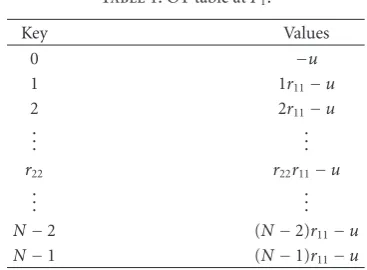
Table1: OT table atP1.
Key Values
0 −u
1 1r11−u
2 2r11−u
..
. ...
r22 r22r11−u
..
. ...
N−2 (N−2)r11−u
N−1 (N−1)r11−u
sider the protocols for addition and multiplication in finite fields. We will concentrate on the canonical two-party case but our construction can be easily extended to more than two parties. Our starting point of building general CSMC is a straightforward secret-sharing scheme: each secret number is simply broken down as a sum of two uniformly distributed random numbers:x1 =r11+r12andx2 =r21+r22.Pithen sendsri j toPjfor j=i. This scheme is clearly homomorphic under addition
x1+x2=r11+r21+r12+r22. (10)
Multiplication, on the other hand, introduces cross-term r11r22which breaks the homomorphism the homomorphism
x1x2=r11r21+r12x2+r11r22. (11)
While the first two terms can be locally computed byP1and P2, respectively, it is impossible to compute the third term r11r22 without having one party revealed the actual secret number to the other. In order to accomplish this under the computational security model, we will make use of a general cryptographic protocol called theoblivious transfer(OT).
A 1-out-of-NOT protocol allows one party (the chooser) to read one entry from a table withNentries hosted by an-other party (the sender). Provided that both parties are com-putationally bounded, the OT protocol prevents the chooser from reading more than one entry and the sender from knowing the chooser’s choice. We first show how the OT protocol can be used to break r11r22 in (11) into random shares u and v such that r11r22 = u+ v. Assume our fi-nite field has N elements. The sender P1 generates a ran-domuand then creates a tableT withN entries shown in Table 1.3 Using the OT protocol, the chooserP2 selects the entryv T(r22)=r22r11−uwithout lettingP1know her selection or inspecting any other entries in the table.
It remains to show how OT provides the security guaran-tee. A 1-out-of-NOT protocol consists of the following five steps.
(1) P1sendsNrandomly generated public keysk0,k1,. . ., kN−1toP2.
3The role ofP
1andP2can be interchanged with proper adjustment to
(2) P2selectskr22based on her secret numberr22, encrypts
her public keykusingkr22, and sendsE(k,kr22) back
toP1.
(3) As P1 does not know P2’s key selection, P1 decodes the incoming message using all possible keys orki =
D(E(k,kr22),si) with private keys si fori = 0, 1,. . .,
N−1. Only one ofki’s (kr22) matches the real keyk
butP1has no knowledge of it.
(4) P1 encrypts each table entryT(i) usingki and sends
E(T(i),ki) fori=0, 1,. . .,N−1 toP2.
(5) P2decrypts ther22th message using her private keys: D(E(T(r22),k
r22),s
)=T(r22) ask r22 =k
is the public
key corresponding to the secret keys.P2then obtains her random share ofv = T(r22) = r22r11−u. Note thatP2will not be able to decrypt any other message E(T(i),ki) fori=r22as it requires the knowledge ofP1’s secret keysi.
It is clear from the above procedure that OT can accomplish a table lookup secure to bothP1andP2. As the definition of the table is arbitrary, OT can support secure two-party computa-tion of any finite field funccomputa-tion. Following similar procedures as inSection 3, the above construction can be extended using standard zero-knowledge proof and verifiable secret-sharing scheme to handle malicious parties that do not follow the prescribed protocols [8, Chapter 7].
5. RECENT ADVANCES
In Sections3and4, we present the construction of general SMC protocols under the perfect security model and the computational security model. While most of these results are established in 1980s, SMC continues to be a very active re-search area in cryptography and its applications begin to ap-pear in many other disciplines. Recent advances focus on bet-ter understanding of the security strength of individual pro-tocols and their composition, improving CSMC propro-tocols in terms of their computation complexity [9,10] and commu-nication cost [11–14], relating SMC to error-correcting cod-ing [15,16], and introducing SMC to a variety of applica-tions [17–22]. The rigorous study of protocol security is be-yond the scope of this paper, and thus we will focus on the remaining three topics.
5.1. Reduction of computation complexity and communication cost
Both the computation complexity and communication cost of the 1-out-of-N OT protocol depend linearly on the size Nof the sender’s table that defines the function—it requires O(N) invocations of a public-key cipher andO(N) messages exchanged between the sender and the chooser. In many practical applications, the value of N could be very large. For example, computing a general function on 32-bit com-puters requires a table ofN=232or more than four billion entries! This renders our basic version of OT hopelessly im-practical. Improving the computation efficiency and
reduc-ing the communication requirement of OT and other CSMC protocols thus become the focus of intensive research effort.
In [9], Naor and Pinkas showed that the 1-out-of-NOT protocol can be reduced to applying a 1-out-of-2 OT proto-col log2N times. The idea is that the two parties repeatedly use the 1-out-of-2 OT on individual bits of the binary repre-sentation of the chooser’s secret numberx2: in theith round, the sender will present two keysKi0 andKi1to the chooser who will chooseKix2[i]based onx2[i], theith bit ofx2. The
keysKi0andKi1fori=1, 2,. . ., log2Nare used by the sender to encrypt the table entriesT(k) using the binary representa-tion ofkas follows:
ET(k)=T(k)⊕
log2N
i=1 fKik[i]
, (12)
wherekis a logN-bit number, f(s) is a random number gen-erated by seeds, and⊕denotes XOR. The entire encrypted table is sent to the chooser. Since the chooser already knows Kix2[i] fori = 1, 2,. . ., log2N, she can use them to decrypt E(T(x2)) as follows:
Tx2=ETx2⊕
log2N
i=1
fKix2[i]
. (13)
The same authors further improved the computation complexity of the 1-out-of-2 OT protocol in [10]. They showed that it is possible to useoneexponentiation, the most complex operation in a public-key cipher, for any number of simultaneous invocations of the 1-out-of-2 OT at the cost of increasing the communication overhead. Their public-key cipher is based on the assumed difficulty of the Decisional Diffie-Hellman problem whose encryption process enables the sender to prepare all her encrypted messages with one exponentiation without any loss of secrecy.
An aspect that the above algorithms do not address is the communication requirement of general CSMC protocols. There are three different facets to the communication prob-lem. First, our basic version of the 1-out-of-NOT protocol requires the sender to sendNrandom keys andNencrypted messages to the chooser. The random keys can be considered as setup cost, provided that the sender changes her random shareuand the chooser changes her keykin every invoca-tion of the protocol. However, it seems necessary to send the Nencrypted messages every time as the messages depend on u. A closer examination reveals that all the chooser needs is one particular message that corresponds to her secret num-ber. The entire set ofNmessages is sent simply to obfuscate her choice from the sender. This subproblem of obfuscating a selection from a public data collection is called private infor-mation retrieval (PIR). PIR attracts much research interest lately and is treated inSection 5.2. It suffices to know that there are techniques that can reduce the communication cost fromO(N) toO(logN) [23].
need to be secured—local operations can be performed with-out any modification. As such, it is important to minimize the number of cross-party operations that need to be forti-fied with the OT protocol. Consider the following example: P1 andP2, each withn/2 secret numbers, want to find the median of the entire set ofnnumbers. The best known unse-cured algorithm to find the median requiresO(n) compari-son operations. To make this algorithm secure, we can use the 1-out-of-NOT protocol to implement each comparison,4 re-sulting in communication requirement ofO(nlogN). This, however, is not the optimal solution—a distributed median-finding algorithm requires much less communication [13]. The idea is to haveP1andP2first compared with their re-spective local medians. The party with the the larger me-dian can then discard the half of the local data larger than the local median—the global median cannot be in this por-tion of the local data as the global median must be smaller than the larger of the two local medians. Following the same logic, the other party can discard the smaller half of her lo-cal data. The two parties again compare their lolo-cal medi-ans of the remaining data until exhaustion. Notice that all the local computation can be done without invocations of OT. As a result, this algorithm only requiresO(logn) cross-party secure comparison and this results in a communi-cation cost of O(lognlogN), a significant reduction from the naive implementation. In fact, it has been shown that if a communication-efficient unsecured implementation exists for a general function, we can always convert it into a secure one without much increase in communication [12].
The final facet of communication requirements has to do with the interactivity of the CSMC protocols. All the pro-tocols introduced thus far require multiple rounds of com-munications between the parties. Such frequent interaction is undesirable in many applications such as batch processing in which one party needs to reuse many times the same se-cret information from another party, and asymmetric com-putation in which a low-complexity client wants to leverage a sophisticated server to privately perform a complex com-putation. Earlier work in this area showed that one round of message exchange is indeed possible for secure computation of any function [11]. However, the length of the replied mes-sage depends on the complexity of the implementation of the function. As a result, this requires the end receiver to devote much time in decoding the message even though the output can be as small as a binary decision. This problem can be re-solved using a doubly homomorphic public-key encryption scheme in which arbitrary computation can be done on the encrypted data without size expansion. It is an open problem in cryptography on whether a doubly homomorphic encryp-tion scheme exists. The closest scheme, which we will explain next, can support arbitrary numbers of additions and one multiplication on encrypted data [14].
The construction is based on two public-key ciphers de-fined on two different finite cyclic groups G andG of the same sizen=q1q2, whereq1andq2are large private primes.
4Secure comparison is also called the Secure Millionaire Problem, one of
the earliest problems studied in SMC literature [3].
These two groups are related by a special bilinear mape : G×G→Gsuch thate(uα,vβ)=e(u,v)αβfor arbitraryu,v∈G and integersα,β.5Furthermore,e(g,g) is a generator forG ifg is a generator forG. The public keys for the cipher de-fined on G are a generator g and a randomh = gαq2 for
someα. The public keys for the cipher onGareg=e(g,g) and h = e(g,h) = gαq2. Given a message m, the sender
generates a random integerr and computes the ciphertext C =gmhr ∈G. To decrypt this ciphertext, the receiver first removes the random factor by raisingCto the power of the private keyq1:
Cq1=gmhrq1=gq1mgαq2rq1=gq1m, (14)
where we use the basic factgq1q2=gn=1 from group theory.
Provided that the message space is small enough, the receiver can then retrievemby computing the discrete logarithm of Cq1 basegq1. The security of the cipher is based on the
as-sumed hardness of the so-called subgroup decision problem of which we refer the readers to the original paper [14]. We now focus on the homomorphic properties of this scheme. Given two ciphertext messagesC1=gm1hr1andC2=gm2hr2,
it is easy to see thatC1C2=gm1+m2hr1+r2which is the
cipher-text of messagem1+m2. For multiplication, we apply the bilinear mape(·,·) onC1andC2:
eC1,C2=egm1hr1,gm2hr2 =egm1+αq2r1,gm2+αq2r2
=e(g,g)m1m2+αq2(m1r2+m2r1+αq2r1r2) =e(g,g)m1m2e(g,h)m1r2+m2r1+αq2r1r2 =gm1m2hr.
(15)
The last expression is clearly a ciphertext form1m2. Unfortu-nately,e(C1,C2) belongs toG, not inG. This means that one cannot further combine this with other ciphertexts inGand as such this scheme falls short of being a completely homo-morphic encryption scheme.
5.2. Private information retrieval
Private information retrieval (PIR) protocols allow a party (a user) to select a record from a database owned by another party (a server) without the server knowing the selection of the user. PIR is a step in OT as explained inSection 5.1. Un-like OT, PIR does not prevent the sender from obtaining in-formation about the collection beyond her choice. Due to its asymmetric protection, the paradigm of PIR is useful for pri-vacy protection of ordinary citizens in using search engine, shopping at online stores, participating in public survey and electronic voting. As we have seen inSection 5.1, the sim-plest form of PIR is to send the entire database to the user. This imposes a communication cost in the order of the size
5An example of such construction is based on the modified Weil paring on
of the database. Recent advances in PIR protocols, however, show that the goal can be accomplished with a much smaller communication overhead.
The problem of PIR was first proposed in the seminal pa-per by Chor et al. as follows [24]: the server has ann-bit bi-nary stringx, and a user wants to knowx[i], theith bit ofx, without the server knowing abouti. The first important re-sult shown in [24] is that, under the perfect security model, it is impossible to send less data than the trivial solution of sending the entirexto the user. On the other hand, if iden-tical databases are available atk ≥ 2 noncolluding servers, then perfect security can be achieved with the communica-tion cost ofO(n1/k). Their results are based on the following basic two-server scheme that allows a user to privately obtain x[i] by receiving a single bit from each of the two servers. Let us denote
S⊗a=
⎧ ⎪ ⎨ ⎪ ⎩
S∪ {a}, ifa∈S,
S\ {a}, ifa∈S. (16)
The user first randomly selects the indexes j ∈ {1, 2,. . . n}
with probability of 1/2 for each value of j, to form a setS. Next, the user computesS⊗i, whereiis the desired index. The user then sendsSto server one andS⊗ito server two. Upon receivingS, server one replies to the user with a single bit which is the result of XORing of all the bits in the positions specified byS. Similarly, server two replies to the user with a single bit which is the result of XORing of all the bits in the positions specified byS⊗i. The user then computesx[i] by XORing the two bits received from the two servers. This scheme works because every positionj=iwill appear twice— one inSand one inS⊗i, therefore the result from XORing of allx[j]’s together will be 0. On the other hand,iappears only once in eitherSorS⊗i, therefore the result of XORing of all x[j]’s andx[i] will bex[i]. Provided the two servers do not collude, every bit is equally likely to be selected by the user. In this scheme, each server sends one bit to the user but the user has to send ann-bit message6to each server. Thus, the overall communication cost is stillO(n). With minor modification, this basic scheme can be extended to reduce the number of bits sent by the user toO(n1/k) [24].
Recently, an interesting connection is made between PIR and a special type of forward-error-correcting codes (FEC) called locally decodable codes (LDC) and it has created a flurry of interest in the information theory community [16]. FEC is used to combat transmission errors by adding redun-dancy to the transmitted data. Formally, the sender uses an encoding functionC(·) to map ann-bit messagexto anm -bit messageC(x) withm > n, and then sendsC(x) over a noisy channel. Upon receiving a string ypossibly different fromC(x), a receiver attempts to recoverxusing a decoding algorithmD(C(x)). In the conventional FEC, it will takes at leastO(n) complexity to recover ann-bitxsinceO(n) is re-quired just to recordx. LDC, on the other hand, allows the
6The message is simply ann-bit number with ones indicating the desired
bit.
user to inspect only a small fraction ofC(x), sayknbits, in order to fully recover a specific bitx[i] inx. Furthermore, each bit inC(x) can be used in ak-bit subset to recoverx[i]. As such, the knowledge of a particular bit inC(x) being used provides no information about whichx[i] is being recovered. To see how LDC is used in PIR, we assume that each of the kservers has the samem-bitC(x) generated using an LDC encoding function on then-bit database x. In order to re-trievex[i], the user sendsq1,q2,. . .,qk ∈ {1, 2,. . .,m}, the locations of bits inC(x) needed to recover x[i], to each of thekservers, respectively. Note that these locations depend only oniand the particular LDC used. Upon receivingqj, thejth server simply replies withC(x)[qj] forj=1, 2,. . .,k. After gathering all thekreplies, the user can then run the de-coding algorithm to recoverx[i]. Using this framework, the communication cost of the PIR system isk(l+ logm) with klogmandklcorresponded to the user’s and server’s com-munication costs, respectively.
In fact, the two-server basic scheme introduced earlier can be viewed as using the Hadamard code in the LDC framework. The Hadamard code H(x) of ann-bit message xhas 2nbits. Thekth bit ofH(x) fork∈ {0, 1,. . ., 2n−1}is defined as follows:
H(x)[k]=
n
j=1
x[j]k[j]. (17)
To retrievex[i] from the servers, the user first randomly picks ann-bit numberk, and then sendskto server one andk⊕ei to server two, whereeiis ann-bit number with a single one in theith position. Upon receivingkandk⊕ei, servers one and two reply withH(x)[k] andH(x)[k⊕ei], respectively. The user can then decodex[i] by computing
H(x)[k]⊕H(x)k⊕ei
=
n
j=1,j=i
x[j]k[j]⊕x[i]k[i]⊕
n
j=1,j=i
x[j]k[j]⊕x[i]∼k[i]
=x[i]k[i]⊕ ∼k[i]=x[i].
(18)
The symbol ∼ denotes negation. This scheme is almost equivalent to the scheme by Chor et al., except that the XOR of all possible selections of bits inxare already contained in the Hadamard codeH(x). We mention again that the com-munication cost of this scheme isO(n) due to the exponen-tial code length of the Hadamard code. Nevertheless, the pos-sibility of using better error-correcting codes in the place of the Hadamard code opens many opportunities for new PIR schemes. PIR schemes based on Reed-Solomon codes and Reed-Muller codes can be found in [16]. The best published result on PIR uses LDC to achieve a communication com-plexity ofO(n10−7) with three noncolluding servers [25].
Fis a quadratic residue, that is, without knowing the prime factorization of the field sizeN, it is difficult to compute the following predicate:
QR(u)=
1 ifu=v2for somev∈F,
0 otherwise. (19)
It is easy to see thatQR(·) is homomorphic under multipli-cation, that is,QR(xy)=QR(x)QR(y). The basic principle of usingQRto retrievex[i] is straightforward: the user sends the servernnumbers y1,. . .,yn ∈ F, all of them quadratic residues exceptyi, that is,QF(yj)=1 for j=iandQF(yi)= 0. The server then replies withm∈Fcomputed as follows:
mΠnj=1wj, wherewj=
yj ifx[j]=0,
y2j ifx[j]=1.
(20)
Since all yj’s are quadratic residues except for yi, we have
QR(wj) = 1 for j=i andQR(wi) = x[i]. Combining the homomorphic property, we get the desired resultQR(m)=
QR(wi)=x[i]. This scheme, however, is very wasteful as the user needs to sendnlogNbits. We can improve this by rear-rangingxas ans×tmatrixMwiths=n(L−1)/Landt=n1/L for some integerL. Assume thatx[i] is the entry at theath row and thebth column ofM. The user then sends the server yj, forj=1, 2,. . .,t, all quadratic residues except foryb. The communication for this step isO(n1/L). Using theset num-bers, the server carries a similar computation as (20) for each row ofM, resulting inmkfork=1, 2,. . .,s. Of all themk’s, all the user needs ismafrom theath row because it is suffi-cient to retrievex[i] asQR(ma)=x[i]. Since each of themk is a logN-bit number, this is equivalent to carrying out the PIR procedure logNtimes—but this time the database size shrinks fromntos = n(L−1)/L. This observation allows the same procedure to be applied recursively with exponentially decreasing communication cost. As a result, the communi-cation is dominated by the first step which isO(n1/L) and we can makeLas big as we want. Subsequent work by Cachin et al. showed that the communication cost can be further re-duced to logarithmic complexity [23].
5.3. Practical applications of SMC
While the theoretical studies of SMC have advanced signif-icantly in recent years, developing practical applications us-ing SMC has been slow. The data minus-ing community is the first to introduce SMC into practical usage. The goal is to compute aggregate statistics over private data stored in dis-tributed databases. Using the OT protocol as the core, dif-ferent SMC protocols have been developed to construct lin-ear algebra routines [27], median computation [13], deci-sion trees [17], neural network [19], and others. Even though these algorithms provide innovative implementations for many data mining schemes, their security relies on modular arithmetic operations on very large integers which are com-putationally intensive. In a recent study on PIR, the authors of [28] showed that even with the most advanced CPUs, the modular arithmetic in the SMC protocol requires more time than simply sending the entire database through a typical broadband connection.
Original signal P1’s estimate
P2’s astimate
0 10 20 30 40 50 60
−150 −100 −50 0 50 100 150 200 250
Figure2: Original signal and least-square estimates in secure inner product.
While an algorithm in a typical data mining applica-tion may need to handle millions of records on a daily ba-sis, a real-time signal processing algorithm needs to handle millions of samples within milliseconds. Very efficient algo-rithms have recently been developed at the expense of pri-vacy. The pioneering work by Avidan and Moshe showed the feasibility of building a secure distributed face detector [20]. While keeping OT as the core, they provide an efficient implementation based on the assumption that certain visual features used in the detector are noninvertible and for this they do not leak important information about the images.
Another noteworthy scheme is a collection of statistical routines, developed in [18], that use linear subspace projec-tion for privacy projecprojec-tion. We illustrate the idea with a sim-ple inner product computation. Assume that two parties,P1 andP2, haven-dimensional vectorsx1andx2, respectively. They both know an invertible matrixMand its inverseM−1. Mis broken down into top and bottom halvesT ∈Rn/2×n andB ∈ R(n−n/2)×n, whileM−1 into left and right halves L ∈Rn×n/2 andR∈Rn×(n−n/2). The inner productxT
1x2 can then be decomposed as follows:
xT1x2=xT1M−1Mx2=xT1LTx2+x1TRBx2. (21)
[22]. Even though all of the above algorithms are computa-tionally very efficient, they all leak private information to a certain degree and thus may not be suitable for applications that demand the utmost privacy and security.
6. CONCLUSIONS
In this article, we have briefly reviewed the foundation of SMC protocols and some of the latest developments. As we do not assume any background in cryptography, we focus on the intuition rather than the rigorous treatment of the sub-ject. Serious readers should consult the comprehensive text of [8] and the collection of papers at specialized bibliogra-phy sites [29,30]. As the demand for secure and privacy-enhancing applications is rapidly growing, we believe that it is a great opportunity for researchers in diverse areas outside of cryptography to understand the concepts of SMC and to develop practical SMC protocols for their respective applica-tions.
ACKNOWLEDGMENT
The authors would like to thank the constructive comments from the anonymous reviewers.
REFERENCES
[1] Trusted Computing Group, “TCG Specification Architecture Overview,” April 2004, https://www.trustedcomputinggroup .org.
[2] R. Anderson, “Trusted Computing Frequently Asked Ques-tions,” August 2003,http://www.cl.cam.ac.uk/∼rja14/tcpa-faq .html.
[3] A. C. Yao, “Protocols for secure computations,” inProceedings of the 23rd Annual IEEE Symposium on Foundations of Com-puter Science, pp. 160–164, Chicago, Ill, USA, November 1982. [4] Shamir, “How to share a secret,”Communications of the ACM,
vol. 22, no. 11, pp. 612–613, 1979.
[5] M. Ben-Or, S. Goldwasser, and A. Wigderson, “Complete-ness thorems for non-cryptographic fault tolerant distributed computation,” inProceedings of the 20th ACM Symposium on the Theory of Computing, pp. 1–10, Chicago, Ill, USA, May 1988.
[6] T. Rabin and M. Ben-Or, “Verifiable secret sharing and multi-party protocols with honest majority,” inProceedings of the 21st Annual ACM Symposium on Theory of Computing, pp. 73–85, Seattle, Wash, USA, May 1989.
[7] S. Goldwasser and M. Bellare,Lecture Notes on Cryptography, Massachusetts Institue of Technology, Cambridge, Mass, USA, 2001.
[8] O. Goldreich,Foundations of Cryptography: Volume II Basic Applications, Cambridge University Press, Cambridge, Mass, USA, 2004.
[9] M. Naor and B. Pinkas, “Oblivious transfer and polynomial evaluation,” inProceedings of the Annual ACM Symposium on Theory of Computing, pp. 245–254, Atlanta, Ga, USA, 1999. [10] M. Naor and B. Pinkas, “Efficient oblivious transfer
proto-cols,” inProceedings of the SIAM Symposium on Discrete Algo-rithms (SODA ’01), pp. 448–457, Washington, DC, USA, 2001. [11] C. Cachin, J. Camenisch, J. Kilian, and J. Muller, “One-round secure computation and secure autonomous mobile agents,” in Proceedings of the 27th International Colloquium on
Au-tomata, Languages and Programming, pp. 512–523, Geneva, Switzerland, July 2000.
[12] M. Naor and K. Nissim, “Communication complexity and se-cure function evaluation,”Electronic Colloquium on Computa-tional Complexity, vol. 8, no. 62, 2001.
[13] G. Aggarwal, N. Mishra, and B. Pinkas, “Secure computation of the kth-ranked element,” inProceedings of Advances in Cryp-tology International Conference on the Theory and Applications of Cryptographic Techniques (EUROCRYPT ’04), vol. 3027 of Lecture Notes in Computer Science, pp. 40–55, 2004.
[14] D. Boneh, E.-J. Goh, and K. Nissim, “Evaluating 2-DNF for-mulas on ciphertexts,” inProceedings of Theory of Cryptogra-phy Conference 2005, vol. 3378 ofLecture Notes in Computer Science, pp. 325–341, Cambridge, Mass, USA, February 2005. [15] W. Gasarch, “A survey on private information retrieval,”The
Bulletin of the EATCS, vol. 82, pp. 72–107, 2004.
[16] L. Trevisan, “Some applications of coding theory in computa-tional complexity,”Quaderni di Matematica, vol. 13, pp. 347– 424, 2004.
[17] Y. Lindell and B. Pinkas, “Privacy preserving data mining,” Journal of Cryptology, vol. 15, no. 3, pp. 177–206, 2003. [18] W. Du, Y. S. Han, and S. Chen, “Privacy-preserving
multivari-ate statistical analysis: linear regression and classification,” in Proceedings of the 4th SIAM International Conference on Data Mining, pp. 222–233, Lake Buena Vista, Fla, USA, April 2004. [19] Y.-C. Chang and C.-J. Lu, “Oblivious polynomial evaluation
and oblivious neural learning,”Theoretical Computer Science, vol. 341, no. 1–3, pp. 39–54, 2005.
[20] S. Avidan and M. Butman, “Blind vision,” inProceedings of the 9th European Conference on Computer Vision, vol. 3953 LNCS ofLecture Notes in Computer Science, pp. 1–13, Graz, Austria, May 2006.
[21] N. Hu and S.-C. Cheung, “Secure image filtering,” in Pro-ceedings of IEEE International Conference on Image Processing (ICIP ’06), Atlanta, Ga, USA, October 2006.
[22] N. Hu and S.-C. Cheung, “A new security model for secure thresholding,” inProceedings of IEEE International Conference on Acoustic, Speech and Signal Processing (ICASSP ’07), Hon-olulu, Hawaii, USA, April 2007.
[23] C. Cachin, S. Micali, and M. Stadler, “Computationally private information retrieval with polylogarithmic communication,” inProceedings of Advances in Cryptology: International Con-ference on the Theory and Applications of Cryptographic Tech-niques (EUROCRYPT ’99), vol. 1592, pp. 402–414, 1999. [24] B. Chor, O. Goldreich, E. Kushilevitz, and M. Sudan, “Private
information retrieval,” inProceedings of the Annual Symposium on Foundations of Computer Science, pp. 41–50, October 1995. [25] S. Yekhanin, “New locally decodable codes and private infor-mation retrieval schemes,” Tech. Rep. 127, Electronic Collo-quium on Computational Complexity, 2006.
[26] E. Kushilevitz and R. Ostrovsky, “Replication is not needed: single database, computationally-private information re-trieval,” inProceedings of the Annual Symposium on Founda-tions of Computer Science, pp. 364–373, Miami Beach, Fla, USA, 1997.
[27] R. Cramer and I. Damgaard, “Secure distributed linear algebra in constant number of rounds,” inProceedings of the 21st An-nual IACR (CRYPTO ’01), vol. 2139 ofLecture Notes in Com-puter Science, pp. 119–136, Santa Barbara, Calif, USA, August 2001.
[29] H. Lipmaa, “Oblivious Transfer or Private Information Re-trieval,” University College London,http://www.adastral.ucl .ac.uk/∼helger/crypto/link/protocols/oblivious.php.