ISSN (e): 2250-3021, ISSN (p): 2278-8719
Vol. 09, Issue 7 (July. 2019), ||S (I) || PP 07-12
Data Acquisition in the Asperous Regions using Legged Robot
M.V Sreenivas Rao
1, Swathi Muralidhar
2,
Amrutha M.S
3,
Spoorthy S
41Associate Professor, 2,3,4 Students of 8th Sem B.E, Department of Electronics and Instrumentation Engineering,
GSSS Institute of Engineering and Technology for Women, Mysuru, Karnataka, India Corresponding Author:M.V Sreenivas Rao
Abstract:
Increasing requirements in the terrain regions has led to growth of research in the field of terrain surveillance. Hence, data acquisition and surveillance is the key requirement in such regions. When the human interventions in such areas are nearly impossible and precarious, the use of robots comes into picture. Hence, the use of legged robots is preferred.The main aim of the project is the acquisition of various parameters like temperature, humidity and methane gas content in the remote regions .This is done by establishing a wireless communication between the sensor part interfaced to the legged robot and the remote control unit using the Bluetooth module. The project is basically designed to work on the Arduino platform.
The project achieved a stable movement of the legged robot having high efficiency with low power consumption. The accurate sensing and acquisition of different parameters is achieved by the system. Hence, this project made use of an efficient legged robot having a data acquisition system that can be implemented in the real time applications for the practical usage in terrain areas so as to reduce human interventions that leads to accurate work and increased safety.
Keywords:
Legged Robot, Surveillance, Terrain Regions, Quadrapod robot, Data Acquisition--- --- Date of Submission: 22-06-2019 Date of acceptance: 10-07-2019 ---
I.
INTRODUCTION
Terrain accidents have increased rapidly in the recent times. Specifically the accidents in mining areas are very high. Most of the deaths occur during these accidents. These accidents are caused mainly due to uneven terrain surfaces. Also, poisonous and explosive gases present in these regions are one of the main causes. Methane being a highly explosive gas trapped within coal layers, it is very hazardous for humans to enter the places where such gases are present. Due to these reasons the monitoring of different parameters like temperature, humidity, methane, etc.. is very necessary. In order to acquire these data, surveillance is important. When it comes to inspection, robots replace the humans in order to reach the places which prove to be hazardous for humans. Initially, wheeled robots were incorporated for such applications. Since the wheeled robots has a huge drawback of not being efficiently movable in the uneven surfaces, the use of legged robots are preferred. The legged robots such as quadrapod robot, which has four legs is utilized for this purpose. The major advantage of using a legged robot is that it can move in 360° directions. The efficiency of legged robot is high compared to that of wheeled robots.
Surveillance of various parameters like temperature, humidity, methane content being the major goal of the project, the sensors like DHT11 and MQ6 are used respectively. This data acquisition system basically works on the Arduino NANO microcontroller platform. The Bluetooth module enables the wireless communication between the sensor part and the control unit.
Lastly, the objectives of the project include testing the movement of legged robot using Arduino, installing pay load such as temperature sensor, humidity sensor, methane gas sensor, video camera, Bluetooth module, 16*2 LCD display and also a battery to serve the power requirements, establishing a wireless communication between the robot data acquisition system and remote monitor and acquiring the real time data like temperature, humidity and content of methane in the places where it is dangerous for humans to reach.
II.
LITERATURE REVIEW
design an insect robot called “Stiquito”. It made use of the material called nitinol to emulate the operation of a muscle that resulted in contracting and relaxing of a muscle fiber and bundles[3]. A 3 Dimension of Field(DOF) leg mechanism was proposed by F.Wieland because of an urgent demand of heavy load walking robot for various purposes. It was designed for better protective characteristics using the revolute joints as driving joints so that the motors can be fixed on the robot body[4]. Abhishek Pratap Singh focused on building six legged walking robot which was capable of performing various tasks. The robot made use of wind detection sensors and various other sensors. The control of this robot was achieved by servomotor control interface[5]. Takuma Nemoto with others designed a controller to control rolling locomotion on the plane ground using a biological inspired hexapod robot the controller could compensate energy loss which was based on dynamic model. So the proposed control approach was effective in achieving the locomotion[6]. Lisbeth Mena with others designed a robot that had special electromagnetic feet to support the movement in vertical surfaces to carry out specific tasks. The robot legs have SCADA configurations that facilitated low energy consumptions[7]. The main aim of Brein Yamauchi in this paper was to provide a versatile platform for modulator payloads that can be used widely in various machines. This versatile platform was known as “Packbot” that helped by assisting medics in returning causalities from the battlefields[8]. He Zhang with others focused on installing a force sensing system combined with algorithms that could help the robot to understand the uneven terrain that it interacted using the force information it received[9]. Nan Hu along with others proposed a constrained model predictive controller for stabilizing the movement of hexapod robot walking over asperous regions. Several stimulations and experiments were performed to verify the effectiveness of the proposed control algorithm of the robot[10]. AlHaza Ta with others proposed and developed an indoor firefighting robot that had the capability of climbing stairs and could withstand high temperatures. Multiple thermal insulation techniques were incorporated and also IR cameras were used to detect the fire[11]. A Eshwaran designed a robot for firefighting and extinguishing using remote operations. Here, Arduino flame sensors were used to detect fire and fuzzy controller was used for obstacle avoidance. The fire extinguishing part discharged gas or water. The robot was controlled externally using android mobile phone[12].
III.
METHODOLOGY
The system basically consists of two parts which are, the data acquisition part and the locomotive part.
Data Acquisition Module
It senses the different parameters in the atmosphere like temperature, humidity and methane content. It establishes the wireless communication between the sensor module and data monitoring unit using
Bluetooth.
It consists of various components like Adruino NANO microcontroller- Atmega 328, Bluetooth module- HC05, DHT11-Temperature and humidity sensor, MQ6- Methane sensor, Lithium ion battery- 4.2V and 16*2 LCD display.
Locomotive Module
The locomotive part is basically a quadrapod robot which has four legs. The legs provide the system with higher stability.
The movement of the robot is controlled using the commands given by the user via Bluetooth.
Each leg of the robot has three servo motors-SG90 which enable the movement of the robot as required. The robot is based on the Arduino NANO microcontroller and the lithium polymer battery of 4.2V supplies
the required power to the entire robot using a buck-boost converter unit.
Figure 1: Block Diagram of the data acquisition part and the locomotive part
The data acquired by the sensors is sent wirelessly through Bluetooth to the PLX DAQ-v2.11 software application.
PLX DAQ v2 is a program used to establish an easy communication between Microsoft Excel on a Windows Computer and any device that supports serial port protocol. Its basic aim is to allow communication between Arduino and Excel. The program uses two parts to work: the special Microsoft Excel Spreadsheet with the PLX DAQ v2 UI and commands plus any Arduino device that sends special commands for communication.
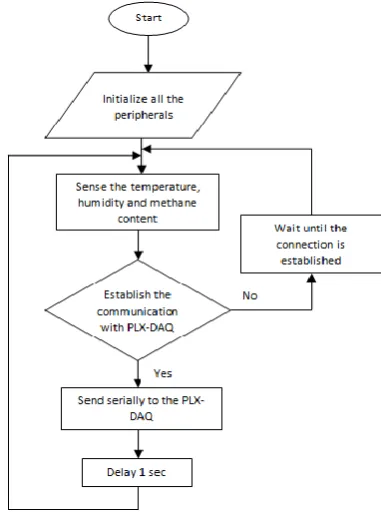
The Figure 2 shows the flow in which the data acquisition and the monitoring takes place.
Figure 2: Flow chart of the data acquisition process
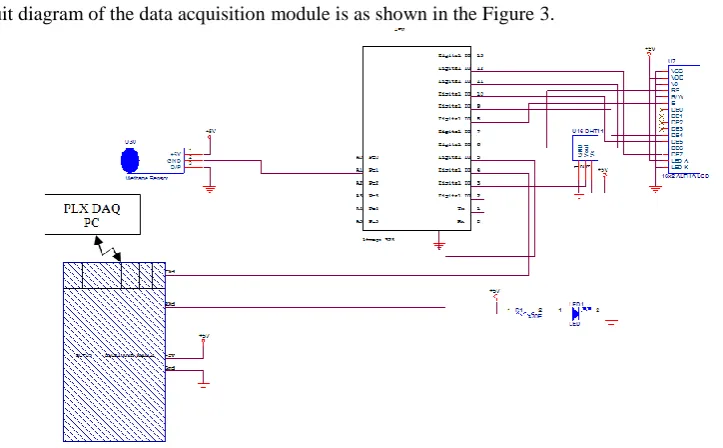
The circuit diagram of the data acquisition module is as shown in the Figure 3.
Figure 3: Circuit diagram of the Data Acquisition module
IV.
RESULTS
The experimental simulations were performed using the PLX DAQ software tool and the data received was monitored on Microsoft Excel Spreadsheet. The data monitored is as given in the Table 1.
Table 1: Typical values of the data acquired
Sl No
TIME HUMIDITY (%)
TEMPERAT URE (ºC)
METHANE (%)
1 4:56:53PM 34 34 10
2 4:56:54PM 34 34 10
3 4:56:55PM 34 34 10
4 4:56:56PM 34 34 32
5 4:56:57PM 34 34 29
6 4:56:58PM 34 34 24
7 4:56:59PM 34 34 23
8 4:57:00PM 34 34 23
9 4:57:01PM 34 34 22
10 4:57:02PM 34 34 22
11 4:57:03PM 35 34 21
12 4:57:04PM 35 34 18
13 4:57:05PM 34 34 16
14 4:57:06PM 34 34 14
15 4:57:07PM 34 34 21
16 4:57:08PM 34 34 88
17 4:57:09PM 34 34 87
18 4:57:10PM 34 34 80
19 4:57:11PM 35 34 52
20 4:57:12PM 35 34 32
21 4:57:13PM 35 34 30
22 4:57:14PM 35 34 27
23 4:57:15PM 35 34 25
24 4:57:16PM 35 34 23
25 4:57:17PM 35 34 20
26 4:57:18PM 35 34 18
27 4:57:19PM 35 34 17
29 4:57:20PM 35 34 15
The Figure 4, Figure 5 and Figure 6 show the graphical representation of the data monitored in the above table.
Figure 4: Graphical representation of the relative humidity content
Figure 5: Graphical representation of the methane content
Figure 6: Graphical representation of the temperature with respect to time
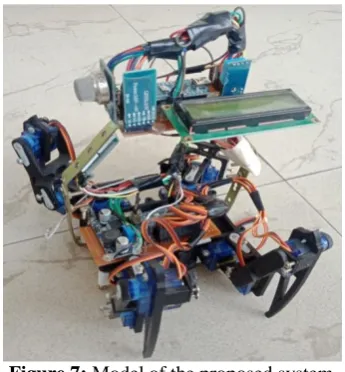
The project model containing the data acquisition unit attached to the 4-legged quadrapod robot is as shown in the Figure 7.
International organization of Scientific Research
12 | Page
V.
CONCLUSION
This paper has described the implementation of acquisition of various parameters such as temperature, humidity and methane content present in unstructured regions using a legged robot. The consideration is taken such that the data acquisition unit and the locomotive unit are viewed as two separate units working simultaneously towards a common goal of the project implementation.
Initially, we intended to use a six legged hexapod robot for the purpose of locomotion. But since the hexapod robot resulted in low efficiency and very high power consumption with high complexity in the testing of movements, we incorporated a 4 legged robot ie., quadrapod robot. Quadrapod robot exhibits high stability with a very well balanced posture since it mimics the walking patterns similar to that of animals and insects. The testing of the movements of the robot based on the arduino platform was successfully done by sending commands via Bluetooth.
On the data acquisition part, the payload containing- the temperature & humidity sensor, methane sensor, Bluetooth module, LCD display and the lithium ion battery interfaced to the arduino NANO microcontroller was initially installed. Later, a wireless communication between the data acquisition unit and the data monitoring system was established through Bluetooth.
Finally, the real time data was successfully acquired and monitored by sending the robot to the intended destination. Further aim of the project is to facilitate the system with more sensors to acquire a wider variety of parameters. The future work includes enabling the system with live video streaming ability by installing a light weight camera.
REFERENCES
[1]. Yilin Xu , Feng Gao, Yang Pan, Xun Chai, “Hexapod Adaptive Gait inspired by Human behavior for six legged robot without force sensor” , Published in Springer, Date of Publication: 2 April 2017.
[2]. Jung-Min Yang, “Fault-Tolerant Gait for a Hexapod Robot Walking over Rough Terrain”, Published in Springer, Published online: 21 August 2008.
[3]. James M. Conrad and Jonathan W.Mills, “The history and future of Stiquito: A hexapod Insectoid Robot”, @ Springer, Published in August-2009
[4]. R.Neugebauer and F.Wieland, “Application of Hexapod based Devices in Machines”, Proceedings of the Thirty-Second International Matador Conference © Department of Mechanical Engineering University of Manchester Institute of Science and Technology 2010
[5]. Abhishek Pratap Singh, Pradeep Rohilla, Abhijai Miglani and Arshdeep Singh Pahwa, “Design, fabrication and control of hexapod robot”, Published in International Journal of Engineering Research & Technology(IJERT), August 2013.
[6]. Takuma Nemoto , Rajesh ElaraMohan ,Masami Iwase “Energy based control for a biologically inspired hexapod robot with rolling locomotion” , Hosted by Elsevier, Published on 1st April,2015
[7]. Lisbeth Mena, Héctor Montes, Roemi Fernández, * Javier Sarria and Manuel Armada, “Reconfiguration of a Climbing Robot in an All-Terrain Hexapod Robot”, © Springer International Publishing Switzerland 2016, L.P. Reis et al. (eds.), Robot 2015: Second Iberian Robotics Conference.
[8]. Brian Yamauchi iRobot Corporation, 63 South Avenue, Burlington “PackBot: A Versatile Platform for Military Robotics”, Published by Elsevier Ltd, November 2009.
[9]. He Zhang , Rui Wu, Changle Li , Xizhe Zang, Xuehe Zhang, Hongzhe Jin and Jie Zhao, “A Force- Sensing System on Legs for Biomimetic Hexapod Robots Interacting with Unstructured Terrain”, Published through MDPI, Published on: 27 June 2017.
[10]. NanHu, ShaoyuanLi, YuxuanZhu, FengGao, “Constrained Model Predictive Control for a Hexapod Robot Walking on Irregular Terrain”, Published by the Journal of Intelligent & Robotic Systems, Published: 27th March 2018.
[11]. AlHaza Ta, Alsadoon Aa, Alhusinan Za, Jarwali Ma , Alsaif Kb ; “New concept for indoor fire fighting robot.”, Published by International Journal of Engineering Research & Technology, Published in 2015. [12]. A. Eshwaran, A Vijay, S Karthik, C Sheikh Mohammed, M Vimal; “Solar powered automatic
firefighting robot”, Published by International Journal of Engineering Research & Technology, ETEDM-2018 conference proceedings Published: ETEDM-2018.