ISSN (Online): 2320-9364, ISSN (Print): 2320-9356
www.ijres.org Volume 3 Issue 10 ǁ October. 2015 ǁ PP.01-05
Based on correlation coefficient in image matching
ZHANG Cheng
1, ZHOU Zhi-feng
21,2(College of Mechanical Engineering, Shanghai University of Engineering Science, China)
PROJRCT NUMBER:15KY0103
Abstract
:With the development of image technology, the application of image technology in industrial manufacturing become more and more widely. Image matching is animportantbranch of the image processing, and also it is very important in the process of industrial detection. The main purpose of this paper is aiming at the traditional image correlation matching algorithm in the application of detection in industrial, which based on similarity matching principle. This paper is going to discuss the similarity of the image matching algorithm on the application of detection in the connector. This paper improves the algorithm to speed up the detection velocity. In some specific circumstance, while correlation coefficient method is more simple and easy to use, the software development cycle will be short.Keywords
: correlation, detection, image matching, algorithm improvement.I.
INTRODUCTION
Whenthe factory produce connectors, in order to use the machine hand smoothly connect the wire with the
wire terminal, the machine hand need to know the state of the connectors clearly when the machine hand deal
with the wire connectors. As known about the direction of the terminal,the machine hand can work accelerate
with more efficiency. The original solution about connectors is before connectors appear on the work table, with
the help of the vibration of transmission track, it can make the connectors in a stable position, thus reduce the
possibilities of how connectors would be.
Image matching is one of the important parts of image recognition. Image matching can be divided into: A)
template matching; B)feature matching, find out the characteristics of the image, and use the image which can
represent the characteristics of the image to implement matching. The former solution fits the condition of the
same environment while the picture been taken many times to compare, the latter solution is more suitable for
the comparison of different shooting conditions pictures, such as a camera photo while the other one is the result
of the infrared sensor. This paper is about to use the different sensor or at different times, in different imaging
conditions with the same sensor at of the same scene to obtain two or more images implement comparison, or
according to the known templateto find the corresponding template matchingin another picture, this processing
method is known as Template matching[1]. The advantage of template matching is to be able to very precise
matching image, compare with the relative characteristics by comparison, it don't need a lot of the early
preparations for feature extraction, the disadvantage is about large amount of calculation.To improve this
disadvantage, people come out various solutions to reduce the number of calculations.
This paper is aboutto use thecorrelation coefficient to solve the practical problems, with improve the
, , 1 1
2 2
, ,
1 1 1 1
(
) (
)
( , )
(
)
(
)
j u k v j k j k
M N M N
j u k v j k
j k j k
f
f
h
h
R u v
f
f
h
h
(1) , 1 11
M M j k j kf
f
MN
,
, 1 1
1
M M j k j kh
h
MN
While the value of correlation coefficient is in the range of [-1, 1], which canindicate the similarity of the two
matrix, the correlation coefficient can describe the degree of approximation in linear description. In general,
when this value is close to 1, that can indicate both have the approximate linear relationship, also indicates that
the higher the similarity of both [2][3].
2.2 HOUGH TRANSFORMS
Hough transform is currently one of the most widely used feature detection methods, whichcan detect the
image many geometric characteristics, mostly used in the straight line and rounddetection.This paper is the
application of straight line detection in hough transforms, in the hough transform, each point can vote on a
number of parameters of linear combination, hough transform traversal image to be detected on each feature
point, the more frequent a line comes out, the more evidence shows this line.
In a straight line as an example, the relationship of the straight line is y = ax + b, at the same time it can be
expressed as linear b = y- ax, and x, ycan be observed, assume that a and b is the variable what we are interested
in the above equation, then equation represent a straight line in (a, b) space. If there are numbers of points in a
straight line, then the corresponding parameter space (a, b) will be a straight line cluster, if all straight line
through a point on the same point of (a, b), we can come to a conclusion that line is what we need.Also we
usually represented a straight line in the polar coordinates, where X can be represented by
r
cos
and Y can be represented byr
si n
, so inpolar coordinates , we always usex
cos
y
si n
r
to represent the straight line. About the point (x, y), in the coordinate system it can be said a straight line, ofcourse, there are a lot of corresponding r and
, however, in the image, each pixel coordinates of the image isknown, so r and
isthe variables what we need to find, when at the start of the hough transform algorithm, point(x, y) is mapped to the space (r,
), if there are numbers of points in straight line, then the correspondingparameter space (r,
) on the numbers of the sine curves, the curve is made at a point on the (r,
), so all theFIG 1.x-y coordinates FIG 2. Polar coordinates
Hough transform can be summarized as follows:
1) Establish a discrete parameter space between the maximum and minimum about r and;
2) Set up an accumulator A(r,), and let each element be zero;
3) Do the image hough transform about every point in the curve, which can be calculate a point that
corresponding curve on the grid, and the accumulator should plus one;
4) Find local maximum about A, which provide collinear parameters of collinear points on the image plane.
2.3 IMPROVEMENT OF THE ALGORITHM
The most important characteristic of correlation matching methodis that the detection precision is high,
basically can achieve full match, but the disadvantage is need a great deal of computation, in the process of
matching, what need to be done isthe template matching images need to move in x axis and Y axis, while move
to a place,the template image shouldbe matched to the same size in what need to be matched image
withcorrelation calculation.In the process of matching, this paper set the threshold value of correlation
coefficient matching, when the matching correlation coefficient is lower than the threshold value, the template
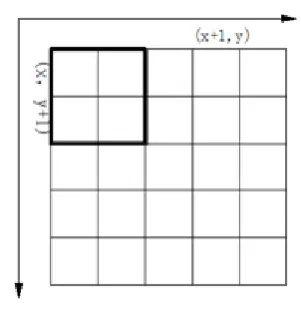
image will to move the distance as the length of the template image in the x direction, just skip the current
matching position, if reached or higher that the threshold, where should need move slowly, movein x
axisdirection with pixels, then move to the next match, the matching process will as below says:
FIG 3.Template image move in x & y direction
III.
RESULT AND ANALYZE
In the process of image matching, there has to be a series of image preprocessing before image
matching.First, changing the RGB image to grey level image, the color image need to turn into grayscale image.
mainly aims focus on how to correct image rotation Angle, which do not need to consider the image size scaling,
translation and image withthe geometric change.
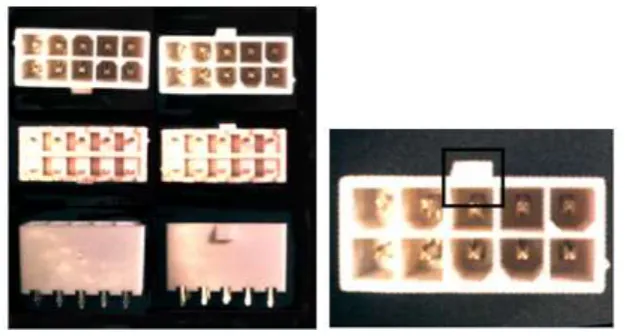
After preprocessing of the image, image matching is the most important. there are mainly six attitudes
ofterminal placement now (as shown in FIG4), according to the standard terminalattitudeswhat need to do is cut
out a small picture which can contain the obvious characteristics of the image, with this characteristics of
images to match images, an image is called a template image, and another is called match images, whereneed to
find the same size as the template image in and also the similarity between two of them. When the value close to
1, that means matching effectively.
FIG 4 Attitudes of the standard FIG 5 Template image where comes
The experiment is implemented on the computer withmatlab tools, the standard template images ofthe
experiment aretakenin a standard environment and each attitude correspond to one of the standard picture.
Matching idea is mainly as follows:
A) First, do basic image processing, including gray level transformation, filtering;
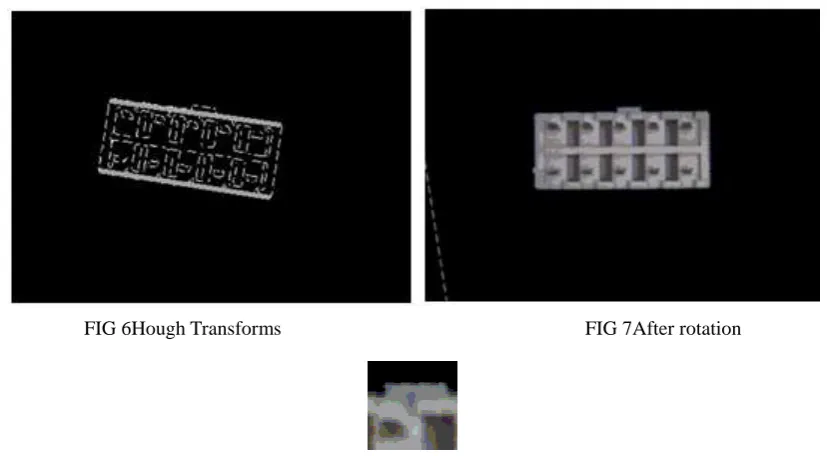
B)Tocorrectthe image rotation Angle, the hough transform were used to detect the image of straight line, with a
straight line to judge whether the image need to rotate relative to the template image, if it need to rotate, do the
image rotation with the angle we achieve by hough transforms to implement calibration;
C) According to judge the area size of the binary image, choose the corresponding template matching;
D)Implement matching, the matching process using rough match first, then precise matching, until the match
eventually.
FIG 6Hough Transforms FIG 7After rotation
FIG 8 Template image
Comparison of the traditional method with the improved method:
IMAGE MATCHING TIME/s
TRADITIONAL IMPROVED
Image1 159.755387 30.251332
Image2 158.271284 32.579095
Image3 167.121586 14.705329
From the table, there shows a big improveabout the dealing time, about traditional method, there are lots of
time spend on the unnecessary work, and the improved method make the time more short.
IV.
CONCLUSION
Through lots of experiments show that in this application, image matching based on correlation coefficient
has certain desirable, with the part of the algorithm is improved, the correlation coefficient of image matching can be used in the circumstance where isn’t require high real-time but demand the high-precision. Under the improved algorithm in this paper, the matching speed had the obvious enhancement.
REFERENCES
[1] wangzhanquan, xuhui. Proficient in Visual c + + digital image processing technology and the engineering case [M].POSTS &
TELECOM PRESS,2009:69.(in Chinese).
[2] Lisa Gottesfeld Brown, A survey of Image Registration Techniques,1992.
[3] Zhu Yongsong , GuoChengming .The research of correlationmatching algorithmbasedoncorrelation
coefficient[J].SignalProcessing,2003,19(6):531-534.(in Chinese).
[4] Li Zhuo, QiuHuijuan. Fast image matching based on correlation coefficient,[J]. Transactions of Beijing Institute of
Technology.2007, 11(27):998-1000.(in Chinese)
[5] Wang Jun, Zhang Mingzhu. Progress on image matching algorithm[J]. Atmospheric and Environmental Optical Journal, 2007,