International Journal of Business and Applied Social Science (IJBASS)
VOL: 4, ISSUE: 8August 2018
http://ijbassnet.com/
E-ISSN:2469-6501
©Center for Promoting Education and Research (CPER) USA
,
www.cpernet.org
Identification of the major constraints that limits the creation, promotion and growth of the Micro, Small, Medium & Large enterprises (MSMLE’s) in Belize.
Dr. Romaldo Isaac Lewis (DBA)
Faculty of Management & Social Sciences University of Belize
Phone: 501-822-3680 Ext 140 Email: [email protected]
Abstract
In Belize and around the globe; Micro, Small, Medium and Large enterprises(MSMLE’s) face numerous constraints from a technical perspective that limits their creation, promotion and Growth. The objectives of the study was to identify the majors constraints that limits the creation, promotion and growth of the enterprise in Belize,2) Determination of the nature as well as the constraint level that limits the creation, promotion & growth of the enterprises in Belize. The enterprises status was based on class interval classification of the estimated Free Cash Flow (FCF). The results revealed that the constraints that were identified during the enterprise creation were; Lack of knowledge of the market condition and access to Finance as well as the cost of financing which calculated a value of 12.3 and 11.7% respectively. During the enterprise promotion, the identified constraint was Unemployment or Economic situation of the country which calculated a value of 6.5%. Finally during the enterprise growth, the constraint that was identified was the competition with a calculated value of 11.0%. Additionally; there were no statistical significance found in the effects caused between the constraints and its level during the enterprises’creation, promotion and growth in Belize.
Keywords: Major constraints, Constraints level, Micro, Small, Medium & Large Enterprise (MSMLE’s), Free Cash Flow, Severity level
1. INTRODUCTION
Enterprises in Belize like any other country in the world benefit from taxes paid by the enterprises. Nevertheless these enterprises face numerous constraints that in some way or the other minimize their operational efficiency base on their Free Cash Flow (FCF). It is known that in Belize and the region, MSME's are of particular interest because they are considered to be amongst the most important growth factors that have a direct impact on the country’s economy.
On another note enterprise are and can be seen as an agenda that affect social stability, as well as labor force creation, as seen in the private sector in Belize, which is approximately 88% (SIB, 2014).
Furthermore, the categorization or statistical clustering of the Enterprises can be seen as an opportunity to create strategic plans that will enhance business development. These entities will stimulate programs such as access to finance as well as low cost of finance, market
access, concessions, professional development training, technological training as well as value chain inclusion.
Additionally, in Belize the primary constraints, as well as the levels that limit the creation, promotion, and growth of the Enterprises, haven’t been identified, hence the reason why they haven’t been statistically documented. It is believed that the combination of the statistical clustering of the Enterprises and the determination of the primary constraints, as well as the level of constraints, will provide an opportunity for the design and implementation of assessment instruments.
Today’s modern business model, calls for the most competitive enterprise to apply the most efficient management instrument continuously in order to stay on top and to prevent other from be active or determined competitors.
International Journal of Business and Applied Social Science (IJBASS)
VOL: 4, ISSUE: 8August 2018
http://ijbassnet.com/
E-ISSN:2469-6501
©Center for Promoting Education and Research (CPER) USA
,
www.cpernet.org
questions. These questions will facilitate and lead us intonew horizons, providing that the required resources of human capital, finance, time, equipment and infrastructure are available to provide the services to the market.These instruments will create innovative tools and strategies for business creation, development, monitoring, and evaluation for long term sustainability.
Finally, it is believed that businesses that are engaged in any aid see the significant economic benefit since this can be translated into economic savings that will minimize operational costs and boost or increase the Net Income from a financial perspective. The product of this research will be essential so that policy makers such as governmental agencies and foreign investors can design strategies that adhere to developmental needs that will benefit the country from an economic perspective.
2. LITERATURE REVIEW 2.1 Constraints
Constraints are described as any limiting factors that diminish the opportunity to obtain expected results or outcomes. From an economic standpoint, constraints could change with the changes in price, customer income, and customer perception of any goods or services. Within the Belizean context MSMLE’s are faced with constraints such as difficulty in Access to Finance, Access to market, Limited infrastructure expansion, Lack of Skilled employees, Poor knowledge of the market conditions and limited Business Support Organization (BSO).
In summary, growth constraints for survival clusters can only be mitigated through formed industrial groups since MSME’s faces similar constraints than a large Enterprise (Brickley et al.2009,p.25-26).Moreover, Yataka, Y. D. (2011,6-8), emphasized that the accessibility to customers is the principal reason enterprise decide to locate within clusters.
Additionally, cluster-based face another set of unit growth of constraints apart from new entrants, and by nature of spontaneous agglomeration new Enterprise continue to flow to the cluster, to speak profitable opportunities and better access to market available at such locations.
Tambunan(2004) mentioned that the SME’s in countries such as Indonesia have been criticized because of key factors such as employment generation, economic growth as well as foreign exchange. The social and
need to analyze the policy of SME’s from a clustering perspective.
The study concludes that development policy hasn’t been so successful, because of failures that one or more critical factors for successful SME’s cluster development did not exist or not addressed correctly.
Yataka, Y. D. (2011, p.2-4) stated that the analysis demonstrates how industrial clusters can be an agent for Africa’s MSME’s sector that can demonstrate enterprises’
significant contribution to the region’s indigenous private sector. Yataka also illustrated that domestically-owned Enterprises were on average less productive than foreign-owned Enterprise in the African continent and worldwide. The same author confirmed that there were differences in the performance gap between the domestically owned and foreign-owned, which exists because of the differences in size, access to capital and technology, and access to the external market.
Yataka, Y. D.(2011, p.5-6) found that Enterprise size seems to be significant size determinant market access, to foreign markets and in productivity, even when taking into account variation among countries and industries.
The same author further confirmed that the cluster-based MSME’s are performing both in sales and its ability to reach distant market than Enterprise of the same size, in the industries, and in the same cities, but outside the clusters. When decomposing on sales performance, the margin an enterprise gets in sales performance from being inside the cluster, shows that the higher capital intensity inside the cluster, which is understood as an agglomeration of Enterprises.
3. HYPOTHESIS
3.1 Null Hypothesis
1. Access to Finance & Cost of Finance is one of the primary constraints that limit MSMLE’s development during at least one of the stages (creation, promotion and growth) in Belize.
2. There is a negative and weak correlation that exists between the primary constraints and the level of
constraints that limit the creation, promotion and growth of MSMLE’s in Belize.
4. OBJECTIVES
International Journal of Business and Applied Social Science (IJBASS)
VOL: 4, ISSUE: 8August 2018
http://ijbassnet.com/
E-ISSN:2469-6501
©Center for Promoting Education and Research (CPER) USA,www.cpernet.org
2. Determined the nature as well as the Constraint Level that limits the creation, promotion, and growth of the enterprises in Belize.
3. Recommend strategies that stimulate enterprise creation, promotion and growth in Belize based on the findings.
5. METHODOLOGY
The study was to identify the major constraints the limits the creation, promotion and growth of the enterprise base on their Micro, Small, Medium and Large Enterprise (MSMLE’s) classification base on the Free Cash Flow (FCF), which was done by Class Intervals.
The data for the determination of the major constraints the limits its creation, promotion and growth were generated from a survey instrument that was administered to a group of Enterprises that were a part of the population. The Enterprises were obtained from the City Council or Municipal office of each municipality in the country, considering that each of the formal Enterprises is legally registered in each municipality and that they were awarded a certificate of registration.
No Enterprise name was placed on the survey instrument to protect the rights of the participants. These instruments were numbered as they were administered to the respondents who agreed to respond since they were not forced to participate.
Furthermore, this study was carried out using the
statistical formula where: no is the provisional sample
size; Z² is the abscissa of the normal curve that cuts off an area at the tails (1 -α equals the desired confidence level,
95%) 1; e² is the desired level of precision; p is the estimated proportion of an attribute that is present in the
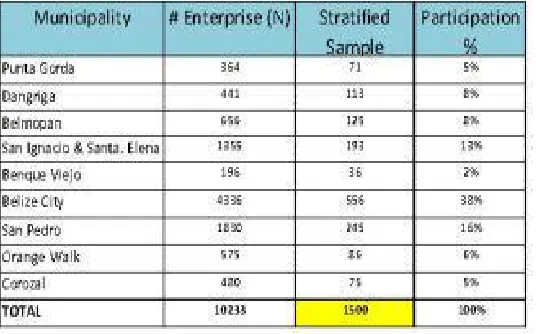
Table No.1, Registered Enterprises and sample size by municipality
For this particular study a convenient stratified sample of 1500 Enterprises were selected to participate in the process throughout the country of Belize, a number that is equivalent to an average of 15% of the population (10,233) of registered enterprises in the nine municipalities in the country. Information was taken from the enterprises that were registered during the last three fiscal years (April 1st, 2013 to Mach 31st 2016).
population; and q is 1-p. The value for Z is found in statistical tables which contain the area under the normal curve (Warner R. M. 2012, p. 551).
The same author confirms that the formula is based on the level of confidential degree desired in regards to the level of statistical tolerance (Error) accepted by the investigator. For this study, to obtain a high confidential level degree, 95% was used and can be translated to the level of probabilistic success and 5% tolerance or failure.
= ((Z²) * P * q) / e²) = Provisional Sample size
Z² = Abscissa of the normal curve (1.96) P = Proportion within the population
q = (1- p)
e² = Precision level or variability n = Sample size
n = / ((1 + (/N)
International Journal of Business and Applied Social Science (IJBASS)
VOL: 4, ISSUE: 8August 2018
http://ijbassnet.com/
E-ISSN:2469-6501
©Center for Promoting Education and Research (CPER) USA
,
www.cpernet.org
The analysis continued with the determination of ClassInterval Range and Class Interval as appears in the formula below, which lead to the first classification method (Warner R. M. 2012),
W = R/K
W= Class Interval Range
R = Difference between largest and smallest data K = Class Interval
Where K = 1+ 1.333 Log N
5. RESULTS
5.1 Constraints Summary Matrix
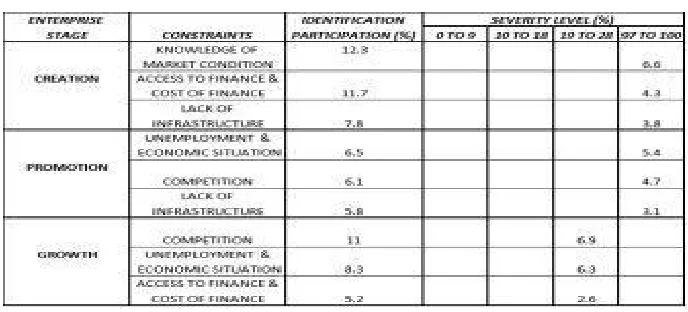
Table No. 2, Overall Constraints Participation, and Severity Level
The overall analysis, as illustrated in Table No. 33, summarized that the constraints can be different or repetitive in the three different development stages of the Enterprises with different participation and severity levels.
During the Enterprise creation, the challenges faced under the primary constraints; 1) Knowledge of Market Condition (12.3%); followed by Access to Finance & Cost of financing (11.7%) and finally; the lack of Infrastructure (7.8%). These constraints all create an unfavorable environment, highly risky and uncertainty for business development; and in many scenarios; enhance failure in a start-up business.
During the Enterprise promotion; firms face difficulty with the increase of uncertainty of the business because of constraints identified such as 1) Economic & Unemployment situation (6.5%); followed by Competition (6.1%), and finally Lack of Infrastructure (5.8%). The second constraint is unfavorable for the merchants but favorable to customers from a consumption perspective. The Enterprise promotion also faces unfavorable condition for its business progress if changes aren’t done to improve the business climate, for example the increase in unemployment conditions that is parallel to the Economic degradation.
Consumption is needed by all Enterprises, hence, the reason to improve the Economic Situation of the country for continuous growth. Enterprise growth has always been the most tangible way of measuring the progress of any business.
However, the study shows that during the last years of Enterprise growth the primary constraint has could be tied to unfavorable factors which are 1) Competition (11.0%); followed by the Economic & Unemployment situation (8.3%); and finally the Access to Finance & Cost of financing (5.2%). At least two of these constraints are the same as those that occur during the Enterprise promotion, and therefore can be seen as a continuing trend or tendency as the years pass by.
In summary; these constraints are unfavorable conditions for business development and therefore if changes aren’t done to improve the business climate; Enterprises are more susceptible to downsize employees, retrenchment or even closure as a measure to cut cost as a short-term strategy.
International Journal of Business and Applied Social Science (IJBASS)
VOL: 4, ISSUE: 8August 2018
http://ijbassnet.com/
E-ISSN:2469-6501
©Center for Promoting Education and Research (CPER) USA
,
www.cpernet.org
From an overall perspective, there wasn’t astatistical significance in the effect caused by the constraint identified and the different Constraint Levels in the three stages. This allows us to accept Null Hypothesis No. 2 considering that the correlating effect caused by the constraints identified and the Constraint Levels were negative and weak.
6. CONCLUSION
1. The primary constraints and level that limits the creation, promotion, and growth of the enterprise are; during creation, it’s the Knowledge of the Market Conditionalong with Access to Finance and Cost of Financing. These calculated figures of 12.3 and 11.7%; at specific severity levels.During the promotion, Unemployment/Economic Situation was the primary constraint with a participation of 6.5% at also specific severity level. Finally, during enterprise growth, the primary constraint identified was Competition with a participation of 11.0% at a specific severity level.
2. There was no statistical significance in the effect caused by the constraints and its level during enterprise creation, promotion, and growth; which concludes that the constraint isn’t predictable or dependable on the severity level.
7. RECOMMENDATION
1. It is recommendable that some relief is rewarded to the Enterprises through tax deduction as a strategy to promote business development and growth. The estimated loss that the state will incur can be compensated by applying the Business Trade & Commerce Policy (BTCP) throughout the entire country. 2. Reformulate and improve Business Support Organization (BSO’s) that can provide Business Support Services(BSS),(Training, Information gathering, processing & sharing, advocacy, Idea & experience sharing and professional development sessions) as a strategy for business development and growth especially in Enterprise creation.
3. All municipalities should formalize the informal business sector; by extending a specific license to Mobile Informal Micro Enterprise (MIME’s) that are doing street vending, which can be seen as an avenue to create illegal competition for business.
ACKNOWLEDGMENT
The author would like to thank the business proprietors who took time out of their busy schedule to respond to the interviews or answer the assessment instrument.
BIBLIOGRAPHY
Boguslauskas, V.&Adlyte, R.(2010), Evaluation of Criteria for the classification of Enterprises, Ruta. Engineering Economics. 2010, Vol. 21 Issue 2, p119-127
Creswell, J.W. (2011), Research Design; Qualitative, Quantitative, and Mixed Methods Approaches, (3rd Ed.), India: Sage Publication, pp. 16–89
George, D.& Mallery, P. (2014), IBM SPSS; Statistics 21, Step by Step, A simple guide, and reference (13th), Pearson Education Inc: pp. 282-295
Hallberg, K. (2000), A Market-Oriented Strategy for Small and Medium Scale Enterprises; Discussion Paper 40, International Finance Corporation (IFC), USA: pp. 1-23
Harris, E. A. (2010), You can be a successful business person; Micro, Small & Medium Enterprises (MSME’s) Fundamentals, (2nda.Ed.), 1st Ed, USA.
Herrle, E. (2006) The promotion of small and medium-sized Enterprises in the EU; Seminar paper: (1st Ed), Germany, pp. 1-23.
International Journal of Business and Applied Social Science (IJBASS)
VOL: 4, ISSUE: 8August 2018
http://ijbassnet.com/
E-ISSN:2469-6501
©Center for Promoting Education and Research (CPER) USA
,
www.cpernet.org
Malhorta, M., Chen, Y., Criscuolo, A., Fan, O., Hamel, I. I., & Savchenko, Y(2007), Expanding Access to Finance, Good Practices and Policies for Micro, Small and Medium Enterprises: (1st Ed), Washington, DC: The World Bank, pp. 3-25
Meyer, G. E,(1993), Statistical Package for Social Science (SPSS), A Minimal Approach, (1st Ed.), USA: Harcourt Bruce Jovanovich, pp. 345–376
Kotler, P & Keller, L.K.(2012), Marketing Management, (14th. Ed.), USA: PEARSON, pp. 34–47
Seepersaud, M. M,(2012), Belize MSME policy and strategy report, Belize, pp. 5- 61
Pooja, K.(2009), Micro, Small and Medium Enterprise, (14th Ed.)
Tri Rahayu1, S. A;(2010), Analysis of investment decision in Micro, Small and Medium Enterprise (MSME’s) in Indonesia.
Tambunan, T. Journal of Small Business Management, 2005, Vol. 2 Issue 43, p13-15.
Vintila, G. & Ghenghina, S.C(2014), Pattern recognition techniques to classify the European Markets companies from the valuation perspective, Jan, Vol. 48, Issue 1, p.1-17.
Warner, R. M;(2012), Applied Statistics: From Bivariate Through Multivariate Techniques, (2nd ed), Sage Publication Inc, pp. 51-59