www.pharmascholars.com
99
Original Article
CODEN: IJPNL6
STABILITY INDICATING RP-HPLC METHOD FOR SIMULTANEOUS ESTIMATION
OF PIOGLITAZONE HYDROCHLORIDE AND ALOGLIPTIN BENZOATE IN
PHARMACEUTICAL FORMULATION
T. Hemant Kumar
*1and D. Gowri Sankar
21
Vignan Institute of Pharmaceutical Technology, Duvvada, Vishakapatnam, Andhra Pradesh,
India
2
College of Pharmaceutical Sciences, Andhra University, Andhra Pradesh, India
*Corresponding author e-mail: [email protected]
Received on: 30-04-2016; Revised on: 07-07-2016; Accepted on: 13-09-2016
ABSTRACT
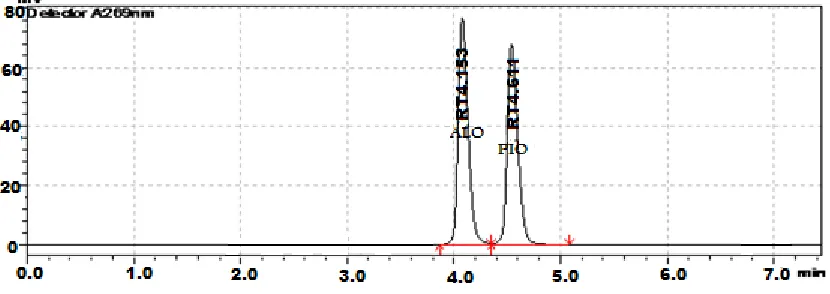
A simple, efficient, sensitive and stability indicating RP-HPLC method was developed and validated for the simultaneous estimation of Pioglitazone HCl and Alogliptin Benzoate in pharmaceutical formulation using Enable C 18G column (250 ×4.6 mm, 0.5 µm) with mobile phase consisting of acetonitrile and 0.01M Ammonium acetate (pH 4.0 adjusted with acetic acid) in the ratio of 60:40 %v/v at a flow rate of 0.8 mL/min .UV detection was carried out at 269 nm. The retention time for Pioglitazone HCl and Alogliptin Benzoate were found to be 4.611 and 4.153 min respectively. The proposed method was validated for linearity, range, accuracy, precision, robustness, LOD and LOQ. Linearity was observed over a concentration range 5-220 µg/ml for Pioglitazone HCl and 15-175 µg/ml for Alogliptin Benzoate. Pioglitazone HCl and Alogliptin Benzoate were subjected to stress conditions of degradation including acidic, alkaline, oxidative, thermal and photolysis. The developed method was found to be precise and robust for the simultaneous estimation of Pioglitazone HCl and Alogliptin Benzoate in pharmaceutical formulation.
Key words: Pioglitazone HCl, Alogliptin Benzoate, RP-HPLC, Stability indicating.
INTRODUCTION
Pioglitazone HCl chemically [Figure 1] is (±)- 5-[[[2-(5-ethyl-2-pyridinyl)ethoxy] phenyl] methyl]-2, 4-thiazolidinedionemonohydrochloride. It is odorless white crystalline powder that contains one asymmetric carbon in the thiazolidinedione moiety. The synthetic compound is a racemate and the two enantiomers of Pioglitazone HCl interconvert in vivo. It is soluble in N, N dimethylformamide, slightly soluble in anhydrous ethanol, very slightly soluble in acetone and acetonitrile, practically insoluble in water, and insoluble in ether. Pioglitazone HCl is a drug belongs to the drug class of thiazolidinedione, which is used to decrease insulin resistance. It is an diabetic agent to manage NIDDM (non- anti-hyperglycemic insulin-dependent diabetes mellitus, sugar diabetes) called type 2 diabetes. Pioglitazone HCl acts as an agonist at peroxisome proliferator
activated receptors (PPAR) in target tissues for insulin action such as adipose tissue, skeletal muscle, and liver. Literature survey reveal various analytical method are reported either alone or combination with other drugs includes Spectrophotometric [1-17], HPLC [18-48] , LC-MS[49-52],HPTLC[53-57],Electrophoresis[58] in pure drug, pharmaceutical formulations and biological fluids.
Alogliptin Benzoate [Figure 2] chemically as 2-({6-[(3R)-3- aminopiperidin-1-yl]-3-methyl-2, 4-dioxo-3, 4-dihydropyrimidin- 1(2H)-yl} methyl) benzonitrilemonobenzoate. It is a white to off-white, crystalline powder, containing one asymmetric carbon in the amino-piperidine moiety. It is soluble in dimethylsulfoxide, sparingly soluble in water and methanol, slightly soluble in ethanol, and very slightly soluble in octanol and isopropyl acetate. Alogliptin Benzoate is a selective, orally-bioavailable
International Journal of Pharmacy
www.pharmascholars.com
100
inhibitor of enzymatic activity of dipeptidyl peptidase-4 (DPP-4). DPP-4 inhibitors represent a new therapeutic approach to the treatment of type 2 diabetes that functions to stimulate glucose dependent insulin release and reduce glucagons levels. This is done through inhibition of the inactivation of incretins, particularly glucagon-like peptide-1 (GLP-1) and gastric inhibitory polypeptide (GIP). Alogliptin Benzoate inhibits dipeptidyl peptidase 4 (DPP- 4), which normally degrades the incretin glucose-dependent insulin tropic polypeptide (GIP) and glucagon like peptide 1 (GLP-1), thereby improving glycemic control. Several analytical methods have been reported for the determination of Alogliptin Benzoate either alone or in combination with other drugs in pure drug, pharmaceutical dosage forms and in biological samples using spectrophotometry [59-61], HPLC [62-67] methods have been reported for the determination of Alogliptin Benzoate in pharmaceutical dosage forms. An Alogliptin Benzoate–Pioglitazone HCl combination is advantageous because it addresses both insulin resistance and islet dysfunction in Type 2 diabetes mellitus. HbA1c reductions are
significantly greater than with either monotherapy [68]. Various analytical methods were reported for simultaneous estimation of Pioglitazone HCl and Alogliptin Benzoate in pure drug, pharmaceutical formulations and biological fluids by Spectrophotometric [69-70], HPLC[71-72] and HPTLC[73]. Only two stability indicating RP-HPLC method was reported for the simultaneous estimation of both drugs in human plasma and pharmaceutical formulation. But the reported method has high concentration of Limit of detection and limit of quantitation for both drugs. Therefore in the present study an attempt was made to develop a simple, sensitive, precise, accurate RP-HPLC method with forced degradation studies for the analysis of Pioglitazone HCl and Alogliptin Benzoate in pharmaceutical formulation.
MATERIALS AND METHODS
Materials and Chemicals: Pioglitazone HCl and Alogliptin Benzoate standard were obtained as gifted sample from pharma industry. Pioglitazone HCl and Alogliptin Benzoate tablets (OSENI TABLETS) containing Pioglitazone HCl 15 mg and Alogliptin Benzoate 25 mg were purchased from on line pharmacy. HPLC grade water and acetonitrile was from MERCK India Ltd. HPLC grade methanol was from standard reagent pvt ltd Hyderabad. Analytical grade hydrochloric acid, sodium hydroxide, hydrogen peroxide, acetic acid and ammonium acetate was from SD Fine chemicals Mumbai, India. Nylon
membrane filters 0.2 µm and 0.45 µm were from PALL life sciences Mumbai, India. Ultrasonicator used was from LAB india Ltd Mumbai. pH meter was of Elico LI 120 make. UV Specctrophotometer was of Elico SL 210 model consisted of spectral treats software.
Instrumentation: The chromatographic system used for the method development and validation consisted of Shimadzu HPLC comprising of LC-20AD binary gradient pump, a variable wavelength programmable SPD-20A detector and an SCL 20A system controller. A Rheodyne injector 7725i fitted with a 20 μL loop was used and data were recorded and evaluated by use of LC solutions software version 5.0.
Chromatographic Conditions: Chromatographic analysis was performed on Enable C18 G column (250 x 4.6 mm i.d, 5µ) .The mobile phase consisted of acetonitrile and 0.01M Ammonium acetate(pH 4.0 adjusted with acetic acid) at the ratio of 60:40 %v/v. The flow rate was 0.8 mL/min, injection volume was 20 µL and detection was carried out at 269 nm using a UV detector.
Preparations of Pioglitazone HCl and Alogliptin Benzoate stock solution: Stock solution of Pioglitazone HCl (1000 µg/ml) and Alogliptin Benzoate (1000 µg/ml) was prepared separately by transferring accurately weighed 50 mg of Pioglitazone HCl and 50 mg of Alogliptin Benzoate into a 50 ml volumetric flask and to it added a 20 ml methanol. The mixture was sonicated for 5 min to dissolve the drug and the solution was diluted up to the mark with methanol. To prepare a binary mixture of Alogliptin Benzoate and Pioglitazone HCl appropriate volume of standard solution was transferred into a 10 ml volumetric flask and diluted with mobile phase to get a solution containing 100 µg/ml of Alogliptin Benzoate and 60 µg/ml of Pioglitazone HCl.
www.pharmascholars.com
101
Benzoate 1000 µg/ml and Pioglitazone HCl 600 µg/ml. The above solution was filtered through 0.2 µ membrane filter. The 1 ml of the filtrate was transferred into a 10 ml volumetric flask and diluted with mobile phase to get a concentration of 100 µg/ml and 60 µg/ml for Alogliptin Benzoate and Pioglitazone HCl respectively.
Method Validation
The method was validated for accuracy, precision, linearity, specificity, robustness, limit of detection, limit of quantitation.
Linearity: Linearity was performed by preparing standard solutions of Alogliptin Benzoate and Pioglitazone HCl at different concentration levels. Alogliptin Benzoate was prepared in the concentration range of 15-175 µg/mL and 5-220 µg/mL for Pioglitazone HCl. Twenty micro litres of each concentration from both drug solutions was injected in duplicate into the HPLC system. The response was carried out at 269 nm and the corresponding chromatograms were recorded from these mean peak areas were calculated. The calibration curve was plotted by taking concentration on x-axis and peak areas on y-axis for both the drugs.
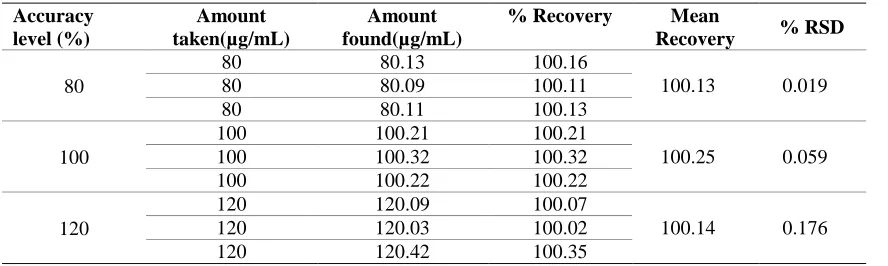
Accuracy: The accuracy of the method evaluated by standard addition method in which a known amount of standard drug was added to the fixed amount of pre-analyzed sample solution. Percent recovery of Alogliptin Benzoate and Pioglitazone HCl was calculated at three concentration levels of 80%, 100% and 120%. The solutions were analyzed in triplicate at each level. The percent recovery and %RSD at each level was calculated.
Precision: Precision of the method was evaluated as system precision and method precision. To study the system precision, six replicate standard solutions of Alogliptin Benzoate and Pioglitazone HCl were analysed. The percent relative standard deviation (%RSD) was calculated for both Alogliptin Benzoate and Pioglitazone HCl. Method precision of the analytical method was carried out on six preparations from the tablet formulation and percentage amount of Alogliptin Benzoate and Pioglitazone HCl in the tablet formulation was calculated. The intraday and interday precision study was conducted for both Alogliptin Benzoate and Pioglitazone HCl. The mean % assay value, standard deviation and percent relative standard deviation was calculated.
Limit of detection (LOD) and Limit of quantitation (LOQ): LOD was measured by serially diluting the standard solutions of Alogliptin Benzoate and
Pioglitazone HCl and determining the concentration was response of sample peaks are three times the noise peak .LOQ was measured by serially diluting the standard solutions of Alogliptin Benzoate and Pioglitazone HCl and determining the concentration was response of sample peaks are ten times the noise peak.
Robustness: Robustness of the method was determined by making slight changes in composition of organic phase ± 5%, pH by ±0.2, flow rate by ± 0.1 ml/min and detection wavelength by ± 2 nm.
Specificity: The specificity of the proposed method was determined against blank and placebo applications. Here mobile phase was used as blank and excipients like starch, lactose, magnesium stearate were used as placebo.
Forced Degradation studies: Different stress conditions were used for the forced degradation studies of formulation .These was also used to evaluate the specificity of the method. All the samples were diluted with mobile phase and filtered through 0.2 µ membrane filter.
Acidic conditions: Weighed accurately about twenty tablets and triturated it to a fine powder form. An a liquate of the powder equivalent to 100 mg of Alogliptin Benzoate and 60 mg of Pioglitazone HCl was transferred into a 100 ml volumetric flask. To this added a 40 ml of diluent and sonicated for 10 min to dissolve the drug completely. Then 10 ml of 1N HCl was added to it, refluxed for 12 hr at 60 0C, cooled to room temperature, neutralized with 1N NaOH and diluted up to the mark with the diluent. The above sample solution was filtered through 0.2 µ nylon membrane filter. Pipetted 1 ml of the above filtered sample solution into a 10 ml volumetric flask and volume made up to the mark with diluent
www.pharmascholars.com
102
Oxidative degradation: Weighed accurately about twenty tablets and triturated it to a fine powder form. An a liquate of the powder equivalent to 100 mg of Alogliptin Benzoate and 60 mg of Pioglitazone HCl was transferred into a 100 ml volumetric flask. To this added a 40 ml of diluent and sonicated for 10 min to dissolve the drug completely. Then 5 ml of 3 % hydrogen peroxide was added, refluxed for 10 hr at 60 0C, then cooled to room temperature and diluted up to the mark with diluents. The above sample solution was filtered through 0.2 µ nylon membrane filter. Pipetted 1 ml of the above filtered sample solution into a 10 ml volumetric flask and volume made up to the mark with diluent.
Thermal degradation: Weighed accurately about twenty tablets and triturated it to a fine powder form. The powder sample was subjected to thermal stress at 80 0C for about 2 days. An a liquate of the powder equivalent to 100 mg of Alogliptin Benzoate and 60 mg of Pioglitazone HCl was transferred into a 100 ml volumetric flask. To this added a 20 ml of diluent and sonicated for 10 min to dissolve the drug completely the diluted up to mark with diluents. The above sample solution was filtered through 0.2 µ nylon membrane filter. Pipetted 1 ml of the above filtered sample solution into a 10 ml volumetric flask and volume made up to the mark with diluent.
Photolytic Degradation: Weighed accurately about twenty tablets and triturated it to a fine powder form. The powder sample was subjected to light in a photostability chamber for about 10 days. An a liquate of the powder equivalent to 100 mg of Alogliptin Benzoate and 60 mg of Pioglitazone HCl was transferred into a 50 ml volumetric flask. To this added a 40 ml of diluent and sonicated for 10 min to dissolve the drug completely the diluted up to mark with diluents. The above sample solution was filtered through 0.2 µ nylon membrane filter. Pipetted 1 ml of the above filtered sample solution into a 10 ml volumetric flask and volume made up to the mark with diluent.
RESULTS AND DISCUSSION
Optimization of chromatographic conditions: In the present work an analytical method based on RP-HPLC using UV detector was developed and validated for simultaneous estimation of Alogliptin Benzoate and Pioglitazone HCl in pharmaceutical formulation. The selection of analytical conditions was based on the chemical nature of Alogliptin Benzoate and Pioglitazone HCl. A systematic study of various factors were undertaken by varying one parameter at a time and keeping all other conditions
constant for development of analytical method. Both Alogliptin Benzoate and Pioglitazone HCl were soluble in polar solvents therefore RP-HPLC was chosen. The selection of stationary phase has been done on the basis of back pressure, resolution, peak shape, theoretical plates and day to day reproducibility in retention time resolution between Alogliptin Benzoate and Pioglitazone HCl peaks. After evaluating all these factors Enable C18 G column (250 x 4.6 mm i.d, 5µ) was chosen for the analysis. For optimization of mobile phase preliminary trials were conducted under isocratic conditions using mobile phases composed of mixture of solvents like water, methanol, actonitrile with buffer and without buffer in different combination.
A mixture of acetonitrile and buffer at a ratio of 60:40 % v/v was found to be most suitable of all the combinations since the chromatographic peaks obtained were have good system suitability parameters. The Flow rate of mobile phase was optimized based on resolution between chromatographic peaks and minimal solvent consumption. The flow rate of mobile phase was changed from 0.5-2 ml/min. It was found from trials that 0.8 ml/min flow rate was ideal for successful elution of both drugs. For selection of analytical wavelength standard solutions of both drugs were scanned in wavelength range of 200-350 nm. A detection wavelength of 269 nm was selected. The chromatogram of sample was shown in Figure 3.
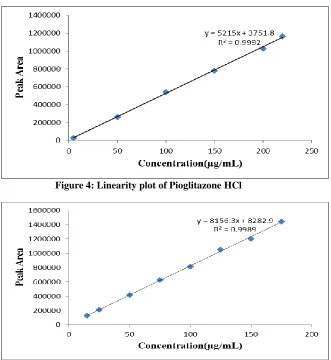
Method Validation: Linearity was studied by preparing standard solutions at different concentration levels. The linearity ranges for Pioglitazone HCl and Alogliptin Benzoate were found to be 5-220 µg/mL and 15-175 µg/mL respectively. The linear regression equation for Pioglitazone HCl was found to be 5215x +3751.8 with correlation coefficient 0.9992. The linear regression equation for Alogliptin Benzoate was found to be 8156.3x +8282.9 with correlation coefficient 0.9989.The calibration table for Pioglitazone HCl and Alogliptin Benzoate was shown in Table 1 and Table 2 respectively. The calibration curve of Pioglitazone HCl and Alogliptin Benzoate were shown in Figure 4 and Figure 5 respectively.
www.pharmascholars.com
103
Precision
System precision: The %RSD for Alogliptin Benzoate was found to be 0.68 and for Pioglitazone HCl was found to be 1.77 which are within the acceptance criteria of not more than 2.0 indicates the precision of the method. The result was shown in Table 5.
Method Precision: The %RSD for Intraday and Interday precision assay results of six preparations for Alogliptin Benzoate were found to be 0.12 and 0.10 respectively which are within the acceptance criteria of not more than 2.0 indicates the precision of method. The %RSD for Intraday and Interday precision assay results of six preparations for Pioglitazone HCl were found to be 0.22 and 0.23 respectively which are within the acceptance criteria of not more than 2.0 indicates the precision of the method. The result was shown in Table 6.
Limit of detection and Limit of quantitation: The LOD and LOQ were found to be 0.21 µg/ml and 0.65 μg/mL for Pioglitazone HCl and the LOD and LOQ for Alogliptin Benzoate were 0.07 μg/mL and 0.21 μg/mL respectively.
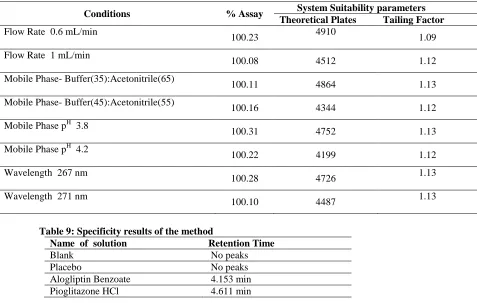
Robustness: To evaluate the robustness of the developed method, small deliberate variations in optimized method parameters were made. The effect of change in flow rate, change in pH, change in composition of mobile phase and detection wavelength on retention time, tailing factor and theoretical plates were studied. The method was found to be unaffected by small changes in flow rate, change in pH, change in composition of mobile phase and detection wavelength as shown in Table 7 and Table 8.
Specificity: Specificity is the ability to unequivocally assess the analyte in the presence of components that may be expected to be present. Typically, these might include impurities, degradants or matrix. Specificity of an analytical method is its ability to accurately and specifically measure the analyte of interest without interference from blank or placebo. The peak purities of Pioglitazone HCl and Alogliptin Benzoate were assessed by comparing the retention times of standard Pioglitazone HCl and Alogliptin Benzoate and the sample, and good correlation was obtained between the retention time of the standard and sample. Placebo and blank were injected and there were no peaks. There is no interference of degradation peaks on drug peaks hence, the method is specific. The specificity results are shown in Table 9.
Analysis of commercial formulation: The proposed method was applied for the determination of
Pioglitazone HCl and Alogliptin Benzoate in marketed formulations available (OSENI TABLETS). The % recovery was found to be 99.73±0.42 and 100.4±0.15 for Pioglitazone HCl and Alogliptin Benzoate respectively. The result was shown in Table 10.
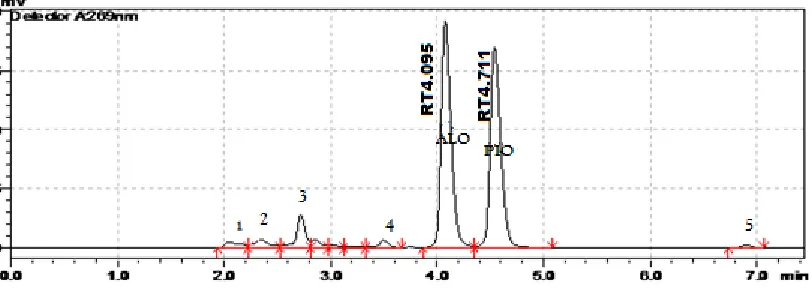
Forced degradation studies: In acidic conditions Pioglitazone HCl degraded to 28.55 % and Alogliptin Benzoate to 48.38 %. There is an appearance of two degradant peaks on chromatogram at the retention time of 2.702 min and 3.511 min (Figure 6). In basic conditions Pioglitazone HCl degraded to 25.64 % and Alogliptin Benzoate degraded to 32.42 %. There is an appearance of five degradant peaks on chromatogram at the retention times 2.151, 2.404, 2.769, 3.512 and 6.896 min (Figure 7). In oxidative conditions Pioglitazone HCl degraded to 1.04 % and Alogliptin Benzoate degraded to 0.24 % .There is a appearance of two degradation peaks at the retention time of 2.255 min and 2.645 min on chromatogram (Figure 8). Under thermal conditions Pioglitazone HCl degraded to 1.21 % and Alogliptin Benzoate degraded to 0.12 %( Figure 9). In photolytic conditions Pioglitazone HCl degraded to 1.04 % and Alogliptin Benzoate degraded to 0.32 % .There is an appearance of two degradation peaks at the retention time of 2.255 min and 2.645 min on chromatogram (Figure 10). From the degradation studies it was concluded that both Alogliptin Benzoate and Pioglitazone HCl degraded significant extent in acidic and basic condition where as remaining conditions they degraded to lesser extent.
CONCLUSION
The proposed method for the simultaneous estimation of Pioglitazone HCl and Alogliptin Benzoate validated as per the ICH guidelines and it is simple, specific and reliable. The data generated from the forced degradation studies enabled the evaluation of Pioglitazone HCl and Alogliptin Benzoate stability under a variety of ICH recommended conditions. These data are valuable for the safety and potency assessment of a drug product. Furthermore, this simple and rapid RP-HPLC method can also be used successfully for the determination of Pioglitazone HCl and Alogliptin Benzoate in pharmaceutical formulations without any interference from the excipient.
ACKNOWLEDGMENTS
www.pharmascholars.com
104
Figure 1: Structure of Pioglitazone HCl
Figure 2: Structure of Alogliptin Benzoate Benzoate
www.pharmascholars.com
105
Figure 4: Linearity plot of Pioglitazone HCl
Figure 5: Linearity plot of Alogliptin Benzoate
www.pharmascholars.com
106
Figure 7: Base degradation chromatogram
Figure 8: Oxidative degradation chromatogram
www.pharmascholars.com
107
Figure 10: Photolytic degradation chromatogram Table 1: Linearity data for Piogliatazone
Level Concentration of Pioglitazone HCl(µg/mL) Mean peak area
Level-1 5 26291
Level-2 50 263619
Level-3 100 538826
Level-4 150 780859
Level-5 200 1028878
Level-6 220 1164936
Slope 5215
Intercept 3751.8
Correlation Coefficient 0.9992
Table 2: Linearity data for Alogliptin Benzoate
Level Concentration of Alogliptin Benzoate(µg/mL) Mean peak area
Level-1 15 128434
Level-2 25 209863
Level-3 50 416378
Level-4 75 628388
Level-5 100 814737
Level-6 125 1092634
Level-7 150 1202669
Level-8 175 1444898
Slope 8156.3
Intercept 8282.9
Correlation Coefficient 0.9989
Table 3: Accuracy results of Alogliptin Benzoate Accuracy
level (%)
Amount taken(µg/mL)
Amount found(µg/mL)
% Recovery Mean
Recovery % RSD
80
80 80.13 100.16
100.13 0.019
80 80.09 100.11
80 80.11 100.13
100
100 100.21 100.21
100.25 0.059
100 100.32 100.32
100 100.22 100.22
120
120 120.09 100.07
100.14 0.176
120 120.03 100.02
www.pharmascholars.com
108
Table 4: Accuracy results of Pioglitazone HCl Accuracy
level (%)
Amount taken(µg/mL)
Amount found(µg/mL)
%
Recovery Mean Recovery
% RSD
80
48 47.98 99.95
99.65 0.32
48 47.67 99.31
48 47.86 99.70
100
60 59.39 98.98
99.44 0.41
60 59.75 99.58
60 59.86 99.76
120
72 71.89 99.84
99.71 0.25
72 71.91 99.87
72 71.59 99.43
Table 5: System precision results for Alogliptin Benzoate and Pioglitazone HCl Injection No. Peak Area of Alogliptin
Benzoate
Peak Area of Pioglitazone HCl
1 814737 263619
2 809271 252713
3 815920 266183
4 818884 259028
5 804328 259993
6 807836 262097
Mean 811829 260605
SD 5544 4638
%RSD 0.68 1.77
Table 6: Method precision results for Alogliptin Benzoate and Pioglitazone HCl Set
Alogliptin Benzoate(%Assay) Pioglitazone HCl(%Assay) Intraday(n=6) Interday(n=6) Intraday(n=6) Interday(n=6)
1 100.43 100.11 99.68 99.89
2 100.18 100.32 99.79 99.76
3 100.21 100.09 99.92 99.37
4 100.09 100.03 99.55 99.61
5 100.14 100.24 100.04 99.91
6 100.04 100.16 99.48 99.94
Mean 100.18 100.15 99.74 99.75
SD 0.1361 0.106 0.215 0.221
www.pharmascholars.com
109
Table 7: Robustness results for Pioglitazone HCl
Conditions % Assay System Suitability parameters
Theoretical Plates Tailing Factor
Flow Rate 0.6 mL/min
99.43 4301 1.12
Flow Rate 1 mL/min
99.61 3998 1.25
Mobile Phase- Buffer(35):Acetonitrile(65)
99.12 4289 1.22
Mobile Phase- Buffer(45):Acetonitrile(55)
99.48 4342 1.28
Mobile Phase pH 3.8
100.17 4197 1.31
Mobile Phase pH 4.2
99.69 4382 1.30
Wavelength 267 nm
99.28 4188 1.31
Wavelength 271 nm
99.88 4223 1.31
Table 8: Robustness results for Alogliptin Benzoate
Conditions % Assay System Suitability parameters Theoretical Plates Tailing Factor
Flow Rate 0.6 mL/min
100.23 4910 1.09
Flow Rate 1 mL/min
100.08 4512 1.12
Mobile Phase- Buffer(35):Acetonitrile(65)
100.11 4864 1.13
Mobile Phase- Buffer(45):Acetonitrile(55)
100.16 4344 1.12
Mobile Phase pH 3.8
100.31 4752 1.13
Mobile Phase pH 4.2
100.22 4199 1.12
Wavelength 267 nm
100.28 4726 1.13
Wavelength 271 nm
100.10 4487 1.13
Table 9: Specificity results of the method
Name of solution Retention Time
Blank No peaks
Placebo No peaks
Alogliptin Benzoate 4.153 min
Pioglitazone HCl 4.611 min
Table 10: Analysis of Pioglitazone HCl(PIO) and Alogliptin Benzoate(ALO) in commercial formulation Formulation Labelled claim(mg) Amount found*(mg) % Recovery*± % RSD
PIO ALO PIO ALO PIO ALO
OSENI TABLETS 15 25 14.96 25.11 99.73±0.42 100.4±0.15
www.pharmascholars.com
110
Table 11: Forced degradation studies of Alogliptin Benzoate and Pioglitazone HCl Stress Conditions %Drug
Recovered
% Drug decomposed
Retention Time (min)
Theoretical Plates
Tailing Factor Alogliptin Benzoate
Control Sample 100.4 ---- 4.153 4822 1.10
Acid Degradation
(1 N/60°C/12 hr) 51.92 48.38 4.156 5123 1.11
Alkaline Degradation
(0.5 N/60°C/12 hr) 67.90 32.42 4.095 4651 1.12
Oxidative Degradation (3 % H2O2/60°C /10 hr)
99.13 1.24 4.156 4984 1.11
Thermal Degradation
(80 °C/2 days) 99.99 0.12 4.162 4846 1.11
Photolytic Degradation
(1.2 million lux hours/10days) 100.03 0.32 4.096 4380 1.12
Pioglitazone HCl
Control Sample 99.73 --- 4.611 4264 1.20
Acid Degradation
(1 N/60°C/12 hr) 71.17 28.55 4.586 4284 1.25
Alkaline Degradation
(0.5 N/60°C/12 hr) 74.08 25.64 4.711 4297 1.20
Oxidative Degradation (3 % H2O2/60°C /10 hr)
98.50 1.04 4.684 4628 1.15
Thermal Degradation
(80 °C/2 days) 98.66 1.21 4.623 4176 1.21
Photolytic Degradation
(1.2 million lux hours/10days) 98.66 1.04 4.684 4628 1.15
REFERENCES
1. Kumar SS, Krishnaveni Y, Ramesh. Int.J. Curr. Pharm. Res, 2012; 4(2):113–116. 2. Adhikari L, Jagadev S, Sahoo S. Int.J. Chem Tech Res, 2012; 4(2): 625–630. 3. Amanlou M, Zarei-Ghobadi M, Rofouei MK. J.Chem, 2010; 7(3): 915–921. 4. Deepa P, Laxmanbhai P, Madhabhai P. Int. Res. J. Pharm, 2011; 2(3): 111–114. 5. Dhole SM, Khedekar PB, Amnerkar ND.Int.J.Anal.Bioanal.Chem.2013; 3(1); 18–22. 6. Havele OS, Havele SS. Int. J. Pharm. Sci. Res, 2011; 1:75–79.
7. Kishore L, Kaur N. Der Pharm. Lett, 2011; 3(4): 276–284.
8. Mahadik SP, Senthil KGP. AsianJ. Biochem. Pharm. Res, 2012; 2(1): 159–165. 9. YounusAli M, Swamy PV, Borgaonkar P. Int. J. Chem. Sci, 2008; 6(4):2062–2065. 10. Mohd S, Kulkarni AP, Zaheer Z. Int. J. Pharm. FrontierRes. , 2012; 2(2):87–94. 11. Pallavi P, Sonali R, Praveen C. J. Pharm. Sci. Innov, 2012; 1(3):58–62. 12. Patil S, Dwivedi S ,Bagade S.,Am.J.PharmTechRes.,2011;1(2):264–275. 13. Rathod SD, Patil PM, Jadhav SB. AsianJ. Pharm. Anal., 2012; 2(2):05–09. 14. Shakya P,Singh K. Int.J.Pharm.Sci.Res,2010;1(11):153–157.
15. Singhvi I, Mehta K, Kapadiya N. J. Appl. Pharm.Sci, 2011; 1(6):159–161. 16. Sujana K, Abbulu K, Souri OB.2011; 3(4):1122–1126.
17. Sujana K, Rani GS, Prasad MB. J.Biomed.Sci.Res.2010; 2(2):110–115.
18. Radhakrishna T, Sreenivas RD, Reddy GO.J.Pharm.Biomed.Anal.2002; 29(4): 593–607.
19. Yamashita K, Murakami H, Teruaki O. J. Chromatogr B Anal. Technol. Biomed. LifeSci, 1996; 677:141–146. 20. Sripalakit P, Neamhom P, Saraphanchotiwitthaya A. J.Chromatogr. BAnal. Technol. Biomed. LifeSci. 2006; 843:164–169.
21. Tahmasebi E, Yamini Y, Saleh A. J.Chromatogr. BAnalt.Technol.Biomed.LifeSci, 2009; 877(20):1923–1929 22. Ravikanth CH , Kumar AA, Kiran VU. Int. J. Pharm.Sci.DrugRes.2011; 3(2):38–41.
www.pharmascholars.com
111
26. Reddy GRK, Rao VSN. J.GlobalTrendsPharm.Sci.2012; 3(2):584–596.
27. Sharma S, Sharma MC, Shaturvedi SC. J.Optoelectron. Biomed. Mater.2010; 1(2):17–24. 28. Saber AMRL. Pak.J.Anal. Environ. Chem.2008; 9(2):118–121.
29. Jedlicka A, Klimes J, Grafnetterova T. Pharmazie, 2004; 59(3):178–182. 30. Wanjari DB, Gaikwad NJ.,IndianJ.Pharm.Sci. 2005; 67 (2):256–258. 31. Sane RT, Menon SN, Inamdar S. Chromatographia, 2004; 59(7):451–453. 32. Swapna J, Madhu C, Srivani M. AsianJ.Pharm.Anal. 2012; 2(3):85–89. 33. Sriram V, Sriram K, Angirekula J.,Int.J. Pharm. Biomed.Sci. 2012; 3(3):89–96. 34. Karthik A, Subramanian G, Rao CM.,Pak .J.Pharm. Sci.2008; 21(4):421–425. 35. Jain D, Jain S. J.Chromatogr.Sci. 2008;46(6):501–504.
36. Sarat M, Krishna PM, Rambabu C. Int.Res.J.Pharm.2012; 3 (5):399–402. 37. Kalyankar M, Badgujar MR, Kakde RB.J.Pharm.Res.2010; 3(12):3078–3080. 38. Havaldar FH, Vairal DL.J.Chem.2010; 7(4):1326–1333.
39. Shankar MB, Modi VD, Shah DA.J.AOACInt.2005; 88 (4):1167–1172. 40. Nirupa G, Tirupathi UM. J. Chem.2013:1–8.
41. Sakuntala MSV, Prasad SVUM, Devi SS. J.Chem. Pharma. Res. 2012; 4(1):154–159. 42. Navaneethan G, Karunakaran K, Elango KP. J.Chil.Chem.Soc. 2011; 56(3):815–818. 43. Shweta H, Dhaneshwar S. Webmed CentralPharm.Sci.2010; 1:1–16.
44. Kumar V,.Sudhakar M,PadmanabhaReddy Y.Curr.Pharm.Res.2011;2(1):404–410.
45. PremAnand DC, Senthilkumar KL, Senthilkumar B., Int.J.ChemTechRes.2009; 3(1):448–454. 46. Lakshmi KS,Rajesh T, Sharma S.Der.Pharm.Chem.2009;1 (1): 238–246.
47. Rashmithaa N ,Hiriyanna GS ,Rao CHS.,Der.Pharm.Chem.2010;2(5):426–433. 48. Madhukar A, Naresh K, Kumar CN. Der.Pharm.Chem.2011;3(3):128–132. 49. Ramulu K, Kumar TT, Krishna SR. Pharmazie; 2010; 65(3):162–168.
50. Xue YJ, Turner KC, Meeker JB. J. Chromatogr. BAnal. Technol. Biomed.LifeSci.2003; 795:215–226. 51. Lin ZJ, Ji W, Desai KD. J. Pharm. Biomed. Anal. 2003; 33(1):101–108.
52. Kumari KV, Rao PN, Kumar IJ . J.Pharm.Anal.2012; 2(3):167–173. 53. Dhirender SSCD, Kushnoor A.,J.Pharm.Res.2011;4(4)3919–3921.
54. Gumieniczek A, Hopkała H ,Berecka A, J.Liq.Chromatogr.Relat.Technol.2005;27 (13) 2057–2070. 55. Sharma M , Sharma S, Kohli D. Ann. Biol. Res. 2010; 1 (1):124–129.
56. Anand DP. Int. J. Pharm. Res.2010; 2(2):185–190.
57. Kale D, Kakde R. J. PlanarChromatogr. Mod. TLC, 2011; 24(4):331– 336. 58. Sharma MC, Sharma S, Kohli DV. Der.Pharm.Chem.2010; 2(1):273–280. 59. Kashyap R , U. Srinivasa . Int.J.Adv.Phar. 2015; 5(2):56-59 .
60. Yadav P.J, Kadam VN, Mohite SK. J. Curr. Pharma Res. 2014; 4 (4); 1286-1290. 61. Chirag , Amrita P., Der. Pharm. Chem, 2014, 6(1):303-311.
62. Sekhar RBRC, Rao NVB, Saraswathi K. Int. J. Adv. in Pharm. Res. 2014; 5(6):319-325.
63. Sri GS, Kumar SA, Saravanan J, Debnath M, Greeshma V, Krishna NS. Ind. Am. J. Pharm. Res. 2013; 3(11): 9222-9241.
64. Kumar AP, Aruna G, Rajasekar K, Reddy PJ. Int. Bull. Drug Res, 2013; 3(5): 58-68. 65. Zhang K , Ma P, Jing W, Zhang X. Asian J. Pharm. Sci. ,2015; 10 :152-158.
66. Rao GS, Mallesh K, Kumar GV, Surekha Ch, Rao BV. Der. Pharm. Chem., 2014; 6(3):234-239. 67. Ashutosh KS, Manidipa D, Seshagiri RJVLN and Gowri SD. J Chromatogr Sep Tech. 2015; 6(6):1-6. 68. Triplitt C, Cersosimo E, DeFronzo RA. Vasc Health Risk Manag, 2010; 6:671–690.
69. Kashyap R, Srinivasa U. Int. J. Pharm. Pharm. Sci.2014; 6(2):730-738.
70. Anusha M, Ahmed M, Shetty SK , Krishna VA , Aradhya C. Int. J. Univers. Pharm. Bio Sci. , 2014;3(6);363-376.
71. Neelima B, Kumar PV, Hima Bindu V ,Prasad YR. Int J Pharm.,2014;4(1):458-464.
72. Ahmed M, Anusha M , Shetty ASK, Kuppast IJ, Siddalingaswamy MS, Ravi MC. World J. Pharm. Pharm. Sci, 2015:4(1):863-874.