Research Article
CODEN: IJPNL6
FORMULATION AND INVITRO EVALUATION OF HYDROGEL
MATRICES OF GLICLAZIDE MODIFIED RELEASE TABLETS
Raja Rajeswari K
*1, Abbulu K
2, Sudhakar M
1and Ravi Naik
1 1Malla Reddy College of Pharmacy, Dhulapally, Maisammaguda, Secunderabad, India
2Malla Reddy Institute of Pharmaceutical Sciences, Dhulapally, Maisammaguda, Secunderabad,
India
*Corresponding author e-mail: [email protected]
ABSTRACT
The work aimed at developing a modified release hydrogel formulation of poorly soluble drug, Gliclazide using a retardant hydrophilic polymer HPMC in two grades i.e., HPMC 15 cps and Methocel K4M. All six formulations
were developed and evaluated for the in-vitro drug release up to 16hrs and compared with that of the marketed formulation. GMF VI was found to have similar release pattern proving to show controlled release following zero order release by anomalous diffusion. The similarity and Dissimilarity factors were found to be 1.12 and 93.99 respectively. Thus the formulation was found to be advantageous in reducing the dosing intervals and enhancing the patient compliance.
Key words: Gliclazide, HPMC, Methocel K4M and Anomalous diffusion.
INTRODUCTION
The design of proper dosage regimens is an important element in accomplishing the goal1 to achieve a steady-state blood or tissue level that is therapeutically effective and non-toxic for an extended period of time. The idealized objective points to the two aspects most important to drug delivery, namely, spatial placement and temporal delivery of a drug. Spatial placement relates to targeting a drug to a specific organ of tissue, while temporal delivery refers to controlling the rate of drug delivery to the target tissue. An appropriately designed sustained release drug delivery system can be a major advance toward solving these two problems. The bulk of research has been directed at oral dosage forms that satisfy the temporal aspect of drug delivery, but many of the newer approaches under investigation may allow for spatial placement as well1.
Potential advantages of modified drug therapy include avoidance of patient compliance problems
include minimization of local and systemic side effects and drug accumulation, improved efficiency in treatment by curing the condition more promptly, reduction of fluctuations in drug levels, improved bioavailability of certain drugs2.
The primary objective is to determine the impact of various factors that have forced the drug industry to direct efforts towards development of modified – release or so – called specialized drug delivery systems. The sustained-release products are often designed with an initial dose intended to establish rapid therapeutic drug blood levels and additional dose of drug intended to maintain those levels for prolonged periods. Those products providing only the slow-release component and lacking the immediate-release component have sometimes been termed prolonged release. Modified release technology implies a quantitative understanding of the physicochemical mechanism of drug availability to the extent that dosage form release rate can be specified. One of the least complicated approaches to the manufacture of modified release dosage forms
International Journal of Pharmacy
involves direct compression of blends of drug, retardant material, and additives to form a tablet in which drug is embedded in a matrix core of the retardant. Alternately, retardant-drug blends may be granulated prior to compression. There exist three classes of retardant material used to formulate modified release tablets, each class demonstrating a different approach to the modified release concept. 1. Retardants that form insoluble or skeleton matrices: For example insoluble, inert materials like polyethylene, polyvinyl chloride, methyl acrylate-methacrylate copolymer and ethyl cellulose, and water-insoluble materials that are potentially erodables like Carnauba wax, Stearyl alcohol, Stearic acid, Polyethylene glycol, Castor wax, Polyethylene glycol monostearate, Triglycerides.
2. Polymers that form hydrophilic matrices: Examples like methyl cellulose (400, 4000 cps), hydroxy ethyl cellulose, hydroxy propyl methyl cellulose (25 cps, 4000cps, 15000cps), sodium carboxy methyl cellulose, carboxy polymethylene.
Gliclazide is an anti diabetic drug with a molecular weight of 323.4 g/mol which is a white or almost white powder. It is practically insoluble in water, freely soluble in dichloromethane, sparingly soluble in acetone and slightly soluble in ethanol 96%. (The Merck Index.,) It was proved that solubility of poorly soluble drug; Gliclazide can be enhanced by using molecular complexes with cyclodextrins3. An attempt was made to develop modified release tablets of a poorly aqueous soluble drug Gliclazide, an antidiabetic drug4-7 using two viscosity grades of hydroxy propyl methyl cellulose i.e., HPMC 15 cps and HPMC 4000 cps to enhance the solubility of the drug as well as retard the release for an extended period of time thus reducing the dose frequency and improving the patient compliance8,9.
EXPERIMENTAL
Materials:
Gliclazide was obtained as gift sample from DR.Reddy’s Laboratories, Hyderabad, povidone HPMC 15 cps and 4000 cps, co-povidone, magnesium Stearate and Avicel were procured from Sigma- Aldrich Chemicals Ltd. All other reagents used were of analytical grade.
Methodology:
Gliclazide and Povidone were weighed accurately and sifted through sieve no: 60. The materials were subjected to dry mixing. Purified water was added slowly to the above materials and blending was performed. The blended material was passed through sieve no: 60 and dried in a hot air oven at 600 C for
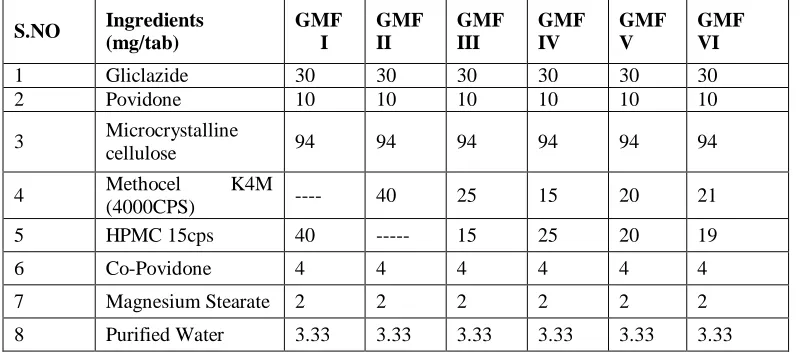
1hour. The dried granules were passed through sieve no: 30. To the dried granules the other excipients (except Magnesium Stearate) like Methocel, HPMC and Co-Povidone were added and blended. Then sifted Magnesium Stearate was added to the blend and compressed to round, flat tablets. The formulations were prepared as shown in the Table 1.
Evaluation of tablets:
The tablets were evaluated for Weight variation, Hardness, Friability, Content uniformity, Size and shape and thickness and In-Vitro dissolution.
Weight variation: The USP weight variation test was
run by weighing 20 tablets individually, calculating the average weight, and comparing the individual tablet weights to the average. The tolerance limits for the tablets was given as shown in the Table 2.
Hardness:Hardness of the tablets was determined by
Monsanto hardness tester and should be found within the range of 3-7 kg/cm2.
Size, Shape and Thickness: The size and shape of
the tablet was dimensionally described, monitored and controlled. A compressed tablet shape and dimensions were determined by the tooling during the compression process. The thickness of a tablet was the only dimensional variable related to the process.10 tablets were measured for their thickness and diameter with vernier Calipers.
Friability: The friability of tablets is determined by
Roche friabilator. 20 tablets were taken and weighed. After weighing the tablets were placed in the Roche friabilator and subjected to the combined effects of abrasion and shock by utilizing a plastic chamber that revolves at 25rpm for 4 minutes dropping the tablets from a distance of six inches with each revolution. After operation the tablets were de dusted and reweighed.
Content Uniformity: The content uniformity was
performed as follows:
Standard Preparation: About 30mg of Gliclazide
was weighed accurately and transferred into a 100ml volumetric flask. It was dissolved and diluted to final volume with methanol and mixed. 3.0ml of this solution was transferred into a 100ml volumetric flask, diluted to final volume with methanol and mixed.
Sample Preparation:One tablet was kept in a 100ml
30mins then it was diluted to volume with methanol and mixed well, filtered through 0.45 membrane filter by discarding the first few ml. 3.0ml of the filtrate was transferred into a 100ml volumetric flask, and diluted to final volume with methanol and mixed. The same procedure was repeated for 9 more tablets. The absorbances of both the standard preparation and the sample preparation were measured in a UV-Visible Spectrophotometer at 235nm using methanol as blank.
In-vitro dissolution studies of Gliclazide modified
release tablets:
In-vitro dissolution of the tablets was carried out using USP type ІІ ( paddle) in 900ml of PH 7.4 buffer (degassed) at 37±0.50C and at an rpm of 75. The samples were withdrawn at regular time intervals of 2, 8 and 16 hrs and observed using UV-Visible Spectroscopy (Electro Lab TDT-O8L, Mumbai) at 225 nm.
Degassing of the Dissolution Medium:The medium
was heated by gentle stirring to about 410 C and filtered immediately under vacuum using a filter of porosity 0.45 microns or less with vigorous stirring under vacuum for about 5 minutes. Other validated deaeration techniques were used for the removal of dissolved gases.
Chromatographic Conditions: Mobile phase was
filtered and degassed which is a mixture of water, acetonitrile, triethylamine and trifluoro acetic acid in the ratio of 55 : 45 : 0.1 : 0.1 v/v. using a Column of 250 x 4.6 mm, 5mm ( X-Terra;C18, 250 x 4.6 mm, 5 or equivalent) with a flow of 1.5 ml/minute at a temperature: 25°C ± 2°C. A Load of 20 μl was given with a runtime of 10 minutes.
Standard preparation: Gliclazide (67 mg) was
accurately weighed and transferred into a working standard of 20 ml volumetric flask, dissolved and dilute to a final volume with acetonitrile. 1 ml of this solution was pipetted into a 100 ml volumetric flask.
Sample preparation:Tablets were studied in 900 ml
of the dissolution medium at 37°C ± 0.5°C . The samples were collected at the specified time intervals and filtered through 0.45 m membrane filter after discarding the first 5 ml.
System suitability: The standard preparation was
injected for 5 times into the liquid chromatogram. The % RSD of standard areas for 5 replicate injections should not be more than 2.0%. The tailing factor for the main peak should not be more than 2.0.
Procedure: Dissolution medium as blank, the
standard preparation and the sample preparation were injected into the liquid chromatogram and the area for major peaks was recorded. The amount of Gliclazide dissolved from each tablet in % on label claim was calculated. The results obtained were compared with acceptance criteria as shown in the Table 8.
RESULTS AND DISCUSSION
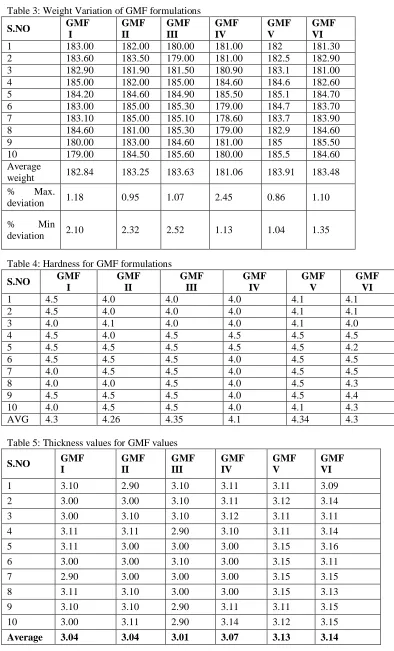
Weight variation: The results of weight variation were shown in Table 3. The results showed that the Gliclazide modified release tablets were within the limits.
Hardness: The results were shown in table: 4, this showed that the tablets have good mechanical strength capable of withstanding mechanical strength during transportation.
Size, Shape and Thickness: The results of thickness
were shown in the table: 5.The tablets were proved to have spherical shape with thickness suitable for packing.
Friability: The results were shown in Table 6. The values were within the range of 0 - 1.0 %.
Content Uniformity: The results of content
uniformity were shown in Table 7.
In-vitro dissolution studies: The results of in-vitro
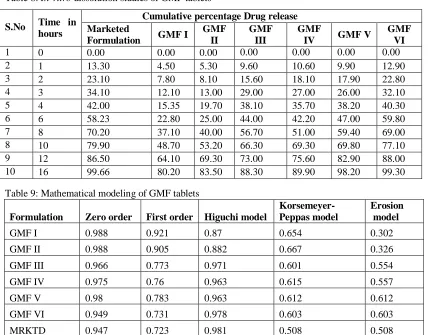
dissolution studies were fitted in mathematical models to predict the release kinetics. Mathematical modeling aids in understanding the physics of the drug transport, its release rate and behavior of the systems thus facilitating the advancement of desired novel drug delivery systems. The results of mathematical modeling were shown in the Table 9. From the results obtained by the mathematical models it was confirmed that the drug release from formulations followed zero-order kinetics by process of anomalous (non-fickian) diffusion mechanism. The results of in-vitro dissolution studies were also calculated for similarity and dissimilarity factors as shown below.
Similarity factor: Similarity factor as a "logarithmic reciprocal square root transformation of one plus the mean squared (the average sum of squares) differences of drug percent dissolved between the test and the reference products".
Rt and Tt are the cumulative percentage dissolved at
each of the selected n time points of the reference and test product respectively.
Dissimilarity factor: The dissimilarity factor (f1) calculates the percent difference between the two curves at each time point and is a measurement of the relative error between the two curves:
f1={[∑t=1nRt - Tt]/[∑t=1nRt]}×100
Where: n is the number of time points, Rt is the
dissolution value of the marketed formulation at time t and Tt is the dissolution value of the Gliclazide
modified release formulation.
The values should lie between 0-15. The results were as follows: f2 =93.99 and f1 = 1.12231
CONCLUSION
The present works concludes with GMF VI as the best formulation for the controlled release of Gliclazide following zero order kinetics with anomalous diffusion method. Furthermore in-vivo studies might confirm the formulation to substantiate the in-vitro results. Thus the Gliclazide hydrogel modified release tablets have the advantages of lowering dose frequency and improve the patient compliance.
ACKNOWLEDGEMENTS
We were very thankful for Dr.Reddy’s Laboratories, Hyderabad for providing us the gift samples.
ABBREVIATIONS
GMF- Gliclazide modifie release tablets. HPMC- Hydroxy propyl methyl cellulose.
Table 1: Formulation of Gliclazide modified release tablets
S.NO Ingredients
(mg/tab)
GMF I
GMF II
GMF III
GMF IV
GMF V
GMF VI
1 Gliclazide 30 30 30 30 30 30
2 Povidone 10 10 10 10 10 10
3 Microcrystalline
cellulose 94 94 94 94 94 94
4 Methocel K4M
(4000CPS) ---- 40 25 15 20 21
5 HPMC 15cps 40 --- 15 25 20 19
6 Co-Povidone 4 4 4 4 4 4
7 Magnesium Stearate 2 2 2 2 2 2
8 Purified Water 3.33 3.33 3.33 3.33 3.33 3.33
Table 2:Tolerance limits for uncoated tablets
S.No. Average weight of
Tablets (mg)
Max% difference
allowed
1 130 or Less ± 10
2 130 to 324 ± 7.5
Table 3: Weight Variation of GMF formulations
Table 4: Hardness for GMF formulations
S.NO GMF
I
GMF II
GMF III
GMF IV
GMF V
GMF VI
1 4.5 4.0 4.0 4.0 4.1 4.1
2 4.5 4.0 4.0 4.0 4.1 4.1
3 4.0 4.1 4.0 4.0 4.1 4.0
4 4.5 4.0 4.5 4.5 4.5 4.5
5 4.5 4.5 4.5 4.5 4.5 4.2
6 4.5 4.5 4.5 4.0 4.5 4.5
7 4.0 4.5 4.5 4.0 4.5 4.5
8 4.0 4.0 4.5 4.0 4.5 4.3
9 4.5 4.5 4.5 4.0 4.5 4.4
10 4.0 4.5 4.5 4.0 4.1 4.3
AVG 4.3 4.26 4.35 4.1 4.34 4.3
Table 5: Thickness values for GMF values
S.NO GMF
I
GMF II
GMF III
GMF IV
GMF V
GMF VI
1 183.00 182.00 180.00 181.00 182 181.30
2 183.60 183.50 179.00 181.00 182.5 182.90
3 182.90 181.90 181.50 180.90 183.1 181.00
4 185.00 182.00 185.00 184.60 184.6 182.60
5 184.20 184.60 184.90 185.50 185.1 184.70
6 183.00 185.00 185.30 179.00 184.7 183.70
7 183.10 185.00 185.10 178.60 183.7 183.90
8 184.60 181.00 185.30 179.00 182.9 184.60
9 180.00 183.00 184.60 181.00 185 185.50
10 179.00 184.50 185.60 180.00 185.5 184.60
Average
weight 182.84 183.25 183.63 181.06 183.91 183.48
% Max.
deviation 1.18 0.95 1.07 2.45 0.86 1.10
% Min
deviation 2.10 2.32 2.52 1.13 1.04 1.35
S.NO GMF
I
GMF II
GMF III
GMF IV
GMF V
GMF VI
1 3.10 2.90 3.10 3.11 3.11 3.09
2 3.00 3.00 3.10 3.11 3.12 3.14
3 3.00 3.10 3.10 3.12 3.11 3.11
4 3.11 3.11 2.90 3.10 3.11 3.14
5 3.11 3.00 3.00 3.00 3.15 3.16
6 3.00 3.00 3.10 3.00 3.15 3.11
7 2.90 3.00 3.00 3.00 3.15 3.15
8 3.11 3.10 3.00 3.00 3.15 3.13
9 3.10 3.10 2.90 3.11 3.11 3.15
10 3.00 3.11 2.90 3.14 3.12 3.15
Table 6: Friability values for GMF formulations
Formulation code
Weight of 20 tablets before test (mg)
Weight of 20 tablets after test (mg)
Friability
F=100(Wo-Wt /Wo)
GMFI 368.55 368.51 0.011%
GMFII 368.55 368.54 0.027%
GMFIII 368.53 368.51 0.054%
GMFIV 368.50 368.42 0.0217%
GMFV 368.40 368.28 0.0325%
GMFVI 368.58 368.46 0.032%
Table 7: content uniformity values for GMF formulations
Table 8: In-vitro dissolution studies of GMF tablets
.
Table 9: Mathematical modeling of GMF tablets
Formulation Zero order First order Higuchi model
Korsemeyer- Peppas model
Erosion model
GMF I 0.988 0.921 0.87 0.654 0.302
GMF II 0.988 0.905 0.882 0.667 0.326
GMF III 0.966 0.773 0.971 0.601 0.554
GMF IV 0.975 0.76 0.963 0.615 0.557
GMF V 0.98 0.783 0.963 0.612 0.612
GMF VI 0.949 0.731 0.978 0.603 0.603
MRKTD 0.947 0.723 0.981 0.508 0.508
Formulation code
Sample absorbance
Standard absorbance
Working standard weight
%Content uniformity
GMF I 0.3555 0.3789
30.8
95.9
GMF II 0.3571 0.3789 96.3
GMF III 0.3622 0.3789 97.7
GMF IV 0.3647 0.3789 98.3
GMF V 0.3668 0.3789 98.9
GMF VI 0.3674 0.3789 99.1
S.No Time in
hours
Cumulative percentage Drug release Marketed
Formulation GMF I
GMF II
GMF III
GMF
IV GMF V
GMF VI
1 0 0.00 0.00 0.00 0.00 0.00 0.00 0.00
2 1 13.30 4.50 5.30 9.60 10.60 9.90 12.90
3 2 23.10 7.80 8.10 15.60 18.10 17.90 22.80
4 3 34.10 12.10 13.00 29.00 27.00 26.00 32.10
5 4 42.00 15.35 19.70 38.10 35.70 38.20 40.30
6 6 58.23 22.80 25.00 44.00 42.20 47.00 59.80
7 8 70.20 37.10 40.00 56.70 51.00 59.40 69.00
8 10 79.90 48.70 53.20 66.30 69.30 69.80 77.10
9 12 86.50 64.10 69.30 73.00 75.60 82.90 88.00
Graph 1: In-vitro dissolution study profile of GMF tablets and Marketed formulation.
The results revealed that GMF VI showed a better release of 99.3% comparable with the marketed formulation.
References:
1. Banarer S, Cryer PE. Hypoglycemia in type 2 diabetes. In Type 2 Diabetes. Garber AJ (ed). Medical Clinics of North America, Volume 88. Elsevier Science, Philadelphia, 2004; pp 1107-1116
2. Gliclazide(4448); The Merck Index,12th edition, pp 754.
3. Hiroshima, y. Immura “Hypoglycemic action and disposition of gliclazide in normal and albino rats”. Hiroshima J. Med. Sci., 1990; 39: 7-97.
4. Marina Levina, Ali R.Rajabi-Siahbhoomi. The Influence of Excipients on Drug Release from HPMC Matrices. J. Pharm. Sci., 2004; 93(11): 2746-54.
5. Reza MS, Quadir MA, Haider SS. Comparative evaluation of plastic, hydrophobic and hydrophilic polymers as matrices for controlled-release drug delivery, J. Pharama. Sci.,2003; 6(2): 282-91.
6. P.Courtis “pharmacokinetics of gliquidone,glibenclamide,gliclazide and glipizide in middle-azed and azed subjects”, Res Cemmun Mol. Pathology and Pharmacol., 2000; 103: 211-22.
7. Robert E.Notari, “Biopharmaceutics and Clinical Pharmacokinetics – An Introduction” 4th edn revised and expanded, pp208.
8. Aggarwal S, Singh PN, Mishra B. Enhancement of solubility and hypoglycemic activity of gliclazide by complexation with beta-cyclodextrin in the presence of hydroxyl propyl methyl cellulose. Pharmazie, 2002; 57: 191-3.