Page 84 www.ijiras.com | Email: [email protected]
Stability Optimization For Renewable Energy Integrated
DC Grid Using Ann Technique
B. Gopinath
Head of the Department, Department of Electrical and Electronics Engineering, Vivekananda institute of Engineering and technology for Women, Tiruchengode,
Namakkal District
J. Reva
PG Scholar, Department of Electrical and Electronics Engineering, Vivekananda institute of Engineering and technology for Women, Tiruchengode, Namakkal District
I. INTRODUCTION
Renewable energy is energy generated from natural resources such as sunlight, wind, rain, tides and geothermal heat which are renewable. Renewable energy technologies range from solar power, wind power, hydroelectricity/micro hydro, biomass and bio fuels .Renewable energy is also called "clean energy" or "green power" because it doesn't pollute the air or the water. Wind energy system: The terms "wind energy" or "wind power" describe the process by which the wind is used to generate mechanical power or electricity. Wind turbines convert the kinetic energy in the wind into mechanical power. A generator can convert this mechanical power into electricity. To power homes, businesses, schools, and the like. Energy is generated without polluting environment.
Many research works on dc micro grids have been conducted to facilitate the integration of various DERs and energy storage systems. In [1], [2], a dc micro grid based wind farm architecture in which each wind energy conversion unit consisting of a matrix converter, a high frequency transformer and a single-phase ac/dc converter is proposed. However, the
proposed architecture increases the system complexity as three stages of conversion are required. In [3], a dc micro grid based wind farm architecture in which the WTs are clustered into groups of four with each group connected to a converter is proposed. However, with the proposed architecture, the failure of one converter will result in all four WTs of the same group to be out of service. The research works conducted in [4]–[5] are focused on the development of different distributed control strategies to coordinate the operation of various DERs and energy storage systems in dc micro grids. These research works aim to overcome the challenge of achieving a decentralized control operation using only local variables. However, the DERs in dc micro grids are strongly coupled to each other and there must be a minimum level of coordination between the DERs and the controllers. In [6], [7], a hybrid ac/dc grid architecture that consists of both ac and dc networks connected together by a bidirectional converter is proposed. Hierarchical control algorithms are incorporated to ensure smooth power transfer between the ac micro grid and the dc micro grid under various operating conditions.
However, failure of the bidirectional converter will result in the isolation of the dc micro grid from the ac micro grid.
Abstract: In our proposed system, the sepic converter controlled to track periodic current and voltage references and the control signals have a limited operating range. Under such operating condition, the ANN algorithm is operating close to its operating limits. In these research works, the conversion of energy is formulated into different output voltage (380V, &700V) different input and output voltages are proposed to solve these optimization problems. The scope of this paper is however focused on the application of PMSG wind for universal dc application with ANN based SEPIC converter. Wind power generation system in a DC grid is proposed and the effectiveness of the proposed system is verified by MATLAB simulation studies under different operating conditions.
Page 85 www.ijiras.com | Email: [email protected] The ANN algorithm will operate the inverters close to their
operating limits to achieve a more superior performance as compared to other control methods which are usually conservative in handling constraints [8], [9]. In this paper, the inverters are controlled to track periodic current and volt-age references and the control signals have a limited operating range. Under such operating condition, the ANN algorithm is operating close to its operating limits where the constraints will be triggered repetitively. In conventional practices, the control signals are clipped to stay within the constraints, thus the sys-tem will operate at the sub-optimal point.
This results in inferior performance and increases the steady-state loss. ANN, on the contrary, tends to make the closed-loop system operate near its limits and hence produces far better performance. ANN has also been receiving increased research attention for its applications in energy management of micro grids because it is a multi-input, multi-output control method and allows for the implementation of control actions that predict future events such as variations in power generation by intermittent DERs, energy prices and load demands [10]. In these research works, the management of energy is formulated into different multi-objective optimization problems and different ANN strategies are proposed to solve these optimization problems. The scope of this paper is however focused on the application of ANN for the control of converters.
II. SYSTEM DESCRIPTION AND MODELING A. SYSTEM DESCRIPTION
The system can operate either connected to or the distribution grid and consists of 40 kW permanent magnet synchronous generators (PMSGs) which are driven by the variable speed WTs. The PMSG is considered in this paper because it does not require a dc excitation system that will increase the design complexity of the control hardware. The phase output of each PMSG is connected to a three-phase converter which operates as a rectifier to regulate the dc output voltage of each PMSG to the desired level at the dc grid.
This architecture minimizes the need to synchronize the frequency, voltage and phase, reduces the need for multiple converters at the generation side, and provides the flexibility for the plug and play connection of WGs to the dc grid.
The maximum power generated by each WT is estimated from the optimal wind power
Pw t ,o p t =K
o p t (ωr,o pt)3 (1)
where kop p t is the optimized constant, for p t is the WT speed for optimum power generation, Cp ,o p t is the optimum power coefficient of the turbine, ρ is the air density, A is the area swept by the rotor blades, do p t is the optimum tip speed ratio, v is the wind speed and R is the radius of the blade. When one converter fails to operate or is under maintenance, the other converter can handle the maximum power output of 40 kW from the PMSGs. Thus the proposed topology offers increased reliability and ensures continuous operation of the wind power generation system when either converter 1 or
converter 2 is disconnected from operation. An 80 Ah storage battery (SB), which is sized according to , is connected to the dc grid through a 40 kW bidirectional dc/dc buck-boost converter to facilitate the charging and discharging operations when the micro grid operates connected to or islanded from the grid. The energy constraints of the SB in the proposed dc grid are determined based on the system-on-a-chip (SOC) limits given by
Sock in < SOC ≤ Sock a x
Although the SOC of the SB cannot be directly measured, it can be determined through the estimation methods as detailed in referred paper. With the use of a dc grid, the impact of fluctuations between power generation and demand can be reduced as the SB can swiftly come online to regulate the voltage at the dc grid. During off-peak periods when the electricity demand is low, the SB is charged up by the excess power generated by the WTs. Conversely, during peak periods when the electricity demand is high, the SB will supplement the generation of the WTs to the loads.
B. SYSTEM OPERATION
When the micro grid is operating connected to the distribution grid, the WTs in the micro grid are responsible for providing local power support to the loads, thus reducing the burden of power delivered from the grid. The SB can be controlled to achieve different demand side management functions such as peak shaving and valley filling depending on the time-of-use of electricity and SOC of the SB.
During islanded operation where the CBs disconnect the mi-corgi from the distribution grid, the WTs and the SB are only available sources to supply the load demand. The SB can supply for the deficit in real power to maintain the power balance of the micro grid as follows:
where Paw t is the real power generated by the WTs, Pub is the real power supplied by SB which is subjected to the constraint of the SB maximum power Pub ,m a x that can be delivered during discharging and is given by
Plod sisis the system loss, and Plis the real power that is
supplied to the loads.
III. BLOCK DIARAM
Wind turbine its convert kinetic energy into mechanical energy. In order to operate with low speeds, a high number of poles are used in PMSG wind turbines. Instead of electrical DC excitation the magnetic rotor field is provided by permanent magnets. Because the multiple poles PMSG is a converter connected low speed application, no damper winding is necessary. The use of permanent magnets eliminates the DC excitation system, which means a reduction of losses and the omission of slip rings and thus maintenance requirements.
Paw t +Pub =Plod sis +Pl (2) P
Page 86 www.ijiras.com | Email: [email protected] This configuration may respond to a variable speed wind
turbine with a permanent- magnet synchronous generator connected to the grid through a full-scale power converter. In ac-dc converter IGBT switche is used..
Figure 1: Block diagram for dc-dc boost converter
It is 3 terminal power semiconductor devices. High efficiency, fast switching. It reduces the audible noise. It has low switching loss & low conduction loss. DC-DC Boost Converter is used to produce the constant voltage.
The sepic converter is used to Boost the dc voltage. The sepic converter is gives the constant voltage to the DC grid. The application of ANN for the control of converter. ANN is used to clear the error. epic converter is used to boost the DC voltage. DC-DC Converter it gives the constant voltage to the DC grid.
PWM gives pulse to the converters.
Figure 2: Block diagram for ANN method
IV. SIMULATION RESULTS AND DISCUSSION The most significant advantage of the proposed dc grid based wind power generation system is that it facilitates the connection of any PMSGs to the microgrid without the need to synchronize their voltage and frequency. This capability is demonstrated in this case study.
Figure 3: Simulation diagram
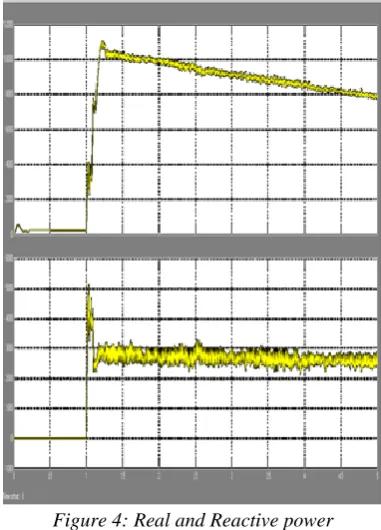
The microgrid operates connected to the grid and PMSG A is disconnected from the dc grid for 0 ≤t < 0.2 s as shown in Fig. 4. The real power generated from each of the remaining three PMSGs is maintained at 5.5 kW and their aggregated real power of 16.5 kW at the dc grid is converted by inverters 1 and 2 into 14 kW of real power and 8 kVAr of reactive power.
Figure 4: Real and Reactive power
Page 87 www.ijiras.com | Email: [email protected]
Figure 5: Wind output
At t = 0.2 s, PMSG A which generates real power of 5.5 kW is connected to the dc grid. This causes a sudden power surge at the dc grid and results in a voltage rise at t = 0.2. At t
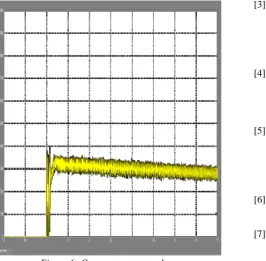
= 0.26 s, the EMS increases the real delivered by each inverter to 10 kW while the reactive power supplied by each inverter remains unchanged at 4 kVAr. This causes a momentarily dip in the dc grid voltage at t = 0.26 s as observed .which is then restored back to its nominal voltage of 500 V for 0.26 ≤ t <
0.4 s. The grid also simultaneously decreases its supply to 40 kW of real power for 0.26 ≤t < 0.4 s while its reactive power remains constant at 4 kVAr as shown in Fig. 6
Figure 6: Converter output voltage
V. CONCLUSION
In this paper, the design of a dc grid based wind power gen-eration system in a micro grid that enables parallel operation of several WGs in a poultry farm has been presented. As compared to conventional wind power generation systems, the proposed micro grid architecture eliminates the need for voltage and fre-quency synchronization, thus allowing the WGs to be switched on or off with minimal disturbances to the micro grid opera-tion. The design concept has been verified through various test scenarios to demonstrate the operational capability of the pro-posed micro grid and the simulation results has shown that the proposed design concept is able to offer increased flexibility and reliability to the operation of the micro grid. However, the proposed control design still requires further experimental val-idation because measurement errors due to inaccuracies of the voltage and current sensors, and modeling errors due to varia-tions in actual system parameters such as distribution line and transformer impedances will affect the performance of the con-troller in practical implementation. In addition, ANN relies on the accuracy of model establishment, hence further research on improving the controller robustness to modeling inaccuracy is required. The simulation results obtained and the analysis per-formed in this paper serve as a basis for the design of a dc grid based wind power generation system in a micro grid.
REFERENCES
[1] A Mogstad, M. Molinas, P. Olsen, and R. Nilsen, ―A power conversion system for offshore wind parks,‖ in
Proc. 34th IEEE Ind. Electron., 2008.
[2] 2106–2112. D. Jovic, ―Offshore wind farm with a series multiterminal CSI HVDC,‖ Elect. Power Syst. Res., vol. 78, no. 4, pp. 747–755, Apr. 2008.
[3] X. Lu, J. M. Guerrero, K. Sun, and J. C Vasquez ―An improved droop con-trol method for DC micro grids based on low bandwidth communication with DC bus voltage restoration and enhanced current sharing accuracy,‖ IEEE Trans. Power Electron., vol. 29, no. 4, pp. 1800–1812, Apr. 2014.
[4] T. Dragicevi, J. M. Guerrero, and J. C Vasquez, ―A distributed con-trol strategy for coordination of an autonomous LVDC micro grid based on power-line signaling,‖ IEEE Trans. Ind. Electron., vol. 61, no. 7, 3313–3326, Jul. 2014.
[5] N. L. Diaz, T. Dragicevi, J. C. Vasquez, and J. M. Guerrero, ―Intel-ligent distributed generation and storage units for DC micro grids—A new concept on cooperative control without communications beyond droop control,‖
IEEE Trans. Smart Grid, vol. 5, no. 5, pp. 2476–2485,
Sep. 2014.
[6] X. Liu, P. Wang, and P. C. Loh, ―A hybrid AC/DC micro grid and its coordination control,‖ IEEE Trans. Smart Grid, vol. 2, no. 2, pp. 278–286, Jun. 2011.
Page 88 www.ijiras.com | Email: [email protected] pp. 462–471, Feb. 2014.
[8] M. Falahi, S. Lotfifard, M. Eshani, and K. Butler-Purry ―Dynamic model predictive-based energy management of DG integrated distribution sys-tems,‖ IEEE Trans. Power Del., vol. 28, no. 4, pp. 2217–2227, Oct. 2013.
[9] N. Mendis, K. M. Muttaqi, S. Sayeef, and S. Perera, ―Standalone op-eration of wind turbine-based variable speed generators with maximum power extraction
capability,‖ IEEE Trans. Energy Convers., vol. 27, no. 4, pp.822–834, Dec. 2012