DEVELOPMENT AND VALIDATION OF REVERSE PHASE HIGH
PERFORMANCE LIQUID CHROMATOGRAPHY METHOD FOR
ESTIMATION OF NICOTINE IN NICOTINE GUM TABLET.
PATEL JIGNESH V.*, PATEL DIPTI B.,
Department of Pharmaceutical Quality Assurance,
Shree S. K. Patel College of Pharmaceutical Education & Research, Ganpat University, Kherva – 382711, Mehsana, Gujarat, India.
Date Received:
19-Mar-2014
Date of Accepted:
13-Apr-2014
Date Published:
15-Apr-2014
Abstract:
This research manuscript describes simple, sensitive, accurate, precise and repeatable reverse phase high performance liquid chromatography method for the determination of nicotine in gum tablet. The sample was analyzed by reverse phase C18
column (Phenomenex C18, 250 mm × 4.6 mm, 5µ) as stationary phase; acetonitrile : phosphate buffer (PH-3.5) (70 : 30 ,
v/v) as a mobile phase at a flow rate of 1.0 ml/min. Quantification was achieved with Photo Diode Array detector at 260 nm. The retention time for nicotine was found to be 3.5 min. The linearity was obtained in the concentration range of 0.2-1.2 µg/ml for nicotine. The method was successfully applied to gum tablet dosage form because no chromatographic interferences from formulation excipients were found. The method retained its accuracy and precision when the standard addition technique was applied.
Keywords
: Nicotine, RP-HPLC, Photo Diode Array, Method validation.Introduction
Nicotine (pyridine, 3-(1-methyl-2-pyrrolidinyl), is one of the highly toxic tobacco alkaloids present in tobacco leaves and cigarette smoke. Nicotine appears to be a promising tracer for environmental tobacco smoke because of its specificity for tobacco. It is also a systemic and contact insecticide and is also used as a drug and in chemical. [1] It is official in British Pharmacopoeia (BP), United States Pharmacopoeia (USP) and European Pharmacopoeia (EP). In which USP [2] and BP [3] describe Potentiometric method for estimation and EP [4] describe simple Spectrophotometry. Literature survey reveals RP-HPLC [5], Liquid chromatography-Mass spectroscopy-
Mass spectroscopy [6], High performance thin layer chromatography (HPTLC) [7], Capillary electrophoresis
[8]
MATERIALS & METHODS Apparatus
The chromatography was performed on a Shimadzu (Japan) RP-HPLC instrument (LC-2010CHT) equipped with Photo Diode Array (PDA) detector and LC-solution software, Phenomenex (Torrance, CA) C18 column (250 mm × 4.6 mm id, 5µm particle size) was used as stationary phase. Sartorius CP224S analytical balance (Gottingen, Germany), an ultrasonic cleaner (Frontline FS 4, Mumbai, India), Digital pH meter (LI 712 pH analyzer, Elico Ltd., Ahmedabad) were used in the study.
Reagents and materials
Nicotine standards was kindly supplied as a gift samples from BGP Healthcare PVT. LTD, Ankleshwar, Gujarat, India. The gum tablet (Nicorex) containing 4 mg nicotine was obtained from local market. Acetonitrile, Methanol, triple distilled water (S. D. Fine Chemicals Ltd., Mumbai, India) used were of HPLC grade. Nylon 0.45 µm – 47 mm membrane filter (Gelman Laboratory, Mumbai, India) and Whatman filter paper no. 41. (Whatman International Ltd., England) were used in the study.
Chromatographic Condition
Stationary phase: C18 column (150 mm x 4.6 mm id., 5
µm).
Mobile phase: Acetonitrile: Phosphate buffer (PH- 3.5)
(70: 30, v/v)
Flow rate: 1.0 ml/min
Injection volume: 20 µL
Temperature: 40 °C
Detection: At 260 nm using PDA detector.
Preparation of Solutions
Preparation of standard stock solutions of Nicotine
Accurately 0.1 ml standard Nicotine was transferred into 100 ml volumetric flask, dissolved and diluted up to mark with distilled water. Transferred 10 ml of the above solution into 100 ml volumetric flask and diluted up to mark with distilled water. This will give a stock solution having strength of 10 µg/ml.
Preparation of Calibration Curve
Aliquots equivalent to 0.2, 0.4, 0.6, 0.8, 1.0 and 1.2 ml working standard solution of nicotine was transferred into a series of five 10 ml volumetric flasks separately and volume was adjusted to the mark with solvent (Methanol) to get concentrations 0.2, 0.4, 0.6, 0.8, 1.0, 1.2 µg/ml of nicotine. 20 µl of each of the solution were injected into HPLC system and analyzed. Calibration curve was obtained by plotting respective peak area against concentration in µg/ml and the regression equation was computed.
Preparation of sample solution
To determine the content of Nicotine in gum tablet, the tablet of Nicotine was taken, cut it into small pieceswas transferred in 100 ml beaker, add 70 ml of distilled water and sonicate it for 5 to 6 hours for the extraction of
filtrate in 100 ml volumetric flask and make up the volume 100 ml with distilled water. Pippete out 0.1 ml of above solution to 10 ml volumetric flask and make up the final volume with methanol.
Method Validation
The method was validated in compliance with ICH guidelines [13].
Accuracy (recovery study)
To study the accuracy of the proposed method, recovery studies were carried out by standard addition method at three different levels (50%, 100% and 150%). A known amount of standard was added to preanalyzed sample powder and percentage recoveries were calculated.
Method precision (Repeatibility)
The precision of the instrument was checked by repeatedly injecting (n=6) solutions of nicotine (0.6
µg/ml) without changing the parameters. The results were reported in terms of relative standard deviation (% RSD).
Intermediate Precision (Reproducibility)
Intraday precision was determined by analysing of nicotine standard solutions in the range 0.6, 0.8 and 1.0
µg/ml of nicotine. Measure three times on the same day and calculate % RSD for nicotine.
Interday precision was determined by analysing of nicotine standard solutions in the range 0.6, 0.8 and 1.0
µg/ml of nicotine on the different day and calculate % RSD for nicotine.
Limit of detection and Limit of quantification
The limit of detection (LOD) and the limit of quantification (LOQ) of the drug were derived by calculating the signal-to-noise ratio (S/N, i.e., 3.3 for LOD and 10 for LOQ) using the following equations designated by International Conference on Harmonization (ICH) guidelines [20-21].
LOD = 3.3 × σ/S LOQ = 10 × σ/S
Where, σ = the standard deviation of the response and S = slope of the calibration curve.
Robustness
The robustness study was performed to evaluate the influence of small but deliberate variation in the chromatographic condition. The robustness was checked by changing three small changes.
1) Mobile phase flow rate (1±0.1ml/min)
2) Organic phase modifier (change in acetonitrile and buffer ratio)
3) pH (3.5±0.2 units)
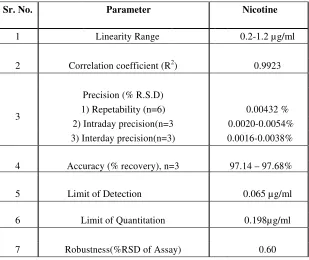
Table 1 Regression analysis data and summary of validation parameter for the proposed RP-HPLC method
Sr. No. Parameter Nicotine
1 Linearity Range 0.2-1.2 µg/ml
2 Correlation coefficient (R2) 0.9923
Precision (% R.S.D)
3 1) Repetability (n=6) 0.00432 % 2) Intraday precision(n=3 0.0020-0.0054% 3) Interday precision(n=3) 0.0016-0.0038%
4 Accuracy (% recovery), n=3 97.14 – 97.68%
5 Limit of Detection 0.065 µg/ml
6 Limit of Quantitation 0.198µg/ml
7 Robustness(%RSD of Assay) 0.60
Table 2 Recovery data for the proposed method
Formulation Level Amount of
sample taken (µg/ml)
Amount of standard spiked (µg/ml)
Mean % recovery ± %R SD (n=4)
Gum tablet I (50%) 0.2 0.1 97.68 ± 0.326
II (100%) 0.2 0.2 97.14 ± 1.267
III (150%) 0.2 0.4 97.18 ± 1.235
Table 3 System suitability test parameters for DIA and PARA for the proposed RP-HPLC method
Parameters Nicotine ± % CV
(n=6) Retention Time
(minutes)
3.5 ± 0.23
Tailing Factor 1.3±1.5
Theorical Plate 2205± 1.813
Ressolution 2.5
Table 4 Analysis of tablet formulation of nicotine by proposed RP-HPLC method (n = 3)
Label Claim (mg) %Assay* ± %RSD
Nicotine Nicotine
Figure 1 : Calibration curve of nicotine at 260 nm
Figure 2: Chromatogram of nicotine standard (0.8 µg/ml) and sample solution at 260 nm
RESULTS AND DISCUSSION
To optimize the RP-HPLC parameters, several mobile phase compositions were tried. A satisfactory separation and good peak symmetry for nicotine was obtained with a mobile phase comprising of acetonitrile: Phosphae buffer (70: 30, v/v) at a flow rate of 1.0 ml/min to get better reproducibility and repeatability. Quantification was achieved with PDA detection at 260 nm based on peak area. The peak with clear baseline was obtained (Figure 1). The retention time for nicotine was found to
was obtained between peak area versus concentrations of nicotine in the concentration ranges of 0.2-1.2 µg/ml for nicotine drugs (Table 1) (Figure 1). The method was found to be specific as no significant changes in the responses of nicotine was observed after 24 hrs. The mean recoveries obtained was 97.33 ± 0.94 % for nicotine (Table 1 and 2), which indicates accuracy of the proposed method. The % RSD value for nicotine was found to be <2 %, which indicates that the proposed method is repeatable. The low % RSD values of interday and intraday variations for both the drugs, reveal that the
0.0 1.0 2.0 3.0 4.0 5.0 m in
0 10 20 30 40 50 60 70 80
m AU
241nm ,4nm (1.00)
1
.8
1
0
2
.0
1
6
2
.5
0
3
2
.7
8
3
2
.9
8
6
3
.5
4
6
0.0 0.5 1.0 1.5 2.0 2.5 3.0 3.5 4.0 4.5 m in
0 5 10 15 20 25 30 35 40
m AU
241nm ,4nm (1.00)
1
.7
9
6
2
.4
9
8
2
.7
7
6
2
.9
6
7
3
.5
1
found to be 0.065 µg/ml and LOQ value for nicotine was found to be 0.198 µg/ml (Table 1). These data show that the proposed method is sensitive for the determination of nicotine.
CONCLUSION
A simple, sensitive, repeatable and specific RP-HPLC method has been developed for the estimation of nicotine using a PDA detector. The method was validated for accuracy, precision, linearity, specificity, LOD & LOQ and robustness. In this proposed method the linearity is observed in the concentration range of 0.2-1.2 µg/ml for both the drugs with co-efficient of correlation (r2) = 0.9923 for nicotine at 260 nm. The result of the analysis of tablet by the proposed method is highly reproducible and reliable and it is in good agreement with the label claim of the drugs. The method can be used for the routine analysis of the nicotine in gum tablet without any interference of excipients.
ACKNOWLEDGEMENT
The authors are thankful to BGP Healthcare PVT. LTD, Ankleshwar, Gujarat, India for providing gift sample of nicotine for research. The authors are highly thankful to Shree S. K. Patel College of Pharmaceutical Education & Research, Ganpat University, Kherva, Mehsana, Gujarat, India for providing all the facilities to carry out the work.
REFERENCES
1. Maryadele J O’ Neil ed, Merck Index, 14th Edition, Merck & Co. Inc, White House Station NJ: 1177,2005.
2. U. S. Pharmacopoeia/ NF Vol. III. The United states pharmacopeial convention, Twinbrook pathway Rockvillae, 3079,2009.
3. British Pharmacopoeia. Vol. ll. Stationary office. London Medicines and Healthcare product regulatory agency, 1501, 2010.
4. European Pharmacopoeia 6.0. Vol. II. 6th edition. Starboary: Council of Europe, 2500, 2007.
5. James A., Denise E. Quantitation of Major Tobacco Alkaloids by High-Performance Liquid Chromatography, Journal of Chromatography., 205: 147–154, 1981.
6. Laurian V., Lorena F., Ioana E. Determination of nicotine from tobacco by LC/MS/MS, Studia Universitais babebolyai, Physica, L., 4b: 19-24, 2005.
7. Lionel P., Christine P., Sophie L. Determination of nicotine in tobacco by HPTLC, ICH harmonized tripartile guidelines, validation of analytical procedures, text & methodology., Q2A(R1): 127-133, 2005.
8. Jin-ying1 S., Xiao-yu1 X., Huan Y., Tian-yan1 Y,. Determination of Nicotine in Tobacco by Capillary Electrophoresis with Electrochemical Detection, Chem. Res. Chinese Universities., 28(3): 415—418, 2012.
9. Lochmann H., Bazzanella A., Kropsch S.Determination of tobacco alkaloids in single plant cells by capillary electrophoresis, Journal of Chromatography., 917: 311–317, 2001.
10. Hiroyuki K., Reiko I., Katsuharu Y., Keita S. Determination of nicotine, cotinine, and related alkaloids in human urine and saliva by automated in-tube solid-phase microextraction coupled with liquid chromatography-mass spectrometry, J Pharm Biomed Anal., 625-635, 2008.
11. K.N Patel. Journal of Pharmacy Research, Derivative Spectrophotometric Method for Simultaneous Estimation of nicotine and Bupropion Hydrochloride in Synthetic Mixture., 2(9): 1525-1527, 2009
12. Laura J.L., John D.L., Delbert J.E., Lee D.H., Edwin A.L. Determination of Nicotine and Cotinine by Ion Pair Reversed-Phase Chromatography, Journal of Chromatographic Science. 28(4): 200-203, 1990. 13. The International conference on harmonization, Q2