ISSN (e): 2250-3021, ISSN (p): 2278-8719
Vol. 08, Issue 7 (July. 2018), ||V (II) || PP 12-17
Image Retrieval Using the Centroid Based Shape Descriptor
Prof. Jayadevi C Karur, Dr. Jagadeesh Pujari, Priyanka R Kabber
Professor, CSE Department, SDM College of Eng & Tech Dharwad , India Professor, ISE Department, SDM College of Eng & Tech Dharwad , India M Tech student, CSE Department, SDM College of Eng & Tech Dharwad , India
Corresponding Author: Prof. Jayadevi C Karur, Dr
Abstract:
Shape analysis is used in many application field including security applications, medical field , agricultural field , cyber crime and many more. A shape descriptor is the simplified representation of the images. These shape descriptors contain the information of the image which will help to store the image information and make easy comparison between the images or easy for matching the different shapes .The proposed method is centroid based shape descriptor. The type of shape descriptor used here is contour based shape descriptor. Distance from center of bounding box encompassing the edge image to farthest point on the edge is calculated. A circle is drawn using the distance mentioned above as radius (the farthest distance between centroid and edge pixel). Compute the distances between every pair of edge pixels on the line, which is diameter of the circle. These intermediate distance matrix is nothing but the features of image. The result of four methods mentioned in the paper are compared in terms of accuracy and efficiency and best method to find the features of images is suggested. The main aim of this research is to look for and develop promising shape descriptor(s) which was found to be Shape Context for image retrieval and also to improve efficiency.--- --- Date of Submission: 22-06-2018 Date of acceptance: 07-07-2018 ---
---I.
INTRODUCTION
Rapid growth in multimedia applications has led to a growing interest in retrieval of images from remote databases or from large collections. There is a demand for searching tools which are effective in identifying of images from large databases. One of the visual features which is important to describe contents of image is shape. Some of the parameters called shape parameters that describes the shape are area, bounding rectangle, compactness, roundness, elongation, convexity, axis of least inertia, Circularity ratios, digital binding energy, elliptic variance, Euler number and whole area ratio. Shape similarity can be measured by measuring similarity between features. The shape features must exhibit some of the properties that are essential for efficient shape features. Shape must be identifiable and properties such as statistically independent, noise resistance, reliable, affine invariance, translation scaling and rotation invariance must be present. Shape descriptors describe given shape and are generally some set of numbers. Shape descriptors must not be in large size and therefore must be stored compactly and must fulfill the requirement of shape approximation and simplification to obtain good accuracy results. Classification of shape representation and description techniques can be done in and as two methods. They are Contour-based methods and Region-based methods. The proposed shape descriptor is Contour-based. The contour-based shape descriptor extracts only boundary information.
II.
SYSTEM MODEL
System model of the implementation is given in Fig2.1. Query Image is chosen randomly from the dataset. Query set is chosen in such a way that, it consists of one image from all classes of MPEG7 dataset (which consists of 70 classes and 20 images in each class).
Remaining steps are explained in next part in detail.
III.
IMPLEMRNTATION
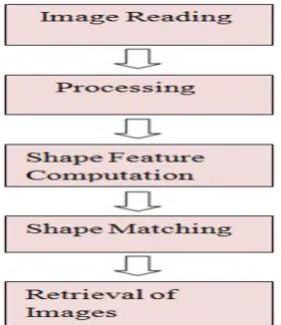
In this section detailed implementation of each step involved in finding the descriptor is explained. The working of descriptor from feature extraction till similarity matching is divided into the following stages as shown in Fig3.1:
Fig3.1 Flow diagram depicting working of the shape descriptor
Here we are concentrating more on shape feature computation. The feature computation varies from method to method. The number of computations to compute the feature is directly proportion to time which increase the cost.
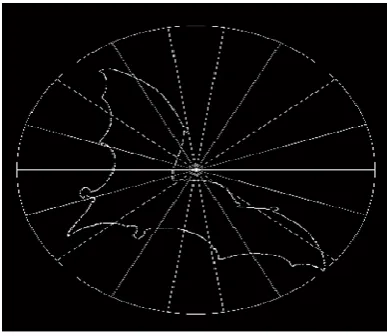
We are considering the guiding circle to compute the features of an object. Divide the circle into two halves, compute the distances of pixels of first half only because opposite half pixels are noted automatically because here considering the diameter rather than the radius.
3.1 Method 1:
Consider 180 degrees of first half circle. To do that, first need to find the number of pixels coverd, in each degree. It is calculated as follows:
A line using Bresenhams algorithm drawn between two opposite pixels on circle forms the basis of computation. Distances between all the edge pixels falling on the above mention line are computed and then normalized by maximum distance.
3.1.1 Shape Matching and Image retrieval
Shape Matching is done on the basis of Histogram matching. Canberra( L1 norm ) distance measure is used for similarity measure. The histogram of this method is given Fig. 3.1.1.
The local histogram is plotted of size 32 x 64. The distances interval is set as follows:
The histogram of query image is compared with the histogram of all images of the dataset .The minimum distance of similarity between histograms of query image and images of data set is calculated. Minimum distance means similar to query image.
3.2 Method 2:
Consider all the pixel values of the half circle i.e. length of half circle. A line using Bresenham algorithm drawn between two opposite pixels on circle forms the basis of computation. Distances between all the edge pixels falling on the above mention line are computed. Normalise all the distances by maximum distance. This method is to overcome the method 1 because in method 1 we are just considering the 180 values or degrees in first half circle where most of the pixels computation are lost which will effect in the term of efficiency while retrieving the query image from the dataset.
3.2.1 Shape Matching and Image retrieval
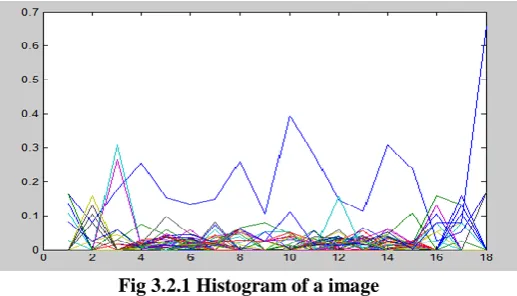
Shape Matching is done on the basis of Histogram matching. Canberra( L1 norm ) distance measure is used for similarity measure. The histogram of this method is given Fig. 3.2.1.
The local histogram is plotted of size 32 x 64 . The distances interval is set as follows:
The minimum of maximum (end to end edge pixel on diameter) is starting value and end value is maximum of maximum which is 1 on x-axis. The range of values on y-axis is from minimum of minimum (distance from one end point on the diameter to all edge pixels on the diameter) to maximum of minimum which is also 1. All the distances are distributed in the intervals mentioned.
Fig 3.2.1 Histogram of a image
The histogram of query image is compared with the histograms of all images in the dataset. The minimum distance of similarity between histograms of query image and images of data set is calculated. Minimum distance means similar to query image.
3.3 Method 3:
Consider the all the pixels values of the half circle i.e., length of half circle. A line using Bresenham algorithm drawn between two opposite pixels on circle forms the bases of computation. Distances between all the edge pixels falling on the above mention line are computing. Normalise the distances by maximum distance. Now distances ranges are in between 0 and 1.Plot the 1 diamensional histogram.
This method is to overcome the method 1and method 2 because in method 1 we are just considering the 180 values or degrees in first half circle where most of the pixels computation are lost which will effect in the term of efficiency while retrieving the the query image from the dataset. And in method two we are plotting 2d histogram for entire image because of that somewhere we are losing data of the object because of the histogram compactness. To overcome the problem in this method we are plotting each histogram for each spike.
3.3.1 Shape Matching and Image retrieval
Shape Matching is done on the basis of Histogram matching. Canberra( L1 norm ) distance measure is used for similarity measure. The histogram of this method is given Fig. 3.3.1.The local histogram is plotted of size 64. The distances interval is to be set as follows:
Fig 3.3.1 Histogram of a image
The histogram of query image is compared with the histograms of all images in the dataset. The minimum distance of similarity between histograms of query image and images of data set is calculated. Minimum distance means similar to query image.
3.4 Method 4
In this method only first half of circle pixels are considered because opposite pixels are noted automatically. A line using Bresenham algorithm drawn between two opposite pixels on circle forms the basis of computation. Distances between all the edge pixels falling on the above mention line are computing.
The circle encompassing the image is being segmented into bins. Here the first half circle is divided into 18 bins. This is to be applied only to the pixels which are covered on one half of circle and diagonally opposite pixels are noted as pixels of other half circle. The distance come under that bin will be plotted in histogram (2D). Each histogram is plotted for each bin.
3.4.1 circle binning 3.4.1 Shape Matching and Image retrieval
Fig 3.4.1.1 Histogram of first bin of image
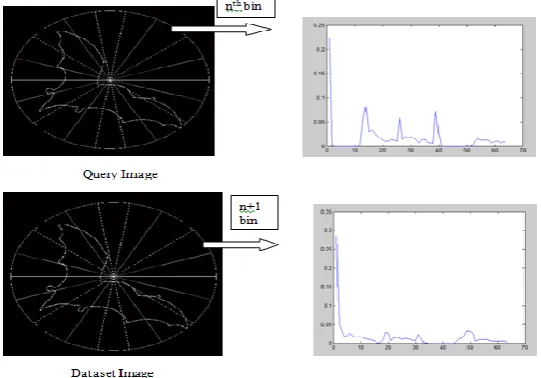
The histogram of query image is compared with the histogram of all dataset .But the way of matching is different. The histogram of one bin of image is compared with the histogram of other bin of query image. Thus the bin wise matching is done by relative way of rotating the bins.
The bins are rotated one by one and compared with the query image until the best match for the query image occurs. For doing so we need to set two flags. Flag 1 means clockwise rotation of bins and Flag 2 means anticlockwise rotation of bins of query image. Find the minimum distance of similarity between the histograms. Minimum distance means closer the result (more is the image close and maximum distance means query image is distinct or not so similar to the query image.
Fig 3.4.1.2 Bin wise rotational histogram matching
In histogram matching, in the first iteration the nth bin of dataset image is compared with nth bin of the query image ,if it not matched means again in second iteration n+1th bin of dataset image is compared with nth bin of query image as shown in Fig 3.4.1.2.
IV.
RESULT
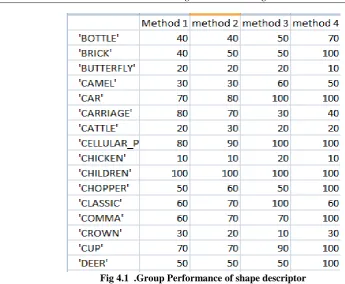
Fig 4.1 .Group Performance of shape descriptor
V.
CONCLUSION
By considering the all four methods, we can say that method 4 is best among four methods to compute the features . Because in method 1 we are considering the 180 values or degrees in first half circle where most of the pixels computation are lost which will effect in the term of efficiency while retrieving the query image from the dataset. In method 2 we are plotting 2D histogram for entire image because of that somewhere we are losing data of the object because of the histogram compactness.In Method 3 for each spike one histogram is drawn where number of computation and time increased but still accuracy decreased compared to method 4. In method 4 localized histograms are plotted for each bin of an image and the histogram matching is done by bin wise rotation in a relative way between query image and dataset image. The results obtained are efficient as the features are compact with reduced computations and the descriptor exhibits invariance towards geometrical transformations and mirroring as well due to the normalization process . So by seeing drawbacks of 3 methods we can say that method 4 is good to compute the image features.
REFERENCES
[1]. Sonya Eini and Abdulah, Shape retrieval using Smallest Rectangle Centroid Distance, IJSP, Image Processing and Pattern Recognition Vol.6, No.4, August, 2013.
[2]. Yong Hu, Zuoyon Li, an Improved Shape Signature for Shape Representation and Image Retrieval, Journal of Software, Vol.8, No.11, November 2013.
[3]. Zhiyan Li, Junjie, Heng, Geometry-based 2D Shape Descriptor Retrieval in Large Databse, ICSP 2012.