GA-based Global Path Planning for Mobile
Robot Employing A* Algorithm
CenZeng,
Dalian University of Technology,Dalian, Liaoning,116024.China [email protected]
Qiang Zhang, Xiaopeng Wei
Key Laboratory of Advanced Design and Intelligent Computing (Dalian University),Ministry of Education Dalian, 116622.China
Abstract—Global path planning for mobile robot using genetic algorithm and A* algorithm is investigated in this paper. The proposed algorithm includes three steps: the MAKLINK graph theory is adopted to establish the free space model of mobile robots firstly, then Dijkstra algorithm is utilized for finding a feasible collision-free path, finally the global optimal path of mobile robots is obtained based on the hybrid algorithm of A* algorithm and genetic algorithm. Experimental results indicate that the proposed algorithm has better performance than Dijkstra algorithm in term of both solution quality and computational time, and thus it is a viable approach to mobile robot global path planning.
Index Terms—Dijkstra algorithm, Global path-planning, Genetic Algorithm,A* Algorithm.
I.INTRODUCTION
The global optimal path planning as the second factor for mobile robots have been a hotspot research area for many years, and several optimization methods such as potential field method [1-3], visibility graph method [2] , grid method [3-5], modified simulated annealing algorithm[9] and straight line path planning[10] have been developed to solve this problem. For the grid method, the main problem is how to determine the size of grid, which has great influence on both the representation precision for obstacles and the planned path. In recent years, many intelligent algorithms were applied to the path planning for mobile robots, such as fuzzy logic and reinforcement learning [6], neural network [7], genetic algorithm [8], and so on.
II. GENETIC ALGORITHM TECHNIQUE FOR GLOBAL ROBOT PATH-PLANNING
The path-planning problem is usually defined as follows[14]: “Given a robot and a description of an environment, plan a path between two specific locations. The path must be collision- free (feasible) and satisfy certain optimization criteria.”The problem emerges after all the viewpoints are generated for a given part: find the minimum-time movement of the eye-in-hand robot to visit all the viewpoints. It is a reasonable assumption that the camera completely stops at each viewpoint and the
time to execute an inspection at all viewpoints is the same, i.e., all equal to a constant time.
Mainly, two factors determine the traverse time: (i) the trajectory, or time history of joint positions, velocities, accelerations, and torques, between each pair of viewpoints: (ii) the order to visit all the viewpoints,global path planning. Obviously if the number of viewpoints is big, the ordering of the viewpoints will be the dominant factor; therefore,both of the factors would be considered in this paper.
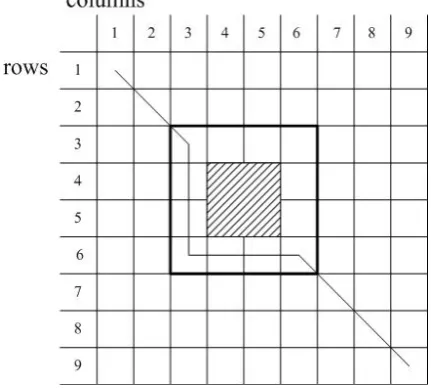
Figure 1.Path-planning example for local obstacle avoidance,
applied on a subsection of the search space.
our path-planning algorithm is utilized to find a feasible path around the obstacle. After avoiding the obstacle, the robot continues to navigate toward the endpoint along a straight line. An example of local path planning is shown in Figure 1.
Genetic algorithms [15,26-28] are a class of adaptive methods that can be used to solve search and optimization problems involving large search spaces. The search is performed using the idea of simulated evolution (survival of
the fittest). These algorithms maintain and manipulate “generations” of potential solutions or “populations”. With each generation, the best solutions (as determined by a problem specific fitness function) are genetically manipulated to form the solution set for the following generation. As in nature, solutions are combined (via crossover) and/or undergo random mutation.
Robot path-planning is part of a larger class of problems pertaining to scheduling and routing, and is known to be NP-hard(NP-complete) [15]. Thus, a heuristic optimization approach is recommended as shown by Hwang [16]. One of these approaches is the use of genetic algorithms. A genetic algorithm (GA) is an evolutionary problem solving method, where the solution to a problem evolves after a number of iterations. A proposed solution with the GA method to the path-planning problem is the best feasible path among the pool of all possible solutions.
There have been several contemporary applications of genetic algorithms to the robot navigation problem. One approach is to combine fuzzy logic with genetic algorithms[17,18,19]. In this approach, the genotype structure represents fuzzy rules that guide the robot navigation, so the genetic algorithm evolves the best set of rules. While this approach can produce a feasible path through an uncertain environment, the genotype structure becomes very complex, as it needs to represent a variety of fuzzy rules. A complex genotype structure can take a long time to process in a genetic algorithm, which affects the real-time performance of the robot during navigation.
Another approach is to use genotype structures that represent local distance and direction, as opposed to representing an entire path [20,21,22,23]. While these are simple to process and allow for faster real-time performance, the local viewpoint of these methods may not allow the robot to reach its target. Some methods have relatively simple genotype structures that can represent feasible paths, but require complex decoders and fitness functions [24, 14, 25].
Thus, our research has focused on improving the genetic algorithm performance.
III. SPACE MODEL OF MOBILE ROBOT’S WORKING ENVIRMENT
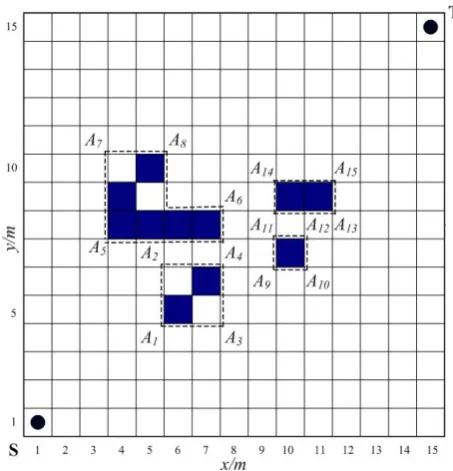
A working environment of a mobile robot is illustrated as shown in figure 1. Between the given starting point S and goal point T, an area with 500×500 cm2 is enclosed, robotic diameter is about 36cm,so the motion region could be divided into 15 × 15 regional grids . The free space for the mobile robot in the environment with obstacles consists of some polygonal areas. For each of
the six obstacles, the black polygon denotes its original size, and the white margin denotes its expanded part. A black part plus its white margin constitute a socalled “grown obstacle”. In Figure 1, the symbols A1, A2, … and A15 denote respectively the vertices of these grown obstacles.The (x, y) coordinates of the starting point S and the goal T are ( 1, 1 ) and ( 15, 15 ), respectively.
Figure 2.Working environment and its reginal grids
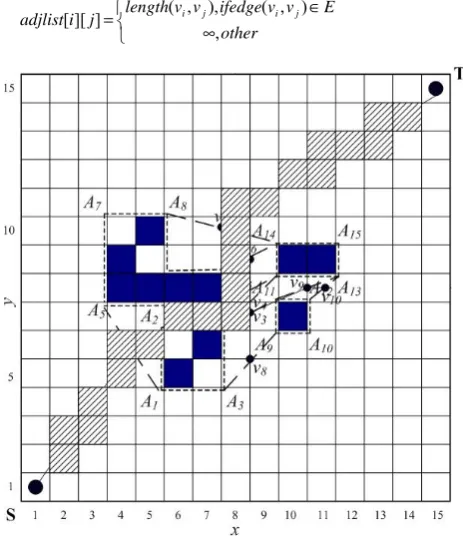
Figure 3.Network graph for free motion of mobile robot.
goal point T were also denoted by v0, and vl+1, respectively. Figure 2 was an undirected graph, we used G(V, E) to denote it, where V={v0, v1, v2, …,vl, vl+1} was the set which consisted of S, T, and the middle points of all the free MAKLINK lines and E was the set which consisted of the lines connecting each pair of the middle points on two adjacent free MAKLINK lines, the lines connecting S (or T) and the middle points on the free MAKLINK lines adjacent to S (or T). Using the undirected graph G(V,E) as the free space model, the global optimal path planning for the mobile robot could be solved by finding the shortest path between the given starting point S and goal point T on the graph G(V, E).
IV. FINDINGFEASIBLEPATHUSINGDIJKSTRA ALGORITHM
In this section, to obtain a feasible path, we adopt Dijkstraalgorithm [14] to find it between the given starting point S and the goal T on the graph G(V, E) and find out all the free MAKLINK lines at which the path intersects at vi (i=1,2,…,l), then connect the obstacle vertexes corresponding to those free MAKLINK lines, and S and T to be a closed free-space. This way, we obtained a sub-search-space where the global optimal path inside.
Before using the Dijkstra algorithm, it is necessary to define the adjacency matrix with weights for the network graph G(V, E), which is the basis for computing the shortest path on G(V, E).Each element of the matrix represents the length of the straight line between two adjacent path nodes on G(V, E), where a path node means the intersection of the moving path for the mobile robot and a free MAKLINK line. And each element of the adjacency matrix is defined as follows.
⎩ ⎨ ⎧
∞
∈ =
other
E v v ifedge v v length j
i
adjlist i j i j
,
) , ( ), , ( ]
][
[
Figure 4. Paths generated by Dijkstra algorithm.
Where adjlist[i][j] is the element corresponding to the ith row and the jth column of the matrix; length (vi , v j) is the length of the straight line between the points vi and vj ; i and j=0, 1, 2,…,l, l+1.
For the example given in Figure 1, by using Dijkstra algorithm,the path is obtained as:
S→v1→v2→v4→v5→v6→v7→T, and the path of the moblie robot is shown in Figure 3. The path of the robot is about 24 grids.
V. GLOBALOPTIMALPATHPLANNINGBASED GAONGAANDA*ALGORITHM
1) Genetic Algorithm
GA optimizers classified as global optimizers are robust and stochastic search methods modeled on principles and concepts of natural selection and evolution [12]. A basic task of GA optimizer must be performed is encoding the solution parameter as genes. The convergence speed largely depends on the encoding method. Binary encoding has some disadvantages when optimized variable dimension is high. Encoding with real numbers is proposed in this paper, which could improve precision of the solution. The value of the genes is denoted by some real number, the length of code depends on the number of decision-making individuals. Before the decision is made, the best individuals of current generation are chosen to contrast against those of the pre-generation, and the better are kept back for the next comparison without any operation of GAs [13].
2) A* algorithm
A* algorithms do the evaluation to each node, in order to find a the most promising node. The evaluation function f(n)=g(n)+ h(n) is introduced into the algorithm. g (n) is the cost value of the shortest path from an initial node to the current node, h(n) is a cost evaluation of the optimal path from node n to the goal[11].
3) Global Optimal Path Planning
The algorithm based on GA and A* algorithm is described as follows:
Step1. Path Eoder Mode
Initialize starting point S:P0(x0,y0),x0=1, y0=1; and initialize goal point T :Pn(xn,yn), xn =15, yn =15.The obstacles could be indicated as ORi(i=1, 2,…,q), so there is a finite set Φ,Φ={OR1, OR2,…,ORq}
The intermediate nodes need to meet 3 points as follow:
i The nodes should be located outside the obstacle. ii The nodes should be located in the planning space. iii The paths should not intersect the obstacles. So the initial population is the point to point paths. Step 2.The Fitness Function
The evaluation function f* is the core design in A* algorithm,
f
*
(
i
)
=
g
(
i
)
+
h
*
(
i
)
g(i) is the measurement of the actual cost from sourcepoint to the goal, h*(i) is the evaluation of minimum cost
from node Pi to the goal.
When the valuation functions is the shortest path from source to the goal, and the network could be viewed as a planar network,h*(i) of A* algorithm would be Euclidean
distance from Pi to the goal.
Based on A* algorithm, set the fitness fuction as
f=A+B
∑
=
= n
i
i g i h A
1
)); ( / ) ( * (
α
) )) ( ( ... ) ) ( 1 ( (
1
2 2
1
∑
∑
= =
+ +
= n
i n
i
k ORq k
OR B β
A is to make sure the path is shortest from source to the goal,α∈[100,300], in this paper
α
=
200
,B is to make sure the path is safe,β
∈
[
0
.
1
,
0
.
5
].
q i
r yi yk xi xk k
ORi
,..., 2 , 1
)}, )
( ) (( , 0 min{ )
( 2 2 2
=
− − + − =
Step3. Genetic Operator (1)Selection Operator
Force the individual reproduce to the next generation on the direct proportion according to the fitness.
(2) Crossover Operator
Use the single-point crossover.First, assume the crossover probability pc, match the individuals randomly,
then generate a random number r(r∈[0,1])for individual, if r < pc, crossover operate the random gene of individual.
(3) Mutation Operator
Mutation is to add some random vibration in the genes of the population,the mutation probability pm is around
0.001~0.100.
Figure 5.Computer simulation
1) Simulation Results
We carry out a computer simulation experiment for the example illustrated in figure 1 using this paper method. The simulation parameters are set as: M=30 (population size), Pc=0.7(initial crossover probability), Pm=0.05 (initial mutation probability), The result of simulation experiment is shown in Figure 4.
In figure 4, the shadow part denotes the global optimal path with the length of 20, which obtained by this paper method.
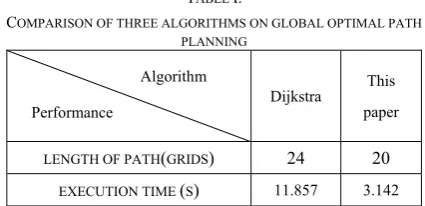
TABLE I.
COMPARISON OF THREE ALGORITHMS ON GLOBAL OPTIMAL PATH
PLANNING
Dijkstra This paper
LENGTH OF PATH(GRIDS) 24 20
EXECUTION TIME (S) 11.857 3.142
To proof the proposed method to be correct, the comparison results with two methods (Dijkstra algorithm, and this paper) on the global optimal path planning problem as shown in figure 1 are given as seen Table 1.
In Table 1, Dijkstra algorithm expends 11.857 s to find the global optimal one with the length of 24 grids; this paper method expends 3.142 s to find the global optimal path one with the length of 20 grids. From the above table, we can see that, compared with the method in dijkstra algorithm, the global optimal path obtained in this paper is shorter and require less time.
VI. CONCLUSION
In this paper, a method of global optimal path planning for mobile robots based on GA and A* algorithm is proposed to solve the problems existing in dijkstra algorithm .The Dijkstra algorithm is used to find a feasible path in the graph of mobile robot environment. A* algorithm was used to overcome its disadvantage of poor local optimizing. The simulation results show that the proposed method is correct, its search speed is faster than Dijkstra algorithm, and its search quality is better than that of recently reported methods.
REFERENCES
[1] Ge S S, Cui Y J. 2000. New potential functions for mobile robot path planning. IEEE Transactions on Robotics and Automation, 16, 5 (Oct. 2000), 615-620.
[2] LI Lei, YE Tao, TAN Min. 2002. Present state and future development of mobile robot technology research. Robot, 24,5 (Sept. 2002), 475-480.
[3] WANG Xing-ce, ZHANG Ru-bo, GU Guo-chang.
2003.Potential grids based on path planning for robots. Journal of Harbin Engineering University, 24, 2(Apr. 2003), 170-174.
[4] Boschian V, Pruski A. 1993. Grid modeling of robot cells: a memory-efficient approach [J]. Journal of Intelligent and Robotic Systems, 8, 2(Oct. 1993), 201-223.
Algorithm
[5] ZHUANG Hui-zhong, DU Shu-xin, WU Tie-jun. 2004. Research on path planning and related algorithms for robots. Bulletin of Science and Technology, 20, 3(May 2004), 210-215.
[6] Yung N H C. Cang Ye. 1999. An intelligent mobile vehicle navigator based on fuzzy logic and reinforcement learning. IEEE Transactions on Systems, Man, and Cybernetics, Part B: Cybernetics, 29, 2(Apr. 1999), 314-321.
[7] Lebedev D. 2001. Neural network model for robot path planning in dynamically changing environment. Modeling and Analysis of Information Systems, 18,1 (2001),12-18. [8] Liu Cai-hong, Hu Ji-quan, Qi Xiao-ning. 2003. Path
design of robot with continuous space based on hybrid genetic algorithm. Journal of Wuhan University of Technology (Transportation Science & Engineering), 27, 6 (Dec. 2003),819-821.
[9] S. Kirkpatrick, C. D. Gelatt Jr., and M. P. Vecchi. 1983.Optimization by Simulated Annealing. Science, 220, 4598(May 1983), 671-680.
[10] Romeijn H E. Smith R L. 1994. Simulated Annealing for Constrained Global Optimization. Journal of Global Optimization, 5, 2 (Sept. 1994), 101-124.
[11] Zhao Ming-ru,Guo Jian,Sun Yuan.2009. Application of A* Algorithm in Map Path-Searching. Journal of Science&Technology Information. 31,6(Oct.2009),411- 413.
[12] Yahya Rahmat-Samii, Eric Michielssen. 1999.
Electromagnetic Optimization by Genetic Algorithms. John Wiley & Sons, Inc., New York, USA.
[13] Ming Zhou, ShuDong Kong. 1999. Genetic
Algorithm:Theory and Applications. National defense industry publishing company, Beijing
[14] Sugihara, K. and Smith, J., 1997 . “Genetic Algorithms for Adaptive Motion Planning of an autonomous Mobile Robot”, Proceedings of the IEEE International Symposium on Computational Intelligence in Robotics and Automation, Monterey, CA, pp. 138-146
[15] Obitko, M., “Genetic Algorithms”, Internet publication, 1998, http://cs.felk.cvut.cz/~xobitko /ga/main.html [16] Hwang, Y.K., Ahuja, N.,September 1992. “Gross Motion
Planning – A Survey”,ACM Computing Surveys, volume 24, issue 3, pp. 219-291.
[17] Arsene, C.T.C. and Zalzala, A.M.S., 1999. “Control of Autonomous Robots Using Fuzzy Logic Controllers Tuned by Genetic Algorithms”, Proceedings of the 1999 Congress on Evolutionary Computation (CEC99), pp. 428-435.
[18] Kubota, N., Morioka, T., Kojima, F. and Fukuda, T., 1999. “Perception-Based Genetic Algorithm for a Mobile Robot with Fuzzy Controllers”, Proceedings of the 1999 Congress on Evolutionary Computation (CEC99), pp. 397-404.
[19] Pratihar, D.K., Deb, K. and Ghosh, A. 1999.
“Fuzzy-Genetic Algorithms and Mobile Robot Navigation among Static Obstacles”, Proceedings of the 1999 Congress on Evolutionary Computation (CEC99), pp. 327-334.
[20] Cazangi, R.R. and Figuieredo, M., 2002. “Simultaneous Emergence of Conflicting Basic Behaviors and Their Coordination in an Evolutionary Autonomous Navigation System”, Proc. 2002 IEEE Conf. on Evol. Comp. (CEC '02), IEEE.
[21] Di Gesu, V., Lenzitti, B., Lo Bosco, G. and Tegolo, D., 2000. “A Distributed Architecture for Autonomous Navigation of Robots”, Proceedings Fifth IEEE
International Workshop on Computer Architectures for Machine Perception, pp. 190 – 194.
[22] Gallardo, D. and Colomina, O., “A Genetic Algorithm for Robust Motion Planing”, Eleventh International Conference on Industrial and Engineering Applications of Artificial Intelligence and Expert Systems, Castellon, Spain, June, pp. 115-121, 1998.
[23] Vadakkepat, P. and Chen, T.K., “Evolutionary Artificial Potential Fields and Their Application in Real Time Robot Path Planning”,Proceeding of the 2000 Congress on Evolutionary Computation, San Diego, CA, pp. 256-264, 2000.
[24] Hocaoglu, C. and Sanderson, A.C., "Planning Multiple Paths with Evolutionary Speciation", IEEE Trans. Evolutionary Computation,vol. 5, no. 3, pp. 169-191, June 2001.
[25] Xiao, J. and Zhang, L., “Adaptive Evolutionary Planner/Navigator for Mobile Robots”, IEEE Transactions on Evolutionary Computation, Vol. 1, No. 1, pp. 18-28, April 1997.
[26] Trivedi, N., Lai, W. and Zhang, Z., “Optimizing Windows Layout by Applying a Genetic Algorithm”, Proceedings of the 2001 Congress on Evolutionary Computation, Seoul, Korea, pp. 431-435, 2001
[27] Filho, J.L.R. and Treleaven, P.C., “Genetic Algorithm Programming Environment”, IEEE Computer, pp. 28-43, June 1994.
[28] Srinivas, M. and Patnaik, L.M., “Genetic Algorithms: A survey”,IEEE computer, pp. 17-26, June 1994.
CenZeng,Liaoning Province, Dalian, China. Birthdate: July, 1983. is mechanical design Ph.D candidate at Dalian University of Technology, China. Her research areas include robotic path-planning, Genetic Algorithm.
Email: [email protected]
Qiang Zhang is a professor at Dalian University, Dalian, China. His research interests are computer animation, intelligent computing. Now he has served as editorial boards of seven international journals and has edited special issues in journals such as Neurocomputing and International Journal of Computer Applications in Technology. Email: [email protected]