Heuristic Algorithm for Min-max Vehicle Routing
Problems
Chunyu Ren
Heilongjiang University /School of Information science and technology, Harbin, China Email: [email protected]
Abstract—In order to satisfy with the individual and various
demand of customer, the present study is focused on the Min-Max Vehicle Routing Problem (MMVRP). According to the characteristics of model, new tabu search algorithm is used to get the optimization solution. It applies newly improved insertion method to construct initial solution, to improve the feasibility of the solution; centers the longest route to design dual layered random operation to construct its neighborhood, to realize the strategy of optimizing between and within the route, to boost the efficiency and quality of the searching. Applies auto adaptive tabu length to control the searching capability dynamically; At last, it uses simulated experiments to prove the effectiveness and feasibility of this algorithm, and provides clues for massively solving practical problems.
Index Terms—MMVRP; new tabu search algorithm;
improved insertion method; dual layered random operation; auto adaptive tabu length
I. INTRODUCTION
Vehicle Routing Problem is a typical NP problem. Its solution can be divided into three categories: the accurate algorithm, the classic heuristic algorithm and the modern intelligent algorithm. With respect to solving the practical large scaled problem, the heuristic algorithm can make it to get satisfactory solution in lesser time. Mester integrated the advantages of oriented local search and evolution strategies, designed an evolution strategy with positive guidance to solve VRP [1]. Derigs applied climbing heuristic algorithm based on attribute to solve VRP [2].
When it comes to solve massive complicated problems, the intelligent algorithm has wider application. Yuvraj applied large-scale ant colony algorithm to solve VRPB [3]. Baker conducted a research on VRP with indefinite number of vehicles and used improved genetic algorithm to solve it [4]. Gehring designed two-phase heuristic algorithm based on three strategies parallel to solve VRPTW [5]. Li H used insertion algorithm to construct initial solution, sequenced the customers through commuting operator, and then used simulated annealing algorithm to finish the control mentioned above [6]. Jose applied TS algorithm to solve VRPB [7]. Homberger combined TS with Evolution Strategies to construct
two-phase algorithm in solving VRPTW [8]. Ai designed a particle swarm optimization algorithm based on multiple social structures to solve pickup-delivery problem [9].
In practice, there exists a type of problems, whose aim is not to demand the shortest distance or the cheapest expenditure of the whole route, but to demand the shortest distance or the shortest time of the longest sub route throughout the whole route, for which is called Min-Max Vehicle Routing Problem, MMVRP.
Michael firstly solved the minimum boundary value of the objective function in MMVRP, and then used tabu search algorithm to get the solution [10]. Sema studied the school commuting bus MMVRP, and used the tabu search algorithm of the Cross and Or-opt Exchange Algorithm [11]. Arkin divided the n number of routes created by MMVRP into n number of sub regions of solving TSP problem and applied approximate algorithm to get the solution [12].
Considering the complexity of MMVRP, the essay proposed to apply new tabu search algorithm. Experiments proved that this algorithm can achieve not only better calculating results, but also better calculation efficiency and quicker convergence rate.
II. MATHEMATICAL MODEL
S
i jSkV ij ijkd
X Max
Min
Z (1)
Constraints:
Y i H
V k
ik
,
1 (2)
qXijk Wk k V
H i jS
i
, (3)
X Yik j S k V
S i
ijk
,
, (4)
X Yik i S k V
S j
ijk
,
, (5)
x m m
n
k VS i jS
ijk
, ..., 3 , 2 ,
1 (6)
X d D j H
V k iS
k ij
ijk
, (7)
Decision Variable:
ijk
X 1, if travel vehicle k moves from nodei to node j,i jS,kV; orXijk0.
ik
Y 1, if travel vehicle k belongs to
nodei,iH,kV, or Yik 0.
In the formula: G
grr1,...,R
is a series of aggregationsof distribution centre in the place R(this essay only has
one); H
hiiR1,...RN
is a series of clients’ aggregationsin the placeN ; S
G
H
is the combination of alldistribution centers and clients. V
vkk1,...K
is travelvehicle k ’s aggregation; qi is the demand amount of client i
iH
; Wk is travel vehicle k ’s loading capacity;dijis the linear distance from clientito client j;k
D is the travel vehiclek’s maximum travel mileage. In the formula (1), the objective function is not to demand the shortest distance of routes in the whole circuit, but to demand the shortest distance of the longest route in the whole circuit; constraint (2) ensures each client to be served by only one travel vehicle of one type; constraint (3) is for travel vehicle’s loading capacity, in
order to ensure every vehicle in each route not to surpass its loading capacity; constraint (4) ensures every vehicle to reach the client and the distribution centre only once; constraint (5) ensures certain vehicle to be dispatched only once from certain distribution centre or certain
receiving point; constraint (6) ensures the routes’
connectivity, that is to say, once the vehicle arrives at a client node, it must leave from the node; constraint (7) is for travel vehicle’s mileage, in order to ensure every
vehicle in each route not to surpass its maximum travel mileage.
III.PARAMETER DESIGN FOR TABU SEARCH ALGORITHM
A. The formation of initial solution
Given
h
kas the total number of client nodes served by vehiclek
, aggregationR
k
{
y
ik0
i
h
k}
to correspond the client nodes served by the numberk
vehicle,
Y
ik signified that vehiclek
served in nodei
,k
Y
0 signified that the numberk
vehicle’s beginningpoint was distribution centre. The procedures as such: Step1: Order vehicles’ initial remaining load capacity:
w
k
w
k1
,
k
0
,h
k
0
,R
k
;Step2: The demand amount corresponding to theiclient node in a route
i
q
, orderk
1
;Step3: if 1
k
i
w
q
, thenorder
w
1k
Min
(
w
k1
q
i),
w
k}
, if not turn to Step6;Step4: if
w
k
q
i
w
k1
, and
D
i1
D
i
D
k ; thenR
k
R
k
{
i
}
,h
k
h
k
1
if not turn to Step6;Step5: if
k
K
, thenk
K
, otherwise,k
k
;Step6:
k
k
1
, turn to Step3; Step7:i
i
1
, turn to Step2;Step8: repeat Step2-7,
K
recorded the total usedvehicles,
R
krecorded a group of feasible routes.B. Inner Neighborhood Operation Specific procedures as such: (1)
1
move
move
1
is a heuristic algorithm the same as operators (1, 0) and (0, 1), which can effectively improve the quality of solutions and the feasibility of poor solutions. Specific operations are: delete a client point in a route, and then insert the client point into another route.(2)
2
opt
In the design of tabu search algorithm,
opt
2
neighborhood operation was applied in the points in the same route, which was to exchange the service order between the two client points in the route in order to realize optimization in the route.opt
2
is used to conduct neighborhood search, which was to randomly choose the positions of two client nodes, and then exchange the clients between the two positions.k
(
i
)
signified the neighbor point of the client pointiin the routel
, anda
(
i
,
j
)
signified to change thedirection of the route fromitoj. That was in the
l
route, the client points were:(
0
,
1
,
2
,...,
n
,
0
)
, in it, 0 signified distribution centre. The procedures of the2
opt
neighborhood operation were as such:Step1:
i
1:
1
,
i
:
0
;Step2: if
i
n
2
, end; otherwise, turn to Step3; Step3: revisei
2:
k
(
i
i),
j
1:
k
(
i
2),
j
:
i
2
; Step4: ifj
n
, turn to Step8, if not, turn to Step5;Step5:
j
2:
s
(
j
1)
, change routel
as such (1)a
(
i
2,
j
1)
, (2) alternately used(
i
1,
j
1)
and(
i
2,
j
2)
, substitute(
i
1,
i
2)
and(
j
1,
j
2)
;Step6: If the changed route
l
1is feasible, and betterthan
l
, revisel
, if not, turn to Step7;Step7:
j
1:
j
2,
j
:
j
1
, return to Step4; Step8:i
1:
i
2,
i
:
i
1
, return to Step2.C. Outer Neighborhood Operation Specific procedures as such:
(1)
1
exchange
exchange
Its neighborhood structure is the same as
1
move
,but its radius can be larger. (2)
2
opt
opt
2
operates on the exchange of two edges in different routes, in order to realize optimization between routes. That is in the routel
, the client pointsare
(
0
,
1
,
2
,...,
n
,
0
)
, in the routek
, the client pointsare
(
0
,
1
,
2
,...,
m
,
0
)
, in it,0
signifies distribution centre. Step1: Randomly choose n number of client points in the routel
, for each client pointi
, choose clientpoint
j
nearby the routek
, if exist, exchangechains
(
i
,
i
1
),
(
j
,
j
1
)
;Step2: Conduct
2
opt
neighborhood operation in theexchanged routes 1
l
andk
1, to obtain feasible solution;Step3: Calculate the exchanged objective function 1
f
,if
f
1
f
, turn to Step4; if not, turn to Step5;Step4: If the current optimal solution does not exist in the tabu list, update tabu list, input the obtained optimal solution into the tabu list, simultaneously remove out the ban-lifted elements; otherwise, turn to Step5;
Step5:
i
i
1
, turn to Step1;Step6: repeat Step1- 5, till the current optimal solution can not update.
D. Tabu List
Tabu list is a structure of tabu objective, which recording the process of reaching optimal solution as part in some iterative or solving.
The study establishes
(
n
1
)
(
n
1
)
rank matrix T to record the route reaching to tabu solution.
nn n n n n n nt
t
t
a
t
t
t
a
t
t
t
a
a
a
a
T
,...,
:
:
:
:
,...,
,..,
,...,
0
2 1 2 22 21 2 1 12 11 1 2 1(8)
Here,
t
ij is expressed bynumber
0
0
ij ijt
exchange
permitting
t
exchange
forbiding
.E. Adaptive Tabu Length
Tabu length is a crucial parameter in the algorithm, and the length of its tenure determines the solution’s option. Lesser the tenure, larger the possibility of obtaining better solution, but at the same time circuitous search is added, and if its tenure over prolongs, more calculating time will be added. In order to ensure effectiveness of the tabu list, during the whole process of searching, make
L
min,
L
max as its variableregion
a
N
,
b
N
, in it0
a
b
. So the tabulengthL’s variable scope is the formula as the following:
L
L
min
(
1
)
L
max (9)In the formula,
L
minandL
maxare the upper and lowerbound of tabu length
L
’s dynamic change respectively,N
refers to the number of clients, the weighingcoefficient is
0
1
.F. Mountain climbing operation
Add mountain climbing algorithm into genetic algorithm. Improve the solution of each generation structure so as to reduce the expense of solving route and quicken algorithm constringency speed. Mountain climbing algorithm adopts 2-opt method to take point exchanging operation.
Supposed routing line before exchanging is s{...,xi,xi1,...xj,xj1,..}, it can get the routing line
,..}
,
,...
,
{...,
1 1'
x
jx
ix
ix
js
after exchanginglocation of two points. If the distance is equal to
{
d
(
x
i1,
x
j)
d
(
x
i,
x
j1)}
{
d
(
x
i1,
x
i)
d
(
x
j,
x
j1)}
, exchanging is successful and keeps exchanging result.Otherwise, exchanging attempt is failure, cancel exchanging and furbish former routing line.
To the optimized individual of each generation group through genetic operation, it can realize mountain climbing operation through searching in neighbors.
The study adopts gene exchanging operator to realize climbing operation. The concrete steps are as followings. Step1: Initial recycling time variable t=1, when the most optimal solution at present ss and its length
isl(s).
Step2: Randomly selecting two top points xi,xj in the most optimal route andi j. xiis not close toxj.
Step3: Calculate saving distance,
c{d(xi1,xj)d(xi,xj1)}{d(xi1,xi)d(xj,xj1)} (8)
Ifc0, it isn’t exchanged. Iftt1, it shifts into
step4.
Otherwise, execute exchanging. And the corresponding solution is '
s . And the optimal solution isss'. If t1,
it shifts into step 2.
Step4: If l(s) isn’t reduced in the last x a circulation,
this algorithm is over. Otherwise, it shifts into step 2. Step5: Repeat step 1 to step 4 till reaching certain exchanging times.
G. The procedures of the algorithm
The procedures of hybrid heuristic algorithm based on tabu search algorithm are as such:
number of not finding the best solution
0
_
iter
unchange
, the initial feasible solutionnow
R
, the current best solutionR
best, and the currentbest function value
f
f
(
R
best)
; Step2: ifmax_
iter
iter
oriter
unchange
iter
unchange
_
max_
_
, stopcalculating, turn to Step9, otherwise, and continue; Step3: In the neighborhood of initial feasible solution now
R
, alternately conduct1
move
and
2
opt
operations, choose a non-tabooed oramnestied and best value-assessed solution next
R
in thisneighborhood, order now
R
=R
next, and update tabu listT
;Step4: In the neighborhood of initial feasible solution now
R
, randomly conduct1
exchange
and
2
opt
operations choose a non-tabooed oramnestied solution with better assessment value than next
R
, order nowR
= nextR
, and update tabu listT
; Step5: Repeat Step3- 4, till all the changes in the nowR neighborhood is tabooed and none is amnestied; Step6: In the now
R neighborhood, search non-tabooed optimal candidate solution or the best solution better than the current one, if the objective function
f
(
R
now)
is better thanf
(
R
best)
, order,R
best =R
now ,iter
unchange
_
=0, turn to Step8;Step7: if
f
(
R
now)
is not better thanf
(
R
best)
,iter
unchange
_
=unchange
_
iter
1
, turn toStep8;
Step8: update tabu listT,
iter
iter
1
turn to Step2;Step9: Output the optimal solution
f
.Ⅳ.EXPERIMENTAL CALCULATION AND RESULT ANALYSIS Example one: The data originates from Document [14]. There are one depot and 20 client nodes, the coordinates and demand amount of each node is created randomly, as indicated in table 1(the depot’s number is 0); give six vehicles of the same type, and the vehicle’s load capacity is 8.
A. Solution of New Tabu Search Algorithm
Tabu search algorithm adopts the following parameters as part. The maximum iterative times
are
max_
iter
=500, tabu lengthis
2
,
3
,
0
.
6
, and candidate solution amount is 50. Randomly solve ten times and calculation results can be seen as table 2.It can be known that new tabu search algorithm in the study all get the much higher solution during the course of ten times from table 2. The average value of total distance is 1092.109(km) and the average using vehicles are six. The calculation result of algorithm is relatively steady. The total distance of least solution is only better 1.431 percent than the best.
Here, the longest line is 205.767 km, the corresponding optimal total length of 1082.918 km. The concrete route can be seen in table 3 and figure 1.
TABLE I.
KNOWN CONDITION OF EXAMPLES
Item coordinate Distribution amount
0 (52,4) 0
1 (15,49) 1.64
2 (0,61) 1.31
3 (51,15) 0.43
4 (25,71) 3.38
5 (38,62) 1.13
6 (35,45) 3.77
7 (100,4) 3.84
8 (10,52) 0.39
9 (26,79) 0.24
10 (87,7) 1.03
11 (24,89) 2.35
12 (19,25) 2.60
13 (20,99) 1.00
14 (73,91) 0.65
15 (100,95) 0.85
16 (7,73) 2.56
17 (69,86) 1.27
18 (24,3) 2.69
19 (66,14) 3.26
20 (9,30) 2.97
TABLE II.
MMVRP USING NEW TABU SEARCH ALGORITHM Calculation
order Total distance New Tabu Search Algorithm The longest line Vehicle amount
1 1100.073 205.767 6
2 1082.918 205.767 6
3 1095.813 205.767 6
4 1095.136 205.767 6
5 1097.753 205.767 6
6 1100.073 205.767 6
7 1082.918 205.767 6
8 1087.674 205.767 6
9 1095.813 205.767 6
10 1082.918 205.767 6
Average
value 1092.109 205.767 6
Standard
0 10 20 30 40 50 60 70 80 90 100
0 10 20 30 40 50 60 70 80 90 100 X Axis Label(km)
Y Axis Label(km)
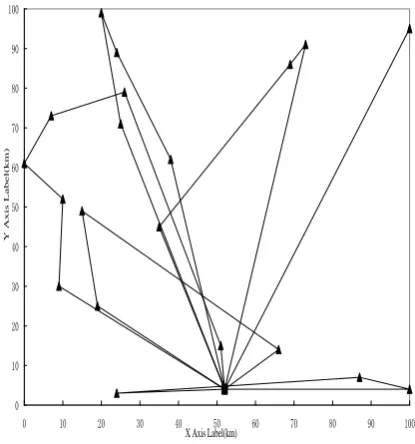
Figure 2. Optimization route of MMVRP using genetic algorithm.
Figure 1. Optimization route of MMVRP using new tabu search algorithm
0 10 20 30 40 50 60 70 80 90 100
0 10 20 30 40 50 60 70 80 90 100
X Axis Label(km)
Y A
xis Labe
l(km)
Figure 3. Optimization route of MMVRP using tabu search algorithm.
B. Solutions by genetic algorithm
Reference [14] is adopted genetic algorithm to get the solution.
The main parameters: population size of 50, the maximum number of iterations is 400; crossover 0.80, mutation operator is 0.2. The concrete route can be seen in table 4 and figure 2.
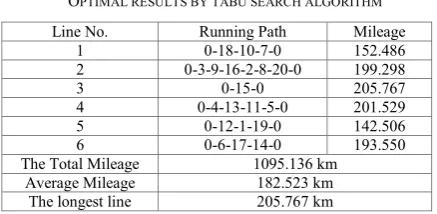
C. Solutions by Tabu Search Algorithm
Reference [14] is adopted tabu search algorithm to get the solution.
The main parameters: the size of the neighborhood list of 20, the candidate set of 10, taboo list is 10, and end time is 5 seconds. The concrete route can be seen in table 5 and figure 3.
TABLE III.
OPTIMAL RESULTS BY NEW TABU SEARCH ALGORITHM Line No. Running Path Mileage
1 0-16-2-8-20-0 181.416
2 0-9-11-13-4-0 201.293
3 0-18-10-7-0 152.486
4 0-6-5-17-14-0 196.754
5 0-15-0 205.767
6 0-12-1-3-19-0 145.202
The Total Mileage 1082.918 km Average Mileage 180.486km
The longest line 205.767 km
TABLE IV.
OPTIMAL RESULTS BY GENETIC ALGORITHM Line No. Running Path Mileage
1 0-1-8-16-19-0 185.945
2 0-9-13-11-4-0 201.293
3 0-18-3-7-10-0 156.254
4 0-6-5-14-17-0 197.247
5 0-15-0 205.767
6 0-12-20-2-0 159.731
The Total Mileage 1106.237 km Average Mileage 184.373 km
D. Analysis on Three Algorithms
Compared the optimal scheme of reference [14], the proposed hybrid genetic algorithm has a strong search capability, high computational efficiency and high quality on algorithm solving.
Ⅴ.CONCLUSIONS
In general, the proposed new tabu search algorithm has strong searching ability, rapid convergence rate, strong ability to overcome the fall into local optimum and high solving high quality. Therefore, it is more practical significance and value so as to reduce operating cost and improve economic benefit.
ACKNOWLEDGMENT
This paper is supported by project of National Social Science Foundation (No. 10CGL076), Natural Science Foundation of Heilongjiang Province (NO. G201020) and Science & Technology Foundation of Heilongjiang Provincial Education Department (No. 11551332)
REFERENCES
[1] D. Mester, O. Brays, “Active-guided evolution strategies for large scale capacitated vehicle routing problems,”
Computers and Operations Research, vol. 34, pp.2964-2975, 2007.
[2] Ergun, J. Orlin, A. Steele Feldman, “Creating very large scale neighborhoods out of smaller ones by compounding move,” Journal of Heuristics, vol. 12, pp. 115-140, 2006. [3] Bell J E, McMullen P R, “Ant colony optimization
techniques for the vehicle routing problem,” Advanced Engineering Informatics, vol. 18, pp. 41-48, 2004.
[4] Ali Haghania, Soojung Jung, “A dynamic vehicle routing problem with time dependent travel times,” Computers & Operations Research, vol. 32, pp.2959-2986, 2005. [5] Bent, R, P. Van Hentenryck, “A two-stage hybrid local
search for the vehicle routing problem with time windows,” Transportation Science, vol. 38, pp.515-530, 2004.
[6] Fermin Alfredo, Roberto Dieguez, “A tabu search algorithm for the vehicle routing problem with pick up and delivery service,” Computers & Operations Research, vol. 33, pp.595-619, 2006.
[7] Chawathe, S.S, “Organizing Hot-Spot Police Patrol Routes,” 2007 IEEE International Conference on Intelligence and Security Informatics, pp.79-86, 2007. [8] Yunjun Han, Xiaohong Guan and Leyuan Shi, “Optimal
supply location selection and routing for emergency material delivery with uncertain demands,” 2010 International Conference on Information Networking and Automation, vol.1, pp.87-92, 2010.
[9] Applegate D., Cook W., Dash S., “Solution of a min-max vehicle routing problem,” Informs Journal on Computing, vol. 14, pp.132-143, 2002.
[10]Michael Molloy, Bruce Reed, “A Bound on the Strong Chromatic Index of a Graph,” Journal of Combinatorial Theory, Series B, vol. 69, pp.103-109, 1997.
[11]J. Carlsson, D. Ge, A. Subramaniam, A. Wu, Y. Ye.,
“Solving min-max multi-depot vehicle routing problem,”
Report, 2007.
[12]Esther M. Arkin, Refael Hassin, Asaf Levin,
“Approximations for Minimum and Min-max Vehicle Routing Problems,” Journal of Algorithms, pp.1-16, 2005. [13]David Applegate, William Cook, Sanjeeb Dash and Andre
Rohe, “Solution of a min-max vehicle routing problem,”
INFORMS Journal on Computing, vol. 14, pp.132-143, 2002.
[14]Liu Xia, “Research on Vehicle Routing Problem,” PhD thesis of Huazhong University of Science and Technology, pp.24-44, 2007.
Chunyu Ren is an associate professor in the department of school of information science and technology, Heilongjiang University, Harbin, China. She holds a master degree in Computer Science and Technology from the Harbin Institute of Technology, Harbin, China. Her previous research areas include e-commerce, logistics system simulation, applications of artificial optimization algorithm and business intelligence. E-mail: [email protected]
TABLE VI.
COMPARISON AMONG GA, TS AND ALGORITHM OF THIS STUDY Genetic
Algorithm Search Tabu Algorithm
Algorithm of This Study
Average value - - 1092.109
Standard
deviation - - 7.214
Vehicle
amount - - 6
Optimal
Solution No. - - 3
The Total
Mileage 1106.237 1095.136 1082.918 Average
Mileage 184.373 182.523 180.486 The longest
line 205.767 205.767 205.767 TABLE V.
OPTIMAL RESULTS BY TABU SEARCH ALGORITHM Line No. Running Path Mileage
1 0-18-10-7-0 152.486
2 0-3-9-16-2-8-20-0 199.298
3 0-15-0 205.767
4 0-4-13-11-5-0 201.529
5 0-12-1-19-0 142.506
6 0-6-17-14-0 193.550
The Total Mileage 1095.136 km Average Mileage 182.523 km