Application of Different Waste in Concrete as a
Partial Replacement of Cement
Anurag Shrivas Devansh Jain
M. Tech Scholar Assistant Professor
Department of Civil Engineering Department of Civil Engineering Rajiv Gandhi Proudyogiki Mahavidyalaya, Bhopal UIT-RGPV, Bhopal
Rajesh Joshi Assistant Professor Department of Civil Engineering
Rajiv Gandhi Proudyogiki Mahavidyalaya, Bhopal.
Abstract
Diverse modern and rural waste materials with pozzolanic properties, for example, saw dust ash, fly ash, miceo silica, and rice husk ash and so on have had critical influence in the generation of superior cement. Amid the late twentieth century, three has been an increment in the utilization of mineral admixture by the bond and solid commercial enterprises. The expanding interest for bond and cement is met by the halfway substitution for vitality escalated Portland concrete. Pozzolanic materials have long exhibit their adequacy in creating elite cement. Manufactured pozzolanas, for example, supplementary solidifying material in numerous piece of the world. This work assesses the compressive quality and workability of rice husk ash, Wheat Straw Ash, Fly Ash, Glass powder, Sugarcane Bagasse Ash, Paper Pulp as a fractional substitution for OPC in cement. The primary point of this work is to focus the ideal rate of rice husk ash, Wheat Straw Ash, Fly Ash, Glass powder, Sugarcane Bagasse Ash, Paper Pulp as incomplete trade of bond for M30 and M40 evaluation of cement upto 30% at interim of 10%.
Keywords: Rice husk ash, Wheat Straw Ash, Fly Ash, Glass powder, Sugarcane Bagasse Ash, Paper Pulp cement replacement, concrete, Compressive strength, Workability
________________________________________________________________________________________________________
I.
I
NTRODUCTIONRice husk ash, Wheat Straw Ash, Fly Ash, Glass powder, Sugarcane Bagasse Ash, Paper Pulp are such a non-traditional materials which are discovered effortlessly and can be utilized as a part of solid industry to give great quality at lower expense.
II.
M
ETHODOLOGYFor this research project 150mm * 150mm * 150mm concrete cube is casted with different waste material, material is used for this project, natural coarse aggregate of 20 mm maximum size, natural river sand and OPC cement of 43 grade. All these ingredient and waste material are locally collected and mix design is done as per IS 10262 : 2009 and mix is prepared with different with industrial and agricultural waste with different mix name and also control concrete mix has been prepared. Curing of this specimen is done at room temperature in clear water.
III.
E
XPERIMENTS&
RESULTDifferent materials utilized all through exploratory projects led on crisp and solidified cement for different blends. Different test like workability, compressive quality are clarified here and This section manages the presentation of test outcome, and examination on compressive quality improvement of control cement and rice husk ash, fly ash, glass powder, wheat straw ash, saw dust ash, Sugar bagasse ash and glass powder Concrete at distinctive curing period.
The present examination depends on the IS strategy for control concrete. husk ash, fly ash, glass powder, wheat straw ash, sa w dust ash, Sugar bagasse ash and glass powder are incompletely supplanted by bond in cement and at distinctive curing period, trial blend of M30 and M40 evaluation of control cement is made by outlined blend plan.
Compressive quality and Workability conduct of husk ash, fly ash, glass powder, wheat straw ash, saw dust ash, Sugar bagasse ash and glass powder blends are examined where in the impact age and rate supplanting of bond with husk ash, fly ash, glass powder, wheat straw ash, saw dust ash on compressive and Workability is concentrated on in correlation with that of M30 and M40 Grade control concrete. Likewise water assimilation studies are additionally done.
Test Performed On Material: A.
Specific Gravity: 1)
Results of specific gravity on material are given in table below in table 1. Table – 1
Specific Gravity of Materials
S. No. Material Specific Gravity
1. Cement 3.12
2. Fine Aggregate 2.60
3. Coarse Aggregate 2.65
4. Fly Ash 2.50
5. Glass Powder 2.25
6. Rice husk Ash 2.10
7. Wheat Straw Ash 2.08
8. Saw Dust Ash 2.15
9. Sugarcane Bagasse Ash 2.20
10 Paper Pulp 2.30
Fineness Modulus of Material: 2)
Fineness modulus of the concrete ingredients are performed in the laboratory results of the fineness is given in the table 2 below Table – 2
Fineness modulus of materials
S. No Material Fineness modulus
1. Cement 2.2
2. Glass powder 5.5
3. Fly ash 4.3
4. Rice husk ash 6.1
5. Wheat straw ash 6.5
6. Saw Dust ash 3.4
7. Sugarcane Bagasse Ash 4.8
9. Coarse Aggregate 7.50
10. Fine Aggregate 3.30
Water Absorption: 3)
Water absorption test is performed in the laboratory and it has been observed that water absorption of coarse and fine aggregate which is used in the project is 1.023 and 0.55 respectively.
Workability: B.
Fly Ash Concrete 1)
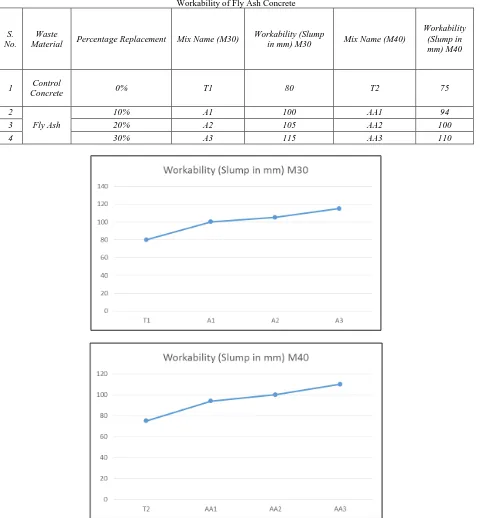
Fly Ash gives improved workability, workability of the concrete increased with increased percentage of concrete fly ash content in concrete. Workability test result are given in table 3 and graph 1-2. Here A3 mix gives 115mm slump in M30 concrete and AA3 mix possess 110 mm slump in M40 concrete. i.e approximately 43.75% increment in workability.
Table – 3
Workability of Fly Ash Concrete
S. No.
Waste
Material Percentage Replacement Mix Name (M30)
Workability (Slump
in mm) M30 Mix Name (M40)
Workability (Slump in mm) M40
1 Control
Concrete 0% T1 80 T2 75
2
Fly Ash
10% A1 100 AA1 94
3 20% A2 105 AA2 100
Graph 1 & Graph 2: Workability of Fly Ash Concrete Rice Husk Ash Concrete:
2)
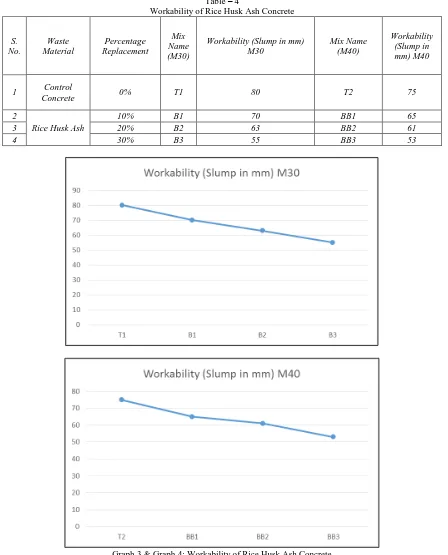
Rice husk Ash Concrete are less workable as we compare it to control concrete, its B3 mix of M30 possess 55 mm slump where BB3 mix of M40 concrete gives 53mm slump. i.e. 31.25% decrease in workability. Results of workability of rice husk ash concrete are given in table 4 and graph 3-4.
Table – 4
Workability of Rice Husk Ash Concrete
S. No.
Waste Material
Percentage Replacement
Mix Name (M30)
Workability (Slump in mm) M30
Mix Name (M40)
Workability (Slump in mm) M40
1 Control
Concrete 0% T1 80 T2 75
2
Rice Husk Ash
10% B1 70 BB1 65
3 20% B2 63 BB2 61
4 30% B3 55 BB3 53
Graph 3 & Graph 4: Workability of Rice Husk Ash Concrete
Wheat Straw Ash Concrete: 3)
Table - 5
Workability of Wheat Straw Ash Concrete
S. No. Waste Material Percentage
Replacement Mix Name (M30)
Workability (Slump in mm) M30
Mix Name (M40)
Workability (Slump in mm)
M40
1 Control Concrete 0% T1 80 T2 75
2
Wheat Straw Ash
10% C1 83 CC1 80
3 20% C2 85 CC2 82
4 30% C3 90 CC3 85
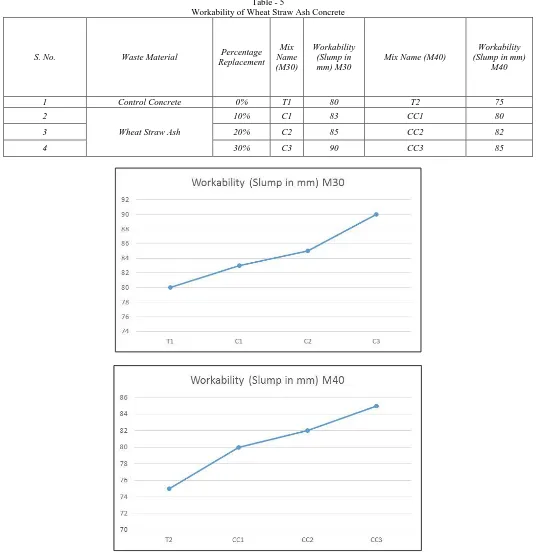
Graph 5 & Graph 6: Workability of Wheat Straw Ash Concrete
Glass Powder Concrete: 4)
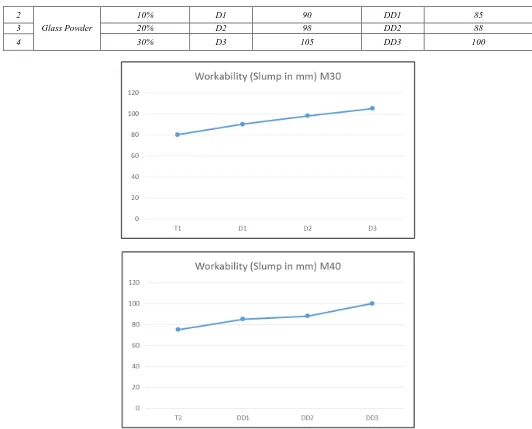
Glass Powder concrete gives more workability when we compare it to control concrete. its M30, D3 mix gives 105 mm slump and M40, DD3 mix gives 100 mm slump. Glass powder concrete shows 31.25% increment in workability. Result of workability of glass powder concrete are given in table 6 and graph 7-8.
Table – 6
Workability of Glass Powder Concrete S.
No.
Waste Material
Percentage Replacement
Mix Name (M30)
Workability (Slump in mm) M30
Mix Name (M40)
Workability (Slump in mm) M40
1 Control
2
Glass Powder
10% D1 90 DD1 85
3 20% D2 98 DD2 88
4 30% D3 105 DD3 100
Graph 7 & Graph 8: Workability of Glass Powder Concrete
Saw Dust Ash Concrete: 5)
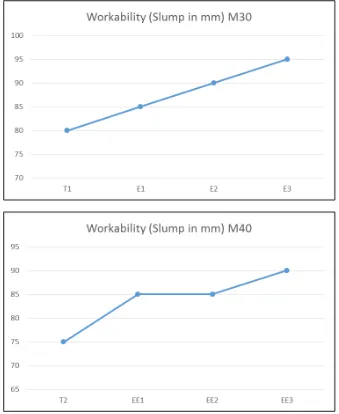
Saw Dust Ash Concrete gives slight increment in concrete, M30 concrete E3 mix gives 95 mm slump and M40, EE3 concrete gives 90mm slump. i.e. 18.75% increment in concrete. workability result of Saw Dust Ash concrete are given in table 7 and graph 9-10.
Table – 7
Workability of Saw Dust Ash Concrete
S.
No. Waste Material
Percentage Replacement
Mix Name (M30)
Workability (Slump in mm) M30
Mix Name (M40)
Workability (Slump in mm) M40
1 Control Concrete 0% T1 80 T2 75
2
Saw Dust Ash
10% E1 85 EE1 85
3 20% E2 90 EE2 85
Graph 9 & Graph 10: Workability of Saw Dust Ash Concrete
Sugarcane Bagasse Ash Concrete: 6)
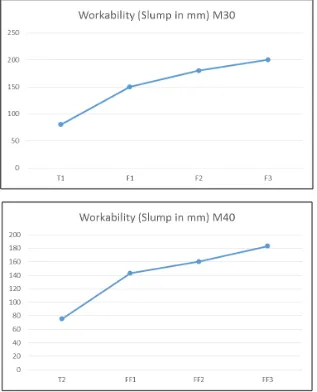
Sugarcane bagasse ash gives a big increment in workability of concrete, it has been observed that 150% increment in workability it F3 mix of M30 and FF3 mix of M40 possess 200mm and 183mm slump respectively. Workability result are given in table 8 and graph 11-12.
Table – 8
Workability of Sugarcane Bagasse Ash Concrete
S.
No. Waste Material
Percentage Replacement
Mix Name (M30)
Workability (Slump in mm) M30
Mix Name (M40)
Workability (Slump in mm) M40
1 Control
Concrete 0% T1 80 T2 75
2
Sugarcane Bagasse Ash
10% F1 150 FF1 143
3 20% F2 180 FF2 160
Graph 11 & Graph 12: Workability of Sugarcane Bagasse Ash Concrete
Paper Pulp Concrete: 7)
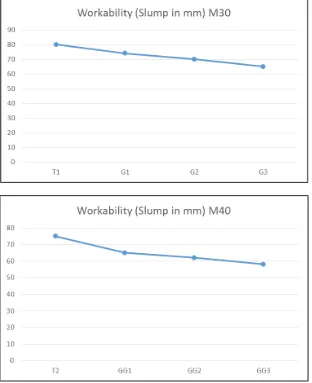
Paper Pulp concrete are less workable when we compare it to control concrete. 18.75% workability is decreased when paper pulp is added to concrete its G3 mix of M30 and GG3 mix of M40 concrete possess 65mm and 58 mm slump respectively. Results od Workability of paper pulp concrete are given in Table 9 and graph 13-14.
Table - 9
Workability of Paper Pulp Concrete
Waste Material
Percentage Replacement
Mix Name (M30)
Workability (Slump in mm) M30
Mix Name (M40)
Workability (Slump in mm) M40
Control
Concrete 0% T1 80 T2 75
Paper Pulp
10% G1 74 GG1 65
20% G2 70 GG2 62
Graph 13 & Graph 14: Workability of Paper Pulp Concrete
Comparative Workability Result: 8)
Comparison of workability of waste materials concrete with control concrete is given below in table 10. Table – 10
Comparative Workability Test Result
S.
No. Waste Material
Percentage Replacement
Mix Name (M30)
Workability (Slump in mm) M30
Mix Name (M40)
Workability (Slump in mm) M40
1 Control Concrete 0% T1 80 T2 75
2
Fly Ash
10% A1 100 AA1 94
3 20% A2 105 AA2 100
4 30% A3 115 AA3 110
5
Rice Husk Ash
10% B1 70 BB1 65
6 20% B2 63 BB2 61
7 30% B3 55 BB3 53
8
Wheat Straw Ash
10% C1 83 CC1 80
9 20% C2 85 CC2 82
10 30% C3 90 CC3 85
12 20% D2 98 DD2 88
13 30% D3 105 DD3 100
14
Saw Dust Ash
10% E1 85 EE1 85
15 20% E2 90 EE2 85
16 30% E3 95 EE3 90
17
Sugarcane Bagasse Ash
10% F1 150 FF1 143
18 20% F2 180 FF2 160
19 30% F3 200 FF3 183
20
Paper Pulp
10% G1 74 GG1 65
21 20% G2 70 GG2 62
22 30% G3 65 GG3 58
Test for Compressive Strength: C.
Fly Ash Concrete: 1)
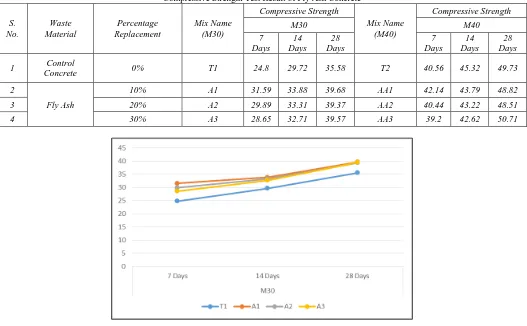
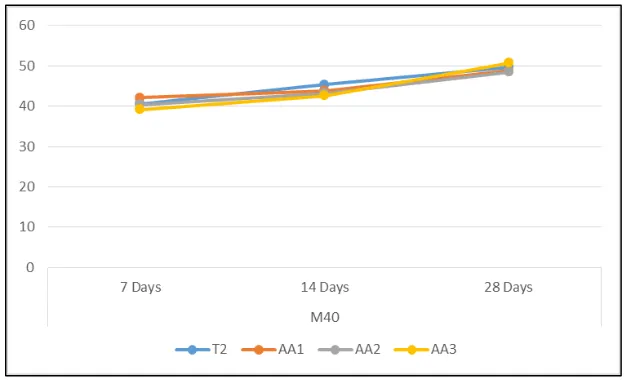
Graph 15-16 and table 11 shows compressive strength of Fly Ash concrete. when fly ash is replaced cement in concrete upto 30% it has been observed that adding fly ash gives good results where M30 mix possess compressive strength 36.68 MPa to 39.57 MPa in 28 days of curing, which is more than 35.58 MPa compressive strength of concrete. M40 concrete possess 48.82 MPa to 50.71 MPa concrete in 28 days of curing which is more then 49.73MPa compressive strength of control concrete.
Table – 11
Compressive Strength Test Result of Fly Ash Concrete
S. No.
Waste Material
Percentage Replacement
Mix Name (M30)
Compressive Strength
Mix Name (M40)
Compressive Strength
M30 M40
7 Days
14 Days
28 Days
7 Days
14 Days
28 Days
1 Control
Concrete 0% T1 24.8 29.72 35.58 T2 40.56 45.32 49.73
2
Fly Ash
10% A1 31.59 33.88 39.68 AA1 42.14 43.79 48.82
3 20% A2 29.89 33.31 39.37 AA2 40.44 43.22 48.51
Graph 15 & Graph 16: Compressive Strength Test Result of Fly Ash Concrete
Rice Husk Ash Concrete: 2)
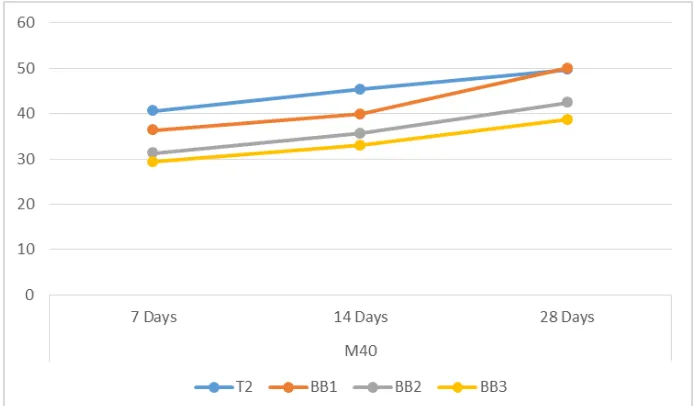
Compressive strength of Rice Husk Ash concrete are given in Table 12 and graph 17-18. Compressive of rice husk concrete varies from 40.87 MPa to 29.5MPa and 50.1MPa to 38.64 MPa of M30 and M40 concrete mix respectively. Rice husk ash concrete 10% and 20% mix i.e. B1,B2,BB1 and BB2 gives good compressive strength where its 30% B3 and BB3 mix gives less compressive strength..
Table – 12
Compressive Strength Test Result of Rice Husk Ash Concrete
S. No.
Waste Material
Percentage Replacement
Mix Name (M30)
Compressive Strength
Mix Name (M40)
Compressive Strength
M30 M40
7 Days
14 Days
28 Days
7 Days
14 Days
28 Days
1 Control
Concrete 0% T1 24.8 29.72 35.58 T2 40.56 45.32 49.73
2
Rice Husk Ash
10% B1 25.75 29.94 40.87 BB1 36.3 39.85 50.01
3 20% B2 20.77 25.73 33.31 BB2 31.32 35.64 42.45
Graph 17 & Graph 18: Compressive Strength Test Result of Rice Husk Ash Concrete
Wheat Straw Ash Concrete: 3)
Table 13 and Graph 19-20 gives good compressive strength only in its 10% mix i.e. C1 and CC1 gives good compressive strength, which is almost equal to control concrete compressive strength.
Table – 13
Compressive Strength Test Result of Wheat Straw Ash Concrete
S. No.
Waste Material
Percentage Replacement
Mix Name (M30)
Compressive Strength
Mix Name (M40)
Compressive Strength
M30 M40
7 Days
14 Days
28 Days
7 Days
14 Days
28 Days
1 Control
Concrete 0% T1 24.8 29.72 35.58 T2 40.56 45.32 49.73
2
Wheat Straw Ash
10% C1 24.43 27.94 34.03 CC1 34.3 37.85 43.01
3 20% C2 18.45 22.5 31.53 CC2 28.32 32.64 40.51
Graph 19 & Graph 20: Compressive Strength Test Result of Wheat Straw Ash Concrete
Glass Powder Concrete: 4)
Glass Powder Concrete 20% mix i.e. D2 and DD2 mix gives good compressive strength, 36.94 MPa and 45.92 MPa of M30 and M40 concrete respectively after 28 days of curing. Table 14 and graph 21-22 shows compressive strength result of glass powder concrete.
Table – 14
Compressive Strength Test Result of Glass Powder Concrete
S. No.
Waste Material
Percentage Replacement
Mix Name (M30)
Compressive Strength
Mix Name (M40)
Compressive Strength
M30 M40
7 Days
14 Days
28 Days
7 Days
14 Days
28 Days
1 Control
Concrete 0% T1 24.8 29.72 35.58 T2 40.56 45.32 49.73
2
Glass Powder
10% D1 20.05 23.61 35.04 DD1 29.92 33.75 44.02
3 20% D2 21.39 25.3 36.94 DD2 31.26 35.44 45.92
Graph 21 & Graph 22: Compressive Strength Test Result of Glass Powder Concrete
Saw Dust Ash Concrete: 5)
Table 15 and graph 23-24 shows compressive strength of Saw dust ash concrete. when saw dust ash is replace cement in concrete, it has been observed that saw dust ash concrete possess less compressive strength when it compare to control concrete.
Table – 15
Compressive Strength Test Result of Saw Dust Ash Concrete
S. No.
Waste Material
Percentage Replacement
Mix Name (M30)
Compressive Strength
Mix Name (M40)
Compressive Strength
M30 M40
7 Days
14 Days
28 Days
7 Days
14 Days
28 Days
1 Control
Concrete 0% T1 24.8 29.72 35.58 T2 40.56 45.32 49.73
14
Saw Dust Ash
10% E1 27.96 28.79 31.58 EE1 38.1 38.93 41.25
15 20% E2 27.48 28.3 30.13 EE2 37.62 38.44 39.8
Graph 23 & Graph 24: Compressive Strength Test Result of Saw Dust Ash Concrete
Sugarcane Bagasse Ash Concrete: 6)
Table 16 and graph 25-26 shows compressive strength of sugarcane bagasse ash concrete. when sugar cane ash replaced cement, sugarcane bagasse ash 10% mix F1 and FF1, 35.03 MPa and 44.70 MPa of M30 and M40 mix respectively i.e. approximately equal to control concrete.
Table – 16
Compressive Strength Test Result of Sugarcane Bagasse Ash Concrete
S.
No. Waste Material
Percentage Replacement
Mix Name (M30)
Compressive Strength
Mix Name (M40)
Compressive Strength
M30 M40
7 Days
14 Days
28 Days
7 Days
14 Days
28 Days
1 Control Concrete 0% T1 24.8 29.72 35.58 T2 40.56 45.32 49.73
17
Sugarcane Bagasse Ash
10% F1 22.19 28.375 35.03 FF1 32.33 38.515 44.7
18 20% F2 18.24 23.86 29.23 FF2 28.38 33.64 38.9
Graph 25 & Graph 26: Compressive Strength Test Result of Sugarcane Bagasse Ash Concrete
Paper Pulp Concrete: 7)
Paper pulp when replaced by cement it has been observed that paper pump concrete possess less compressive strength when it is compared to control concrete. table 17 and graph 27-28 shows result of compressive strength of paper pulp concrete.
Table – 17
Compressive Strength Test Result of Rice Paper Pulp Concrete
S. No.
Waste Material
Percentage Replacement
Mix Name (M30)
Compressive Strength
Mix Name (M40)
Compressive Strength
M30 M40
7 Days
14 Days
28 Days
7 Days
14 Days
28 Days
1 Control
Concrete 0% T1 24.8 29.72 35.58 T2 40.56 45.32 49.73
2
Paper Pulp
10% G1 27.4 31.28 35.08 GG1 37.54 41.06 44.58
3 20% G2 25.01 28.655 33.14 GG2 34.23 38.435 42.64
Graph 27 & Graph 28: Compressive Strength Test Result of Rice Paper Pulp Concrete
Comparative compressive Strength Test Result: 8)
Comparison of compressive strength of waste materials concrete with control concrete is given below in table 18. Table – 18
Comparative Compressive Strength Test Result
S.
No. Waste Material
Percentage Replacement Mix Name (M30) Compressive Strength Mix Name (M40) Compressive Strength
M30 M40
7 Days 14 Days 28 Days 7 Days 14 Days 28 Days
1 Control Concrete 0% T1 24.8 29.72 35.58 T2 40.56 45.32 49.73
2
Fly Ash
10% A1 31.59 33.88 39.68 AA1 42.14 43.79 48.82
3 20% A2 29.89 33.31 39.37 AA2 40.44 43.22 48.51
4 30% A3 28.65 32.71 39.57 AA3 39.2 42.62 50.71
5
Rice Husk Ash
10% B1 25.75 29.94 40.87 BB1 36.3 39.85 50.01
6 20% B2 20.77 25.73 33.31 BB2 31.32 35.64 42.45
7 30% B3 19.53 23.12 29.5 BB3 29.4 33.03 38.64
8
Wheat Straw Ash
10% C1 24.43 27.94 34.03 CC1 34.3 37.85 43.01
9 20% C2 18.45 22.5 31.53 CC2 28.32 32.64 40.51
10 30% C3 17.53 18.89 27.66 CC3 27.4 29.03 36.64
11
Glass Powder
10% D1 20.05 23.61 35.04 DD1 29.92 33.75 44.02
12 20% D2 21.39 25.3 36.94 DD2 31.26 35.44 45.92
13 30% D3 18.48 22.76 34.13 DD3 28.62 32.9 43.11
14
Saw Dust Ash
10% E1 27.96 28.79 31.58 EE1 38.1 38.93 41.25
15 20% E2 27.48 28.3 30.13 EE2 37.62 38.44 39.8
16 30% E3 28.82 31.16 36.13 EE3 38.96 41.3 45.8
17
Sugarcane Bagasse Ash
10% F1 22.19 28.375 35.03 FF1 32.33 38.515 44.7
18 20% F2 18.24 23.86 29.23 FF2 28.38 33.64 38.9
19 30% F3 17.36 22.095 26.75 FF3 27.5 31.875 36.25
20
Paper Pulp
10% G1 27.4 31.28 35.08 GG1 37.54 41.06 44.58
21 20% G2 25.01 28.655 33.14 GG2 34.23 38.435 42.64
Cost Analysis: D.
Concrete is a versatile material and largely used in construction. The raw materials required for manufacture of the product are Portland cement and aggregates which are available locally in every part of the country. when we determine cost of a 1 m3. Here general cost of concrete is determined by simply calculating aggregates and cement content by its present rate. One bag of the cement which is of 50 kg is of approximately INR 315/- i.e. 1 kg of cement is of INR 6.3/- if we replace 30% of the cement by any waste material, so approximately 15kg of the cement is saved so that INR 94.5/- is saved on per bag that means 30% of the cost is saved.
IV.
C
ONCLUSIONThe effect of study shows that there are good prospects of using Rice husk Ash, Fly Ash, Wheat Straw Ash, Saw Dust Ash and Glass Powder, Sugarcane Bagasse Ash, Paper Pulp as a porcelain combination with ordinary Portland cement (OPC) in the Concrete cube. M-30 and M-40 grade concrete cube is cast and its compressive strength and workability is determined. The combination of 10%, 20% and 30% cement replacement Mix is prepared by using industrial and agricultural waste.
Workability of the concrete increased with the increased percentage of Fly Ash, Wheat Straw Ash, Glass Powder, Saw Dust Ash, Sugarcane Bagasse Ash in concrete and decreased with increased percentage of Rice husk Ash and Paper Pulp. It has been observed that Sugarcane Bagasse Ash and Fly Ash gives very good workability when they replace cement in concrete.
Compressive Strength of concrete increased with increasing percentage of Fly Ash, its all three mix give good compressive strength. When Rice Husk Ash replace cement in concrete it has been observed that its 10% and 20% mix gives good compressive strength. Wheat Straw Ash possess less compressive strength with increased percentage of Wheat Straw Ash, only its 10% mix are useable. Glass Powder concrete are generally gives good compressive strength with all their mixes. Saw Dust Ash 30% mix only gives good compressive strength. When Sugarcane Bagasse Ash replaced cement in concrete, its 10% mix gives better compressive strength. Paper Pulp possess lower compressive strength, its only 10% mix are useable.
Concrete is a versatile building material which is largely used in construction. When cement is replaced by these waste material upto 30%. By using these waste material INR 94.5/- can be saved on per bag of cement i.e. 30% of the cost.
R
EFERENCES[1] A. Dass, Pozzolanic behaviour of rice husk ash, Building Research and Practice 12 (1984) 307–311.
[2] Sener, S., Bažant, Z. P., and Becq-Giraudon, E. (1999). Size effect on failure of bond splices of steel bars in concrete beams. Journals of Structural Engineering, ASCE, 125(6), 653-660.
[3] Krauthammer, T., Elfahal, M. M., Ohno, T., Beppu, M., and Mindess, S. (2003). Size effect of high strength concrete cylinder subjected to axial impact. International Journals of Impact Engineering, Elsevier, 28, 1001-1016.
[4] Deepak Gargate, Deepali Verma, Manuraj Singh Aharwal, Rajeshwari Dhurve, Devansh Jain, S.S.Kushwaha; Evolution Of Concrete By Partially Replacing All The Ingredient Of Concrete; International Journal of Engineering Research-Online, Vol.3, Issue 3, 2015; pp.367-372; ISSN: 2321-7758; http://www.ijoer.in.
[5] Chandrakant Sharma, Digvijay Singh Rathore, Kanchan Atram, Megha Kunjam, Devansh Jain , S.S.Kushwaha; hybrid concrete by partial replacement of all ingredients of concrete; International Journal of Engineering Research-Online, Vol.3, Issue 3, 2015; pp.377-383; ISSN: 2321-7758; http://www.ijoer.in. [6] P.K. Roy, Devansh Jain, Vijay Meshram; Use Of Electronic Waste As A Partial Replacement Of Coarse Aggregate In Concrete; International Journal Of
Engineering Research-Online, Vol.3, Issue 4, 2015; Pp.132-138; Issn: 2321-7758; http://www.ijoer.in.
[7] Pravin Zarbade, Rajesh Joshi, Devansh Jain; Evolution of Concrete using Recycled Aggregate, Coconut Shells and E-Waste as a Coarse Aggregate; IJSTE - International Journal of Science Technology & Engineering; Volume 2, Issue 03, September 2015; ISSN (online): 2349-784X.
[8] Sener, S., Barr BIG, and Abusiaf, H. F. (2004). Size effect in axially loaded reinforced column. Journal Structural Engineering, ASCE, 130(4):662-670. [9] Elfahal, M. M., Krauthammer, T., Ohno, T., Beppu, M., and Mindess, S. (2005). Size effect of normal strength concrete cylinder subjected to axial impact.
International Journal of Impact Engineering, Elsevier, 31,461-481.
[10] Bindiganavile, V., and Banthia, N. (2006). Size effects and the dynamic response of plain concrete. Journal of Materials in Civil Engineering, ASCE, 18(4), 485-491.
[11] Koc, V., and Sener, S. (2009). Size effect in normal- and high-strength concrete with different notches under the axial load. Journal of Materials in Civil Engineering, ASCE, 21(9), 433-445.
[12] Choudhury, A. M. (2010). Study on size effect of RC beam-column connections with and without retrofitting under cyclic loading. Doctoral Thesis, Department of Civil Engineering, Indian Institute of Technology, Guwahati, India.
[13] Vikas Kumar Singh, Pradeep Tiwari, Devansh Jain“Comparative Study of the Compressive Strength of Concrete when Natural Crushed Stone Coarse Aggregate is Replaced by Recycled Aggregate and Coconut Shells”; International Journal of Engineering Research and Management (IJERM); ISSN:2349-2058; Volume-01, Issue-06; September 2014.
[14] Adarsh Dubey, Sanjay Saraswat, Devansh Jain; “Study of Properties of Concrete when its Fine Aggregate is replaced by Glass Powder”; IJSRD - International Journal for Scientific Research & Development; Vol. 2, Issue 08, 2014; ISSN (online): 2321-0613.
[15] Anubhav Tiwari, Devansh Jain, Rajesh Joshi; Effect Of Partial Replacement Of Cement By Fly Ash Using Nylon Fiber In Concrete Paver Block; International Journal of Engineering Research-Online, Vol.3, Issue 2, 2015; ISSN: 2321-7758; http://www.ijoer.in.
[16] Varsha Mishra, Devansh Jain, Rajesh Joshi; Evolution of Properties of Fly Ash-Lime Bricks with Soil; IJSTE - International Journal of Science Technology & Engineering; Volume 1, Issue 9, March 2015; ISSN (online): 2349-784X.
[17] Devansh Jain, Amarendra Parasd, Sonu Sahu; Effect of Fly Ash on Properties of Black Cotton Soil; IJSRD - International Journal for Scientific Research & Development, Vol. 3, Issue 01, 2015; pp.768-770; ISSN (online): 2321-0613.
[19] Marthong, C. (2012b). Experimental study on rehabilitated RC beam-column connections under cyclic loading. Doctoral Thesis, Department of Civil Engineering, Indian Institute of Technology, Guwahati, India.
[20] Marthong, C. (2012c). Size Effect Study on Fly Ash Concrete. International Journal of Engineering Research and Technology, ISSN 2278 – 0181, Accepted for publication, Vol. 1 (6).
[21] K.H. Khayot, P.C. Aitcin, Silica fume in concrete. An overview, Proceedings, Fourth International Conference on Fly Ash, Silica Fume, Slag and Natural Pozzolans in Concrete, vol. 2, sp. 132, Istanbul, Turkey, 1992, pp. 835–872.
[22] IS 10262 : 2009, Bureau of Indian Standard, New Delhi. [23] IS 516-1959, Bureau of Indian Standard, New Delhi. [24] IS 45:2000, Bureau of Indian Standard, New Delhi. [25] IS 383, Bureau of Indian Standard, New Delhi.
[26] IS 2386(part IV) -1963, Bureau of Indian Standard, New Delhi. [27] IS 7320-1974, Bureau of Indian Standard, New Delhi.
[28] Devansh Jain, A K Saxena and Sanjay Saraswat ; “A Review of Effect of Micro Silica in Concrete”; Corona Journal of Science and Technology ISSN : 2319 – 6327 (Online), Vol. 3, No. I (2014), pp. 14-18 @Corona Publication http://www.coronapublication.com.
[29] Himanshu Jain, Sanjay Saraswat, Devansh Jain; “Study on Rice Husk Ash as a Partial Replacement of PPC Cement (Fly Ash based) in Concrete”; IJSRD - International Journal for Scientific Research & Development; Vol. 2, Issue 06, 2014; ISSN (online): 2321-0613.
[30] Samant Thakur, Sanajay Saraswat, Devansh Jain; “Use of Ash of Agricultural Waste as Partial Replacement of Cement in Concrete (Rice Husk Ash, Saw Dust Ash, Wheat Straw Ash)”; International Journal of Engineering Research and Management (IJERM); ISSN: 2349-2058; Volume-01, Issue-06; September 2014.