Collecting Sensitive Information from Windows
Physical Memory
Qian Zhao, Tianjie Cao
School of Co mputer, China University of M ining and Technology Sanhuannanlu, Xuzhou, Jiangsu, 221116, Ch ina
National Mobile Co mmun ications Research Laboratory, Southeast University Sipailou No.2, Nan jing, Jiangsu, 210096, China
Ema il: [email protected] m, t jcao@cu mt.edu.cn
Abstract²When investigators are faced with a target system, they want to find sensitive information such as userID and password. Unfortunately, sensitive information can not be found on the hard drive in most cases. Consequently, sensitive information needs to be gathered from physical memory. In our research, we have found lots of sensitive information from physical memory by different techniques. Besides userID and password, we also have found QQ -chat logs that never have been referred in other papers.
Index Terms²memory forensics, sensitive information, live system
I. INT RODUCTION
According to RFC 3227 [1] (Guide lines for Evidence Collection and Archiving), which is we ll-known standard of evidence collect ion, there is a rule for collecting the volatile informat ion since such volatile information has a diffe rent order of volatility. Order of volatility fro m RFC 3227 is as follo ws: Registers, cache; Routing table, arp cache, process table, kernel statistics, me mo ry; Tempora ry file systems; Disk; Re mote logging and monitoring data that is relevant to the system in question; Physical configuration, network topology; Archival med ia. We could see that the first ite m of vo latile data that should be collected on a live system is the contents of physical me mo ry, co mmonly referred to as RAM.
Co mpared with other branches of dig ital forensics, me mo ry forensics is still at an infancy stage. It aims at JDWKHULQJLQIRUPDW LRQIUR PWKHFRQWHQWVRIDFR PSXWHU¶V physical me mo ry. Me mo ry fo rensics is not an easy task, because we must collect evidence fro m a live system. As a result, we need to keep Loca rd Exchange Princ iple [2] in mind. It means it is impossible to take a forensically sound snapshot of the me mory system being observed without altering it. When an investigator interacts with a live system, changes will occur to that system as programs are e xecuted and data is copied fro m the system. These changes might be transient (process me mory, network connections) or permanent (log files, Registry entries) [3].
Sensitive informat ion, which is important for fo rensics
sensitive information, we have to collect physical me mo ry firstly. Collecting the contents of physical me mo ry on a live system is not easy. It should maintain as small a footprint as possible on the system. There are several ways have been identified. Each of the m has its own advantages and drawbacks and none is suitable for all cases.
7KH PDLQ LGHD RI ³+DUGZDUH 'HYLFHV´ LV WR DFFHVV physical me mory through a dedicated communication port by means of a physical device (e.g., a PCI ca rd). This would allow an investigator to retrieve the volatile me mo ry fro m the system without introducing any new code or relying on potentially untrustworthy code to perform the e xt raction. In February 2004, Brian and Joe [4] presented the concept for a hardwa re e xpansion card dubbed Tribble that could be used to retrieve the contents of physical me mory to an external storage device. The authors also stated that they had built a proof-of-concept Tribble device, designed as a PCI e xpansion card that could be plugged into a PC bus. Other hardwa re devices are availab le that allow you to capture the contents of physical me mo ry and are largely intended for debugging hardware systems. These devices may also be used for forensics. Hardwa re devices are easily accessible and have no impact on the live system. Using hardware GHYLFHVWRGXPSWKHFRQWHQWVRISK\VLFDOPHPR U\GRHVQ¶W have new or additional progra m to be loaded into me mo ry. But the hardware has to be installed prior to the incident. Moreover it is not widely availab le on the general market today.
for direct ly accessing physical me mo ry on Linu x and Mac OS systems [3]. Ho wever, Arne Vidstro m has pointed out some technical issues that fire wire bus presents problems with a region of the me mory ca lled Upper Me mory Area (UMA) [5]. Furthermo re, in some cases this method causes hardware to malfunction, even Blue Screens of Death on some target Windows systems.
Data Du mpe r (DD) is a co mmon used tool for acquiring an image of physical me mo ry fro m Unix. DD has long been considered a standard for producing forensic images, and most major forensic imaging/ acquisition tools as well as analysis tools support the dd format. It is able to co llect the contents of physical me mo ry by accessing the \Device\PhysicalMemory object fro m user mode. The modified version of DD that runs on Windows systems and can be used to dump the contents of physical me mory fro m Windows 2000 and XP systems is available within the windows forensic tools images developed by Garner [6]. DD might be the best method for retrieving the contents of physical me mo ry. It does not require rebooting the system or restrict how and to where the contents of physical me mo ry are written. Further, tools have been developed and made free ly available to parse the contents of these RAM du mps to extract informat ion about processes, network connections, etc. But it also has some dra wbacks. Memory collection can last a long t ime (say several hours). As it is a user space solution, an attacker can hook several places in order to tamper with collected data. $QRWKHU SUREOHP LV WKDW ³\Device\3K\VLFDO0HPR U\´ device is not available any more fro m user space since Windows 2003 SP1.
Some v irtualization products such as VMwa re [7], allo w the c reation of pseudo-networks utilizing the hardware of a single system. This technique allows investigators to create a snapshot of the target system and WRSHUIRUPDOOPDQQHURIWHVWLQJ,Q9PZDUH¶VFDVHZKHQ ³VXVSHQGLQJ´ WKH YLUWXDO PDFKLQH SK\VLFDO PHPRU\ LPDJH LV ZULWWHQ WR D ³Y PHP´ ILOH 6XVSHQGLQJ D VM ware session is quick, easy, and min imizes the
LQYHVWLJDWRU¶VLQWHUDFWLRQZLWKDQGLmpact on the system. The whole system activity is frozen during acquisition. Thus, the acquired data is fully consistent. However, virtualizat ion technologies are not wide ly used in systems. ,Q %UDGOH\6FKDW] >@SUHVHQWHG³%RG\6QDWFKHU´ which has demonstrated proof of concept by acquiring me mo ry fro m W indows 2000 operating systems. This idea is to inject an independent, acquisition specific OS into the potentially subverted host OS kernel, snatching IXOOFRQWURORIWKHKRVW¶VKDUGZDUH7KLVPHWKRGLs fidelity, UHOLDELOLW\ DQG GRHVQ¶W UHTXLUH VSHFLILF KDUGZDUH %XW LW also has many limitations. For e xa mp le, loader components for the a lternative OS have a significant impact on the existing OS me mory; the alternative OS has to support existing hardware on the target; etc.
Besides the above techniques, there are other methods to collect physical me mory. Our research is focused on opening RAM directly, crash dump, pagefile and hibernation. By these methods, we have found a lot of sensitive informat ion.
II. GAT HERING SENSIT IVE INFORMATION FROM RAM DIRECT LY
There are some tools can provide access to physical PHPR U\ DQG RWKHU SURFHVVHV¶ YLUWXDO PHPR U\ VXFK DV WinHe x [9]. WinHe x is in its core a universal hexadecimal ed itor, particula rly helpfu l in the rea lm of computer forensics , data recovery, low-level data processing, and IT security.
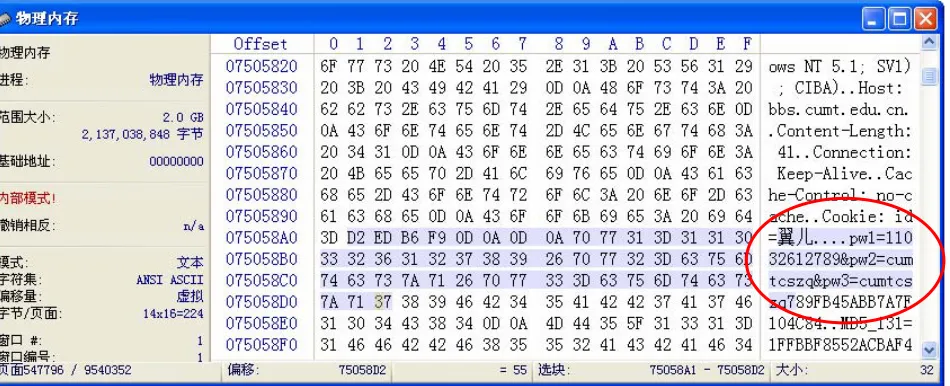
RAM can be opened directly by W inHe x. It is a very simp le way to collect and analyze RAM. After opening RAM, some information of physical me mory is also given. Although using this tool can make RAM change, lots of sensitive informat ion can be found. For e xa mp le, in our research we have found the process of a user changing his password.
In Fig. 1, we can see that the web site which the user ORJJHG RQ LV ³EEVFXPWHGXFQ´ WKH XVHU,' LV ³yier &K LQHVHFKDUDFWHU´³SZ ´Peans the old SDVVZRUGLV³´³SZ FX PWFV]T´PHDQVWKH QHZ SDVVZRUG LV ³FXPWFV]T´ DQG ³SZ FX PWFV]T´ means repeating the new password to make sure of password changing.
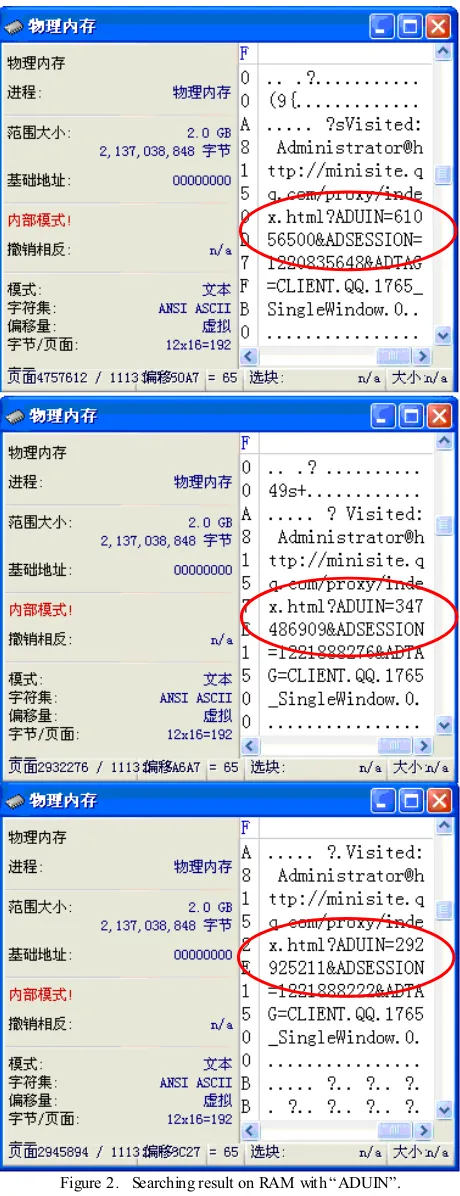
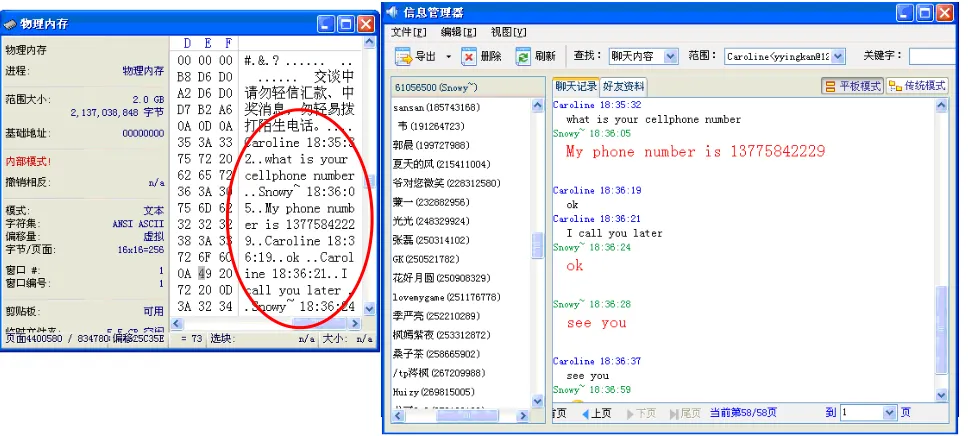
/HW¶V WDNH D ORRN DW DQRther exa mp le. We started QQ.e xe, and logged in with three QQ numbe rs: 61056500, 292925211 and 348486909. Then we chatted with QQ-IULHQGV EURZVHG ³4]RQH´ DQG GLG VRPHWKLQJ HOVH DV usual. After c losing all of the QQ processes, we opened RAM by WinHe x. We seDUFKHG³$8',1´RQ5$0:H found all of QQ-nu mbers that had logged in this system (Fig. 2). And then we searched one of the nu mbers ³´ ZH IRXQG D ORW RI LQIRUPDWLRQ VXFK DV WKH XVHU¶V44-IULHQGVFRQWHQWVRIWKHXVHU¶V³4]RQH´)LJ and even thHXVHU¶VFKDWORJV)LJ
According to Locard e xchange principle , opening RAM direct ly can change RAM. But it is very easy for investigators to approach physical me mory.
III. GAT HERING SENSIT IVE INFORMATION FROM CRA SH DUMP FILE
A crash dump can be the result of instability on the system. In most cases it manifests itself as an infa mous Blue Sc reen of Death. In this way we can obtain a pristine, untainted copy of the content of RAM fro m a ³OLYH´: LQGRZVV\VWHP:KHQDFUDVKGXPSRFFXUVWKH system state is fro zen and the contents of RAM are swapped or copied to the disk. This preserves the state of the system and ensures that no alterations are made to the system, beginning at the time the crash dump was init iated.
According to MS Knowledge Base (KB) art icle Q254649 [10], there are three types of crash dump: small .% NHUQHO DQG FRPSOHWH FUDVK GXPSV :KDW ZH¶UH looking for is the complete crash dump because it contains the complete contents of RAM.
MS KB a rtic le Q244139 [11] describes how to induce crash dump:
1) Se lect me mory du mp file options to comp lete me mo ry du mp.
2) Start Registry Editor,Locate the following registry subkey:
HKEY_ LOCA L_MACHINE\SYSTEM\ CurrentContro lSet\Serv ices\i8042prt\Para meters,
On the Edit menu, c lick Add Va lue, and then add the following registry entry:
Na me : CrashOnCtrlScroll, Data Type: REG_ DWORD, Value : 1;
Exit Reg istry Ed itor, and then restart the computer. 3UHVV³5LJKW&WUO6FUROO/RFN´W ZLFH
7KHRXWSXWILOHZLWKD³'03´H[WHQVLRQLVZULWWHQLQ a Microsoft-proprietary file fo rmat, legib le to Microsoft debugging tools.
Figure 3. 7KHFRQWHQWVRIWKHXVHU¶V³4]RQH´
Figure 4. 7KHXVHU¶VFKDWORJVRQ5$0
%\ GXPSFKNH[H ZH FDQ REWDLQ ³ ELW .HUQHO )XOO 'X PS $QDO\VLV´ )LJ ,W LQFOXGHV PXFK XVHIXO informat ion such as structure of DUMP_HEA DER, physical me mory description, version of the operating system, ke rnel base and unloaded modules.
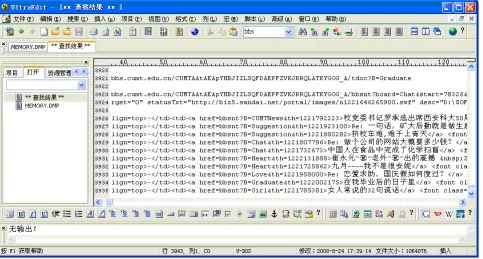
In our research, we have used other tools to run strings searching on MEMORY.DMP. We opened 0(025<'03 E\ 8OWUD(GLW >@ DQG VHDUFKHG ³EEV´
Fro m Fig. 6, we can see all of bullet in board systems that have been logged in by users of this computer and some contents of them.
We also used WinHex to perfo rm a string searching on 0(025<'03 ZLWK ³SDVVZRUG´ $V D UHVXOW ZH discovered username and password of E-Mail. This is an E-PDLO RI ³VLQDFR PFQ´ ,Q )LJ ZH FDQ VHH WKDW
--- 32 b it Ke rnel Full Du mp Analysis
DUM P_HEADER32: MajorVe rsion 0000000f MinorVersion 00000a28 ««
Physical Me mory Description: Nu mber of runs: 3 (limited to 3) File Offset Start Address Length 00001000 00001000 0009d 000 0009e 000 00100000 00e ff000 00f9d000 01000000 7e 680000 Last Page: 7f61c000 7f67f000
KiProcessorBlock at 8055c 580 2 KiProcessorBloc k entries: ffdff120 ba 338120
Windows XP Kernel Version 2600 (Service Pac k 2) MP (2 p rocs) Free x86 compatib le
Product: WinNt, suite: Termina lServer Single UserTS Built by: 2600.xpsp_sp2_gdr.070227-2254
Kernel base = 0x804d8000 Ps LoadedModuleList = 0x8055d700
Debug session time : Sat Aug 16 21:28:34.203 2008 (GMT+8)
System Uptime: 0 days 1:11:25.884 start end module na me
804d8000 806e 3000 nt Wed Feb 28 16:38:53 2007 (45E53F9D)
806e 3000 80703d00 hal Mon Oct 30 17:50:16 2006 (4545CAD8)
a7db8000 a 7de2180 kmixer Wed Jun 14 16:47:45 2006 (448FCD31)
««
Unloaded modules:
a806e 000 a 8099000 kmixe r.sys Timesta mp: unavailable (00000000) Checksu m: 00000000
a8aec000 a8b 17000 kmixer.sys Timesta mp: unavailable (00000000) Checksu m: 00000000
««
Figure 5. 32 bit Kernel Full Dump Analysis by dumpchk.exe.
Figure 7. Searching result on MEMORY.DMP ZLWK³SDVVZRUG´
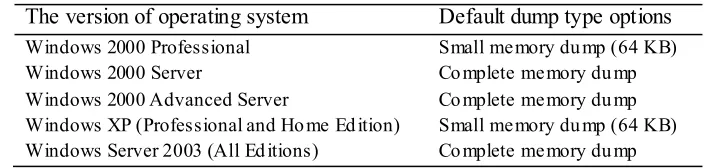
The crash dump solution is perhaps the only technically accurate method for creating an image of the contents of RAM. However, this method is not perfect. Windows systems do not generate full crash dumps by default (Table I). The registry setting requires a reboot to be taken into account. It must have been set prior to the incident. The crash dump process will still create a file
equal in size to physical me mory on the hard drive. To do so, as stated in KB a rtic le Q274598 [14], the pagefile must be configured to be equal to at least the size of physical me mo ry p lus 1 M B. Furthermore, given pagefile limits, the ma ximu m du mp file size is 2GB. No co mp lete dump can be obtained on a system with mo re than 2GB of physical me mory [15].
TABLE I. DEFAULT DUMP TYPE OP TIONS
The version of operating system
Default dump type options
Windows 2000 Professional Small me mory du mp (64 KB) Windows 2000 Server Co mplete me mory du mp Windows 2000 Advanced Server Co mplete me mory du mp Windows XP (Professional and Ho me Ed ition) Small me mory du mp (64 KB) Windows Server 2003 (All Ed itions) Co mplete me mory du mpIV. GAT HERING SENSIT IVE INFORMATION FROM PAGEFILE
7KHSDJHILOHLVDKLGGHQILOHRQDFRPSXWHU¶VKDUG GLVN WKDW :LQGRZV ;3 XVHV DV LI LW ZHUH 5$0 2Q D ³OLYH´ system, part of the me mory is swapped out into the pagefile. Collecting the pagefile is required for co mp lete DQDO\VLV7KHGHIDXOWSDJHILOHLV³&\SDJHILOHV\V´$VORQJ as Windows is running, the pagefile is locked by the kernel. It is still possible to access this file using a VSHFLDOO\ FUDIWHG GULYHU RU WKH VSHFLDO GHYLFH ³\Dev ice\ 3K\VLFDO'ULYH´ ,QFLGHQWDOO\ WKLV WHFKQLTXH KDV EHHQ
Figure 8. 6HDUFKLQJUHVXOWRQSDJHILOHV\VZLWK³SDVVZRUG´
The pagefile is not a me mory dump file. However, in order to recover as many me mo ry pages as possible, it would be valuable to have access to the pagefile fo r a Windows based system. Then the physical me mory and pagefile data should be me rged into a single set of data.
V. GAT HERING SENSIT IVE INFORMATION FROM HIBERNAT ION FILE
Hibernation means the whole system state is backed up to hard drive and the system is frozen for a infinite a mount of time without any power source. The Powe r Manager saves the compressed contents of physical me mo ry to a file ca lled
Hiberfil.sys in the root directory of the system vo lu me. Hiberfil.sys is created when the system hibernates for the first time. This file is large enough to hold the uncompressed contents of physical me mo ry, but co mpression is used to minimize disk I/O and to improve resume -fro m-hibernation performance. During the boot process, if a va lid Hiberfil.sys ILOHLVORFDWHGWKH17 /RDGHUZLOO ORDGWKHILOH¶VFRQWHQWV into physical me mo ry and transfer control to code within the ke rnel that handles resuming system operation after h ibernation.
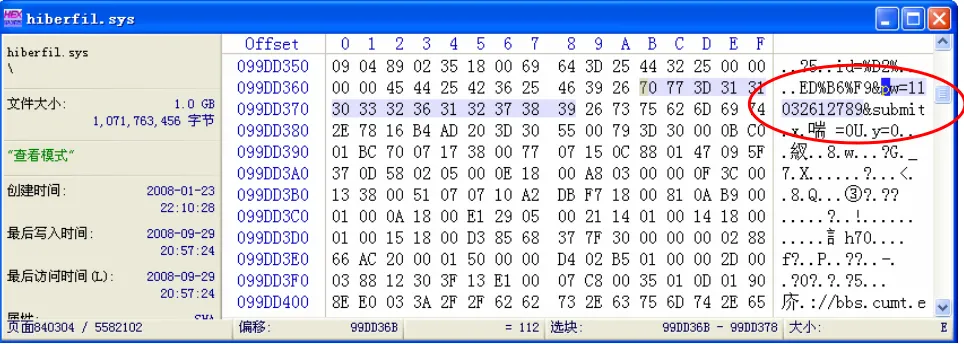
In our research, we also used WinHex copy hiberfil.sys and VHDUFK³SZ´RQLW)LJ
Figure 9. Searching result on hiberILOV\VZLWK³SZ´
If h ibernation has previously been used on the target system, this me mory collection method could prove to be a useful idea. Analy zing the contents of a hibernation file could give us a clue as to what was happening on the system at some point in the past. But if the last hibernation occurred long time ago, the hibernation file is
VI. CONCLUSIONS
By now it should be c lear that we have several options for collecting physical me mory fro m a live system. Each of them has its own advantages and limitations. In order to recover as much sensitive informat ion as possible, it is better to me rge crash du mp and pagefile to collect physical me mory. Ho wever, there is much more volat ile informat ion can be gathered from physical me mo ry, such as information of running processes. So we can make a deeper research in physical me mory re levant fields in farther work.
ACKNOWLEDGMENT
This work is supported by the Jiangsu Provincial Natural Science Foundation of China (BK2007035), the open research fund of National Mobile Co mmunicat ions Research Laboratory, Southeast University (W200817) and the Science and Technology Foundation of CUMT (0D080309).
REFERENCES
[1] RFC 3227, Guidelines for Evidence Collection and Archiving. http://www.faqs.org/rfcs/rfc3227.html, 2002 [2] W. Chisum and B. Turvey , ³(YLGHQFHG\QDPLFV/RFDUG¶V
exchange principle and crime reconstruction´, Journal of Behavioral Profiling, vol.1, January 2000.
[3] H. Carvey , Windows Foreniscs Analysis DVD Toolkit, 2005.
[4] B. D. Carrier and J. Grand. ³A hardware-based memory acquisition procedure for digital investigations´,Journal of Digital Investigations, vol. 1, pp. 50-60, February 2004. [5] http://ntsecurity.nu/onmymind/2006/2006-09-02.html [6] G. M . Garner, Forensic Acquisition Utilities,
http://www.gmgsystemsinc.com/fau/. [7] http://www.vmware.com/
[8] S. Bradley , ³BodySnatcher: Towards reliable volatile memory acquisition by software´, Journal of Digital Investigations, vol. 4, pp. 126-134, September 2007 [9] http://www.x-ways.net/winhex/index-m.html
[10]³Overview of memory dump file options for Windows Server 2003, Windows XP, and Windows 2000´, http://support.microsoft.com/kb/254649/en-us
[11]³Windows feature lets you generate a memory dump file
by using the keyboard´,
http://support.microsoft.com/kb/244139/en-us
[12] http://www.microsoft.com/whdc/devtools/debugging/defau lt.mspx
[13] http://www.ultraedit.cn/
[14]³Complete memory dumps are not available on computers that have 2 or more gigabytes of RAM´, http://support.microsoft.com/kb/274598/en-us
[15]N. Ruff, ³Windows memory forensics´, Journal of Computer Virology, vol. 4, pp. 83-100, M ay 2008.
[16] J. Rutkowska, ³Subverting Vista Kernel´, http://invisiblethings.org/papers/joanna%20rutkowska%20 -%20subverting%20vista%20kernel.ppt
[17] http://www.runtime.org/
[18] http://www.accessdata.com/catalog/partdetail.aspx?partno =11000
[19] http://www.x-ways.net/forensics/index-m.html [20] http://www.ilook-forensics.org/
[21] S. Lee, H. Kim, S. Lee, and J. Lim, ³Digital evidence collection process in integrity and memory information gathering´, In Proceedings of Systematic Approaches to Digital Forensic Engineering, First International Work-shop, Proc. IEEE, pp. 236-247, 2005.
Qian Zhao is currently working toward the M aster degree in the School of Computer Science and Technology, China University of M ining and Technology.