Categorisation in Infants and
Adults: Perceptual Saliency
as a Function of Timing
Janine V. Spencer
Thesis submitted for the degree of Doctor of Philosophy
MRC Cognitive Development Unit
&
ProQuest Number: U642350
All rights reserved
INFORMATION TO ALL USERS
The quality of this reproduction is dependent upon the quality of the copy submitted.
In the unlikely event that the author did not send a complete manuscript and there are missing pages, these will be noted. Also, if material had to be removed,
a note will indicate the deletion.
uest.
ProQuest U642350
Published by ProQuest LLC(2015). Copyright of the Dissertation is held by the Author.
All rights reserved.
This work is protected against unauthorized copying under Title 17, United States Code. Microform Edition © ProQuest LLC.
ProQuest LLC
789 East Eisenhower Parkway P.O. Box 1346
Abstract
Concepts mentally represent categories of entities in the world. They are
thought to be fundamental to thinking. O f primary concern is whether conceptual
information is at the core o f infants’ representations o f categories, or if infants first
learn to classify on a purely perceptual basis. The relationship between perceptual
and conceptual categorisation has been conceived o f in terms o f a dichotomy. I
argue, however, that both perceptual and conceptual information are constrained by
the amount o f time the cognitive system has to process information. In this thesis, I
investigate the relative weighting o f perceptual information under time pressure at
the beginning o f conceptual development, in infants, and when conceptual
development is complete, in adults.
The effects o f timing on categorisation were investigated in 16 experiments
with infants and adults. Experiments 1 to 3 utilised the familiarisation/novelty
preference procedure with 4-month-old infants. The experiments demonstrated that
when processing time is limited, infants show a marked preference for the highly-
diagnostic information. With increased looking time, less diagnostic information is
incorporated into the object representation. Experiments 4 to 16 revealed that the
properties adults use in rapid categorisation tasks correspond to those o f infants,
and are therefore not a function of age. Rather, how subjects perceive, process and
assign relative weighting to different properties in categorising objects is dependent
Acknowledgements
I am grateful to many people, without whom this thesis would not exist, including
Annette Karmiloff-Smith for her advice, support and friendship, Mark Johnson,
Paul Quinn, Bradley Franks, John Morton, Greg Murphy, Rob Goldstone, Clive
Rosenthal, Kristina Scheuffgen, and Jean Mandler. I am very grateful to everyone
at the CDU baby lab for their assistance over the past 3 years, and o f course the
infants and adults who made the experimental testing possible.
I would also like to thank my parents for their love and continued support over the
Table o f Contents
Abstract__________________________________________________________________2
Acknowledgem ents_______________________________________________________ 3
Table o f Contents____________________________________________________ 4 Chapter 1___________________________________________________________ 9
Introduction_____________________________________________________________ 9
P lan ______________________________________________________________________________ 11
1.1 Conceptual Content___________________________________________________ 12
1.1.1 The Classical View____________________________________________________________ 12 1.1.2 Prototype V iew o f Concepts____________________________________________________ 13 1.1.2.1 Problems with Prototype Theories__________________________________________18 1.1.3 Theory-Based Views O f Conceptual Representation______________________________ 19 Interim Summary 1 : _______________________________________________________________ 22
1.2. The Development of Concepts_________________________________________ 23
1.2.1 The Development O f Perceptual and Conceptual Categorisation___________________ 24 Interim Summary 2: _______________________________________________________________ 32
1.3 The Relationship Between Perception and Concepts______________________ 34
1.3.1 Perceptual Learning__________________________________________________________ 35 1.3.2 Perceptual Learning and Attention_____________________________________________ 36 1.3.3 Perceptual Learning via Stimulus Imprinting____________________________________ 36 1.3.4 Task Constraints on Categorisation Processes___________________________________ 38
1.4 Conclusions__________________________________________________________ 42
Chapter!__________________________________________________________ 44
Introduction____________________________________________________________ 44
2.1 Experiment 1 ________________________________________________________ 50
2.1.1 M ethod______________________________________________________________________53 2.1.1.1 Subjects ________________________________________________________________ 53 2.1.1.2 Design and Stimuli_______________________________________________________ 53 2.1.2 Procedure___________________________________________________________________ 59 2.1.3 R esu lts______________________________________________________________________61 2.1.3.1 Familiarisation Trials_____________________________________________________ 61 2.1.3.2 Preference Test Trials_____________________________________________________ 61
2.1.4 Discussion__________________________________________________________ 62
2.2 Experiment 2 ________________________________________________________ 65
2.2.1 M ethod______________________________________________________________________66 2.2.1.1 Subjects ________________________________________________________________ 66 2.2.1.2 Design and Stimuli_______________________________________________________ 66 2.2.2 R esu lts______________________________________________________________________67 2.2.2.1 Familiarisation Trials_____________________________________________________ 67 2.2.2.1 Preference Test Trials_____________________________________________________ 67
2.3 Experiment 3 ________________________________________________________ 71
2.3.1 M ethod______________________________________________________________________71 2.3.1.1 Subjects ________________________________________________________________ 71 2.3.2 Design and Stimuli___________________________________________________________ 72 2.3.3 R esu lts______________________________________________________________________ 72 2.3.3.1 Familiarisation T rials____________________________________________________ 72 2.3.3.2 Preference Test Trials____________________________________________________ 72
2.3.4 Discussion__________________________________________________________ 75
2.4 Experiment 4 ________________________________________________________ 78
2.4.1 M ethod______________________________________________________________________ 80 2.4.1.1 Subjects ________________________________________________________________ 80 2.4.1.2 S tim u li_________________________________________________________________ 80 2.4.2 Procedure___________________________________________________________________ 81 2.4.3 R esu lts______________________________________________________________________ 81 2.4.4 D iscu ssio n __________________________________________________________________ 82
2.5 Experiment 5 ________________________________________________________ 85
2.5.1 M ethod______________________________________________________________________ 85 2.5.1.1 Subjects ________________________________________________________________ 85 2.5.1.2 Stimuli _________________________________________________________________ 86 2.5.2 Procedure___________________________________________________________________ 86 2.5.3 R esu lts______________________________________________________________________ 86 2.5.4 D iscu ssio n __________________________________________________________________ 90
2.6 General Discussion____________________________________________________94
Chapters__________________________________________________________ 97
Introduction____________________________________________________________ 97
3.1 Experiment 6 _______________________________________________________ 102
3.1.1 Method_____________________________________________________________________ 103 3.1.1.1 Subjects _______________________________________________________________ 103 3.1.1.2 Design and Stim uli______________________________________________________ 103 3.1.2 Procedure__________________________________________________________________ 105 3.1.3 R esu lts_____________________________________________________________________ 105 3.1.3.1 Data Analysis o f Reaction T im es_________________________________________ 106 3.1.4 D isc u ssio n _________________________________________________________________ 106
3.2 Experiment 7 _______________________________________________________ 109
3.2.1 M ethod_____________________________________________________________________ 111 3.2.1.1 Subjects _______________________________________________________________ 111 3.2.1.2 S tim u li________________________________________________________________ 111 3.2.2 Procedure__________________________________________________________________ 114 3.2.3 R esu lts_____________________________________________________________________ 114 2.2.4 D iscu ssio n _________________________________________________________________ 115
3.3 Experiment 8 _______________________________________________________ 117
3.3.4 D iscu ssio n _________________________________________________________________ 121
3.4 Experiment 9 _______________________________________________________ 122
3.4.1 Method_____________________________________________________________________122 3.4.1.1 Subjects _______________________________________________________________ 122 3.4.1.2 Design and Stim uli______________________________________________________ 122 3.4.2 Procedure__________________________________________________________________ 123 3.4.3 R esu lts_____________________________________________________________________125 3.4.3.1 Data Analysis for Reaction T im e s________________________________________ 126 3.4.4 D iscu ssio n _________________________________________________________________ 129
3.5 Experiment 1 0 ______________________________________________________ 130
3.5.1 Method_____________________________________________________________________130 3.5.1.1 Subjects _______________________________________________________________ 130 3.5.1.2 S tim u li________________________________________________________________ 130 3.5.3 Procedure__________________________________________________________________ 130 3.5.4 R esu lts_____________________________________________________________________131 3.5.4 D iscu ssio n _________________________________________________________________ 133
3.6 Experiment 11 ______________________________________________________ 134
3.6.2 Procedure__________________________________________________________________ 135 3.6.3 R esu lts_____________________________________________________________________137 3.6.3.1 Data Analysis o f Reaction T im es_________________________________________ 137 3.6.4 D iscu ssio n _________________________________________________________________ 140
3.7 General Discussion___________________________________________________141
Chapter 4__________________________________________________________ 147
Introduction___________________________________________________________ 147
4.1 Experiment 12 ______________________________________________________ 151
4.1.1 Method_____________________________________________________________________151 4.1.1.1 Subjects________________________________________________________________ 151 4.1.1.2 Design and Stimuli______________________________________________________ 151 4.1.2 Procedure__________________________________________________________________ 151 4.1.3 Results and Discussion_______________________________________________________ 156 4.1.3.1 Data Analysis for Yes / N o Response and for Reaction T im e s _______________ 156
4.2 Experiment 13 ______________________________________________________ 159
4.2.1 Method_____________________________________________________________________159 4.2.1.1 Subjects________________________________________________________________ 159 4.2.1.2 Design and Stim uli______________________________________________________ 159 4.2.2 Results: Data Analysis for Yes / No Response and for Reaction Times ____________ 160
4.3 General Discussion___________________________________________________163
C hapters__________________________________________________________ 167
Introduction___________________________________________________________ 167
5.1 Experiment 1 4 _____________________________________________________ 168
5.1.1 Method_____________________________________________________________________169 5.1.1.1 Subjects _______________________________________________________________ 169 5.1.1.2 Design and Stimuli______________________________________________________ 169 5.1.2 Procedure__________________________________________________________________ 170
5.1.3.1 Familiarisation T rials____________________________________________________ 174 5.1.3.2 Preference Test Trials____________________________________________________ 174 5.1.4 D isc u ssio n ________________________________________________________________ 176
5.2 Experiment 1 5 ______________________________________________________ 180
5.2.1 M ethod_____________________________________________________________________ 180 5.2.1.1 Subjects _______________________________________________________________ 180 5. 2.1.2 Stimuli________________________________________________________________ 180 5.2.2 Procedure__________________________________________________________________ 181 5.2.3 R esu lts_____________________________________________________________________181 5.2.4 D iscu ssio n _________________________________________________________________ 184
5.3 Experiment 1 6 ______________________________________________________ 185
5.3.1 M ethod_____________________________________________________________________185 5.3.1.1 Subjects _______________________________________________________________ 185 5.3.1.2 Design and Stimuli______________________________________________________ 185 5.3.2 Procedure__________________________________________________________________ 186 5.3.3 Results and Discussion_______________________________________________________ 186 5.3.3.1 Data Analysis o f Reaction T im es________________________________________ 187
5.4 General Discussion___________________________________________________ 189
Chapter 6_________________________________________________________ 192
6.1 Introduction________________________________________________________ 192
6.2 Summary of Experimental F in d in g s___________________________________ 192
6.3 Experimental and Methodological I s s u e s ______________________________ 198
6.4 Generalisability of Results____________________________________________ 203
6.5 Implications and Scope______________________________________________ 208
Table o f Figures
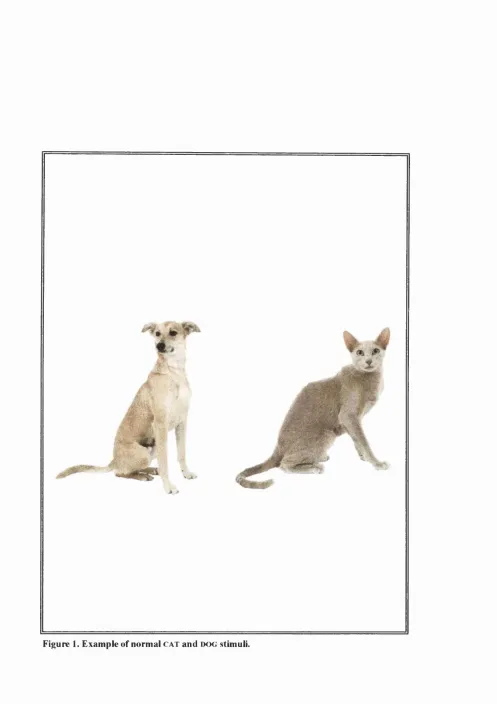
Figures fo r chapter 2Figure 1. Example o f normal cat and dog stimuli. ~______________________________________56 Figure 2. Example o f a cat-dog hybrid pair. _______________________________________________ 57
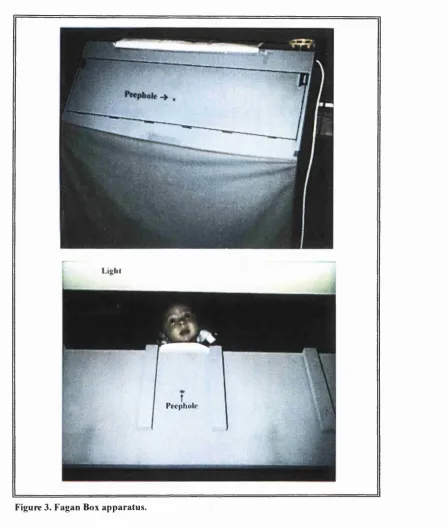
Figure 3. Fagan Box apparatus.__________________________________________________________ 57
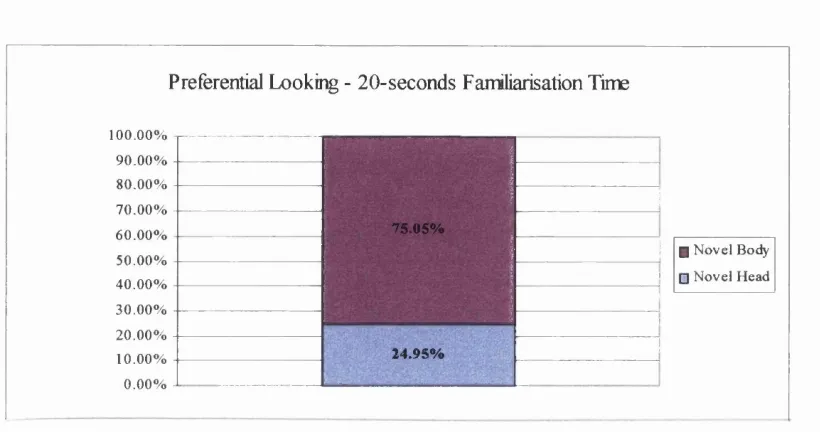
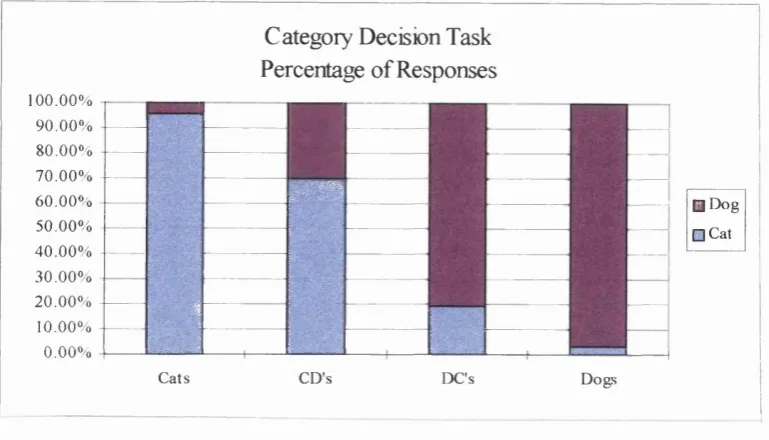
Figure 4. Preferential looking: 10-seconds familiarisation tim e______________________________64 Figure 5. Preferential looking: 15-seconds familiarisation tim e______________________________70 Figure 6. Preferential looking: 20-seconds familiarisation tim e__________________________ 74 Figure 7. Preferential looking time as a function offamiliarisation time ______________________ 74 Figure 8. Mean typicality ratings fo r the fou r c a teg o ries.____________________________________84 Figure 9. Percentage o f cat and dog respon ses_____________________________________________88 Figure 10. Mean reaction times fo r the fou r category types___________________________________88 Figure 11. Mean reaction times collapsed over normal and hybrid stimuli_____________________89
Figures fo r chapter 3
Figure 12. Examples o f the head and body stimuli__________________________________________104 Figure 13. Percentage o f cat and dog responses by stimulus ty p e____________________________108 Figure 14. Mean reaction times collapsed over head and body s tim u li______________________108 Figure 15. Examples o f a normal cat and dog split up into p a r ts____________________________112 Figure 16. Examples o f hybrid cats and dogs split into p a r ts_______________________________ 113 Figure 17. Mean typicality ratings fo r the fou r categories o f split animals. ___________________116 Figure 18. Percentage o f cat and dog resp o n ses___________________________________________120 Figure 19. Mean reaction times collapsed over normal and hybrid stimuli____________________120 Figure 20. Examples o f normal and hybrid outline s tim u li__________________________________124 Figure 21. Percentage o f frequencies fo r the outline stim u li________________________________127 Figure 22. Mean reaction times fo r the fou r category types__________________________________127 Figure 23. Mean reaction times collapsed over normal and hybrid stimuli____________________128 Figure 24. Mean typicality ratings fo r whole outline stim u li________________________________ 132 Figure 25. Examples o f head and body outlines____________________________________________136 Figure 26. Percentage o f responses fo r the head and body outlines
Figure 27. Mean reaction times fo r the head and body outlines _____________________________139
Figures fo r Chapter 4
Figure 28. Examples o f the differences between stimuli in phase 1 and 2._____________________154 Figure 29. Examples o f the differences between stimuli in phase 1 and 2._____________________155 Figure 30. Mean reaction times fo r 2000 ms presentation ta sk______________________________158 Figure 31. Mean reaction times fo r correct and incorrect responses__________________________158 Figure 32. Mean reaction times - 500 ms presentation t i m e________________________________ 162
Figures fo r Chapter 5
Chapter 1
Introduction
Concepts are integral to thinking. For a child to leam that fire can bum, she
must use her concepts o f fire and burn. Without making this assumption it is
difficult to say why a child’s experience with one kind o f fire and one particular
experience of burn would be related to a different kind o ffire and a different kind
o f burn. It is not that the child is simply using association to generalise from one
type of fire to another type. Rather, her thoughts concerning fire and burn are
structured. For example, the concepts o f John, Mary, and Lucy, and having the
concept John loves Mary makes it is possible to entertain the concept Lucy loves
John. Evans (1980) has called this the Generality Constraint. The idea is that to
have a concept permits one to think about infinite states o f affairs that involve that
concept. It is only by treating events, entities, or situations, as different, but related
instances are we able to form concepts. Concepts represent our knowledge of the
world, be it personal, social or physical. Knowledge is divided up into concepts,
and concepts represent or encode categories o f things in the world. In other words,
concepts classify things into categories. They reflect the way in which we divide
the world into classes. On this account, concepts mentally represent categories of
entities in the world.
Concepts then are mental representations of categories. A primary function
o f concepts is the promotion o f cognitive economy (Rosch, 1978, but see Pinker,
1997 for an alternative view). The basic premise is that the human cognitive system
partitions the large number o f objects and information in the world into a
manageable number o f categories. This process serves to both (1) decrease the
amount o f information the cognitive system must store in memory and, (2) allow
members o f a familiar category. Without the ability to categorise every novel entity
encountered would require a new mental representation denoted by a different
word.
A further function o f concepts is that they enable us to go beyond the
information given (Bruner, Goodnow, & Austin, 1956). When encountering an
entity, for example a dog, the only direct knowledge o f the dog is given by its
appearance. It is essential that we can go beyond the basic appearance o f the dog
and draw upon other related knowledge that we have, such as that even if a dog
looks furry and has a wagging tail, not all dogs are friendly and some may even
inflict injury. On this account, to have a concept is to have the ability to link
perceptual and non-perceptual information (Rips, & Collins, 1993).
In this chapter I aim to address the following issues. Firstly, since concepts
have functions, then it is probable that these functions impose constraints on the
content o f concepts in much the same way that the function of an object, say a
chair, imposes constraints on its structure. A chair that does not have a seat o f any
kind does not fulfil its function as a chair. If it is the case that the content of a
concept is constrained by its function, then it is important to know what the nature
o f the conceptual representation is.
Secondly, people frequently apply their knowledge about categories in a
flexible way, giving greater weighting to some aspects o f an entity depending on
the processing involved or the context (Barsalou, 1987). For example, it is possible
to classify a chair as a chair at one time and as a ladder at another. This suggests
that conceptual content is context dependent. Given the flexibility people
demonstrate in categorisation, how can we provide a psychologically plausible
account o f the processes involved in categorisation? To classify an entity may
interpretation required by the context. To classify a chair as a chair in one context -
say when sitting on it - and as a ladder in another - when climbing on it to reach a
book - requires paying more attention to some properties o f the object than to
others. A similar idea to this has been put forward by Lamberts (1995) who
suggests that because categorisation must often be carried out rapidly people adjust
the way in which they weight stimulus dimensions, with perceptual salience
dominating the category decision when processing time is limited. One method of
ascertaining the relative weighting people assign to objects when making category
decisions is by looking at what happens during time-dependent categorisation.
Plan
This chapter is organised as follows. I will firstly consider what the content
of concepts is. If concepts are mental representations that allow for the forming of
classes of entities into categories, then we need to know what it is that is being
represented. Are the contents o f concepts restricted to the diagnosticity of
perceptual properties, which are used as the building blocks for complex object
representations? Or, are the contents of concepts made up o f our underlying beliefs
about what something is? This issue will be explored in the light o f different
theories of classification and representation. In section two I will discuss the issues
concerning whether infants first leam to classify things in the world on a purely
perceptual basis, or whether non-perceptual information is at the core of their
representations o f categories. This will naturally lead onto looking at the exact
relationship between perception and categorisation and will be discussed in section
three. Finally, in section four I argue that because much of everyday categorisation
is carried out quickly, the relative weighting o f perceptual and non-perceptual
information is constrained by the amount o f time the cognitive system has to
process information and make a category decision (Lamberts, 1995).
-1.1 Conceptual Content
It has generally been assumed that a concept is a stable mental
representation in long-term memory and that people use this representation when
thinking and making inferences. It is also believed that people use concepts as a
means o f classification whereby some kind o f feature-detection mechanism is
employed so as to compare the content o f a concept with the properties o f an
object, and so decide whether or not an object falls under the denotation o f that
concept (Franks, 1995). In this section I review some o f the basic theories o f how
people compare the content o f their concepts with the properties o f an object when
making category decisions.
1.1.1 The Classical View
The classical view o f categorisation can be traced back to Aristotle. He
believed that every concept possesses a defining essence, the attributes o f which are
singly necessary and jointly sufficient conditions for category membership.
Aristotle reasoned that the essences of things are simply a part of an individual’s
knowledge of the world. We know what a dog is, what it is that defines a dog as a
dog, and we know this by inferring it from the examples that we encounter in the
world. On this Aristotelian view, membership in a category is defined as being all-
or-none. Either an entity fulfils all o f the conditions o f being a dog in which case it
is a member of the category of dogs, or it fails to fulfil at least one o f the conditions
o f being a dog, in which case it is not a member o f the category o f dogs.
The psychological plausibility o f the classical view o f concepts has not been
without its challengers. Objects are defined as members o f a category only if they
are in possession o f singly necessary and jointly sufficient properties. For example
are both necessary and sufficient simply because the defeat o f any one of them
would result in the entity no longer being a "Bachelor". So, for instance, if "male"
was changed to "female", the person might be classified as a "Spinster" rather than
a "Bachelor"; and similarly if "unmarried" was changed to "married", the person
would no longer be classified as a "Bachelor". The problem, however, is how to
reconcile the list o f definitions with other, perhaps non-defining attributes o f our
concepts. For example, a Bachelor has the defining attributes o f being [unmarried]
[adult] and [male]. A Catholic priest has all of these attributes, yet he does not fit
the concept o f bachelor very well. One would be very surprised to find a Catholic
priest on a list o f eligible bachelors. It is apparent then that people’s concepts are
far richer than simply the core definitional features (Cohen & Murphy, 1984;
Rosch, 1975). For the purposes o f this discussion the assumptions o f individually
necessary and jointly sufficient attributes made by the classical view have one
central problematic implication. If an object has the necessary and sufficient
attributes then it can be classified as a member; if it does not, then it cannot be
classified as a member. However, as I noted earlier, in the course o f everyday
categorisation, there is often a divergence between the set o f properties that an
object has, the amount o f time needed to check those properties, and the amount of
time a person has for making a category decision. In my view, for a person to make
a decision on category membership in such cases implies that there are some
features o f a concept which are defeasible. This defeasibility o f features is not
accounted for in the classical view. Given this, theorists such as Rosch (1978) and
Rosch and Mervis (1975) developed a theory claiming that concepts are organised
around prototypes, a view to which we turn next.
1,1.2 Prototype View o f Concepts
A particular difficulty with the classical view o f concepts is that it is unclear
what the defining properties o f natural kinds such as water or gold are. Quine
relation which explains their belonging to the same kind. Similarity can be defined
in terms o f surface characteristics, that is perceptual, or conceptual ones (i.e., due to
being the same kind). Within prototype theories similarity comparisons are made
on the basis o f perceptual properties. With respect to more abstract concepts, it was
Wittgenstein (1953) who first remarked upon the difficulty o f defining necessary
and sufficient properties for something to be a game. His argument was that there is
no set o f properties that will separate all games and only games from all other
things. The apparently necessary properties, such as, being played, are not o f
themselves sufficient. And, the apparently sufficient properties, for example the
characteristics o f cricket, are also not all necessary. Wittgenstein’s claim was that
different members share a family resemblance. Some resemblances overlap more
than others, e.g., {A, B, C, D}, {A, D, E}, {E, F, G, H}, {A, H, K}. These similarities
can be likened to family resemblances. A child may look like her father with
respect to her nose, and like her mother with respect to her mannerisms. Although
Wittgenstein’s observation of finding appropriate necessary and sufficient
properties for defining something as a game highlights the shortcomings o f the
classical view of concepts, it still does not capture the nature o f the conceptual
phenomena when subjects are assigning category membership.
Based on Wittgenstein’s notion of family resemblance, Rosch (1978)
carried out a number o f experiments to see how concepts could be structured
according to this view. It was proposed that conceptual representations have a
prototypical structure. The prototype view o f concepts holds that there is no
necessity for an entity to have all o f the necessary and sufficient properties for
picking out sub-parts o f an entity in a given context and establishing category
membership. Rather, all that is required is for the entity to be in possession o f a
sufficient number o f attributes that other members o f the category have. This view
argues that concepts are made up o f diagnostic attributes (e.g., the shape and colour
members. The greater the weighting (i.e., the more commonly occurring diagnostic
attributes an entity has), the more likely that entity is o f being classified as a typical
member o f that category. For a concept such as lemon the attributes o f taste and
colour might be included in the concept. However, taste (e.g., sour, bitter, sweet)
might be more highly weighted than shape. So the attributes yellow and sour for
lemons would have a greater weighting than say yellow and oval, and so an object
that was yellow, sour, and juicy would, according to this view, be more
prototypical o f a lemon than an object that was yellow, sweet and juicy. The
flexibility o f conceptual content is accounted for by assuming that all o f the
possible weighting for attributes is represented in the concept itself and according
to the context the relevant values are chosen.
This view o f concepts often holds that classification is accomplished using
an idealised abstraction over the cases of the individuals in the category - the
average member. Features in the concept are matched fo r similarity against the
properties o f the object classified: if similarity exceeds the threshold level, then it is
classified as a member (Smith & Osherson 1984). Every match adds to similarity
and every mismatch reduces similarity. The extent to which matches/mismatches
change similarity depends on the diagnosticity weighting of the attributes, their role
in identifying members, and the salience o f attributes. Higher weighting or salience
will increase change in similarity. Similarity, typicality and category membership
are all measured on the same scale. Context dependency o f classification is thought
to vary by either lowering the similarity threshold, that is, letting more things into
the category, or by increasing the weighting on one or more attributes (narrowing
the category).
Several theories are based on similarity relations. The exemplar theory
(Medin & Schaffer, 1978; Brooks, 1987; Nosofsky, 1991), for example, is
assumed that sets o f instances determine categorisation, not single instances. A
concept is represented as the most typical instancesImQvcibQrs o f a category, or a set
o f such instances. For example, a Labrador, Alsatian, and Collie may be the set of
best exemplars, or most typical members o f the concept dog.
Another recent similarity-based proposal is the probabilistic theory
(Hampton, 1993). Within this theory a concept is represented as a set of
characteristic attributes - which are normally sufficient for membership. The
attributes have different weights indicating their importance in identifying category
members. The representation reflects typicality structure/gradient for the concept.
There are differences between probabilistic and exemplar theories. Within the
exemplar theory if the most typical dogs are brown, then they represent the most
typical dogs; whereas within the probabilistic theory brown would be the most
typical/diagnostic value o f one attribute of dogs - the colour attribute. Regardless,
however, o f whether the representation o f a concept is seen as being probabilistic,
an exemplar, or a prototype, all o f these theories have in common the notion of
good instances or average instances as being crucial to determining the set of
entities that fall under the denotation o f the concept as well as determining which
term(s) associated with the concept truly relate.
The representations o f concepts within prototypicality theories are thought
to form hierarchies in which successive levels refer to increasingly more abstract
concepts. The structure o f such hierarchies goes from a single instance my dog
Darcey to progressively more abstract concepts. In the hierarchical taxonomy of
animals, for example, the Subordinate level might include Black Labradors, the
Basic level dogs, and Superordinate level would include the concept mammal
Rosch, Mervis, Gray, Johnson, and Boyes-Braehm (1976) argued that it is the
basic-level that has the most psychological significance. The basic-level terms are
world, and adults are also thought to primarily assign names to groups o f objects
using basic-level names (Atran, 1996). Children’s initial basic-level categories,
however, do not always map directly onto adult basic-level categories denoted by
the same word. Such differences are to be expected given that children do not
possess the same knowledge or expertise as adults. Objects that fall under the
extension o f basic-level terms are seen as sharing coarse perceptual and/or
functional properties in common. These perceptual properties do not vary
orthogonally with the world. Rather, they come in causally related clusters (Rosch,
1975). Objects with dog-like feet tend to have dog-like heads. Birds with webbed
feet tend to have bills. The basic-level is thought to maximise between-category
dissimilarity and maximise within-category similarity, and as such is seen as
representing a level o f object categorisation that is psychologically fundamental.
In a number o f typicality rating experiments' Rosch (1975) asked subjects
to rate how typical or representative certain objects were as members o f the
category o f vegetable. The findings revealed that there were typicality gradients
ranging from highly typical members (e.g., carrot) through borderline members
(e.g., tomato) to non-members (e.g., cod). These findings were replicated for many
other categories, (e.g., colour categories, natural kinds, artefacts, and social
categories). In a further study McCloskey & Glucksberg (1978) asked subjects to
say whether objects were or were not category members. Subjects were re-tested a
week later. Within this study subjects additionally had to rate the typicality of
instances. The findings showed that subjects assigned intermediate ratings to
borderline cases like olive (as a fruit) or amoeba (as an animat). Additional support
for the gradedness of category membership comes from a study by Smith, Shoben
& Rips (1974). Here subjects had to verify category membership statements as
quickly as possible: e.g., A tomato is a fruit. It was found that both high typicality
and low typicality produced rapid verification times; whereas subjects’ reaction
times were slower for borderline cases. Hence, the empirical support for categories
having some members which are more or less prototypical, appears to be
supported.
1.1,2.1 Problems with Prototype Theories
As mentioned previously, all prototype theories are similarity-based.
However, similarity may be the consequence o f classification rather than the cause.
The notion of similarity presupposes a constraint on the specification o f the
attributes for comparison. To say that things are similar because they fall into the
same category emphasises the circularity o f similarity, where the notion o f
similarity is in need o f a supplementary explanation. This point was made by
Goodman (1972) who argued that for this reason prototype theory itself is only
descriptive. Furthermore, people do not always classify solely on the basis of
(surface) similarity. For example Rips (1989) found that although a 3-inch disk is
more similar to a coin in size than to a pizza, subjects were more likely to
categorise it as a pizza. Thus, for some objects central attributes appear to be more
important. Prototype theory expresses degrees o f diagnosticity of attributes (surface
appearances), and has no way o f representing central attributes. Furthermore,
judging the typicality o f objects does not imply that they are represented in terms of
typicality. Typicality ratings are off-line and so could reflect processing effects
subsequent to concept access.
Recent evidence also suggests that typicality ratings vary both across
contexts and as a function o f the perspective subjects are asked to adopt. For
instance, subjects asked to adopt the perspective o f an American tend to rate eagles
as more typical birds than peacocks, whereas subjects adopting the perspective o f a
such findings, it has been argued that prototypes may not be stable (Barsalou,
1987), or iterable (Barsalou & Sewell, 1985). And, since classification is not stable,
it might be argued that representations are not stable either (see Smith & Jones,
1993 who have argued that there are no such things as stable mental representations
since mental activity is essentially dynamic.). This intraperson instability is
dependent on contextual effects. So, those attributes that are important in one
context may be less so in another. If the prototypical view o f concepts is adhered
to, this would suggest that the content of people’s concepts is comprised o f all the
possible sets o f attributes associated with an object. Categorisation, however, is
usually performed in real-time, the mind having to constantly adapt to
accommodate sensory input from an ever-changing world, thus it seems unlikely
that the brain, as a finite organ, is able to store all o f the infinity o f unique senses in
the content of the concept - just waiting for the right context to occur for them to be
retrieved.
1.1.3 Theory-Based Views O f Conceptual Representation
As mentioned previously, in the course o f everyday categorisation, there is
often a divergence between the set o f properties that an object has, the amount o f
time needed to check those properties, and the time a person has for deciding
whether the object is a member o f a particular category. In the previous two
sections I have argued that neither the classical nor the prototypical view o f
concepts can adequately handle the context-dependent flexibility o f categorisation.
The classical approach is inadequate simply because it does not allow for the
defeasibility o f features. The prototype theory o f concepts holds that all o f the
possible weightings for attributes are represented in the concept itself and,
according to the context, the relevant values are chosen. This theory might allow
for the defeasibility of features. However, the efficiency o f categorising objects in
the world indicates that we need to have very simple representations and not an
involve a great deal o f processing to see if enough o f the properties o f an entity can
be mapped on to features in the conceptual representation (Franks, 1995).
Consequently we need a theory o f concepts which can account for the flexibility of
categorisation whilst at the same time overcoming the problems evident in
prototype theories.^ Thus, in this section I consider how a theory-based view of
conceptual knowledge could account for the flexibility of categorisation.
The basic premise o f the theory-based view of concepts is that people’s
theories about the world embody knowledge. A theory is a complex set o f causal
relations between concepts (Murphy & Medin, 1985). Concepts and general
knowledge are interwoven. There are no separate representations o f concepts.
Concepts are simply subparts o f information drawn from general knowledge in
context.
The representation o f concepts within the Theory-theory is coherent to the
extent that category membership is explained by a plausible commonsense theory
o f the domain. It is the commonsense theory that specifies the critical attributes for
similarity judgements. Attributes can be more or less deeply embedded in the
theory; deeper ones have more (and more critical) explanatory links. There are
surface or diagnostic attributes that relate to the perceptual properties o f an entity,
central/highly frequent attributes, and essence placeholders. Murphy and Medin
(1985) argue that observable diagnostic properties are the basis for inferring the
presence o f usually non-observable central properties. For example, lions have
some essence o f lionhood, which, although unobservable, is how one can look at a
lion and classify it as a member o f the category o f lions. On this account, if a
commonsense theory posits a strong, often causal link between a property and the
classification of the object, then that property is central. These central attributes are
thought to be immutable (Kahneman & Miller, 1986).
Immutability suggests that people believe central attributes are essential to
category membership. Medin and Ortony (1989) label this belief psychological
essentialism - the belief that natural kinds have essences. It is not important
whether natural kinds really do have essences but that people believe that they do
and make category judgements accordingly. On this view, the central features o f a
concept are those properties that a subject will not allow to be defeated if the entity
is to remain a member o f the category. If centrality is critical to category
membership, then it should help explain differentiating within the basic-level as
well as across superordinates.
The Theory-theory proposes that classification will vary according to the
task. Quick identification will be based on perceptual similarity, but for analytic
categorisation, i.e., when there is no limit on the time given for making a category
decision, classification will be explanation/essence-based.
It has been argued that categorising a diverse entity as an instance o f the
same kind requires stable mental representations (Keil, 1994). However, given the
efficiency o f categorisation the content of a concept may be made up o f a relatively
few features with little causal information rather than representing a complex array
of idealised attributes of an entity. Whenever we attempt to assign category
membership we just access these simple representations. Only when there is not
enough information in the perceptual array will deeper theories concerning the
entity be accessed (Franks, op. cit.). Hence, within the theory-based theories,
The advantage o f theory-based theories over prototype theories is that they
provide an explanation for conceptual content and classification varying between
contexts, depending on which attributes of an entity are relevant to the task. By
contrast, a disadvantage o f theory-based theories is that they are prone to circularity
in that concepts comprise theoretically structured information, and theories
themselves are composed of concepts.
— oOo —
Interim Summary 1:
In the previous section I argued that since concepts have functions, these
functions impose constraints on the content of concepts. Therefore, in order to
understand the implications o f such constraints requires knowledge o f the nature o f
conceptual representations. Secondly, I have argued that our knowledge o f
categories is often applied in a flexible way, with greater weighting being assigned
to some aspects o f an entity depending on the processing demands or the context.
This suggests that people’s conceptual representations are flexible, and perhaps
assembled in real-time.
Both the classical theory and the prototype theory are insufficient at
explaining the nature o f conceptual representations. The theory-based approach to
concepts argues that people’s theories about the world have a predictive value
(Carey, 1985). In explaining how it is that people are able to make category
decisions about an entity when some of its surface properties have been defeated, it
was argued that people make use of their world knowledge and so are able to
access more profound theories (Franks, 1995). However, it was also argued that a
conflict may arise between the extent to which attributes o f an object have been
defeated and the amount o f time a person has for deciding whether the object is a
simple task even when timing constraints reduce the amount o f perceptual
information available to the perceiver. I would argue that this apparent flexibility in
categorisation is a result o f people having theories about what attributes o f a
concept can or cannot be defeated. This suggests that there is a trade-off between
the importance of perceptual information and conceptual/theory-based information
as a function o f timing constraints. Rapid categorisation will be
similarity/perceptual appearance-based, and when there is no time limit
categorisation will be explanation-based. For categorisation to be explanation-
based suggests that learning has occurred. However, even categorising on a
perceptual basis may involve learning (see Franks, 1995; Medin & Schaffer, 1978).
Since the ultimate aim o f this thesis is to investigate the relative weighting of
perceptual information under time pressure at both the beginning o f conceptual
development (infants) and in the end-state of conceptual development (adults), it is
necessary to establish the role of both perception and conception in the
development o f conceptual knowledge. Thus, in the following section, I will
discuss whether infants first leam to classify entities on a purely perceptual basis,
later re-describing it into conceptual knowledge, or whether perceptual information
remains intrinsic to categorisation throughout the continuum o f concept acquisition.
— oOo —
1.2. The Development o f Concepts
In recent years, there has been extensive interest in the origins and
development o f conceptual representations (e.g., Cohen & Strauss, 1979; Mandler
& McDonough, 1993; Jones & Smith, 1993; Quinn & Eimas 1986). It has been
suggested that the capacity to form perceptual representations early in life is an
essential prerequisite for the acquisition o f higher-level cognitive abilities later in
development (Quinn, Eimas & Rosenkrantz, 1993). These authors argue that the
going beyond the information given, depend on a cognitive system being able to
categorise things in the world (for a similar view, see Pinker, 1997). A recent focus
o f research has been on what categories infants leam and when they come to leam
them. In answer to these questions it has been shown that from 3 to 4-months, and
possibly even earlier, infants can categorise objects from within a basic-level, and
do so on a perceptual basis (e.g., Quinn & Eimas, 1996; Colombo, O ’Brien,
Mitchell, Roberts, & Horowitz, 1987; Mervis, 1987; Slater, 1995; Cohen &
Younger, 1983). The nature o f how early categorical representations develop
beyond the purely perceptual has been the focus o f extensive debate. Just as there is
no single theory o f concepts in the adult literature, similarly in the developmental
literature there is no single theory o f how children develop concepts. Thus, in the
next section I will explore how different theorists rate the relative importance o f
perceptual information in the formation o f conceptual development. I will begin by
giving an overview of what perceptual categorisation is thought to be, prior to
comparing it with conceptual categorisation. I will then give the arguments for and
against the importance o f perceptual categorisation in the formation o f concepts.
1.2.1 The Development O f Perceptual and Conceptual Catesorisation
Within developmental theory on concepts and categorisation, perceptual
and conceptual information have been contrasted. As mentioned previously,
concepts are thought to be meaningful in that they support higher-level cognitive
functions such as reasoning and inference. Perceptual representations, on the other
hand, are determined solely on the basis of perceptual experience. Although
perceptual representations are important to cognition, it has been argued that
conceptually based representations are richer in that they necessitate a relationship
between perceptual aspects o f an object and a persons beliefs conceming that object
(Neisser, 1987). The idea is that over developmental time children are able to go
beyond perceptually-bound representations to form concepts. This conceptual
superordinate or global categorisation, simply because objects in the basic-level are
perceptually similar (or functionally similar in the case o f artefacts), whereas
objects in the superordinate level need not be.
A compelling set o f findings related to the conceptual versus perceptual
distinction is that infants’ categorical distinctions are a function of perceptual
similarity. For example, Quinn, Eimas, and Rosenkrantz (1993) using a
familiarisation / novelty-preference looking technique found that infants can form
basic-level categorical distinctions chosen from the same superordinate category
from as early as 3-4-months o f age. However, the reliability o f the infants making
such categorical distinctions depended on the degree o f perceptual similarity or
dissimilarity o f the objects from within a particular superordinate category. In the
Quinn et al study infants were presented with a series o f photographic images of
either cats or dogs and subsequently tested with a pair o f novel photographic
exemplars: one a novel exemplar from the familiar category and the other from a
novel category. Within this paradigm, categorisation is thought to have occurred if
the infant looks significantly longer at the novel out-of-category exemplar than at
the novel within-category exemplar. Quinn et al found that infants could form a
categorical representation for cats that excluded dogs. However, their categorical
representation for dogs did not exclude cats. In other words, when infants were
familiarised with dogs they treated a novel cat as if it were a familiar dog.
Interestingly, when adult subjects were asked to rate the variability of the cats and
dogs, they rated dogs as being far more variable than the cats. Thus, Quinn et al,
ran a supplementary experiment in which the perceptual variability o f the dogs was
reduced to that o f the cats. With the variability levels reduced they found that
infants could form a categorical representation for dogs that excluded cats. These
results highlight the importance o f contextual effects when formulating a theory of
how children develop categorical representations. The familiarisation study with
representations of categories. However, the results o f the familiarisation study with
dogs could be taken as demonstrating that infants categorise dogs and cats using a
more global or superordinate categorical representation. These findings suggest that
whether basic-level or global representations o f categories are formed is a function
o f the level of within-category perceptual similarity.
Using a sequential-touching task, Bauer, Dow, and Hertsgaard (1995) found
a similar pattern of results. A sequential-touching task involves presenting infants
with a number o f stimuli and observing their touching o f those stimuli.
Categorisation is thought to be present when infants touch multiple objects from
one category in succession. These authors presented 13- to 28-month old infants
with plastic toy replicas of superordinate category contrasts such as animals versus
vehicles as well as basic-level category contrasts such as dogs versus fish. When
prototypical basic-level objects were presented to the infants, Bauer, et al
established that infants performed sequential-touching behaviour at an earlier age
than when non-prototypical objects were presented. As mentioned in section 1.2,
prototypicality implies a similarity relation between the prototypical entity and
other members of that category. Prototypical members o f a category are, however,
usually at the basic-level and are thought to maximise between-category
dissimilarity and maximise within-category similarity. Given the findings o f Bauer
et al that infants make category distinctions at an earlier age as a function of
whether or not the stimuli are prototypical suggests that the ability to use perceptual
similarity when forming representations of categories begins very early in
development. If this is the case, then perceptual similarity is an important cue for
infants forming representations o f categories in the first year o f life.
That infants can form categories based on perceptual similarity is evident
(e.g., Eimas & Quinn, 1994; Quinn, Eimas, & Rosenkrantz, 1993). The issue,
form concepts. By the time infants begin to talk and name objects, they often
recognise the function o f objects. As mentioned previously, the relationship
between conceptual and perceptual categorisation is conceived as a dichotomy. On
the one hand Mandler (1988, 1992) argues that perceptual and conceptual
categorisation are basically independent and, on the other hand. Smith (1993)
argues that perception is the grounding force for conceptual categorisation. In the
following section I present both sides o f this perception versus conception debate in
the development o f concepts.
The idea that infants’ conceptual categories are basically unrelated to their
perceptual ones results from studies focusing on the basic-level versus the
superordinate/global level. Basic-level objects within the same category are
perceptually similar, whereas superordinate objects within a category do not
necessarily share perceptually similar properties. Mandler and McDonough (1993)
argued that if perceptual similarity is the basis for developing conceptual
categories, then infants should categorise objects together that are perceptually
more similar. However, these authors found that 9-month-old infants made a
categorical distinction between superordinate categories (i.e., animals versus
vehicles, and birds versus aeroplanes) but not between basic-level categories (i.e.,
dog versus rabbits, and dogs versus fish). In other words, perceptual similarity was
not the main basis for the infants’ categorical distinctions. Rather, superordinate
categorisation took precedence over basic-level categorisation. It is the ability to
disregard perceptual similarity in making categorical distinctions that Mandler and
McDonough (1993) believe indicates that the infants have formed conceptually-
based representations. Concepts are meaningful representations that support higher-
level reasoning, thought, and inference and, unlike perceptually-based
representations, are not determined solely by immediate perceptual experience.
Mandler and Bauer (1988; Mandler & McDonough, 1993) argue that perceptually-
categorisation captures what babies think things are. So, even though birds and
aeroplanes look alike, 9-month-old infants can distinguish between them because
they know that they are conceptually different. According to this view, 3- to 4-
month old infants’ representations of categories are based on perceptual
information with little or no conceptual content.
Although Mandler et al agree that the information about objects that forms
the basis o f concepts enters the mind in the first instance via the perceptual system,
they argue that from early on in infancy perceptual information is continually being
transformed into a form o f knowledge that is more properly called conceptual.
They suggest that some early conceptual representations formed in infancy are
based on animacy (Mandler, 1992). Conceptual representations develop by
observing how objects move and interact with one another. Perceptual categories
are, according to this view, simply patterns that by themselves do not have
meaning. A pattern is turned into a concept by a process o f perceptual analysis - a
means o f analysing which kinds o f perceptual information are useful for
conceptualising what objects do (Mandler, 1997).
However, Mandler and McDonough’s (1993) conclusion that the infants
tested during their experiments were not forming categories solely on the basis o f
perceptual information may be unfounded on at least two counts. Firstly, they did
not say how perceptually variable their stimuli were. And secondly, there may be
more perceptual variability between global categories than within them. For
example, cars and cats would seem to be more perceptually variable than cats and
giraffes or cars and trains. Both cats and giraffes have faces and legs, and are
texturally distinct from vehicles. In fact, Rakison and Butterworth (1998) have
demonstrated with 14- to 22-month old infants that there is actually a perceptual
basis for forming superordinate categories. Although a lot changes developmentally
formed purely on perceptual similarity. Furthermore, the surface geometry o f
artefacts, such as vehicles, is perceptually very distinct from naturally occurring
kinds such as animals^. It may be that infants do begin to form primitive concepts
o f animacy and inanimacy, and they may begin to do so by picking out the
perceptual commonalties within and across global / superordinate kinds. Thus,
infants arrive at superordinate categories via a perceptual route rather than a
conceptual one. This does not imply, however, that the eventual conceptual
categories that babies come to form are distinct from their perceptual ones as
Mandler suggests.
Quinn and Eimas (1996) have offered an alternative account o f the
development o f concepts. They suggest that both perceptual and conceptual
information is involved in categorisation. Early on in life the majority o f
information to which infants are exposed is via their perceptual system, and so any
categorical distinctions that young infants make should be on the basis o f
perceptual similarity. Quinn and Eimas (1996) found that infants can form
perceptually-based representations o f categories for cats that excludes dogs and
birds, and for dogs that excludes cats and birds. These results indicate that by 3- to
4-months of age infants are able to form some basic-level representations of
categories that exclude exemplars from other basic-level categories from the same
superordinate category. Over developmental time, the infants gain more
information concerning objects in the world, and as a result their categorisation
becomes more conceptual in nature. These early categorical distinctions, although
perceptually-based, are not arbitrary. Rather, infants’ categorisation for animals
maps directly onto the basic-level category distinctions that adults make.
Additionally, Behl-Chadha (1996) has shown that young infants can make
perceptually-driven basic and superordinate representations of categories for
artefacts as well as for the more ecologically driven natural kinds, and that they
parallel the conceptual categories that adults make. It has been suggested, therefore
(Quinn & Eimas, 1996), that conceptual categories are based on the perceptually-
driven categories that young infants make.
Given that concepts are thought to be founded on perceptual distinctions
made early on in development, infants should employ perceptual similarity and
dissimilarity in different ways as a function o f age. Oakes, Coppage, and Dingel
(1997) found that age does play a role in whether infants attend to basic-level or
superordinate distinctions. More specifically, their study shows that infants attend
to basic-level categories when they are familiarised with perceptually dissimilar
stimuli, and to superordinate categories when they are familiarised with
perceptually similar stimuli. Furthermore, Mervis, Johnson, and Scott (1993)
demonstrated with adults the importance of perceptual information on the structure
o f concepts using natural kinds. In their experiments both novices and experts
relied on perceptual similarity when making categorisation judgements, but which
perceptual cues were used differed as a function of their level o f expertise"^. This
evidence indicates that perceptual representations are not simply replaced by
conceptually-based representations as a child’s conceptual abilities develop. Rather,
perception in the first instance may direct one towards those properties o f an entity
that can subsequently be used as a relatively reliable indicator o f category
membership. As knowledge or expertise develops, however, it is the knowledge
that directs perception towards other relevant perceptual properties, thus allowing
for more fine-grained categorisation.