Smart Air Conditioning
Nabil Ahmad MoussaHistory of cooling uses: The need for man and his interest in conditioning is due to ancient times. for example, ancients enjoyed drinking cold water without having any kind of ice in their countries by putting water in pottery vessels and leave them on the roofs of their houses at sunset and long nights, Dry desert air vaporizes the water that passes through the pores of pottery vessels and the water inside it becomes cold. The Romans and the Greeks used their slaves to bring the snow from the mountain tops and then store it in huge conical pits in the ground, lined with leaves and covered to use it when needed. Also the great Alexander used this natural ice to cool wine barrels that he offered to his soldiers in every battle they won. Emperor Nero was always offering chilled food at his concerts. Hundreds of slaves were used to store the natural ice in the vaults of his palace. People continued to use natural ice only as a way to cool their drinks for a long time.
————————————————————
Thinking about Alternatives:
With the increasing need for natural ice over time and the great difficulties to get and keep it for a long time, many scientists and researchers began to produce artificial ice. The first of these scientists was the great scientist Michael Faraday (Varday) and Dr William Cullen In 1775 using the theory of discharge for the production of artificial ice, but this experience did not pass the walls of his laboratory. In 1834, an American engineer named Jakob Perkins made the first machine to produce artificial ice, which was very successful in preserving frozen meat and beer. In the thirty years following the manufacture of this machine, many inventors and scientists were interested in manufacturing machines that produce artificial ice, which led to an increase in the number of ice factories in different places in the nineteenth century and spread its use among all classes after it was limited to the rich and elite By the discovery of electricity at the beginning of the 20th century, the industry of cooling and air conditioning has made great progress felt by any human being in our time. So that there is no house at this time without an electric refrigerator or air conditioning device. Recent studies show that buildings occupy the top place in energy usage, counting for 40% of total energy usage in many countries. A large part of the energy used in the buildings is used for fans, air conditioning (HVAC) and heating systems, which counting for up to 50% of the total energy use in the buildings so improve energye_ciency of buildings, especially the improvement of the HVAC system is very important and will have an impact in reducing overall usage For energy. When talking about reducing the use of energy, which has become an urgent necessity locally, globally and environmentally for the safety of our planet from the harmful effects of carbon dioxide and its impact on the heating of the Earth, we must pay attention to reduce the use of the spent energy on the air conditioning and ventilation systems of buildings and find solutions and systems to reduce the excessive energy usage.
Evolution of air conditioning technology:
For a comfortable and modern life, people rely on air conditioners (ACS) much more than before in both developed and developing countries. Air conditioners have increased consumption in buildings and this has also led to rapid growth in energy usage through air conditioners. According to static data, the HVAC consumes nearly half of the energy in buildings and 20% of the total national energy consumption. So it is important to reduce energy consumption in air conditioners in residential and commercial buildings. There are methods of developing
new equipment for energy efficiency and applying complicated control strategies using solar energy as a new source of energy.. etc. All are considered to save energy in air conditioners. Therefore, the application of energy usage reduction strategies may be a more economical and efficiencial . In this study, we are introducing studies to save energy by running compressors and variable speed pumps in refrigeration equipment and central air conditioning (AC). The results showed that power usage in pumps could be reduced using these control systems. Therefore, a new designed controller has been added to the air conditioners to improve efficiency, as the experiment results showed that the strategy can provide a better coefficient of AC performance and a comfortable internal environment even in very hot and humid weather. And for multiple types of air conditioners.
Cooling cycle:
The parts in which the coolant passes are called the mechanical cooling cycle. The cooling cycle consists of the following main parts:
1- Compressor:
The function of the compressor in the cooling cycle is to raise the gas pressure and rotate it in different parts of the circuit.
2- Condenser:
Its function is to expel the excess heat from the hot gas resulting from the heat absorption in the machete as well as the compressive heat of the gas, and to condense the compressed gas into liquid.
3. Capillary-Tube or Expansion -Valve
Its function is to control the flow of liquid to the evaporator and to reduce the pressure, which results in the flow of fluid flowing from the valve to the evaporator.
4- Evaporator:
The cooling fluid is allowed to be extended and converted to gas, where the evaporative heat is absorbed from the surrounding space of the evaporator, resulting in the required cooling. The following models are used for air conditioning:
Window Unit:
Fig(1)
In Figure (1) a model of the windows unit is a widespread model and is still used on a limited scale but with the development of the need for air conditioning in places that do not fit the work of such units either because of high noise or the rooms do not have direct walls with The external atmosphere was developed into a Split Unit model.
Split Unit:
The separate unit model is a cooling cycle developed by dividing the cooling cycle into two parts inside the chamber. This is the evaporator, the expansion valve and the air propulsion fan on the evaporator. External is the compressor, condenser and the condenser fan as in Fig(2) This flexible and suitable model for many air-conditioned places has been widely spreaded for its rapid response and ease of control, and more importantly the possibility of controlling different temperatures in different rooms.
Fig(2)
package unit:
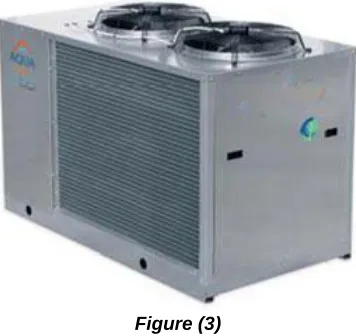
In the case of air conditioning for multiple rooms or a whole house using the combined units of air cooling, which is a unit integrated cooling unit on a single unit as in Figure (3)
Figure (3)
Cold air is then transported to the rooms through pipes made of metal sheets or galvanized asbestos In the large commercial complexes, hotels and hospitals, the air cooling method is used by cold water and cold water is brought by the chiller air conditioners repair. It is an completed cooling unit that cools and prepares water for later use in special exchangers distributed in the rooms of the building as in Figure 4.
Figure (4)
All the cooling circuits mentioned above contain the aforementioned components, which are the basic elements of the cooling cycle, but with the development of the science of cooling and the need for it in many applications, many things has been added to the cooling cycle for the following reasons:
1. To improve performance
2. To customize the cooling cycle in a particular area of the cooling areas
3. To organize the work of the parts with a better interactionه
4. To protect the parts of the cooling cycle, especially the compressor from operating errors or changes in working conditions like the very variable heat loads or sudden failures.
For this reason, we can now find a lot of additions in the cooling circuits to achieve optimum operation and maximum utilization of the energy spent. Computers, software and smart devices have also been used to drive cooling circuits and this is the subject of our current research.
Summary:
Buildings are one of the largest consumers of energy and are the first place with 40% of the total energy consumed in many countries. This part of the energy in the buildings is due to the air conditioning systems (HVAC) which represents the process of cooling and heating the air and also the process of ventilation, Up to 50% of the total energy consumption in buildings. Therefore, improving the HVAC system in buildings has critical effects and will be important in reducing energy efficiency. In general, we need energy in air conditioning systems to maintain room temperature at the comfortable and desirable rate. Air conditioning systems are typically used to detect changes in air temperatures based on the wire system in temperature measurement and on site temperature stabilization. This classical control is inconvenient to deal with dynamic changes in the thermal behavior of buildings especially if the temperature is not spatially uniform. Sensors installation in limited locations and sites can not react quickly with thermal variables because room comfort conditions can change rapidly due to the behavior or human activity of occupants of the place. therefore the new generation of wireless sensors is considered a revolution in the design of HVAC systems because wireless sensors do not Limited to wired installations in the actuators and custom thermal sources (eg, near doors, windows and computers) Wireless sensors can be the fastest response to climate control, monitoring and tracking human behavior and room conditions. Moreover wireless sensors can be integrated with home security and information and entertainment systems, allowing advanced intelligent control systems to provide services that are more important later.
Modern technological development:
In this study, mobile phones and wearable devices have been integrated with intelligent sensors for temperature and human movement so that we can control the working and living environment in the various climatic conditions of the atmosphere and get appropriate feedback, especially information technology for occupants of public places like factories, companies, institutions and residential buildings through mobile phones and wearable devices, which placed on the human body. this information can be used to adjust air conditioners in advance according to human intentions, which is called intention to cause control. The results showed that the indoor temperature can be controlled accurately with errors below ± 0.1 ° C As the weather conditions for the residents can not be achieved quickly within 2 minutes, air conditioning compressor must be operated in a timely manner so that it can reach the appropriate weather conditions for the inhabitants of the places before they arrive . This ideal solution is what made us think about the appropriate solutions by using smart devices and wearable devices that can detect the temperature of the person and the type of activity that he exercises, Which helped to set sleep times flexibly and adjust sleep function optimally and maintain human health
during sleep. During sleep, it can reduce energy consumption by up to 46.9%. With intelligent air conditioners and smart air conditioners can provide a comfortable environment and achieve the objectives of energy conservation and environmental protection at the same time. In order to become smart air conditioners using communication technology and adjusting air conditioners is not just an idea in the world of IT, smart air conditioners can be combined with an infrared sensor for human position sensors as well as with meteorological networks to obtain weather information abroad. These devices can be worn without affecting human activity from now on. It is expected that the indoor temperature will be controlled efficiently, considering the human comfort and energy used in air conditioners. The evolution of air conditioning control is shown in the following figure:
Fig (5)
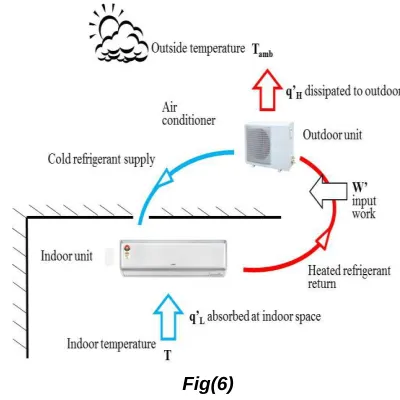
The figure shows the evolution of the air conditioning units (windows unit) and the transition to Split Unit, which allows control of the external unit or internal unit accurately and also control between them as distinctly in Figure (6)
Fig(6)
line in the figure refers to the coolers of heat absorption from a closed place (q_L) through the evaporator and dissipating that heat (q_H) to the outside air through the outdoor unit. And the temperature is the controller in the operation unit, we can install the evaporator temperature sensor in the internal unit of the type of air conditioning (Split Unit)
Figure (7)
This signal is received by a remote control to control the operation of the unit depending on the temperature changes according to the following box diagram:
Figure (8)
Or the following:
Figure (9)
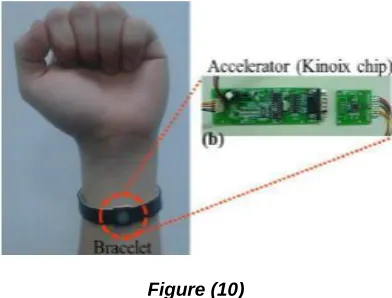
This is a model of the sensor method and control of the operation of the air conditioners by smart devices that can be personal phones or watch worn around the wrist.
Figure (10)
Either be controlling the turning on and off the compressor as in the following diagram:
Figure (11)
Or by changing the flow of coolant by changing the speed of the compressor as shown in Fig.
Intelligent Control Based on Smart Sensors:
Control depends on quantitative analysis between fixed values and variable values that are monitored by smart sensors, which collect information and send it to smartphones or wearable devices that include:
1. Mobile phones with GPS and the expected time to be in the place to be operated
2. Bracelet can read the situation of the residents of the cooled places, which increases the temperature of the place during sleep to provide energy consumption, so it can control the air conditioner in accordance with the activity of residents.
The system uses multiple sensors to achieve intelligent control such as an internal infrared sensor that can detect human position and control airflow. Or mobile phones with GPS and expected personal timetables for movement can be used to detect the occupant position of chilled places as in Figure 13:
Figure (13)
Results and discussion:
The expected objectives of intelligent air conditioning control include human comfort and energy conservation and should be evaluated by:
1. Human comfort represented by:
The temperature response during the specified time to reach the required temperature in indoor, which is a numerical value varies depending on climatic conditions.
2 - Conservation of calculated energy:
Compressor energy: Intelligent measurements are used to measure the output of the compressor during two test cases -
- Control the outside of the compressor when the air conditioner operates at constant frequency
- Monitoring the effect on indoor and its response to the temperature and time required to reach the required temperature, for example 28 C°
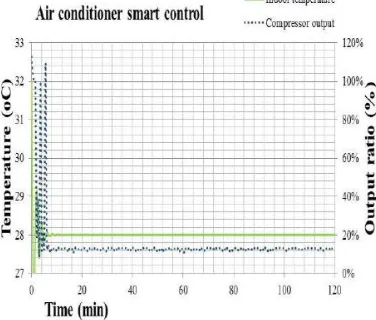
- In the following figure: Comparison shows the difference between using the two control methods: - The usual on-off controls with running on a single
fixed frequency
- Intelligent control inverter with variable frequency ornaments as shown in Figure 14
Figure 14
The constant line is the indoor temperature response, and the dotted line is the compressor output when the required heat is reached (eg 28 ° C). The compressor will be turned off when the setting point is reached. Complex calculations take longer to adjust the air conditioner to the required indoor temperature, which may take 8 minutes to reach the specified indoor temperature. This means that residents of cooled areas should wait for an 8-minute delay in the environment when using a variable-frequency air conditioner, when compared to a single fixed frequency where residents only need to wait about 4 minutes Comparison of power consumption between fixed frequency and variable frequency of air conditioners can be assessed by monitoring compressor consumption as shown in Figure 15.
Indoor temperature in case of variable frequency or on-off operation
Figure 16
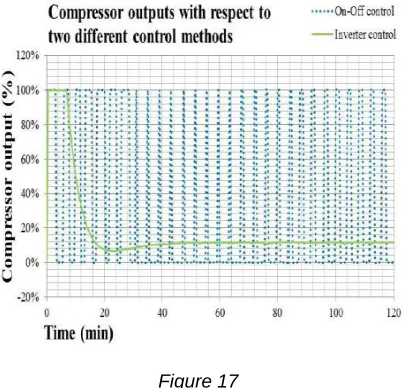
The compressor output (as% of complete load) is switched on or off when the air conditioner is controlled.
Figure 17
In Figure 17, the continuous line is the compressor output when operating on-off and dotted line is to operate the compressor in variable frequency. This study was done for a compressor of 0.825 KW Since this study the same air conditioner has been adopted to compare the operating results in a fixed and switchable frequency mode and their effect on energy consumption The calculated results indicate that energy consumption in the variable frequency air conditioner is 45.4% lower than operating at a fixed frequency within two hours of operating the air conditioner.
References:
[1]. Curriculum[2]. 2- Book MODERN REFRIGERATION AIR CONDITIONHNG