INTRODUCTION
Dyes are widely used in textile, paper, plastic, food and cosmetic industries. The waste coming from these industries can affect atmosphere causing pollution. Even in very low concentrations these dyes are visible and will affect aquatic life as well as food web. Many dyes are difficult to degenerate, stable to light and non-biodegradable therefore they affect public health and many serious environmental problems.Methylene blue is one of the most toxic industrial pollutants and even at low concentration it is reported to affect water quality and harmful to human health¹. The methods used for the removal of dyes from waste water are divided into three types namely biological, chemical and physical. An aerobic biodegradation have low removal efficiency. Chemical methods requires large
Removal of cationic dye from aqueous solution using
raw agro wastes as non - conventional low- cost adsorbent
K.S. MUNDHE¹,
A.A. BHAVE¹,
R.C. TORANE¹,
N.R. DESHPANDE¹ and R.V. KASHALKAR¹*
¹Dr.T.R.Ingle Research Laboratory, Department of Chemistry, S.P. College, Tilak Road, Pune - 411 030 (India). (Received: August 30, 2009; Accepted: October 08, 2009)
ABSTRACT
In the present study the use of cheap and ecofriendly biosorbents have been studied as an alternative substitution for commercial activated carbon for the removal of methylene blue from waste water. Batch adsorption study was carried out using inflorescence of Celosia argentea L, stem of Cicer
arietinum and cob of Zea mays L as a raw agro waste material. This study investigates the potential
use of biosorbents for the removal of methylene blue from waste water. Effects of process parameters such as amount of adsorbent, concentration, temperature and pH were studied. By using uv spectrophotometer concentration of dye was measured before and after adsorption. The adsorption efficiency of different adsorbents was found nearly in the same order. . The percent removal increases with increase in amount of adsorbent and is maximum at low concentration. Adsorption was favorable at room temperature indicating physisorption. The dye removal was maximum at the pH between 8 to 10.The equilibrium data were fitted to Langmuir and Freundlich isotherms..
Key words: Methylene blue, sorption, aqueous system, agro- wastes.
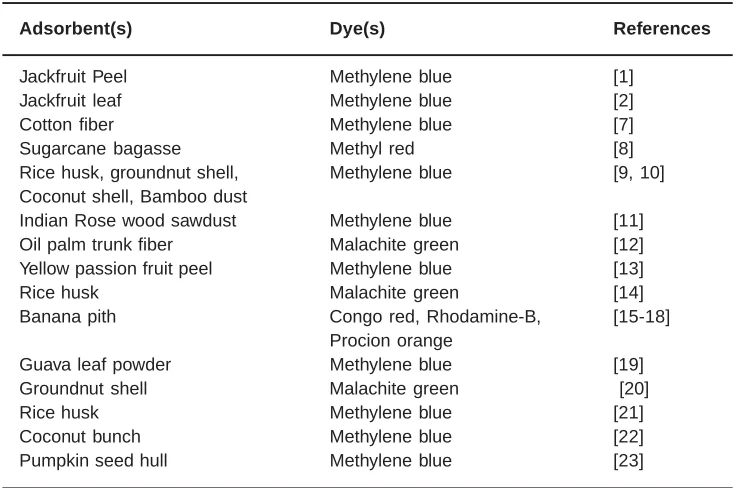
bioadsorbents. This leds the researchers to investigate substitute adsorbent of low cost. Many efforts have been made to use low cost agro waste materials substitute for commercial activated carbon. Some agro waste materials had been used as sorbent for dye sorption from waste water are listed in Table 1. In the present work adsorption efficiency of inflorescence of Celosia argentea, stem of Cicer arietinum, cob of Zea mays L powders were investigated using methylene blue as a basic dye. Celosia argentea commonly called ‘kurdu’ belongs to the family Amaranthaceae.It is common throughout as weed of wet and harvested fields, in wastelands³. Cicer ar ietinum commonly called‘Herbara’ belongs to the family Fabaceae4. Zea mays L commonly called, ‘Maka’ belongs to the family Poaceae.It is cultivated for food grain and for fodder throughout India5. The objectives of the present study were to examine adsor ption characteristics of above material, to investigate the potential use as low cost biosorbents and to predict maximum possible adsorption capacity.
MATERIAL AND METHODS Preparation of adsorbents
The inflorescence of Celosia argentea, stem of Cicer arietinum and cob of Zea mays L were collected from near by area washed and dried separately. Materials are crushed, powdered and sieved through sieve (250 mesh size) to get uniform particle size. All the three powders were stored in different air tight bottles.
Preparation of dye solution
For this study methylene blue used was obtained from the local supplier. Table 2 shows the characteristics of the methylene blue. Stock solution (100mg/lit.) was prepared using double distilled water. Experimental solution of the desired concentration was obtained by further dilutions. Dye concentrations were deter mined by using absorbance values measured before and after the treatment at 620nm with Shimadzu UV visible Spectrophotometer (EQ-650-A Equip Tronics). The experiments were carried out at different dose of adsorbent, concentration, temperature and pH. pH was controlled by the addition of sodium hydroxide or hydrochloric acid etc.
Adsorption study
In each adsorption experiment, 50ml of dye solution of known concentration at initial pH of solution was added into 0.050gm of adsorbent in a 100ml of conical flask at room temperature and the mixture was stirred at 500rpm on a mechanical stirrer. After predetermined time intervals adsorbent was separated from solution by gravity separation. The absorbance of the supernatant solution was estimated to deter mine the residual dye concentration.
The experiment was done by varying, the amount of adsorbent dose (from 0.200gm to 3.0gm/ lit.), and concentration of dye solution, temperature and at different pH values.
RESULTS AND DISCUSSION Effect of amount of adsorbent
In case of all the three powdered materials as the adsorbent dose increases from 0.200gm to 3.0gm/lit, percent adsorption increases. Celosia argentia shows 76% adsorption of dye for 0,125gm of adsorbent. This is due to increase in surface area and availability of adsorption sites with increase in adsorption dose. The adsorption capacity decreases with increase in amount of dose of adsorbent. Table 3. shows the % removal with amount of dose of adsorbent for Celosia argentia, Cicer arietium, Zea mays L.
Effect of Initial dye concentration
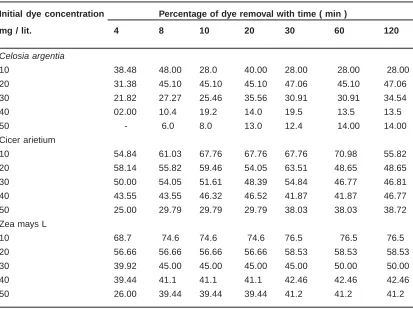
The study had shown that as concentration increases % removal of dye decreases. At low concentration % removal was maximum. For all the
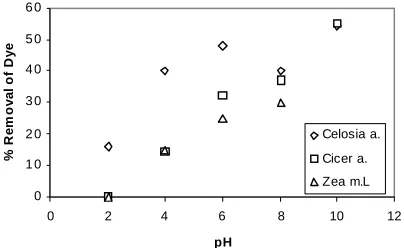
0 1 0 2 0 3 0 4 0 5 0 6 0
0 2 4 6 8 10 12
pH % R e mo v a l o f D y e Celosia a. Cicer a. Zea m.L
Table 1: Some low cost materials for dyes removal from aqueous solution
Adsorbent(s) Dye(s) References
Jackfruit Peel Methylene blue [1]
Jackfruit leaf Methylene blue [2]
Cotton fiber Methylene blue [7]
Sugarcane bagasse Methyl red [8]
Rice husk, groundnut shell, Methylene blue [9, 10] Coconut shell, Bamboo dust
Indian Rose wood sawdust Methylene blue [11]
Oil palm trunk fiber Malachite green [12]
Yellow passion fruit peel Methylene blue [13]
Rice husk Malachite green [14]
Banana pith Congo red, Rhodamine-B, [15-18]
Procion orange
Guava leaf powder Methylene blue [19]
Groundnut shell Malachite green [20]
Rice husk Methylene blue [21]
Coconut bunch Methylene blue [22]
Pumpkin seed hull Methylene blue [23]
Table 2: Characteristic of the methylene blue
Common name Methylene blue
CAS No. [61-73-4]
C.I. No. 52015
Solubility in H2O 3.55 % Solubility in Ethanol 1.48 % Absorption maxima 668 nm
Color Blue
Empirical formula C16H18N3SCl Formula weight 319.86 gm / mol.
M.P. 100 – 110o
(with decomposition) three materials 70% of the dye was removed within 30minutes thereafter % of dye removal remains nearly constant. Cicer arietium shows maximum % removal for various initial dye concentrations. The % removal was rapid initially and then remains constant as time increases. Adsorption capacity is large at low concentration but it decreases as concentration inceases.Table 4. Shows % removal with different initial dye concentrations for the adsorbents Celosia argentia, Cicer arietium, Zea mays L.
Effect of temperature
Temperature is one of the most important factor which affect the process of adsorption. From the Table 5. it was clear that % removal was maximum at room temperature showing the physisorption process .At initial stage % removal was maximum thereafter it remains constant.Zea mays L.removes 50% of the dye from aqueous solution at low temperature. Table 5. shows % removal of dye at different temperatures for Celosia argentia,Cicer arietium, Zea mays L.adsorbents.
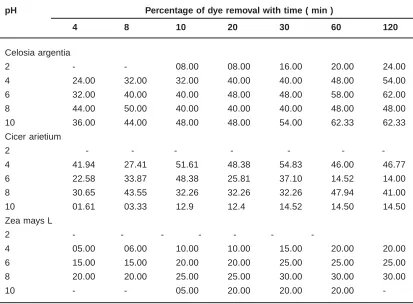
Effect of pH of solution
Table 3: Effect of adsorbent dose on dye removal. (Initial concentration of dye = 10 mg / lit., Initial pH = 8.7, time of stirring 30 mins.)
Amount of adsorbent Percentage of dye removal
dose gm / 50 ml. Celosia argentia Cicer arietium, Zea mays L.
0.025 46.16 11.61 05
0.050 42.32 15.66 10
0.075 46.16 19.36 20
0.100 73.06 24.52 20
0.125 76.92 32.26 25
0.150 65.38 45.17 30
0.175 65.38 67.76 50
0.200 73.07 70.00 53
Table 4: Effect of initial concentration on dye removal (adsorbent dose = 0.050 gm / 50 ml at initial pH of solution) Initial dye concentration Percentage of dye removal with time ( min )
mg / lit. 4 8 10 20 30 60 120
Celosia argentia
10 38.48 48.00 28.0 40.00 28.00 28.00 28.00
20 31.38 45.10 45.10 45.10 47.06 45.10 47.06
30 21.82 27.27 25.46 35.56 30.91 30.91 34.54
40 02.00 10.4 19.2 14.0 19.5 13.5 13.5
50 - 6.0 8.0 13.0 12.4 14.00 14.00
Cicer arietium
10 54.84 61.03 67.76 67.76 67.76 70.98 55.82
20 58.14 55.82 59.46 54.05 63.51 48.65 48.65
30 50.00 54.05 51.61 48.39 54.84 46.77 46.81
40 43.55 43.55 46.32 46.52 41.87 41.87 46.77
50 25.00 29.79 29.79 29.79 38.03 38.03 38.72
Zea mays L
10 68.7 74.6 74.6 74.6 76.5 76.5 76.5
20 56.66 56.66 56.66 56.66 58.53 58.53 58.53
30 39.92 45.00 45.00 45.00 45.00 50.00 50.00
40 39.44 41.1 41.1 41.1 42.46 42.46 42.46
Table 5: Effect of temperature on dye removal (0.050gm adsorbent dose,10mg/lit concentration,at original pH of solution) Temperture in °C Percentage of dye removal with time ( min )
4 8 10 20 30 60 120
Celosia argentia
30 38.48 60.00 48.00 40.00 48.00 54.00 62.00
40 32.00 48.00 44.00 40.00 48.00 48.00 54.00
50 20.00 54.00 32.00 28.00 40.00 28.00 28.00
Cicer arietium
30 40.32 41.94 45.20 45.20 45.20 45.20 46.77
40 35.48 35.48 41.94 41.94 41.94 37.10 40.32
50 17.71 19.35 25.81 31.00 25.81 24.19 16.15
Zea mays L
30 45.00 45.00 50.00 50.00 55.00 50.00 50.00
40 35.00 45.00 45.00 50.00 50.00 50.00 50.00
50 26.00 40.00 45.00 45.00 45.00 45.00 45.00
Table 6: Effect of pH on dye removal. (0.050gm adsorbent dose, 10mg/lit concentration,at original pH of solution)
pH Percentage of dye removal with time ( min )
4 8 10 20 30 60 120
Celosia argentia
2 - - 08.00 08.00 16.00 20.00 24.00
4 24.00 32.00 32.00 40.00 40.00 48.00 54.00
6 32.00 40.00 40.00 48.00 48.00 58.00 62.00
8 44.00 50.00 40.00 40.00 40.00 48.00 48.00
10 36.00 44.00 48.00 48.00 54.00 62.33 62.33
Cicer arietium
2 - - - - -
-4 41.94 27.41 51.61 48.38 54.83 46.00 46.77
6 22.58 33.87 48.38 25.81 37.10 14.52 14.00
8 30.65 43.55 32.26 32.26 32.26 47.94 41.00
10 01.61 03.33 12.9 12.4 14.52 14.50 14.50
Zea mays L
2
-4 05.00 06.00 10.00 10.00 15.00 20.00 20.00
6 15.00 15.00 20.00 20.00 25.00 25.00 25.00
8 20.00 20.00 25.00 25.00 30.00 30.00 30.00
-CONCLUSION
The removal of methylene blue from aqueous solution by using powdered untreated material of flowers of Celosia argentea, stem of Cicer arietinum and cob of Zea mays L has been investigated for different variable viz adsorbent dose, initial dye concentration, temp and pH.For this study it was found that, Celosia argentea removes 76.00 % of dye for 0.125 gm of adsorbent. Cicer arietinum can removes higher % of dye at var ious concentration of dye. Zea maize shows maximum % removal with effect of temp. Maximum % of dye was removed at room temperature showing the physisorption process. The pH range 8 to 10 is optimum for dye removal for all the adsorbents. As all the materials are easily available in the local area, can be used for the small scale industries producing dyes.
Further study needs the production of chemically treated carbon and to investigate its potentialities for the % removal and adsorption capacity of adsorbent, so that it can be used as a substitute for commercially available activated carbon having high cost.
The data may be useful for designing the economically cheap treatment process in a batch wise removal of methylene blue from different industrial effluents.
ACKNOWLEDGMENTS
The authors are thankful to the Principal and the Head, Depar tment of Chemistr y, S.P.College, Pune, Maharashtra, India, for providing necessary laboratory facilities for the work.
1. Prahas D, Kartika Y, Indraswati N, Ismadji S, The Use of Activated Carbon Prepared from Jackfruit (Artocarpus heterophyllus ) Peel Waste for Methylene Blue Removal. Journal of Environmental Protection Science 2:1-10 (2008).
2. Md.T.Uddin, Md.Rukanuzzaman, Md.M. Rahman Khan, Md.A.Islam,Jackfruit (Artocarpus heterophyllus) leaf powder: An effective adsorbent for removal of methylene blue from aqueous solutions. Indian Journal of Chemical Technology 16: 142-149 (2009). 3. Singh N.P, Lakshminarasimhan P, Karthikeyan S, Prasanna P.V,. Flora of India, Ser ies 2, Flora of Maharashtra State Dicotyledones 2: 789 (2001).
4. Singh N.P, Lakshminarasimhan P, Karthikeyan S, Prasanna P.V, Flora of India, Ser ies 2, Flora of Maharashtra State Dicotyledones 1: 769 (2000).
5. Sharma B.D, Karthikeyan, Singh N.P,. Flora of India, Series 2, Flora of Maharashtra State Monocotyledones: 635 (1996).
6. Saad.S.A, Daud.S, Kasim.F.H, Saleh. M.N,.Dyes removal from aqueous solution by using chemical treated empty fruit bunch
REFERENCES
at various pH. ICoM2007: 297-300 (2007). 7. Rasheed Khan A, Tahir H, Uddin F, Hameed
U, Adsor ption of Methylene Blue from aqueous Solution on the Surface of Wool Fiber and Cotton Fiber. Journal of Applied Sciences and Environmental Management 9: 29-35 (2005).
8. S.Saiful Azhar, A.Ghaniey Liew, D.Suhardy, K.Far izulHafiz, M.D.Irfan Hatim,. Dye Removal from Aqueous Solution by using Adsorption on Treated Sugarcane Bagasse. American Journal of Applied Sciences 2: 1499-1503 (2005).
9. Chandrasekhar S, Pramada P.N Rice husk ash as an adsorbent for methylene blue-effect of ashing temperature; Adsorption 12: 27-43 (2006).
10. Kannan, N, AND m.m.Sundram, , Kinetic and mechanism of removal of methylene blue by adsor ption on various carbons: A comparative study. Dyes and Pigments, 1: 25-40 (2001).
a timber industry waste. Dyes and Pigments 63: 243-250 (2004)
12. B.H.Hameed and M.I.El-Khaiary, Batch removal of malachite green from aqueous solutions by adsorption on oil palm trunk fibre: Equilibrium isotherms and kinetic studies. Jour nal of Hazardous Materials 154: 237-244 (2008).
13. Flavio Andre Pavan, A.C.Mazzocato and Yoshitaka Goshikem,. Removal of methylene blue dye from aqueous solutions by adsorption using yellow passion fruit peel as adsorbent. Bioresource Technology 99: 3162-3165 (2008).
14. Guo, Y., S.Yang, W.Fu, J.Qi, R.Li and Z.Wang, Adsorption of malachite green on micro and mesoporous rice husk based activatedcarbon.Dyes and Pigments, 3: 219-229 (2003).
15. Namasivayam, C. and N.Kanchana, Removal of Congo red from aqueous solution by waste banana pith. J. Sci. Technol. 1: 33-42 (1993). 16. Namasivayam, C. and N.Kanchana and R.C.Yamuta, Waste banana pith as adsorbent for the removal of Rhodamine-Bfrom aqueous solution. Waste Manage. 13: 89-95 (1993).
17. Namasivayam, C. and N.Kanchana,. Waste banana pith as adsorbent for color removal from waste waters. Chemosphere, 2:
1691-1705 (1992).
18. Namasivayam, C., D. Prabha and M.Kumutha, Removal of dyes by adsorption onto agricultural solid waste. Bioresource Technol., 64: 77-79 (1998).
19. V.Ponnusami, S.Vikram and S.N.Srivastava,. Guava (Psidium guajava) leaf powder: Novel adsorbent for removal of methylene blue from aqueous solutions. J.of Hazardous Materials 152: 276-286 (2008).
20. R.Malik, D.S.Ramteke and S.R.Wate, Adsorption of malachite green on groundnut shell waste based powdered activated carbon. Waste Management 27: 1129-1138 (2007).
21. A.A.M.Daifullah, B.S.Girgis and H.M.H.Gad, Utilization of agro residues (rice husk) in small waste water treatment plans. Materials Letters 57: 1723-1731 (2003).
22. B.H.Hameed, D.K. Mahmoud and A.L. Ahmad,. Equilibrium modeling and kinetic studies on the adsorption of basic dye by a low-cost adsorbent: Coconut (Coccus nucifera) bunch waste. of Hazardous Materials 158: 65-72 (2008).