EXECUTIVE FUNCTION, THEORY OF MIND AND SOCIAL PROBLEM SOLVING IN ASPERGER’S SYNDROME.
JANE HEAP
JULY 1999
D. CLIN. PSY
ProQuest Number: 10608918
All rights reserved INFORMATION TO ALL USERS
The qu ality of this repro d u ctio n is d e p e n d e n t upon the q u ality of the copy subm itted. In the unlikely e v e n t that the a u th o r did not send a c o m p le te m anuscript and there are missing pages, these will be note d . Also, if m aterial had to be rem oved,
a n o te will in d ica te the deletion.
uest
ProQuest 10608918
Published by ProQuest LLC(2017). C op yrig ht of the Dissertation is held by the Author.
All rights reserved.
This work is protected against unauthorized copying under Title 17, United States C o d e M icroform Edition © ProQuest LLC.
ProQuest LLC.
789 East Eisenhower Parkway P.O. Box 1346
CONTENTS VOLUME 1 : RESEARCH THESIS
ACKNOWLEDGEMENTS ABSTRACT
1 .INTRODUCTION
1.1.1 OVERVIEW 1
1.1.2 DEFINITION OF ASPERGER’S 4
1.1.3 AETIOLOGY 7
1.1.4 POSSIBLE BRAIN MECAHANISMS 8
1.15 DEFICITS IN AUTISM AND ASPERGER’S SYNDROME 9
1.2.1 COGNITIVE THEORY 13
1.2.2 CENTRAL COHERENCE 14
1.2.3 INTERPERSONAL RELATEDNESS 15
1.2.4.THEORY OF MIND 15
1.2.5 EXECUTIVE FUNCTION 20
1.3.HOW WELL DO THE THEORIES EXPLAIN THE PATTERN
OF IMPAIRMENT 26
1.4 SUMMARY OF RESEARCH 35
1.5 AIMS OF THE PRESENT STUDY 38
1.6 HYPOTHESIS’ 39
2 METHOD
2.1.1 PARTICIPANTS 40
2.1.2 PROCEEDURE 41
2.1.3DESIGN 41
2.2.1 RA YENS STANDARD PROGRESSIVE MATRICES 42
2.2.2 CLINICAL EVALUATION OF LANGUAGE 43
FUNDAMENTALS-REVISED
2.3.EXECUTIVE FUNCTION MEASURES 45
2.3.1 BEHA VIOURAL DYSEXECUTIVE SYNDROME 45
2.3.2 POISIONED FOODS 47
2.3.3 TRAIL-MAKING 47
2A.THE0RY OF MIND AND SOCIAL COGNITION MEASURES 48
2.4.1 HAPPE STRANGE STORIES 48
2.4.2 EYES TASK 51
2.4.3 DEWEY STORIES 51
2.5 SOCIAL PROBLEM SOLVING MEASURES 53
2.5.1 PREDICAMENTS 53
2.5.2 EXAMPLE OF PREDICAMENTS 56
2.6. DEX QUESTTONAIRE 59
3.RESULTS
3.1. DESCRIPTION OF ANAYSIS OF DATA 60
3.1.1 DYSEXEUTIVE QUESTIONAIRE 61
3.1.2 EXECUTIVE FUNCTION MEASURES 62
3.1.3 THEORY OF MIND AND SOCIAL COGNITION MEASURES 64
3.1.4 PREDICAMENTS 66
3.1.5 CORREALATIONS BETWEEN PREDICAMENTS MEASURES 74 3.1.6 CORRELATIONS BETWEEN PREDICAMENTS AND EXECUTIVE
FUNCTION MEASURES 78
3.1.7 CORRELATIONS BETWEEN PREDICAMENTS AND THEORY OF MIND
AND SOCIAL COGNITION ASSSESSMENTS 81
3.1.8 CORRELATIONS BETWEEN THEORY OF MIND AND EXECUTIVE
3.1.9 LANGUAGE 83
4.DISCUSION
4.1 MAIN FINDINGS 86
4.1.1 PREDICAMENTS 86
4.1.2 EXECUTIVE FUNCTION MEASURES 87
4.1.3THEORY OF MIND MEASURES 88
4.1.4 RELATIONSHIP BETWEEN EXECUTIVE FUNCTION AND
THEORY OF MIND MEASURES 90
4.1.5 THEORY OF MIND AND EXECUTIVE FUNCTION: EVIDENCE
FROM PREDICAMENTS 91
4.1.6 SUMMARY OF MAIN FINDINGS 93
4.2.FURTHER EXPLORATION OF THE FINDINGS 93
4.2.1 OTHER EXPLANATIONS OF THE FINDINGS 93
4.2.2 FURTHER EXPLORATION OF PREDICAMENTS 94
4.2.3 FURTHER EXPLOARTION OF EXECUTIVE FUNCTION
MEASURES 99
4.2.4 FURTHER EXPLORATION OF THE THEORY OF MIND
MEASURES 101
4.3 SUMMARY 104
4..4.LIMITATIONS 107
4.5 CLINICAL IMPLICATIONS 111
4.6 FUTURE RESEARCH 112
5 REFERENCES 114
6 APPENDICES 128
LIST OF TABLES
1 SAMPLE CHARCTERISTICS
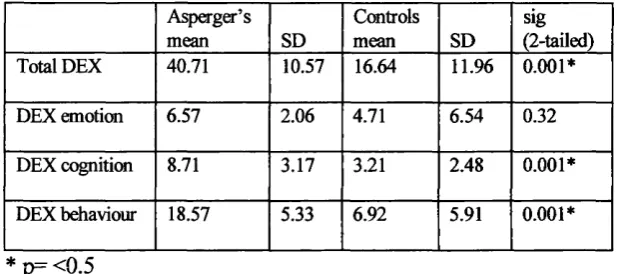
2 T-TESTS TO LOOK AT THE DIFFERENCES BETWEEN ASPERGER’S AND CONTROLS ON THE DEX QUESTIONNAIRE.
3 T-TESTS TO LOOK AT DIFFERENCES BETWEEN
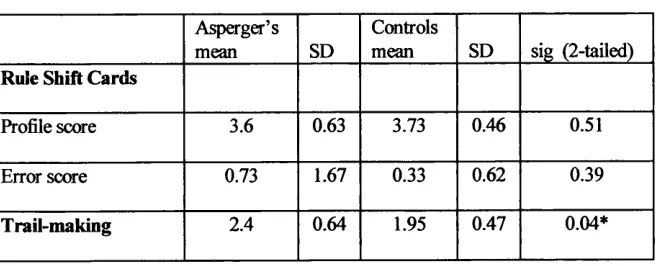
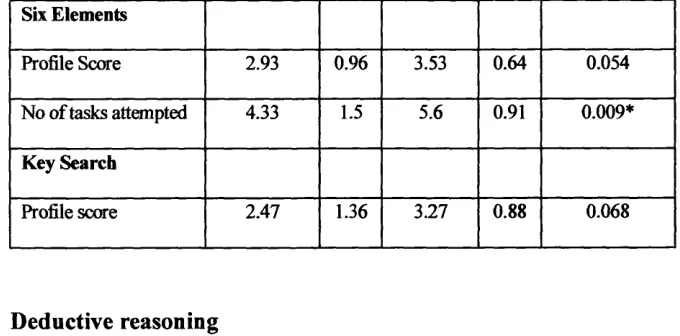
ASPERGER’S AND CONTROLS ON THE EXECUTIVE BATTERY.
4 T-TESTS TO LOOK AT DIFFERENCES BETWEEN
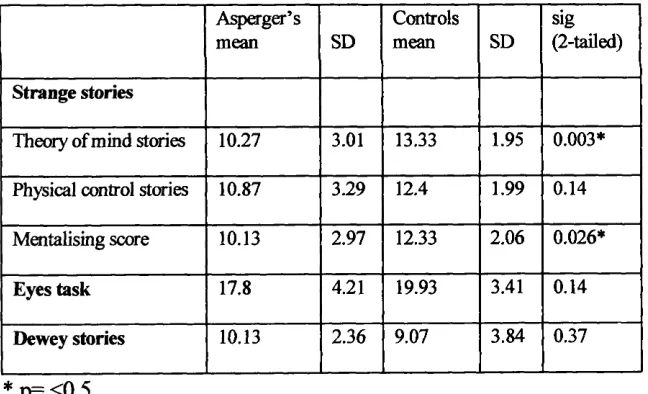
ASPERGER’S AND CONTROLS ON THE THEORY OF MIND AND SOCIAL COGNITION BATTERY
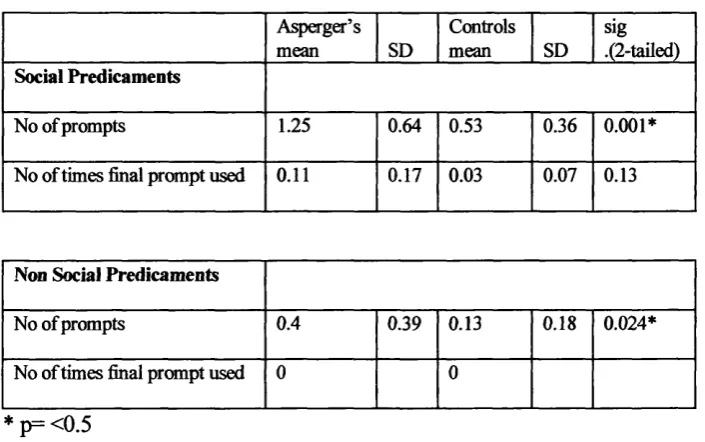
5 T-TESTS TO LOOK AT DIFFERENCES BETWEEN ASPERGER’S AND CONTROLS ON NUMBER OF PROMPTS USED IN RECOUNTING THE PREDICAMENTS.
6 T-TESTS TO LOOK AT DIFFERENCES BETWEEN
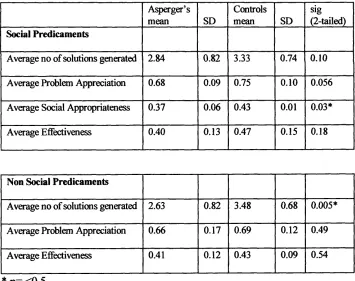
ASPERGER’S AND CONTROLS ON THE SOLUTIONS GENERATED IN SOCIAL PREDICAMENTS AND NON SOCIAL PREDICAMENTS
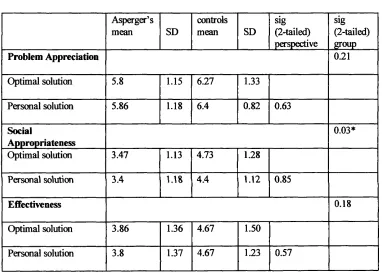
7 MEANS, STANDARDS DEVIATIONS AND SIGNIFICANCE LEVELS FOR THE EFFECT OF GROUP AND PERSPECTIVE ON OPTIMAL AND PERSONAL SOLUTIONS.
8 T-TESTS TO LOOK AT DIFFERENCES BETWEEN
ASPERGER’S AND CONTROLS ON RATING ALTERNATIVE SOLUTIONS
9 T-TESTS TO LOOK AT RATINGS OF AWKWARDNESS OF PREDICAMENTS AND SATISFACTION WITH SOLUTIONS
10 CORRELATIONS BETWEEN AVERAGE SOLUTION
11 CORRELATIONS BETWEEN TOTAL SOLUTION
QUALITY AND OTHER PREDICAMENTS MEASURES FOR ASPERGER’S AND CONTROLS
12 CORRELATIONS BETWEEN NUMBER OF
SOLUTIONS GENERATED AND NONSOCIAL PREDICAMENTS
13 CORRELATIONS BETWEEN PREDICAMENTS AND
EXECUTIVE FUNCTION MEASURES FOR ASPERGER’S AND CONTROLS
14 CORRELATIONS BETWEEN WITH THEORY OF
MIND/SOCIAL COGNITION ASSESSMENTS AND PREDICAMENTS FOR ASPERGER’S AND CONTROLS.
15 CORRELATIONS BETWEEN THEORY OF MIND AND EXECUTIVE FUNCTION MEASURES
16 CORRELATIONS BETWEEN LANGUAGE AND EXECUTIVE FUNCTION MEASURES
17 CORRELATIONS BETWEEN LANGUAGE AND THEORY OF MIND MEASURES
ACKNOWLEDGEMENTS
ABSTRACT
1. Introduction
l.lOverview
In the introduction the history and development o f Asperger’s syndrome will be considered, and its relationship to autism discussed. The deficits common to this spectrum o f disorders will then be explained. The cognitive theories which aid to explain the behaviours will be considered with particular reference to executive function and theory o f mind accounts. The strengths and weaknesses o f each theory will then be explored through considering how well, each theory accounts, for the observed behaviours and the experimental findings. Finally the aims and hypothesis o f the current study will be set out.
Historical background of autism
Historical background of Asperger’s syndrome
Shortly after this in 1944 Asperger wrote a dissertation describing “autistic psychopathy5’, this was translated by Frith (1991). In this he described seven areas in which children demonstrated their autistic psychopathy. Asperger thought the most obvious characteristic was an impairment in two-way social interaction. He suggested the problem arose due to a lack o f ability to understand and use the rules governing social behaviour. Aspereger claimed speech developed at around the same age as in normal child development, but was characterised by difficulties in using pronouns correctly, abnormal content and a tendency to be pedantic. He also noted that there was a tendency for lengthy reports o f favorite subject areas. In non verbal communication he noted little fecial expression and poor comprehension o f the gestures and expressions o f others. He also described repetitive activities and resistance to change. He observed motor coordination to be clumsy and poorly coordinated and described these children as having an odd gait and posture. Asperegr claimed that those with the syndrome in its most typical form had certain skills. He described excellent rote memories and an interest in one or two subjects, such as, prehistoric monsters, astronomy, steam trains, genealogy o f royalty and bus time tables.
Overlap in the early descriptions of Kanner & Asperger
schizophrenia. They felt that there was an improvement rather than a deterioration with time, with the children appearing to demonstrate the syndrome from the earliest years and the absence o f hallucinations.
Their accounts diverged in three main areas, language, motor co-ordination and learning. Firstly as regards language abilities, Kanner described his group o f children as not using speech to communicate, even when vocabulary was good. Asperger described his group as using language w ell Asperger’s group was characterised by deficits in both gross and fine motor co-ordination whilst Kanner described some o f his group as having poor gross motor skill with fine motor skills in tact. The final discrepancy was in how the child best learned. Kanner believed rote learning produced the best results in his group and Asperger believed that his group performed best when allowed to produce spontaneously. Overall whilst it is difficult to say with certainty it is likely, that Asperger and Kanner were describing a different group of children.
The autistic continuum
remaining 132 children. They discovered that the children with social impairments also had repetitive behaviour and abnormalities o f language. These three deficits they described as problems o f socialisation, imagination and communication, they have become known as the triad o f impairments. This triad constitutes the syndrome o f autism and is generally considered the common denominator for the spectrum o f autistic disorders.
Since Wing (1981) other researchers have tended to consider Asperger’s syndrome at the end o f this autistic continuum. Tantam (1988) studied a group o f adults in touch with psychiatric services and concluded that autism and Asperger’s lay on a continuum o f severity. Similarly Gilberg & Gilberg (1989) who examined all non-retarded six-year-old children in Gothenburg suggested a continuum o f disorders. This continuum ranged from severe to mild autism, Asperger’s and included a more mildly handicapped group and the very end o f the continuum with deficits in attention, motor control and perception. Wing (1991) p i l l describes the continuum as ranging, “from the most profoundly physically and mentally retarded person, who has a social impairment as one item among a multitude o f problems, to the most able, highly intelligent person with social impairment in its subtlest form as his only disability. It overlaps with learning disabilities and shades into eccentric normality.” For the purposes of the present research, and review, evidence from the research in autism and Asperger’s shall be considered on the assumption that they do indeed lie on a continuum.
1.1.2 Definition of Asperger’s Syndrome
The diagnostic criteria for 299.80 Asperger’s disorder
A. Qualitative impairment in social interaction, as manifested by at least two o f the following:
(1) marked impairment in the use of multiple nonverbal behaviours such as eye-to-eye gaze, fecial expression, body postures, and gestures to regulate social interaction
(2) feilure to develop peer relationships appropriate to developmental level (3) a lack o f spontaneous seeking to share enjoyment, interests or
achievements with other people ( e.g., by a lack of showing, bringing or pointing out objects o f interest to other people)
(4) lack o f social or emotional reciprocity
B. Restricted patterns o f behaviour, interests, and activities, as manifested by at least one o f the following:
(1) encompassing preoccupation with one or more stereotyped and restricted patterns o f interest that is abnormal either in intensity or focus
(2) apparently inflexible adherence to specific, nonfunctional routines or rituals (3) stereotyped and repetitive motor mannerisms (e.g., hand or finger flapping or twisting, or complex whole-body movements)
4) persistent preoccupation with parts of objects
C. The disturbance causes clinically significant impairment in social, occupational, or other important areas o f functioning.
D. There is no clinically significant general delay in language ( e.g., single words used by age 2 years, communicative phrases used by age 3 years).
E. There is no clinically significant delay in cognitive development or in the development o f age appropriate self-help skills, adaptive behaviour (other than in social interaction), and curiosity about the environment in childhood.
The diagnosis o f Asperger’s is essentially different from that o f autism in terms of language and cognitive abilities, shown in criteria D and E. Indeed it may be misleading to consider Asperger’s at the end of a spectrum as it implies all o f the difficulties are less severe. However the same criteria for social impairment has to be met for Asperger’s as autism, despite their largely intact cognitive and language skills.
Currently the syndrome is described in terms o f behavioral descriptions o f symptom clusters, meaning the diagnosis entails subjective judgments of whether behaviours are normal or clinically abnormal. There is continuing disagreement between professionals as to whether or not Asperger’s syndrome is synonymous with high functioning autism It is not clear what the differences are, if any, between high functioning autism and Asperger’s. Gilberg (1998) notes that there are at present no explicit diagnostic guidelines for high functioning autism He maintains that it is open to speculation as to whether high functioning autism and Asperger’s are identical or essentially different. Whilst this study does not directly address this issue it is important nevertheless, as the literature reviewed will include studies which used participants diagnosed with high functioning autsim and Asperger’s syndrome.
1.1.3 Aetiology
Early theories focused on environmental explanations o f autism (e.g. Bettelheim, 1967) who described autism as a maladaptive response to an unloving environment. However in the last twenty years, research has increasingly focused on genetic factors in the aetiology. In 1977, Folstein & Rutter reported that the concordance rate in twins with autism was higher in monzygous twins than dyzygous twins, the conclusion being that genetic factors must then be responsible for this. Subsequent research has confirmed this, Szatmari, Jones Zwaigenbaum & Maclean (1998) reviewed all the published family studies, and found that combining the results gave a risk o f 2.2% for the incidence o f autism in siblings. Happe and Frith (1996) note that estimates between 2-3% may be low in absolute terms but are high in comparison to the general population as they represent a 20-50 times greater risk. When the studies are widened to include any type o f pervasive developmental disorder (PDD) risk may be increased to 5%. They found that Asperger’s, autism and atypical autism demonstrated significant familial aggregation. The reviewers note that in the few studies which look at second and third degree relatives give a greatly risk estimate is reduced to 0.18%, suggesting multiple interacting genes in aetiology.
They conclude there review by saying autism and PDD are genetic disorders and share common genetic mechanisms.
1.1.4 Possible Brain Mechanisms
Damasio & Maurer (1978) implicated the mesolimbic system and associated frontal lobe structures in their proposal o f the neurobiological basis o f autsim Recent research in brain imaging has supported this contention. Happe et al (1996) assessed a group o f five young men with a diagnosis o f Asperger’s syndrome. The group was asked to read stories which required mentalising, physical control stories and strings o f unconnected sentences. PET scans were taken in each o f the different conditions They found significant differences in the activation o f a specific brain area in the prefrontal cortex responding to the theory o f mind stories. The researchers suggest that the abnormal activation in this region may be due to the Asperger’s subjects using a different mechanism in order to understand mental states. Further Bauman & Kemper (1994) looked at sections o f autistic brains and found increased cell packing, reduced cell size and reduced connections in parts o f the limbic system They suggseted that this type o f pattern resembled earlier stages o f brain maturation, and as such, may signify a curtailment o f development in the effected areas. There are a number o f signs o f neurological damage in studies o f autism including significant associations with learning disabilities, Pennington et al (1997) notes that 75% of individuals with autism also have a learning disability. Happe & Frith (1996) conclude that individuals with autism are at a significantly increased risk o f being affected by epilepsy and infantile spasms.
but Happe & Frith (1996) conclude there has been no robust evidence to implicate the dopaminergic system and pharmacological treatment has not been effective. Hobson (1993 p ll), concludes, “that it has yet to be established that any given pattern of inheritence, or any given distribution o f neuroanatomical or neurological dysfimction, is applicable to all autistic people”.
1.1.5 Deficits in autism and Asperger’s
We have discussed how the deficits found in the autistic continuum can be considered to fall into the three domains of communication, socialisation and imagination. There is considerable overlap between these domains so that difficulties in socialisation will be related to difficulties in both communication and imagination, indeed ‘social communication’ is a term often used in the literature to explain some o f the deficits common to autism. The evidence will be reviewed in each o f these three domains, with the proviso that some o f the evidence will be relevant to more than one domain.
Communication
suggest that at least three of the following are characteristic of speech; a) delayed development, b) superficially perfect expressive language, c) formal pedantic language, d) odd prosody, e) peculiar voice characteristics and f) impairments in comprehension, including misinterpretations of literal implied meanings.
Attwood (1998) points out that as the person with Asperger’s matures they show impairment in the “art of conversation”. He suggests a number of areas where the person with Asperger’s may have difficulties: in initiating a conversation appropriately, repairing a conversation, coping with uncertainty or mistakes, overcoming the tendency to make irrelevant comments and knowing when not to interrupt.
Imagination
Socialisation
Happe & Frith (1996) state that the three core areas o f very early social interaction which are impaired in autism and presumed to be the foundation for later social development are, joint attention, imitation and interpersonal relatedness. Peer relationships are also
considered as an aspect of socialisation in older autistic individuals.
Joint attention
Social difficulties are present early in development. Joint attention is one o f the earliest social behaviours and usually emerges in infant behaviour between 9-12 months being well developed by 24 months. Joint attention behaviours are those which “involve directing another person’s attention (or being directed by another) to a visual spectacle or object,” McEvoy, Rogers & Pennington (1993, p565). It is well replicated that autistic children are impaired in their joint attention skills (e.g. Loveland & Landry, 1986)
Imitation
consistent findings of imitation deficits with older subjects with autism.
Interpersonal relatedness
Hobson (1993, pl5) maintains that lack of engagement is the essential and universal feature of autsim and it is the “autistic child’s limited experience of intersubjective engagement per se that severely constrains their ability to develop an understanding of the nature of persons and thereby evolve a range of supervenient cognitive, linguistic and social capacities. In this sense, abnormalities in the intersubjective domain would constitute an irreducible bedrock in the explanation of autism.”
Peer relationships
1.2.1 Cognitive Theory
The general consensus at present is that autism and Asperger’s syndrome are biologically caused. However the diagnosis, is currently based on its behavioural features as seen by the DSM-IV criteria. Cognitive theory has the potential to aid the explanation o f behaviour and improve understanding the deficits and strengths found in autistic psychopathology. As Pennington,et al (1997) report it is assumed that the effects o f biology on observable behaviour (symptoms) is typically mediated by underlying cognitive processes. Happe & Frith (1996) suggest that cognitive theories can give explanatory and predictive accounts o f the complex pattern o f behaviour we see in developmental disorders such as autism.
One o f the aims o f cognitive theory in autism and Asperger’s has been to uncover the primary deficit that accounts for the whole spectrum o f behaviour found in this continuum. The theories which have generated most recent research interest are “theory of mind” accounts (Baron-Cohen, Leslie & Frith, 1985), deficits in executive function (Ozonoff, Pennington & Rogers, 1991), central coherence (Frith,1989) and interpersonal relatedness, (Hobson ,1989).
intervention. The two theories considered here are theory o f mind and executive function, however central coherence and interpersonal relatedness will be briefly discussed.
1.2.2 Central Coherence
Frith (1989) suggested that the pattern o f symptoms found in autistic psychopathology reflect an imbalance o f integration o f information at different levels. Normal information processing is considered to be a procedure which enables one to draw together information from diverse sources, to construct its higher level meaning within the context. The central coherence theory proposes that autistic individuals may not be able to utilise contextual information well. Thus the theory predicts that autistic subjects would be good at tasks where attention to local information is necessary, but would perform less well on tasks which require recognition o f global meaning. The first evidence for this theory came from Shah & Frith (1983) who found autistic subjects performed more quickly and accurately on the embedded figures task where subjects are required to spot a hidden figure within a drawing o f an object. In this task the autistic subjects were not as effected and therefore distracted by the context as controls.
1.2.3 Interpersonal relatedness
The interpersonal relatedness theory suggested by Hobson (1989) sees the deficits in interpersonal relatedness as responsible for the whole pattern o f deficits seen in autism. However Hobson does not entirely exclude the utility o f establishing ‘lower order psychological deficits’ but suggests that the difficulty may be that there could well be a range o f diverse deficits which could act either alone or in combination to effect a disruption at this intersubjective level. Indeed Hobson (1993) regards his theory as a different level o f explanation rather than one which is in competition with other accounts such as theory o f mind and executive function describing his account as “a re-description o f the phenomenon under consideration”pl7. Happe (1994b) notes that Hobson’s theory has been hard to either prove or disprove because the o f the unclear causal pathway.
1.2.4 Theory of Mind
Definition
Historical background
In (1983) Wimmer & Pemer published an article on the understanding o f false beliefs by normally developing pre-school children. This was then followed by an article by Baron- Cohen, Leslie & Frith (1985) who questioned whether indeed the autistic child had a “theory o f mind.” This possibility was initially inspired by the observation that autistic children did not engage in pretend play. The understanding o f and ability to use pretense in play typically develops at around 18 months (e.g., Fein, 1981). Leslie ( 1987) suggested that in order for the child to separate pretense from real world knowledge he must possess two types o f representations. Primary representations which are concerned with the way things really are in the world and metarepresentations which allow pretense to be incorporated but kept separate. These metarepresentations are required for representing independent mental states to ones self and others. This became a testable theory which could make predications about performance on certain types o f task.
Assessing theory of mind
back into the room and wants her marble. The participants are then asked “where will Sally look for her marble? Approximately 80% o f autistic children with a verbal mental age o f 4 and a non-verbal mental age o f 9 could not answer this correctly. They said that Sally would look in the box. However approximately 80% o f normal children aged 4 and children with Down’s syndrome and a lower mental age that the autistic group answered the question correctly.
Theory of mind and autism
The type o f false belief described above is considered a first order false belief task, whereby one is able to understand that somebody may think something is true which is really false. Second order false belief tasks are described by Baron-Cohen et al (1997) as those “tests which involve reasoning about what one person think o f another persons thoughts.” These second order theory of mind tests and are typically passed by normally developing six year olds (Pemer & Wimmer 1985). In a later study Baron-Cohen (1989b) found that a group o f older autistic subjects, who passed a first order theory o f mind test, did not pass a second order theory o f mind test. In this study, the autistic subjects could not predict a protagonists behaviour on the basis o f his or her false belief about another persons true belief about a state o f affairs.
puts a chocolate inside one o f the boxes. The subjects task is to tell the opponent which box to open in order to find the chocolate. The subject does not know which box the chocolate is in at this stage. If the opponent opens the empty box the subject retains the chocolate, but if the opponent opens the baited box they get to keep the chocolate. Thus the subject learns that it is in their interest that the opponent look in the empty box. After 15 o f these trials the boxes were changed to boxes with windows which faced the subjects. Normal 4 year old children and non autistic mentally handicapped controls tended to point to the empty box and get the chocolate on the first and remaining trials, whereas 3 year old normal children and autistic children failed to deceive their opponent. They found that success on this windows task correlated well with success on a false belief task, and was consistent with metarepresentational deficit theory.
Problems for theory of mind
In studies which look at mentalising using the false belief tasks some children with autism pass. In a study by Prior et al (1990) 60% o f the autistic subjects passed. Frith (1996) suggests that this does not necessarily mean that these subjects do have in tact theory of mind they simply have a strategy which allows them to “hack out” solutions in these artificial test conditions, but does not serve as a theory o f mind in real life situations. A delay hypothesis would take into account these difficulties, thus, it would be the delay in acquiring the skill, rather than it’s total absence which would explain the difficulties found in autistic spectrum disorders.
cognitively able young people and adults with autism and Aspergers. Happe (1994) uses ‘Strange Stories’ to determine how well autistic children who could pass the second order theory o f mind tasks could perform on more naturalistic and complex stories. The Happe stories covered a range o f vignettes involving mental state thinking, these included joking, lying, persuasion, double bluff, sarcasm and misunderstanding, and found that the autistic group were impaired, relative to controls. Baron-Cohen, et al (1995) found older autistic subjects, with a verbal mental age o f 4.9, and a non verbal mental age o f 7.2 were impaired in their use the direction o f eye gaze to infer mental states. In this instance cartoon feces were used and questions like “which sweet is he going to take” were asked o f children, the correct response could be inferred, from which sweet the face was looking at. Baron- Cohen (1997) developed an advanced assessment o f this ability to infer mental states from feces, using photographs o f a persons eyes. He found that subjects with high functioning autism and Asperger’s syndrome were impaired, compared to matched controls. These types o f task help understand how delayed acquisition o f theory o f mind may express itself in terms o f mentalising abilities in older children and adults.
Frith (1996) notes that, so fer, no child with autism or Asperger syndrome has been found who can pass felse belief tasks by the normal age for passing of 5 years. Frith (1996) notes that while people with Asperger syndrome do perform well on some theory o f mind tests that it is also highly unlikely that a single behavioural measure would automatically denote the presence of a critical underlying capacity that the test was supposed to tap. She goes on to say that any task can be performed in a number o f different ways, it would be more likely then that this group would perform unreliably and would feil on at least some o f a battery o f mentalising tasks.
understand the nature o f the autistic child’s impairment in play, social interaction and in verbal and non verbal communication, it does not explain the non-triad features. They include in these features, restricted repertoire o f interests, obsessive desire for sameness, islets o f ability, idiot savant abilities, excellent rote memory and preoccupation with parts o f objects. Further the theory can not account for the early deficits in behaviours such as joint attention, which are apparent before theory o f mind is thought to develop.
Finally there is also recent evidence to suggest theory o f mind deficits may not be specific to autistic spectrum disorders, deficits in theory o f mind tasks have been demonstrated in deaf children, (Peterson & Siegal, 1995), in non speaking children with cerebral palsy, (Dahlgren, & Trllinsgsuaard 1996) and in children with ADHD, (Buitelaar, et al, 1999).
1.2.5 Executive Function
Definition
Executive functions are the cognitive operations thought to be driven by the prefrontal cortex. Burgess (1997) states that current consensus regards the executive system as a set o f processes whose primary purpose is to facilitate adaptation to novel situations. He goes on to say that evidence suggests that it does this though regulation and control o f more routine cognitive skills. Real life situations typically require some adaptation o f these skills as no two situations are exactly alike. Dennis (1991) states that all executive function behaviours share the need to disengage from the immediate environment, or external context, and guide action instead by mental models or internal representations.
maintain an appropriate problem solving set for attainment o f a future goal”. This set can involve one or more o f the following: (a) an intention to inhibit a response or defer it to a later more appropriate time, (b) a strategic plan of action sequences, and (c) a mental representation o f the task, including the relevant stimulus information encoded into memory and the desired fixture goal state. In cognitive psychology, the concept o f executive ftmction is closely related to the notion o f a limited capacity central processing system.
Pennington & Ozonoff (1996, p55) note that typical lists o f executive functions include set shifting and set maintenance, interference control, inhibition, integration across space and time, planning and working memory. They go on to describe two central ideas in the concept o f executive fimction; a) “context specific action selection, especially in the face o f strongly competing, but context-inappropriate responses and b) “maximal constraint satisfaction in action selection, which requires the integration o f constraints from a variety o f other domains, such as perception, memory affect and motivation.”
^fistory of executive function
Burgess (1997) describes “executive fixnctions” as relatively new term to neuropsychology. The executive processes have always been linked to the frontal lobes and damage to them has resulted in a range o f symptoms previously known as frontal lobe syndrome.
disturbances, repetitive stereotyped movements and verbal communication impairments. Ozonoff, Pennington & Rogers (1991) described a number o f features of autism which were similar to that o f patients with frontal lobe damage. They made reference to; the rigid and inflexible appearance and sensitivity to small changes in the environment, impassivity the inability to delay or inhibit responses, preservation, the tendency to focus on one narrow interest or repetitively engage in one stereotyped behaviour and difficulties in self-reflecting and self monitoring. They suggest that overall the autistic persons cognition seems to lack executive fimctions, in that it is not fixture orientated and the long term consequences o f behaviour do not appear to be anticipated.
Assessing executive function
One o f the difficulties in measurement o f executive dysfixnction, known as dysexecutive syndrome is that there is no prototypical screening measure. A further difficulty arises from the assumption that executive fimctions are potentially fractionable, making the manifestation of executive damage different across patients. Burgess (1997) describes the study of executive fimctions as differing from other areas o f neuropsychology in that there is task impurity, individual response styles and causal dependence on complex behavioural sequences. This means it is often difficult to detect, the often subtle effect, o f executive control on behaviour.
convergent and divergent validity and the construct o f executive functions does have utility The Wisconsin Card Sorting Task (WCST) is probably the most often used measure of executive function and will be described here to give an indication o f how executive fimction may be measured. The WCST is a sorting test which requires subjects to match cards according to three categories, colour, shape and number. The examiner feeds back to the subject whether they have sorted the cards correctly or incorrectly, and after 10 correct responses the examiner changes the sorting strategy. There is no comment from the examiner except to feedback whether the sorting strategy is correct or incorrect. A measure o f preseveration is obtained by collating the number o f times the subject will continue to sort using a previously correct principle whilst getting the negative feedback from the examiner.
Executive function and autism
The first formally reported study o f executive function deficits in an individual with autism was reported by Steel, Gorman & Flexman (1984). They described a man with intact visuo-spatial and nonverbal analytic abilities. Alongside these intact cognitive functions, this man demonstrated a mild memory impairment, and impairment on measures o f executive function, such as the WCST and Porteous Maze test. They described preserverative errors and rigid, inflexible problem solving strategies. The first group studies o f executive fimction deficits in autistic psychopathology were carried out by Rumsey (1985). Rumsey found that autistic, non-retarded verbal men were significantly more perseverative on the WCST, described above, than controls.
syndromes recognized which correspond to separate lesion sites in the prefrontal cortex. The syndromes are described as akinetic mutism, apathetic or pseudodepressed syndrome and euphoric or pseudopsychopathic syndrome. The syndrome o f akinetic mutism is produced by medial lesions and is characterised by a profound deficit in initiation o f speech and other spontaneous behaviour. The psuedopsychopathic syndrome is characterised by sporadic hypomania, childish humor or facetiousness, disinhibition o f sexual and eating behaviour, lack o f concern for others, and disregard for ethical principles. The apathetic syndrome is the syndrome, which they believe, shares some similarities with autistic psychopathology. It is characterised by reduced awareness, lack o f initiative, unconcern and blunting of emotional responses. In this paper they review the evidence o f executive dysfunction and the developmental pathologies including conduct disorder, ADHD, Tourettes syndrome and autism. They review 14 papers which have studied executive function in autistic populations and compared these with a control group. They conclude that the WCST, has in the majority o f studies, been a highly sensitive indicator of executive dysfunction in individuals with autism. However due to the variety o f operations involved in successful performance on the WSCT it does not indicate which cognitive operations may be impaired. One study carried out by Minshew et al (1992) found no significant differences in WSCT performance between high functioning adolescents and adults with autism and controls. However they did find evidence o f executive dysfunction in another measure, the Goldstein-Scheerer object sorting test, in which autistic subjects were found to be less able to shift set.
whose mean effect size was 2.07, and the WCST which was the most widely used measure had an effect size of 1.06. They concluded that these large effects are not only statistically significant but clinically meaningful. Overall, research in young people and adults with autism and Asperger’s has been consistent in reporting deficits in executive fimction.
Problems for executive function theory
Executive fimction deficits are not specific or unique to the disorder, for example executive problems have been found in ADHD ( Pennington & Ozonoff, 1996), and early treated PKU (Welsh, Pennington, Ozonoff Rouse & McCabe, 1990). However Pennington et al (1997) report that the profiles and severity o f the executive deficits differ in autism, so that the exact type o f executive deficit found in autism has not been found in any other disorder. Difficulties specifying executive deficits arise from the lack o f specificity in current methodology. However manipulations using more pure versions of the presently available tasks, (Ozonoff, 1995) and clearer profiles o f executive deficits using multiple measures can potentially resolve this problem
of his descision making process when choosing a restaurant. The process could apparently take hours and entailed analysing seating plans, menus, atmosphere, management, even driving to different restaurants to see how busy they were, and still being undecided. However brain damage acquired in adulthood is unlikely to effect the same structures, in the same way, as damage from birth, and is thus likely to produce a very different picture. Brain damage in childhood, at early stages o f development, tend to generally be nonspecific as there is considerable plasticity in the brain at this age. However Pennington & Bennetto (1993) reviewed reported early acquired frontal damage, which led to conduct type disorders characterised by difficulties in peer relationships.
A final difficulty for the theory concerns primacy, a study by Wehner & Rogers (1994) cited in Pennington et al (1997) found no executive deficits in a very young group o f children with autism, using some o f the same measures as used in other studies which looked at slightly older preschoolers.
1.3. How Well do the Theories Explain the Pattern of Impairment
Communication
Language impairment has been historically considered the cardinal feature o f autism (Rutter et al, 1971). Happe & Frith (1996) maintain that the communication deficits in autism show a particular pattern o f strengths and weaknesses. Their review suggests that coded communication is possible without mentalising ability. However ostensive- inferential communication (where the fimction is to communicate information) is not possible without mentalising ability, as one needs to know who knows what. Loveland, Tunali, Kelly & McEvoy (1989) found that when autistic subjects were asked to explain the rules o f a board game to a naive listener they did so less efficiently than Downs syndrome controls. They were typically less informative, and included more irrelevant information, yet could reply correctly when asked the specific questions to elicit the missing information.
Happe & Frith (1996) go on to suggest that a mentalising deficit may also account for delays in language acquisition, due to failure in learning words through ostention and by reference to the speakers intention.
Happe (1997) found that autistic subjects made more errors in reading and were less likely to correct themselves when reading sentences using homographs ( in her eye there was a tear, in her dress there was a tear) than matched controls. Even participants who performed well on second order o f theory o f mind tasks still failed to use the context appropriately in the homograph task. This suggests that a deficit in theory o f mind is not sufficient to explain this peculiarity o f language.
number o f different language domains. Abnormalities tend to occur in prosodic features, so that information is not conveyed about attitudes or meaning using intonation, stress and rhythm, for example. These features may be more difficult for a mentailising theory to explain.
Imagination
unable to impose their personal pretend schema’s on objects with a salient function. Thus the prediction in this experiment would be that if children with autism were given a selection o f props where perceptual similarity was controlled they would be more reluctant to use a prop with an alternative fimction. Jarrold et al found that this was not the case. They concluded that M ure to inhibit a salient reference did not seem to be a factor in explaining the problems autistic children have with pretense.
Hughes & Russell (1993) suggest that an executive fimction deficit explains a number symptoms which could be considered in the domain o f imagination. These include stereotypies, excessive desire for sameness, and repetitive narrow interests. They propose these are all easy to regard as manifestations o f a deep volitional disorder, and all in some ways involve preseveration.
It seams then that both theories may have some explanatory use in the domain of imagination, although neither seems to be able to give a account which fits all the evidence so far.
Socialisation
Joint attention
Social difficulties are usually present early in development. Joint attention is one of the earliest social behaviours and usually emerges in infant behaviour by about 9-12 months and is well developed by 24 months. Joint attention behaviours are those which “involve directing another person’s attention (or being directed by another) to a visual spectacle or object,” McEvoy, Rogers & Pennington (1993, p565). It is well replicated that autistic children are impaired in their joint attention skills (e.g. Loveland & Landry, 1986). Baron- Cohen (1989) demonstrated that children with autism are not impaired in their production and comprehension o f pointing when the behaviour has an instrumental function, but are impaired in both aspects when the behaviour is to share an interest or awareness o f an object.
use primitive gestures such as moving another persons hand towards desired object. However Pennington (1997), found that there were no executive function deficits in an even younger group, mean age 43 months, o f autistic children on this task. Pennington et al (1997) compared the results from two studies and found that perseverative behaviour increases as autistic children get older, a pattern which is opposite to that o f normal development.
impairments in shared attention, the children at age 1, attended less to people and foiled to orient when their names were called.
Finally Klin, Volkmar & Sparrow (1992) used the Vineland Adaptive Behaviour scales to assess the range o f early social deficits in autism They found that social dysfimction affects very early emerging social behaviours such as reaching out to caregivers in anticipation o f being picked up and showing affection for, and interest in, others. The absence o f these behaviours discriminated this group from developmentally delayed controls matched for mental age. The mental age o f this group was around 2 years or below. Developmentally equivalent but nonsocial behaviours did not discriminate the groups.
Happe & Frith (1996) note that deficits in very basic social abilities which appear early on in life pose problems for a mentalising theory, a skill which is thought to develop later and as such can not account for deficits which emerge prior to its development. Executive theories have had some success is putting forward explanations for these early occurring deficits. Although the study which measured executive fimction in the youngest group of autistic children, Pennington et al, (1997), found no deficits in executive fimction. In this sense the executive account improves on the theory o f mind account in terms o f primacy o f the deficits, but it may not be the primary deficit either.
Deception
nature o f a camera to refer to current reality. Hughes and Russell argue that in this task there is not competition between a mental state and knowledge about an object, rather there is competition between two physical objects for salience and the differences in the demands of this task may explain the different outcomes.
Imitation
Peer relationships
The quality o f relationships may vaiy across individuals. Pennington & Ozonoff (1996) suggest that the core difficulty in autistic people o f all functioning levels appears to be reciprocity. Even those mildly affected who are interested in others have difficulty with social reciprocity. This means relationships tend to be one-sided and do not involve “the same level o f mutuality, shared interests, and intimacy observed in non autistic peers”(p70). As autistic children develop, the difficulties in social interaction with others becomes more apparent, diagnostic criteria, such as DSM-IV and ICD 10 emphasise peculiarities in social interactions. Attwood (1998) notes that at present much o f our knowledge about later social behaviour is based on clinical observation rather than scientific study. In view o f the feet that there has been little research into the quality of peer relationships and the points at which it breaks down, it is possible that an executive deficit hypothesis and a theory o f mind hypothesis could potentially account for the difficulties in this area.
1.4.1 Summary of the Research
specificity, universality and primacy.
Specificity has been a problem for both theories, especially the executive theories. However there is the possibility that different executive syndromes may explain different disorders, (Pennington & Ozonoff 1996), or different disorders may simply have different executive profiles,(Pennington, 1997).
Universality, could again be considered a problem for both theories as there is always a group o f people who pass both executive fimction and theory o f mind tests, measurement issues could be considered partly responsible for this. However, recent research, Baron- Cohen (1997), Happe (1994), concerned with devising developmentally appropriate tasks is taking up this issue. Frith (1996) noted that we would not expect a single measure to highlight the difficulties, rather we would expect to see deficits in a battery o f mentailising measures. Indeed the same reasoning is relevant for executive fimction, especially in light o f its potential to fractionate.
Primacy, poses clear problems for a theory o f mind account as deficits such as deficits in shared attention and orienting to social stimuli are apparent before mentailising ability is thought to develop. Whereas executive deficits have been reported at an early age,(McEvoy et al, 1993), although not consistently (Pennington, et a l, 1997).
Reconciling the findings: the relationship between executive function and theory of
mind.
Baron-Cohen & Swettenham (1997) suggest that one o f the confounds in autism research is that many tests o f theory o f mind involve some attention shifting, and many tests o f executive function involve taking into account one’s own mental states such as plans and thoughts. A further difficulty arises from the number o f different possible predications from executive function accounts, however, recently a more coherent account o f executive dysfunction is emerging, (Pennington, 1997). Operations such as working memory, (Benneto, Pennington & Rogers, 1996) cognitive set shifting, (McEvoy et al 1993) disengagement, (Hughes & Russell, 1993) and planning, (Pennington & Ozonoff, 1996) are consistently demonstrated to be inpaired in this group.
Baron- Cohen & Swettenham (1997) suggest that the theory-of-mind deficits in autism are not reducible to executive fimction. They suggest that executive function deficits in autism may co-occur with theory-of-mind deficits, because o f their shared frontal origin in the brain. They review the research and propose that the executive function, central coherence and theory o f mind are relatively independent o f each other.
1.5.1 Aims of the Present Study
Most research has focused on younger autistic children. Cognitive theories such as theory o f mind and executive dysfunction have both had some success in explaining these deficits and predicting behaviour in this group. However, little research has been undertaken which systematically looks at how executive function and theory o f mind deficits are related to the cognitive and behavioural symptoms o f autism, in older children and adolescents.
Moreover, these older children and adolescents experience severe difficulties in socialisation and these problems often cause the most considerable distress to those with diagnosis o f Asperger’s. Wing (1991) notes that these social deficits have “a particularly profound effect upon the development o f the child as a whole person and upon his or her chances o f becoming an independent adult, able to work, marry and raise a family”. This group can often do well on, standard assessments and have language and IQ within the normal range, they typically pass second order theory o f mind tasks (e.g. Dahlgren & Trilingsgaard, 1996). However, despite their skills they still have profound difficulties socially.
damage, and resultant executive dysfunction, from controls (Channon & Crawford 1999). The social problem solving task attempts to deconstruct, some o f the aspects, o f what may constitute responding to a social predicament. It is designed to consider areas such the generation o f ideas, and the various components o f ideas, for example, social appropriateness and effectiveness. The objective in this instance is to consider how patterns o f cognitive impairment on executive function tasks might be related to deficits on theory o f mind tasks, and how these are both related to the more behavioural symptoms o f autism as demonstrated by the social problem solving task
1.6.1 Hypothesis*
Hypothesis T.The Asperger’s group will be impaired relative to controls on the social problem solving task.
Hypothesis 2 : If the Asperger’s group have executive function deficits they will be significantly impaired relative to controls on the executive function tasks. If the Asperger’s group have theory o f mind deficits they will be significantly inpaired relative to controls on the theory o f mind tasks.
Hypothesis 3: If there is a relationship between theory o f mind and executive function there would be some correlations between these measures.
2.M ethod
2.1.1 Participants
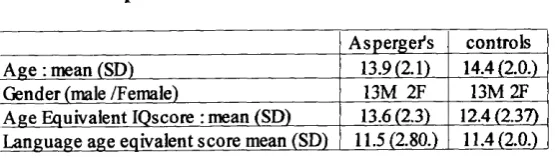
Twenty five individuals with Asperger’s syndrome were originally identified through a tertiary level child development centre. The potential participants were contacted via post. Eighteen people agreed to be involved in the study. Three people were excluded from the final analysis, one person was unable to complete the battery and a further two were found to have severely impaired language scores. Fifteen people were included in the final analysis. The group were aged between 11-19. The participants had all received a diagnosis o f Asperger’s from this service. Diagnosis is based on developmental interviews with parents and direct observations o f the child’s behaviour in the clinic and school settings and based on DSM-IV criteria (see introduction). All participants had no additional psychiatric history. Fifteen control subjects were recruited from local youth agencies, in inner city London. The groups were matched on gender and balanced for IQ, as assessed by the Ravens matrices, and language ability as measured by the Clinical Evaluation o f Language Fundamentals - Revised, (CELF).
Table of sample characteristics
Asperger's controls
A g e: mean (SD) 13.9(2.1) 14.4(2.0.)
Gender (male /Female) 13M 2F 13M2F
Age Equivalent I Q sc o r e : mean (SD) 13.6(2.3) 12.4(2.37)
2.1.2 Procedure
The subjects were given the assessment battery in two sessions with a break in between. The time taken for assessment ranged between 3 and 4 hours. Order o f presentation was counterbalanced. Parents were asked to complete a consent form and a behaviour questionnaire.
2.1.3 Design
A between group design was used to investigate differences between a group o f Asperger’s participants and group o f matched controls, on measures o f theory o f mind, executive function and social problem solving.
2.2. Measures
The Ravens matrices (Ravens, Court, & Ravens, 1996) and the CELF (Klein, et a l, 1994) were used as matching tools. A range o f the most advanced measures o f theory of mind tasks, and a broad range of executive fimction measures were chosen to assess the participants.
Each participant was asked to complete the Raven’s Standard Progressive matrices, sets A, B, C, & D and the 4 o f the 6 subtests o f the CELF. These two assessments enabled us to balance the groups on measures o f IQ and language skill.
Each participant was given a range o f theory o f mind tasks, the Eyes task, Baron-Cohen (unpublished), the Dewey stories, Dewey (1991) and the 1998 version o f the Happe stories (unpublished).
Evans (1996). Poisoned foods based on Arenberg (1968) and Trail-making Reitan (1958). Each participant was also given the Predicaments assessment, Channon (1999). Parents were asked to complete the Dysexecutive syndrome questionnaire (DEX), Wilson, Burgess, Emslie & Evans (1996).
2.2.1 The Raven’s Standard Progressive Matrices.
Purpose.
Raven reports the matrices were designed to measure what is termed as the eductive component o f cognitive ability. This eductive component is described as the ability to forge new insights, the ability to perceive and the ability to identify relationships. The essential feature o f eductive ability is the ability to generate new, largely non verbal, concepts which make it possible to think clearly. Lezac (1996) described the RPM as a series o f visual pattern matching and analogy problems pictured in nonrepresentational designs which has correlated consistently well as a measure o f general ability with a range o f other ability measures.
Items.
The scale consists o f five sets, A, B, C, D, E each consisting o f twelve problems. In this study set E was not included as this last set is more complex, and as such is the most time consuming part o f the matrices.
Description.
Scoring.
The response is marked correct or incorrect. Responses are then simply added together to form a total score, this can be compared to normative data to give a non verbal IQ estimate which is scaled for age, up to 15.5 years.
The expected score composition presented in the manual allows one to estimate score for set E to give an estimated total score.
2.2.2 Clinicai Evaluation of Language Fundamentals - Revised
Purpose.
This is a test o f receptive and expressive language skills, standardised on an American population ranging in age from 5 years 0 months to 16 years 11 months. The test has been modified for use in Britain.
Items
The test comprises six subtests, three focus on expressive language and three focus on receptive language. For the purpose o f this assessment we chose two subtests from expressive language, formulated sentences and sentence assembly and two from receptive language oral directions and semantic relationships.
Description
correctness.
Subtest 2: Sentence Assembly. The aim o f this subtest is to assess the ability to assemble syntactic structures into grammatically and semantically acceptable sentences. The participant is given groups o f words to put together to make a sentence. The participant is then required to give a second sentence using the same words. For each group o f words there are between 2-6 sentences which can be made. The participant must give two correct sentences to score a correct response.
Subtest 3: Oral Directions. The aim o f this subtest is to evaluate the ability to interpret, recall and execute oral commands o f increasing length and complexity. The participant here is asked to point to shapes in various positions, using various descriptions o f the comparative size and position o f the shape, in the order the administrator requests. The participant must complete each direction without any errors to score correct on each item. Subtest 4: Semantic Relationships. The aim o f this subtest is to assess the ability to interpret different semantic relationships in sentences. The participant is asked to chose two correct solutions from four possibilities. The semantic relationships are divided into comparative relationships, spatial relationships, passive relationships and temporal relationships. Again the participant has to give the two correct answers to score correct.
Scoring
2.3 Executive Function Measures
2.3.1 Behavioural Assessment of Dvsexecutive Syndrome ( BADS)
Purpose
This assessment aims to measure Dysexecutive syndrome previously described as frontal lobe syndrome. It is designed to pick up the characteristic deficits within this syndrome. The battery has six test components and a questionnaire. In this study we have chosen three items from the battery and the questionnaire.
Items
The three items used in this study are Rule Shift Cards Test, Key Search Test and Modified Six Elements. The questionnaire will be discussed later.
Description
The Rule Shift Card Test examines the pariciapant’s ability to respond correctly to a rule and to shift from one rule to another. In the first part of this test the participant is asked to look at a set o f 21 pictures o f playing cards and respond ‘Yes’ to a red card and ‘No’ to a black card. Time taken and the number o f errors are recorded. In the second part of the assessment the participant is asked to respond to a different rule, participants are asked to respond ‘Yes’ if the card that has been just turned over is the same colour as the previously turned card and ‘No’ if it is a different colour. In both conditions the rule is placed in front o f the subject in large print. The test is designed to measure the ability to shift from one rule to another and to keep track o f the colour o f the previous card and the current rule.
line, starting from a black dot outside the square, to demonstrate where they would search the field to be certain that they would find their keys no matter where they were.
This task is designed to examine the participant’s ability to plan an effective and efficient course o f action. The tester can also look at the participant’s ability to monitor their own performance. The scoring o f the strategy used relates to the efficacy o f the search.
Modified Six Elements Test This is a simplified version o f the original ShaJlice and Burgess (1991) test. It involves the participant being given instructions to follow. There are three tasks, dictation, arithmetic and picture naming. Each task is divided into parts A and B. Thus there are six separate tasks in total. The particiapnt is required to attempt something from each o f the six tasks within 10 minutes. The participant is told that there is a rule, that is that they are not able to do two parts o f the same task consecutively. This assessment is described as making demands on an individuals ability to plan, organise and monitor behaviour.
Scoring.
2.3.2 Poisoned foods.
Purpose
This is a deductive reasoning task first designed by Arenberg (1968).
Items
In this study we initially gave the participants two sample problems followed by twelve different sets o f meals (3-5), each meal containing four foods.
Description
In the original study the task was to decide which o f nine foods had been poisoned, this has been replicated in the present study. The participant was given a set o f meals that people had eaten and information on whether they had lived or died. If the person lived then poisoned food could not have been included in the meal and if they died one o f the foods they had eaten was poisioned.
Scoring
The participants response and response time was recorded.
2.3.3 Trail-making
Purpose
The original test was standardized on 200 subjects with past or present brain damage and 80 controls. It is designed to measure how well the participant can switch from one set to another.
Items
Description.
The two tasks are preceded by a short practice trail with 8 items. The participants are instructed to complete the task as quickly and as accurately as they can. Errors are pointed out to the participant who must then correct them and continue. The two conditions are matched on number o f items, but in the second task the participant has to alternate between letters and numbers.
Scoring
Completion time is recorded for each task. The Time taken on task A can be divided by taken on task B to estimate how efficiently the participant can alternate from letters to numbers.
2.4 Theory of Mind and Social Cognition Measures
2.4.1 Happe Strange Stories
Purpose
Items
In this study we used a more recent unpublished version o f the Happe 1994 strange stories. In the new version o f the stories there are eight theory o f mind stories based on her original 1994 strange stories and eight physical control stories.
Description
In the eight theory o f mind stories the participant can only make sense o f the story by implicating a motive to the persons behaviour or communication. In the eight physical control stories matched for difficulty, one can only make sense o f the story a by implicating a practical reason for the behaviour or communication. The participant is asked to read the story and is then asked to explain the why the person said or did something in the story.
Scoring
a) complexity
The response is given two marks for a correct answer, one mark for a reasonable or possible answer, and nil if they fail to understand the general principle involved in the story.
b) mentalising
Sensitivity
Using the original stories Happe found that the autistic group in her sample gave as many mental state answers as controls but that they were inappropriate to the story contexts. She found that autistic subjects who had passed second order theory o f mind tasks gave between 17 to 21 correct answers and normal controls 22 to 24 out o f a maximum o f 24.
Example o f a theory o f mind story
A burglar who has just robbed a shop is making his getaway. As he is running home, a policeman on his beat sees him drop his glove. He doesn’t know the man is a burglar, he just wants to tell him he dropped his glove. But when the policeman shouts out to the burgular, “Hey, you! Stop!”, the burglar turns round, sees the policeman and gives himself up. He puts his hands up and admits that he did the break-in at the local shop. Q : Why did the burglar do that ?
Example o f a physical control story
2.4.2 Eves Task
Purpose
The task is designed to be a ‘pure’ measure o f theory mind as it is thought to involve no executive function component and no central coherence component.
Items
There are 28 photographs o f male and female eyes.
Description
In this the participant is shown a section o f a face, so that just the eyes are visible. They are then read four words (which are also written next to the eyes), and asked to pick the word which best describes what the person is thinking or feeling.
Scoring
The response is awarded 1 if correct and 0 if incorrect.
Sensitivity
Baron-Cohen (1997) used a different version o f the task with adults with either Asperger’s syndrome or high functioning autism He found that this group was significantly impaired relative to age matched normal controls and a clinical control group with a diagnosis o f Tourette’s syndrome. In this assessment we used a later version o f this task, there are no published data o f this test to date.
2.4.3. Dewev stories
Purpose
Description
The task is to read eight brief stories which have parts in italics. The reader has to rate the behavior after the italics on a scale A-D as they think most people would judge it if they witnessed it. A, is fairly normal behaviour in that situation; B, is rather strange behaviour in that situation; C, is very eccentric behaviour in that situation; D, is shocking behaviour in that situation.
Example
The behaviour the participant is asked to rate is shown in italics and the modal response in brackets. Keith, age 25, was a clerk who worked in an office in the city. At noon he took his lunch to a small park and sat on a sunny bench to eat. Often he tore part o f a sandwich
into bits, scattering it on the ground for pigeons (A). One day when he came to his
favorite bench a pram was parked beside it. Keith noticed that a young woman was pushing an older child on a nearby swing. The baby in the pram began to cry but the mother did not hear this because the swing was squeaking. Now, Keith had learnt that when his baby nephew screamed, sometimes this meant that a pin in his nappy had opened.
Rather than bother the mother in the park, Keith quickly checked the baby's clothing to
see whether he could feel an open pin (B/C).
Items
There are eight stories and the respondent is required to make 23 judgments over the eight stories.
Scoring