555
The Effect Of Knowledge Management On Crisis
Management In Higher Institute Of Engineering
Professions In Al-Qubba City East Of Libya
Adel Salih Elhendawi
Abstract: The aim of the study was to test the impact of knowledge management on crisis management at the Higher Institute of Engineering Professions in the city of Al-Qubba east of Libya. To achieve the aims of the study, the researcher used the descriptive analytical method. The study was conducted on a sample of (239) employees at the institute. To measure knowledge management, the study adopted four processes: knowledge diagnosis, knowledge capture, knowledge sharing and knowledge application. As for measuring crisis management, a five-stage scale was used: alarm signals, preparedness and prevention, damages containment, restore activity and learning. The study concluded that there is a significant effect of the processes of knowledge on crisis management, and the results also indicated the presence of an effect of knowledge management in three stages of crisis management, namely: alarm signals, preparedness prevention and learning, while it did not have a significant effect on damages containment and restoring the activity.
Index Terms: Knowledge Management, Crisis Management, Higher Institute Al-Qubba, Libya.
—————————— ——————————
1.
INTRODUCTION
Today the world is living in a unique period in terms of rapid change and continuous development, as it became the trend towards a knowledge-based economy business organizations were established based on knowledge and information, which rely primarily on experts, competencies and outstanding knowledge competencies. Therefore, contemporary organizations have become focused on the accumulated knowledge in the minds of individuals and competencies that come from the mental practices of work, guidance and support from leaders, also, through the exchange of ideas, knowledge and experience with co-workers. In addition to exposure to customer demands, training and all development efforts in which organizations invest large sums (Gad-Alrb, 2010). Throughout human history, it is noted that knowledge has today become the cultural center of nations and peoples it is involved in all areas of social and political life and other areas. However, it represents a wide and essential field in the economic field in the current stage. Knowledge management is currently gaining great importance and is the basis for focusing the efforts of multiple parties through different perspectives and interests. Knowledge management has become an intellectual development and this through its great role in achieving competitive advantage in the field of business organizations. In order to achieve the desired benefit through the introduction of knowledge management approach in business organizations. Therefore the management of organizations should focus on the effective use of this approach, this is done through employing knowledge management in the direction of achieving the strategic goals and operational goals of these organizations, in addition to enhancing the capabilities of organizations and the skills of their cadres, achieving continuous improvement and improvement of these abilities and skills (Alyan, 2008). To achieve the desired benefit from adopting knowledge management approach in organizations. The role of management of organizations should focus on the effective use of this approach, by employing it towards achieving the goals of the organizations. Crisis management has existed since human existence. There are many types of them, including natural crises, with no income and reason for humans to appear, such as volcanoes, earthquakes, floods
and hurricanes. There are man-made crises, such as financial crises, as a result of raging competition, corruption and others. There are also other organizational crises such as strikes and sit-ins that affect the activity and work of business organizations and others negatively or even in government organizations such as business resulting from fires or loss of records and theft of information, embezzlement and other factors that lead to the emergence of crises, Therefore, all these crises of all kinds need scientific management to manage them during their different stages. Knowledge management plays a fundamental and strategic role through explicit knowledge and tacit knowledge in all stages of crisis management; therefore, it is imperative for the organization’s administration to configure early warning systems to be used in exploring and sensing the signs of crisis and facing them. Then evaluate its results and effects, and learn from them, and benefit from it (Al-Mutairi, 2017). The researcher is trying in this study Highlight the impact of knowledge management on crisis management, at the Higher Institute of Engineering Professions in Al-Qobba, Libya.
2.
STUDY
PROBLEM
556
1. What is the reality of the practice of knowledge management at the Higher Institute for Engineering Professions?
2. What is the reality of crisis management in the Higher Institute for Engineering Professions?
3. What is the effect of knowledge management processes in crisis management at the Higher Institute for Engineering Al-Qobba?
3. STUDY IMPORTANCE
The importance of this study lies in the following:
1. The importance of employing knowledge management in crisis management, it helps in facing crises and eliminating them as they happen as quickly as possible. 2. Because of the changes and complications that
accompanied the environment of organizations, including educational institutions, such as universities and higher institutes, and the spread of technology, as a result, increased attention has been paid to managing knowledge and skills of individuals, especially those skills related to the field of technology, which has become the basis for building and sustaining competitive advantage.
3. The growing interest in the field of knowledge management as a modern management at the level of educational institutions such as universities and higher institutes through the application of some knowledge management activities and enabling them to achieve their goals.
4. The study derives its importance from submitting recommendations that can assist the administration of the Higher Institute for Engineering Professions in facing it in future crises.
4. STUDY OBJECTIVES
1. Highlighting the role of knowledge management in crisis management at the Higher Institute for Engineering Professions.
2. Learn about the levels of knowledge management processes at the Higher Institute of Engineering Professions.
3. Determine the level of interest in crisis management at the Higher Institute for Engineering Domes.
4. Learn about the impact of knowledge management processes on crisis management at the Higher Institute of Engineering Professions
5. THEORETICAL BACKGROUND
5. 1 .KNOWLEDGE MANAGEMENT
Knowledge management has been defined as the method that the organization uses through its collective intelligence to achieve its strategic goals (Barquin, 2001, 138). The concept of knowledge management is constantly evolving as thinkers acquire it from different angles due to its breadth and multiplicity of fields. Knowledge management has been defined as the set of processes developed in an organization to create, store, transform, and classify knowledge (Laudon & Laudon, 2003, 317). It was also known as the systematic and developed processes that are performed in the organization in order to diagnose, generate, store, distribute and apply knowledge, which results in adding value to the work carried
out by the organization and an increase in its organizational performance (Naif & Al-Aboudi, 2016, 130). The oldest categorization of knowledge is provided by the Hungarian philosopher Michael Polanyi in the 1960s. He distinguished between explicit knowledge and tacit knowledge (Beijerse, 1999, 100) and he supported it in this distinction (Nonaka & Takeuchi, 1995, 8) as he classified knowledge into two types which are the most used (Najm, 2005, 44):
1. Explicit knowledge: it is formal and organized knowledge that can be coded as well as written and passed on to others, also known as leaked knowledge, because of the possibility of leakage out of the organization.
2. Tacit knowledge: it is informal knowledge and is not transferable and depends on personal experience and on evidentiary rules, intuition and personal judgment.
3. Knowledge is described as a form of intellectual capital, it will not be so unless it is discovered and invested by the organization, by converting it into a value, wealth is achieved through application (Stewart, 1999, 57). Turban (2002, 49) also referred to it as data and information that has been applied and processed in order to transfer the understanding, experience and cumulative learning that is applied in the problem or in the current activity. Knowledge is also referred to as a coherent mixture of experience, values and all information that provides a framework for assessing and assessing recent experiences and information (Najm, 2005, 26). It is a group of experiences, skills, abilities and all information that is in a specific context and fixed and cumulative among employees and the organization. It includes several types, including explicit knowledge and tacit knowledge (Al-Ali, Qandalji & Al-Omari, 2009, 26). Naif & Al-Aboudi, 2016, 129 indicates knowledge that it is the experiences, capabilities, and all the explicit and implicit information and the accumulated learning of the organization and its employees.
5.1.1 KNOWLEDGE MANAGEMENT OPERATIONS
Al-Tit and Al-Eid (2017) are seen as represented in four successive processes, namely the generation of knowledge, storage, diagnosis, acquisition, distribution and application. Al-Rubaie and Alwan (2018) believe that these four processes of knowledge management can be continuous, permanent and repeated and that they basically require knowledge sharing. Knowledge management is carried out through the implementation of activities related to the process of knowledge discovery. Possessing knowledge, Knowledge sharing and apply knowledge, so these four processes constitute the main processes of knowledge management (Arouf & Attia, 2018). For the purpose of conducting this study, the four main processes were approved, namely:
557
human sources of knowledge, In addition to the presence of digital sources such as electronic databases.
- Knowledge Capture: capture knowledge refers to the process of restoring and retrieving both explicit knowledge and implicit knowledge, whether from outside or from within the organization. It can be retrieved from suppliers, competitors, or experts (Hamshary, 2013, 125-126), whereas, the process of owning knowledge can be accomplished by retrieving the tacit knowledge present in the minds of workers in the organization (Al-Kubaisi, 2005, 69). Al-Shanti (2017) also defined it as the way in which knowledge from all workers within the organization is recorded and stored and in it all new knowledge is recorded, analyzed and documented by the organization.
- Knowledge Sharing: Knowledge sharing is the process of spreading explicit and implicit knowledge among all members of the organization (Araf Suwais, Falak, Bugatti and Abu Hammad 2011). The knowledge sharing process is the first step in the process of stimulating the circulation and use of knowledge, where knowledge is transferred between workers at the right time and at the right cost, so that the workers of the organization can perform the tasks required of them (Obaid, 2017). Exchange: this process relates to replacing and transferring the explicit knowledge that exists between individuals, one of the mechanisms of this process is the distribution of documents, brochures, and brochures among workers (Sweiss et al., 2011).
- Knowledge Application: knowledge application processes are an important process in knowledge management in organizations, as the main goal of them is to invest knowledge that has been discovered, owned and shared and implement them because the success of the application of knowledge reflects the success of the organization. The organization's ability to manage knowledge is assessed (Obaid, 2017). The correct application of knowledge is a contribution to achieving the goals of organizations efficiently and effectively. This requires the organization to empower employees and provide an atmosphere of confidence and freedom to share and apply their knowledge (Al-Shanti, 2017).
5.2 CRISIS MANAGEMENT
Margaret (2013, 3) defined crisis management as the implementation of strategies that were designed to help an organization that was exposed to a negative event and suddenly due to an unpredictable event or as an unexpected outcome of some events that were an expected risk. Therefore, the foundation will have to make quick decisions in order to limit the damage caused to it, with the need for a person to be a manager of the crisis when it occurs. From Jafar (2017) viewpoint that it is a pre-planning process towards an unexpected negative event with the aim of limiting or minimizing its harm to the organization and this is done through setting strategies or a set of scenarios expected to occur and proposing appropriate solutions for each scenario in the event of its occurrence. Abu Fara (2008, 59) believes that crisis management is the system that provides the organization with a coordinated response to crisis situations so that the organization has the ability to continue its daily activities related to providing products and collecting profits and others and at the same time when the crisis is managed successfully. Celik and Yilmaz (2016) defines it as a set of methods and frameworks that help the institution to make
quick and correct decisions in order to face the challenges, developments and all the specific contingencies.
5.2.1 CRISIS MANAGEMENT STAGES
Al-Maliki (2013) and Al-Hudmi (2009) state that the stages of crisis management are as follows:
Alarm Signals: as the initial stage in which warnings are sent before the crisis has occurred, or that manifestations of the crisis are sent and no one pays attention to it.
- Preparedness and Prevention: the aim of prevention is to discover and know the weaknesses in the institution's prevention system, as it is difficult to confront or prevent something from happening if it is not foreseen, therefore institutions must be sufficiently prepared to prevent them. - Damages Containment: In this stage, means are designed to limit the damage and limit its spread so that it does not include other parts that have not been affected yet. The crisis is contained by absorbing the results and recognizing the reasons that led to that, then overcoming them, and address its results and outputs, and through the provisions of control over the administrative entity with the aim of dealing with the exploitation of the crisis, by motivating and participating individuals and working to increase their affiliation so that their productivity is maximized.
- Restore Activity: at this stage, work is done to prepare and implement ready-tested programs, these programs may be short or long-term.
- Learning: in this stage, a reassessment is carried out in order to improve what has already been accomplished and to draw lessons and experiences that have been used. And that is in order to address it and face it in the future if it occurs.
6. LITERATURE REVIEW
558
on the consumer’s intention to purchase after the crisis. It showed that both the responsible recall variable and the crisis communication had a positive effect on the consumer’s intention to purchase after the crisis. Business organizations must be prepared to manage effective crises, as well as crisis communication strategies able to help the success of application of crisis management. The study conducted by Marshall (2015) indicated that individuals believe that among the important stages that help organizations' departments are the stage of preparation and discovery. It reduces the effects of the crisis. It showed that there are no differences in terms of gender or experience in the perceptions of individuals about the importance of discovery as one of the stages of crisis management, And the presence of differences in perceptions of individuals due to the age factor in favor of the oldest.
7. HYPOTHESES
H1: There is a significant effect of knowledge management on crisis management in higher institute of engineering professions in Al-Qubba City East of Libya.
H2: There is a significant effect of knowledge management on alarm signals in higher institute of engineering professions in Al-Qubba City East of Libya.
H3: There is a significant effect of knowledge management on preparedness and prevention in higher institute of engineering professions in Al-Qubba City East of Libya.
H4: There is a significant effect of knowledge management on damages containment in higher institute of engineering professions in Al-Qubba City East of Libya.
H5: There is a significant effect of knowledge management on restore activity in higher institute of engineering professions in Al-Qubba City East of Libya.
H6: There is a significant effect of knowledge management on learning in higher institute of engineering professions in Al-Qubba City East of Libya.
8. METHOD
The descriptive analytical approach to this study was adopted in the process of collecting data and information related to the subject of the study. Two sources were adopted in data collection, namely:
- Secondary sources, which relied on the administrative literature on the subject of the study as well as on the desk survey.
- Primary sources, which are data collected from the sources of the study sample and through the survey tool.
8.1 Population and Sample
The study population consisted of all 264 workers at the Higher Institute of Engineering Professions. The questionnaire was distributed using the comprehensive survey method to all workers in the study population, (239) questionnaires valid for analysis were returned, and this represents (91%) of the distributed questionnaires.
8.2 Measurements
To measure the knowledge management variable, the researcher used a measure consisting of four processes used in several studies (Al-Khshali, 2015; Marshall, 2015; Abdul Rahman, 2019; Jaafar, 2017) which are: Knowledge discovery, Possessing knowledge, Knowledge sharing and application of knowledge. The scale is corrupted from (20) phrases distributed with (5) phrases for each knowledge
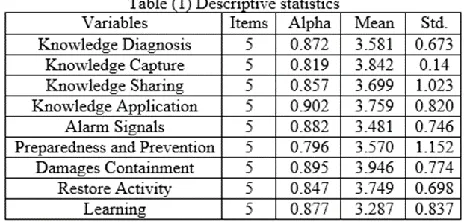
management process. To measure crisis management, a five-stage scale was used that is widely used in the study of crisis management (Al-Rubaie and Alwan, 2018; Al-Shanti, 2017; Sweis and others, 2011; Al-Tit and Al-Eid, 2017; Obaid, 2017, Awad, 2012) which are: Discover alarm signals, Preparedness and prevention, Containment of damages, Restore activity, and Learning. The scale consists of (25) phrases distributed with (5) phrases for each stage of crisis management. The consistency of the study measures was confirmed by using the stability factor of Cronbach alpha and the alpha values ranged between (0.827) as the lowest value for the stage of learning from the stages of crisis management as shown in table (1) This indicates an internal consistency in the parameters of the study variables.
9. RESULTS
Table (1) indicates the number of dimensions items for each variable on this study and reliability coefficient of these items, it’s all greater than the statistically acceptable percentage (0.70) (Sekaran & Bougie, 2010). The highest value in mean it was for damages containment items with this value (3.946) and the lowest value in mean it was for learning items with this value (3.287).
H1: There is a significant effect of knowledge management on crisis management in higher institute of engineering professions in Al-Qubba City East of Libya.
559
H2: There is a significant effect of knowledge management on alarm signals in higher institute of engineering professions in Al-Qubba City East of Libya.
Table (3) shows the results of a linear simple regression analysis for the effect of knowledge management on alarm signals in higher institute of engineering professions in Al-Qubba City East of Libya, and it showed that there is a significant effect of knowledge management on alarm signals, where the value of R2 reached (0.251), this means that knowledge management explains (25.1%) of the variance in alarm signals, and the value of B (0.370), while the value of F (64.115) with a significant level (0.000). The results of regression analysis indicate to accept of the second study hypothesis.
H3: There is a significant effect of knowledge management on preparedness and prevention in higher institute of engineering professions in Al-Qubba City East of Libya.
Table (4) indicates the results of a linear simple regression analysis for the effect of knowledge management on preparedness and prevention in higher institute of engineering professions in Al-Qubba City East of Libya, where the value of R2 reached (0.129), this means that knowledge management explains (12.9%) of the variance in preparedness and prevention, and the value of B (0.218), while the value of F (19.779) with a significant level (0.000). The results of regression analysis indicate to accept of the third study hypothesis.
H4: There is a significant effect of knowledge management on damages containment in higher institute of engineering professions in Al-Qubba City East of Libya.
Table (5) shows the results of a linear simple regression analysis for the effect of knowledge management on damages containment in higher institute of engineering professions in Al-Qubba City East of Libya, and it showed that there is not significant effect of knowledge management on damages containment, where the value of R2 reached (0.047), and the value of B (0.096), while the value of F (1.731) with a significant level (0.293). The results of regression analysis indicate to reject the fourth study hypothesis.
H5: There is a significant effect of knowledge management on restore activity in higher institute of engineering
professions in Al-Qubba City East of Libya.
Table (6) indicates the results of a linear simple regression analysis for the effect of knowledge management on restore activity in higher institute of engineering professions in Al-Qubba City East of Libya, where the value of R2 reached
(0.038), and the value of B (0.084), while the value of F (1.575) with a significant level (0.327). The results of regression analysis indicate to reject the fifth study hypothesis. H6: There is a significant effect of knowledge management on learning in higher institute of engineering professions in Al-Qubba City East of Libya.
Table (7) indicates the results of a linear simple regression analysis for the impact of knowledge management on learning in higher institute of engineering professions in Al-Qubba City East of Libya, where the value of R2 reached (0.228), this means that knowledge management explains (22.8%) of the variance in learning, and the value of B (0.327), while the value of F (53.832) with a significant level (0.000). The results of regression analysis indicate to accept of the sixth study hypothesis.
10. DISCUSSION
560
actual existence of knowledge is stored in the form of databases and their participation by workers, whether it is tacit knowledge or explicit knowledge that enables workers to transfer it to the reality of application to face crises when they occur. With regard to the impact of knowledge management in the stages of crisis management, it has been shown that there is a significant effect of knowledge management in three stages: warning signals, Readiness, prevention and learning. As the availability of different information databases and the ease of access to and updating them help the institute’s administration by monitoring the events that foretold from the occurrence of crises and then forming teams to confront them and then learn from them to face the coming crises.
11. RECOMMENDATIONS
1. The need for the institute’s administration to pay attention to diagnosing the knowledge it needs in its various activities, and identify the parties that possess this knowledge and its sources, whether internal or external, In addition to determining its size and cost.
2. The necessity of giving the institute administration more attention to the stages of the crisis warning signals, preparation, prevention and not waiting for the crisis to occur and starting to deal with it, because this increases the losses incurred by the institute, this can be done by collecting information on the parties with which the Institute deals with, studying and analyzing this information for the purpose of forming a crisis management team and developing plans and scenarios to confront the crisis.
3. The administration of the institute should pay attention to taking lessons and lessons from the events that accompanied the crisis and learning from it, at the time of the crisis, the administration will have taken many decisions, which have had positive and negative results, the administration, after the crisis is over, must review these events that accompanied the crisis to determine its negative and positive aspects, in order to avoid the negative ones and adopt positive decisions as a working method in facing the coming crises.
REFERENCES
[1] Abdel Rahman, Iman (2019).The reality of crisis management in Jordanian higher Education institutions: The case of Al-Balqa Applied University. An-Najah University Journal for Research, 33 (7), 1098-1122. [2] Abu Fara Youssef Ahmed (2008). Crisis management.
Jordan, Amman: Enrichment for publication and distribution.
[3] Al-Ali, Abdul Sattar, Qandilji, Amer, & Al-Omari, Ghassan (2009). Introduction to knowledge management (2nd ed.). Jordan, Amman: Al Masirah Publishing House.
[4] Alamad Majd Marwan (2019). The effect of administrative communication management in crisis management: knowledge management as an intermediate variable (field study in Jordanian press institutions). Unpublished doctoral thesis, International Islamic Science University, Amman, Jordan.
[5] Al-Hdami, Jassim Muhammad (2009). The principles of strategic crisis management and solutions. Amman, Jordan: Dar Zahran Publishing and Distribution
[6] Al-Khshali, Shaker Jarallah (2015). Contemporary management issues. Jordan, Amman: Dar Al-Hamid
Publishing and Distribution.
[7] Al-Kubaisi, Amer (2005). Knowledge management and organization development. Egypt, Alexandria: The Modern University Office.
[8] Al-Maliki, Safar bin Ghariz bin Graz (2013). The reality of the practice and eligibility of the method of crisis management in secondary schools in Makkah from the point of view of the principals and teachers of those schools. Unpublished Master Thesis. Umm Al-Qura University - Kingdom of Saudi Arabia.
[9] Al-Mutairi, Saad (2017). The role of knowledge management practices in the effectiveness of crisis management: a study of the attitudes of Saudi Electricity Company employees. PhD thesis in Knowledge Management, King Abdulaziz University, Jeddah, Saudi Arabia.
[10]Al- Orifan, Amtethal Hamad Rashid (2018). A proposed strategy for managing administrative crises in Kuwaiti higher education institutions in light of the standards of strategic leadership. Unpublished PhD thesis, University of Jordan, Amman, Jordan.
[11]Al-Rubaie, Kholoud, Alwan, Raad (2018). The role of knowledge management processes in tax performance (applied research in the General Tax Authority ). Journal of Accounting and Financial Studies, 13(43), 182-192.
[12]Al-Shanti, Mahmoud (2017).The role of transformational leadership in knowledge management processes: An applied study on workers in the Palestinian Ministry of Interior in the Gaza Strip. The Jordanian Journal of Business Administration, 13(3), 435-459.
[13]Al-Tit, Ahmad, & Al-Ayed, Surrey (2017). The role of knowledge management in choosing the strategic alternative for the directors of Saudi telecom companies. Arab Journal of Management, 37(1), 21-38.
[14]Alyan, Ribhi Mustafa (2008). Knowledge management. Jordan, Amman: Safaa House for Publishing and Distribution.
[15]Arouf, Radia, Atieh, Khadija (2018). Apply knowledge management as a strategy to build the educated organization. Magazine Business and Finance Economics, 7(1), 351-365.
[16]Awad, Atef Mohamed (2012). The role of knowledge management and its technologies. University of Damascus Journal, 28(1), 73-101.
[17]Ballah, Abdullah, and Khamis, Abdullah (2018). Information quality implications in crisis management. An Exploratory Study at the Operations and Infrastructure Center Disaster Management Cell in Nineveh. Tikrit Journal of Administrative and Economic Sciences, 3(43), 56-67.
[18]Barquin, Roman C. (2001). What is knowledge management. Pub,Virgenia, Vienna.
[19]Beijerse, R. (1999). Questions in knowledge management: Defining and conceptualising a phenomenon. Journal of Knowledge Management, (3)2, 26-34.
[20]Celik, A., & Yilmaz, R. (2016). Research of the effectiveness of strategic leadership in crisis management: A comparative study in large scale enterprises in Kenya (3rd) Industrial Zone. Postmodern openings Deschideri Postmoderne, 7(2), 93-114.
561
is the path to excellence and leadership. Jordan, Amman: Safaa House for Publishing and Distribution.
[22]Iqbal, Amjat d., Latif, Fawad, Marimon, Frederic, Sahibzada, Umar, & Hussain, Saddam (2019). From knowledge management to organizational performance: Modelling the mediating role of innovation and intellectual capital in higher education. Journal of Enterprise
Information Management, 32(1), 36-59. [23]Jaafar, Younis Ibrahim (2017). The impact of strategic
planning in crisis management: An empirical study: Public institutions in the Jerusalem suburbs. Al-Aqsa University Journal, 21(1), 293-324.
[24]Jad-Alrb, Syed Muhammad (2010). International business administration. Egypt, Cairo: Academic Library.
[25]Loudon, Kenneth, & Laudon. J. P. (2003). Essentials of management information systems: Managing the digital firm. Prentice Hall,New Jersey.
[26]Mansor, Farhana & Kader Ali, Noor Nasir. (2017). Crisis management, crisis communication, and consumer purchase intention post-crisis. Global Business and Management Research, 9(4), 60-79.
[27]Margaret, Rouse (2013). Crisis management plan. USA. [28]Marshall, John (2015). Travis rating the cities: A city
resilience index for assessing the effect of state and local laws on long-term recovery from crisis and disaster. 90 Tul. L. Rev., (35), 48-57.
[29]Naif, Asaad Kazem, & Al-Aboudi, Haider Abdul Mohsen (2016). The impact of knowledge management operations on some operations decisions: An exploratory study of the views of a sample of directors of the General Company for Battery Industry. Al-Ghari Journal of Economic and Administrative Sciences, 37(1),143-151.
[30]Najm, Najm Abboud (2005). Knowledge management concepts strategies and processes. Jordan, Amman: Al-Warraq for Publishing and Distribution.
[31]Nonaka, I., & Takeuchi, T. (1995). The knowledge creating company: How Japanese companies create the dynamics of innovation. New York: Oxford University Press. [32]Obaid, Shaher (2017). The impact of knowledge
management dimensions on the competitive advantage in banks. An-Najah University Journal for Research, 31(10), 1745-1782
[33]Stewart, Thomas (1999). Customer learning is a two-way street. Fortune, (139), 9-22.
[34]Sweiss, Ratib, Falaq, Muhammad, Bugatti, Jana, & Abu Hammad, Ayman (2011). Knowledge Management Operations and their Impact on Achieving Competitive Advantage A case study of Jordan Telecom Group. Jordanian Journal of Business Administration, 7(4), 511-526.