THE DEFORMED TRANSFORMED
And Jesus said, How hardly shall they that have riches enter into the kingdom of God! For it is easier for a camel to go through a needle's eye, than for a rich man to enter into the kingdom of God. And they that heard it said, Who then can be saved? And he said, The things which are impossible with men are possible with God. . . There is no man that hath left house, or parents, or brethren, or wife, or children, for the kingdom of God's sake, Who shall not receive manifold more in this present time, and in the world to come life everlasting.1
In 1711 William Derham, Canon of Windsor and Fellow of the Royal Society, gave a series of lectures, surveying the physical and natural world, with the object of demonstrating how perfect is God’s Creation in every respect. His survey, published as his Physico-Theology, ranged from the exist ence of gravity (without which, Derham observed, the earth would fly apart ) to the dist ribution of venomous snakes (of which, he noted with evident satisfaction, that all the worst o nes live in lands peopled by non-Christians). In particular, Derham found that Man himself is: “every Part of him, every Thing relat ing to him contriv’d, and made in the very best Manner; his Body fitted up with the utmost Foresight, Art and Care”.2 Indeed if
anyone were to suggest, to the contrary, that there are ways in which the design of human beings can be improved, it would be blasphemy.
That was three hundred years ago. Times have moved on, and our style of argument has changed. Nonetheless as modern-day followers of Darwin we remain no less committed than Derham and his fellow philosopher-theologians to an idea of optimal design in nature. We may no longer believe that we live in the best of all possible worlds. But we do have reason to believe that we live in the best – or close to best – of all available worlds.
It is easy to see why. Let’s suppose we are considering the evolution of some desirable phenotypic trait that can be scaled from less to more – intelligence, say, or beauty. Then theory tells us t hat, if and when an increase in this trait is indeed an available option within the biological “design space” of the species, and if it will indeed bring an increase in fitness to go that way, then this is the way that natural selection will drive the population as a whole. In other words, it is highly likely that, provided there is time and opportunity, the species will evolve to the point where t his trait goes to fixation at t he best level throughout the population.
therefore, is that any significant improvement in bodily or mental capacities can be achieved as a result simply of minor tinkering with t he human design plan.
Yet the truth is that there is accumulating evidence to suggest just t his.
For a start , as medical science gro ws ever bolder, it is proving to be a relatively
straight forward task for doctors to increase human performance levels by direct intervention in human embryology and later physiology – with, say, foetal androgens for brain gro wth, anabolic stero ids fo r st rength, growth hormones for height, and soon-to-co me memo ry-enhancing drugs and anti-aging drugs. I recently saw a report that even such an elementary intervent ion as providing extra oxygen to newborn babies can lead to significantly above average IQ scores when tested at eight years.3
But, more to the point, there has long been evidence from natural history that Nature herself can intervene t o boost performance levels if she so chooses – pro ducing exceptionally well-endowed individuals all on her own.
These natural “sports”, if I may use that word, can t ake the form of individuals who grow up to have exceptional height, or strength, or beauty, or brains, or long life because they carry rare genes that bias them specifically in these directions. But, surprisingly enough, they can also show up as individuals who develop islands of extraordinary ability in the context of what we would more usually think of as retardation or pathology: epileptics with remarkable eidetic imagery, idiot savants possessed of extraordinary mnemonic faculties or musical talents, elderly patients with dementia who come out with superb artistic skills.4
Even enhanced beauty can come about as a secondary consequence of a developmental disorder. There is a syndrome called CAIS, complete androgen insensitivity syndrome, where male foetuses fail to respo nd to male sex hormones and consequently grow up to have the bodies of women: but not just any wo men – t hese transfo rmed boys typically have enviable bodily proportions, long legs, unusual symmet ry, glossy hair, pellucid skin (indeed it is rumoured that several highly successful super-models and film actresses have been just such cases).
Now, if these examples mean what they seem to mean, we Darwinians perhaps have some explaining to do. For what the examples seem to suggest is that there is room for further pro gress in human evolution. In some respects anyway, human beings are not yet as highly evolved as in principle they could be (and perhaps they’d like to be). Perhaps Nature, after all, has not done the best that can be done for us – at least not yet. In which case the question we must ask is: Why?
That’s to say, in these case we are interested in: either an increase in the trait in question, over and above what already typically exists, is act ually not an available option within biological design space, or it is act ually not a desirable option that wo uld lead to increased fitness.
The first possibility, that the maximal level is actually not biologically attainable – or at any rate sustainable – is very much the answer that is currently in vogue among evolutionary biologists. In relation to IQ, for example, it is argued that while Nature has indeed done her best t o design all human brains to maximise general intelligence, she is co ntinually thwarted by the occurrence of deleterious mutations that upset the delicate wiring.5
Or in relation to health and beauty, it is argued that while Nature has set us all up to have the best chance of having perfectly symmetrical bodies, pure complexions, and so on, there is no way she can provide complete protect ion against the ravages o f parasites and other environmental insults during development.6
Yet, while there is surely somet hing in this, it cannot be the whole story. Fo r we have already seen some of the most telling evidence against the idea of there being this kind of upper ceiling: namely, that, despite the mutations, parasites and other retarding factors that are undoubtedly at work, it is possible to intervene in quite simple ways – oxygen, foetal
androgens, memory drugs, and so on – to enhance performance in particular respects; and, what ’s more, there do exist natural examples where, against the apparent odds, these problems have been overcome – those genetic variants, pathological compensations, and so on. In other words, it is clear that the reason why human beings typically do not reach these levels cannot be entirely that Nature’s hands are tied.
The second possibility, that to reach for the maximum possible will not actually pay off in fitness, is in several cases both more plausible and more interesting.
This is the answer William Derham himself clearly preferred. What Derham pointed out is that even when a trait seems desirable, and indeed is so up to a certain point, in many cases it is possible to have too much of a good thing. 90*,< "("< [meden agan], as the classical proverb goes, do nothing in excess. Too little and you will miss out on the benefits, but too much and you will find yourself incurring unexpected costs.
So, Derham argued, we should expect that true perfection must o ften lie in
compromise. And in a perfect world God – or as we now say Nature – will have occasion to settle not for the maximum but for the “golden mean”.
too short, nor is it too long: too short and he would not have time to have enough children to propagate the species, too long and there would be severe overcrowding.
However, while this explanation seems to work nicely provided we choose our examples carefully, it is not clear it is going to work so well across the board. For there are other traits – intelligence, for instance – for which the dangers of excess are by no means so apparent and there may seem to be advantages to be had all down the line.
True, even when this is so, and advantage never actually turns to disadvantage, t he ret urns to be had beyo nd a cert ain po int may hardly be wo rth having. As Darwin himself noted: “In many cases the continued development of a part, for instance, of the beak of a bird, or of the teeth of a mammal, would not aid the species in gaining its food, or for any other object”. Yet the fact remains that in some ot her cases – and intelligence may seem the prime example – the returns in terms of fitness actually seem likely to remain quite high. Will there ever come a point where a human being, struggling for biological survival, will cease to benefit from being just that little bit cleverer, for instance? Darwin himself thought not: “but with man we can see no definite limit to t he continued development of the brain and mental abilities, so far as advantage is concerned.”7
Here, however, it seems that Derham was ahead of Darwin. Realising that if a trait such as intelligence really were to be unmitigatedly advantageous, then God – or Nature – would have no excuse for sett ling for anything less than t he maximum possible, and being under no illusion that human intelligence in general is in fact anywhere near this maximum point, Derham had no hesitation in concluding that increased intelligence must in reality be disadvantageous.
So, Derham reasoned, there must in fact be hidden costs to being too clever. What could t hey be? Well, Derham’s idea was t hat, if Man had been made any cleverer than he actually is, he would have been capable of discovering things he ought not to know. And, to prove his point he proceeded to discuss t hree examples of discoveries to which Man (at the time of writing, in 1711) had failed to find the key, and which it seemed obvious were beyond the powers of reasoning that God has given him. These are: in mechanics, the ability to fly; in mathematics, the ability to square the circle; and, in navigation, the ability to judge longitude at sea.
Power of ot hers to prevent; and by making Man less sociable, for upon every true or false Ground of Fear, or Discontent, and other Occasions, he would have been fluttering away to some other Place.” 8
We smile. But this idea is by no means entirely silly. The notion that it is possible for a person to be “too clever by half” is one that has considerable folk credibility. And where there is folk credibility there is generally more than a little factual basis. Beginning with the story of Adam and Eve eating from the t ree of knowledge, through Daedalus giving his son Icarus the wax wings with which he flies too close to the sun, to Frankenstein creating a monster he cannot control, myths and fairy tales offer us numerous examples of individuals who come to grief as a result o f their being t oo clever or inquisitive for their own goo d. “Curiosity killed the cat,” we say. “More brains than sense.” And in the course of human history there must indeed have been many real life instances where human inventiveness has redounded in tragic ways on the inventor.
Not only in human history, but most likely in the history of other species too. I am reminded of a report that appeared in the British Medical Journal some years ago: “Charles Darwin would doubtless have been upset had he known of the Coco de Mono tree of Venezuela. It apparently bears pods of such complexity that only the most dexterous of monkeys can open them and obtain the tasty almond-like nut. Once the nuts have been eaten the monkey's hair drops out and he soo n expires – thus ensuring the survival of the least fit members of each generation.”9
But note that the author is wrong to have written “the survival of the least fit”; rather he should have written “the survival of the least skilled” – for the lesson of this (possibly apocryphal) sto ry is precisely that the least skilled may in fact be the most fit.
What is true for practical intelligence, can surely be true for social intelligence as well. In an essay on the “Social Function of Intellect”, nearly thirty years ago, I myself raised just this possibility: arguing that Machiavellian intelligence, beyond a certain point, may turn against its o wner because success in interpersonal politics beco mes an obsession, leading him or her to neglect t he basic business of pro ductive living. “There must surely come a point when the time required to resolve a ‘social argument’ becomes insupportable”.10
The same surely goes for other capacities that we do not usually think of as having a downside. I have no doubt a case could be made for the dangers of excess in relation beauty, say, or health. “Too beautiful by half” and a perso n may run the risk of envious att acks by rivals. “Too healthy by half” and . . well, I’m sure there is something to be said against it.
straight forward way of explaining why Nature has not pushed desirable t rait s to their biological limits.
But it is not t he only possible way of explaining this apparent paradox. And it is not the one I am going to dwell on in this essay. For I think there is an even more interest ing
possibility out there waiting to be explored. It is an idea that was anticipated by another of those ingenious scientist-theologians at the turn of the seventeenth century, one Nehemiah Grew. And it is an idea that in some ways is the precise opposite of Derham’s.
Derham’s line was that too much of a good t hing can get you into trouble. But Grew’s line, expounded a few years earlier in his Sacred Cosmology, was that too much of a good thing can get you out of trouble, when actually it would be better for you if you stay in trouble – better because trouble can be a blessing in disguise, forcing you to cope by other means.
Take the case of height and strength, for instance. Derham, as we have seen, suggested that God in his wisdom does not choose to set man’s height greater than it is because if men were taller they might get into damaging self-destructive fights. Grew however came up with the remarkable suggestion that Go d does not do so because if men were taller they might find life too easy, and consequently neglect to cultivate other essential skills. “Had the Species of Mankind been Gigantick . . there would no t have been the same Use and Discovery of his Reason; in that he would have done many Things by mere Strength, for which he is now put to invent innumerable Engines.”11
Less strength because only comparative weaklings can be expected to invent innumerable engines! Let’s call this “Grew’s argument”. It is a startling idea. It needs some unpacking. But then I think it may turn out to hold the key to several major puzzles about human evolut ion.
To see how Grew’s argument can be developed, let’s begin now from a more modern perspective (which is , as you may guess, where I myself set out from – having only later found my way back to Grew and Derham).
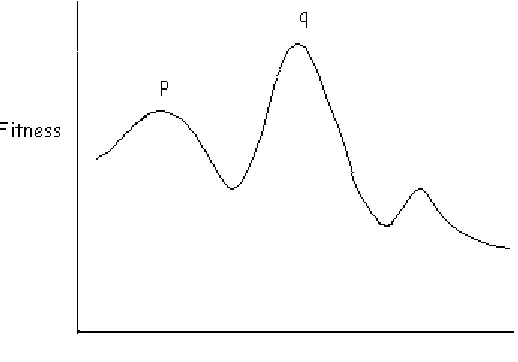
When the question is whether and how natural selection can arrive at the best design for an organism, a recurrent issue for evolutionary biologists is that of “local maxima”.
Figure 23
Figure 24
maximum at point q. But suppose it is already at a local maximum at point p. Then, because it will have to go downwards before it can continue upwards, it is stuck where it is.
Let’s think of it in terms of the following analogy. Imagine the graph with its local maxima is a ceiling with hollows, and t he organism is a hydrogen filled balloon that is float ing up against it, as in Figure 24. The balloon would like to rise to the highest level, but it cannot, it is trapped in one of those hollows.
This problem is of course typical of what happens to any kind of system, evo lving in a
losses. There is no way such a system can take one step backwards for the sake of two steps forward. No way it can make a tactical retreat so as to gain advantage later.
The situation is familiar enough in our own lives. Even we, who pride ourselves on our capacity for foresight, easily get trapped by t he short-termism of our go als. “The good”, as is said, “is the enemy of best”: and, provided we are already doing moderately well, we are often reluctant to incur the temporary costs involved in moving on to something better. So, for example, we continue in an all-right job, rather than enter the uncertain market for the quite-right o ne. We st ick t o techniques that work well enough, rat her than retrain ourselves in ways that could potentially work so much better. We stay with an adequate marriage rather than leave it for the distant prospect of a perfect one.
But let ’s look again at the balloo n. Although it is true the balloon will never take the one step backwards for itself, it may still happen of course that it gets to have some kind of set-back imposed from outside. Suppose a whirlwind blows through and dislodges it, or it gets yanked down by a snare, o r it temporarily loses hydrogen. Then, once it has suffered this unlooked-for reverse, there is actually a fair chance it may float higher at its next attempt. In other words there is a way the balloon can escape from the local hollow and achieve its true potential after all. But, oddly eno ugh, what is needed is that something “bad” will happen to it – bad in the sho rt-term, but liberating in the longer-term.
And the same is true for us. Sometimes we too need to have a whirlwind blow through our lives before we will start over again and give ourselves the chance to move on to a new level
Human histo ry is full of examples of how seeming cat astrophes can in fact be the catalyst for profitable change. People suffer dire poverty, or slavery, or are forced to migrate: they discover in their new world unprecedented riches. They have their cities razed and factories destroyed by bombs: they rebuild in ways far more efficient than the old. They lose their inherited wealth in a stock-market crash: they go to work to become healthier and wealthier than they ever were to start with.
Shakespeare, as always the superb student of human nature, remarked how sweet are the uses of adversity “which like the toad, ugly and venomous, wears yet a precious jewel in his head”.12 Nietzsche wro te: “Examine the lives of the best and most fruitful men and peoples, and
ask yourselves whether a tree, if it is to grow proudly into the sky, can do without bad weather and storms: whether unkindness and opposition from witho ut . . do not belong to the
favouring circumstances without which a great increase in virtue is hardly possible.”13
But people are more interesting than balloons. The reason why disaster so often breeds success with human beings is not simply that it gives them, as it were, a new throw of the dice – so that with luck they may do better this time round (although it is true that luck may
sometimes have a hand in it: many a human group forced to emigrat e has by pure chance found a superior environment awaiting them abroad). The more surprising reason is that when people suffer losses and are obliged to find imaginative ways of replacing assets they previously took for granted, they frequently come up with solutions that bring a bonus over and above what they originally lost.
So, for example, when famine strikes, people who have previously foraged for
themselves may discover ways of collaborating with others, which in the event bring in much more than the individuals could harvest even in good times on their own. Or, when they lose their vision from short-sight, they may (they did!) invent spectacle lenses to make up for it, which in the event leads to the development of telescopes and microscopes and so provides them with better vision than they had before.
And it can happen on an individual level too. After Stephen Hawking (whom I knew as a childhood friend and who lived with my family for two years in the 1950's) suffered a
debilitating neurological illness, he transformed himself from a relatively ordinary student into the ext raordinary mathemat ical cosmologist he has since become. How did t hat happen? The novelist Martin Amis wrote recently: “Hawking understood black holes because he could stare at them. Black ho les mean oblivion. Mean death. And Hawking has been staring at death all his adult life.”14
But the true reason is both more prosaic and more wonderful. Stephen Hawking, having lost the ability to write, could no longer work with algebraic formulae on paper, and was obliged to begin using geometric methods which he could picture in his mind’s eye.. But these geometric methods did more than substitute for the lost algebra, they gave Hawking ways of looking at things that his old algebra might never have revealed.
Remarkably enough, Albert Einstein told a similar story about how he himself gained from a disability. Einstein claimed that he was very late learning to speak and, even after he did, he found whole sentences tricky, rehearsing them in an undertone before speaking them out loud. This delayed development, Einstein said, meant that he went on asking childlike questions about the nature of space, t ime and light long after others had simply accepted the adult version of the world. 15
So, we can come back to Nehemiah Grew. If ill fortune in the short term may indeed actually be good fortune in the long term, then it does make obvious sense that God himself will sometimes choose to impose ill fortune on his creatures in the sho rt term in order that they achieve good fortune in the long term. That’s to say, God may deliberately arrange to have human beings born less than perfect just in order that they find their way to becoming perfect. In particular God may, as Grew suggested, contrive to make human beings in certain respects weak and inadequate by nat ure, precisely because they will then be highly motivated to invent those “innumerable engines”.
At any rate – God or not – here is the logic of these various examples:
• An accident or acquired defect threatens disaster by taking away a person’s normal means of coping wit h a problem.
• The person is thereby given the incentive to find some alternative route to the same end.
• This alternative route, as it happens, not only overcomes the original problem but brings unanticipated benefits as well.
The burden of this essay is to argue that something very like this has played a significant part in biological evolution (and in particular the evolution of human beings):
• A mutation – a genetic accident – threatens to reduce an individual’s fitness by removing some previously evolved means o f solving a survival problem.
• The individual is thereby given the incentive to compensate by some novel behavioural strat egy.
• This novel strategy, in the event, more than makes up for the pot ential loss in fitness and leaves the individual ahead.
I need hardly say that Nature – unlike God – cannot, of course, do things deliberately. She will never take a step backwards in order to take two steps forward. But I would argue that Nature may perhaps take a step backwards by chance in circumstances where the
And here I do mean more than likely. For I think there are theoretical grounds for supposing that, if and when an individual who finds himself deficient in some way is obliged to make up for his deficiency by replacing a genet ically-given strategy with an invented one, and succeeds, he will more often than not end up better off than if he has not had to do it.
The simplest reason is this. Suppose we assume that in order to survive in competition with others the deficient individual has to come up with a new strategy that is at least as good as the genetically-given one it is replacing. True, he may be able to get by with a new strategy that is only just as good as the original one, in which case he will have made one step
backwards and only one step forwards, and will be back where he started. But it is a simple law of statistics that most of the possible strategies that are at least as good as the original will actually be better than it. (And if you want to see why, consider, for example, why most o f the people who pay at least as much tax as you do actually pay more tax than you do; why most of the prime numbers that are at least as high as 523 are higher than 523; and so on.) Hence the chances really are high that the deficient individual, if he survives at all, will adopt a strategy better than the o ne he started with.
Is it only human beings who will be able to get ahead in this surprising way? In principle all that is required is the capacity to replace genetically given features with invented ones. But in practice this probably does limit it – as a significant path for change – to our human ancestors. For there is, of course, one big barrier to its working out well even in the case of human beings: namely, the need for the individual who suffers the setback to be not only peculiarly inventive but peculiarly quick.
When Houdini was bound hand and foot and thrown into the lake he could not afford to wait for his grandchildren to set him free. No more co uld one o f our ancestors bo rn with a biological deficiency leave it to later generations to make good what he had lost. The human brain, working within the context of human culture, is an organ – the one organ in nature? – that (quite unlike the genetically programmed body) is able t o make astonishing pro gress within the span of an individual life.
Let’s look then specifically to human prehistory. And let’s look for scenarios t o fit the logic spelled out above: where human ancestors can be seen as losing some genetically-given beneficial trait (measured perhaps by comparison with their chimpanzee-like cousins, who st ill have it), therefore being o bliged to make up fo r this loss by rapidly inventing a way round it (for which their cousins have no obvious need), and as result moving unexpectedly ahead of the game (leaving those cousins standing – or extinct).16
fire-making; second the case of the loss of memory capacity and the coming of abstract thinking. The first is in some ways a “toy example”, which I shall present not because I am entirely serious about it, but because I think it nicely illustrates how the principle can work. But the second is a case about which I am serious to a degree.
Hair loss / Fire
Why have humans lost their body hair? Answers range from Desmond Morris’s interesting suggestion in his book, The Naked Ape,17 that hairlessness makes sexual intercourse more pleasurable and so promotes pair-bonding between human parents, to the standard theory that hairlessness reduces the dangers to human hunters of getting too hot when running after prey under the midday sun on the savannah.
These answers, within the conventional paradigm, seek to explain hairlessness as a simple direct benefit: human beings function better as lovers, say, or hunters without body hair than with it. Let’s agree that such direct benefits, so far as they go, may be a factor (although this may not be very far.18) But what about the much more obvious direct costs: the costs of
gett ing cold?
The sun does not always shine even in Africa. And while a hairless human being may benefit from not overheat ing when active at midday, the plain fact is the same human is bound to be at considerable risk of overcooling at other times of day, especially when inactive and at night. The dangers of co ld are po tentially severe. This is how the Cambridge Encyclopaedia of Human Evolution summarises the situation:
“Although early human populations were established in quite cold climates long before the evolutionary appearance of Homo sapiens, modern humans have a very low tolerance of cold. Because we lack insulation such as fur and hair, nude exposure to still air temperature as high as 26 EC causes constriction of blood vessels in the skin. At around 20 EC, increased heat production, manifest as shivering, begins, and at 5 EC inactive young adults may suffer such a reduction in brain temperature that they become unconscious in a few hours. . . Without the culture that produced clothing and fire and without access to some kind of shelter, our predecessors were limited to places where it never became colder than about 10 EC.”19
We can pict ure tho se “early human po pulations” t hat were “established in quit e cold climates long before the evolutionary appearance of Homo sapiens” as still having plenty of body hair and so as having no need as yet to go looking for a remedy. We know that at so me stage between t hen and now human beings did lose their hair, and t hey did indeed come through with “the culture that produced clothing, fire and shelter”. The questio n is: What is the causal relat ionship here?
My hypothesis is that it was indeed hair loss that came first. That’s to say, certain of those early humans – those who in fact became our ancestors – were driven to develop the arts of keeping warm precisely because they lacked sufficient hair and were becoming cold . But then, as things turned out, these individuals – and the trait for hairlessness – actually prospered: for the fact is that the cultural innovations brought a significant, though unanticipated, premium.
Consider in particular the case o f fire. No doubt people first learned to make and t end fires for no other reason than to stave off cold. Yet we now know – as the first fire-makers presumably did not – that once the fires were burning, a host of other benefits would soon become available. Fo r the very same fire that provided warmth could help keep predators away; it could provide light; it could be used to harden stone and wooden tools; it could be used for cooking food, rendering meat and vegetables more digestible and killing parasites; and – perhaps the biggest if least tangible benefit of all – it co uld provide a focus for family and friends to gather round, to exchange gossip and information and cement social bonds.
The upshot is that the biological set-back of hair loss – in so far as it was a
precondition for the cultural innovations – would have actually brought a net gain in biological fitness. Hairlessness t herefore would have proved t o be on balance an evo lutionarily adaptive trait, and so would have been set to spread through the population at a genetic level.
But why, you may ask, should it be true that hairlessness was a precondition for fire-making? If fires could bring all those added benefits besides warmth, why did not early human beings hit on the idea of making fires anyway – even before they lost t heir hair?
The probable answer is that these other benefits simply did not provide the right kind of psychological incentive. Human beings, if and when they are cold, have an instinctive liking for the warmth of fire. But they have no comparable instinctive liking for parasite-free cooked meat, or fire-hardened knives, or predator-scaring flames, or even camp-fire-facilitated social gatherings. Even if these other benefits would have come to be appreciated in good time, t heir absence would have been unlikely to provide the necessary shock to the system that was required to get fire-invention going.
been tho ught t o be something of a mystery, fire-making does not seem to have caught on, and hearths remain remarkably rare in areas known to have been lived in by humans – until about 150,000 years ago, after which they soon become much more common.
The archaeologist Ian Tattersall comments: “The advantages of domesticating fire are so great that, once technologies for its control had been developed, it’s hard to see why they should not have spread rapidly.”20
I’d say the reason may well have been that it all depended on the history of hair loss – and people first feeling cold.
Memory loss / Abstraction
Have human beings lost their memories? The fact that modern human beings have less hair than their chimpanzee-like ancestors is obvious and indisputable. But that they have less memory capacity than their ancestors is not something generally acknowledged.
My chief reason for claiming it is so is some little known research on “picture memory” in chimpanzees, undertaken by Donald Farrer nearly forty years ago.21
In his experiment Farrer gave three chimpanzees a “match-to-sample task”, where each subject was presented with an array of pictures as shown below, and was rewarded for finding and touching the picture in the bottom row that matched the sample picture at the top.
k
# a k
Twenty four different combinations were presented, as shown in Figure 25. But these were no t a random selection. In fact the same line-up in the bott om row never recurred with a different matching picture above: so that, for each particular line-up in the bottom row, there was only ever one correct answer. This meant that, to perform well on the task, the subject did not actually have to learn the “match-to-sample” rule at all, but could instead learn by trial and error which one picture was correct for each of the twenty four possible line-ups.
** Figure 25. The 24 problems used in the picture memory task. **
bottom row of pictures was presented without the sample on top being visible – so there was now no way of applying the rule, and only rote memory for each particular line-up could possibly suffice. Astonishingly, t he chimps cont inued to perform as well as before, selecting the “correct” pict ure bet ween 90% and 100% of the time. Clearly they had in fact learned the task by rote. Farrer’s conclusion was that chimpanzees do indeed have a supra-human capacity for “picture memory” – or “photographic memory”.22
But if chimpanzees have this capacity today, t hen, unless they have acquired it
relatively recently, it is a fair guess t hat our human ancestors also had it to begin with. And, if our ancestors had it, then modern humans must indeed have lost it.
Why? Why lose a capacity for memorising pictures, when prima facie there can only be immediate costs – just as there are to losing hair? I suggest the reasons for memory loss were indeed structurally of the same kind as the reasons for hair loss: when human beings lost their memories they were obliged to solve their problems some way else, and this some way else turned out to be hugely advantageous.
And Farrer’s experiment provides an immediate lead to what the advantage of this some way else might be. If you or I were given the same match-to-sample task, we with our poor memories would find it nearly impossible to solve it by rote learning and so we would do the modern human thing and search for so me higher-order patt ern in the data. But, lo and behold, once we identified this pattern, the match-to-sample rule, we would have not merely caught up with the chimpanzees on this one task, we would have inadvertently qualified ourselves t o so lve a whole range of pro blems we have never met before.
Suppose, for example, that after being trained with the original set of twenty four combinations of pictures, we were now given a combination that was not part of the original set, such as the one below, where the same line-up below appeared with a different picture above:
#
# a k
In short, the use of rules – and abst raction in general – allows knowledge of the world acquired in one situation to be applied in another: a capacity that is the very ground of our human cleverness and creat ivity.
There is increasing evidence that chimpanzees are in fact surprisingly backward when it comes to rule learning and abstract thinking. It is not that they are completely incapable of it – chimpanzees certainly can learn the match-to-sample rule when there is no other way – but, rat her, that in many sit uations they simply do not bot her with it. The work o f Daniel Povinelli, in particular, has demonstrated how superficial chimpanzees’ understanding generally tends to be: how they seldom if ever classify things on the basis of essential properties or interpret events in terms of hidden causes. And Povinelli himself raises the possibility that this failure to seek explanations beneath the surface of appearances results from the fact that, for
chimpanzees, appearances are indeed too memorable – and salient – for them to let go. 23
But even better evidence of what might have become of us if we had retained our memories is provided by the rare cases of modern human beings who, for whatever reasons, still do po ssess a chimpanzee-like capacity. And most remarkable is the case of the Russian, Mr S., described by Alexander Luria in his book The Mind of a Mnemonist.
In the 1920's, S. was a young newspaper reporter in Moscow who, one day, got into trouble with his editor for not taking notes at a briefing. By way of excuse, he claimed he had no need for notes since he could remember everything that had been said, word for word. When put to the test, he soon demonstrated that he was in truth able to recall just about every detail of sight and sound he had ever encountered.
For the rest of his life S. was intensively investigated. In laboratory tests he was shown tables of hundreds of random numerals, and after looking at t hem for just a few minutes, he was able to “read off from memory” exactly what was there – forwards, backwards, diagonally, or in any way requested. What is more, after years of memorising thousands of such tables, he could go back to any particular one of them on any particular date and recollect it perfectly, whether it was an hour after he first saw it or twenty years. There really did seem to be almost no limit t o his memory capacity.
1 2 3 4 2 3 4 5 3 4 5 6 4 5 6 7 etc.
he proceeded to recall the entire series, unaware t hat the numbers progressed in a simple logical order. As he later remarked to Luria: “If I had been given the letters of the alphabet arranged in a similar order, I wouldn’t have noticed their arrangement.”24
It should be said that, as with the chimpanzees, S.’s problem was almost certainly not that he was entirely incapable of abstract thinking, it was just that he had little if any inclination for it. Memorising was so comparatively easy for him that he found abstract thinking
unnecessary and uninviting.
So, S.’s plight perfectly illustrates what is at stake.25
In fact I’d suggest S. can be regarded (with due respect) as having been a living exemplar of that earlier stage in human evolution when our ancestors all had similar qualities of mind: similar strengths in the memory department and consequently similar weaknesses in understanding. There but for the grace of evolution, go you and I.
What happened, however, was that memory loss liberated us. Those of our ancestors unfortunate enough (but fortunate) to suffer a sudden decline in memory capacity, had to discover some way of making up for it. And the happy result was that they found themselves reaping a range of unanticipated benefits: the benefits that flow from a wholly new way of thinking about the world. No longer able to picture t he world as made up of countless
particular objects in part icular relat ionships to each ot her, they had to begin to conceive of it in terms of categories related by rules and laws. And in doing so they must have gained new powers of predicting and controlling their environment.
In fact there would have been additional ways in which human beings, o nce t heir memories begin to fail, wo uld have tried to make up fo r it. No doubt for example, t hey wo uld soo n enough have been taking measures, just as we do today, to organise their home
environment along tidy and predictable lines; they would have been making use of external ways of recording and preserving information (the equivalent of S.’s absent notebook!); they would have been finding ways of sharing the burden of memorising with other human beings. And all these t ricks of off-loading memory into the “ext ended mind” would certainly have increased the net gain.
development of language. Quite why and when human language took off remains a scient ific mystery. But, before it could happen, there’s no question several favouring factors had t o be in place: (i) human beings must have had minds prepared for using high-level concepts and rules, (ii) they must have had a cultural environment prepared for the externalisation of symbols, and (iii) they must have had a social structure where individuals were prepared for the sharing of ideas and information. Each of these factors might well have arisen, separat ely, as a way o f compensating for the loss of memory.
Once these several factors were in place, things would most likely have developed rapidly. Not only would language have proved of great survival value in its own right, but there could have been an emergent influence moving things along. I have been emphasising how loss of memory would have encouraged the development of language, with the causal influence running just in one direction. But the fact is memory and language can interact in both directions. And there is reason to believe that in certain circumstances the use of language may actually weaken memory: as if at some level linguistic descriptions and picture memory are rivals – even as if wo rds actively erase pict ures from memory.
Consider the following experimental finding. People are asked to remember a visual scene, under two conditions: those in one group are asked to describe the scene in words, while those in a control group do not describe it. Later, both groups are given a recognition test in which they have to say whet her particular details - including some which were no t in the description - were present in the original scene. It turns out that those who have described the scene in words are likely to have retained less of the information about details than the control group.26
But, now, think about what this might mean for the early stages of language evolution. If the effect of using language was indeed to undermine memory, while the effect of memory being undermined was to promote the use of language, t here wo uld then have been the potential for a virtuous circle, a snowball effect – with every advance in the use of language creating conditions such as to make further advances more probable. The language “meme” (compare a software virus) would effectively have been manipulating the environment of human minds so as to make it s own spread ever more likely.
Thus, I’d say it really could have been the same story as with hair: the biological set-back of memory loss – in so far as it was a precondition for the mental innovations – brought a net gain in biological fitness. Memory loss pro ved on balance to be an evolutionarily adaptive trait, and so was set to spread through the population at a genetic level.
The examples of S. and the chimpanzees do seem to confirm that, for so long as memory remains too good, there really is not sufficient immediate payoff to do anything else (even if the capacity is latent). And yet the extent of the mental laziness is certainly surprising. One of the founding fathers of cognitive psychology, Frederick Bartlett, made much of what he called “t he effo rt after meaning”, which he supposed to be an instinctive delight that all human beings take in making sense of things: and it does seem strange that this instinct – if it is such – should have been so little evident in a case like S. Possibly the answer is that it kicks in only after a first attempt at gaining cognitive control at a lower level by rote memory has failed. Maybe S., like a man who has never been thirsty and so never kno wn the joys of slaking his thirst at a cool spring, simply never had cause to feel as we do about rules.
Let me turn to what we can discover from the archaeological record. The evidence for when human beings first responded to memo ry loss by adopting new styles of thinking is never go ing to be as clear as the evidence for when they responded to hair loss by making fires. However, there could be indirect evidence in the form of artefacts or traces of cultural practices that show the clear signature of human beings who either were or were not thinking in particular ways. Archaeologists do now claim, on the basis of traditions of stone tool
making, in particular, that humans were using abstract concepts – and possibly verbal labels – as long ago as half a million years.27
In which case, presumably, it would follow that the crucial loss of memory capacity must have occurred before that time.
I will no t presume to criticise t his interpret ation of the sto ne tool evidence. But I shall, nonetheless, refer to an observation of my own which, if it means what I have elsewhere suggested it means, tells a very different story. T his is the observation (described at length in Chapter 12) of the uncanny resemblance between ice-age cave paintings of 30,000 years ago, and the drawings of an autistic savant child, Nadia, living in the 1960's: a child with
photographic memory but few if any mental concepts and no language.
We have only to compare reproductions of the cave paintings side-by-side with t he child’s to be struck by how similar they are in style, in content and in execution (see Figures –). But the reason this resemblance is so surprising and important is that this level of graphic skill is never found in modern-day children in whom thinking and language have developed normally. Indeed there are goo d grounds for believing that Nadia (and the few other savant children like her) could draw as she did only because she pictured t he world in a non-conceptual way.
Let this be as it may. You do not need to be convinced by every detail of the story to accept we are o n to an interesting set of possibilities here. Let’s ask what else falls into place if it is right.
An obvious question is: if there have been these steps backwards in the design of minds and bodies in the course of human evolution, just how could they have been brought about genetically? For, in principle, there would seem to be two very different ways by which a genetically controlled feature, such as hair or memory, could be got rid of, if and when it was no longer wanted: it could be removed, or it could be switched off.
It might seem at first that removal would be bound to be the easier and more efficient option. But this is likely to be wrong. For t he fact is t hat in order to remove an existing feature, as it appears in the adult organism, it would o ften be necessary to tamper with the genetic instructions for the early stages of development, and this might have unpredictable side effects elsewhere in the system. So , in many cases the safer and easier course would actually be to switch the feature o ff – perhaps by leaving the original instructions intact and simply inserting a “stop code” preventing these being followed through at the final stage.29
The most dramatic evidence for switching-off rat her than removal of genet ic programs is the occurrence of so-called “atavisms” – when ghosts of a long-past stage of evolution re-emerge as it were from the dead. To give just one remarkable example: in 1919 a humpback whale was caught off the coast of Vancouver which at the back of its body had what were unmistakeably two hind-legs. The explanation has to be t hat, when the hind-legs of the whale’s ancestors were no longer adapt ive, natural select ion eliminated t hem by turning off hind-leg formation, while the program for hind-legs nonetheless remained latent in the whale’s DNA – ready to be reactivated by some new mutation that undid the turning off.
Do such atavisms occur in the areas of human biology we are interested in? Let’s consider first the case of hair. If body hair has been turned off, does it ever happen that it gets turned on again? The answer is most pro bably: Yes. Every so o ften peo ple do in fact grow to have hair covering their whole bodies, including their faces. The best documented cases have occurred in Mexico, where a mutant gene for hairiness (or, as I am suggesting, the return to hairiness) has become well established in certain localities.30
brain pathology, and it can emerge, in particular, in cases of senile dementia associated with degeneration of the fronto-temporal areas of the cortex. Several cases have recently been described of senile patients who, as they begin to lose their minds in other ways, have developed a quite extraordinary – and novel – ability to make life-drawings.31
There is also evidence, albeit controversial, that certain racial groups possess
exceptional memory. The anthropologist, Eugene Marais, described in his book, The Soul of the Ape, a variety of tests he undertook with Kalahari Bushmen from which he concluded that the Bushmen have preserved a capacity for memorising features of the landscape that civilised human beings have subsequently lost.32
More recently, and more reliably, studies of Australian Aborigines show that they typically perform brilliantly – and much better than European whites – at “Kim’s game” type memory tasks, where they are asked to look at a complex spatial array of objects and then, after the array has been disassembled, to put everything back in its right place.33
In no ne of these cases can we be sure where the exceptional ability is coming from. But, assuming that no special training has taken place, it does seem likely that what is
occurring is some kind of release effect. That is to say, the extra memory capacity is emerging spontaneously as and when some influence that normally keeps it in check is lifted. 34
Even in S.’s case it can be argued several ways. Nonetheless, I dare say S. was indeed an example of the kind of atavism that our theory of evolved memory loss predicts might sometimes occur: a man born to remember because of a congenital absence of the active inhibition that in most modern human beings creates forgetting.
Luria wrote: “There is no question that S.’s exceptional memory was an innate characteristic, an element of his individuality”. Interestingly enough, the trait seems to have run in S.’s family, with both his parents and a nephew also having unusually good memories.35
Was there a simple genetic cause involved here? We do not know. But , let’s suppose for a moment it was so. Then perhaps I may be allowed one further speculation. If such a t rait can run in a family, then presumably it could run in a whole racial group. In which case t he superior memory capacity of Australian Aborigines (assuming the claims for this stand up) may in fact be evidence that the Aborigines as a group are carrying genes for a (newly acquired?) atavism.
loss. These cases are too complicated to deal with due seriousness. But I will try not to disappoint you entirely.
Beauty
Why are most people less than perfect beauties – certainly not as beautiful as they would like to be, and probably not as beautiful as they could be if o nly they were to have the right start in life (the right genes, the right hormones)?
I have mentioned already how one way of explaining the general mediocrity is to attribute it to the sheer difficulty of achieving a perfect face and body when everyone is up against the mutations, parasites, and accidents that dog all human development. Beauty has evolved as a form of sexual display, designed by sexual selection to show off each person’s qualities as a mate: and this means – to make matters worse – that the dimensions of beauty most closely watched by other people are likely to be precisely those on which it is most difficult to do well. Thus, we particularly admire bodily symmetry, high cheekbones, unblemished complexion and so on, precisely because not everyone, not even most, can achieve a perfect score in these respects.36
Let’s allow that this is partly it. Yet I make bold to assert that most people’s scores are so far o ff perfect – in fact so much closer to frank plainness t han to beauty – that something else must be going on. Perhaps this something else is indeed the active masking of beauty.
Yet why should beauty be masked? Derham’s view, as we saw, would be that too great beauty (like too great anything) can get a person into difficulties, perhaps by making him or her unduly narcissistic or the object of too much attention from the o pposite sex. But Grew’s view, I assume, would be that the problem with too great beauty is not simply that of attracting too much at tention but of attracting it too easily and so having no incentive to compete for mates by other means. By contrast, those individuals blessed with lack of beauty will have a strong incentive to make up fo r it. These relatively plain men and women will indeed have to have recourse to the “innumerable engines” by which individuals can and do try to compensate for their deficits in physical attractiveness – by being particularly kind, witty, artistic, creative, charming, houseproud and so on. But in so doing they will more than make up in at tractiveness and fecundity for what they lacked to start with.
herself especially nice. And so, in fact , she did – going on to lead an enviably successful life all round.
There are other grand examples. George Eliot had such a poor opinion of her chances in the conventional marriage market that she took to writing novels instead. And, on the man’s side, Tolstoy complained that he could “see no hope for happiness on earth for a man with such a wide nose, such thick lips, and such tiny grey eyes as mine”, and so he too decided he might as well make the best of a bad job and develop himself as a writer.
Perhaps this has been a recurring theme in relatively recent human history. But I emphasise relatively recent because I guess this route to success for those who lack beauty would have opened up only once human beings had already evolved the minds and the culture to enable them to seize the opport unity to develop and showcase their compensatory talents. We can imagine, t hen, an earlier stage of human evolution when physical beauty was actually more impo rtant – and so presumably more prevalent – than it is today: because, frankly, beauty was it and t here were few if any ways of competing at a cultural level.
Intelligence
And why are most people so far off being highly intelligent? Given that the human brain is capable of creating a Newton or a Milton, the fact that t he average person is – well – only so averagely good at the kinds of reasoning and imaginative tasks that form the basis for
intelligence tests is, to say the least, regrettable.
Again there is a possible explanation in terms of mutat ion load and depredations to the brain during development. And again it is possible that these effects are amplified by sexual selection. The evolutionary psychologist Geoffrey Miller argues persuasively that a person’s performance on an IQ test (or its equivalent in courtship rituals) can function, like beauty, as a way of displaying his or her genetic and physiological health, so that the signs of intelligence and creativity we most value are likely to be precisely those which only the highest quality individuals can reliably lay on.37
Let’s allow, once more, that there is something in this. But I seriously question whet her it is t he whole explanation. An IQ of 100 is not just a notch or two below the best , it would seem to be in a completely different league.. And with half the human population scoring less than this, we should be thinking again about the possibility of active masking.
effortlessly and unaided. By cont rast those individuals with a relative lack of brain power will be bound to resort to more ro undabout means, including again a variety of those cultural “engines”. They will spend more time over each problem, make more mistakes, use more props – all of which may bring serendipitous rewards.38
But, most important, I would say, they will be obliged to seek assistance from other people – and so will gain all that flows from this in terms of camaraderie and social bonding.
Perhaps you remember from your schooldays the risks of being the member of the class whose mind works too fast, the know-all who races ahead on his own while others seek help from the teacher and each other. These days kids have a new word for it: to be too bright in class is distinctly not “cool”. But it is not only school-kids who will ostracise an individual who may be too self-sufficient to work well with the team. I heard the following CNN news report on the radio recent ly: “The police department in New London, Co nnecticut, has turned down a man as a potential member of the force because he has too high an IQ. A spokesman for the recruiting agency says: ‘The ideal police recruit has an IQ of between 95 and 115'. The man rejected had an IQ of 125.”39
An IQ of 125 is about the level of most college students. No t, you might think, so exceptionally, dangerously intelligent. Nonetheless I suspect the recruiting agency – and our classmates, and in the long run natural selection too – are better judges than we might like to believe of what plays out to people’s best advantage. When individuals are so clever that they have no need to work with others, they will indeed tend shift for themselves, and so lose out on the irreplaceable benefits of teamwork and cooperation.
“But many that are first shall be last; and the last shall be first.”40
It is hard for a rich man to enter into the kingdom of God. It is hard for a furry ape to catch on to making fires, for a mnemonist to become an abstract thinker, for a beautiful woman to become a professor, for a man with a high IQ get into the New Londo n police force. The warm-coated, the memorious, the beautiful, the smart, shall be last; the naked, the amnesic, the plain, the dull shall be first.
Many of us must find the teaching of Jesus on this matter – and the parallel
conclusions we have come to in this paper – parado xical. I think these conclusions are and will probably always remain deeply and interestingly counter-intuitive.
What we have discovered is that what people consider desirable is in fact often less than optimal. But, then, the question remains: why do they still desire it? Why has Nature saddled human beings with a yearning to possess qualities they are better off without?
1. Luke 18: 24-30.
2. W. Derham, 1723, Physico-Theology: or a Demonstration of the Being and Attributes of God from His Works of Creation (sixth edition), p. 321, London.
3. W. Ikle, D.N. Ikle, S.G. Morland, L.M. Fanshaw, N. Waas, A.M. Rosenberg, 1999, “Survivors of neonatal extracorporeal membrane oxygenation at school age: unusual findings on intelligence testing, Developmental Medical Child Neurology, 41, 307-310.
4. Narinder Kapur, 1996, “Paradoxical functional facilitation in brain-behaviour research: A critical review”, Brain, 119, 1775-1790
5. Geoffrey Miller, 2000, “Sexual selection for indicators o f intelligence”, in The Nature of Intelligence (Novartis Foundation Symposium 233), Chichester: Wiley.
6. S.W. Gangestad, J.A. Simpson, 2000, “The evolution of mating: trade-o ffs and strategic pluralism”, Behavioural & Brain Sciences, 23.
7. Charles Darwin, 1861, On the Origin of Species (second edition), p. 149, London: Murray. 8. W. Derham, 1723, op. cit., p.268.
9. Editorial on "Irritant Woods", British Medical Journal,. 16 October, p. 900, 1976, not t ry sufficiently hard t o compensate for t heir own perceived deficiencies by alternative means. They have to be continually teased by the contrast between what they are and what they imagine that they might be before they will go on to on to take the two st eps forward that secure their place in histo ry. It is t he individual who, harking back to the time when peo ple were angels, still has a vision of what it must be to fly like a bird, will eventually learn how to take to the skies (and so prove that old Derham’s worst fears wrong).
Lord Byron knew this, and wrote a poem about it in 1824, The Deformed Transformed.41
– a poem that captures in eight lines all that this chapter is about.
. . . Deformity is daring.
It is its essence to o ’ertake mankind
By heart and soul, and make itself the equal -Aye, the superior of the rest. There is A spur in its halt movements, to become All that the others cannot, in such things As still are free to both, to compensate For stepdame Nature’s avarice.
10. Nicholas Humphrey, 1976, “The social function of intellect”, in Growing Points in Ethology, ed. P.P.G. Bateson and R.A. Hinde, pp. 303-317, p. 311, Cambridge: Cambridge University Press.
11. Nehemiah Grew, 1701, Cosmologica Sacra. B. 1, ch. 5, sect. 25, quoted by W. Derham, 1723, op. cit., p. 292.
12. William Shakespeare, As You Like It, Act 2, Sc. 1, l.12
13. Friedrich Nietzsche, 1882 / 1977, The Gay Science, in A Nietzsche Reader, ed. R.J. Hollingdale, p. 100, Harmondsworth: Penguin.
14. Martin Amis, 1998, Night Train, New York: Harmony Books. 15. See, Denis Brian, 1996, Einstein: A Life, p. 61, London: Wiley.
16. In the simplest case as I’ve outlined it, we will be looking for evidence of the original genetic traits being replaced by invented and culturally transmitted ones. However in reality this picture may have become blurred somewhat in the longer course of human evolution. The reason is that there is a well established rule in evolution, to t he effect t hat when the same kind of learning occurs generation after generation, invented or learned traits tend over time to get “assimilated” into the genome, so that eventually they themselves become genetically based (the “Baldwin effect”, see Chapter 11). We must be prepared, therefore, for the possibility that a genetic trait has been replaced by a learned one as a result of the Grew effect, but that this new trait may nonetheless itself today be largely genetic.
17. Desmond Morris, The Naked Ape, (London: Cape, 1967)
18. Anyone who has watched pigmy chimpanzees in sex play, or for t hat matter anyone who has ever fondled a pet cat, will realise that tactile stimulation can be pleasurable enough even through a hairy pelt. And anyone who has observed cheetahs or lions hunting on the savannah or gazelles outrunning them, will realise that it is possible for hair-covered animals to keep up a sustained chase without suffering major problems of overheating. But, in any case, it is not even clear that the net result of hairlessness for ancestral humans will have been to reduce the danger of overheating, since one of the prices that has to be paid for hairlessness is a black pigmented skin, to prevent damage to the body’s biochemistry from the ultraviolet light that now falls directly on the body surface: and black skins of course absorb more infra-red radiation and so tend to heat up faster in sunlight (besides cooling faster at night).
19. Cambridge Encyclopedia of Human Evolution, ed. Steve Jones, Robert Martin, David Pilbeam, p. 49, Cambridge: Cambridge University Press, 1992.
20. Ian Tattersall, 1998, Becoming Human, p. 148, New York: Harcourt Brace.
21. D. N. Farrer, 1967, “Picture memory in the chimpanzee,” Perceptual and Motor Skills, 25, 305-315.
23. Daniel Povinelli, 2000, Folk Physics for Apes, pp. 308-11, Oxford: Oxford University Press.
24. A.R. Luria, 1969 , The Mind of a Mnemonist, trans. Lynn Solotaroff, p. 59, Lo ndon: Cape.
25. Jorge Luis Borges invented perhaps an even more startling example in his story “Funes the Memorious” (Ficiones, 1956). “He knew by heart the forms of the southern clouds at dawn on 30 April 1882, and could compare them in his memory with the mot tled st reaks on a book in Spanish binding he had seen only once, and with the outlines of the foam raised by an oar in the Ríío Negro the night before the Quebracho uprising. These memories were not simple ones; each visual image was linked to muscular sensations, thermal sensations, etc. He could reconstruct all his dreams, all his half-dreams. Two or three times he had reconstructed a whole day; he never hesitated, but each reconstruction had required another whole day. He told me: 'I alone have more memories than all mankind has probably had since the world has been the world.' ...I suspect, however, that he was not very capable of thought. To think is to forget differences, generalise, make abstractions. In the teeming world of Funes, there were only details, almost immediate in their presence.”
26. Jonathan W. Schooler and Tonya Y. Engstler-Schooler, 1990, “Verbal overshadowing of visual memories: Some things are better left unsaid,” Cognitive Psychology, 22, 36-71
27. This is the field of “cognitive archaeology”. The sort of thing that can be done, for instance, is to follow the design of stone tools, and look for evidence of when their makers first begin to think of each tool as being of a definite kind - a “hammer”, a “chopper”, a “blade” (compare our own conceptual expectations of “knife”, “fork” and “spoon”). See: Steven J. Mithen, 1996, The Prehistory of the Mind, New York: Thames & Hudson.
28. This seems too recent? It does seem surprisingly recent . No t much time for a genetic trait to spread through the entire human population. I think the best way to understand it is, in fact, to at tribute at least part of the change to non genetic means – to the snow-balling of a meme (see also the discussion in Chapter 12 )
29. It is for just this reason that modern day computer programmers, when updating a complex program, generally prefer to suppress obsolete bits of the old program rather than excising them – with the interesting result that the latest version o f the program still contains large swathes of earlier obsolete versions in a silenced form. The software for WordPerfect 9.0, for instance, almost certainly has long strings of the programs for WordPerfect 1.0 to 8.0 hidden in its fo lders. We do not know whether the DNA of Homo sapiens sapiens still
contains long strings of the DNA of earlier human versions hidden in its folders (perhaps as what is called junk DNA) – Homo erectus, Homo habilis, Australopithecus, etc. But, since what makes sense for modern-day programmers of software has almost certainly always made sense for natural selection as a programmer of DNA, we should not be surprised to find that this is so.
31. B. L. Miller, J. Cummings, F. Mishkin, K. Boone, F. Prince, M. Ponton, and C. Co tman, 1998, “Emergence of artistic talent in frontotemporal dementia”, Neurology, 51, 978-982. 32. Eugene Marais, 1969, The Soul of the Ape, New York: Atheneum.
33. J. Klepkamp, A. Riedel, C. Harper, & H-J. Ktretschman, 1994, “Morphometric study on the postnatal growth of the visual cortex of Australian Aborigines and Caucasians”, Journal of Brain Research, 35, 541-548.
34. There would seem to be two possibilities. One is t he one I have been pushing, namely that in normal brains there is active inhibition of memory, which has been put there as a designed-in feature in order to limit memory. In this case, if there are part icular individuals in whom the influence is lifted, t his will likely be because the specific genes respo nsible for the inhibition are not working, or the pathways by which these genes work are damaged.
But the alternative possibility, which I have also allowed for above, is that in normal brains there is competition for resources between memory and other mental functions such as language, so that, far from being a designed-in feature, the limits on memory are merely a side effect of the brain trying to do several jobs at the same time. In this case, if the influence is lifted, this will more likely be because the competition from the other mental operations is reduced or eliminated.
Which is it? Most theorists, apart from me, wo uld favour the compet ition explanation. I do not say they are wrong. It is certainly true that, with the artistic patients with dementia, their skills emerge only when their language falls away. Autistic savant children almost always have retarded language; and if their language begins to improve, their abilities for drawing or remembering usually decline (as in fact happened to Nadia). Even in normal children who have eidetic imagery, t his tends to disappear around the same time as language is develo ping. All this does suggest that heightened memory in such cases is due to the lack of competition from language.
Several researchers have in fact argued that the “islands of exceptional ability” in autism are a direct result of brain resources being freed up because they are not being used in the ways they would be normally. For arguments to this effect see the review by Rita Carter, 1999, “Tune in, turn off”, New Scientist, 9 October 1999, pp. 30-34.
All the same, I am not sure. For a start , so me of the evidence just cited could equally well be given the reverse interpretation, namely that the lack of language is due to an over-capacious memory – and that it is actually the heightening of memory that has come first. But the best evidence that, in some cases anyway, it all begins, rather than ends, with heightened memory is provided by those rare cases such as S. in whom the release of memory occurs without any accompanying defects in language.
35. Aleksander Luria, 1969, op. cit., p.63.
36. Geoffrey Miller, 2000, The Mating Mind, London: Weidenfeld & Nicolson. 37. Geoffrey Miller, 2000, op. cit.
39. CNN radio news report, New York, 1 August 1998. 40. Matthew 19: 30.