Neuropsychiatric Disease and Treatment 2016:12 2349–2361
Neuropsychiatric Disease and Treatment
Dovepress
submit your manuscript | www.dovepress.com 2349
R e v i e w
open access to scientific and medical research
Open Access Full Text Article
The role of augmentative and alternative
communication for children with autism:
current status and future trends
Teresa iacono1
David Trembath2
Shane erickson3
1Living with Disability Research
Centre, La Trobe University, Bendigo,
viC, Australia; 2Menzies Health
institute Queensland, Griffith University, Gold Coast, QLD,
Australia; 3Living with Disability
Research Centre, La Trobe University, Melbourne, viC, Australia
Background: Augmentative and alternative communication (AAC) interventions are used for children with autism, often as stand-alone communication interventions for those who are minimally verbal. Our aim was to synthesize the evidence for AAC interventions for children (up to 21 years), and then consider the role of AAC within established, comprehensive, evidence-based autism interventions targeting learning across multiple developmental domains.
Design: We completed a systematic search of three databases (OVID Medline, PsycINFO, ERIC) as well as forward citation and hand searches to identify systematic reviews of AAC intervention efficacy research including children with autism, published between 2000 and March 2016 in peer-reviewed journals. Data pertaining to the quality indicators of included studies, effect sizes for intervention outcomes, and evidence for effectiveness were extracted for descriptive analysis.
Results: The search yielded 17 systematic reviews. Most provided indicators of research quality for included studies, of which only relatively few provided conclusive results. Communication targets tended to be focused on teaching children to make requests. Still, effect size measures for included studies indicated that AAC was effective to highly effective.
Conclusion: There is growing evidence for the potential benefits of AAC for children with autism, but there is a need for more well-designed studies and broader, targeted outcomes. Furthermore, a lack of evidence for the role of AAC within comprehensive intervention programs may account for a tendency by autism researchers and practitioners to neglect this intervention. Attempts to compare evidence for AAC with other interventions for children with autism, including those in which the use of AAC is delayed or excluded in pursuit of speech-only communication, must take into account the needs of children with the most significant learning needs. These children pose the greatest challenges to achieving large and consistent intervention effects, yet stand to gain the most from AAC interventions.
Keywords: autism, augmentative and alternative communication, intervention, research synthesis
The role of augmentative and alternative
communication for children with autism:
current status and future trends
Over recent decades there has been increasing research that has provided empirical support for the use of augmentative and alternative communication (AAC) by children with autism. These children demonstrate pervasive deficits in social communication as well as repetitive and restricted behaviors.1 AAC encompasses various modalities
that can replace or augment a person’s speech and other existing communication skills.
Correspondence: Teresa iacono Living with Disability Research Centre, La Trobe Rural Health School, 102 Arnold Street, Bendigo, viC 3552, Australia
Tel +613 5449 9110
email [email protected]
Journal name: Neuropsychiatric Disease and Treatment Article Designation: Review
Year: 2016 Volume: 12
Running head verso: Iacono et al
Running head recto: AAC for children with autism DOI: http://dx.doi.org/10.2147/NDT.S95967
Neuropsychiatric Disease and Treatment downloaded from https://www.dovepress.com/ by 118.70.13.36 on 25-Aug-2020
For personal use only.
Number of times this article has been viewed
This article was published in the following Dove Press journal: Neuropsychiatric Disease and Treatment
Dovepress
iacono et al
These modalities are either unaided, usually in the form of manual signs, or aided, with systems including graphic symbols displayed on communication boards and in books, or devices relying on technology, such as speech generating devices (SGD), including mobile technologies.1 About 30%
of children with autism who fail to develop speech skills sufficient for daily communication functions2 and have the
most severe disability stand to benefit most from AAC.1
These children are at particular risk of developing problem behaviors, limited academic learning, lack of job prospects, poor social networks, and mental health problems as they move from childhood to adulthood.1,3
Aided AAC, in particular, would seem well suited to individuals with autism because it has been argued that they process visual information more easily than auditory information.4,5 Despite the growth of research influencing
clinical applications,1 evidence for AAC as an autism
inter-vention has been identified as emerging only, rather than established by the National Autism Centre (NAC)6,7 in the US.
Emerging interventions are those found by a panel of expert reviewers to be supported by some, but without sufficient high-quality studies indicating their benefits for individu-als with autism.6,7 This category contrasts with established
interventions for which the NAC panel found sufficient high quality, quantity, and consistency of research evidence of treatment effects. Of interest was the separate consideration of manual signs (also rated as emerging) and visual schedules (established), both of which are considered forms of AAC within the field,8,9 and these were reported by Wendt and
Mirenda and Brown, respectively. Further, there are indica-tions from the autism field that AAC has been viewed as having only a limited role (eg, incorporated only after speech-alone instruction has failed to produce an adequate interven-tion response, as in the Early Start Denver Model10), or no
role (eg, Pivotal Response Training11) in some comprehensive
intervention programs. A failure to consider the benefits of AAC early in a child’s comprehensive intervention program is at odds with decades of work from within the AAC field. The aim of this work has been to ensure that children with significant communication impairment are provided with communication support as early as possible.12
Any attempt to evaluate the role of AAC for children with autism and identify future avenues for its efficacious application requires consideration of research from across both AAC and autism fields. Within each field, research accumulated over the last 40 years has led to an increasing number of systematic reviews in an attempt to synthesize and evaluate the quality of research addressing specific topics. In AAC, such synthesis began around 1999, in an effort
to apply evidence-based principles from medicine.13 Early
reviews by Schlosser and Lee14 indicated gaps in research
quality, particularly in failures to demonstrate generalization and maintenance or social validity (ie, the practicality of interventions and the social importance of outcomes).15 Since
then, a number of systematic reviews have been conducted with a specific focus on AAC and autism (eg, Ganz1). In
autism, similarly, systematic reviews have provided a means to synthesize and evaluate the quality of a large body of intervention research (eg, Howlin et al16), but perhaps none
has been as comprehensive as that completed over a number of years by the expert panel of the NAC.6,7
Aim
Our aim was to summarize the systematic reviews in AAC of relevance to children with autism to provide a comprehensive overview of the state-of-the-art in this area. Along with this, our further aim was to consider the role of AAC within the context of established interventions identified by the NAC.6,7
In particular, we sought to consider existing and potential points of convergence so as to move both fields forward in addressing the problems with social communication and behavior that impede academic learning by and social inclu-sion of children with autism.
Method
identifying the reviews
We adopted a combined approach to locate published reviews addressing AAC in children with autism, beginning with sys-tematic searches of the databases OVID Medline, PsycINFO, and ERIC, and then conducting forward citation and hand searches of reference lists.17 Database search terms were autis*
or autism spectrum disorders or ASD; AAC or augmentative and alternative, or augmentative communication or alternative communication, and limits were from 2000 (coinciding with the earliest systematic reviews in AAC) to March 2016, review articles, and papers published in English. After the removal of duplicates, a title and abstract review was conducted, deleting dissertations and book chapters, and other non-peer-reviewed journal publications, and reviews relating to facilitated com-munication, given that it has been evaluated as a non-evidence-based strategy.6,18 Forward citations of early reviews (n=5)
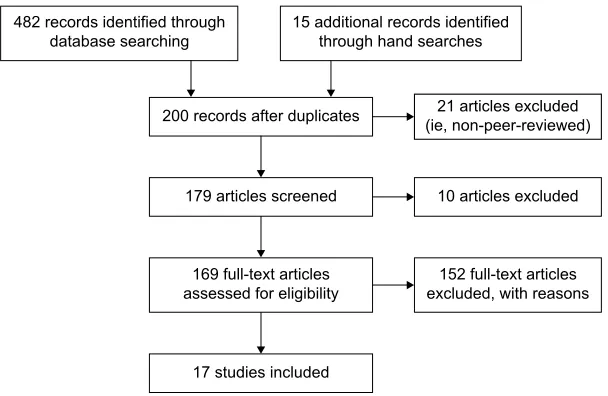
yielded two additional reviews, and hand searches of reference lists of later reviews (n=13) yielded eleven more. Following title and abstract reviews of retrieved papers, full-text papers were retrieved for 37 articles. The search and selection process are detailed in Figure 1.
Two of the authors then independently evaluated the retrieved full text articles against the following inclusion
Neuropsychiatric Disease and Treatment downloaded from https://www.dovepress.com/ by 118.70.13.36 on 25-Aug-2020
Dovepress AAC for children with autism
criteria: (1) a systematic search was conducted; (2) the review included one or more effect size metrics, with results reported in either aggregate form or for each included study, and/or a quality appraisal was conducted of included studies; (3) studies were of children with autism (up to 21 years, in line with the NAC6,7), or if other participant groups or older
individuals were included, results for children with autism could be extracted; and (4) all included studies addressed some aspect of the efficacy of AAC as an intervention or part of an intervention.
Results
Articles included and data extraction
Seventeen systematic reviews were included (with 100% agreement between authors). The aims, type of systematic review and effect size metric (if used), publication period of included studies, inclusion criteria, quality indicator or appraisal method, and key findings were extracted. This information is presented in Table 1, with studies organized according to key themes relating to review aims. These themes were (1) overall effectiveness of various types of AAC and comparison of effectiveness across variables (n=5); (2) evaluation of the AAC instructional package, Picture Exchange Communication System (PECS) (n=5); (3) effects on speech (n=2); (4) use of high technology, including SGD and newer mobile technologies of iPods®, iPads® (n=4); and
(5) partner instruction (n=1).
Quality indicators
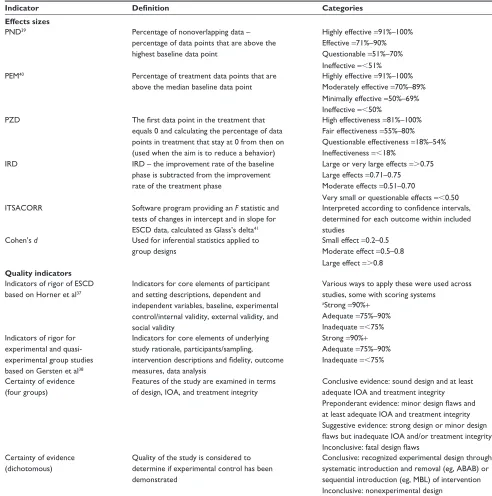
Most included reviews applied some measure of quality through appraisals that varied in detail: these are summa-rized in Table 2. These appraisals provided an evaluation of
the rigor of studies, thereby indicating the confidence with which outcomes could be attributed to the AAC intervention being investigated. Across the reviews, most studies were of experimental single case designs (ESCD), and in fact, seven reviews had this design as an inclusion criterion.19,20,22,26–28,36
Strategies to address the certainty of the evidence varied. In some reviews, only studies in which experimental control was demonstrated were included, thereby focusing on internal validity, such as through the type of design used.35 In other
reviews, studies were categorized according to the extent to which evidence was conclusive.34 More detailed appraisals,
such as those based on indicators of quality of ESCD37 or
group studies38 addressed internal validity and aspects of
external validity, with indicators taken from Horner et al37
including social validity. In five studies, certainty of evidence was not addressed directly19,28,36 or specific design features,
such as inclusion of treatment fidelity measures27 or broader
indicators, were simply noted.30
Information from reviews that did include some form of critical appraisal suggests that only few studies provided con-clusive results, with more providing evidence described as preponderant in one coding scheme: that is, based on studies with only minor flaws (Table 2). In some reviews, however, a large proportion of studies were evaluated as providing inconclusive results (eg, Schlosser and Koul32).
Measures of effect size
There was debate evident across reviews about the most appropriate means to measure effect size for ESCD. Ganz et al,19,20,28,36 for example, argued that the Improvement Rate
Difference index had advantages over the frequently used Percentage of Nonoverlapping Data points, including that it
IXOOWH[WDUWLFOHV H[FOXGHGZLWKUHDVRQV UHFRUGVLGHQWLILHGWKURXJK
GDWDEDVHVHDUFKLQJ DGGLWLRQDOUHFRUGVLGHQWLILHGWKURXJKKDQGVHDUFKHV
VWXGLHVLQFOXGHG UHFRUGVDIWHUGXSOLFDWHV
DUWLFOHVH[FOXGHG
IXOOWH[WDUWLFOHV DVVHVVHGIRUHOLJLELOLW\
DUWLFOHVVFUHHQHG
DUWLFOHVH[FOXGHG LHQRQSHHUUHYLHZHG
Figure 1 Flow chart of systematic search.
Neuropsychiatric Disease and Treatment downloaded from https://www.dovepress.com/ by 118.70.13.36 on 25-Aug-2020
Dovepress
iacono et al
Table 1
Summaries of included reviews
Study
Aims (review period)
Effect size indicator
Key findings
Overall effectiveness and comparison across variables Ganz et al
19
Meta-analysis of
eSCD for effects
of AAC on communication, social skills, and CB, and differences across age and autism diagnostic categories (1980–2008)
iRD
•
24 studies
•
Aided AAC: P
eCS, SGD, P
iC; key outcomes included requesting (n
=
13), social communication (n
=
4),
CB (n
=
4), vocalizations or speech (n
=
5), spelling (n
=
2), and word comprehension and production (n
=
1)
•
iRD across diagnostic groups: autism
= 0.83; autism + DD = 0.70; autism + multiple comorbidities = 0.53 •
iRD across age groups: preschool
= 0.86; elementary = 0.70; secondary = 0.64
Ganz et al
20
Meta-analysis of
eSCD studies of
individuals with autism for effects of AAC on communication, social skills, CB, and academic skills (1980–2008)
iRD
•
24 studies; 64% of children
•
Aided AAC: P
eCS, P
iC, SGD; key outcomes included requests (n
=
13), social communication (n
=
4),
CB (n
=
4), vocalizations or speech (n
=
5), spelling (n
=
2), use of SGD (n
=
2)
•
Using 84% C
i for
iRD: overall effects
=
0.99; communication
=
0.99; social skills
= 0.90, CB = 0.80; academic skills = 0.79 • Pe
CS and SGD
=
0.99; P
iCs
=
0.61
Gevarter et al
21
Systematic review of
eSCD and
group studies of individuals with developmental disabilities for AAC intervention component comparisons (2004–2012) eSCD: meeting or approaching mastery criterion; group studies – statistical significance
•
14 studies; seven of only autism; three with at least 50% autism
•
6/10 compared P
eCS to other AAC
•
Conclusive evidence: Phase
i– ii P eCS; P eCS + prompting +
video modeling; function-preferred mands in
Phases
i,
ii acquired more rapidly than non-function-preferred mands
•
Preponderant evidence: P
eCS
+
Braille more effective than P
eCS only for child with visual impairment;
pictures and photographs equal; 3/4 children more likely to use picture exchange for items with establishing operations; speech output, speech output with print, and print only effective for teaching spelling; function based more effective than non-function-based mands for setting generalization
•
All other comparisons were suggestive or inconclusive
Gevarter et al
22
Systematic review of
eSCD
studies of individuals with developmental disabilities for comparisons of AAC modalities and outcomes (2004–2012) Meeting or approaching mastery criterion
•
28 studies; 15 of only autism; three with autism and other disability groups
•
Conclusive evidence: P
eCS/other picture system and SGD equal effectiveness for stages
i &
ii P
eCS;
pictures and microswitch equal, pictures preferred; speech
+
sign more effective than speech only,
results in maintenance and generalization
•
Preponderant evidence: PECS/PIC vs SGD: PECS/PIC more effective and efficient (n
=
3) or no difference
(n
=
5) to SGD; preference for SGD (n
=
2), for P
eCS/P
iC (n
=
1); both microswitch and P
iC reduced CB,
preference for microswitch (n
=
1); P
eCS/P
iC vs sign: both effective (n
=
7), PECS more efficient (n
=
3);
more vocalizations with sign (n
=
3); SGD, P
iC, microswitch: equal (n
=
2), SGD, P
iC more effective (n
=
2),
SGD preferred (n
=
1), sign harder to maintain (n
=
1); SGD, P
iC, sign equal in effectiveness, sign less
efficient (n
=
3), preference for SGD (n
=
1), SGD better maintained (n
=
3); P
iC more effective than speech
(n
=
1); speech, sign, echoic model most efficient combined, result in maintenance and generalization (n
=
2)
•
All other comparisons were suggestive or inconclusive
Ganz et al
23
Meta-analysis of
eSCD studies
of individuals with autism for effectiveness of aided AAC to be moderated by research setting, type of AAC, and outcome variables (1980–2011)
iRD
•
35 studies
•
iRD across settings: home (n
=
11)
=
0.70; general education (n
=
5)
=
0.84; special education (n
=
17)
=
0.71;
therapy room (n
=
5)
=
0.66
•
iRD across AAC type/outcomes: P
eCS/communication (n
=
15)
=
0.73; SGD/communication (n
= 8) = 0.71; Pi Cs/communication (n = 7) = 0.58; P eCS/CB (n = 2) = 0.83; P
eCS/social skills (n
= 2) = 0.77; SGDs/academic skills (n = 2) =
0.66; SGD/CB (n
=
2)
=
0.83
Neuropsychiatric Disease and Treatment downloaded from https://www.dovepress.com/ by 118.70.13.36 on 25-Aug-2020
Dovepress AAC for children with autism
PECS Preston and Carter
24
Systematic review of
eSCD
and group studies of individuals with autism for efficacy of PECS (1992–2007)
eSCD: PND & P
eM
RCT: Cohen’s
d
•
27 studies; 24 of children only
•
eSCD (n
=
14): PND/P
eM calculated for 9, overall PND range
=
55.6–100 (mean
=
78.5), picture exchange
68.7–100 (mean
=
90.0); overall P
eM range
=
72.3–100; picture exchange 87.7–100 (mean
= 94.3) • RCT (n = 1): d =
0.63 for speech frequency; 0.50 for different words used
•
Other group studies (n
=
9): significant increases in communication behaviors
•
Maintenance data in five studies; three with positive findings
•
Generalization data in 15 studies, most with positive findings
Flippin et al
25
Systematic review of
eSCD and
group studies of children with autism for efficacy of PECS in terms of communication and speech outcomes (1994–2009)
eSCD:
iTSACORR
software, PND Group studies: inferential statistics
•
11 studies
•
Six studies taught to Stage
iii
, two to Stage
iv
, two to Stage
vii
, one not reported
•
eSCD (n
=
8): communication outcomes (n
= 7), iTSACORR range = 0.16–1.04 (mean = 0.51, 95%
CI [0.04–0.67]) indicating significant impact; PND range
=
64.4%–100% (mean
=
84.26%), indicating
fairly effective (
eS could not be determined n
=
2); speech outcomes (n
=
6),
eS range
=-1.45 to 0.26
(mean
=
0.17, 95% C
i [
-0.01 to 0.36]), PND range
=
6.5%–100% (mean
=
44.7%) indicating questionable
effectiveness (
eS not determined n
=
4)
•
Group studies (n
=
3): communication outcomes (n
=
3),
eS 0.95, 0.65 suggesting strong and moderate, but
inadequate quality (not determined n
=
1); speech outcomes (n
=
2),
eS
=
0.05, 0.57 (negligible)
•
General lack of maintenance and generalization data
Hart and Banda
26
Systematic review of
eSCD of
individuals with autism or other developmental disabilities for efficacy of PECS: communication, speech, CB, generalization, and social validity (1994–2007)
PND
•
13 studies, 10 of children with autism
•
PECS Phases taught: I in six studies, II in five, III in five, IV in two, III in three, VI in two
•
Mands taught to 90% of children with autism
•
Pe
CS compared to SGD (n
=
1) and sign (n
=
2), autism only
•
Communication outcomes: PND range
=
40%–100% (mean
=
83.8%, effective)
•
Reductions in CB (four children) PND range
=
53%–97% (mean
=
78.5, effective)
Tincani and Devis
27
Systematic review of
eSCD
studies of individuals with autism or other developmental disabilities for efficacy of PeCS: establishing functional communication and potential for interactions among learner and other variables (2002–2009)
PND
•
16 studies; 14 of children with autism
•
Phases
i–
iv
; PND mean
=
74.4 (SD
=
28.8)
•
Across all studies: PND preschool children
=
80.5, school age
=
71.3, adults
=
89.7; highest level mastered
was Phase
i for three participants,
ii for 6,
iii
for 20,
iv
for 8; relationships between PND and diagnosis,
sex, age, highest phase achieved, setting taught not significant
Ganz et al
28
Meta-analysis of
eSCD studies
of individuals with autism for efficacy of PECS: (a) Differentiated across learner age, diagnosis, phase mastered
(b)
Differentiated across target (use of P
eCS) and non-target
(CB, socialization, speech) (1980–2009)
iRD
•
13 studies
•
94 separate effect sizes,
iRD range = 0.49–0.62 (mean = 0.56) •
Targeted – mean
iRD
=
0.65 (0.59–0.73)
•
Non-targeted – mean
iRD
=
0.61 (CB), 0.73 (socialization), 0.37 (speech)
•
iRD across age groups for targeted/non-targeted: preschool
= 0.79/0.48; elementary = 0.60/0.44; secondary = 0.49/0.32 •
iRD across disability groups for targeted/non-targeted: autism
= 0.69/0.43; autism + DD = 0.59/0.64; autism + multiple disabilities = 0.44/none •
iRD across P
eCS phases for targeted/non-targeted: three phases
=
0.65/0.78; four phases
= 0.33/0.33; six phases = 0.84/0.45 ( Continued )
Neuropsychiatric Disease and Treatment downloaded from https://www.dovepress.com/ by 118.70.13.36 on 25-Aug-2020
Dovepress
iacono et al
Table 1
(
Continued
)
Study
Aims (review period)
Effect size indicator
Key findings
SGD van der Meer and Rispoli
29
Systematic review of
eSCD or
group studies of children with autism into the efficacy of SGD as part of intervention (up to September 2009)
None
•
23 studies (29 interventions)
•
Outcome to increase communication functions (mostly requests): seven conclusive, two inconclusive
•
Outcome to compare SGD to other AAC: four conclusive
•
Outcome to reduce CB: three conclusive
•
Outcome as use of device: one conclusive, two inconclusive
•
Other outcome: three conclusive, one inconclusive
•
15 studies used ABA principles, others used naturalistic strategies
•
20 studies – positive outcomes; seven included follow-up and 10 included generalization
Still et al
30
Systematic review of studies into efficacy of high-tech devices for children with autism: requesting skills (up to July 2013)
None
•
16 studies
•
iPod
® or iPad ® (n
=
5); P
eCS (n
=
7) manual signing (n
=
3) mostly as comparison modalities; others
used dedicated SGDs; the key outcome was requests (n
=
15) or requests and other communicative
behaviors
(n
=
1)
•
15 were
eSCD (mostly MBL)
•
14 studies included ABA teaching strategies; one used enhanced milieu teaching and one naturalistic intervention
•
Children learned from one to eight requests (mostly for preferred food or toys)
Lorah et al
31
Systematic review of efficacy of handheld tablets as SGDs for individuals with autism or other developmental disabilities (2007–2014)
None
•
17 studies; 12 of only children with autism, two studies mostly autism
•
effectiveness of SGD to teach requests (n
=
12 studies), labeling (n
=
1), other functions (n
=
1)
•
More requests using SGD for 2/3 children with autism (n
=
1)
•
Comparisons across modalities, better for SGD (n
=
9 children), better for P
iC or sign (n
=
4); preference
for SGD (n
=
17) and for P
iC (n
=
1)
Schlosser and Koul
32
Systematic review to map research of the efficacy of SGD interventions for individuals with autism or other developmental disabilities (up to 2014) eSCD: PND & PZD Group: Cohen’s
d
•
47 studies
•
effects of SGD as part of a treatment package (n
=
26): requesting (n
=
4), PND range
=
43–100
(mean
=
0.79, fairly effective; reduction in CB (n
=
2), PZD
=
0–100 (mean
=
0.69, fair effectiveness); speech
production PND
=
0 (2
eSCD),
eS
=
0.21–0.62 (1 RCT, small to medium)
•
SGD vs other AAC (n
=
16): one at least preponderant, PND for SGD
=
100, for comparison AAC
range
=
25–60
•
SGD with and without speech (n
=
5) three preponderant, PND for spelling or requesting using
speech
=
31–100 (mean
=
71), fairly effective; increasing child’s speech, ineffective
Effects on speech Millar et al
33
Systematic review to determine if AAC results in improved speech outcomes for individuals with developmental disabilities (1975–2003)
PND
•
23 studies, 31% of 67 participants with autism
•
Six studies demonstrated experimental control: four children with autism, aged 3–12 (mean
=
6), two
studies; PND for speech
=
21 for sign range
=
33–73 (mean
=
58) for aided (no speech output)
Schlosser and
w
endt
34
Systematic review to determine the effects of AAC on speech for children with autism (1975–2007) eSCD: PND RCT: Cohen’s
d
•
11 studies
•
eSCD (n
=
9): PND range
=
0–100 across speech outcomes, 4/21 fairly or highly effective; 17/21
ineffective; PND range
=
0–100 for AAC outcomes, 12/18 fairly or highly effective, four questionable or
ineffective, two not reported
•
Group (n
=
2): speech outcomes no differences across three sign and one speech only condition (n
=
1);
PECS resulted in significantly more nonimitative speech than a non-AAC condition (n
=
1)
Neuropsychiatric Disease and Treatment downloaded from https://www.dovepress.com/ by 118.70.13.36 on 25-Aug-2020
Dovepress AAC for children with autism
Partner training
Kent-w
alsh
et al
35
Meta-analysis of
eSCD of
individuals with autism or other disabilities for efficacy of partner instruction: communication of individuals who use AAC and differences across variables (up
to 2013)
iRD
•
17 studies, six of children with autism
•
Communication partners were peers for nine children and parents for eight children
•
iRD for communication turns range
=
0.21–1.0 across 12 children (mean
=
0.66); for picture
exchange
=
0. 80, 1.0, 1.0 for each of three children; requests 0.61, 0.83 for two children
•
iRD across all studies: SGD
=
0.95, very large effects, non-SGD
=
0.72, large effects; poorest effects for
adolescents, others yielded very large effects; participants with autism
=
0.69, moderate effects, compared
to very large for other disabilities
Abbreviations:
CB,
challenging
behaviors;
D
v
, dependent
variable;
eSCD,
experimental
single
case
designs;
iRD,
improvement
rate
difference;
iv
, independent
variable;
MBL,
multiple
baseline;
Pe
CS,
picture
exchange
communication
system;
Pi
C,
picture-based
communication
other
than
Pe
CS;
Pe
M,
percentage
of
data
points
exceeding
the
baseline
mean;
PND,
percentage
of
nonoverlapping
data;
PZD,
percentag
e
of
zero
data;
SGD,
speech
generating
devices;
RCT,
randomized controlled trial; CI, confidence interval; SD, standard deviation.
allowed confidence intervals to be determined. Regardless of the index used, effect sizes enabled the aggregation of outcomes across studies, as well as a means for evaluat-ing differential effects across variables, which have been reported in Table 1.
effectiveness of AAC
Even taking into consideration concerns about study quality, the evidence presented across reviews, as summarized in Table 1, indicates that, overall, AAC has been found to be effective to highly effective for children with autism accord-ing to the metrics applied (Table 2). The reviews included favored aided AAC, with most evidence supporting the use of PECS, a manualized instructional package for teaching individuals to exchange pictures for desired wants – that is, to learn to request (described by Flippin et al25) – and SGD
(including newer mobile tablets and other handheld devices), with evidence being weaker for other picture-based sys-tems or manual signs. In fact, studies of manual signs were included in systematic reviews only when compared to aided systems.22,26,31,33,34 It has been suggested that manual signs
may pose a number of challenges, including being difficult to produce in the presence of motor difficulties and reduced use of gestures and/or poor imitation skills seen in many children with autism.20,42 On the other hand, arguments that aided AAC
suits strengths in processing visual material26,28 have been
made because pictures provide a concrete representation to which a child can refer back.20 This premise was questioned
in a recent study, in which it was found that children with autism, unlike children with global developmental delays or without disability,43 did not show improved task performance
when asked to complete a series of short instructions under speech + pictures vs speech-only experimental conditions.
Effectiveness of AAC appears overwhelmingly to relate to teaching functional communication, with a focus on requests.20 As shown in Table 1, key targeted
out-comes were predominantly requests across the included reviews; this was particularly the case for studies of PECS, designed to teach requests through picture exchange.25
A tendency to target requests may reflect the relative ease with which they can be taught to children with autism in light of their strengths in behavioral regulation (ie, commu-nication to gain desired objects or actions, usually through requests), as opposed to deficits in social interaction.1
In particular, much research has focused on the efficacy of PECS, designed specifically for children with autism (Table 1). Aggregation of data through meta-analysis indicates that the first three stages of PECS are effective
Neuropsychiatric Disease and Treatment downloaded from https://www.dovepress.com/ by 118.70.13.36 on 25-Aug-2020
Dovepress
iacono et al
Table 2 effect size and quality indicators
Indicator Definition Categories
Effects sizes
PND39 Percentage of nonoverlapping data –
percentage of data points that are above the highest baseline data point
Highly effective =91%–100%
effective =71%–90%
Questionable =51%–70%
ineffective =,51%
PeM40 Percentage of treatment data points that are
above the median baseline data point
Highly effective =91%–100%
Moderately effective =70%–89%
Minimally effective =50%–69%
ineffective =,50%
PZD The first data point in the treatment that
equals 0 and calculating the percentage of data points in treatment that stay at 0 from then on (used when the aim is to reduce a behavior)
High effectiveness =81%–100%
Fair effectiveness =55%–80%
Questionable effectiveness =18%–54%
ineffectiveness =,18%
iRD iRD – the improvement rate of the baseline
phase is subtracted from the improvement rate of the treatment phase
Large or very large effects =.0.75
Large effects =0.71–0.75
Moderate effects =0.51–0.70
very small or questionable effects =,0.50
iTSACORR Software program providing an F statistic and
tests of changes in intercept and in slope for
eSCD data, calculated as Glass’s delta41
Interpreted according to confidence intervals, determined for each outcome within included studies
Cohen’s d Used for inferential statistics applied to
group designs
Small effect =0.2–0.5
Moderate effect =0.5–0.8
Large effect =.0.8
Quality indicators
indicators of rigor of eSCD
based on Horner et al37
indicators for core elements of participant and setting descriptions, dependent and independent variables, baseline, experimental control/internal validity, external validity, and social validity
various ways to apply these were used across studies, some with scoring systems
aStrong =90%+
Adequate =75%–90%
inadequate =,75%
indicators of rigor for experimental and quasi-experimental group studies
based on Gersten et al38
indicators for core elements of underlying study rationale, participants/sampling, intervention descriptions and fidelity, outcome measures, data analysis
Strong =90%+
Adequate =75%–90%
inadequate =,75%
Certainty of evidence (four groups)
Features of the study are examined in terms of design, iOA, and treatment integrity
Conclusive evidence: sound design and at least adequate iOA and treatment integrity Preponderant evidence: minor design flaws and at least adequate iOA and treatment integrity Suggestive evidence: strong design or minor design flaws but inadequate IOA and/or treatment integrity Inconclusive: fatal design flaws
Certainty of evidence (dichotomous)
Quality of the study is considered to determine if experimental control has been demonstrated
Conclusive: recognized experimental design through systematic introduction and removal (eg, ABAB) or sequential introduction (eg, MBL) of intervention inconclusive: nonexperimental design
Note:aindicates these categories used only by Flippin et al,25 others applied the indicators more descriptively.
Abbreviations: PND, percentage of nonoverlapping data; PeM, percentage of data points exceeding the baseline mean; PZD, percentage of zero data; iRD, improvement rate difference; iOA, inter-observer agreement; eSCD, experimental single case designs; MBL, multiple baseline.
to highly effective in teaching children to request preferred items.24–27 In stages IV and V of PECS, the use of requests
in multiword utterances is targeted, with other communi-cative functions not introduced until the final stage VI.25
Ganz et al28 found large effects for the only two included
studies in their review in which all stages were taught, but improvement rate differences ranged from 0.15 to 0.94, indicating some effects were questionable (Table 2).
AAC has also been found effective for reducing challeng-ing behaviors.20,21,26,28,29,32,36 Interventions reported in Table 1
were of functional communication training, in which AAC was taught as a replacement behavior.1 In addition, reduction
in challenging behavior has been examined as a nontargeted, but rather collateral outcome, again with the rationale that AAC would provide a functional behavior as a replacement (eg, Ganz et al28).
Neuropsychiatric Disease and Treatment downloaded from https://www.dovepress.com/ by 118.70.13.36 on 25-Aug-2020
Dovepress AAC for children with autism
In many reviews, speech as an outcome, but usually not as a primary target of intervention, was examined. Results point mostly to negligible or small effects.25,28,32 The two
reviews focused on speech outcomes were motivated by a concern often expressed in AAC literature about the potential for AAC to impede speech development, as well as a desire to investigate the potential for speech to be enhanced.33,34
These reviews indicate variable outcomes, with Schlosser and Wendt34 finding that, for individuals with autism,
although modest gains in speech could not be attributable directly to AAC intervention, there was no evidence of loss of speech skills.
Discussion
Reconciling evidence from the fields of
AAC and autism
The finding of the NAC6,7 that AAC is an emerging area,
only, appears at odds with the findings from the 17 reviews presented here, even considering differences in publica-tion periods captured: the most recent reviews in Table 1 included studies published in 2014;31,32 the NAC reviews
were completed for two time periods, the first ending 2007,6
and the second covering 2007–2012.7 The main difference
appears to be that studies that incorporated AAC as a com-ponent or primary part of the intervention were not grouped together as AAC interventions, but rather according to the categories of AAC devices (ie, low- and high-tech aids, including SGD, with 14 studies published from 1983 to 2007 included), and PECS (ie, this was treated separately from other aided AAC, with 13 studies published from 1994 to 2007 included), and sign instruction (with 11 studies pub-lished from 1976 to 2004 included). These were all judged to be emerging interventions in the first report,6 with further
research reviewed for the second report failing to result in changing the classification for any of these forms of AAC to established interventions.7
In the current review, the number of studies judged as lacking rigor or to be of overall poor quality is perhaps further evidence of the emerging status of AAC. On the other hand, closer inspection of studies that contributed to classifying some interventions as established in the first NAC report6
reveal some included the use of AAC as part of intervention protocols. In studies of functional communication training, a type of behavioral package6 (established), for example,
were the use of signs and picture systems,44 and
high-tech devices45 as replacements for problem (challenging)
behaviors. Schedules, also an established intervention,6 are
the use of task lists, often in the form of pictures (ie, AAC),
to support comprehension and learning within structured activities (eg, Dettmer et al46). Finally, studies incorporating
AAC were also considered by the NAC in determining that naturalistic teaching strategies were established.47
Regardless of the form of AAC used, interventions are multicomponent, with effective implementation requiring considerations beyond the actual modality or system used. Hence, although there have been many attempts to compare across types of AAC, the system used is part of an interven-tion only. Pictures used in PECS, for example, comprise one component of a comprehensive instructional package that draws on applied behavior analysis (ABA), which has a strong research base,6 implemented in a natural context.24
Lorah et al31 argued that intervention needs to address both
learning how to use these AAC systems, including the newer technologies of iPods® and iPads®, as well as how to
commu-nicate effectively and efficiently with them. van der Meer and Rispoli29 suggested that, in addition to behavioral approaches,
greater use of naturalistic strategies that take advantage of incidental teaching moments, environmental arrangement, and following the child’s lead might help extend communica-tion to a range of funccommunica-tions beyond requests, including joint attention and social interactions.
A concern expressed both in the AAC and the autism literature has been the reliance on interventionists highly skilled in the teaching approaches used, resulting in potential problems in translating evidence into real-world settings. Tincani and Devis,27 for example, suggested that
improvements gained through teaching PECS may fail to maintain or generalize to new communication partners and settings once highly skilled researchers, who implement many and complex teaching strategies, have completed their research. Only one review focused on training people in a child’s social environment to support the use of AAC, which indicated varying levels of success across studies.35
Some studies did show strong effects, with perhaps greater potential for maintenance than when outcomes rely solely on highly skilled intervention agents, usually researchers. Within the autism literature, there is an emerging focus on training parents to implement evidence-based interventions, such as those based on ABA, or a combination of ABA and naturalistic teaching strategies.48 Furthermore, incorporating
AAC into an approach combining established interventions and delivered by parents has been shown to be effective in improving the communication skills of young children with autism.49 However, as in the AAC literature, a recent autism
evidence update50 indicated that more research is needed to
determine if approaches considered established or emerging
Neuropsychiatric Disease and Treatment downloaded from https://www.dovepress.com/ by 118.70.13.36 on 25-Aug-2020
Dovepress
iacono et al
by the NAC6,7 prove to be as effective when parents are
trained to deliver them.
Clinical implications
A goal of the NAC was to provide families, teachers, and other professionals supporting children with autism clear guidance for selecting evidence-based interventions.6,7 This
task appears challenging in light of the large and diverse evidence bases in AAC and autism, with studies of vari-able quality, in addition to differences in the role assigned to various forms of AAC across the fields. In addition, the heterogeneity evident across children with autism further complicates attempts to take an evidence-based approach to intervention.
It has been suggested that there is now sufficient evi-dence that early and intensive intervention can ameliorate skill deficits and, thereby, ensure that children with autism will enjoy academic success.50 In particular, in the last few
years there has been an increase in randomized controlled trials (RCTs), considered to provide more robust evidence for both treatment effects and their potential to generalize to the population from which samples have been drawn, than can be provided using ESCD.50 A review of this more
recent research by Smith and Iadarola50 provides further
sup-port for the findings by the NAC in terms of interventions considered established, emerging, or questionable.6,7 The
extent to which this research base, as well as that for AAC, as reviewed here, can inform intervention in real-world set-tings would seem to be complicated by limitations of even robust research designs.
A problem with RCTs is the need to obtain homogeneous samples, a challenge that has seen the proliferation of ESCD in both AAC1 and autism50 research. The results of group
studies suggest that individual differences across participants may be lost in group means, although measures of variance or the reporting of individual data can reveal that some chil-dren may fail to benefit from interventions found effective for others.43 Parents and practitioners would benefit from the
reporting of subgroup analyses of intervention outcomes so that treatment effects for children with the most complex communication needs can be evaluated. As a result of the extent and complexity of their social, communication, and behavioral needs, these children face challenges in achieving the rapid and consistent progress that may be attainable only by children with lesser difficulties. More detailed reporting of individual variations in intervention performance might avoid masking poor results for children with severe disability. Such reporting would provide better indicators of the quality, quantity, and consistency of evidence for intervention effects.
Individual patterns of learning are readily discernible in ESCD, an alternative to RCTs, and therefore make compari-son with a child for whom a practitioner may be considering the intervention an easier task. Further, Smith and Iadarola50
noted that child variables, including preintervention IQ, age, functional language, and play, as well as intervention vari-ables, such as treatment intensity or whether pure or eclectic approaches are used, may influence outcomes. It is these potential influences that have relevance in implementing the findings from research reviews to practice.
In light of these complex issues, families and practitio-ners may do well to adopt an eclectic approach. Use of AAC may prove useful when extended beyond the fairly focused aim of teaching basic communication skills, particularly requests.1,29 Promises that AAC can support ongoing language
development12 have yet to be demonstrated convincingly for
children with autism, but may be more likely if integrated into comprehensive interventions that combine evidence-based approaches, such as those using ABA and naturalistic teaching strategies in everyday contexts, as in Pivot Response Training11 and the ESDM.10 Developers of the ESDM, in
sug-gesting that AAC be considered only when a child has failed to demonstrate progress in spoken language,10 may see AAC
as a last-resort intervention. This approach could increase the potential for learned helplessness, challenging behavior, and missed learning opportunities. Rather, incorporating AAC into early interventions might avoid or reduce these problems. In particular, the use of visual supports, and other forms of AAC within a child’s learning environments, has been sug-gested as good practice.50 Even children who demonstrate
increasing spoken language skills stand to benefit from the additional supports that could assist with comprehension and extending language skills. For those who may not make use of visual stimuli for learning,43 providing AAC within
child-led naturalistic teaching situations is unlikely to impede learning, including of speech.33,34
The underlying tenets of AAC research are that commu-nication is multimodal and that individuals differ in terms of those modalities that may best suit their learning needs and preferences.12 The reliance on aided AAC has resulted
in few studies including sign as a component of instruction or as a communication modality. Sign models provided within naturalistic teaching could play a valuable role for children with autism, including extending vocabulary across situations.51 Systematic reviews have tended to include only
very early manual sign studies6 or those in which signs have
been compared to aided systems (Table 1). Although some studies have demonstrated better outcomes using aided AAC, Gevarter et al found that (1) signs combined with
Neuropsychiatric Disease and Treatment downloaded from https://www.dovepress.com/ by 118.70.13.36 on 25-Aug-2020
Dovepress AAC for children with autism
speech were more effective than speech alone in increasing communication; (2) signs were more likely to result in maintenance and generalization; and (3) in comparison to PECS, signs were as effective, while being associated with more vocalizations. Such findings demonstrate the value of considering individual differences, both in terms of explor-ing the evidence base, and makexplor-ing various AAC modalities available. The provision of models using both signs and symbols on aids, for example, could maximize the potential to meet individual child learning needs and preferences. Furthermore, although it has been suggested that reduced fine motor, gesture, and imitation skills in children with autism may, to some extent, preclude the use of signing,20,42
manual sign instruction may in fact provide a highly salient and ecologically valid communication context in which to target these skills.
Future directions
In light of the potential for individual differences across children with autism to influence the success of both estab-lished and emerging interventions, research that provides details of participant characteristics would seem a priority. Of the reviews included here, most provided details of children’s age and diagnosis, but only two addressed com-munication skills of children at the start of intervention. Schlosser and Wendt34 included only studies in which
par-ticipants lacked functional speech, but no information was provided about comprehension ability. In studies included by Hart and Banda,26 children with autism were described as
having limited expressive language, limited speech, being nonverbal, using only 1–2 word phrases, using a few signs, or demonstrating some vocal imitation prior to intervention. Such varied descriptions fail to provide information about possible outcome predictors for children whose commu-nication profiles vary dramatically in terms of underlying linguistic ability and social communication.52
The potential for AAC to support ongoing language development is reliant on moving children beyond simple requests. The extent of research into the effectiveness of AAC in increasing requests in children with autism seems to warrant a meta-analysis.32 While such a review may further
understanding of the most effective and efficient strategies to enhance communication for behavior regulation, there appears to be a greater need to evaluate eclectic teaching strategies in real-world environments that incorporate AAC as a means of addressing deficits in social-communication. Research into comprehensive and intensive programs, such as the ESDM,53 modified by incorporating various forms of
AAC, would help build evidence for effective intervention
for children with variable skill profiles and learning needs.12,43
In this way, AAC, when integrated with established interven-tions, which start early,50 could provide more socially valid
outcomes than have been demonstrated to date for children with autism.
Conclusion
Extensive research across the fields of AAC and autism provides a strong evidence base to inform decisions about how and when to intervene to ensure optimal communication support for children with autism. Yet this evidence base lacks the detail needed to determine the potential for successful outcomes for children with the most significant learning needs, including those who are minimally verbal, following even those interventions with the strongest empirical sup-port. A tendency to ignore the role of AAC or relegate it to a last-resort strategy for children who fail to show progress may be a response by autism researchers to an apparent nar-row focus of AAC research. Achieving meaningful changes in the developmental trajectories of children with autism requires comprehensive and intensive approaches that have been based on a solid research foundation. AAC has a role in such approaches, but future research that broadens the lens beyond immediate communication targets, while also addressing the learning needs of children with the most severe and complex disabilities is required to converge research across autism and AAC fields.
Acknowledgment
David Trembath is supported by a National Health and Medi-cal Research Council ECR Fellowship (GNT1071811).
Disclosure
The authors report no conflicts of interest in this work.
References
1. Ganz JB. AAC Interventions for individuals with autism spectrum disorders: state of the science and future research directions. Augment Altern Commun. 2015;31(3):203–214.
2. Rose V, Trembath D, Keen D, Paynter J. The proportion of minimally ver-bal children with autism spectrum disorder in a community-based early intervention programme. J Intellect Disabil Res. 2016;60(5):464–477. 3. Iacono T, Johnson H, Forster S. Supporting the participation of
adoles-cents and adults with complex communication needs. In: Mirenda P, Iacono T, editors. Autism Spectrum Disorders and AAC. Baltimore, MD: Paul H Brookes; 2009:443–478.
4. Schuler A, Baldwin M. Nonspeech communication and childhood autism.
Lang Speech Hear Ser Schools. 1981;12:246–257.
5. Mirenda P. Autism, augmentative communication and assistive technol-ogy: what to we really know? Focus Autism Other Dev Disabil. 2001;16: 141–151.
6. National Autism Center. National Autism Center National Standards Report. Randolph, MA: National Autism Center; 2009. Available from: http://www.nationalautismcenter.org/reports/. Accessed March 3, 2016.
Neuropsychiatric Disease and Treatment downloaded from https://www.dovepress.com/ by 118.70.13.36 on 25-Aug-2020
Dovepress
iacono et al
7. National Autism Center. Findings and Conclusions: National Autism Center National Standards Project, Phase 2. Randolph, MA: National Autism Center; 2015. Available from: http://www. nationalautismcenter.org/national-standards-project/results-reports/. Accessed March 3, 2016.
8. Wendt O. Research on the use of manual signs and graphic symbols in autism spectrum disorders: a systematic review. In: Mirenda P, Iacono T, editors. Autism Spectrum Disorders and AAC. Baltimore, MD: Paul H. Brookes; 2009:83–140.
9. Mirenda P, Brown K. A picture is worth a thousand words: using visual supports for augmented input with individuals with autism. In: Mirenda P, Iacono T, editors. Autism Spectrum Disorders and AAC. Baltimore, MD: Paul H. Brookes; 2009:303–332.
10. Rogers SJ, Dawson G. Early Start Denver Model for Young Children with Autism: Promoting language, learning, and engagement. New York, NY: Guilford Press; 2010.
11. Koegel RL, O’Dell MC, Koegel LK. A natural language teaching paradigm for nonverbal autistic children. J Autism Dev Disord. 1987; 17(2):187–200.
12. Romski M, Sevcik RA, Barton-Hulsey A, Whitmore AS. Eary inter-vention in AAC: what a difference 30 years makes. Augment Altern Commun. 2015;31(3):181–202.
13. Schlosser R, Raghavendra P. Evidence-based practice in augmenta-tive and alternaaugmenta-tive communication. Augment Altern Commun. 2004; 20(1):1–21.
14. Schlosser R, Lee D. Promoting generalization and maintenance in aug-mentative and alternative communication: a meta-analysis of 20 years of effectiveness research. Augment Altern Commun. 2000;16(4): 208–226.
15. Schlosser R. Social validation of interventions in augmentative and alternative communication. Augment Altern Commun. 1999;15(4): 234–247.
16. Howlin P, Magiati I, Charman T. Systematic review of early intensive behavioral interventions for children with autism. Am J Intellect Dev Disabil. 2009;114(1):23–41.
17. Greenhalgh T, Peacock R. Effectiveness and efficiency of search methods in systematic reviews of complex evidence: audit of primary sources. BMJ.2005;331(7524):1064–1065.
18. Schlosser RW, Balandin S, Hemsley B, Iacono T, Probst P, von Tetzchner S. Facilitated communication and authorship: a systematic review. Augment Altern Commun. 2014;30(4):359–368.
19. Ganz JB, Earles-Vollrath TL, Mason RA, Rispoli MJ, Heath AK, Parker RI. An aggregate study of single-case research involving aided AAC: participant characteristics of individuals with autism spectrum disorders. Res Autism Spectr Disord. 2011;5(4):1500–1509. 20. Ganz JB, Earles-Vollrath TL, Heath AK, Parker RI, Rispoli MJ,
Duran JB. A meta-analysis of single case research studies on aided aug-mentative and alternative communication systems with individuals with autism spectrum disorders. J Autism Dev Disord. 2012;42(1):60–74. 21. Gevarter C, O’Reilly MF, Rojeski L, et al. Comparisons of
interven-tion components within augmentative and alternative communicainterven-tion systems for individuals with developmental disabilities: a review of the literature. Res Dev Disabil. 2013;34(12):4404–4414.
22. Gevarter C, O’Reilly MF, Rojeski L, et al. Comparing communi-cation systems for individuals with developmental disabilities: a review of single-case research studies. Res Dev Disabil. 2013;34(12): 4415–4432.
23. Ganz JB, Rispoli MJ, Mason RA, Hong ER. Moderation of effects of AAC based on setting and types of aided AAC on outcome variables: an aggregate study of single-case research with individuals with ASD.
Dev Neurorehabil. 2014;17(3):184–192.
24. Preston D, Carter M. A review of the efficacy of the picture exchange communication system intervention. J Autism Dev Disord. 2009;39(10): 1471–1486.
25. Flippin M, Reszka S, Watson LR. Effectiveness of the Picture Exchange Communication System (PECS) on communication and speech for children with autism spectrum disorders: a meta-analysis. Am J Speech Lang Pathol. 2010;19(2):178–195.
26. Hart SL, Banda DR. Picture exchange communication system with individuals with developmental disabilities: a meta-analysis of single subject studies. Remed Spec Educ. 2010;31(6):476–488.
27. Tincani M, Devis K. Quantitative synthesis and component analysis of single-participant studies on the picture exchange communication system. Remed Spec Educ. 2011;32(6):458–470.
28. Ganz JB, Davis JL, Lund EM, Goodwyn FD, Simpson RL. Meta-analysis of PECS with individuals with ASD: investigation of targeted versus non-targeted outcomes, participant characteristics, and imple-mentation phase. Res Dev Disabil. 2012;33(2):406–418.
29. van der Meer LA, Rispoli M. Communication interventions involving speech-generating devices for children with autism: a review of the literature. Dev Neurorehabil. 2010;13(4):294–306.
30. Still K, Rehfeldt RA, Whelan R, May R, Dymond S. Facilitating request-ing skills usrequest-ing high-tech augmentative and alternative communication devices with individuals with autism spectrum disorders: a systematic review. Res Autism Spectr Disord. 2014;8(9):1184–1199.
31. Lorah ER, Parnell A, Whitby PS, Hantula D. A systematic review of tablet computers and portable media players as speech generating devices for individuals with autism spectrum disorder. J Autism Dev Disord. 2014;45(12):3792–3804.
32. Schlosser RW, Koul RK. Speech output technologies in interventions for individuals with autism spectrum disorders: a scoping review. Augment Altern Commun. 2015;31(4):285–309.
33. Millar DC, Light JC, Schlosser RW. The impact of augmentative and alternative communication intervention on the speech production of individuals with developmental disabilities: a research review. J Speech Lang Hear Res. 2006;49(2):248–264.
34. Schlosser RW, Wendt O. Effects of augmentative and alternative communication intervention on speech production in children with autism: a systematic review. Am J Speech Lang Pathol. 2008;17(3): 212–230.
35. Kent-Walsh J, Murza KA, Malani MD, Binger C. Effects of communication partner instruction on the communication of individu-als using AAC: a meta-analysis. Augment Altern Commun. 2015;31(4): 271–284.
36. Ganz JB, Mason RA, Goodwyn FD, Boles MB, Heath AK, Davis JL. Interaction of participant characteristics and type of AAC with individu-als with ASD: a meta-analysis. Am J Intellect Dev Disabil. 2014;119(6): 516–535.
37. Horner RH, Carr EG, Halle J, McGee G, Odom S, Wolery M. The use of single-subject research to identify evidence-based practice in special education. Except Child. 2005;71(2):165–179.
38. Gersten R, Fuchs LS, Compton D, Coyne M, Greenwood C, Innocenti MS. Quality indicators for group experimental and quasi-experimental research in special education. Except Child. 2005;71(2): 149–164.
39. Scruggs T, Mastropieri MA. Summarizing single-subject research: issues and applications. Behav Modif. 1998;22:221–242.
40. Ma HH. An alternative method for quantitative synthesis of single-subject researches: percentage of data points exceeding the median.
Behav Modif. 2006;30(5):598–617.
41. Maughan DR, Christiansen E, Jenson WR, Olympia D, Clark E. Behavioral parent training as a treatment for externalizing behaviors and disruptive behavior disorders: a meta-analysis. School Psychol Rev. 2005;34(3):267–286.
42. Rose V, Trembath D, Bloomberg K. Visual attention and key word sign in children with autism spectrum disorder. J Dev Phys Disabil. 2016; 28(1):33–55.
43. Trembath D, Vivanti G, Iacono T, Dissanayake C. Accurate or assumed: visual learning in children with ASD. J Autism Dev Disord. 2015; 45(10):3276–3287.
44. Brown KA, Wacker DP, Derby KM, et al. Evaluating the effects of functional communication training in the presence and absence of establishing operations. J Appl Behav Anal. 2000;33(1):53–71. 45. Durand VM. Functional communication training using assistive devices:
recruiting natural communities of reinforcement. J Appl Behav Anal. 1999;32(3):247–267.
Neuropsychiatric Disease and Treatment downloaded from https://www.dovepress.com/ by 118.70.13.36 on 25-Aug-2020
Neuropsychiatric Disease and Treatment
Publish your work in this journal
Submit your manuscript here: http://www.dovepress.com/neuropsychiatric-disease-and-treatment-journal
Neuropsychiatric Disease and Treatment is an international, peer-reviewed journal of clinical therapeutics and pharmacology focusing on concise rapid reporting of clinical or pre-clinical studies on a range of neuropsychiatric and neurological disorders. This journal is indexed on PubMed Central, the ‘PsycINFO’ database and CAS,
and is the official journal of The International Neuropsychiatric Association (INA). The manuscript management system is completely online and includes a very quick and fair peer-review system, which is all easy to use. Visit http://www.dovepress.com/testimonials.php to read real quotes from published authors.
Dovepress
Dovepress
AAC for children with autism46. Dettmer S, Simpson RL, Myles BS, Ganz JB. The use of visual supports to facilitate transitions of students with autism. Focus Autism Other Dev Disabil. 2000;15(3):163–169.
47. Hamilton B, Snell M. Using the milieu approach to increase spontaneous communication book use across environments by an adolescent with autism. Augment Altern Commun. 1993;9:259–272.
48. Strauss K, Mancini F, Fava L. Parent inclusion in early intensive behavior interventions for young children with ASD: a synthesis of meta-analyses from 2009 to 2011. Res Dev Disabil. 2013;34(9):2967–2985. 49. Hemmeter ML, Kaiser A. Enhanced milieu teaching: effects of
parent-implemented language intervention. J Early Intervention. 1994; 18(3):269–289.
50. Smith T, Iadarola S. Evidence base update for autism spectrum disorder.
J Clin Child Adolesc Psychol. 2015;44(6):897–922.
51. Tan XY, Trembath D, Bloomberg K, Iacono T, Caithness T. Acquisition and generalization of key word signing by three children with autism.
Dev Neurorehabil. 2014;17(2):125–136.
52. Tager-Flusberg H, Kasari C. Minimally verbal school-aged children with autism spectrum disorder: the neglected end of the spectrum.
Autism Res. 2013;6(6):468–478.
53. Dawson G, Rogers S, Munson J, et al. Randomized, controlled trial of an intervention for toddlers with autism: the early start denver model.
Pediatrics. 2010;125(1):e17–e23.
Neuropsychiatric Disease and Treatment downloaded from https://www.dovepress.com/ by 118.70.13.36 on 25-Aug-2020