IJSRR, 8(1) Jan. – Mar., 2019 Page 1833
Research article
Available online www.ijsrr.org
ISSN: 2279–0543
International Journal of Scientific Research and Reviews
A Comparative Study of Normal, Conditional, Special Type and New
Screening Procedure on Double Sampling Plan
D Manjula
Department of Statistics, PSG College of Arts & Science, Coimbatore – 641014 Email: [email protected] Mobile : 9994145662
ABSTRACT
Every industry gives much attention for the improvement of quality of products. Acceptance sampling is an inspection procedure used to determine whether to accept or reject the specific quantity of material. In recent scenario most of the industries are adopting the TQM concepts and Six sigma in order to have zero percent defective and to ensure the quality of the product for the customer satisfaction. In many companies, the rely on the inspection of the incoming items especially raw materials. Sampling plans are playing most important role for the inspection of products from the raw material to finished products in the industry. The sampling plans pressurize and protect both the producer and consumer. This paper presents the review of the procedure for the construction and selection of Double Sampling plan Special Type of DSP, Conditional DSP and NSDSP. From the review of all type of DSP, this paper reviews some major principles, Implementation and Operating Characteristic Curve for the good determination of acceptance sampling. Comparative study based on OC and Table values to be determined.
KEY WORDS:
Acceptance Sampling, DSP, STDSP, CDSP, NSDSP and OC function.*Corresponding author
D Manjula
Research Scholar
Department of Statistics, PSG College of Arts & Science, Coimbatore – 641014
IJSRR, 8(1) Jan. – Mar., 2019 Page 1834
1.
INTRODUCTION
A sampling plan in which a decision about the acceptance or rejection of a lot is based on two samples that have been inspected is known as a double sampling plan.
The double sampling plan is used when a clear decision about acceptance or rejection of a lot cannot be taken on the basis of a single sample. In double sampling plan, generally, the decision of acceptance or rejection of a lot is taken on the basis of two samples. If the first sample is bad, the lot may be rejected on the first sample and a second sample need not be drawn. If the first sample is good, the lot may be accepted on the first sample and a second sample is not needed. But if the first sample is neither good nor bad and there is a doubt about its results, we take a second sample and the decision of acceptance or rejection of a lot is taken on the basis of the evidence obtained from both the first and the second samples.
A double sampling plan requires the specification of four quantities which are known as its parameters. These parameters are
n1 – size of the first sample,
c1 – acceptance number for the first sample,
n2 – size of the second sample, and
c2 – acceptance numbers for both samples combined.
2.
REVIEW OF DOUBLE SAMPLING PLAN
There are number of tables available to design a double sampling plan including Dodge and Roming (1959) which provide Double sampling plans with minimum Average Total Inspection1 The performance measures of double sampling plan can be seen in Schilling (1982)2.. Duncan (1986) has provided a compilation of Poisson Unity and operating ratio p2 /p1 values for the Double sampling
plans3 taken from the tables of US Army Chemical Corps Engineering Agency (1953)4.. Hald (1981) has constructed tables for single and double sampling plans with the fixed 5% procedures and 10% consumer's risks Guenther (1970)developed a trial and error procedure for finding double sampling plans for given (p1,1-α) and (p2 ,β)5.
Schilling and Johnson (1980) have developed a table for the construction and evaluation of matched sets of single, double and multiple sampling plans6. Muthuraj (1988) constructed tables based on the Poisson distribution for selecting a double sampling plan for a given (p0 , ho ) or (p*,
IJSRR, 8(1) Jan. – Mar., 2019 Page 1835
and Manjula (2018) Constructed a New Screening Procedure on Double Sampling Plan indexed by OC11.
3. IMPLEMENTATION OF DOUBLE SAMPLING PLAN
Suppose, lots of the same size, say N, are received from the supplier or the final assembly line and submitted for inspection one at a time. The procedure for implementing the double sampling plan to arrive at a decision about the lot is described in the following steps:
Step 1:Draw a random sample (first sample) of size n1 from the lot received from the supplier
or the final assembly.
Step 2: Inspect each and every unit of the sample and classify it as defective or non-defective. At the end of the inspection, count the number of defective units found in the sample.Suppose the number of defective units found in the first sample is d1.
Step 3: Compare the number of defective units (d1) found in the first sample with the stated
acceptance numbers c1 and c2.
Step 4: Take the decision on the basis of the first sample as follows:
3.1 Under acceptance sampling plan
If the number of defective units (d1) in the first sample is less than or equal to the stated
acceptance number (c1) for the first sample, i.e., if d1≤ c1, we accept the lot and if d1 > c2, we
reject the lot. But if c1 < d1≤ c2, the first (single) sample is failed.
3.2 Under rectifying sampling plan
If d1 ≤ c1, we accept the lot and replace all defective units found in the sample by
non-defective units. If d1 > c2, we accept the lot after inspecting the entire lot and replacing all defective
units in the lot by non-defective units. But if c1 < d1≤ c2, the first (single) sample is failed.
Step 5: If c1 < d1≤ c2, we draw a second random sample of size n2 from the lot.
Step 6: Inspect each and every unit of the second sample and count the number of defective units found in it. Suppose the number of defective units found in the second sample is d2.
Step 7: Combine the number of defective units (d1 and d2) found in both samples and consider d1 +
d2 for taking the decision about the lot on the basis of the second sample as follows:
3.3 Under acceptance sampling plan
If d1 + d2≤ c2, we accept the lot and if d1 + d2 > c2, we reject the lot.
3.4Under rectifying sampling plan
If d1 + d2≤ c2, we accept the lot and replace all defective units found in the second sample by
non-defective units. If d1 + d2 > c2, we accept the lot after inspecting the entire lot and replacing all
IJSRR, 8(1) Jan. – Mar., 2019 Page 1836
4. REVIEW OF CONDITIONAL DOUBLE SAMPLING PLAN
Vijayaraghavan (1990) has provided procedures and tables for the selection of conditional double sampling plans with various entry parameters. A search procedure is developed to determine the parameters of the plans when two points on the OC curve are specified. Baker and Brobst (1978) proposed conditional sampling procedures which are similar in structure to double sampling. These conditional double sampling procedures have operating characteristic (OC) curves identical to those of comparable double sampling procedures. Conditional double sampling is operationally different from double sampling in that the results of the second sample, if required, are obtained from a related lot and not from the current lot. According to Baker and Brobst (1978), using sample information from related lots results in more attractive OC curves and smaller sample sizes. This reduction in sample size is the principal advantage of these procedures over traditional sampling procedures.
5. IMPLEMENTATION OF CONDITIONAL DOUBLE SAMPLING PLAN
In Conditional double sampling plan by attributes the lot acceptance procedure is characterizes by the parameters N, n1 , n2 , c1 , c2 and c3 The operating procedure for a conditional
double sampling plan is given below:
1. Select a random sample size n (=n1 = n2) from a lot of size "N‘
2. Inspect all the articles included in the sample. Let ‘d1’ be the number of defectives in the
sample.
3. If d1< c1, accept the lot
4. 4.If d1> c3, reject the lot.
5. If c1 +1< d1 < c3, take a second sample of size ‘n2' from the remaining lot and find
6. the number of defectives ‘d2’
7. If d2 < c2 or d1 + d2 < c3 accept the lot otherwise reject the lot.
6. REVIEW OF STDS PLAN
IJSRR, 8(1) Jan. – Mar., 2019 Page 1837
7. IMPLEMENTATION OF THE STDS PLAN
1) From a lot, select a random sample of size n1 units and observe the number of defectives d1.
If d1 ≥ 1, reject the lot. If d1=0, select a second random sample of size n2 and observe the
number of defectives d2.
Table 1 : Operating Ratios for Certain Single Sampling Plans
Ac Values of p2/p1
α=0.05 β=0.10
α=0.05 β=0.05
α=0.05 β=0.01
α=0.01 β=0.10
α=0.01 β=0.05
α=0.05 β=0.01
0 44.890 58.404 89.781 229.105 298.073 458.210
1 10.946 13.349 18.681 26.184 31.933 44.686
2 6.509 7.699 10.280 12.206 14.439 19.278
3 4.890 5.675 7.352 8.115 9.418 12.202
4 4.057 4.646 5.890 6.249 7.156 9.072
5 3.549 4.023 5.017 5.195 5.889 7.343
(2) If d2≤ 1, accept the lot. Otherwise, that is if d2≥ 2, reject the lot.
A compact representation of the STDS plan is given below:
Table – 2
Stage Sample Size Accept Reject
1 2
n1 n2
* 1
1 2
*Cannot Accept
8. REVIEW OF NEW SCREENING PROCEDURE ON DOUBLE SAMPLING
PLAN
The purpose of this paper is to describe a method and to present a set of tables for constructing two and three stage drug screening procedures of the type discussed by Armitage and Schneider man(1958) and Schneider man (1961). These procedures allow rejection at any stage but acceptance at only final stage. Similar procedures have been advocated by Davies (1957) and Dunnett(1961), based on this operating characteristic curve and accept-reject rules for two and three stage screening procedures had been derived by Roseberry and Gehan (1964). Mixed sampling product control for costly or destructive items by Deva Arul (2011) for switching variable to attribute plan for accepting the lot.
IJSRR, 8(1) Jan. – Mar., 2019 Page 1838
9. IMPLEMENTATION OF A NEW SCREENING PROCEDURE IN DOUBLE
SAMPLING PLAN
The procedure for implementing to arrive at a decision about the lot is described in the following steps:
Step 1: We draw a random sample (first sample) of size n1 from the lot received from the supplier or
the final assembly.
Step 2: We inspect each and every unit of the sample and classify it as defective or non-defective. At the end of the inspection, we count the number of defective units found in the sample. Suppose the number of defective units found in the first sample is d1.
Step 3: We compare the number of defective units (d1) found in the first sample with the stated
acceptance numbers c1 and c2.
Step 4: We take the decision on the basis of the first sample as follows:
Step 5: If d1 > c2 but nearer value, we can also draw a second random sample of size n22 from the
lot. We inspect each and every unit of the third sample and count the number of defective units found in it. Suppose the number of defective units found in the third sample is d22.
Step 6: We combine the number of defective units (d1 and d22) found in both samples and consider
d1 + d22 for taking the decision about the lot on the basis of the third sample as follows: Step 7: If d1 + d22≤ c2, we accept the lot otherwise reject the lot.
10. OPERATING CHARACTERISTIC (OC) CURVE
The operating characteristic (OC) curve displays the discriminatory power of the sampling plan. That is, it shows the probability that a lot submitted with a certain fraction defective will either be accepted or rejected. in a double sampling plan, the decision of acceptance or rejection of the lot is taken on the basis of two samples. The lot is accepted on the first sample if the number of defective units (d1) in the first sample is less than the acceptance number c1. The lot is accepted
on the second sample if the number of defective units (d1 + d2) in both samples is greater than c1 and
less than or equal to the acceptance number c2. Therefore, if Pa1(p) and Pa2(p) denote the
probabilities of accepting a lot on the first sample and the second sample, respectively, the probability of accepting a lot of quality level p is given by:
Pa (p) = Pa1 (p) + Pa2 (p) ---(1)
Under Poisson model the OC function of the Conditional double sampling plan is
Pa (p) = ∑
( ) ! + [∑
( ) ! {∑
( )
IJSRR, 8(1) Jan. – Mar., 2019 Page 1839
The OC function of the STDS plan is
Pa (p) = (1-θ) + θ ( + n p ) --- (3)
The OC function of the NSDSP is
Pa (p) = Pa1 (p) +( Pa21 (p) + Pa22 (p)) ---(4)
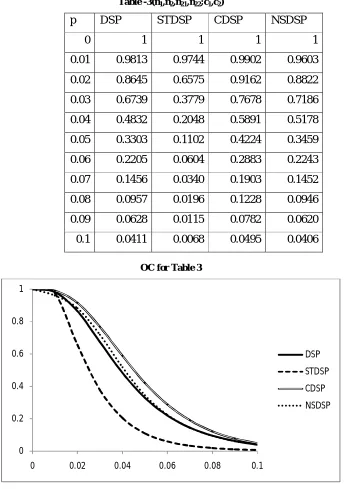
A COMPARISON MADE FOR SAME SAMPLE SIZES WITH DSP, STDSP,
CDSP AND NSDSP
Table -3(n1,n2,n21,n22;c1,c2)
OC for Table 3
Figure – 1 0
0.2 0.4 0.6 0.8 1
0 0.02 0.04 0.06 0.08 0.1
DSP
STDSP
CDSP
NSDSP
p DSP STDSP CDSP NSDSP
0 1 1 1 1
IJSRR, 8(1) Jan. – Mar., 2019 Page 1840
CONCLUSION
Double sampling plans are generally superior to corresponding single sampling plans from an economic standpoint. That is because the double sampling plans can give an early decision at the first stage whenever lot quality is extremely good or bad. The recent developments also made in DSP. According to that we want some standard stable DSP for minimum sample size with maximum acceptance. From the OC curve it is clear that CDSP is superior to other three plans. When the sample size concerned both the samples are equal in size. In a similar way the NSDSP also have the same sample size in two stages except of taking another sample size. Consider the sample size and good determination between good and bad lots the CDSP and NSDSP is better than that of STDSP and DSP.
REFERENCE
1. Govindaraju -Fractional acceptance number single sampling plan, Communicational statistics. -simula., 1991; 20(1): 173-190
2. Uma and Manjula – A New Screening Procedure on Double Sampling Plan for costly or Destructive items ,International Journal of Research in Advent Technology 2019; 6: 12.
3. Sven Berg - Double Sampling for Cluster or Two Stage Sampling, 1972; 40(1): 13-22. 4. Ksenija Dumicic - Decision making based on Single and Double Acceptance Sampling Plans
for assessing quality of lots, Business Systems Research 2012; 3(2).
5. Dodge H.F, Romig H.G, (2nd Edition) John Willey and Sons -Sampling Inspection Tables – Single and Double Sampling, New York 1959
6. Duncan A.J, - Quality Control and Industrial Statistics, 5th Edition-Homewood Publisher, , Illinois, U.S.A. 1986
7. Schilling E.G, Acceptance Sampling in Quality Control, Marcel Dekker, New York, 1982. 8. Acharya Nagarjuna - Construction of conditional double sampling plans using intervened
random effect Poisson distribution, Proceedings volume of SJYSDNS, UniversityGuntur, 2005;57-61.
9. Sampling Plans, Ph.D., Dissertation, Bharathiar University, Coimbatore, Tamil Nadu, India. University Guntur 2007
10.Schilling E.G- Acceptance Sampling in Quality Control, Marcel Dekker, New York, 1982.