
Open Access
H Y P O T H E S I S
Bio
Med
Central
© 2010 Bernhardt and Tate; licensee BioMed Central Ltd. This is an Open Access article distributed under the terms of the Creative Com-mons Attribution License (http://creativecommons.org/licenses/by/2.0), which permits unrestricted use, distribution, and reproduc-tion in any medium, provided the original work is properly cited.Hypothesis
The transition from noncoded to coded protein
synthesis: did coding mRNAs arise from
stability-enhancing binding partners to tRNA?
Harold S Bernhardt* and Warren P Tate
Abstract
Background: Understanding the origin of protein synthesis has been notoriously difficult. We have taken as a starting premise Wolf and Koonin's view that "evolution of the translation system is envisaged to occur in a compartmentalized ensemble of replicating, co-selected RNA segments, i.e., in an RNA world containing ribozymes with versatile activities". Presentation of the hypothesis: We propose that coded protein synthesis arose from a noncoded process in an RNA world as a natural consequence of the accumulation of a range of early tRNAs and their serendipitous RNA binding partners. We propose that, initially, RNA molecules with 3' CCA termini that could be aminoacylated by ribozymes, together with an ancestral peptidyl transferase ribozyme, produced small peptides with random or repetitive sequences. Our concept is that the first tRNA arose in this context from the ligation of two RNA hairpins and could be similarly aminoacylated at its 3' end to become a substrate for peptidyl transfer catalyzed by the ancestral ribozyme. Within this RNA world we hypothesize that proto-mRNAs appeared first simply as serendipitous binding partners, forming complementary base pair interactions with the anticodon loops of tRNA pairs. Initially this may have enhanced stability of the paired tRNA molecules so they were held together in close proximity, better positioning the 3' CCA termini for peptidyl transfer and enhancing the rate of peptide synthesis. If there were a selective advantage for the ensemble through the peptide products synthesized, it would provide a natural pathway for the evolution of a coding system with the expansion of a cohort of different tRNAs and their binding partners. The whole process could have occurred quite unremarkably for such a profound acquisition.
Testing the hypothesis: It should be possible to test the different parts of our model using the isolated contemporary 50S ribosomal subunit initially, and then with RNAs transcribed in vitro together with a minimal set of ribosomal proteins that are required today to support protein synthesis.
Implications of the hypothesis: This model proposes that genetic coding arose de novo from complementary base pair interactions between tRNAs and single-stranded RNAs present in the immediate environment.
Reviewers: This article was reviewed by Eugene Koonin, Rob Knight and Berthold Kastner (nominated by Laura Landweber).
Background
Wolf and Koonin [1] have described the origin of the translation system as "arguably, the central and the hard-est problem in the study of the origin of life, and one of the hardest in all evolutionary biology". This is due not only to the overwhelming complexity of contemporary
protein synthesis with its large number of components and the large size of some of these components, and the extreme unlikelihood that these could have all arisen simultaneously, but also to the fact that evolution is not goal-driven: "Since evolution has no foresight, the trans-lation system could not evolve in the RNA World as the result of selection for protein synthesis and must have been a by-product of evolution driven by selection for another function" [1]. In the most well known version of this idea, Weiss and Cherry [2], Gordon [3] and Penny * Correspondence: [email protected]
1 Department of Biochemistry, Otago School of Medical Sciences, University of Otago, Dunedin, New Zealand
and colleagues [4,5] have proposed that the small ribo-somal subunit evolved from an RNA replicase/triplicase that replicated RNAs using the anticodon triplets of tRNAs rather than mononucleotides, in a process possi-bly driven energetically by concomitant peptide synthesis [2,4,5]. Originally proposed as a model for the origin of translocation [2], the triplicase hypothesis has the benefit of satisfying the perceived need for a prior function for the proto-ribosome, plus the added bonus of explaining the absence of evidence for an RNA replicase in contem-porary biology, presumably essential to the existence of an RNA world [5]. One piece of evidence given in support of the model [3] is the existence of an E. coli anticodon nuclease which is able to cleave tRNA immediately 5' to the anticodon [6]. However, as Wolf and Koonin [1] point out, a triplicase/protoribosome would have to be a "tre-mendously advanced, complex RNA machine", conclud-ing that, "the triplicase might not be the most likely solution to the origin of translation problem".
In this context, the argument that evolution is not goal-driven ignores the possibility that the evolution of coded protein synthesis may have been driven by the accumula-tion of incremental advances which led initially from the synthesis of random short peptides by a noncoded pro-cess through to the eventual production of long complex proteins by a system of coded protein synthesis. This view holds that the contemporary (sometimes very large) components have evolved from smaller molecules that possessed, if not all, at least some of their current func-tions. Thus, the larger problem can be distilled down to a smaller problem: how did the two main functions of the contemporary ribosome, peptide synthesis and decoding, arise? As W. Ford Doolittle has stated, of these two, pep-tide synthesis presumably came first, as without it there would be nothing to be coded (comment in [7]). Peptide synthesis is a function of the large ribosomal subunit RNA of the contemporary ribosome, so key to this dis-cussion is the origin of this structure. Maizels and Weiner [8], Bokov and Steinberg [9] and Yonath and associates [10] have all proposed that the large ribosomal subunit RNA arose from the duplication of a ribozyme able to bind an RNA hairpin possessing an aminoacylated 3' CCA terminus. Bokov and Steinberg [9] have decon-structed the large ribosomal subunit RNA based on an analysis of the distribution of tertiary structure A-minor interactions, in which unpaired nucleotide bases (usually adenines) interact with a double helix [11]. Reasoning that the double helix component is stable in the absence
of the unpaired adenosines but not vice versa, they argue that the double helices must have evolved first, allowing them to define the ancestral components of the large ribosomal subunit RNA. When this was done, a region of Domain V of the large subunit RNA was identified con-sisting of two consecutive 110-nucleotide fragments
hav-ing almost identical secondary and tertiary structure, corresponding to the A and P sites of the peptidyl trans-ferase centre (PTC) where peptide synthesis occurs in the contemporary ribosome. Bokov and Steinberg's findings are in agreement with those of Yonath and colleagues [12] who made the observation that the "backbone folds [of the A and P sites of the PTC], irrespective of the nucle-otide sequences, are related by pseudo two fold symme-try". The ribose-phosphate backbones of the two proposed duplicated segments map onto each other extremely closely.
Smith et al. [7] have also presented a theory for the ori-gin of the ribosome that supports the large ribosomal subunit arising first. However, their argument is based largely on the fact that, unlike the case of the peptidyl transfer centre, there is no single self-folding RNA seg-ment comprising the decoding site of the small subunit; why this should infer a more recent origin is not intrinsi-cally obvious, as the small subunit RNA had to evolve at
some time. It would be interesting to repeat the decon-struction performed on the large subunit RNA (based on the A-minor interaction) [9] for the small subunit RNA. However, if the two subunits originally evolved in isola-tion (with the regions of interacisola-tion evolving at a later stage), such a chronology may not be informative for how the early parts of the two evolutionary histories relate.
In the absence of the small ribosomal subunit (which is responsible for decoding in the contemporary ribosome), peptide synthesis catalysed by the ancestral peptidyl transferase ribozyme would necessarily have been non -coded. The evolution of coded protein synthesis from such an earlier noncoded system has been proposed by a number of researchers, including Orgel [13], de Duve [14-16], Schimmel [17,18] and Noller [19,20], and more recently joined by Penny et al. [21]. Noller [19] has pro-posed that the ribosome evolved from "smaller functional units capable of carrying out the different translational steps such as peptidyl transfer, decoding, and so on", sim-ilar to the view of Penny and co-workers, who have stated, "It is possible that the several active sites of mod-ern ribosomes evolved as separate ribozymes" [4]. Of par-ticular interest in relation to the current proposal, de Duve has suggested that coded protein synthesis arose from a noncoded system in which selection was on the basis of efficient peptide synthesis, and that proto-mRNA originally played a structural role, immobilizing pairs of proto-tRNAs on an ancestral peptidyl transferase [14-16]; in a recent paper on the origin of introns, Penny et al.
non-pro-grammed 70S ribosomes [i.e. in the absence of mRNA] contacts predominantly the 50S, as opposed to the 30S subunit, indicating that codon-anticodon interaction at the P site is a prerequisite for 30S binding [italics in the original]" [22] argues that the mRNA-tRNA interaction is the more ancestral. Wolf and Koonin have suggested that the first proto-mRNAs arose as part of the small ribo-somal subunit RNA, only later becoming discrete entities (this is similar to the idea of Maizels and Weiner [8]). The opposing view is that that mRNA was a diffusible element from the outset, with Penny and colleagues, for example, arguing that mRNA originally evolved from nonfunc-tional RNA interspersed between funcnonfunc-tional RNA genes, as part of their "introns first" theory [4], and Crick and co-workers suggesting that mRNA could have been formed initially "using the anticodon loops of the existing tRNA's [sic] molecules as partial templates [italics in the original]" [23].
Presentation of the hypothesis
In presenting this model, we take as a starting premise this statement from Wolf and Koonin (2007): "Our main guide in constructing the models is the Darwinian Conti-nuity Principle whereby a scenario for the evolution of a complex system must consist of plausible elementary steps, each conferring a distinct advantage on the evolv-ing ensemble of genetic elements. Evolution of the trans-lation system is envisaged to occur in a compartmentalized ensemble of replicating, co-selected RNA segments, i.e., in a RNA world containing ribozymes with versatile activities". In what follows we seek to demonstrate selective advantage at each step, and, in line with the Continuity Principle, a continuous path-way where information is preserved from the ancestral system to the present. As logic dictates, the evolution of coded peptide synthesis must have occurred in the absence of complex proteins.
Initial selection for noncoded protein synthesis
Schimmel has proposed an ancestral system of noncoded protein synthesis utilizing hairpin precursors of tRNA [17,18]. Prior to the existence of complex polypeptides, specific aminoacylation would have been catalyzed by the ribozyme predecessors of contemporary protein aminoa-cyl-tRNA synthetases. Co-existing with these ribozymes was an RNA fragment containing the peptidyl trans-ferase, the ancestral large ribosomal subunit, which func-tioned as a specific ribozyme promoting the synthesis of short peptides. The evolution of peptidyl transferase activity may have been relatively straightforward, as the primary function of the contemporary peptidyl transfer centre of the large ribosomal subunit appears to be the positioning of the two 3' CCA termini of tRNA through a network of hydrogen bonds [24]. This process would have
produced only peptides with random and perhaps repeti-tive sequences. However, new enzymatic activities could have been possible even in such a primitive context, deduced from what is known today of functions of sequences of repetitive amino acids:
1. Short tandem repeats rich in glycine are able to bind Cu2+ ions [25].
2. A polyglycine-Cu2+ complex exhibits superoxide
dismutase activity [26].
Interestingly, Cu2+ cleaves the bond between the
amin-oacyl-tRNA bond of aminoacyl- but not peptidyl-tRNA [27], suggesting the possibility, if Cu2+ were present in the
RNA world environment, of a positive-feedback mecha-nism in which polyglycine was able to sequester Cu2+
ions, thus enhancing its own synthesis. Additionally, these and other like peptides might have interacted with existing catalytic RNA domains enhancing and develop-ing ribozymal catalysis [4,20,28]. Lastly, polyglycine may have formed stabilizing interactions with the ancestral peptidyl transferase ribozyme [19]: glycine is a well-known 'helix-breaker' that is commonly found in unstructured protein tail and loop regions, such as the internal loop of ribosomal protein L11-C76 which is dis-ordered in the free protein but becomes dis-ordered in its association with rRNA [29].
Origin of mRNA as stability-enhancer
Based on the theories of Di Giulio [30-32] and experi-mental work by Schimmel [33], we have previously pro-posed on the basis of a highly conserved anticodon loop sequence containing CCA in contemporary tRNAsGly that
the first proto-tRNA (specific for glycine) was formed by the ligation of two RNA hairpins, with subsequent muta-tions to form the familiar cloverleaf structure [34] (Figure 1). Possessing the same 3'-end structure as its hairpin pre-cursors, this proto-tRNA was similarly aminoacylated and was a substrate for peptidyl transfer catalyzed by the ancestral ribozymes. Subsequently, tRNAGly gave rise to
other tRNAs by a process of duplication and mutation, similar to the concept of Wolf and Koonin [1] (Figure 1). A critical new feature of the tRNA molecule was the cen-tral anticodon loop, formed by the head-to-tail ligation of the 3' and 5' ends of the respective hairpins.
syn-thesis) was demonstrated by Spirin and associates on contemporary ribosomes with lysyl-tRNA as a substrate in the absence of a directing mRNA [35]. Previously, Monro [36] and, more recently, Wohlgemuth et al. [37] have demonstrated the ability of the isolated 50S ribo-somal subunit to catalyse peptide synthesis in the absence of mRNA, and Wohlgemuth et al. have shown this occurs at the same rate as when catalysed by the complete ribo-some. Significantly, Monro [36] detected the synthesis of short peptides using full-length tRNAs as substrates, strongly suggesting these occupied both A and P sites.
Experiments by Jonák and Rychlík [38] demonstrated that binding of oligolysyl-tRNA (with anticodon U*UU, where U* is modified) to the isolated E. coli 50S ribo-somal subunit P site is enhanced approximately two-fold by cognate poly A (but not poly U or poly (U, C)). Simi-larly, Gnirke and Nierhaus [39] have demonstrated a two-fold enhancement in the binding of deacylated tRNAPhe
to the 50S subunit E site in the presence of the cognate poly U (but not poly A). Of interest, Tate and colleagues demonstrated a similar degree of binding enhancement of the protein termination factor RF-2 to the 50S subunit A site in the presence of the cognate termination codon UAA [40]. Although in these examples single site binding to the 50S subunit is highlighted, we would suggest that such binding was possible originally with pairs of tRNAs
positioned in the adjacent A and P sites, thereby enhanc-ing both the bindenhanc-ing of the pair to the ancestral peptidyl transferase and the rate of peptide synthesis. The enhancement in RF-2 binding in the presence of the UAA codon argues that the enhancement is due to the trans-mittance of a conformational change in the protein from the codon-binding site to the part of the molecule that interacts with the 50S subunit. In the experiments utiliz-ing tRNAs, the poly A and poly U respectively could be regarded as the equivalent of our proposed ancestral sta-bility-enhancing RNAs that were able to base pair with tRNA anticodon loops. Although these experiments were done using 50S subunits containing a full complement of ribosomal proteins, recent structural studies have shown the main contacts for tRNA even on the modern ribo-some are with rRNA moieties [41]. These findings sup-port the hypothesis that a complementary RNA sequence (proto-mRNA) could have played a structural role enhancing binding of the first tRNAs to an ancestral pep-tidyl transferase ribozyme and the rate of peptide synthe-sis even though the prototype of the contemporary small ribosomal subunit RNA, responsible for coding, was missing.
Subsequent to our developing this model we became aware that a similar concept had been discussed
Figure 1 Proposed hairpin duplication origin of tRNA, based on Di Giulio [31-33]. RNA hairpin (left) was specifically aminoacylated with glycine, enabling it to participate in noncoded peptide synthesis. The hairpin monomer was in equilibrium with the partial duplex (middle), which underwent ligation to form a covalently joined molecule possessing an anticodon loop with the anticodon derived from the 3'-terminal CCA sequence of the upstream hairpin. Mutations produced the first tRNAGly (far right), also a substrate for noncoded protein synthesis. Subsequent gene duplication and
mutation led to a proliferation of tRNA molecules with different amino acid specificities.
other tRNAs
amino-acylation
ligation A
C C N hairpin
noncoded peptide synthesis
A C C N
gly tRNAGly
noncoded peptide synthesis NCCA
mutation
gene duplication
and mutation N
C C A gly
partial duplex
A C C N
gly
A C C N
gly
NCCA A C C N
briefly by Christian de Duve in his 1991 book, Blue-print for a Cell:
"If the protein-synthesizing machinery first devel-oped without an informational element, how did this element enter the system? In addressing this question, we must remember that, in living organisms today, mRNAs do not only serve to dictate the sequence of amino acid assembly. They also play an essential role in the strategic positioning of aminoacyl-tRNA and peptidyl-tRNA complexes on the surface of ribo-somes. It is thus conceivable that the conformational function preceded the informational one and that it was, in fact, instrumental in bringing about the latter. Proto-mRNAs could have entered the system as structural adjuncts of the peptide-synthesizing machinery [italics added]" [14].
The takeover of peptide synthesis by tRNA
In our earlier paper [34] we suggested that the first tRNA(s) might have evolved in an environment of up to eleven specifically-aminoacylated hairpins [24] that were the original substrates for noncoded peptide synthesis. The relative strength of binding of such hairpins and tRNAs to the ancestral peptidyl transferase ribozyme is not known, but the small size of the proposed ancestral peptidyl transferase implies fewer intermolecular
interac-tions than occur on the modern ribosome. However, Schimmel and co-workers have demonstrated a similar rate of peptide synthesis for aminoacylated hairpins and tRNA by the isolated 50S ribosomal subunit [42], indicat-ing the two may have similar bindindicat-ing strengths. If this were true for the ancestral peptidyl transferase ribozyme, the enhancement in binding brought about by serendipi-tous proto-mRNA binding partners may have led to the eventual replacement of hairpins by tRNA for peptide synthesis. Di Giulio [33] has presented a scenario in which a mixed population of aminoacylated RNA species (including hairpins and cloverleafs) were simultaneously substrates for peptide synthesis.
Origin of coding
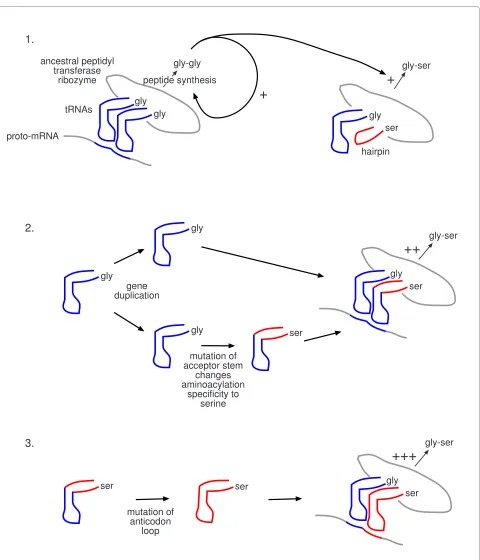
The above considerations provide a plausible pathway for the evolution of genetic coding that is outlined below and in Figure 3. Our aim in presenting it is to set forth some of the general principles that we believe may have guided the process, although for the detail the model will undoubtedly need further refinement and experimental validation.
Initially, we assume the presence of a small number of specifically-aminoacylated RNA hairpins (or other RNAs, see below) giving rise to a number of homo- or hetero-dipeptides. If we make the assumption that only two of these were useful, gly-gly and gly-ser, then these two pep-tides produced by a noncoded process had their produc-tion under positive selecproduc-tion because of a net benefit to the compartment or cell.
The original aminoacylated RNAs, described up to this point as 'hairpins', may have actually constituted a mixed population of molecules, having in common only the presence of an acceptor stem-like helix (containing nucle-otides of the operational RNA code conferring specificity of aminoacylation) and a 3' CCA terminus allowing spe-cific aminoacylation. (As Schimmel and colleagues have noted, some may have been larger than contemporary tRNA [43], as a number of viral RNAs contain a 3' tRNA-like structure that is specifically aminoacylated in vivo).
At this stage the appearance of the first tRNAGly by
duplication and ligation of the glycylated hairpin would have occurred (Figure 1). Subsequent gene duplication of this first tRNAGly, with mutation of nucleotides
compris-ing the operational RNA code in the acceptor stem of one of the copies, would have altered the specificity of amino-acylation by the RNA synthetase, for example from gly-cine to serine. The production of this new mutant tRNA species would facilitate the synthesis of a beneficial pep-tide gly-ser, enhanced by the same proto-mRNA that enhanced the synthesis of gly-gly, as both tRNAs would at this stage share the same anticodon. The lack of specific-ity of the proto-mRNA, however, would also have enhanced the production of ser-gly and ser-ser, perhaps
Figure 2 Our proposal for the origin of coded protein synthesis. A depiction of the ancestral peptidyl transferase ribozyme as proposed by Bokov and Steinberg [9] with two tRNAs and a serendipitous proto-mRNA binding partner bound to the two tRNA anticodon loops. Adapted from the PDB files of the T. thermophilus 70S ribosome (with tRNAs and mRNA) taken from Voorhees et al. [98]. PDB files rendered using MacPyMol [99].
tRNAs
stabilizing proto-mRNA
ancestral peptidyl transferase
Figure 3 A detailed scenario for the origin of genetic coding. 1. Synthesis of gly-gly peptide enhanced by a proto-mRNA complementary to the anticodon loops of tRNAGly, sets up positive feedback loop to further enhance gly-gly synthesis from two tRNAsGly, plus noncoded synthesis of gly-ser
from tRNAGly and the hairpin specific for serine, respectively. 2. tRNAGly undergoes gene duplication, with one copy undergoing mutation of the
ac-ceptor stem to produce a tRNA with aminoacylation specificity for serine (ser). As a result, the synthesis of gly-ser is enhanced by the same proto-mRNA that enhances the synthesis of gly-gly. 3. Selection occurs for mutation of the anticodon loop of proto-tRNASer so that the synthesis of gly-ser
is specifically enhanced. In this way, each new amino acid incorporated into the genetic code is specified by a different sequence (codon). Comple-mentary proto-mRNA and tRNA anticodon loop sequences are represented by the same colour.
gly gly
gly-gly ancestral peptidyl
transferase ribozyme
tRNAs
proto-mRNA
peptide synthesis
gly-ser
+
1.
+
gly ser
ser
3.
mutation of anticodon
loop ser
ser gly
gly-ser
+++
ser gly
ser gly
gly-ser
++
2.
gene duplication
gly gly
mutation of acceptor stem
changes aminoacylation
specificity to serine
with deleterious effects on the cell. Selection for increased specificity would be favoured so that the syn-thesis of only the useful peptides was increased. If each new amino acid incorporated into the nascent coding sys-tem (and its corresponding mutant tRNA) eventually became specified by a different sequence (in other words, by a different codon), then each combination of tRNAs would have bound a unique complementary mRNA, giving a one-to-one relationship between proto-mRNA and peptide. This advantage could have driven the evolution of coding specificity - each codon sequence interacted with only a single tRNA, coding for only a sin-gle amino acid (Figure 3). De Duve [14] has said the fol-lowing about this stage:
"Even if precise matching between amino acids and proto-anticodons did not exist initially, its progressive appearance would, predictably, be favoured by natural selection. Consider that we are dealing with a random peptide synthesizer of which there are many copies situ-ated in distinct, competing entities. Mutations of the RNAs involved create the diversity on which selection acts, but within stringent constraints. First, only muta-tions that respect the topological factors just defined will be tolerated, as others disrupt the machinery. Further-more, the critical mutations will be those that affect the proto-tRNAs rather than those that affect proto-mRNAs, as it is not yet the quality of the messages that counts, but that of the parts of the synthetic machinery. In such a context, units possessing unambiguous proto-tRNAs will have a manifest advantage over those that have proto-tRNAs associating the same proto-anticodon with differ-ent amino acids, the advantage being the possibility of faithful reproduction of a message. In other words, from the moment translation [=coded protein synthesis]
became mechanistically possible, its emergence was oblig-atory [italics added]".
One constraint on the first anticodon sequences was that they must form stable anticodon-codon interactions in the absence of modified anticodon loop nucleotides, if, as suggested by Crick [44], there was no post-transcrip-tional modification of tRNA nucleotides at this early stage. Then anticodon sequences (and their complemen-tary codons) with a high G+C content would have an advantage; this may be the reason the first tRNA (tRNAGly) possessed an NCC anticodon.
In overview, the principle selective pressure was for the production of novel useful peptides enhancing biological function, and this in turn resulted in selection for the diversification of anticodon and proto-mRNA sequences. Wolf and Koonin have expressed a parallel concept as part of their proposal for the origin of protein synthesis [1].
Origin of translocation
Translocation provides an evolutionary route to cod-ing, even in the absence of the small ribosomal subunit. While in the first instance merely passively binding to the anticodon loops of pairs of tRNAs in the A and P sites, upon movement of the tRNA CCA-termini from the A to P and P to E sites (along with the proto-mRNA), the downstream codon of the proto-mRNA might well have played a role in favouring the selection of the tRNA enter-ing the newly vacated A site. Another way of viewenter-ing the experiments of Jonák and Rychlík [38] and Gnirke and Nierhaus [39] that demonstrate stimulation of binding of various tRNA species to the isolated large ribosomal sub-unit by cognate single-stranded RNAs, is that they dem-onstrate a form of coding by the large ribosomal subunit. A comparison with the small subunit is instructive. The presence of poly A similarly enhances the binding of oli-golysyl-tRNA to this subunit [38]. However, in contrast to the large subunit, non-cognate RNAs cause a decrease in binding of oligolysyl-tRNA to the small subunit, remind-ing us that in conjunction with the small subunit the polynucleotide is playing a selective role in the interac-tion. As previously discussed, this idea is supported by the demonstration [22] that, "a tRNA bound to the P site of non-programmed 70S ribosomes [i.e. in the absence of mRNA] contacts predominantly the 50S, as opposed to the 30S subunit, indicating that codon-anticodon interac-tion at the P site is a prerequisite for 30S binding [italics in the original]."
Origin of the small ribosomal subunit
The small subunit RNA was a later addition to the cohort of RNAs and added fine control over the interaction between tRNA and mRNA so that the fidelity of peptide synthesis was increased. According to Bokov and Stein-berg's [9] deconstruction of the large subunit, regions that form interactions with the small subunit occurred in the second stage of the evolution of the large subunit. Although the decoding function of the small ribosomal subunit RNA is made up of a number of segments that are widely separated [7], a 49-nucleotide hairpin compris-ing part of the decodcompris-ing site at the 3'-end of the small ribosomal subunit RNA binds both poly U and the tRNAPhe anticodon stem/loop in a similar fashion to the
entire small subunit, suggesting such a hairpin-type structure could be an ancestral decoding fragment [54]. This hairpin contains the two nucleotides C1401 and G1402 (E. coli numbering) that complex a Mg2+ ion and
mark the border between the A and P site codons, thought to be important for maintaining the reading frame and preventing slippage [55]. It also contains the two mobile nucleotides A1492 and A1493 that proofread the anticodon-codon helix [56]. These two nucleotides may have originally functioned in isolation to other ele-ments contributing to decoding in the contemporary
ribosome, such as G530, almost 1,000 nucleotides distant in the primary sequence. Intriguingly, there is evidence from the ribosome crystal structure that, if the G530 interaction were missing, A1492 may be able to proofread the second codon position on its own, albeit with lower fidelity, as the ribosomal decoding site can apparently accommodate a G-U base pair at the second position if either A1492 or G530 is utilized, but not with both [57]. Such a decoding hairpin could have originally functioned
in trans [4], interacting solely with the tRNA-proto-mRNA complex (Figure 4). As discussed above, its acqui-sition as an intrinsic component of the ribosomal com-plex and specific interactions with the large subunit RNA would be a later development.
Summary of the model
The model can be summarized in ten progressive steps. These are listed below with supporting evidence from the literature.
(i) Selection of ribozymes able to aminoacylate a variety of RNA substrates with 3' CCA termini, perhaps related to a role in the replication of genomic RNA. That this is feasi-ble is supported by the demonstration that self-aminoa-cylation and the ability to aminoacylate in trans are some of the most easily selected RNA functions in vitro. For example, a 114-nucleotide ribozyme capable of activating amino acids by catalysing the formation of aminoacyl guanylates (chemically similar to aminoacyl adenylates
Figure 4 The origin of the small ribosomal subunit as an RNA hairpin acting in trans. A depiction of the proposed decoding hair-pin, possibly ancestral to the small ribosomal subunit RNA [54], inter-acting with tRNAs in the ancestral A and P sites of the ancestral peptidyl transferase ribozyme [9], and a serendipitous proto-mRNA binding partner bound to the tRNA anticodon loops. Note: this view is from the opposite side of the complex to that shown in Figure 2. Adapted from the PDB files of the T. thermophilus 70S ribosome (with tRNAs and mRNA) taken from Voorhees et al. [98]. PDB files rendered using MacPyMol [99].
ancestral peptidyl transferase
ribozyme
tRNA
tRNA
proto-mRNA
used universally in biological systems) [58] and a 45-nucleotide ribozyme capable of aminoacylating tRNAs in trans [59] have been selected in vitro from random popu-lations of RNAs. Amazingly, Yarus and colleagues have very recently demonstrated that a tiny RNA of just five nucleotides can catalyse the aminoacylation of a partly complementary even smaller four nucleotide RNA using the naturally occurring substrate phenylalanine adenylate [60].
(ii) Serendipitous production of an ancestral peptidyl transferase by a gene duplication and ligation (perhaps of an aminoacyl-RNA synthetase ribozyme), enabling the resulting ribozyme to bind two RNAs with aminoacylated 3' CCA termini, and to promote noncoded peptide synthe-sis. Weiner and Maizels [61] have proposed that the first ribosome arose from the gene duplication of a tRNA-binding ribozyme - perhaps an aminoacyl-tRNA syn-thetase - that created two tRNA binding sites on the same molecule. Bokov and Steinberg's [9] deconstruction of the large ribosomal subunit RNA supports the evolution of the proto-ribosome from the duplication of a fragment of about 110 nucleotides, and Yonath and co-workers have shown that the ribose-phosphate backbones of the A and P sites of the PTC map onto each other extremely closely, suggesting a duplication-ligation origin [12].
(iii) Generation of a proto-tRNA by duplication-ligation of a hairpin with a specifically-aminoacylated 3' CCA ter-minus able to participate in noncoded peptide synthesis. This scenario is supported by the analysis of contempo-rary tRNAsGly demonstrating a highly conserved
anti-codon loop CCA sequence [34] and previous statistical analyses of tRNA molecules by Di Giulio and colleagues arguing for a duplication-ligation origin of tRNA [31-33,62]. Incidentally, the idea that the ancestral peptidyl transferase ribozyme and tRNA both arose by a duplica-tion-ligation event suggests that this may have been a general mechanism for the origin of components of the RNA world [63] (Figure 5).
(iv) The recruitment of single-stranded RNAs (or RNAs with single-stranded regions) as binding partners to the anticodon loops of tRNA pairs. This is supported by the ability of single-stranded RNAs to bind to the tRNA anti-codon loop free in solution (see the next section for dis-cussion and references).
(v) Enhancement of the selection of tRNAs as preferred substrates for the peptidyl transferase due to their interac-tion with single-stranded RNAs (proto-mRNAs), giving rise to a binding enhancement and a consequential rate enhancement of peptide synthesis. This concept is sup-ported by isolated experiments demonstrating enhanced binding of oligolysyl-tRNA to the P site [38], deacylated tRNAPhe to the E site [39] and the protein termination
factor RF-2 to the A site [40] of the isolated 50S
ribo-somal subunit, dependent upon the presence of the cog-nate RNA or codon.
(vi) Synthesis of a greater diversity of beneficial peptides by selection for mutations in the acceptor stem of tRNA, altering the specificity of aminoacylation. This is sup-ported by the demonstration that a single C70U mutation in the acceptor stem of E. coli tRNALys results in its
amin-oacylation with alanine [64].
(vii) Enhanced specificity for the synthesis of particular peptide products by selection for mutation of the anti-codons of these mutant tRNAs, leading to new unique proto-mRNA sequences complementary to the new anti-codon loop sequences. This step is supported in contem-porary biology by the existence of suppressor tRNAs that possess altered anticodons complementary to termina-tion codons, that insert the amino acid corresponding to the original tRNA at these positions [65].
(viii) Synthesis of longer peptides with the emergence of an E site on the ancestral peptidyl transferase. The rela-tively early evolution of the E site as the ribozyme expanded is supported by its conservation across all three kingdoms [51] although the analysis of Bokov and Stein-berg did not support this conclusion [9].
(ix) Enhancing the fidelity of protein synthesis by evolu-tion of a short decoding hairpin (the ancestral small ribo-somal subunit RNA, functioning in trans), to enforce the genetic coding rules. This is supported by the demonstra-tion that a 49-nucleotide hairpin comprising part of the decoding site of the small ribosomal subunit RNA binds both poly U and the tRNAPhe anticodon stem/loop in a
similar fashion to the entire small subunit, suggesting such a hairpin-type structure could be an ancestral decoding fragment [54].
(x) Control and fidelity of protein synthesis further evolved from a gradual increase in the sizes and interac-tions between the ancestral peptidyl transferase and decoding hairpin.
Arguably, each step in this development would have been selected for the ability to produce reproducibly increasingly more complex (and thus potentially more useful) peptides.
Discussion
Evidence for tRNA anticodon interactions in the absence of the ribosome
Figure 5 A duplication-ligation origin of coded protein synthesis. The origin of coded protein synthesis from the duplication of a hairpin-binding ribozyme [8] to form the proposed ancestral peptidyl transferase ribozyme [9] and the duplication of a hairpin possessing a 3'-terminal CCA [30-32,34] to form the first tRNA. Serendipitous binding of a single-stranded RNA (proto-mRNA) complementary to the tRNA anticodon loops enhanced the binding and positioning of the two tRNAs on the peptidyl transferase, and thereby, the rate of peptide synthesis. Adapted from the PDB files of the T. thermophilus 70S ribosome (with tRNAs and mRNA) taken from Voorhees et al. [98]. PDB files rendered using MacPyMol [99].
hairpin-binding ribozyme
ancestral peptidyl transferase ribozyme
hairpin tRNA
duplication and ligation
duplication and ligation
X2
single-stranded RNAs
tRNA anticodon loop outside of the contemporary ribo-some and its subunits. What interactions with the anti-codon loop can occur free in solution? On the basis of a highly conserved anticodon loop 'signature' we proposed tRNAGly as the first tRNA [34]. Contemporary tRNAGly
contains on average the fewest post-transcriptionally modified nucleotides (and the lowest proportion of mod-ifications at position 37, immediately downstream of the anticodon, important for stabilizing the anticodon-codon interaction through base stacking [66]), with the unmodi-fied state assumed to be ancestral [44]. Three types of interaction occur between single-stranded RNAs and a hypomodified anticodon loop:
(i) Oligonucleotide-binding of single-stranded tri, tetra and pentanucleotides with the tRNA anticodon loop. Most pertinent to the ancestral situation are studies using
E. coli tRNAiMet, whose anticodon loop contains a single
post-transcriptional modification at position 32 (a 2'-O methylcytidine), a position which is not thought to have a significant influence on anticodon binding [67]. This tRNA has an unmodified anticodon and an unmodified adenine at position 37, and binds a trinucleotide and tet-ranucleotide complementary to its anticodon (or anti-codon plus adjacent U33) with molar association constants of 1.2 × 10³ and 1.4 × 10⁴, respectively [68]. In
the absence of the ribosome, tri, tetra and pentanucle-otides bind to the anticodon loop of E. coli or yeast tRNAPhe with increasing strength [69-72]. These tRNAs,
however, contain a hypermodified nucleotide at position 37, and so probably do not represent the ancestral state [44].
(ii) Interactions between complementary anticodons of two tRNAs. Interactions between E. coli tRNAGly (with
anticodon U*CC, where U* is modified) and tRNASer
(with an unmodified GGA anticodon) were found to be highly stable [73]; the sole anticodon loop modification in this interaction is that of U34 in the first (wobble) posi-tion of the tRNAGly anticodon, as indicated. Importantly,
neither tRNA has a modified purine at position 37, lead-ing the authors to state that, "the presence of three con-secutive purines in the [tRNASer] anticodon triplet
together with the two purines on its 3' side may yield suf-ficient stability..." [74]. The interaction between wheat tRNAGly and E. coli tRNAAla (with unmodified GCC and
GGC anticodons respectively) is also highly stable [75]. In this case the sole anticodon loop modification is a single 5'-methylation of cytidine at position 38 of the tRNAGly
[76].
(iii) Anticodon interactions with other RNAs. The GCC anticodon of Bacillus subtilis tRNAGly interacts with a
complementary GGC 'codon' sequence within the eight-nucleotide internal specifier loop of the 5'-UTR of the
Bacillus subtilis glyQS gene, regulating transcription of
the encoded glycyl-tRNA synthetase [77]. Deacylated tRNAGly prevents termination of transcription (and thus
increases synthesis of the glycyl-tRNA synthetase, and thereby its own aminoacylation) by also interacting through its 3' UCCA terminus with a complementary UGGA sequence in the anti-terminator bulge of the mRNA transcript, similar to the twin interactions of the anticodon loop and 3' CCA terminus of tRNA on the ribosome. Although the post-transcriptional sequence of the mature Bacillus subtilis tRNAGly(GCC) is not known, by
comparison with other tRNAs of similar sequence [76] it is likely to be minimally modified. Significantly, this inter-action has been reproduced in vitro using unmodified tRNAGly, suggesting that post-transcriptional
modifica-tion of the tRNA, if present, is not critical for the interac-tion [77].
The above data suggest that the interaction between unmodified tRNA anticodon loops and single-stranded RNAs, such as we have proposed for the ancestral tRNA and proto-mRNA, would have been strong enough to allow binding in the absence of the contemporary ribo-some. The interaction of a single-stranded RNA with two
adjacent anticodon loops (such as two tRNAs held in jux-taposition by the ancestral peptidyl transferase ribozyme) would have enhanced such binding. Although Labuda et al. [78] observed no ternary complexes formed between yeast tRNAPhe in free motion in solution and the
comple-mentary UUCUUCU oligonucleotide containing two consecutive codons (in italics), our proposal is that the two tRNAs were fixed in place by their 3' CCA termini to the ancestral peptidyl transferase ribozyme, and so were positioned for such an interaction with the proto-mRNA. As we have previously proposed [34], the advent of the genetic coding interaction may have been due to the abil-ity of the unmodified NCCA sequence to form a stable hydrogen bonding interaction with its complementary sequence, with the strength of G-C base pairs and the ability of the adjacent adenine (A37) to base stack on to the resulting helix important [79].
Origin of the triplet code
impossi-ble, as this would destroy all previously encoded informa-tion. However, recent structural data demonstrates that the contemporary ribosome is able to accommodate anti-codon loops with an extra nucleotide in the reading of four-nucleotide codons, leading Ramakrishnan and asso-ciates to make the comment "it appears that normal trip-let pairing is not an absolute constraint of the decoding centre" [80]. Along similar lines, Baranov et al. [81] have stated that "the emerging picture of decoding strategies used by different organisms...argue [sic] that non-triplet codes or codes with mixed codon sizes are possible"; fur-ther, they have provided evidence from computer model-ling that decoding systems with codons larger than three nucleotides evolve spontaneously into mainly triplet decoding systems. Grosjean et al. [75] argued on the basis of anticodon-anticodon interactions that the natural ten-dency of seven-membered RNA loops like the anticodon loop is to interact through the three central nucleotides, for example the anticodon triplet. However, as previously discussed, this does not preclude the ability of tRNA free in solution to interact with tetra and pentanucleotides [69-72]. Because of the close similarity Grosjean et al.
[75] discovered between anticodon-anticodon interac-tions and the rules of genetic coding, they hypothesized that one of the functions of the ribosome was to fold mRNA into a loop conformation similar to the anticodon loop. While this has not been shown to be the case, there
is a 45° kink in the mRNA between the codons in the adjacent A and P sites [41]. In view of all of the above, the rationale for the triplet code is still unclear.
Origin of the coding principle
How did the genetic coding principle arise? Although Rodin and colleagues have postulated that the genetic code (embodied by the anticodon) and operational RNA code (embedded in the tRNA acceptor stem and govern-ing the specificity of aminoacylation) have a common ancestor [82-84], there is a lack of an obvious relationship between them. Rodin and Rodin [84] themselves have stated, "straightforward analysis failed to uncover any traces of homology in this case". Yarus et al. [85] have postulated that the organization of the genetic code origi-nated in specific interactions between amino acids and RNA binding sites. However, Ellington et al. [86] have pointed out that understanding how such an association (with the requirement for the amino acid-binding site and coding triplet to be in close proximity) would lead to tRNA, with its widely separated sites for the amino acid and the anticodon, is problematic. Specifically, such a scenario would appear to violate the Continuity Principle. In contrast, an intrinsic feature of our model is that the genetic code has not descended from a previous code, but rather has arisen de novo. Wolf and Koonin have stated, "the origin of translation appears to be truly unique among all innovations in the history of life in that it
involves the invention of a basic and highly non-trivial molecular-biology principle, the encoding of amino acid sequences in the sequences of nucleic acid bases via the triplet code. This principle, although simple and elegant once implemented, is not immediately dictated by any known physics or chemistry (unlike, say, the Watson-Crick complementarity)" [italics added] [1]. We would agree with Wolf and Koonin in part, namely that the principle of genetic coding, derived from the advent of the tRNA anticodon loop (as a novel binding partner for single-stranded RNAs) held in pairs on the ancestral peptidyl transferase ribozyme, was a non-determined event not dictated by physics or chemistry. By contrast, the comple-mentary base pairing interaction at the heart of genetic coding is dictated by chemistry, in fact, by Watson-Crick complementarity. In the evolution of coded protein syn-thesis then, it would appear that the advent of the anti-codon loop provided the necessary precondition for development of the genetic code. However, this structural invention occurred in a molecule (RNA) able to carry information. The models of Rodin and Yarus postulate the transfer of information from either a pre-existing code (the operational RNA code) [84] or from an amino acid-RNA binding site interaction [85] to the genetic code. On the contrary, we would argue that with the emergence of the molecular assembly described above, genetic coding arose spontaneously due to the intrinsic chemical properties of RNA as an informational mole-cule.
Coded protein synthesis - an irreducibly complex system?
Wolf and Koonin [1] have suggested that the problem of the origin of the translation system is so complicated and involves the interplay of so many factors that, at least at first glance, its occurrence "evokes the scary spectre of irreducible complexity". In contrast, our model would suggest that the evolution of protein synthesis was similar to that of other complex systems. A good example is the vertebrate eye; in this instance, Darwin argued, one is able to plot an evolutionary trajectory from a light-sensi-tive spot to a fully-fledged eye, where each small step was selected for the "particular advantage it conferred onto the evolving organism" [1]. We would argue similarly that peptide synthesis evolved from a more rudimentary non-coded form, and that the synthesis of increasingly more complex peptides provided the selective advantage for a stepwise evolution of the contemporary translation sys-tem (similar to the view expressed by Maizels and Weiner [8]). It appears unnecessary to invoke a reassignment of a selectable function during evolution for the protein syn-thesis machinery.
Testing the hypothesis
While it would be ideal to test our hypothesis using only
pos-sible, as promising reports of protein synthesis by in vitro
transcripts of the large ribosomal subunit RNA (as well as the individual domains) of E. coli were subsequently retracted [87-91]. The contemporary large subunit RNA domain V that includes the peptidyl transfer centre com-prises over 600 nucleotides, and achieving the correct folding and function in the absence of ribosomal proteins today may be extremely difficult [88]. More recently, Anderson et al. [92] have attempted unsuccessfully to demonstrate peptide synthesis using a 322-nucleotide construct containing the most conserved regions of the peptidyl transfer centre, very close to the proposed ances-tral peptidyl transferase sequence of Bokov and Steinberg [9]. Subsequent in vitro selection aimed to enrich for pep-tidyl transferase activity produced a sequence able to ligate A and P site substrates; the ligated product however did not contain a peptide bond. Moreover, product for-mation was not sensitive to chloramphenicol, indicating that the active site in the RNA, improved by in vitro selec-tion, is different from the classical peptidyl transferase centre [92].
Yonath's group has used small stem-elbow-stem (SES) RNA structures in an attempt to demonstrate peptide synthesis. They report that some sequences form dimers, dependent on sequence and the presence of Mg2+ ions;
also that "functional experiments, exploring the peptidyl transferase activity of a large variety of the RNA dimers are in accord with the structural analysis" [93]. However, to date no data from these experiments have been pub-lished.
Despite much effort, it has not been possible to pro-duce 50S ribosomal subunits that are able to catalyze peptide synthesis in the complete absence of ribosomal proteins [94]. As discussed above, this may be due to a requirement for ribosomal proteins to achieve the proper folding and function of rRNA in contemporary ribo-somes.
The experiments that have demonstrated peptide syn-thesis in the absence of mRNA and enhanced binding of tRNAs in the presence of cognate oligonucleotides have used the whole 50S subunit, including ribosomal pro-teins. In view of this, a realistic experimental approach would be as follows:
1. Initially, use the isolated 50S ribosomal subunit together with in vitro transcribed tRNAs and comple-mentary oligonucleotides to define the parameters for the stabilization of tRNA binding by single-stranded RNAs and enhancement of peptide synthesis, as per the experiments of Jonák and Rychlík [38] and Monro [36].
2. Repeat these experiments using (a) in vitro tran-scribed 23S rRNA together with a minimal set of ribosomal proteins essential for peptidyl transferase activity [95]; and (b) an in vitro transcribed 23S rRNA
fragment corresponding to the proposed ancestral peptidyl transferase [9] in the absence of ribosomal proteins.
3. Test the ability of polyglycine (and other peptides composed of proposed evolutionarily 'early' amino acids [96]) to stabilize the RNA elements of the sys-tem and either increase the rate of peptide synthesis or allow it to occur in the absence of ribosomal pro-teins.
4. Investigate whether a proposed ancestral decoding hairpin derived from the small ribosomal subunit RNA [54] (in vitro transcribed) is able to function in trans to control the specificity of binding of tRNAs to the 50S subunit in the presence of cognate RNA, and thus direct the synthesis of specific peptides.
Success in these experiments would bolster the case for our hypothesis, without necessarily discriminating against the counter theory of a replicase/triplicase origin of the ribosome. Penny has suggested that an experimen-tal proof of the latter theory could be carried out using existing RNA polymerase ribozymes generated by in vitro
experiments [5]. Experimental proof against the proposal by Wolf and Koonin [1] that the ancestral small subunit RNA rather than proto-mRNA was involved in stabilizing tRNA binding to the ancestral peptidyl transferase would not appear necessary, due to experimental evidence dem-onstrating that, on the contemporary ribosome at least, the small subunit only binds tRNA at the P site in the presence of mRNA [22]. As previously discussed, this suggests that the interaction between tRNA and mRNA predates the interaction between tRNA and the small ribosomal subunit.
Implications of the hypothesis
The hypothesis presented here is that proto-mRNAs were firstly serendipitous binding partners to tRNA and acted as enhancers of noncoded protein synthesis. It is an extension of our previous proposal of the origin of the first tRNA by a hairpin ligation [34], and suggests that, against a background of noncoded peptide synthesis uti-lizing aminoacylated RNAs, the advent of the anticodon loop was critical in providing a novel binding surface for the evolution of the first proto-mRNAs. The increased stability these proto-mRNAs conferred on the binding of proto-tRNA pairs to the ancestral peptidyl transferase evolved into a system of coded protein synthesis. This remarkable development could have occurred quite natu-rally and unremarkably as the portfolio of tRNAs and their serendipitous binding partners gradually expanded. A coding system had been acquired by stealth!
Reviewers' reports
Reviewer 1: Eugene Koonin, National Center for
In this Hypothesis article, Bernhardt and Tate propose a conceptual solution to the great evolutionary puzzle, the origin of protein coding and translation. The idea is that initially the proto-mRNA played a structural role in facilitating non-templated peptide synthesis rather than an informational role as is the case in modern translation. I find this hypothesis very plausible. Indeed, it is a natural extension of or variation on the detailed scenario for the origin of translation presented by Wolf and Koonin [1]. Furthermore, the authors gamely note that an idea essen-tially similar to theirs was proposed by De Duve in his 1991 book [14]. Considering these predecessors and the extensive discussion and citation in the present article, the paper of Bernhardt and Tate reads, perhaps, more like a review than a hypothesis in the strict sense. This is not a criticism: the discussion is thoughtful and thorough, and should be appreciated by readers interested in the origin of translation which indeed is central to the origin of modern-type life.
Authors' response
As noted in our acknowledgements, Koonin and Wolf 's 2007 paper in Biology Direct [1] was an inspiration for our model. The theory of a structural role for mRNA pre-ceding its informational one (in the words of de Duve [14]) was our own, and the earlier work by de Duve was only discovered at a relatively late stage during prepara-tion of the manuscript. Surprisingly, although de Duve's ideas were first published almost 20 years ago [14] and have been published on two occasions since then [15,16], there appears to be very little general awareness of them by researchers in the field, as can be seen by an absence of reference to his work in recent reviews of the area [97,1,5]. An exception is the recent paper - "An overview of the introns-first theory" - by Penny and colleagues [21]. However, the origin of coded protein synthesis is not the main focus of the paper, and reference to de Duve's the-ory is made in a single figure and its accompanying leg-end without citation. While we acknowledge our hypothesis is not completely novel, we feel our paper presents the concept in a new context, namely within a model for the evolution of coding from noncoded peptide synthesis. The realisation that a coding scheme could develop by stealth was a 'eureka' moment for us. In addi-tion, we have highlighted isolated original work by Jonák and Rychlík [38], Gnirke and Nierhaus [39] and from our own lab [40] that provides experimental support. Lastly, when we discovered de Duve's earlier reference to the idea, we were excited that the central concept has a natu-ralness that has occurred to more than one person in the field, and one of great stature; in fact, as de Duve [16] notes, " [This theory] corresponds to what is about the simplest and most straightforward course of events that can be imagined to account for the development of
RNA-dependent protein synthesis. Most workers who have thought about the question have come up with more or less similar solutions" [italics added]. The low awareness in the field of de Duve's concept, alluded to in three books over a 14-year period [14-16], perhaps also tells us that as scientists we should be more cognisant of significant books!
Reviewer 2: Rob Knight, University of Colorado
In this manuscript, the authors provide a model for the evolution of coded translation based on the concepts of RNA hairpins as handles for amino acids used as coen-zymes or in noncoded peptide synthesis, origin of tRNAs via hairpin duplication, and expansion of the genetic code from a primordial repertoire of a few amino acid specific-ities in the original hairpins and/or tRNAs. They propose based on their earlier work and based on the ability of poly(Gly) to bind Cu2+ and exhibit superoxide dismutase activity that the original selection pressure was to pro-duce poly(Gly) or similar peptides, that this ability was then extended to the ability to make simple copolymers of other amino acids, that proto-mRNAs initially evolved as RNA effectors that assisted in the orientation of hairpins for non-coded peptide formation and only later evolved coding potential.
The problem of how the translation apparatus evolved is an important one, especially because it is important that proposed mechanisms provide some sort of continu-ity of function (so that each subsequent step is an improvement). As the authors note, the steps in the pro-cess they have proposed have largely been proposed before (e.g. by de Duve, by Weiner and Maizels, by Wolf & Koonin, by Yarus, by Knight & Landweber, etc.) so the question becomes (i) whether the pathway is sufficiently interesting to be publishable as a starting point for dis-cussion, and (ii) whether the pathway is sufficiently com-pelling that we should accept it as a likely account of how the code evolved.
My impression is that the model passes the first test but not the second. As the authors note, one attraction of this model is that several steps are empirically testable, although the experiments are not clearly described in the present version of the manuscript. The manuscript is also relatively long in relation to its news value and could ben-efit from a substantial reorganization (especially because a lot of what appears in the discussion about different alternative models should really be in the discussion.
I would suggest the following reorganization/refocus-ing:
- In the introduction, clearly enumerate the competing models (grouping related models into families) and high-light the main differences among them.
peptide synthesis function into one section, rather than repeating variations on this material in several places.
- Present the model earlier: the model and the methods for testing it appear on p 30 and take 2 pages out of the 45 in this version of the manuscript. Since the new model is what is central in this paper, it should appear earlier and then the steps should be justified with citation of specific, appropriate literature.
- In general, shorten both the introduction and the dis-cussion considerably to focus more on the proposals that are directly relevant to this proposal.
- In the discussion, clearly enumerate what experiments you would do in order to test each step of the model, how the outcome of each experiment could discriminate between this model and the alternatives mentioned in the introduction, etc.
Authors' response
We agree with the reviewer's suggestions and have revised the manuscript accordingly.
- I was surprised not to see the original Yarus DiRT paper, or the Knight and Landweber 2000 piece on alter-native models for getting from triplet/site associations to the present, or the original Szathmary paper on coding coenzyme handles, in the reference list although I acknowledge there could be reasonable motivations for omitting these and the reference list is long already.
One additional question I have is whether the Cu2+/ superoxide dismutase selection pressure is a reasonable candidate: since these events presumably took place before the oxygenation of the atmosphere, how strong a selective advantage would SOD activity provide? Interest-ingly, Schwedinger & Rode reported in 1989 that Cu2+ could catalyze peptide bond formation at high tempera-ture/salt (Analytical Sciences 4:411), so the copper bind-ing activity could be more directly relevant to peptide evolution. However, this weakens the argument that Cu2+ sequestration would be necessary (and, given the likely levels of sulfides, what would the Cu concentration have been in the early oceans?)
Authors' response
We acknowledge the discussion regarding potential inter-actions of glycine peptides with Cu2+ was not well
devel-oped in the original manuscript (see also comments by reviewer 3), and this has been revised. The examples of glycine-Cu2+ chemistry, while interesting from our point
of view - having proposed tRNAGly was the first tRNA
[34] - were given to illustrate the possible roles that could be played even by very simple peptides. The 1989 paper by Schwedinger & Rode is indeed interesting, suggesting a possible prebiotic route for the synthesis of short pep-tides. However, we would argue that such mechanisms
were ultimately supplanted by firstly noncoded, and then coded protein synthesis.
I think the model presented here is interesting and hope that the manuscript can be rewritten in such a way as to inspire the empirical testing that it deserves. In par-ticular, the demonstration that a generic proto-mRNA could enhance the rate of nontemplated protein synthesis using aminoacylated hairpins would be an interesting finding.
Reviewer 3: Berthold Kastner, Max Planck Institute,
Göttingen
Bernhardt and Tate present in their manuscript "The transition from noncoded to coded protein synthesis: did coding mRNAs arise from serendipitous binding partners to paired tRNAs that enhanced peptide synthesis on an ancestral peptidyl transferase?" a very compelling sce-nario of evolution of coded protein synthesis. In addition, the line-up of the various steps leading from the RNA- to the RNP-world presented at the end of the manuscript is very attractive, as each step could lead to an advantage of the system. For readers from outside the field it might be helpful if this concept is presented in a short version already in the results section. The many possible individ-ual steps of the evolution scenario formulated already previously require thorough discussion that leads to a quite lengthy manuscript. Nevertheless, it might be pos-sible to compact it a bit more. For one of the steps, the first appearance of di-/oligo- peptides, the reviewer sees the focusing on the Cu2+ binding argument for the evo-lutionary advantage as being rather narrow. As we have very limited perception on the chemical environment that might have existed in the RNA-world "cell", the avail-ability of short peptides could have given the system an advantage for various chemical pathways. It might have even been as simple as the prime benefit of amino acids have been the ability of buffering the pH of the system and di-peptides would have then the advantage of being more confined to the containment (the "cell"). The pH buffer function of proteins is still important in modern life. Then, the coded protein synthesis might have brought about the more specific functions of the peptides and mark the starting point of the RNP world. Still, detailed scenarios of such early stages of evolution remain mostly speculation, but the scenario presented here for evolution of the coded protein synthesis is highly plausible within the framework of current thinking. With the presented new perspectives and the careful discus-sions the manuscript of Bernhardt and Tate is well suited for publication in Biology Direct.
Authors' response
As discussed in our response to the last reviewer, the examples of glycine-Cu2+ chemistry were given to
reviewer's suggestion of early peptides having a role in the maintenance of pH is an interesting one, and worthy of further investigation.
Competing interests
The authors declare that they have no competing interests.
Authors' contributions
HB formulated the hypothesis. WT provided original ideas and played a men-toring role. Both authors discussed ideas and wrote the manuscript.
Acknowledgements
We would like to acknowledge Wolf and Koonin whose 2007 paper in Biology Direct [1], initially inspired the development of our model, and to thank Ingo Wohlgemuth and Michael Yarus for providing helpful information. This work was supported by the Department of Biochemistry, the Functional Genomics, Gene Expression and Proteomics Research Theme, and the Division of Health Sciences (all University of Otago) and by a grant from the Marsden Fund of New Zealand (to WPT).
Author Details
Department of Biochemistry, Otago School of Medical Sciences, University of Otago, Dunedin, New Zealand
References
1. Wolf YI, Koonin EV: On the origin of the translation system and the genetic code in the RNA world by means of natural selection, exaptation, and subfunctionalization. Biol Direct 2007, 2:14.
2. Weiss R, Cherry J: Speculations on the origin of ribosomal translocation. In The RNA World Edited by: Gesterland RF, Atkins JF. Cold Spring Harbor, New York: Cold Spring Harbor Laboratory Press; 1993:71-89.
3. Gordon KHJ: Were RNA replication and translation directly coupled in the RNA (+ protein?) world? J Theor Biol 1995, 173:179-193.
4. Poole AM, Jeffares DC, Penny D: The path from the RNA world. J Mol Evol
1998, 46:1-17.
5. Penny D: An interpretive review of the origin of life research. Biol Philos
2005, 20:633-671.
6. Morad I, Chapman-Shimshoni D, Amitsur M, Kaufmann G: Functional expression and properties of the tRNA(Lys)-specific core anticodon nuclease encoded by Escherichia coli prrC. J Biol Chem 1993, 268:26842-26849.
7. Smith TF, Lee JC, Gutell RR, Hartman H: The origin and evolution of the ribosome. Biol Direct 2008, 3:16.
8. Maizels N, Weiner AM: Peptide-specific ribosomes, genomic tags, and the origin of the genetic code. Cold Spring Harb Symp Quant Biol 1987, 52:743-749.
9. Bokov K, Steinberg SV: A hierarchical model for evolution of 23S ribosomal RNA. Nature 2009, 457:977-980.
10. Agmon I, Bashan A, Zarivach R, Yonath A: Symmetry at the active site of the ribosome: structural and functional implications. Biol Chem 2005, 386:833-844.
11. Nissen P, Ippolito JA, Ban N, Moore PB, Steitz TA: RNA tertiary interactions in the large ribosomal subunit: the A-minor motif. Proc Natl Acad Sci USA 2001, 98:4899-4903.
12. Davidovich C, Belousoff M, Bashan A, Yonath A: The evolving ribosome: from non-coded peptide bond formation to sophisticated translation machinery. Res Microbiol 2009, 160:487-492.
13. Orgel LE: The origin of polynucleotide-directed protein synthesis. J Mol Evol 1989, 29:465-474.
14. de Duve C: Blueprint for a Cell: The Nature and Origin of Life Burlington, North Carolina: Neil Patterson Publishers, Carolina Biological Supply Company; 1991.
15. de Duve C: Life Evolving: Molecules, Mind, and Meaning New York: Oxford University Press; 2002.
16. de Duve C: Singularities: Landmarks on the Pathways of Life New York: Cambridge University Press; 2005.
17. Schimmel P, Henderson B: Possible role of aminoacyl-RNA complexes in noncoded peptide synthesis and origin of coded synthesis. Proc Natl Acad Sci USA 1994, 91:11283-11286.
18. Henderson BS, Schimmel P: RNA-RNA interactions between
oligonucleotide substrates for aminoacylation. Bioorg Med Chem 1997, 5:1071-1079.
19. Noller HF: On the origin of the ribosome: coevolution of subdomains of tRNA and rRNA. In The RNA World 3rd edition. Edited by: Gesterland RF, Cech TR, Atkins JF. Cold Spring Harbor, New York: Cold Spring Harbor Laboratory Press; 2006:287-307.
20. Noller HF: The driving force for molecular evolution of translation. RNA
2004, 10:1833-1837.
21. Penny D, Hoeppner MP, Poole AM, Jeffares DC: An overview of the introns-first theory. J Mol Evol 2009, 69:527-540.
22. Schäfer MA, Tastan AO, Patzke S, Blaha G, Spahn CM, Wilson DN, Nierhaus KH: Codon-anticodon interaction at the P site is a prerequisite for tRNA interaction with the small ribosomal subunit. J Biol Chem 2002, 277:19095-19105.
23. Crick FH, Brenner S, Klug A, Pieczenik G: A speculation on the origin of protein synthesis. Orig Life 1976, 7:389-397.
24. Rodnina MV, Beringer M, Wintermeyer W: How ribosomes make peptide bonds. Trends Biochem Sci 2007, 32:20-26.
25. Matsushima N, Yoshida H, Kumaki Y, Kamiya M, Tanaka T, Izumi Y, Kretsinger RH: Flexible structures and ligand interactions of tandem repeats consisting of proline, glycine, asparagine, serine, and/or threonine rich oligopeptides in proteins. Curr Protein Pept Sci 2008, 9:591-610.
26. Pogni R, Baratto MC, Busi E, Basosi R: EPR and O2. - scavenger activity: Cu(II)-peptide complexes as superoxide dismutase models. J Inorg Biochem 1999, 73:57-65.
27. Schofield P, Zamecnik PC: Cupric ion catalysis in hydrolysis of aminoacyl-tRNA. Biochim Biophys Acta 1968, 155:410-416. 28. Cech TR: Crawling out of the RNA world. Cell 2009, 136:599-602. 29. Markus MA, Hinck AP, Huang S, Draper DE, Torchia DA: High resolution
solution structure of ribosomal protein L11-C76, a helical protein with a flexible loop that becomes structured upon binding to RNA. Nat Struct Biol 1992, 4:70-77.
30. Di Giulio M: On the origin of the transfer RNA molecule. J Theor Biol
1992, 159:199-214.
31. Di Giulio M: Was it an ancient gene codifying for a hairpin RNA that, by means of direct duplication, gave rise to the primitive tRNA molecule?
J Theor Biol 1995, 177:95-101.
32. Di Giulio M: The origin of the tRNA molecule: implications for the origin of protein synthesis. J Theor Biol 2004, 226:89-93.
33. Musier-Forsyth K, Schimmel P: Atomic determinants for aminoacylation of RNA minihelices and relationship to genetic code. Acc Chem Res
1999, 32:368-375.
34. Bernhardt HS, Tate WP: Evidence from glycine transfer RNA of a frozen accident at the dawn of the genetic code. Biol Direct 2008, 3:53. 35. Belitsina NV, Tnalina GZ, Spirin AS: Template-free ribosomal synthesis of
polylysine from lysyl-tRNA. FEBS Lett 1981, 131:289-292. 36. Monro RE: Protein synthesis: uncoupling of polymerization from
template control. Nature 1969, 223:903-905.
37. Wohlgemuth I, Beringer M, Rodnina MV: Rapid peptide bond formation on isolated 50S ribosomal subunits. EMBO Rep 2006, 7:699-703. 38. Jonák J, Rychlík I: Role of messenger RNA in binding of peptidyl transfer
RNA to 30-S and 50-S ribosomal subunits. Biochim Biophys Acta 1970, 199:421-434.
39. Gnirke A, Nierhaus KH: tRNA binding sites on the subunits of Escherichia coli ribosomes. J Biol Chem 1986, 261:14506-14514.
40. Tate WP, Brown CM, Kastner B: Codon recognition by the polypeptide release factor. In The Ribosome: Structure, Function, & Evolution Edited by: Hill WE, Dahlberg A, Garrett RA, Moore PB, Schlessinger D, Warner JR. Washington, DC, American Society for Microbiology; 1990:393-401. 41. Yusupov MM, Yusupova GZ, Baucom A, Lieberman K, Earnest TN, Cate JH,
Noller HF: Crystal structure of the ribosome at 5.5 A resolution. Science
2001, 292:883-896.
42. Sardesai NY, Green R, Schimmel P: Efficient 50S ribosome-catalyzed peptide bond synthesis with an aminoacyl minihelix. Biochemistry
1999, 38:12080-12088. Received: 20 March 2010 Accepted: 9 April 2010
Published: 9 April 2010 This article is available from: http://www.biology-direct.com/content/5/1/16 © 2010 Bernhardt and Tate; licensee BioMed Central Ltd.
This is an Open Access article distributed under the terms of the Creative Commons Attribution License (http://creativecommons.org/licenses/by/2.0), which permits unrestricted use, distribution, and reproduction in any medium, provided the original work is properly cited.
![Figure 1 Proposed hairpin duplication origin of tRNA, based on Di Giulio [31-33]. RNA hairpin (left) was specifically aminoacylated with glycine, enabling it to participate in noncoded peptide synthesis](https://thumb-us.123doks.com/thumbv2/123dok_us/382246.1530908/4.595.57.541.100.351/proposed-duplication-specifically-aminoacylated-enabling-participate-noncoded-synthesis.webp)
![Figure 2 Our proposal for the origin of coded protein synthesis. A depiction of the ancestral peptidyl transferase ribozyme as proposed by Bokov and Steinberg [9] with two tRNAs and a serendipitous proto-mRNA binding partner bound to the two tRNA anticodon](https://thumb-us.123doks.com/thumbv2/123dok_us/382246.1530908/5.595.57.291.93.342/proposal-synthesis-depiction-ancestral-transferase-steinberg-serendipitous-anticodon.webp)
![Figure 4 The origin of the small ribosomal subunit as an RNA hairpin acting in trans. A depiction of the proposed decoding hair-pin, possibly ancestral to the small ribosomal subunit RNA [54], inter-acting with tRNAs in the ancestral A and P sites of the a](https://thumb-us.123doks.com/thumbv2/123dok_us/382246.1530908/8.595.306.541.445.629/ribosomal-depiction-proposed-decoding-possibly-ancestral-ribosomal-ancestral.webp)
![Figure 5 A duplication-ligation origin of coded protein synthesis. The origin of coded protein synthesis from the duplication of a hairpin-binding ribozyme [8] to form the proposed ancestral peptidyl transferase ribozyme [9] and the duplication of a hairpi](https://thumb-us.123doks.com/thumbv2/123dok_us/382246.1530908/10.595.58.537.96.641/duplication-synthesis-synthesis-duplication-ribozyme-ancestral-transferase-duplication.webp)