I N N O V A T I O N
Open Access
Stepwise development of a simulation
environment for operating room teams: the
example of vertebroplasty
Michael Pfandler
1*, Philipp Stefan
2, Patrick Wucherer
2, Marc Lazarovici
3and Matthias Weigl
1Abstract
Background:Despite the growing importance of medical simulation in education, there is limited guidance available on how to develop medical simulation environments, particularly with regard to technical and non-technical skills as well as to multidisciplinary operating room (OR) team training. We introduce a cognitive task analysis (CTA) approach consisting of interviews, structured observations, and expert consensus to systematically elicit information for medical simulator development. Specifically, our objective was to introduce a guideline for development and application of a modified CTA to obtain task demands of surgical procedures for all three OR professions with comprehensive definitions of OR teams’ technical and non-technical skills.
Methods:To demonstrate our methodological approach, we applied it in vertebroplasty, a minimally invasive spine procedure. We used a CTA consisting of document reviews, in situ OR observations, expert interviews, and an expert consensus panel. Interviews included five surgeons, four OR nurses, and four anesthetists. Ten procedures were observed. Data collection was carried out in five OR theaters in Germany.
Results:After compiling data from interviews and observations, we identified 6 procedural steps with 21 sub-steps for surgeons, 20 sub-steps for nurses, and 22 sub-steps for anesthetists. Additionally, we obtained information on 16 predefined categories of intra-operative skills and requirements for all three OR professions. Finally, simulation requirements for intra-operative demands were derived and specified in the expert panel.
Conclusions:Our CTA approach is a feasible and effective way to elicit information on intra-operative demands and to define requirements of medical team simulation. Our approach contributes as a guideline to future endeavors developing simulation training of technical and non-technical skills for multidisciplinary OR teams.
Keywords:Cognitive task analysis, Non-technical skills, Observation, Interview, Multidisciplinary, Vertebroplasty
Background
Although high fidelity simulation is widely adopted in medical education, there is only limited guidance on simulator development [1]. With regard to medical simulation, it is essential to gather precise information on the actual procedure prior to the development of a simulation environment. Moreover, information on op-erating room (OR) team coordination, interaction, and communication are highly relevant to surgery and sig-nificantly broaden the application of simulation [2]. This
is in line with the call for medical training environments that encompass non-technical skills (NTS) training, fa-cilitate collaborative learning, and assess multidisciplin-ary care teams [3, 4]. Systematic guidance on simulator development and consensus-based definition of simula-tion requirements are therefore needed.
Multidisciplinary OR team simulation training
Currently, the majority of simulation training in surgery is designed to train technical skills (TS) of individual partici-pants [5]. In contrast, adverse events in the OR are often associated with erroneous or missing non-technical skills (NTS) [6,7]. NTS in the OR are defined as“the cognitive and social abilities that complement surgeons’ technical
* Correspondence:[email protected]
1Institute and Outpatient Clinic for Occupational, Social, and Environmental
Medicine, University Hospital, Ludwig-Maximilians-University Munich, Ziemssenstrasse 1, 80336 Munich, Germany
Full list of author information is available at the end of the article
expertise, clinical knowledge, and procedural skills in the operating room (OR)”[8 p.1124]. Although various def-initions have been applied, we particularly consider communication, situation awareness, decision-making, teamwork, and leadership to be key NTS [6]. NTS are essential for surgical success, procedure efficiency, and patient outcomes [7].
NTS training as well as TS training can be incorpo-rated into OR multidisciplinary team training, which has been defined as training at least one participant from surgery, nursing, and anesthesia simultaneously [9]. But few studies meet these criteria [4, 9], and actual OR teams often lack effective NTS [7,10]. Therefore, train-ing of the entire OR teams on TS and NTS is important as teams that work together should also train together [11]. Nevertheless, to the best of our knowledge, there are no methods established for developing medical simu-lations for multidisciplinary OR teams. We therefore introduce a systematic approach for stepwise develop-ment of simulation environdevelop-ments for surgical teams.
Cognitive task analysis for identification of simulator requirements
Procedural simulators for individual trainees in health-care are mostly based on cognitive task analysis (CTA). CTA has been introduced to reliably elicit information on cognitive regulation and task performance [12], as modern work practices in complex sociotechnical work systems involve unobservable tasks like decision-making, planning, and problem-solving [1]. CTA identifies cogni-tive aspects of expertise from subject matter experts (SMEs) and was developed for“…identifying, analyzing, and structuring the knowledge and skills experts apply when they perform complex tasks” [13p.541]. As med-ical experts tend to omit information when describing a task, CTA reduces the risk of missing or failing informa-tion [14, 15]. Simulation training in medical education that is based on CTA methods has various advantages: it is efficient, adheres to participants’needs, and is associ-ated with superior training outcomes compared with traditional methods of medical training [16, 17]. More-over, CTA-based training saves training time [18].
CTA is not one particular method, but a set of dif-ferent approaches with more than 100 types of CTAs available [13, 19]. Referring to Yates [20], structured or semi-structured interviews are the most frequently used CTA method. Interview-based CTAs should in-clude at least three to four SMEs to capture the full amount of knowledge [21]. SMEs develop a connec-tion between the important cues of the clinical pro-cedure and appropriate behavioral responses [22]. For development of medical simulators, CTA-based inter-views need to identify these cues [12,23].
In situ observations are a powerful and frequently used approach to elicit knowledge [12]. They help to scrutinize tasks being performed, identify interactions among team members like communication and coordination, and help to elicit demands and processes, strategies of skilled workers, and how work is done [19,22]. On-site obser-vations complement other CTA approaches, such as in-terviews, to establish a comprehensive understanding of the task.
Researchers developing a simulation environment need a thorough understanding of the task and its key charac-teristics [24]. Therefore a team consisting of clinicians, simulator developers, engineers, and human factor experts should collaboratively deduce and define key characteris-tics of the simulator environment. Their decisions should be derived from observational and interview data in order to ensure comprehensive consideration of the medical procedure, intra-operative requirements, technical feasi-bilities, and resources.
Objectives
We sought to introduce a CTA approach that can be used as a guideline on how to elicit and represent know-ledge from experts to develop a multidisciplinary team simulation environment for surgical training of technical and non-technical skills. Specifically, we aimed:
1. To define all steps and sub-steps of a surgical procedure; and
2. To identify intra-operative technical and non-technical skills relevant to all involved OR professions, i.e., surgeons, nurses, and anesthetists for multidisciplinary team training; and
3. To analyze the results collaboratively with clinicians, computer scientists, and human factor experts to deduce the simulation requirements.
Methods
Before starting the study, we obtained ethical approval from the Ethics Committee of the Faculty of Medicine, LMU University (Nr 773-15). All participants were in-formed about the purpose of the study and confidential-ity of data and provided written consent prior to data collection.
neuro surgeon. The OR team further consists of one anesthetist and at least one sterile nurse. VP is widely applied and carried out by different specialties and is therefore suitable for medical simulation training where all team members are trained together on TS and NTS.
Our CTA-based approach that encompassed in situ observations in the OR, expert interviews, and an expert consensus panel consisted of two parts: knowledge elicit-ation and knowledge representelicit-ation [24]. For the first part, elicitation aims to capture experts’cognitive know-ledge that is often tacit and automated [1]. As second part, knowledge representation means the subsequent interpretation, description, and representation of the elicited knowledge [22]. It is recommend to conduct knowledge elicitation and representation in five steps [22, 25]: collect preliminary knowledge (step I), identify knowledge representations (step II), and apply focused knowledge elicitation methods (step III). Steps I–III form knowledge elicitation. Knowledge representation consists of analyzing and verifying data acquired (step IV) and for-matting results for intended application (step V). Table1 depicts these steps and our methods.
Steps I and II: collection of preliminary knowledge and identification of knowledge representations
The objective of step I was to collect preliminary know-ledge on the target procedure, i.e., vertebroplasty. We studied procedure descriptions and case reports and reviewed available video tapes. Procedure descriptions and case reports were retrieved from surgical handbooks and journals. Video tapes were obtained from Internet video portals. For step II, we identified key tasks of the procedure and respective knowledge representations. Hereby, we used information collected during step I and examined each task to identify subtasks and types of knowledge required to perform this task. On the team level, we surveyed for dependencies between surgeons, nurses, and anesthetists.
In preparation of step III, we first determined appro-priate methods to elicit knowledge from experts. To de-cide on CTA methods, it is important to consider which types of cognitive processes and tasks should be inves-tigated [24]. We defined requirements of the CTA
methods to obtain essential information on tasks and simulation requirements. Specifically, not only informa-tion on task sequences, demands, and equipment were es-sential, but also information on decisions, sensory experience, and teamwork was deemed relevant. As differ-ent CTA techniques may represdiffer-ent differdiffer-ent aspects of knowledge, it is recommended to combine two or more methods [19]. Based on established CTA literature [e.g., 12, 19, 22], we decided on semi-structured observations and semi-structured interviews. Observations in natur-alistic OR settings allow to compare an expert’s de-scription of a task with actual events. Interviews are the most direct way to elicit experts’ knowledge with the appropriate depth. Our complementary combination of observational and self-report methods is consistent with previous recommendations on CTA [1, 13, 19] and has been previously applied in CTA-based case studies in medical settings [26].
Step III: application of focused knowledge elicitation methods
Prior to observations, we defined aims and important as-pects of this third step. The purpose of in situ observa-tions using semi-structured data collection was (1) to develop a deeper understanding of the VP procedure in real-world ORs and determine its main procedural steps, (2) to observe team roles and teamwork behaviors as well as intra-team communication and coordination (including leadership), and (3) to identify potential de-viations in intraoperative practice in course of VP pro-cedures. With these purposes in mind, we developed an observational guideline. The guideline can be found as Additional file 1 (A1 “Observation guideline”). Obser-vations were conducted in the OR by two experienced and trained observers (MP, MW). After the procedure, both observers reviewed their notes and their results were cumulated for final evaluation.
The aim of the semi-structured interviews was to gather information on VP for a detailed and thorough understanding of its technical and non-technical tasks, steps, and key behaviors. We decided on the Concepts-Processes-and-Principles-Method [27, 28] because it is considered as an evidence-based CTA method [29]. It
Table 1Overview of CTA parts, steps, and methods applied
Cognitive task analysis
CTA parts Knowledge elicitation Knowledge representation
Steps Step I Step II Step III Step IV Step V
What was done? (Aims)
Collect preliminary knowledge
Identify knowledge representations
Apply focused knowledge elicitation methods
Analyze and verify data acquired
Format results for the intended application
How was it done? (Methods)
Procedure descriptions, case reports, and video tapes
Identify key contents of the medical procedure
OR observations and expert interviews
Evaluation of observations and interviews and establish consensus
elicits knowledge based on predefined categories and has been used successfully in medical settings [30]. We modified the categories for our purpose (development of simulation environment for OR teams including TS and NTS) after our preliminary collection of knowledge (steps I and II). For example, we added the categories communication and coordination to elicit information on interactions and dependencies between team mem-bers. A description of all included categories can be found in Table 3. A comparison between the original [12] and our modified categories can be found as Add-itional file 2 (A2 “Category comparison”). According to the Concepts-Processes-and-Principles approach, tasks are divided into steps (phases) and sub-steps, while at least three to four SMEs have to be asked the same questions for every sub-step [21]. We deduced all steps and sub-steps of a VP from procedure descriptions, our observations, and a pilot interview with an expert. If a step could not be divided into any more sub-steps by the expert, the next step starts. We decided to start our simulation with the step “intra-operative preparation” and end it with the completion of the “closure” step since these include all intra-operative behaviors and ac-tivities for our simulation purposes. For the steps before and after, we only gathered basic information. Interview guidelines including all relevant categories were designed for all three OR professions respectively. As an example, the surgeon’s interview guideline can be found as Add-itional file3(A3“Surgeons interview guideline”). During each interview, the SMEs were asked questions pertain-ing to each sub-step of the procedure. To the best of our knowledge, there is no definite criterion for who is con-sidered SME. In the literature, various criteria such as numbers of procedures and years of experience can be found [31]. Moreover, the validity of selection criteria has been discussed, e.g., for surgeons, the number of successful procedures instead of the overall count of oper-ations should be considered [27]. Therefore, we decided to recruit SMEs that are considered and suggested as ex-perts in their field by their colleagues. A convenience re-cruitment strategy was applied, i.e., senior surgeons (in the field of neurosurgery, trauma, and orthopedics) in various hospitals were directly asked for an interview. Additionally, we asked observed professionals for sugges-tions of potential SMEs. All interviews were recorded on a voice recorder and transcribed verbatim afterwards.
Steps IV and V: analysis, verification of data, and formatting of results for intended application
The aim of step IV was to evaluate observation and inter-view results to establish simulation experts’consensus on what is considered essential for implementation in the simulation environment. We used Protocol Analysis [32] for this step that classifies data into pre-defined categories
and for an intended purpose, i.e., simulation development. Although alternative methods to analyze data are available (see [20] for more information), we decided on this ap-proach as we already used these pre-defined categories in step III.
We started by analyzing our observational data. All observation notes were jointly reviewed, and information was classified in a table for surgeons, anesthetists, and nurses respectively. These tables consisted of the cat-egories (table columns) and sub-steps (table rows) of the interview guidelines. Then, we coded and categorized all transcripts of the anonymized interviews and transferred the results into the three tables. In the next step, our team discussed all three result tables to establish a consensus on respective simulation requirements. Our expert team of simulation developers and behavioral analysists consisted of two psychologists (MP, MW), two computer scientists with experience in simulator development (PS, PW), and a medical doctor (ML) with a computer science degree and extensive experience in medical simulation training. Together, the panel exam-ined every category of each sub-step in the three result tables and identified important tasks, cues, and other relevant information to be implemented into the simula-tion environment. Our resulting findings were classified into the newly formed category“simulator requirements.”
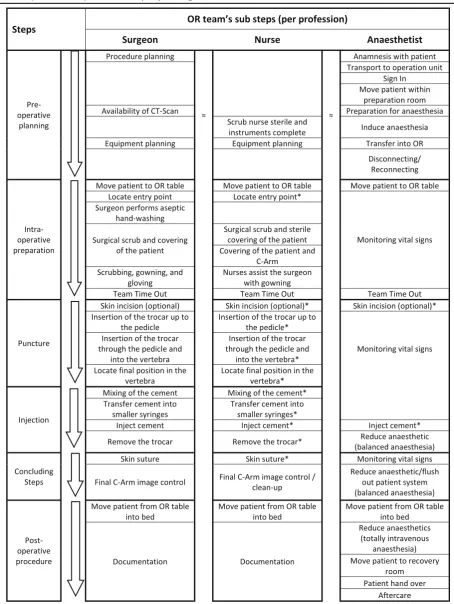
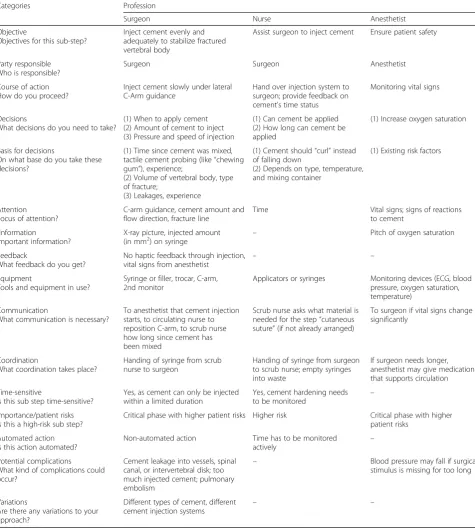
The aim of step V was to format all results for final ap-plication. The Concepts-Processes-and-Principles-Method combined with Protocol Analysis already generates a de-tailed list and description of the actions, conceptual knowledge, and conditions necessary to perform a task (see Additional file 4 [A4 “Result Tables”] for compre-hensive result tables). Additionally, results were revised and streamlined for clarity and comprehensibility. We created a table with the steps and sub-steps for all three OR team professions (Table 2). For demonstration pur-poses, we additionally compiled a table with all ana-lyzed categories for a single sub-step for all three OR professions respectively (Table3).
Results
Observational and interview sample
Table 2Steps and sub steps of a vertebroplasty for surgeon, nurse, and anesthetist
Expert interviews were conducted with five surgeons, four nurses, and four anesthetists with mean durations of 47, 61, and 56 min respectively. All five surgeons were male with two being neurosurgery specialists, two trauma specialists, and one orthopedic specialist. All had at least 10 years of experience with VPs. Of the four nurses, two were female. All had at least 7 years of
professional tenure. All four anesthetists were male, and all but one had at least 15 years of experience. This one was about to successfully complete his specialty training and was explicitly suggested as expert with regard to our criteria by his colleagues and head of department. All in-terviewees successfully completed more than 100 VPs and can therefore be considered experts.
Table 3Intra-operative demands for surgeon, nurse, and anesthetist (example sub-step“inject cement”)
Categories Profession
Surgeon Nurse Anesthetist
Objective
Objectives for this sub-step?
Inject cement evenly and adequately to stabilize fractured vertebral body
Assist surgeon to inject cement Ensure patient safety
Party responsible Who is responsible?
Surgeon Surgeon Anesthetist
Course of action How do you proceed?
Inject cement slowly under lateral C-Arm guidance
Hand over injection system to surgeon; provide feedback on cement’s time status
Monitoring vital signs
Decisions
What decisions do you need to take?
(1) When to apply cement (2) Amount of cement to inject (3) Pressure and speed of injection
(1) Can cement be applied (2) How long can cement be applied
(1) Increase oxygen saturation
Basis for decisions
On what base do you take these decisions?
(1) Time since cement was mixed, tactile cement probing (like“chewing gum”), experience;
(2) Volume of vertebral body, type of fracture;
(3) Leakages, experience
(1) Cement should“curl”instead of falling down
(2) Depends on type, temperature, and mixing container
(1) Existing risk factors
Attention Focus of attention?
C-arm guidance, cement amount and flow direction, fracture line
Time Vital signs; signs of reactions to cement
Information
Important information?
X-ray picture, injected amount
(in mm2) on syringe – Pitch of oxygen saturation
Feedback
What feedback do you get?
No haptic feedback through injection, vital signs from anesthetist
– –
Equipment
Tools and equipment in use?
Syringe or filler, trocar, C-arm, 2nd monitor
Applicators or syringes Monitoring devices (ECG, blood pressure, oxygen saturation, temperature)
Communication
What communication is necessary?
To anesthetist that cement injection starts, to circulating nurse to reposition C-arm, to scrub nurse how long since cement has been mixed
Scrub nurse asks what material is needed for the step“cutaneous suture”(if not already arranged)
To surgeon if vital signs change significantly
Coordination
What coordination takes place?
Handing of syringe from scrub nurse to surgeon
Handing of syringe from surgeon to scrub nurse; empty syringes into waste
If surgeon needs longer, anesthetist may give medication that supports circulation
Time-sensitive
Is this sub step time-sensitive?
Yes, as cement can only be injected within a limited duration
Yes, cement hardening needs to be monitored –
Importance/patient risks Is this a high-risk sub step?
Critical phase with higher patient risks Higher risk Critical phase with higher patient risks
Automated action Is this action automated?
Non-automated action Time has to be monitored
actively –
Potential complications
What kind of complications could occur?
Cement leakage into vessels, spinal canal, or intervertebral disk; too much injected cement; pulmonary embolism
– Blood pressure may fall if surgical stimulus is missing for too long
Variations
Are there any variations to your approach?
Different types of cement, different
CTA results
We present the results as an overview according to our three study objectives. Specific examples from the target procedure are used as to demonstrate the findings. Due to brevity of space, in-depth presentation of all retrieved data is provided as Additional file4(A4“Result Tables”).
1. Definition of steps and sub-steps of the procedure
We identified 6 procedural steps with 21 sub-steps for surgeons, 20 sub-steps for nurses, and 22 sub-steps for anesthetists (see Table2for an overview and Additional file4 [A4 “Result tables”] for an in-depth presentation). As can be seen in Table2, the surgeons’sub-steps differ from the anesthetists’sub-steps, whereas surgeons’and scrub nurses’ sub-steps are almost identical. For example, surgeons’task steps from “locate entry point” till “transfer cement into smaller syringes”concur with anesthetists’task of“ monitor-ing vital signs,” except for the steps“team time out” and “skin incision.”Surgeons and nurses share 18 of their 21 re-spectively 20 sub-steps while anesthetists only share 5 sub-steps with either of them. However, although we con-sistently used the identical terms for the shared sub-steps for simplification, the tasks on hand of the single profes-sions differ. As an example, the sub-step“inject cement”is presented in detail in the next section and in Table 3. Interactions and dependencies between single profes-sions can be seen in the categories “communication” and “coordination.” Additionally, we identified consid-erable variation in OR teams’ sub-steps. For example, there are varying anesthesia procedures possible, de-pending on the type of anesthetic used, and therefore, the sub-steps change accordingly. Moreover, in the step “preoperative preparation,” there are fewer overlapping sub-steps for all OR members due to their individual tasks while preparing and setting up.
2. Definition of intra-operative technical and non-technical skills relevant to all involved OR professions
We collected information on 16 predefined categories for all three OR professions through observations and interviews. Variations in the procedure are possible due to different hospitals and their particular standards, dif-ferent departments (neurosurgery, trauma, and orthope-dics), and available equipment (one or two C-Arms, CT). Table 3 provides an example excerpt for the sub-step “inject cement” that lists intra-operative de-mands for each OR profession. We chose this sub-step because it bears high patient risks, and all three OR team members need to collaborate closely and pay par-ticular attention to each other’s actions. The full results reporting the comprehensive descriptions of all OR pro-fessionals’intra-operative task demands can be found as Additional file4(A4“Result Tables”).
3. Consensus-based deduction of simulation requirements
All task information was then discussed in an expert panel to achieve consensus on simulation requirements of intra-operative demands. The comprehensive list of defined requirements for the whole procedure can be found as Additional file 4 (A4“Result Tables”). Figure1 represents the consensus on team’s task step“place tro-car on pedicle”as an example. On the left side of Fig.1, the previously established intra-operative demands are listed; in the case of this example of surgeons’sub-step “insertion of the trocar up to the pedicle,” the expert panel deduced respective simulation requirements (see right column, Fig. 1). Here, surgeons reported that a needle placed on the pedicle is able to stand independ-ently if it is inserted deeply enough into the soft tissue (cf., category“course of action”). Accordingly, simulation requirements were defined such that soft tissues of the simulator provide sufficient resistance to laterally hold the needle. Moreover, surgeons reported that during initial trocar placement, they rely upon haptic feedback from varying tissue and bone contact for orientation (cf., category ‘feedback’). Consequently, the difference
between soft tissue and bone needs to be noticeable for sensing bone surface and structure. Additionally, surgeons revealed that the absence of a second C-Arm leads to more coordination needs between surgeon and circulating nurse, as the single C-Arm needs to be turned by the cir-culating nurse on the surgeon’s instructions constantly (cf., category “coordination”). Therefore, to increase co-ordination training, a simulation environment may delib-erately implement a single C-Arm instead of two.
Discussion
We introduce a CTA approach that may serve as a guideline for team simulation environment development. It contributes in several ways to the current knowledge base on simulation in surgery:
First, we show how to identify tasks and demands of a surgical procedure that provides a basis for definition of realistic simulation environments. In comparison with existing studies on simulator development [33, 34], our approach allows generation of information about the procedure, inherent demands and skills, and simulator environment characteristics that emerge from the actual surgical procedure. Our approach thus combines the in-structiveness of CTA-based methods with the explora-tive nature of simulation development [19, 35]. We are convinced that this systematic development process fa-cilitates the construction of surgical simulation environ-ments that enable“the operator to reproduce or represent under test conditions phenomena likely to occur in actual performance”[36].
The definition and simulation of key tasks and learn-ing objectives are considered as belearn-ing more important than fidelity in simulation [37, 38]. The systematic com-bination of structured observations and expert interviews generates reliable information of the surgical procedure’s key tasks through minimizing biases and sources of unre-liable information that are inherent to each of the individ-ual methods. By using different methods, single sources of bias like recall bias in SME-interviews or observer bias in realistic observations are minimized. Potential bias and er-roneous information are compensated through the com-bination of different methodologies. Clearly defined key tasks and learning objectives are prior conditions for the design of training technologies [39] that have a sustainable impact for the transfer of technical skills from simulation to patient outcomes [5]. Our approach strengthens the evidence of validity of the findings and provides a plaus-ible basis for the design of a simulation environment.
Moreover, our approach captures technical and non-technical demands relevant for all OR professionals, i.e., surgeons, nurses, and anesthetists. This perspective of OR teamwork provides basis for future development of multidisciplinary OR team training [9]. Current simulation literature in this field frequently lacks descriptions about
the development of medical team training and scenarios [40]. Our method facilitates definition of surgical OR team simulations that include all essential behaviors, skills, key demands, and intra-operative steps. We are confident that our systematic definition procedure, through precise de-velopment description and elicitation categories, can be used for other medical procedures, beyond spine or min-imally invasive surgery. A wider adaption of this method would limit previous criticism that available NTS and multidisciplinary OR team trainings often lack thorough reporting of their development process [4,41].
A further contribution of our work relates specifically to the field of simulation in spine surgery. Simulators in spine surgery are increasingly introduced since many procedures involve high risks [3, 42]. While other surgi-cal specialties already incorporate team training in their assessment and education, there are no team simulations available for spine procedures. Despite the introduction of simulators for minimally invasive spine surgery [3, 43], concurrent reports omit information on how the simula-tor protocol was actually obtained and how simulasimula-tor re-quirements were deduced. Our attempt to take account of NTS across all involved professional roles in the OR ex-pands previous work since team simulations are key to surgical safety and quality of care [3]. This concurrent in-clusion of all OR professions prevents silo development and separation of professions in improvement efforts of OR teamwork [44].
Limitations
Although we successfully applied our CTA-based ap-proach for the vertebroplasty procedure and OR team-work, the external validity of our results may be limited concerning other surgical procedures, e.g., OR teams in more complex procedures and consisting of additional OR professionals. Our approach was well suited for VP and minimally invasive surgery, characterized by small teams, short durations, few risk-associated steps, and a homogeneous patient group. Other surgical procedures may require a more adaptive approach, e.g., consider-ation of task scheduling. Wei and Salvendy [19] offer an extensive discussion of other types of CTAs and their possibilities. We sought to minimize bias by utilizing dif-ferent complementary methods. Yet, we cannot rule out information bias since observers, interviewers, and part of the reviewers of step IV and V were identical (MP and MW).
Experience reflection on potential benefits, challenges, and recommendations
Concerning potential benefits, this CTA approach gen-erated an in-depth understanding of the surgical proced-ure and all its characteristics, challenges, and processes. We were able to gather information and insights about procedure characteristics that are not reported in text-books, training lessons, or taught by senior experts. This representation of intra-operative demands for all OR team members during all steps of a vertebroplasty will guide the further development of our simulation environment.
One of the biggest challenges for us was to select the appropriate CTA methods for our aims, as there are many CTA methods available and only limited literature on their pros and cons exists. Moreover, similar develop-ment studies do not describe their methods and under-lying choices in depth. We therefore suggest, prior to start, a careful literature review and consultation of a CTA expert. Additionally, the nomenclature within the CTA literature can be confusing. For example, the sec-ond part of a CTA is labeled“knowledge representation” and can be mistaken for step II“identify knowledge rep-resentations”which belongs to the first part of CTA (see Table 1). Although this can be misleading, we decided not to change nomenclature for enhanced comparability with other CTA literature. A further challenge was the complexity of CTA approaches: they are time-consuming and require a set of skills like accuracy, endurance, pa-tience, and understanding of complex tasks. Experts are often hard to recruit for interviews that last longer than 30 min. During CTA interviews, we experienced that sur-gical experts perceive it as challenging to unravel a com-plex procedure in such details, i.e., fine-grained tasks steps with repeatedly explaining decisions and demands.
Our recommendations are therefore to carefully choose the appropriate CTA method as the results will strongly depend upon the selected approach. Our method was feas-ible for defining VP simulation development demands, but other scenarios may require different or additional CTA methods. Moreover, it might be necessary to adapt or mod-ify CTA methods to specific needs and aims. Additionally, we recommend to include a surgical expert or specialist in the development team from the very start (i.e., behavioral analysts in general lack surgical insights). Moreover, surgi-cal specialists on the team can help recruiting other experts for interviews and observations. In addition, we recom-mend conducting pilot observations for adapting to surgi-cal context and collecting preliminary knowledge (i.e., to provide a “feeling” for the surgical procedure). Lastly, we recommend identifying and contacting experts as soon as possible as recruiting can be time-consuming due to their rotations and acutely changing schedules.
Implications for future studies and simulation practice This approach may guide future studies aiming at struc-tured and systematic identification and definition of TS
and NTS in the course of surgical simulator development. Adaptions to other surgical procedures in and outside min-imally invasive and spine surgery and to other procedure characteristics, e.g., large teams or interchangeable proced-ure steps, are recommended. Through identification of simulation demands and reporting of the development process, our approach may facilitate future endeavors to bridge the gap between a medical procedure and its simu-lation. Recent systematic reviews showed an overall low methodical quality for medical simulation studies with weak standardized reporting of the development [3, 9]. In particular, knowledge elicitation and representation methods need to be reported thoroughly with the ob-jective to establish reliable and valid simulation envi-ronments for education and training. Future development of medical training simulators needs to draw upon sys-tematic and well-structured methods of task and skill identification as well as concise definition of simulator re-quirements with comprehensive reporting. Medical skill training based on CTA approaches is recommended.
Conclusions
Through a CTA approach using in situ observations and semi-structured interviews and protocol analysis, we de-fined steps, sub-steps, and demands of vertebroplasty procedures for all three OR professions and deduced simulation requirements in an expert panel. In our ex-perience, CTA is a well-suited and effective method for simulator development to elicit, interpret, and represent information on intra-operative demands. This work con-tributes to future approaches, guiding them on imple-menting training for multidisciplinary OR teams regarding TS and NTS.
Additional files
Additional file 1:A1“Observation guideline.”(PDF 143 kb)
Additional file 2:A2“Category comparison.”(PDF 337 kb)
Additional file 3:A3“Surgeons interview guideline.”(PDF 243 kb)
Additional file 4:A4“Result Tables.”(XLSX 55 kb)
Abbreviations
CTA:Cognitive task analysis; NTS: Non-technical skills; OR: Operating room; SME: Subject matter expert; TS: Technical skills; VP: Vertebroplasty
Acknowledgements
We would like to thank Anna Schwarz for proofreading.
Funding
This research is supported by the German Research Foundation (DFG, WE 4682/4-1, NA 620/30-1, and LA 3341/2). The funding body did not interfere in the design of the study and collection, analysis, and interpretation of data or in writing the manuscript.
Availability of data and materials
Authors’contributions
MP conducted the observations and interviews, reviewed and evaluated them, and wrote the main parts of the manuscript. MW conducted the observations, reviewed and evaluated the observations and interviews, and supervised the manuscript writing. ML, PW, and PS evaluated the observations and interviews and revised the final manuscript. All authors read and approved the final manuscript.
Ethics approval and consent to participate
Ethics approval was obtained from Ethics Committee of the Faculty of Medicine, Ludwig-Maximilians-University Munich (Nr 773-15). All participants provided written consent.
Consent for publication
Not applicable
Competing interests
The authors declare that they have no competing interests.
Publisher’s Note
Springer Nature remains neutral with regard to jurisdictional claims in published maps and institutional affiliations.
Author details
1Institute and Outpatient Clinic for Occupational, Social, and Environmental
Medicine, University Hospital, Ludwig-Maximilians-University Munich, Ziemssenstrasse 1, 80336 Munich, Germany.2Chair for Computer Aided
Medical Procedures & Augmented Reality, Department of Informatics/I-16, TU Munich, Boltzmannstrasse 3, 85748 Garching, Germany.3Institute for
Emergency Medicine and Management in Medicine (INM), University Hospital, Ludwig-Maximilians-University Munich, Schillerstraße 53, 80336 Munich, Germany.
Received: 22 May 2018 Accepted: 22 August 2018
References
1. Cannon-Bowers J, Bowers C, Stout R, Ricci K, Hildabrand A. Using cognitive task analysis to develop simulation-based training for medical tasks. Mil Med. 2013;178:15–21.
2. Fung L, Boet S, Bould MD, Qosa H, Perrier L, Tricco A, et al. Impact of crisis resource management simulation-based training for interprofessional and interdisciplinary teams: a systematic review. J Interprof Care. 2015;29:433–44. 3. Pfandler M, Lazarovici M, Stefan P, Wucherer P, Weigl M. Virtual reality-based simulators for spine surgery: a systematic review. Spine J. 2017;17:1352–63. 4. Robertson JM, Dias RD, Yule S, Smink DS. Operating room team training
with simulation: a systematic review. J Laparoendosc Adv Surg Tech A. 2017;27:475–80.
5. Dawe SR, Pena GN, Windsor JA, Broeders JAJL, Cregan PC, Hewett PJ, et al. Systematic review of skills transfer after surgical simulation-based training. Br J Surg. 2014;101:1063–76.
6. Agha RA, Fowler AJ, Sevdalis N. The role of non-technical skills in surgery. Ann Med Surg. 2015;4:422–7.
7. Siu J, Maran N, Paterson-Brown S. Observation of behavioural markers of non-technical skills in the operating room and their relationship to intra-operative incidents. Surgeon. 2016;14:119–28.
8. Yule S, Parker SH, Wilkinson J, McKinley A, MacDonald J, Neill A, et al. Coaching non-technical skills improves surgical residents’performance in a simulated operating room. J Surg Educ. 2015;72:1124–30.
9. Cumin D, Boyd MJ, Webster CS, Weller JM. A Systematic review of simulation for multidisciplinary team training in operating rooms: Simul Healthc J Soc Simul Healthc 2013;8:171–179.
10. O’connor P, O’dea A, Lydon S, Offiah G, Scott J, Flannery A, et al. A mixed-methods study of the causes and impact of poor teamwork between junior doctors and nurses. Int J Qual Health Care. 2016;28:339–45.
11. Murphy M, Curtis K, McCloughen A. What is the impact of multidisciplinary team simulation training on team performance and efficiency of patient care? An integrative review. Australas Emerg Nurs J. 2016;19:44–53. 12. Clark RE, Feldon D, van Merrienboer J, Yates K, Early S. Cognitive task
analysis. In: Spector JM, editor. Handb Res Educ Commun Technol. New York: Macmillan/Gale; 2008. p. 577–93.
13. Clark R. Cognitive task analysis for expert-based instruction in healthcare. In: Spector JM, Merrill MD, Elen J, Bishop MJ, editors. Handb Res Educ Commun Technol. New York: Springer; 2014. p. 541–51.
14. Riggle JD, Wadman MC, McCrory B, Lowndes BR, Heald EA, Carstens PK, et al. Task analysis method for procedural training curriculum development. Perspect Med Educ. 2014;3:204–18.
15. Sullivan ME, Yates KA, Inaba K, Lam L, Clark RE. The use of cognitive task analysis to reveal the instructional limitations of experts in the teaching of procedural skills. Acad Med. 2014;89:811–6.
16. Tofel-Grehl C, Feldon DF. Cognitive task analysis-based training: a meta-analysis of studies. J Cogn Eng Decis Mak. 2013;7:293–304.
17. Wingfield LR, Kulendran M, Chow A, Nehme J, Purkayastha S. Cognitive task analysis: bringing Olympic athlete style training to surgical education. Surg Innov. 2015;22:406–17.
18. Clark RE, Estes F. Cognitive task analysis for training. Int J Educ Res. 1996;25:403–17. 19. Wei J, Salvendy G. The cognitive task analysis methods for job and task
design: review and reappraisal. Behav Inf Technol. 2004;23:273–99. 20. Yates K. Towards a taxonomy of cognitive task analysis methods: a search
for cognition and task analysis interactions [dissertation]: University of Southern California; 2007.http://www.cogtech.usc.edu/publications/yates_ dissertation_2007.pdf.
21. Yates K, Sullivan M, Clark R. Integrated studies on the use of cognitive task analysis to capture surgical expertise for central venous catheter placement and open cricothyrotomy. Am J Surg. 2012;203:76–80.
22. Crandall B, Klein GA, Hoffman RR. Working minds: a practitioner’s guide to cognitive task analysis. Cambridge: Mit Press; 2006.
23. Grant T, McNeil MA, Luo X. Absolute and relative value of patient simulator features as perceived by medical undergraduates. Simul Healthc J Soc Simul Healthc. 2008;3:133–7.
24. Klein GA, Militello L. Some guidelines for conducting a cognitive task analysis. In: Salas E, editor. Adv Hum Perform Cogn Eng Res. Amsterdam. New York: JAI; 2001. p. 163–99.
25. Schraagen JM, Chipman SF, Shalin VL. Cognitive task analysis. Hove: Psychology Press; 2000.
26. Adermann J, Geißler N, Bernal LE, Kotzsch S, Korb W. Development and validation of an artificial wetlab training system for the lumbar discectomy. Eur Spine J. 2014;23:1978–83.
27. Clark RE. Design document for a guided experiential learning course. Technical Report DAAD 19-99-D-0046-0004, 53-4400-8040, Institute for Creative Technology and the Rossier School of Education. Los Angeles: University of Southern California, 2004.
28. Clark RE. Training aid for cognitive task analysis Technical Report ICT 53-0821-0137-W911NF-04-D-0005, Institute for Creative Technologies to the Center for Cognitive Technology, Los Angeles: University of Southern California, 2006. 29. Yates KA, Feldon DF. Advancing the practice of cognitive task analysis: a call
for taxonomic research. Theor Issues Ergon Sci. 2011;12:472–95. 30. Pugh CM, Santacaterina S, DaRosa DA, Clark RE. Intra-operative decision
making: more than meets the eye. J Biomed Inform. 2011;44:486–96. 31. Clarke MA, Belden JL, Kim MS. Determining differences in user performance
between expert and novice primary care doctors when using an electronic health record (EHR): EHR usability gaps between doctors. J Eval Clin Pract. 2014;20:1153–61.
32. Ericsson KA, Simon HA. Protocol analysis: verbal reports as data. Rev. ed. Cambridge: MIT Press; 1993.
33. Keri Z, Sydor D, Ungi T, Holden MS, McGraw R, Mousavi P, et al. Computerized training system for ultrasound-guided lumbar puncture on abnormal spine models: a randomized controlled trial. Can J Anaesth J Can Anesth. 2015;62:777–84.
34. Fürst D, Hollensteiner M, Gabauer S, Esterer B, Trieb K, Eckstein F, et al. Transpedicular approach on a novel spine simulator: a validation study. J Surg Educ. 2018;75(4):1127–34.
35. Bewley WL, O’Neil HF. Evaluation of medical simulations. Mil Med. 2013;178:64–75. 36. Merriam-Webster Online Dictionary.https://www.merriam-webster.com/
dictionary/simulator. Accessed 08 Mar 2018.
37. Krage R, Erwteman M. State-of-the-art usage of simulation in anesthesia: skills and teamwork. Curr Opin Anaesthesiol. 2015;28:727–34.
38. Dieckmann P, Krage R. Simulation and psychology: creating, recognizing and using learning opportunities. Curr Opin Anaesthesiol. 2013;26:714–20. 39. van Merriënboer JJG, Kirschner PA. Ten steps to complex learning: a
40. Seymour NE, Paige JT, Arora S, Fernandez GL, Aggarwal R, Tsuda ST, et al. Putting the MeaT into TeaM training: development, delivery, and evaluation of a surgical team-training workshop. J Surg Educ. 2016;73:136–42. 41. Gordon M, Darbyshire D, Baker P. Non-technical skills training to enhance
patient safety: a systematic review: non-technical skills education: a systematic review. Med Educ. 2012;46:1042–54.
42. Kirkman MA, Ahmed M, Albert AF, Wilson MH, Nandi D, Sevdalis N. The use of simulation in neurosurgical education and training: a systematic review. J Neurosurg. 2014;121:228–46.
43. Bohm P, Arnold P. Simulation and resident education in spinal neurosurgery. Surg Neurol Int. 2015;6:33.