DOI 10.1007/s10152-008-0118-7 O R I G I N A L A R T I C L E
E
V
ects of regular and irregular temporal patterns of disturbance
on biomass accrual and species composition of a subtidal
hard-bottom assemblage
Susanne Wollgast · Mark Lenz · Martin Wahl · Markus Molis
Received: 19 November 2007 / Revised: 30 April 2008 / Accepted: 5 May 2008 / Published online: 11 June 2008 © Springer-Verlag and AWI 2008
Abstract Assessing patterns of species distribution and abundance is important to understand the driving processes of, and predict future changes in, biodiversity. To this date, ecological studies have been mainly designed to investigate the eVects of the mean magnitude of predictor variables, although ecological factors naturally vary in space and time. In a nine month long Weld experiment, we tested the eVects of diVerent temporal patterns (regular, lowly and highly irregular) in biomass removal (=disturbance event) on the diversity, species composition, and biomass accrual of macrobenthic assemblages grown on 15£15 cm2 PVC-panels. For each pattern of disturbance, disturbance events were timed at three sequences to control for possible con-founding eVects with recruitment patterns. Disturbance intensity was kept identical among treatments. Assem-blages developed in the absence of disturbance for 3 months prior to a 150-day manipulation period, during which the biomass from 20% of the panel area was
removed at each of ten disturbance events. Additional undisturbed settlement panels were deployed in the Weld to assess monthly recruitment rates and species succession over a one year period. Disturbance (i) reduced biomass and total species cover, (ii) changed species composition during the Wrst half of the manipulation period signiWcantly, and (iii) was without eVect on species richness and even-ness. Irregular disturbance regimes enhanced the abun-dance of the ascidian Ciona intestinalis, biomass accrual, and total species cover of assemblages relative to the regu-lar disturbance regime, but had either no or only transient eVects on diversity and species composition, respectively. Neither the degree of irregularity in disturbance nor the sequence of disturbance events aVected any of the response variables signiWcantly. Recruitment of species was strongly seasonal with almost only diatoms recruiting during winter, while recruitment was most intense during summer. Our results suggest that the temporal patterns of predictor vari-ables might be of low explanatory power for the variance of responses in communities with seasonal recruitment pat-terns that are exposed to a high level of disturbance. Thus the need to include temporal patterns of predictor variables in experimental designs may depend on community dynam-ics and the characteristdynam-ics of the process under investiga-tion.
Keywords Community ecology · Hard-bottom · Helgoland · Species richness · Succession
Introduction
Theoretical and experimental evidence from a variety of habitats suggests that declining diversity can adversely aVect the functioning and stability of ecosystems (e.g. Communicated by H.-D. Franke.
S. Wollgast and M. Molis contributed equally to this work. S. Wollgast
University Duisburg-Essen, Universitätsstraße 5, 45117 Essen, Germany
M. Lenz · M. Wahl
IFM-GEOMAR, Leibniz Institute of Marine Sciences at the University of Kiel, Düsternbrooker Weg 20, 24105 Kiel, Germany
M. Molis (&)
Loreau 2000; Morin and McGrady-Steed 2004). A change in global diversity may matter to mankind due to an altered provision of ecosystem goods and services (sensu Hooper et al. 2005). Consequently, ecological research needs to assess at various scales which factors aVect diver-sity, to better understand the causes and consequences of the presently observed loss of species (Hughes et al.
1997).
Disturbance is perhaps the best studied factor aVecting local patterns of species diversity in both terrestrial and aquatic systems (Menge and Sutherland 1987). Distur-bances are deWned as stochastic and discrete events, caus-ing partial or total destruction of biomass (Grime 1977). Common to the diVerent kinds of disturbance is the release of limiting resources, e.g. substrate, which alters niche opportunities (Shea et al. 2004). Previous studies on distur-bance–diversity relationships did not allow for drawing general conclusions on the eVects of disturbance. For instance, from meta-analysis of studies testing the ‘Interme-diate Disturbance Hypothesis (IDH)’, Mackey and Currie (2001) concluded that diversity–disturbance relationships did not peak as consistently as predicted by the IDH. This suggests that factors other than disturbance per se control diversity patterns. For instance, the interactive eVects of productivity and disturbance were hypothesized to increase the predictability of disturbance eVects on species diversity (Kondoh 2001), with limited support from Weld experi-ments (Jara et al. 2006; Svensson et al. 2007).
Under natural conditions, biological responses are determined by a variable environment. For instance, pred-ator attacks are not evenly distributed in time and space, resulting in variable consumer–resource interactions (Sommer 2000). Despite the wide acceptance of this notion, the majority of experiments in ecology assessed the eVects of diVerent mean magnitudes of factors on eco-logical processes. Designing experiments that include the eVects of temporal or spatial irregularity in disturbance regimes may produce more realistic data (Benedetti-Cec-chi 2003), which could also improve the predictability of disturbance–diversity relationships. Some studies that used diVerent temporal patterns of predictor variables, manipulated the frequency of the predictor variable, e.g. predation (Navarrete 1996), thereby confounding temporal irregularity and intensity of predation. Only a few studies, all but one (Sugden et al. 2007) conducted in the Mediter-ranean, rigorously tested the eVects of the variation of disturbance events on community responses (Benedetti-Cecchi et al. 2005, 2006; Bertocci et al. 2005, 2007). However, these studies focused on the interactive eVects of mean intensity and temporal variability of e.g. distur-bance, and did not assess the interactive eVects of irregular disturbance patterns and the sequence of disturbance events. Testing the eVects of the sequence of disturbance
events is necessary to tease apart the eVects of irregularity of disturbance from those of seasonal recruitment periods of organisms (Bertocci et al. 2005). If disturbance events coincide with the period of recruitment of species having a discontinuous release of propagules, community responses may be due to the speciWc sequence of disturbance events, rather than to irregular disturbance patterns (Benedetti-Cecchi 2003).
Experiments testing the eVects of variability of those environmental factors, such as climate, that currently undergo a rapid change are of particular interest. For instance, altered disturbance regimes from a climate change induced modiWcation in the frequency and intensity of storms are expected to have striking eVects on the ecology of coastal systems (Kjerfve et al. 1994). In the German Bight, storm frequency and intensity increased over the last decades (Danard et al. 2004) and may aVect benthic com-munity structure, e.g. due to the overturning of boulders in subtidal habitats or by battering of drift wood in intertidal habitats. Using a multi-factorial Weld experiment, we assessed the eVects of (1) a physical disturbance, (2) the temporal irregularity in a disturbance regime while keeping disturbance intensity constant, and (3) the sequence of dis-turbance events on biomass accrual, diversity, and species composition of subtidal macrobenthic assemblages at the Island of Helgoland, North Sea.
Material and methods
Study site
One observational and one manipulative Weld experiment were conducted at “Nebelhorn” (54°10⬘57⬙N, 7°53⬘7⬙E), a wave sheltered site in the outer harbour of the Island of Helgoland, Germany. There, large stones (bunker debris) are scattered over soft sediments in 7.5m water depth and a concrete jetty frames the study site at two sides. These artiWcial hard substrata are covered by typical members of subtidal communities, including algae, barnacles, amphi-pods, ascidians, and bryozoans, which were also found elsewhere on the rocky shores of Helgoland (de Kluijver
1991). Species recruitment around Helgoland follows a strong seasonal pattern that was observed at diVerent sites (including the study site) and in diVerent years (Anger
Experimental design and set-up
Variability experiment
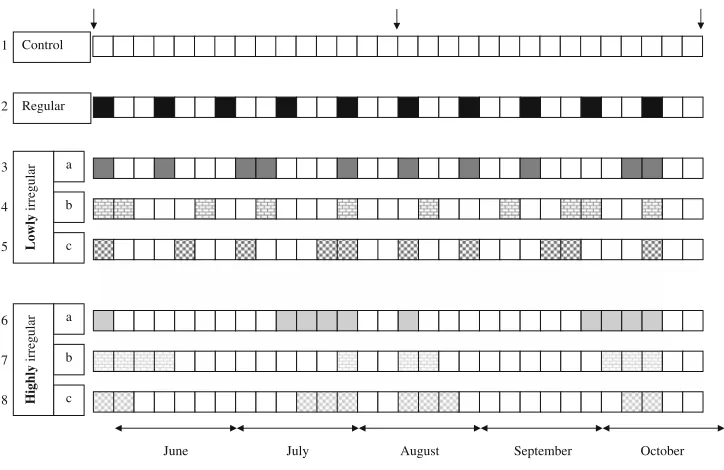
A manipulative factorial experiment was designed to test for the eVects of temporal irregularity of a physical, non-selective disturbance regime (four levels, Wxed: control, regular, lowly, and highly irregular) on biomass accrual, diversity, and species composition of epibenthic communi-ties. Disturbance events were scheduled at three diVerent sequences, nested in a low and a high level of temporal irregularity, resulting in a total of eight treatment combina-tions (Fig.1).
The experiment was conducted between February 14 and October 24, 2005. Two larger buoys (Ø 50 cm), at a distance of 20 m, were connected by a line at the water surface, and each buoy was attached to one ground weight. This mooring was ca. 70 m away from the con-crete jetties framing the study site. Eight smaller buoys (Ø 15 cm) were Wxed to the surface line to keep it Xoating. Eight grey PVC rings (60 cm Ø, 25 cm height, 3 mm thick) that served as experimental blocks were Wxed to the surface line. The distance between adjacent rings was ¸2 m. Rings were allowed to rotate around their centre axis. Ten grey PVC settlement-panels (experimental units = EUs) were Wxed at a distance of 5 cm between adjacent panels perpendicular to the sea Xoor to the inside of each ring (total of 80 EUs). Concrete weights (3 kg) were Wxed to rings without reaching the sea Xoor, to ensure that rings and therefore EUs were suspended at 0.5 m water depth with reference to panel centre. Neither benthic nor pelagic predators were observed on the set-up.
Furthermore, missing bit marks indicate that our set-up generated a consumer-free space, minimising confound-ing eVects by consumer activity to disturbance treatments. Settlement panels of 15£15 cm² (3 mm thick) were roughened (sand paper grading 60) and randomly allo-cated to a disturbance treatment. Since the number of EUs per block, i.e. 10, exceeded the number of treatment com-binations, i.e. 8, two within-block replicates, both of diVerent treatment combination, were added to each block (Fig.2).
Succession experiment
An observational study was designed to assess temporal patterns in recruitment and succession of species on settle-ment panels over an 11-month period. On May 27, 2005, 16 PVC panels with properties identical to those used in the variability experiment were Wxed with ropes to the sur-face line of the above described mooring. PVC panels were positioned at 50-cm water depth and a distance of 60 cm to each other as well as to the rings of the variability experiment. Half of the panels (recruitment panels, n= 8) were randomly selected to assess species recruitment by estimating percent cover of each sessile species encoun-tered on the panels (see “sampling” for details). After sam-pling, all biota were removed and clean panels returned within 24 h to the set-up. This procedure was monthly repeated until the last sampling on April 25, 2006. The second half of the panels (succession panels, n= 8) was used to follow species succession for 11 months. Succes-sion panels were always sampled together with and in the same way as recruitment panels. However, biota were not
Fig. 1 Variability experiment. Temporal patterns of distur-bance events for all eight treat-ment combinations. Single boxes
represent 5-day intervals. Open boxes indicate among distur-bance intervals, while Wlled box-es mark intervals when a disturbance event was applied on the Wrst day of this interval. DiVerent levels of disturbance variation are colour-coded:
black regular, dark grey lowly irregular, and light grey highly irregular. Patterns of box Wllings
indicate diVerent sequences (a
full, b brick, and c chess board) of disturbance events. Numbers
at the start of lines code diVerent treatment combinations. Sampling dates are arrowed
Regular
a
b
c
Hi
g
hl
y
irre
gu
lar
a
b
c
Lowl
y
irre
gu
lar
June July August September October Control
1
2
3
4
5
6
7
removed and panels with attached assemblages were returned to the set-up.
Treatments
All experimental units were disturbed for the Wrst time on 27 May 2005, after they had been incubated at the study site without manipulation for 13 weeks to allow for the establishment of early successional epibenthic assemblages (Fig.3, May). During the 150-day manipulation period, assemblages on all panels (except controls) were disturbed 10 times; therefore, they experienced the identical distur-bance intensity. At a single disturdistur-bance event, we removed the entire biomass from two randomly selected, non-over-lapping circular spots, representing together 20% of the area of each settlement panel. As the selection of distur-bance areas was at random, the same area could be dis-turbed at successive disturbance events. Assemblages were disturbed every Wfth day or a multiple thereof (Fig.1). In the “regular” treatment, communities were disturbed every 15 days, i.e. at regular intervals. Irregularity of intervals between disturbance events was deWned as the standard deviation of among disturbance intervals from the mean interval length of 15 days (=no variability). By accordingly timing the disturbance events, a lowly irregular (SD = 5.77) and a highly irregular (SD = 16.33) treatment were applied (Fig.1). To reduce the risk of confounding the eVects of irregularity of disturbance with recovery time (Bertocci et al. 2005), the period between the last disturbance event and the end of the experiment was kept identical to 15 days in all disturbance treatments. A further assumption underly-ing our experiment is that the eVects of removing biomass, and by this opening space for new settlers, should depend on temporal patterns in larval and propagule settlement. To assess possible interactions between the sequence of distur-bance events and the degree of irregularity of disturdistur-bance, three diVerent sequences of disturbance events were applied for both, the low and high irregularity treatment,
without changing the level of irregularity nor intensity of disturbance (Fig.1).
Sampling
For sampling, panels were removed from the set-up, trans-ferred in shaded containers within 15 min to the laboratory of the Biologische Anstalt Helgoland, maintained in large
Xow-through containers, and returned within 24 h to the set-up. In the laboratory, percent cover of all sessile species (>1 mm) encountered on the panels was estimated non-destructively by the same person prior to (27 May 2005), in the middle (10 August 2005), and at the end of the manipu-lation period (October 24, 2005). Mobile species were not recorded. A 1 cm wide band along panel margins was ignored to avoid edge eVects, leaving 169 cm² of sampling area per EU. Diatoms and green Wlamentous algae were recorded as two group taxa, because non-destructive sam-pling prevented unambiguous species identiWcation. All other colonizers were identiWed to the lowest possible taxonomic level, usually to species level. Percent cover of macroscopic species in the area sampled was estimated by the naked eye and, using a stereo microscope (12£
magni-Wcation) for those species that were not detectable macro-scopically, from six randomly chosen 2£2 cm2 sized subsamples. Due to the multi-layered structure of the foul-ing assemblages, total percent cover could exceed 100%. In the middle and at the end of the manipulation period, bio-mass was non-destructively assessed as wet bio-mass after rest-ing panels for 1 min vertically to allow drainage of excess water, weighing communities still attached to panels to the nearest 0.1 g, and subtracting panel mass. At the end of the experiment, dry mass was measured for each EU by remov-ing all organisms from the samplremov-ing area, dryremov-ing them at 60°C to constant weight, and weighing to the nearest 0.001 g. As diversity variables, species richness was recorded, while Pielou’s evenness was calculated from abundance data.
Fig. 2 Schematic illustration of two (roman numbers in buoys) adjacent rings (=blocks) from part of the set up. Squares and numbers
inside squares indicate the position of settlement panels within rings and allocated treatment levels (total number of treatment
combinations = 8), respectively. Bold font indicates within block rep-licates. Distances are arrowed. Note: drawing not to scale. For clarity, the surface line and concrete weights are not shown
II
6
1
8 4 8
3 1 7 5 2
6
7 3 2
4
I
4 5 8 6 1
0.5 m
Statistical analysis
Data were tested for homogeneity of variances prior to the analysis and log-transformed where appropriate to meet the assumptions (Cochran’s test). Diversity and biomass data from undisturbed (control) assemblages were compared between the three sampling events using a 1-factorial ANOVA and Tukey’s HSD post hoc test. We tested for the eVects of the factors “disturbance”, “irregularity of distur-bance”, and “sequence of disturbance events” in the middle and at the end of the 150-day manipulation period with a multi-staged ANOVA. First, we obtained the variation between replicates on the block level, i.e. the error term, from a mixed model two-factorial ANOVA, including the replicates of treatments in each block (Wxed, two levels) and blocks (random, eight levels) as factors. Second, we used a three-factorial nested ANOVA, with the “sequence of disturbance events” (random, three levels), which was nested within “irregularity of disturbance” (Wxed, four lev-els), and crossed with “block” (random, eight levels). When the “block”£“irregularity of disturbance” interaction was non-signiWcant at ¸0.25, the term was eliminated from the model and we tested for eVects of “disturbance”, “irreg-ularity of disturbance”, and “sequence of disturbance events”.
Treatment eVects on the composition of fouling commu-nities were assessed with ANOSIM (Primer 5.0), based on multidimensional scaling of the Bray-Curtis similarity index. The SIMPER routine was used for exploration of the
relative contribution of species to observed diVerences in community composition.
Results
Variability experiment
Community composition
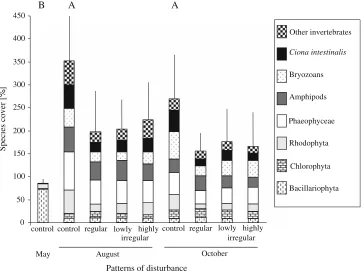
In total, 31 taxa were encountered on the settlement panels (Table1). In May 2005, prior to manipulations, diatoms dominated the assemblage (Fig.3), but Wve species of mac-roalgae and two invertebrate species were also present. In August, tube-dwelling amphipods, mainly Jassa falcata,
were the most abundant taxon on undisturbed assemblages. There were 1.5 times more invertebrates (13) than macroal-gae taxa (9) on undisturbed plots. At the end of the experi-ment in October, a total of 29 taxa were encountered on the settlement panels. Besides diatoms, we identiWed 16 spe-cies of invertebrates and 12 macroalgae. The large solitary sea squirt Ciona intestinalis was on average the most abun-dant species, occasionally completely covering control pan-els; followed by the bryozoan Scupocellaria scruposa and the amphipod J. falcata. The most abundant seaweeds were the red alga Ceramium virgatum and the green alga Ulva lactuca. Species composition in August was signiWcantly diVerent among diVerently disturbed assemblages (ANO-SIM: R= 0.10, P= 0.001). The species composition of
Fig. 3 Mean (+SD) total cover and average percent cover of taxa of communities prior to manipulations (May), in the middle (August), and at the end (October) of the manipulation period. Controls sharing a letter were not signiWcantly diVerent.
Solid horizontal lines group con-trasts among assemblages after exposure to diVerent disturbance regimes in the middle and at the end of the 150-day manipulation period
Ciona intestinalis
Bacillariophyta Rhodophyta Amphipods Bryozoans
highly 0
50 100 150 200 250 300 350 400 450
control control regular highly control regular lowly
May August October
B
pecies
c
[
%
]
lar
Patterns of disturbance A A
irregu irregular
So
v
er
lowly
Chlorophyta
Table 1 Dots indicate times when species were encountered during succession experiment (black) and disturbance experiment (white)
Filamentous green algae group a conglomerate of diVerent species of green algae, including the genera Monostroma, Ulva, and Chaetomorpha, for which unambiguous identiWcation in the Weld was impossible
2005 2006
May Jun Jul Aug Sep Oct Nov Jan Feb Mar Apr
Algae
Bacillariophyta 䊉䊊 䊉 䊉 䊉䊊 䊉 䊉䊊 䊉 䊉 䊉 䊉 䊉
Rhodophyta
Ceramium virgatum 䊉䊊 䊉 䊉 䊉䊊 䊉 䊉䊊 䊉 䊉 䊉 䊉 䊉
Polysiphonia stricta 䊉䊊 䊉 䊉䊊 䊉 䊉 䊉 䊉 䊉
P. elongata 䊉 䊉 䊉䊊 䊉 䊉䊊 䊉 䊉 䊉 䊉 䊉
Callithamnion corymbosum 䊉䊊 䊉 䊉 䊉
Plocamium cartilagineum 䊉䊊 䊉 䊉 䊉 䊉 䊉
Lomentaria clavellosa 䊉䊊
Phaeophyceae
Desmarestia aculeata 䊊 䊉 䊉䊊 䊉 䊉䊊
Laminaria digitata 䊉䊊 䊉 䊉 䊉䊊 䊉䊊 䊉 䊉 䊉
Chorda Wlum 䊉 䊉䊊 䊉 䊉䊊 䊉
Scytosiphonaceae 䊉 䊉 䊉䊊 䊉 䊉䊊 䊉 䊉 䊉
Cholophyta
Ulva lactuca 䊊 䊉 䊉 䊉䊊 䊉 䊉䊊 䊉 䊉 䊉 䊉 䊉
Filamentous green algae 䊉䊊 䊉 䊉䊊 䊉䊊 䊉 䊉 䊉 䊉 䊉
Bryopsis lyngbyei 䊉 䊉 䊉 䊉
Invertebrates Ascidians
Ciona intestinalis 䊉 䊉 䊉䊊 䊉 䊉䊊 䊉 䊉 䊉 䊉 䊉
Ascidiella aspersa 䊉䊊 䊉 䊉䊊 䊉
Botryllus schlosseri 䊉䊊
Botrylloides leachii 䊉䊊 䊉 䊉䊊
Sidnyum turbinatum 䊉
Diplosoma listrium 䊉䊊 䊉 䊉䊊 䊉 䊉 䊉 䊉 䊉
Didemnum macrulosum 䊉 䊉 䊊 䊉 䊉
Molgula spec. 䊉䊊
Crustaceans
Jassa falcata 䊊 䊉 䊉 䊉䊊 䊉 䊉䊊 䊉 䊉 䊉 䊉
Balanus crenatus 䊉 䊉 䊉䊊 䊉 䊉䊊 䊉 䊉 䊉 䊉 䊉
Elminius modestus 䊉 䊉 䊉䊊 䊉 䊉 䊉 䊉 䊉
Verruca stroemia 䊉 䊉 䊉䊊 䊉 䊉 䊉 䊉
Bryozoans
Electra pilosa 䊊 䊉 䊉䊊 䊉 䊉 䊉
Scupocellaria scruposa 䊉 䊉䊊 䊉 䊉䊊 䊉 䊉 䊉 䊉 䊉
Cryptosula pallasiana 䊉䊊 䊉 䊉䊊 䊉 䊉 䊉 䊉
Molluscs
Mytilus edulis 䊉 䊉 䊉䊊 䊉 䊉䊊 䊉 䊉 䊉 䊉 䊉
Ostrea spec. 䊉䊊 䊊
Polychaetes
Pomatoceros triqueter 䊉䊊
Hydroids
Obelia geniculata 䊉 䊉 䊉䊊 䊉 䊉䊊 䊉 䊉 䊉
Porifera
undisturbed control assemblages was signiWcantly diVerent from that of assemblages exposed (i) to the regular as well as (ii) to the lowly irregular disturbance regime. The spe-cies contributing >50% to these diVerences were, in declin-ing order of signiWcance, the brown seaweed Desmarestia aculeata, the ascidian C. intestinalis, the red alga C. virga-tum, the amphipod J. falcata, and the mussel Mytilus edulis. Each species was consistently more abundant in undis-turbed assemblages than in those under regular and lowly irregular disturbance regimes. In October, the global analy-sis showed no signiWcant diVerences among undisturbed communities and those exposed to any of the disturbance regimes (one-way ANOSIM: R= 0.06, P= 0.055).
Species abundance and community biomass
Total cover of undisturbed assemblages changed signiW -cantly during the course of the experiment (ANOVA:
F2,26= 14.31, P< 0.001). Total cover on undisturbed panels increased by a signiWcant four times between May and August and showed a non-signiWcant 21% decrease until October (Fig.3). Total cover was a signiWcant 42 and 38% lower on disturbed than on undisturbed panels in August and October, respectively (Table2; Fig.3). Furthermore, total species cover was a signiWcant 8 and 10% lower on regularly than on irregularly disturbed panels in August and October, respectively. Neither the degree of irregularity in disturbance (low vs. high) nor the sequence of disturbance events aVected total species cover signiWcantly. SigniWcant interactive block£disturbance and block x irregularity eVects indicate that the main eVects of disturbance and irregularity of disturbance were dependent on the position of experimental units at the study site. Disturbance itself had a strong eVect on biomass accrual (Table2). The biomass of
disturbed assemblages was on average a signiWcant 1.6 and 3.4 times lower than the biomass of undisturbed assem-blages in August (wet mass) and October (dry mass), respectively (Fig.4a). Moreover, biomass diVered signiW -cantly among the disturbance regimes (Table2). Biomass accrual in irregularly disturbed assemblages was on average 10 and 19% higher than in regularly disturbed assemblages in August and October, respectively (Fig.4a). Neither the degree of irregularity (low vs. high) nor the sequence of dis-turbance events signiWcantly aVected biomass accrual. The signiWcant block eVect at both sampling times indicates that biomass accrual was diVerent across the study site.
Because C. intestinalis contributed most to changes in species composition among disturbance treatments, we analysed disturbance eVects on the abundance of this ascid-ian species separately. Disturbance was without eVect on
C. intestinalis abundance at both sampling times. Yet,
C. intestinalis cover was signiWcantly higher on irregularly disturbed than on regularly disturbed panels after 75 days of manipulation. This eVect disappeared during the second half of the manipulation period (Table2; Fig.3). Timing of disturbance was without signiWcant eVect on C. intestinalis
abundance (Table2). After 75 days of manipulation, the abundance of C. intestinalis was signiWcantly diVerent across the study site.
Diversity
Evenness of the undisturbed assemblages increased during the course of the experiment and was three times lower in May (evenness: 0.29§0.13) than in August (0.85§0.07) and October (0.86§0.02). Similarly, species richness increased signiWcantly with the successional age of undis-turbed assemblages (ANOVA: F2,23= 69.45, P< 0.001).
Table 2 ANOVA-results for community biomass [wet mass in August (75 days) and dry mass in October (150 days)] and species abundances
Total species cover and C. intestinalis cover data were arcsine-transformed prior to the analysis. SigniWcant results in bold font
df degrees of freedom
Source df Biomass Total species cover Ciona intestinalis cover
75 days 150 days 75 days 150 days 75 days 150 days
F P F P F P F P F P F P
Disturbance (D) 1 34.32 0.001 28.66 0.001 20.93 0.003 7.32 0.030 0.28 0.941 3.49 0.104 Irregularity (I) 1 32.61 0.001 26.61 0.001 20.62 0.003 7.84 0.035 9.01 0.020 3.34 0.110 Degree of irregularity (DI) 1 2.83 0.136 1.03 0.345 0.74 0.418 0.18 0.685 0.40 0.547 0.92 0.368 Sequence (irregularity) SQ (I) 1 1.00 0.422 0.11 0.977 1.41 0.255 0.48 0.747 2.67 0.053 0.65 0.629 Block (B) 7 2.85 0.023 3.11 0.015 2.95 0.019 0.64 0.716 3.40 0.009 1.67 0.157
B£D 7 1.55 0.192 0.96 0.475 5.31 0.001 1.56 0.183 0.80 0.594 0.04 1.000
B£I 7 0.47 0.849 0.24 0.970 2.91 0.020 0.39 0.898 0.50 0.827 0.46 0.855
B£DI 7 0.46 0.852 0.86 0.549 2.15 0.071 1.06 0.415 1.76 0.135 1.53 0.197
B£SQ(I) 28 0.61 0.875 0.63 0.860 0.73 0.771 0.69 0.807 0.91 0.597 0.84 0.666
Early successional assemblages (May) had on average two to three times less species (5.33§1.70) than assemblages in August (11.33§2.36) and October (16.63§1.32). After 75 and 150 days, no signiWcant eVect of any distur-bance treatment was detected on any measure of diversity (Table3; Fig.4b, c). However, a signiWcant interaction
between “disturbance” and “block” (Table3) indicates that disturbance eVects on evenness were heterogeneous across the study site.
Succession experiment
Recruitment panels
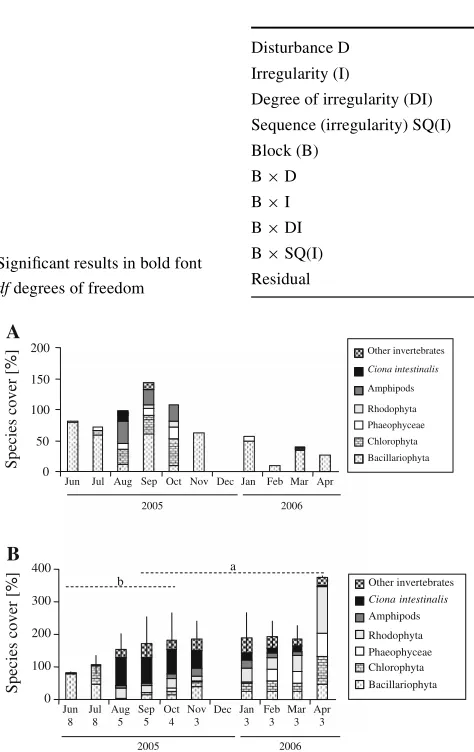
Species recruitment at the study site showed a strong sea-sonal pattern (Fig.5a). During most of the year, i.e. November–June, almost only diatoms recruited. In contrast, species recruitment was strongest from July to October, with maximum number of recruiting species in August. The ascidian C. intestinalis was only observed in August on recruitment panels, although its abundance on succession panels was much higher in August, suggesting that recruit-ment of C. intestinalis started in July, but recruits were too small to be identiWed on July recruitment panels. Thus, recruitment panels may reXect patterns lagging actual recruitment by 1 month so that the main recruitment period at the study site may last from June to October.
Succession panels
A total of 34 species was encountered on succession panels (Table1). The average number of species increased almost monotonically by a signiWcant Wvefold between May 2005 and April 2006 (ANOVA: F9,36= 13.16, P< 0.01). Species richness was non-signiWcantly diVerent among assemblages until September, but in October, it was signiWcantly higher than in June and July. Interestingly, the number of species did not change signiWcantly after October until the end of the study. A very similar pattern was detected for the species composition of the assemblages, which changed signiWcantly during the study period (ANOSIM: R= 0.889, P= 0.001). However, this diVerence was only present between younger (until September 2005) and older (from October 2005 to April 2006) assemblages, indicating that assemblages had a persistent species structure over the winter. The ascidian
C. intestinalis contributed most (on average almost 30%) to the observed diVerences in assemblage structure. Finally, total species cover also changed signiWcantly during the study period (ANOVA: F9,36= 10.54, P< 0.01, Fig.5b), and was at least two times higher in April 2006 than at any other sampling date. Furthermore, total species cover was at least a signiWcant 30% lower in June and July than during the remaining time of the experiment (Fig.5b).
Discussion
Disturbance treatments did not aVect the diversity of the macrobenthic assemblages at any time during the
experi-Fig. 4 Mean (+SD) wet mass (a), evenness (b), and species richness (c) of assemblages under diVerent disturbance regimes in the middle (black squares) and at the end (white squares) of the 150-day manipu-lation period. Stippled horizontal line indicates mean evenness and species richness prior to manipulations. Since the factor “timing of dis-turbance events” was not signiWcant (at > 0.25), we pooled the data. Treatments sharing a capital or small letter were not signiWcantly diVerent in the middle and at the end of the manipulation period, respectively. Letters were omitted for non-signiWcant response vari-ables. Note discontinuous ordinate in 4B
Evenness
Wet mass [
g
]
Species richness
0 50 100 150 200 250 300 350 400
A A C B B
0.0 0.1 0.2 0.3 0.8 0.9
10 12 14 16 18
0 2 4 6 8
C B
control regular c
a b b
lowly highly irregular
ment and showed only transient eVects on species composi-tion. As expected, strong and negative disturbance eVects were observed on biomass accrual and total species cover. Moreover, the irregularity of temporal patterns of distur-bance itself aVected the abundance of the ascidian C.
intesti-nalis, biomass accrual, and total species abundance
signiWcantly, but the latter two at a much lower range than disturbance per se. Interestingly, the abundance of C.
intesti-nalis, biomass accrual, and total species cover were all
higher in irregularly than in regularly disturbed assemblages, thus slightly ameliorating strong disturbance-mediated losses. Neither the timing, nor the degree of irregularity in disturbance aVected the tested community parameters.
Disturbance eVects
Disturbance was without signiWcant eVect on evenness and species richness at both sampling events. Such comparable levels of diversity in strongly disturbed and undisturbed communities have also been predicted by the ‘Intermediate Disturbance Hypothesis’ (IDH) (Connell 1978; Kondoh
2001). Under harsh environmental conditions, communities are kept at an early successional stage with low diversity due to a constant removal of species, while competitive exclusion of inferior competitors reduces diversity in the absence of disturbance (e.g. Valdivia et al. 2005). In the present study, however, species richness increased mono-tonically and consistently in undisturbed assemblages, sug-gesting that competitive exclusion did not occur. At least two explanations seem feasible. First, early colonizers such as diatoms and Wlamentous species of macroalgae may have facilitated settlement of species throughout the study period. Such facilitation eVects (sensu Connell and Slatyer
1977) of Wlamentous structures for the settlement of spores and larvae has been reported previously (Pulfrich 1996; Molis et al. 2003). Second, superior competitors were absent from the assemblage. This is corroborated by the consistently high levels of evenness during the study period, indicating a lack of dominant species. Two species, the blue mussel (M. edulis) and the sea squirt C. intestinalis
are known to be strong competitors in a type of assemblage comparable to the one tested in the present study (Harms and Anger 1983; Dürr and Wahl 2004). However, mussels recruited in low numbers and, in contrast to earlier studies (Anger 1977), were unable to dominate the assemblages. Given the climate change related decline in mussel stocks at other sites in the region (Beukema and Dekker 2005,
2007), the role of mussels in structuring hard-bottom com-munities around Helgoland may continue to mitigate in the future. The second potential superior competitor, C.
intesti-nalis, was unable to dominate the substratum during the
Table 3 ANOVA-results for diversity measures in August (75 days) and October (150 days)
Source df Evenness Species richness
75 days 150 days 75 days 150 days
F P F P F P F P
Disturbance D 1 0.06 0.821 1.27 0.297 1.41 0.274 0.11 0.746 Irregularity (I) 1 0.02 0.896 2.05 0.195 1.25 0.301 0.10 0.765 Degree of irregularity (DI) 1 0.05 0.834 0.00 0.975 0.58 0.472 0.01 0.921 Sequence (irregularity) SQ(I) 2 2.07 0.112 0.27 0.896 0.20 0.938 0.28 0.886
Block (B) 7 1.73 0.143 0.83 0.573 2.24 0.061 0.35 0.926
B£D 7 1.85 0.117 2.60 0.033 1.04 0.425 0.40 0.891
B£I 7 0.22 0.978 0.93 0.496 0.88 0.534 0.49 0.833
B£DI 7 1.44 0.228 0.36 0.920 0.63 0.731 0.85 0.558
B£SQ(I) 28 0.82 0.685 0.90 0.608 1.09 0.438 1.53 0.882
Residual 16
SigniWcant results in bold font
df degrees of freedom
Fig. 5 Percent total species cover on (a) recruitment (mean) and (b) succession panels (mean + SD). Numbers indicate sample size. Treat-ments sharing a letter or showing overlapping stippled lines were not signiWcantly diVerent. Capital and minor letters indicate results of spe-cies richness and spespe-cies composition, respectively. No samples were taken in December
A
200 Other invertebrates
Species cover [
%
]
Ciona intestinalis
150
Amphipods
100 Rhodophyta
Phaeophyceae
50 Chlorophyta
Bacillariophyta 0
Sep
Jun Jul Aug Oct Nov Dec Jan Feb Mar Apr 2005 2006
0 100 200 300 400
Species
cover
[
%
]
Other invertebrates Cionaintestinalis
Bacillariophyta
Phaeophyceae Chlorophyta Amphipods Rhodophyta
6 0 0 2 5
0 0 2
Apr 3 Mar
3 Feb
3 Jan
3 a
Dec Nov
3 Oct
4 Sep
5 Aug
b
5 Jul
8 Jun
study period and even vanished during the winter season. This suggests that the lack of competitive exclusion in undisturbed assemblages resulted from a reset of the suc-cession during winter months rather than from the short duration of the study. Therefore, disturbance may not have long lasting eVects on the diversity of hard-bottom assem-blages that show strong seasonal recruitment patterns and transient appearance of superior competitors, like in the present study.
Surprisingly, species richness also increased monotoni-cally during succession in disturbed assemblages despite the relatively high intensity of disturbance. Similar patterns were reported from other studies (reviewed in Mackey and Currie 2001). For instance, Lenz et al. (2004) explained higher levels of diversity under harsh than under moderate disturbance conditions by the development of an alternative community structure. However, this seems unlikely to apply to at our study site because signiWcant diVerences in on spe-cies composition between disturbed and undisturbed assem-blages were not recorded at the end of the study period.
EVects of diVerent disturbance regimes
In our study, irregular disturbance regimes caused signiW -cantly higher biomass accrual, total cover, and C. intesti-nalis cover than a regular regime. This pattern may be due to diVerences in the rate at which open space became avail-able for colonizers under the regular and the irregular dis-turbance regimes. In contrast to the regular disdis-turbance regime, relatively larger patches of cleared or recently cleared substratum were opened in irregular disturbance regimes, due to clumping of disturbance events. Larger, contiguous patches are microhabitats that diVer from smaller patches (Keough 1984) and could thereby aVect recruitment in several ways. First, neighborhood eVects–– detrimental eVects of sweeping algal fronds on larval settle-ment and early recruitsettle-ment have been reported to decrease when patch size increases (Jenkins et al. 1999). Second, trophic interactions––less predation pressure on recruits due to an increased visibility of meso-consumers to their predators in larger patches. Third, altered margin to area ratio––recruitment of macrobenthic species to smaller patches is more controlled by margin eVects than recruit-ment to larger patches (Osman 1977). Fourth, sampling eVect––the relative importance of propagule-mediated recruitment increases with patch size (Connell and Keough
1985) and chances rise that species with new traits, e.g. fast biomass accrual, enter the community. This assumes a dis-proportionately higher recruitment success of species in larger compared to smaller patches. However, as we did not observe diVerential recruitment success between regularly and irregularly disturbed assemblages this possibility seems unlikely.
The positive eVects of irregular disturbance on biomass, total cover, and C. intestinalis cover were small compared to the detrimental eVects of disturbance per se. This suggests that the irregularity of disturbance events was of very low importance under our experimental conditions. Although the eVect size of irregular disturbance patterns was small, it counterbalanced to some degree the eVects of detrimental disturbance per se, corroborating the Wndings of Benedetti-Cecchi et al. (2006) that high temporal variance may mitigate ecological impacts of climate changes. Possi-bly, the high intensity of the applied disturbance regime was responsible for the small eVect size and repeating the experiments with lower mean intensity might have pro-duced stronger eVects by irregular disturbance regimes. The few studies that have tested for interactive eVects of inten-sity and irregularity of disturbance on species richness, do suggest that the eVects of irregular disturbance patterns can depend on the level of disturbance intensity (Bertocci et al.
2005; Benedetti-Cecchi et al. 2006). Yet, present evidence gives contrasting results about the direction of this interac-tion. For instance, mean intensity of aerial exposure either magniWed or dampened the eVects of temporal variability of aerial exposure in a species-speciWc manner (Bertocci et al. 2007).
In conclusion, the present study indicates that the eVects of temporal variation in disturbance events were drastically lower in magnitude and of opposite direction than distur-bance eVects per se. This contrasts some of the recent W nd-ings from Mediterranean shores, suggesting that the eVects of temporal variation in predictor variables are likely to be dependent on system-immanent characteristics and the type of factors under investigation. Using advanced experimen-tal designs with variable factor regimes may in some but not all systems help to improve the assessment of generally important topics on climate change and the testing of mod-els in ecology.
Acknowledgments We are grateful for the help of the R. V. Aade crew in setting up the experiment. Assistance during Weld work of C. Funk, K. Zacher, and the research divers. C. Wanke and S. Brandt are greatly acknowledged. We thank L. Benedetti-Cecchi for assistance in designing and analyzing the study. Earlier drafts of the manuscript ben-eWted from discussions with other GAME students, in particular M. Cifuentes.
References
Anger K (1977) Development of a subtidal epifaunal community at the island of Helgoland. Helgol Meeresunters 31:457–470
Benedetti-Cecchi L (2003) The importance of the variance around the mean eVect size of ecological processes. Ecology 84:2335– 2346
Benedetti-Cecchi L, Bertocci I, Vaselli S, Maggi E (2006) Temporal variance reverses the impact of high mean intensity of stress in climate change experiments. Ecology 87:2489–2499
Bertocci I, Maggi E, Vaselli S, Benedetti-Cecchi L (2005) Contrasting eVects of mean intensity and temporal variation of disturbance on a rocky seashore. Ecology 86:2061–2067
Bertocci I, Vaselli S, Maggi E, Benedetti-Cecchi L (2007) Changes in temporal variance of rocky shore organism abundances in re-sponse to manipulation of mean intensity and temporal variability of aerial exposure. Mar Ecol Prog Ser 338:11–20
Beukema JJ, Dekker R (2005) Decline of recruitment success in cock-les and other bivalves in the Wadden Sea: possible role of climate change, predation on postlarvae and Wsheries. Mar Ecol Prog Ser 287:149–167
Beukema JJ, Dekker R (2007) Variability in annual recruitment suc-cess as a determinant of long-term and large-scale variation in an-nual production of intertidal Wadden Sea mussels (Mytilus
edulis). Helgoland Mar Res 61:71–86
Connell JH, Slatyer RO (1977) Mechanisms of succession in natural communities and their role in community stability and organisa-tion. Am Nat 111:1119–1144
Connell JH (1978) Diversity in tropical rain forests and coral reefs. Science 199:1302–1310
Connell JH, Keough MJ (1985) Disturbance and patch dynamics of subtidal marine animals on hard substrata. In: Pickett STA, White PS (eds) The ecology of natural disturbance and patch dynamics. Academic Press, Orlando, pp 125–151
Danard MB, Dube SK, Gonnert G, Munroe A, Murty TS, Chittibabu P, Rao AD, Sinha PC (2004) Storm surges from extra-tropical cyclones. Nat Hazards 32:177–190
de Kluijver MJ (1991) Sublittoral hard substrate communities oV Helgoland. Helgol Meeresunters 45:317–344
Dürr S, Wahl M (2004) Isolated and combined impacts of blue mussels (Mytilus edulis) and barnacles (Balanus improvisus) on structure and diversity of a fouling community. J Exp Mar Biol Ecol 306:181–195
Grime PJ (1977) Evidence for the existence of three primary strategies in plants and its relevance to ecological and evolutionary theory. Am Nat 111:1169–1194
Harms J, Anger K (1983) Seasonal, annual, and spatial variation in the development of hard bottom communities. Helgol Meeresunters 36:137–150
Hooper DU, Chapin FS, Ewel JJ, Hector A, Inchausti P, Lavorel S, Lawton JH, Lodge DM, Loreau M, Naeem S, Schmid B, Setala H, Symstad AJ, Vandermeer J, Wardle DA (2005) EVects of biodi-versity on ecosystem functioning: a consensus of current knowl-edge. Ecol Monogr 75:3–35
Hughes JB, Daily GC, Ehrlich PR (1997) Population diversity: its extent and extinction. Science 278:689–692
Jara VC, Miyamoto JHS, da Gama BAP, Molis M, Wahl M, Pereira RC (2006) Limited evidence of interactive disturbance and nutri-ent eVects on the diversity of macrobenthic assemblages. Mar Ecol Prog Ser 308:37–48
Jenkins SR, Norton TA, Hawkins SJ (1999) Settlement and post-settle-ment interactions between Semibalanus balanoides (L.) (Crusta-cea: Cirripedia) and three species of fucoid canopy algae. J Exp Mar Biol Ecol 236:49–67
Keough MJ (1984) EVects of patch size on the abundance of sessile marine invertebrates. Ecology 65:423–437
Kjerfve B, Michener WK, Gardner LR (1994) Impacts of climate change in estuary and delta environments. University of South Carolina, Columbia
Kondoh M (2001) Unifying the relationships of species richness to productivity and disturbance. P R Soc Lond B Biol 268:269–271 Lenz M, Molis M, Wahl M (2004) Testing the intermediate distur-bance hypothesis: response of fouling communities to various levels of emersion intensity. Mar Ecol Prog Ser 278:53–65 Loreau M (2000) Biodiversity and ecosystem functioning: recent
theoretical advances. Oikos 91:3–17
Mackey RL, Currie DJ (2001) The diversity-disturbance relationship: is it generally strong and peaked? Ecology 82:3479–3492 Menge BA, Sutherland JP (1987) Community regulation: variation in
disturbance, competition, and predation in relation to environ-mental stress and recruitment. Am Nat 130:730–757
Molis M, Lenz M, Wahl M (2003) Radiation eVects along a UV-B gra-dient on species composition and diversity of a shallow-water macrobenthic community in the western Baltic. Mar Ecol Prog Ser 263:113–125
Morin PJ, McGrady-Steed J (2004) Biodiversity and ecosystem func-tioning in aquatic microbial systems: a new analysis of temporal variation and species richness-predictability relations. Oikos 104:458–466
Navarrete SA (1996) Variable predation: eVects of whelks on a mid-intertidal successional community. Ecol Monogr 66:301–321 Osman RW (1977) The establishment and development of a marine
epifaunal community. Ecol Monogr 47:37–63
Pulfrich A (1996) Attachment and settlement of post-larval mussels (Mytilus edulis L.) in the Schleswig-Holstein Wadden Sea. J Sea Res 36:239–250
Shea K, Roxburgh SH, Rauschert ESJ (2004) Moving from pattern to process: coexistence mechanisms under intermediate disturbance regimes. Ecol Lett 7:491–508
Sommer U (2000) Benthic microalgal diversity enhanced by spatial heterogeneity of grazing. Oecologia 122:284–287
Sugden H, Panusch R, Lenz M, Wahl M, Thomason JC (2007) Tem-poral variability of disturbance: in this important for diversity and structure of marine fouling assemblages? Mar Ecol 28:1–9 Svensson JR, Lindegarth M, Siccha M, Lenz M, Molis M, Wahl M,
Pavia H (2007) Maximum species richness at intermediate frequencies of disturbance: consistency among levels of produc-tivity. Ecology 88:830–838


![Table 2 ANOVA-results for community biomass [wet mass in August (75 days) and dry mass in October (150 days)] and species abundances](https://thumb-us.123doks.com/thumbv2/123dok_us/417695.1534884/7.595.48.543.73.259/table-results-community-biomass-august-october-species-abundances.webp)