R E V I E W
Open Access
The importance of genotype-by-age interactions
for the development of repeatable behavior and
correlated behaviors over lifetime
Jon E Brommer
*, Barbara Class
From
New Perspectives in Behavioural Development: Adaptive Shaping of Behaviour over a Lifetime?
Bielefeld, Germany. 29 September - 1 October 2014
Abstract
Behaviors are highly plastic and one aspect of this plasticity is behavioral changes over age. The presence of age-related plasticity in behavior opens up the possibility of between-individual variation in age-related plasticity (Individual-Age interaction, IxA) and genotype-age interaction (GxA). We outline the available approaches for quantifying GxA. We underline that knowledge of GxA for behaviors is an important step in reaching and understanding of the evolution of plasticity in behavior over lifetime. In particular, the heritability (repeatability) and/or the rank order of behavior across individuals are predicted to change across ages in presence of GxA. We draw on the theory of reaction norms to illustrate that GxA, when present, is likely to lead to developmental changes in the magnitude and possibly sign of the genetic correlation between behaviors (behavioral syndrome). We present an overview of the literature on changes in the ranking of individuals’behavior across ages, and in the correlation between behaviors. Although all studies were carried out on the phenotypic level, they overall suggest clear scope for increased study of GxA as a process explaining age-related plasticity in behaviors. Lastly, we throughout emphasize that many of the approaches and underlying theory of GxA is applicable to the study of IxA, which is informative as it presents the upper limit of GxA, but is also a more attainable target of study in many systems. Empirical work aimed at understanding IxA and GxA in behavior is needed in order to understand whether patterns predicted by theory on plasticity indeed occur for age-related plasticity of behavior.
Introduction
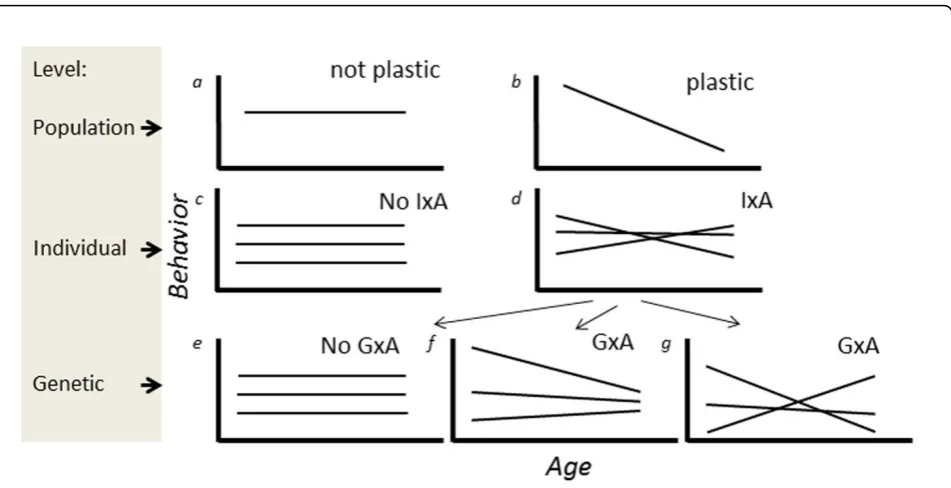
Behavior is often systematically affected by environmental conditions and by internal states. Such gradients driving plasticity may be an external environmental variable (e.g. temperature), but can also be the age of the organism [1]. In this paper, our focus is explicitly on plasticity in beha-vior in response to the age at which the behabeha-vior is expressed. Plasticity of behavior across ages can be viewed on the level of the population (mean behavior varies over ages), the individual (behavior of the same individual var-ies over ages) and the genotype (Fig. 1). For illustration purposes, plasticity is in this figure and throughout this paper presented as linear (gradual) changes in the expres-sion of a behavior over ages. Linearity depicts the simplest
form of plasticity, but clearly plasticity can have a more complicated (non-linear) shape, and the approaches and concepts applied here apply also to non-linear plasticity. Importantly, whenever a trait is plastic, we may expect variation in the degree of plasticity across individuals (in the context of age-specific expression, Individual–Age interaction; IxA, Fig. 1, cf. [2]). IxA signals that some indi-viduals show a greater or smaller degree of plasticity in behavior when ageing than others. For example, an indivi-dual shows low plasticity when it is approximately equally aggressive when assayed at different ages, whereas other individuals may be highly plastic, being e.g. very aggressive when young but expressing much lower levels of aggres-sion when old. One part of the variation between indivi-duals in their plasticity may be on the additive genetic level, which is termed Genotype–Age interaction (GxA, Fig. 1). Below we provide more details on quantitative * Correspondence: [email protected]
Department of Biology, University Hill, 20014 University of Turku, Turku, Finland
genetic concepts and approaches for estimation of IxA and GxA (see also the glossary Additional file 1), but we first outline three reasons to be interested in between-individual (IxA) or between-genotype (GxA) variation in the plasticity of a behavior over ages.
Firstly, a range of students of behavior ask whether variation underlying between-individual differences mea-sured at a certain age is representative for differences between these individuals at other ages. The (implicit or explicit) assumption in most studies is that a behavior shows constant between-individual or additive genetic variance over all age classes and that the ranking of trait values (behavior expressed by an individual) does not change across age [3,4]. Consider, for example, aggres-sive behavior. The study of IxA and GxA in aggression would answer questions as: Is the individual that is the most aggressive juvenile also expected to be the most aggressive adult or does the ranking of individuals in terms of their aggressive behavior change as they age? Does the repeatability and heritability of aggression change during the lifetime of individuals, and, if so, does it increase or decrease? Essentially, knowledge of the presence and the extent of variation in plasticity between individuals and genotypes in a behavior allows
answering these questions (cf. [5]). These answers have relevance in a variety of fields. For example, animal breeders are interested in the above listed questions when they want to develop behavioral assays which can be conducted in young animals and predict the behavior of the individual at a later age (e.g. [6]). Researchers of human behavior are interested in understanding at what age pronounced differences between individuals arise (e.g. [7]) as well as whether behavior of individuals in one age group predict their behavior in another [8]. Behavioral ecologists study the above questions, because between-individual differences in behavior is considered the hallmark of animal personality, a current focus in behavioral ecology [8,4].
Secondly, the study of GxA relates to fundamental aspects of evolutionary biology, because evolutionary the-ories of senescence [9,10] predict the presence of GxA in traits showing senescence [11-13]. Senescence can be defined as a decline in organismal performance with age, and senescence occurs in practically all taxa [14,15]. Senescence in, say, aggression could cause individuals to become less aggressive with age, i.e. to show age-related plasticity. Evolutionary theories explaining why senes-cence occurs, hinge on the assumption that the trait
which shows a senescent decline is related to an indivi-dual’s fitness. Meta-analysis shows that many behaviors have selective consequences [16,17]. Thus, some beha-viors are a measure of organismal performance and an explicit investigation of plasticity over lifetime in such fit-ness-related traits from the perspective of senescence would hence be of interest. One would expect an age-related change in behavior towards values with lower fitness on the population level (i.e. senescence). When-ever a behavior shows such a senescent decline, the study of between-individual and especially between-genotype variation in the rate of senescence (IxA and GxA respec-tively), provides one approach to test for the“fingerprint” of evolved senescence [12,13].
Third, knowledge of GxA in behavior is of potential interest for those who aim to gain insight in the causes of variation in behavior on the proximate level in terms of either identifying genetic loci associated with varia-tion in behavior or studying the physiological mechan-isms underlying behavior. Behaviors without GxA are indicative of a clear consistency in behavior over ages, and hence signal a behavior where the proximate deter-minants (genes, physiological mechanisms) are likely to be the same independently of organismal age. In contrast, behaviors with GxA require a more careful dissection because these suggest that genetic associations and phy-siological mechanisms are acting in an age-dependent manner.
The main aim of this paper is to flag the potential importance and relevance of considering between-indivi-dual and between-genotype variation in age-related plas-ticity in behavior (IxA and GxA respectively). To this end, we start with a short primer on quantitative genet-ics and then focus in some detail on approaches used in the estimation of GxA as well as the kind of information one obtains on the basis of these approaches. These approaches are established in quantitative genetics, but are applicable also in the estimation of IxA such that they are of interest even when the focus is mostly on understanding between-individual differences rather than genetic effects. We emphasize what the putative existence of GxA would imply for changes in the herit-ability (and repeatherit-ability) of behavior during the lifetime of individuals as well as the correlation in behavior across ages. Because the study of GxA in behavior is lar-gely unexplored to date, we present an overview of the patterns in age-related changes in repeatability assuming it presents an upper limit of the heritability [18], and changes in the ranking of individuals’behaviors across ages. We then explore the implications of the presence of GxA for the correlation between behaviors when such correlations are measured at different ages. Corre-lated behaviors are termed behavioral syndromes. Such syndromes are a defining feature of many behaviors
[3,19]. Although most behavioral syndromes described to date are based on phenotypic correlations, there is reasonable evidence for genetic correlations underlying syndrome correlations [20]. We outline, based on the norms of reaction framework [21], how the putative pre-sence of GxA in behavior predicts age-related changes in the strength and possibly sign of a behavioral syndrome. We present an overview of the literature exploring changes in the phenotypic correlation between behaviors over age. Based on our overview of approaches and the literature, we end with a perspective for future work on this exciting research question.
Primer in quantitative genetics
In this section, we briefly summarize some of the core concepts in quantitative genetics. Some of the concepts mentioned in this section are explained in the glossary (Additional file 1). The quantification of age-related changes in (genetic) (co)variances requires a quantitative genetic approach [22]. Quantitative genetics provides a statistical description of the relative contribution of dif-ferent sources of genetic versus non-genetic effects underlying phenotypic variance in a quantitative trait. A quantitative trait is any trait which is not inherited Men-delian, and is typically viewed as a measurable quantity on the continuous scale (e.g. body length). However, a quantitative trait can be meristic (e.g. number of bristles) or discrete (e.g. winged vs. unwinged morphs) assuming there is a latent underlying variable triggering a switch in discrete phenotypes once a certain threshold value is exceeded [23]. Thus, most behaviors are amenable for analysis in the quantitative genetic framework.
Quantitative genetics builds on the assumption that var-iation in quantitative traits is caused by many loci of small effect, an assumption typically confirmed by molecular genetic analyses [22,24,25]. The breeding value may be constant over all ages in which the individual is expected to express the same value for the focal behavior at each age. However, when GxA is present, the magnitude and possibly the sign of the effects of loci on the focal trait changes as the individual ages. Some loci which earlier did not have an effect are turned on, others may be turned off, or the same genes increase/decrease in their effect. Thus, the presence of GxA is assumed to signal a change in the genetic underpinning of the behavior.
include a breeding design or artificial selection [22]. By marking individuals and their offspring for a number of breeding episodes, one can obtain a multi-generational pedigree. In species where parentage is difficult to assign based on observation, one needs to resort to molecular genetic assignment methods [26]. Pedigrees can be assembled both in wild populations and populations reared under more controlled environmental conditions. Depending on the organism, a number of breeding designs may be applicable to laboratory or (semi-)domestic popu-lations; detailed treatment of these can be found in text-books (e.g. [18,22]). Cross fostering of offspring is one breeding design with potential to improve quantitative genetic estimates, which is also applicable to many wild, domestic and laboratory populations [27]. While certainly not all organisms are amenable for such approaches, it is clear that many laboratory, domesticated or wild systems which are currently used in the study of behavior would allow construction of a pedigree and hence quantitative genetic analyses.
A general approach for analysis of most of the pedigree or breeding design data described above, is to use a speci-fic form of linear mixed model, where information on the relatedness between individuals is included. This so-called“animal model”uses individual-specific measure-ments to estimate quantitative genetic parameters and was originally developed by animal breeders, but is increasingly used in various fields [22,28]. A starting point in getting acquainted with this approach, including tutorials, is provided by ref. [29]. The animal model can flexibly include information on various factors which are likely to cause resemblance between individuals, for example the brood in which siblings were reared or the identity of their mother. In this paper, we follow the con-vention in assuming that variance in phenotypes are due to additive genetic effects and various other, non-herita-ble (environmental) effects. Thus, non-additive genetic effects (dominance and epistasis) and their interactions are not considered in this paper. Non-additive genetic effects can be incorporated within the animal model fra-mework, but doing so requires much information on spe-cific relatives and is hence challenging to estimate. In general, dominance genetic effects are important, both in the study of senescence [30] and in the study of behavior [17,31]. Because these effects are challenging to estimate, a reasonable first step, nevertheless, is to get a handle on the additive genetic effects, bearing in mind the underly-ing assumption that non-additive genetic effects are ignored.
Age-related changes in (co)variances created by IxA and GxA
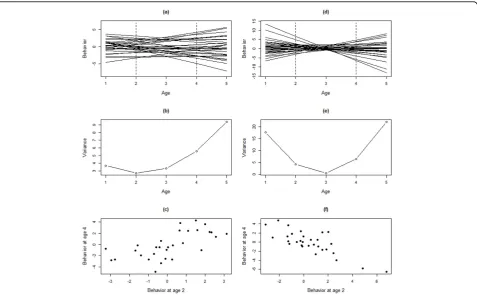
A central prediction of GxA (or IxA) is that, when it is present in the population, the variance between genotypes
(or, for IxA, individuals) changes across ages (Fig. 2). The treatment of GxA in this paper is equivalent to general insights related to the presence of Genotype– Environ-ment interactions as discussed in textbooks (e.g [18,22]). An overview of between-individual variation in plasticity and its relation to genetic variation in plasticity is provided by ref. [2]. The concept of between-individual variation in plasticity within the context of studies on behavior is dis-cussed by ref. [32].
GxA (and IxA) can be present in one of two forms. One in which the ranking of the expected behaviors expressed by individuals is maintained across all ages considered (Fig. 2a,b,c), in which case the additive genetic variance increases (decreases) across ages, but correlations in expression differences between genotypes are maintained. In contrast, GxA may also take the form where the ranking changes as the organism ages (Fig. 2d,e,f), in which case there is a minimum in the additive genetic variance at some age. Despite the fact that these two forms of GxA have different biological implications, the only difference between them is whether the crossing of the GxA reaction norms occurs outside the range of ages considered (Fig 2a) or within the range of ages considered (Fig. 2d).
Typically, the study of plasticity of behavior over age, and variation in this plasticity, is based on repeated mea-sures of behavior made on individuals during (part of) their lifetime. It is important to note that although each individual is likely to be a unique genotype, the demon-stration of IxA does not constitute proof of underlying GxA. This is because, in broad terms, the expected beha-vior of an individual at a certain age is not only deter-mined by its genotype, but also by its permanent environment. These permanent-environment effects may cause between-individual differences to have no additive genetic basis. Thus, the presence of plasticity in behavior itself does not inform whether there is variation in plasti-city between individuals (IxA), nor does the presence of IxA inform on GxA. Instead, IxA and GxA are properties which need to be estimated explicitly. Provided informa-tion on the relatedness across individuals is available, quantitative genetic approaches, which we outline below, can be used to quantify GxA.
How to estimate GxA
be estimated instead of additive genetic (co)variances. In order to quantify IxA and GxA, one needs to measure a behavior which is repeatedly expressed by the same indivi-dual at different ages during its lifetime. Because the inter-est is in age-related changes, the focal behavior shows plasticity on the individual level (i.e. the same individual may behave differently at different ages). Plasticity on the individual or genetic level (as illustrated schematically by lines in Fig. 1 and 2) concern deviations from the age-spe-cific mean of the individual and breeding value, respec-tively [22]. Thus, even when the mean behavior shows a non-linear pattern over ages (e.g. aggression increases early in life, but then decreases), the issue is whether the individual-specific deviations and breeding value devia-tions from these age-specific mean values varies over age classes. Thus, despite IxA and GxA being illustrated here with linear lines (Fig. 1 and 2), the population-level pattern of behavioral plasticity may be more complex (illustrated in additional file 2). Statistically, the focus on deviations from specific mean values necessitates correcting
age-specific behavior for its age-age-specific mean (e.g. by inclusion of age as a factorial fixed effect or by considering the beha-vior at each age, as detailed below).
For estimation of GxA, the basic approach is to recog-nize that a behavior expressed at a certainage is poten-tially different (in terms of the additive genetic effects underlying it) than atage+1 and so on. Thus, the beha-vior is considered to have, what quantitative geneticists term, different character states [22]. Conceptually, the model structure is multivariate , and follows the same procedure as if the focal trait measured at each charac-ter state were separate traits (see e.g. [29] for details on how to implement such models). Under the character-state model, one obtains estimates of
G=
⎡ ⎢ ⎢ ⎢ ⎣
VA1 C2,1A · · · CωA,1 C1,2A VA2 · · · CωA,2
..
. ... . .. ...
C1,AωC2,Aω· · · VAω ⎤ ⎥ ⎥ ⎥ ⎦,
which is the genetic (co)variance matrix denoting in its diagonal the additive genetic variance VA for the behavior at age classes 1, 2,…ω, where ω is the last age class considered. In the off-diagonal, the pair wise genetic covariances (CA) are denoted between the age classes. Again, depending on the design of the study, the full multivariate mixed model used to estimate G
(eq. 1) will include other matrices which may or may not be similarly structured as Gdescribing the (co)var-iances at other levels including the residual level.
The full character-state approach requires estimation of many parameters. TheGmatrix (eq. 1) for age classes requiresω(ω+ 1)/2 additive genetic (co)variances to the estimated, which rapidly becomes demanding. For example, three age classes require six, five age classes 15, and seven age classes requires 28 genetic parameters. One possibility to reduce complexity is to group some age classes intoa prioridetermined biologically relevant age groups (e.g. juveniles, sub-adults, adults). Another approach is to use a function-valued trait approach to approximate theG matrix under simplifying assump-tions requiring the estimation of a reduced set of para-meters (reviewed by [33]). The main function-valued trait approach used is the so-called infinite-dimensional model [1], which assumes that a set of n-orthogonal polynomials can describe the Gmatrix. The variances and covariances in the parameters describing these poly-nomial functions are typically estimated using random regression [34], and within the animal model framework such a model is known as a Random Regression Animal Model (RRAM; [35,2]. The RRAM is a statistical imple-mentation of what is an intuitive conceptual visualiza-tion of GxA, because it concerns the “drawing” of reaction norms of how the breeding value for a behavior depends on the age at which it is expressed (cf. Fig. 1 and 2).
The hierarchical nature of plasticity can be illustrated by considering two general formulations of random regression. The traitz for individual i as a function of its ageageis, at the phenotypic level, described by
zi,age=μ+AGEF+find(x,age) +εi,age,
which can be partitioned further into
zi,age=μ+AGEF+fa(x,age) +fpe(x,age) +εi,age,
whereμis the overall fixed-effect mean, AGEFdenotes the inclusion of age as a factor in order to model age-specific means. Functionsfind(x, age), fa(x, age)and fpe(x, age) describe an orthogonal polynomial of orderx on the level of the individual, additive genetic and perma-nent environment, respectively. These polynomials cap-ture the deviations from the age-specific fixed effect means. In practice, the coefficients of the polynomial
are assumed to stem from a multivariate normal distri-bution [35]. Lastly εi,age is the (age-specific) residual for
individuali.
The reduction in the number of parameters when using a RRAM to estimate G is potentially large. For example, when a second-order polynomial (linear and quadratic reaction norms;a0 +a1× age + a2× age2) are assumed, the RRAM estimates these coefficients as stemming from the multivariate normal covariance matrix
Ka=
⎡
⎣CVaa0,10 CVaa0,11 CCaa0,21,2
Ca0,2Ca1,2 Va2
⎤ ⎦,
where Vand Care variance and covariance, respec-tively, in the breeding value for the intercept (a0), the linear slope (a1) and the quadratic slope (a2) of the reac-tion norms. For a polynomial of order x, Kawill be of dimensionx×x.
Once the random-regression covariance matrices Kais obtained, it can be transformed toG for any ages con-sidered as appropriate character states [36], and confi-dence intervals can be estimated( [37]. Importantly, it is this transformation of the covariance matrix of reaction-norm properties to the character-state (Ka, eq. (3) to G
(eq. 1); or, when studying IxA, fromKind to the indivi-dual matrixID, [5]) which provides information on the age-specific repeatability and cross-age correlations (changes in ranking across ages). Changes in repeatabil-ity and the level of crossing cannot be distilled directly from investigation of the covariance/correlation between reaction-norm elevation and slope (i.e. K). This is because even when the reaction norms show consider-able crossing (low or negative correlation between eleva-tion and slope), the critical aspect is whether this crossing occurs within the range of ages considered and on the variances in elevation and slope (detailed in [5]).
correct description of the phenomenon of interest. Thus, RRAM risks producing spurious results regarding what, in the end, is the key focus of the analysis: Does additive genetic variance increase with age? An impor-tant aspect of using Random Regression (for modelling GxA or IxA) is hence to critically check the outcome with respect to models based on the character-state approach (where older age classes are combined) as well as the phenotypic variances predicted by the model and found in the data (see [5] for a conceptual illustration). Although random regression is the most common func-tion-valued trait approach, it should also be noted that other function-valued trait models can be used to approximate eq. (1). For example, genetic (co)variances may be assumed to stem from an auto-correlation across ages [38]. A full treatment of the recommenda-tions in fitting function-valued trait models is outside the scope of this paper; overviews are given in ref [12] and [33].
Phenotypic patterns of behavioral variation over lifetime
In this section, we explore the literature on age-related behavioral plasticity to explore central predictions of GxA. Because there are few studies which have explicitly quantified GxA, we here focus on
(1) changes in the repeatability of behavior over ages, assumed to be indicative of changes in between-indivi-dual variance over ages. Repeatability presents the upper limit of heritability [18]. Assuming residual variances are approximately constant over ages, absence of a change in repeatability over ages suggests, although it does not prove, an absence of GxA.
(2) We explore age-related changes in the ranking of behavior, which have been estimated primarily as the phenotypic correlation of a behavior expressed by indivi-duals at different ages. Under the assumption that the behavior is heritable, and that age-specific residuals are not correlated, such phenotypic correlations should pre-sent the lower expectation of the genetic correlation in behavior between ages (cf. [39]).
We performed a search in ISI Web of Knowledge using different combinations of keywords (“personality”,“ tem-perament”,“stability”,“consistency”,“repeatability”,“ devel-opment”, “age”) and selected only studies on behavior reporting estimates of repeatability for, or rank-order con-sistency between consecutive ages or ontogenetic stages. However, most of these studies did not test the statistical difference between ages and only provided information on whether each point estimate differed significantly from 0 (p<0.05). In total, we found 39 publications [6,40-77], summarized in additional file 3. Below we summarize the findings of these studies.
Changes in the repeatability of behavior over lifetime
The importance of quantifying changes in the repeat-ability of behavior with age has been recognized (e.g. [78]). Behavioral ecologists, in particular, emphasize that the direction of change in repeatability over age is diffi-cult to predict. On one hand, repeatability can be expected to be lower in juveniles because of ongoing developmental changes. On the other hand, repeatability can be higher in juveniles because developmental trajec-tories are highly constrained [78]. Nevertheless, indivi-dual differences in behavior are typically assumed to remain consistent over the individual’s lifetime. The average repeatability of behaviors is 0.37 (reviewed by [79]). However, most of the behavioral tests have been conducted in one ontogenetic stage (adults) and repeat-ability decreases with the interval between measure-ments [79]. This decrease suggests that repeatability in behaviors, which is not very high, can be even lower across life-stages.
Changes in the correlation of a behavior between age classes
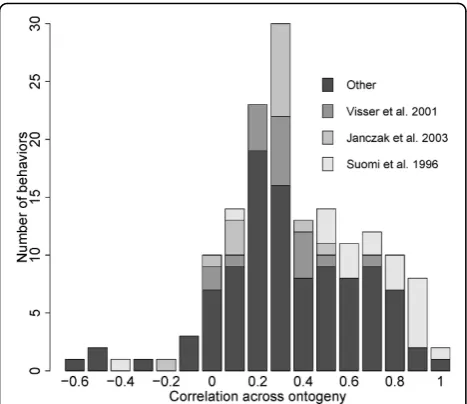
The correlation in behavior across age classes is regu-larly measured in studies on animal behavior. Typically, behavior is measured once at different ages and a (Spearman rank) correlation is calculated for the beha-vior between consecutive ages (reported in additional file 3 as Cor age-age+1). These correlations indicate how the rank order of measurements (i.e. phenotypes) for behavioral traits changes, as individuals age. Three studies [55-57] only reported significant correlations, because the objective in these studies was to arrive at methods for behavioral assessment of adult (2.5 year old) horses on the basis of their behavior as a fawn. Thus, these latter estimates inform us of the upper expected value of a correlation between age classes, which is around 0.6 for behavior in horses. When the results of all studies which have reported both signifi-cant and non-signifisignifi-cant correlations are taken together, they suggest that behavioral traits are moderately corre-lated across ontogeny: The modal correlation between the first and second age class (Cor1-2 in additional file 3) is 0.3 (Fig.3). Although three studies contributed a disproportional amount of estimates, a similar pattern is also visible in the other studies (Fig. 3). Furthermore, we note that cross-ontogeny correlations can reach very high values for certain traits and shorter test inter-vals (see e.g. [45]). Low cross-age phenotypic correla-tions are consistent with the pattern of rank-changes in behavior predicted when GxA occurs such that the
reaction norms cross within the range of ages consid-ered (cf. Fig. 1d). Contrary to repeatability estimates, cross-ontogeny correlations can be negative which means that the rank order of individuals for one trait will be reversed across ontogeny, as predicted when the reaction norms cross within the age interval considered. Overall, there is little evidence for such changes in rank in the studies included in our literature overview. Nega-tive cross-age correlations occur in only a few cases (22/467 correlations) and in most of these cases (17/22 correlations), the point estimates in fact did not differ significantly from 0. Nevertheless, our overview under-lines that among studies measuring behavior at more than two ages, the correlations between consecutive ages can clearly change as the organism ages (Additional file 3), such that behavior of an individual at early age is not necessarily a good predictor of its behavior at late ages. Nevertheless, none of these studies has tested the statistical difference between rank-order correlations at different ages as the age-related change in ranking was not a specific focus of these studies.
The development of personality has been extensively studied in humans, not only from childhood to maturity but also in old ages, to understand how personality changes with age due to genetic or environmental factors and to be able to predict and prevent maladaptive changes in personality. Most psychology studies agree that person-ality is characterized by continuity and change [85-88]. On one hand, there is empirical evidence that rank-order con-sistency in personality traits is moderate from childhood to adulthood and increases with age to reach high values in late adulthood [88]. On the other hand, personality traits do not become fixed in adulthood and are still likely to undergo some changes at the population mean level but also on the individual level, as a result of the interac-tion of the individual and his or her environment. Indeed, some studies have found significant individual differences in age-related changes in personality traits [89-92]. More-over, rank-order consistency has been found to increase with age and decrease with the time interval between tests [88]. More recently, human personality research has started to include individuals older than 60 years and found a curvilinear pattern for rank-order consistency with age which, after reaching a maximum at around 50 years, started to decrease [7,93-96]. These findings imply that the rank orders of individuals are more and more likely to be maintained from childhood to mid-adulthood when the individuals grow old, but this consistency decreases after a certain age. Again, rank-order changing GxA may be underlying such patterns.
The importance of genetic vs. environmental determi-nation of personality and its development has been long studied in psychology. Firstly, common patterns of change in the 5 human personality dimensions over age
Fig 3Distribution of the rank-order correlations of behavioral traits across ontogeny. Studies reporting more than 8 traits are
and across cultures have been found even in older ages, showing that genes play an essential role in personality development across the entire lifetime [97]. Secondly, heritability of personality dimensions has been estimated at different ages using long-term studies of monozygotic and dizygotic twins. Heritability seems to be relatively consistent in early life [98,99] but there is evidence for an increase during adolescence and young-adulthood [100,101] and a decrease in late adulthood [102,103]. Indeed, the rank-order changes across ages have been attributed to both genetic and environmental causes, genetic factors being the main contributor to inter-indi-vidual differences in behavior in early life whereas envir-onmental effects accumulate over the lifetime to become the main contributor in older ages [102,103]. This is because the genetic variance is relatively stable over the ontogeny while the environmental variance increases with age. As a result, heritability is expected to decrease after a certain age. Hence, studies of human behavior have specifically addressed the question of personality development over the entire lifetime, while separating genetic and environmental factors with evidence that GxA acts as a potential cause of individual differences in age-related changes in personality.
Taken together, the overview of literature of behavioral studies in this section suggests there is considerable scope for changes in the ranking of individual expression of behavior during development. In particular, the modal phenotypic correlation of a behavior in animals across ages was 0.3 (Fig.3). Although this is a positive correlation, it suggests that many behaviors are not particularly well correlated from one age class to the next; variation in behavior in one age class tends to predict 0.32
= 9% of var-iation in behavior in the next age class (where many age classes are arbitrarily defined and often concern a short time span). However, studies done thus far are largely restricted to the phenotypic level and do not separate relations due to additive effect of genes from residual cor-relations or permanent environmental corcor-relations. Hence, changes in the rank order of individuals for certain beha-vioral traits across their lifetime do not necessarily indicate the presence of GxA. Indeed, phenotypic correlations typi-cally underestimate the magnitude of genetic correlations, although their sign is generally consistent with the sign of genetic correlations [104]. Thus, the genetic correlation of behavior across ontogeny is likely to, on average, be greater than 0.3, but answering this question for any parti-cular study can only be done by explicitly calculating genetic correlations across ontogeny.
Correlation between multiple traits across ages: theoretical considerations
Different behaviors are often correlated. In the beha-vioral ecology literature, such correlational structures
are termed behavioral syndromes [3]. Some authors argue that behavioral syndrome correlations should be quanti-fied as between-individual correlations, requiring a parti-tioning of (co)variances in between-individual and residual (co)variances [105]. Supporting this view is the notion that the between-individual covariance/correlation focuses on the same hierarchical level of interest as repeatability, which is a measure of the between-individual variance [105]. However, the majority of studies document beha-vioral syndromes on the phenotypic level only. Although there are studies quantifying the genetic correlation between two or more behaviors (reviewed in [104]), there are few studies which have estimated the genetic correla-tion between behaviors at multiple ages. In this seccorrela-tion, we first illustrate whether and how the genetic correlation between traits is expected to vary over ages, given the pre-sence of GxA. We then present an overview of the litera-ture on age-specific phenotypic correlations between behaviors in order to explore whether patterns predicted to exist under the presence of GxA are found on the phe-notypic level.
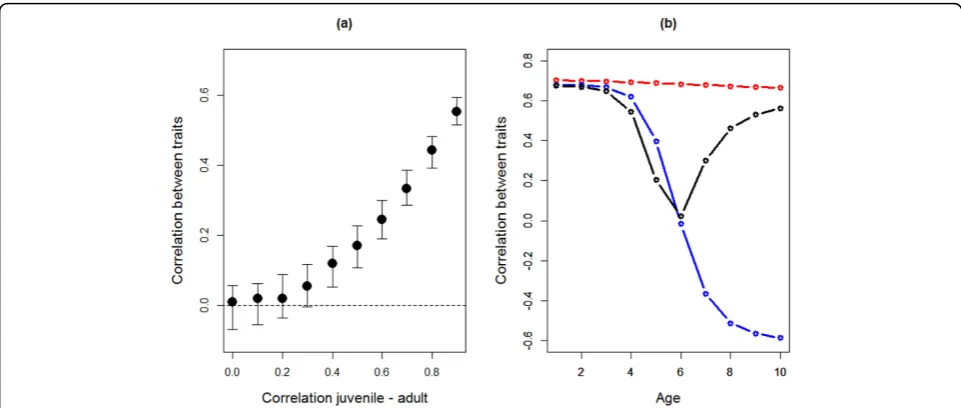
level (Fig. 3), the correlation in two behaviors falls from 0.7 in juveniles to a low of approximately 0.1 –0.2 in adults. Thus, the (implicit) assumption that a behavioral syndrome stays stable over age classes essentially assumes that the behaviors forming the syndrome show little to no variation in plasticity over age classes. When considering more than two ages, it becomes parti-cularly clear how different patterns of changes in the cor-relation between behaviors during aging can be due to different types of GxA [106]. To illustrate this we consid-ered three different scenarios of GxA on the correlation between two behaviors from age 1 to 10. In the first sce-nario, reaction norms“fan out”such that the rank orders of both behaviors are maintained across ages (cf. Fig 2a). Under these conditions, the correlation between the behaviors is high and positive across all ages (red line in Fig. 4b). In the second scenario, the rank order of beha-viors is maintained for the first trait but is for the second trait reversed in old ages (crossing reaction norms, cf. Fig 2d). The correlation between the behaviors then becomes negative (blue line in Fig. 4b) after the point where the reaction norms of the second behavior are crossing, i.e. where the variance reaches it minimum (cf. Fig. 2d). Finally, when the rank order of both traits is reversed across ages, the correlation between the behaviors initi-ally decreases towards zero before increasing again in
older ages (black line in Fig. 4b). Given the rarity of nega-tive phenotypic rank-order correlations in behaviors, these 3 scenarios can seem far from biological reality. However, the key point of this exercise is to demonstrate that crossing of the IxA and/or GxA reaction norms within the range of ages considered in at least one of two correlated behaviors leads to changes in the correlation between these two behaviors across ages. Whenever such crossing of reaction norms occurs and depending on which ages are considered in a study, one would predict that correlations between behaviors either disappear (e.g. blue and black lines for ages 1-5 in Fig. 4b) or appear (black line for ages 6-10 in Fig.4b) or show changes in sign or non-linear patterns (ages 1-10 in Fig.4b).
Correlation between multiple traits across ages: literature overview
Theoretical considerations [21,106] reviewed above clearly predict that age-specific correlations between multiple behaviors are expected to change as the organ-ism ages, whenever IxA and/or GxA is present in one or more of the behaviors. In order to investigate whether such patterns are found in the literature, we selected among the studies reviewed in the previous section an overview of the literature on changes in age-specific phe-notypic correlations between behaviors. Although the
Fig 4Expected correlation between two behaviors over various ages depending on the form of GxA. (a) Correlations between two behaviors expressed at the adult stage, given that they are strongly correlated on the juvenile stage (rJUV= 0.7), and according to the rank-order
correlation of each trait across ontogeny (rJUV-AD) which is here varied from 0 to 0.9 and assumed to be the same for both traits. Plotted are the
limited amount of studies does not allow quantitative statements, there indeed are studies finding a change in the magnitude and sometimes even the sign of the corre-lation between two behaviors across ages (additional file 5). At present, we do not know the extent to which the observed correlational changes are caused by underlying GxA and to what extent they are due to non-heritable age-related factors. Nevertheless, changes in correlations between behaviors over age classes clearly occur in nature, and hence beg an explanation. Explicit study of the extent to which GxA is underly-ing such changes is likely valuable for gainunderly-ing further insight into this interesting phenomenon.
Future perspective
The take-home message of this paper is that when there is plasticity in behavior over ages, there may be variation in age-related plasticity between individuals (IxA) and/or genotypes (GxA). Whenever there is variation in plasti-city, there is the clear expectation that repeatability and/ or heritability of a focal behavior varies over ages. In addition, it is likely that the ranking of individual-speci-fic and/or breeding values for the focal behavior change as a function of age, thereby leading to low cross-age correlations in behavior, and changes in the correlation between multiple behaviors. Thus, calculation of the repeatability or heritability of a behavior or the correla-tion between multiple behaviors while pooling all age groups may give a misleading impression of the consis-tency in behavior or a behavioral syndrome. Our litera-ture overview, based on phenotypic measures, indeed illustrates that the consistency of behavioral differences between individuals across ages may be low, despite a behavior being repeatable when measured at different ages. We believe that changes in repeatability and herit-ability over ages as well as appreciation of cross-age correlations are of importance if we are to properly understand the sources of behavioral variation from a lifetime perspective.
We have outlined conceptual models, which illustrate why the presence of IxA and GxA is expected to lead to age-related changes in repeatability, heritability and low cross-age correlations in behavior. In addition, we briefly underlined the quantitative genetic approaches which provide accessible means to model age-related plastic changes in behavior on the individual and/or genetic levels. In general, there is a clear scope for increased uptake of quantitative genetic approaches in the study of behavior [107]. We believe the approaches outlined in this paper are applicable to various systems in which behavior is studied, and hope future studies will con-sider approaching their research from this perspective. It is the explicit empirical investigation of IxA and GxA in behavior which will inform us whether the theoretical
concepts and patterns predicted by theory on plasticity indeed are present in behaviors.
Additional material
Additional file 1: Glossary of terms used in this paper
Additional file 2: Schematic illustration of how changes in the age-specific expression of behavior by an individual are modelled as deviations from the age-specific mean
Additional file 3: Overview of literature estimates of the correlation of behavioral traits across age classes
Additional file 4: R script for producing the simulations in this paper
Additional file 5: Overview of the literature considering changes in the correlation between two or more behavioral traits across ages
Authors’contributions
JEB conceived the study and wrote the first draft. BC performed the literature search and compiled the literature estimates. JEB and BC jointly wrote the paper, and its final version is approved by both authors.
Acknowledgement
We thank the organizers of the“New perspectives in behavioral
development”workshop at the ZiF in Bielefeld. Three reviewers are thanked for providing in-depth comments which massively improved the
transparency of our paper.
Declarations
The authors declare no competing interests. Publication costs for this article were funded by the German Research Foundation (FOR 1232) and the Open Access Publication Fund of Bielefeld and Muenster University.
Published: 24 August 2015
References
1. Kirkpatrick M, Heckman N:A quantitative genetic model for growth, shape, reaction norms, and other infinite-dimensional characters.J Math Biol.1989,27(4):429-450.
2. Nussey DH, Wilson AJ, Brommer JE:The evolutionary ecology of individual phenotypic plasticity in wild populations.J Evol Biol.2007,
20(8):831-844.
3. Sih A, Bell A, Johnson JC:Behavioral syndromes: an ecological and evolutionary overview.Trends Ecol Evol.2004,19(7):372-378. 4. Réale D, Dingemanse NJ, Kazem AJN, Wright J:Evolutionary and
ecological approaches to the study of personality.Philos Trans R Soc B.
2010,365(1560):3937-3946.
5. Brommer JE:Variation in plasticity of personality traits implies that the ranking of personality measures changes between environmental contexts: Calculating the cross-environmental correlation.Behav Ecol Sociobiol.2013,67(10):1709-1718.
6. Kooij v. Erp-v. d, Kuijpers AH, Schrama JW, van Eerdenburg FJCM, Schouten WGP, Tielen MJM:Can we predict behaviour in pigs?? Searching for consistency in behaviour over time and across situations.
Appl Anim Behav Sci.2002,75(4):293-305.
7. Ardelt M:Still Stable after All These Years? Personality Stability Theory Revisited.Soc Psychol Q.2000,63(4):392-405.
8. Réale D, Reader SM, Sol D, McDougall PT, Dingemanse NJ:Integrating animal temperament within ecology and evolution.Biol Rev Camb Philos Soc.2007,82(2):291-318.
9. Medawar PB:An unsolved problem of biology.London: HK Lewis; 1952. 10. Williams GC:Pleiotropy, Natural Selection, and the Evolution of
Senescence.Evolution1957,11(4):398-411.
12. Wilson AJ, Charmantier A, Hadfield JD:Evolutionary genetics of ageing in the wild: Empirical patterns and future perspectives.Funct Ecol.2008,
22:431-442.
13. Charmantier A, Brommer JE, Nussey DH:The quantitative genetics of senescence in wild animals.InQuantitative genetics in the wild.Oxford: Oxford University Press;Charmantier A, Garant D, Kruuk LEB, editors. 2014:68-83.
14. Nussey DH, Froy H, Lemaitre JF, Gaillard JM, Austad SN:Senescence in natural populations of animals: Widespread evidence and its implications for bio-gerontology.Ageing Research Reviews2013,
12(1):214-225.
15. Jones OR, Scheuerlein A, Salguero-Gómez R, Camarda CG, Schaible R, Casper BB,et al:Diversity of ageing across the tree of life.Nature2014,
505(7482):169-173.
16. Stirling DG, Roff DA, Réale D:Selection, structure and the heritability of behaviour.J Evol Biol.2002,15(2):277-289.
17. van Oers K, Sinn DL:The quantitative and molecular genetics of animal personality.InAnimal personalities: behavior, physiology, and evolution.
Chicago: University of Chicago Press;Carere C, Maestripieri D, editors. 2010:149-200.
18. Falconer DS, MacKay TFC:Introduction to quantitative genetics.Harlow: Longman;, 4th ed 1996.
19. Garamszegi LZ, Markó G, Herczeg G:A meta-analysis of correlated behaviours with implications for behavioural syndromes: Mean effect size, publication bias, phylogenetic effects and the role of mediator variables.Evol Ecol.2012,26(5):1213-1235.
20. Dochtermann NA, Dingemanse NJ:Behavioral syndromes as evolutionary constraints.Behav Ecol.2013,24(4):806-811.
21. de Jong G:Quantitative Genetics of reaction norms.J Evol Biol.1990,
3(5-6):447-468.
22. Lynch M, Walsh B:Genetics and Analysis of Quantitative Traits.
Sunderland: Sinauer Associates; 1998.
23. Roff DA:The evolution of wing dimorphism in insects.Evolution1986,
40(4):1009-1020.
24. Roff DA:Evolutionary Quantitative Genetics.New York: Chapman & Hall; 1997. 25. Hill WG, Goddard ME, Visscher PM:Data and theory point to mainly
additive genetic variance for complex traits.PLoS Genet.2008,4(2): e1000008.
26. Pemberton JM:Wild pedigrees: the way forward.Proc Biol Sci.2008,
275(1635):613-621.
27. Kruuk LEB, Hadfield JD:How to separate genetic and environmental causes of similarity between relatives.J Evol Biol.2007,20(5):1890-1903. 28. Kruuk LEB, Slate J, Wilson AJ:New Answers for Old Questions: The
Evolutionary Quantitative Genetics of Wild Animal Populations.Annual Review of Ecology, Evolution, and Systematics2008,39:525-548. 29. Wilson AJ, Réale D, Clements MN, Morrissey MM, Postma E, Walling CA,
et al:An ecologist’s guide to the animal model.J Anim Ecol.2009,
79(1):13-26.
30. Charlesworth B:Patterns of age- specific means and genetic variances of mortality rates predicted by the mutation-accumulation theory of ageing.J Theor Biol.2001,210(1):47-65.
31. Wolak ME, Keller LF:Dominance genetic variance and inbreeding in natural populations.Quantitative Genetics in the WildOxford: Oxford University Press; 2014, 104-127.
32. Dingemanse NJ, Kazem AJ, Réale D, Wright J:Behavioural reaction norms: animal personality meets individual plasticity.Trends Ecol Evol.2009,
25(2):81-89.
33. Stinchcombe JR, Kirkpatrick M:Genetics and evolution of function-valued traits: understanding environmentally responsive phenotypes.Trends in Ecology and Evolution2012,27(11):637-647.
34. Henderson CR:Analysis of covariance in the mixed model: higher-level, non homogeneous, and random regressions.Biometrics1982,
38(3):623-640.
35. Schaeffer L:Application of random regression models in animal breeding.Livest Prod Sci.2004,86(1-3):35-45.
36. Meyer K:Estimating covariance functions for longitudinal data using a random regression model.Genetics Selection Evolution1998,30:221-240. 37. Fischer TM, Gilmour AR, van der Werf JH:Computing approximate
standard errors for genetic parameters derived from random regression models fitted by average information REML.Genet Sel Evol.2004,
36(3):363-369.
38. Pletcher SD, Geyer CJ:The genetic analysis of age-dependent traits: Modeling the character process.Genetics1999,153(2):825-835. 39. Brommer JE:On between-individual and residual (co)variances in the
study of animal personality: Are you willing to take the“individual gambit”?Behav Ecol Sociobiol.2013,67(6):1027-1032.
40. Petelle MB, McCoy DE, Alejandro V, Martin JGA, Blumstein DT:
Development of boldness and docility in yellow-bellied marmots.Anim Behav.2013,86(6):1147-1154.
41. David M, Auclair Y, Cézilly F:Assessing Short- and Long-Term
Repeatability and Stability of Personality in Captive Zebra Finches Using Longitudinal Data.Ethology2012,118(10):932-942.
42. Biro PA, Adriaenssens B, Sampson P:Individual and sex-specific differences in intrinsic growth rate covary with consistent individual differences in behaviour.J Anim Ecol.2014,83(5):1186-1195. 43. Sinn DL, Gosling SD, Moltschaniwskyj NA:Development of shy/bold
behaviour in squid: context-specific phenotypes associated with developmental plasticity.Anim Behav.2008,75(2):433-442.
44. Kanda LL, Louon L, Straley K:Stability in Activity and Boldness Across Time and Context in Captive Siberian Dwarf Hamsters.Ethology2012,
118(6):518-533.
45. van Overveld T, Careau V, Adriaensen F, Matthysen E:Seasonal- and sex-specific correlations between dispersal and exploratory behaviour in the great tit.Oecologia2014,174(1):109-120.
46. D’Eath RB:Consistency of aggressive temperament in domestic pigs: The effects of social experience and social disruption.Aggress Behav.
2004,30(5):435-448.
47. Guenther A, Trillmich F:Photoperiod influences the behavioral and physiological phenotype during ontogeny.Behav Ecol.2012,
24(2):402-411.
48. Guenther A, Finkemeier M-A, Trillmich F:The ontogeny of personality in the wild guinea pig.Anim Behav.2014,90:131-139.
49. Eccard JA, Rödel HG:Optimizing temperament through litter size in short-lived, iteroparous mammals in seasonal environments.Dev Psychobiol.2011,53(6):585-591.
50. Janczak AM, Pedersen LJ, Bakken M:Aggression, fearfulness and coping styles in female pigs.Appl Anim Behav Sci.2003,81(1):13-28.
51. Ruis MAW, te Brake JHA, van de Burgwal JA, de Jong IC, Blokhuis HJ, Koolhaas JM:Personalities in female domesticated pigs: behavioural and physiological indications.Appl Anim Behav Sci.2000,66(1-2):31-47. 52. Erhard HW, Mend M:Measuring aggressiveness in growing pigs in a
resident-intruder situation.Appl Anim Behav Sci.1997,54(2-3):123-136. 53. Bell AM, Stamps JA:Development of behavioural differences between
individuals and populations of sticklebacks, Gasterosteus aculeatus.Anim Behav.2004,68(6):1339-1348.
54. Visser E, van Reenen C, Hopster H, Schilder MB, Knaap J, Barneveld A, Blokhuis H:Quantifying aspects of young horses’temperament: consistency of behavioural variables.Appl Anim Behav Sci.2001,
74(4):241-258.
55. Lansade L, Bouissou M-F:Reactivity to humans: A temperament trait of horses which is stable across time and situations.Appl Anim Behav Sci.
2008,114(3-4):492-508.
56. Lansade L, Bouissou M-F, Erhard HW:Fearfulness in horses: A
temperament trait stable across time and situations.Appl Anim Behav Sci.
2008,115(3-4):182-200.
57. Lansade L, Bouissou M-F, Erhard HW:Reactivity to isolation and association with conspecifics: A temperament trait stable across time and situations.Appl Anim Behav Sci.2008,109(2-4):355-373.
58. Ray J, Hansen S:Temperamental development in the rat: The first year.
Dev Psychobiol.2005,47(2):136-144.
59. Carere C, Drent PJ, Privitera L, Koolhaas JM, Groothuis TGG:Personalities in great tits, Parus major: stability and consistency.Anim Behav.2005,
70(4):795-805.
60. SchÜrch R, Heg D:Life history and behavioral type in the highly social cichlid Neolamprologus pulcher.Behav Ecol.2010,21(3):588-598. 61. Suomi SJ, Novak MA, Well A:Aging in rhesus monkeys: Different
windows on behavioral continuity and change.Dev Psychol.1996,
32(6):1116-1128.
62. Sinn DL, Perrin NA, Mather JA, Anderson RC:Early temperamental traits in an octopus (Octopus bimaculoides).J Comp Psychol.2001,115(4):351-364. 63. Cussen VA, Mench JA:Personality predicts cognitive bias in captive
64. Taylor JH, Mustoe AC, French JA:Behavioral responses to social separation stressor change across development and are dynamically related to HPA activity in marmosets.Am J Primatol.2014,76(3):239-248. 65. Herde A, Eccard JA:Consistency in boldness, activity and exploration at
different stages of life.BMC Ecol.2013,13:49.
66. Wilson ADM, Krause J:Personality and metamorphosis: Is behavioral variation consistent across ontogenetic niche shifts?Behav Ecol.2012,
23(6):1316-1323.
67. Gyuris E, Feró O, Barta Z:Personality traits across ontogeny in firebugs, Pyrrhocoris apterus.Anim Behav.2012,84(1):103-109.
68. Stöwe M, Bugnyar T, Loretto MC, Schloegl C, Range F, Kotrschal K:Novel object exploration in ravens (Corvus corax): Effects of social relationships.Behav Processes2006,73(1):68-75.
69. Van Reenen CG, Van der Werf JTN, O’Connell NE, Heutinck LFM, Spoolder HAM, Jones RB,et al:Behavioural and physiological responses of heifer calves to acute stressors: Long-term consistency and relationship with adult reactivity to milking.Appl Anim Behav Sci.2013,
147(1-2):55-68.
70. Clark CCA, D’Eath RB:Age over experience: Consistency of aggression and mounting behaviour in male and female pigs.Appl Anim Behav Sci.
2013,147(1-2):81-93.
71. Budaev S V, Zworykin DD, Mochek AD:Consistency of individual differences in behaviour of the lion-headed cichlidSteatocranus casuarius.Behav Processes1999,48(1-2):49-55.
72. Rensel M a, Schoech SJ:Repeatability of baseline and stress-induced corticosterone levels across early life stages in the Florida scrub-jay (Aphelocoma coerulescens).Horm Behav.2011,59(4):497-502. 73. Brouček J, Kišac P, UhrinčaťM:The effect of sire line on learning and
locomotor behaviour of heifers.Czech J Anim Sci.2003,48(9):387-394. 74. Visser EK, Van Reenen CG, Van der Werf JTN, Schilder MBH, Knaap JH,
Barneveld A, Blokhuis HJ:Heart rate and heart rate variability during a novel object test and a handling test in young horses.Physiol Behav.
2002,76(2):289-296.
75. Coss RG, Biardi JE:Individual Variation in the Antisnake Behavior of California Ground Squirrels (Spermophilus beecheyi).J Mammal.1997,
78:294-310.
76. Francis RC:Temperament in a Fish: A Longitudinal Study of the Development of Individual Differences in Aggression and Social Rank in the Midas Cichlid.Ethology1990,86(4):311-325.
77. Schielzeth H, Bolund E, Kempenaers B, Forstmeier W:Quantitative genetics and fitness consequences of neophilia in zebra finches.Behav Ecol.2011,
22(1):126-134.
78. Biro PA, Stamps JA:Are animal personality traits linked to life-history productivity?Trends Ecol Evol.2008,23(7):361-368.
79. Bell AM, Hankison SJ, Laskowski KL:The repeatability of behaviour: a meta-analysis.Anim Behav.2009,77(4):771-783.
80. Bakker TCM:Aggressiveness in Sticklebacks (Gasterosteus aculeatus L.): A Behaviour-Genetic Study.Behaviour1986,98(1):1-144.
81. Masters MW, Raver KAS, Kazial KA:Sonar signals of big brown bats
Eptesicus fuscus, contain information about individual identity, age and family affiliation.1995,50(5):1243-1260.
82. Battley PF:Consistent annual schedules in a migratory shorebird.Biol Lett.2006,2(4):517-520.
83. Bajer K, Horváth G, Molnár O, Török J, Garamszegi LZ, Herczeg G:European green lizard (Lacerta viridis) personalities: Linking behavioural types to ecologically relevant traits at different ontogenetic stages.Behav Processes2015,111:67-74.
84. Fratkin JL, Sinn DL, Patall EA, Gosling SD:Personality Consistency in Dogs: A Meta-Analysis.PLoS One2013,8(1):e54907.
85. Caspi A, Roberts BW:Personality Development Across the Life Course?: The Argument for Change and Continuity.Psychol Inq.2001,12(2):49-66. 86. Donnellan MB, Conger RD, Burzette RG:Personality development from
late adolescence to young adulthood: differential stability, normative maturity, and evidence for the maturity-stability hypothesis.J Pers.2007,
75(2):237-263.
87. McAdams DP, Olson BD:Personality development: continuity and change over the life course.Annu Rev Psychol.2010,61:517-542.
88. Roberts BW, DelVecchio WF:The Rank-Order Consistency of Personality Traits from Childhood to Old Age: A Quantitative Review of Longitudinal Studies.Psychol Bull.2000,126(1):3-25.
89. Mroczek DK, Spiro A:Modeling Intraindividual Change in Personality Traits?: Findings From the Normative Aging Study.J Gerontol B Psychol Sci Soc Sci.2003,58(3):153-165.
90. Mõttus R, Johnson W, Starr JM, Deary IJ:Correlates of personality trait levels and their changes in very old age: The Lothian Birth Cohort 1921.
J Res Pers.2012,46(3):271-278.
91. Roberts BW, Helson R, Klohnen EC:Personality Development and Growth in Women Across 30 Years?: Three Perspectives.J Pers.2002,70(1):79-102. 92. Small BJ, Hertzog C, Hultsch DF, Dixon RA:Stability and Change in Adult
Personality Over 6 Years: Findings From the Victoria Longitudinal Study.
Journals Gerontol Ser B Psychol Sci Soc Sci.2003,58(3):166-176. 93. Lucas RE, Donnellan MB:Personality development across the life span:
longitudinal analyses with a national sample from Germany.J Pers Soc Psychol.2011,101(4):847-861.
94. Milojev P, Sibley CG:The stability of adult personality varies across age: Evidence from a two-year longitudinal sample of adult New Zealanders.
Journal of Research in Personality.2014,51:29-37.
95. Specht J, Egloff B, Schmukle SC:Stability and change of personality across the life course: the impact of age and major life events on mean-level and rank-order stability of the Big Five.J Pers Soc Psychol.2011,
101(4):862-882.
96. Wortman J, Lucas RE, Donnellan MB:Stability and change in the Big Five personality domains: evidence from a longitudinal study of Australians.
Psychol Aging2012,27(4):867-874.
97. McCrae RR, Costa PTJ, Ostendorf F, Angleitner A, Hrebícková M, Avia MD,
et al:Nature over Nurture: Temperament, Personality, and Life Span Development.J Pers Soc Psychol.2000,78(1):173-186.
98. Saudino KJ:Tester-rated temperament at 14,20 and 14 months?: Environmental change and genetic continuity.Br J Dev Psychol.1996,
14(2):129-144.
99. Saudino KJ:Sources of continuity and change in activity level in early childhood.Child Dev.2012,83(1):266-281.
100. Bergen SE, Gardner CO, Kendler KS:Age-related changes in heritability of behavioral phenotypes over adolescence and young adulthood: a meta-analysis.Twin Res Hum Genet.2007,10(3):423-433.
101. Bornovalova MA, Hicks BM, Iacono WG, McGue M:Stability, change, and heritability of borderline personality disorder traits from adolescence to adulthood: a longitudinal twin study.Dev Psychopathol.2009,
21(4):1335-1353.
102. Kandler C:Nature and Nurture in Personality Development: The Case of Neuroticism and Extraversion.Curr Dir Psychol Sci.2012,21(5):290-296. 103. Kandler C, Riemann R, Angleitner A:Patterns and sources of continuity
and change of energetic and temporal aspects of temperament in adulthood: A longitudinal twin study of self- and peer reports.Dev Psychol.2013,49(9):1739-1753.
104. Dochtermann NA:Testing Cheverud’s conjecture for behavioral correlations and behavioral syndromes.Evolution.2011,65(6):1814-1820. 105. Dingemanse NJ, Dochtermann NA, Nakagawa S:Defining behavioural
syndromes and the role of“syndrome deviation”in understanding their evolution.Behav Ecol Sociobiol.2012,66(11):1543-1548.
106. Stearns S, de Jong G, Newman B:The effects of phenotypic plasticity on genetic correlations.Trends Ecol Evol.1991,6(4):122-126.
107. Dochtermann NA, Roff DA:Applying a quantitative genetics framework to behavioural syndrome research.Philos Trans R Soc Lond B Biol Sci.2010,
365(1560):4013-4020. doi:10.1186/1742-9994-12-S1-S2
Cite this article as:Brommer and Class:The importance of