S T U D Y P R O T O C O L
Open Access
Effectiveness of the tailored EBP training program
for Filipino physiotherapists: A randomised
controlled trial
Janine Margarita Dizon
1,2*, Karen Grimmer-Somers
1and Saravana Kumar
1Astract
Background:Evidence implementation continues to challenge health professionals most especially those from developing countries. Filipino physiotherapists represent a group of health professionals in a developing country who by tradition and historical practice, take direction from a doctor, on treatment options. Lack of autonomy in decision-making challenges their capacity to deliver evidence-based care. However, this scenario should not limit them from updating and up-skilling themselves on evidence- based practice (EBP). EBP training tailored to their needs and practice was developed to address this gap. This study will be conducted to assess the effectiveness of a tailored EBP-training program for Filipino physiotherapists, in improving knowledge, skills, attitudes and behaviour to EBP. Participation in this program aims to improve capacity to EBP and engage with referring doctors to determine the most effective treatments for their patients.
Methods/Design:A double blind randomised controlled trial, assessing the effectiveness of the EBP training intervention, compared with a waitlist control, will be conducted. An adequately powered sample of 54
physiotherapists from the Philippines will be recruited and randomly allocated to EBP intervention or waitlist control. Intervention: The EBP program for Filipino physiotherapists is a one-day program on EBP principles and techniques, delivered using effective adult education strategies. It consists of lectures and practical workshops. A novel component in this program is the specially-developed recommendation form, which participants can use after completing their training, to assist them to negotiate with referring doctors regarding evidence-based treatment choices for their patients. Pre and post measures of EBP knowledge, skills and attitudes will be assessed in both groups using the Adapted Fresno Test and the Questions to EBP attitudes. Behaviour to EBP will be measured using activity diaries for a period of three months.
Discussion:Should the EBP-training program be found to be effective in improving EBP-uptake in Filipino
physiotherapists, it will form the basis of a much needed national intervention which is contextually appropriate to Filipino physiotherapists. It will therefore form the genesis for a model for building EBP capacity of other health professionals in the Philippines as well as physiotherapists in developing countries.
Trial Registration:Current Controlled Trials: ISRCTN74485061
Background
Evidence-based practice (EBP) has been defined as the
“conscientious, explicit and judicious use of current best evidence in making decisions about the care of indivi-dual patients”[1]. The use of research evidence in clini-cal practice has been an area of interest in the health
profession around the world [2,3]. The aims of using evidence to guide practice are to build a defensible body of clinical professional knowledge, and use the best available evidence to support effective practice in patient care [4]. Strategies have been continuously proposed and tested to enhance the application of research evi-dence in practice. However, across all health professions, the uptake of the evidence into clinical practice has been a common challenge, because to do so requires change and sustainable thinking, and behaviours [2]. Barriers
* Correspondence: [email protected] 1
International Centre for Allied Health Evidence University of South Australia City East Campus, North Terrace Adelaide 5000, Australia
Full list of author information is available at the end of the article
such as lack of knowledge, skills, time, and access to the literature have been consistently reported [5-8], and strategies are continually being refined to address the range of barriers that confront clinicians wanting to implement research evidence into practice.
In developing countries, there are additional barriers in applying evidence into guide clinical practice. The diversity and culture of these countries have had signifi-cant impact on the type of health care provided, and the way in which it is delivered to patients. Generalising evi-dence developed in other countries may not always be appropriate, and summary evidence from systematic lit-erature reviews is often not relevant and applicable to developing countries. For instance, a recent Cochrane review reported that there is no evidence that using tap water for wound cleansing increases infection [9]. There are no trials included in the review to represent the use of tap water in developing countries and thus, the evi-dence cannot be recommended in settings where a con-stant supply of potable tap drinking water is unavailable. Consequently, context-specific clinical trials that can represent scenarios in developing countries can also be difficult to conduct, due to limited knowledge, resources, funding, skills etc. Trials conducted in devel-oping countries have often been found to be of poor quality because of lack of research training of the authors. Thus these trials may well be excluded in inter-national systematic literature reviews, as they may not meet the criteria of high methodological quality [10]. As a result, out-of-date and even harmful practices are still being implemented in developing countries, despite evi-dence to the contrary from international research [11].
There is no simple answer to this scenario. However, a key solution to overcome these barriers has been con-sidered to be effective education, training and peer sup-port [10-13]. Researchers and clinicians in developing countries need more support to learn the concepts and acquire the skills related to evidence based practice, so that research and clinical practices improve. Thus there is an urgent need to build capacity for EBP knowledge and skills amongst health professionals in developing countries. The South East Asia Optimising Reproductive and Child Health in Developing Countries known as the SEA-ORCHID project, is one of the few research-based projects which builds on this need to train health pro-fessionals (doctors, nurses and midwives) in evidence-based practice [13,14]. This group tested the effective-ness of a multifaceted intervention designed to increase the capacity for EBP and research synthesis, of the health professionals involved in reproductive medicine. The authors reported that although there were difficul-ties encountered during the project, such as access to academic expertise when the health professionals returned to their countries and availability of resources
(i.e. computers with internet connection), the project resulted in a greater understanding of EBP and develop-ment of skills related to EBP.
The impact of using evidence to guide clinical practice is also being explored in the field of allied health. Allied health has been defined by the United States Association of Schools of Allied Health Professionals (ASAHP) as
“professionals [being] involved with the delivery of health care related services pertaining to the identification, eva-luation and prevention of diseases and disorders; dietary and nutrition services; rehabilitation and health systems management, among other...”[15]. The National Health Service (NHS) Scotland classified allied health as“ scien-tific, technical and therapy workers”[16]. More recently, a broader and three-dimensional classification of Austra-lian allied health has been presented by Turnbull et al [17]. This classification is built on allied health group-ings of therapies, diagnostic and technical, scientific and complementary services. Physiotherapy is an allied health profession classified in the therapy group, along with occupational therapy, psychology, podiatry etc. These professions provide treatment to manage a range of conditions, particularly musculoskeletal, neurological and respiratory. As developing countries rarely have either enough money to fund adequate health services, or enough health professionals to provide adequate treatment, treatment interventions should be under-pinned by the concepts of EBP to ensure efficient, and effective services.
Specific to the needs of a group of allied health pro-fessionals, namely physiotherapists in the Philippines, we designed and pilot-tested an EBP training program to enhance their knowledge, skills, attitudes and behaviour to EBP. This tailored, multifaceted EBP program builds on the concept of effective education, training and peer support as key solution to overcome barriers to EBP in developing countries. It is further underpinned by evi-dence from the literature on contents and strategies of effective EBP programs [19-22]. We conducted prelimin-ary exploratory studies which established the nature and scope of physiotherapy practice in the Philippines, the needs of Filipino physiotherapists and their perspectives on teaching EBP to the Filipino physiotherapy popula-tion [18].
The planned intervention (the EBP program for Fili-pino physiotherapists) is a one-day evidence-based program using effective adult education strategies. It consists of short lectures, practical workshops and practice sessions. A detailed description of the gram is attached in this protocol. The training pro-gram has been pilot-tested and assessed for feasibility and acceptability. The training program resulted in a large effect size (0.83) in terms of improving knowl-edge and skills to EBP. The participants reported in evaluation summaries and feedback, that the content of, and strategies used in, the training were effective and practical. This training was viewed by partici-pants as a medium to update physiotherapy practice and bridge the gap between theory and actual practice.
Methods
Study Aims
There are two aims in this research project:
1. To assess the effectiveness of the EBP training pro-gram in improving knowledge, skills, attitudes and beha-viour of Filipino physiotherapists; and
2. To provide a tested model of continuing education and uptake of evidence which is contextually relevant to Filipino physiotherapists, and which could be adapted readily for physiotherapists from other developing coun-tries, and allied health professionals who are not first contact practitioners in any health care system.
Study design and setting
Ethics
Ethical approval has been obtained from the University of South Australia’s Human Research Ethics Committee (protocol no. 0000021872). The primary author is a PhD student at this university.
Design
The EBP training program will be tested using a rando-mised controlled design, using a waitlist control group.
Outcomes
Significantly improved knowledge, skills, attitudes and behaviour to EBP as measured by psychometrically sound instruments. A moderate effect size of >0.6 of the education program is anticipated, based from several trials synthesized in a systematic review [23].
Timing
The study will commence in January 2011 and finish in October 2011. A detailed time table is attached with this protocol.
Sample Size determination
To detect a “moderate” effect size (0.6) at 80% power and 5% level of significance (2 tailed distribution), the required sample size for each group (intervention and control) is 27 physiotherapists (calculated using standard sample size calculator software in MedCalc). We will test for a conservative (moderate) effect in our RCT, as we are uncertain whether the large effect size from the pilot study was an artefact of the small sample, or an example of a Hawthorne effect.
Participant recruitment
Physiotherapists from hospitals and clinics in the Philip-pines will be recruited. Participants will be selected using the following criteria:
1. Licensed to practice physiotherapy and trained in the Philippines
2. Have not ever participated in any formal EBP training
Identification of reference population of participants A register will be collated from a) a database of phy-siotherapists collated by the primary researcher from a preliminary study which established the profile of phy-siotherapists [18] and b) the registry of the Philippine Physiotherapy Association (PPTA), of which the primary researcher is a member and from whom approval has been sought and granted.
Physiotherapists who will express their interest in parti-cipating in the study will complete an information sheet which includes age, gender, years in practice, and highest educational attainment. There is also a screening compo-nent of the questionnaire which will seek information on any EBP training program. This section is particularly important as participants should not have been exposed to a formal EBP course or training to minimize the potential influence of such to the outcomes. To be specific, they should not have attended lectures and workshops on clini-cal question formulation, database searching, criticlini-cal appraisal and applying findings on patient cases. Once screened for eligibility, participants will be asked to attend a meeting to orient them to the procedures of the study and to obtain written informed consents.
Randomisation and blinding
control group, using a computer generated random numbers. Allocation into treatment and control groups will be undertaken by an independent research assistant who is unaware of the study objectives and the partici-pants. The schedule of training will depend on the group allocation, such that those in the intervention group will have their training earlier than the waitlisted control group. Participants and assessors of the study outcomes will be blinded to the allocation at all times. Procedure
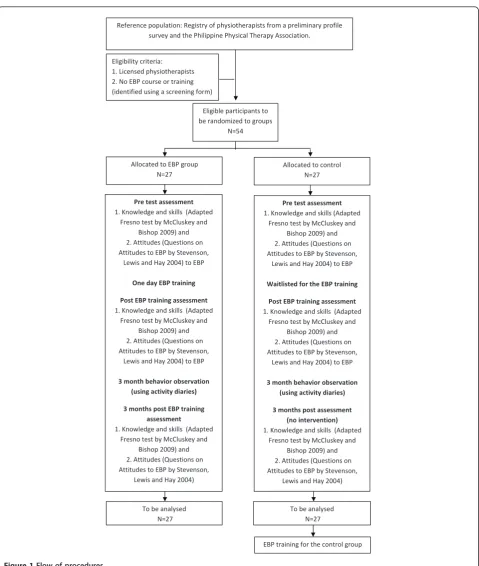
All participants will be asked to answer the Adapted Fresno Test or the AFT [24] for baseline or pre- assess-ment of their knowledge and skills to EBP, and the Questions on attitudes to EBP [25], for baseline or pre-assessment of their attitudes to EBP (Figure 1). These tools will be sent through the participants’ email, the day before the EBP intervention group’s scheduled training.
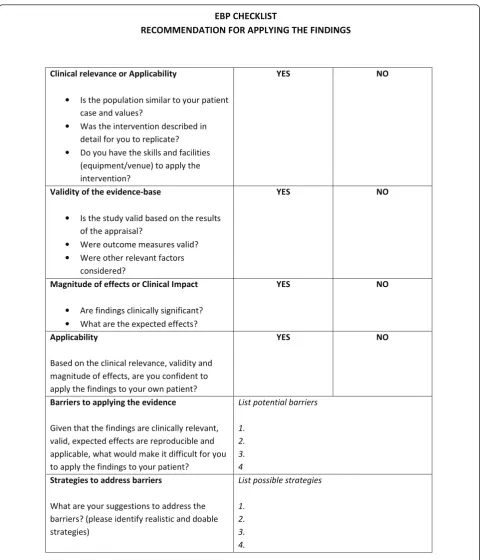
The EBP intervention group will attend a one day training (Additional File 1) in a training centre at the University of Santo Tomas, Philippines. The objectives of the training will be provided to the participants before each of the six lectures and the practical ses-sions. Small group discussions will occur between the lectures, to enhance learning opportunities for partici-pants. A checklist to assist participants to apply the evidence developed for this study will be provided as a take-home recommendation form, to guide the appli-cation of evidence in actual patient cases (Figure 2). After the EBP training, a link to an online support will be introduced to the participants. This has been devel-oped to assist the participants in their EBP-related activities post training, as follow up support and multi-faceted interventions have more potential to influence clinicians’ behaviour to using evidence in practice [2]. This online support is further described in the inter-vention section of this document. Activity diaries will also be provided to participants to log their EBP-related activities when faced with a new or unique case, and provide their comments to their activities for a period of three months for short term EBP behaviour assessment.
At the end of the training, participants will be asked to provide a second set of answers to the Adapted Fresno test and the Questions on attitudes to EBP for post EBP training intervention assessment.
The waitlist control group will undergo the pre and post- knowledge, skills and attitude test at the same per-iod as the intervention group. There will be no training for the control group during this time. However, for the next three months, they will also be provided with activ-ity diaries to log their activities as basis for their treat-ment when faced with a new or unique case, whether these activities are EBP-related or not.
Three months post EBP training, a third set of answers to the Adapted Fresno test and the Questions on attitudes to EBP, will be obtained from both groups to measure if knowledge, skills and attitudes to EBP were sustained over the three month period in the EBP intervention group and to measure the stability of knowledge, skills and attitudes to EBP of the control group.
The Intervention
The design of the EBP training program was based on preliminary exploratory studies on the nature and scope of physiotherapy practice in the Philippines, perspectives in teaching EBP to the local physiotherapists and the lit-erature on effective training programs for allied health. From these studies, we identified culture specific strate-gies to teach Filipino physiotherapists about the con-cepts of EBP and how to apply them. The most effective training strategies appear to be short and simple lectures with plenty of time for practice sessions [22]. Educa-tional strategies using combined lectures and workshops [26-29] which occur face-to-face and are conducted over at least a half-day are effective to improve knowl-edge and skills to EBP [22]. Multifaceted interventions and post training support have the potential to improve attitudes and behaviour to EBP, thus a post training online support has been designed for the participants. Principles of adult learning and educational strategies fitted to the type of population have also informed the design of the training program. Adult learners learn more by solving a problem [30] and so we designed the program in a manner where the participants will formu-late their own clinical question and at the end of the training, should find an answer to the question based on the lectures and practice sessions provided.
The findings from our preliminary studies and the lit-erature were layered in order to construct theEBP for FilPTstraining program. The training program is com-posed of six lectures interspersed with four practical ses-sions to facilitate learning of knowledge and skills in EBP. The main contents of the training program are:
1. Introduction to EBP
2. Hierarchy of evidence and study designs
3. Drafting the clinical question using the PICO format
4. Designing the search
5. Critical appraisal of the evidence and
6. Answering the clinical question based from the evidence found.
best evidence should be identified through a systematic literature search and is appraised as having good metho-dological quality. Small group discussions will occur during the training sessions to enhance participant learning. TheEBP Checklist will assist participants to
apply the evidence in practice. This will provide the
‘tale-home’elements of the training as it can be used by participants to implement the evidence they have found in actual patient cases (Figure 2). This checklist is an innovative concept which physiotherapists who are not Eligibilitycriteria:
1.Licensedphysiotherapists
2.NoEBPcourseortraining
(identifiedusingascreeningform)
Referencepopulation:Registry ofphysiotherapistsfromapreliminaryprofile
surveyandthePhilippinePhysicalTherapyAssociation.
Eligible participantsto
berandomizedtogroups
N=54
Pretestassessment
1.Knowledgeandskills(Adapted
FresnotestbyMcCluskeyand
Bishop2009)and 2.Attitudes(Questionson
AttitudestoEBPbyStevenson,
LewisandHay2004)toEBP
OnedayEBPtraining
PostEBPtrainingassessment
1.Knowledgeandskills(Adapted
FresnotestbyMcCluskeyand
Bishop2009)and 2.Attitudes(Questionson
AttitudestoEBPbyStevenson,
LewisandHay2004)toEBP
3monthbehaviorobservation
(usingactivitydiaries)
3monthspostEBPtraining
assessment
1.Knowledgeandskills(Adapted
FresnotestbyMcCluskeyand
Bishop2009)and 2.Attitudes(Questionson
AttitudestoEBPbyStevenson,
LewisandHay2004)
AllocatedtoEBPgroup
N=27
Allocatedtocontrol
N=27
Pretestassessment
1.Knowledgeandskills(Adapted
FresnotestbyMcCluskeyand
Bishop2009)and 2.Attitudes(Questionson
AttitudestoEBPbyStevenson,
LewisandHay2004)toEBP
WaitlistedfortheEBPtraining
PostEBPtrainingassessment
1.Knowledgeandskills(Adapted
FresnotestbyMcCluskeyand
Bishop2009)and 2.Attitudes(Questionson
AttitudestoEBPbyStevenson,
LewisandHay2004)toEBP
3monthbehaviorobservation
(usingactivitydiaries)
3monthspostassessment
(nointervention) 1.Knowledgeandskills(Adapted
FresnotestbyMcCluskeyand
Bishop2009)and 2.Attitudes(Questionson
AttitudestoEBPbyStevenson,
LewisandHay2004)
Tobeanalysed
N=27
Tobeanalysed
N=27
EBPtrainingforthecontrolgroup
first contact practitioners, can use to recommend an evi-dence-based intervention to doctors for the management of a patient. The EBP checklist consists of items related to applicability or clinical relevance, validity of the evi-dence base, clinical impact or magnitude of effects. The
EBP checklist is comparable to the Relevance, Educa-tion, Applicability, Discrimination EvaluaEduca-tion, Reaction (READER) checklist used by general physicians in evalu-ating the literature to make recommendations for treat-ment [31]. It is also based partly on the body of
W,<>/^d
ZKDDEd/KE&KZWW>z/E'd,&/E/E'^
ůŝŶŝĐĂůƌĞůĞǀĂŶĐĞŽƌƉƉůŝĐĂďŝůŝƚLJ
• /ƐƚŚĞƉŽƉƵůĂƚŝŽŶƐŝŵŝůĂƌƚŽLJŽƵƌƉĂƚŝĞŶƚ ĐĂƐĞĂŶĚǀĂůƵĞƐ͍
• tĂƐƚŚĞŝŶƚĞƌǀĞŶƚŝŽŶĚĞƐĐƌŝďĞĚŝŶ ĚĞƚĂŝůĨŽƌLJŽƵƚŽƌĞƉůŝĐĂƚĞ͍ • ŽLJŽƵŚĂǀĞƚŚĞƐŬŝůůƐĂŶĚĨĂĐŝůŝƚŝĞƐ
;ĞƋƵŝƉŵĞŶƚͬǀĞŶƵĞͿƚŽĂƉƉůLJƚŚĞ ŝŶƚĞƌǀĞŶƚŝŽŶ͍
z^ EK
sĂůŝĚŝƚLJŽĨƚŚĞĞǀŝĚĞŶĐĞͲďĂƐĞ
• /ƐƚŚĞƐƚƵĚLJǀĂůŝĚďĂƐĞĚŽŶƚŚĞƌĞƐƵůƚƐ ŽĨƚŚĞĂƉƉƌĂŝƐĂů͍
• tĞƌĞŽƵƚĐŽŵĞŵĞĂƐƵƌĞƐǀĂůŝĚ͍ • tĞƌĞŽƚŚĞƌƌĞůĞǀĂŶƚĨĂĐƚŽƌƐ
ĐŽŶƐŝĚĞƌĞĚ͍
z^ EK
DĂŐŶŝƚƵĚĞŽĨĞĨĨĞĐƚƐŽƌůŝŶŝĐĂů/ŵƉĂĐƚ
• ƌĞĨŝŶĚŝŶŐƐĐůŝŶŝĐĂůůLJƐŝŐŶŝĨŝĐĂŶƚ͍ • tŚĂƚĂƌĞƚŚĞĞdžƉĞĐƚĞĚĞĨĨĞĐƚƐ͍
z^ EK
ƉƉůŝĐĂďŝůŝƚLJ
ĂƐĞĚŽŶƚŚĞĐůŝŶŝĐĂůƌĞůĞǀĂŶĐĞ͕ǀĂůŝĚŝƚLJĂŶĚ ŵĂŐŶŝƚƵĚĞŽĨĞĨĨĞĐƚƐ͕ĂƌĞLJŽƵĐŽŶĨŝĚĞŶƚƚŽ ĂƉƉůLJƚŚĞĨŝŶĚŝŶŐƐƚŽLJŽƵƌŽǁŶƉĂƚŝĞŶƚ͍
z^ EK
ĂƌƌŝĞƌƐƚŽĂƉƉůLJŝŶŐƚŚĞĞǀŝĚĞŶĐĞ
'ŝǀĞŶƚŚĂƚƚŚĞĨŝŶĚŝŶŐƐĂƌĞĐůŝŶŝĐĂůůLJƌĞůĞǀĂŶƚ͕ ǀĂůŝĚ͕ĞdžƉĞĐƚĞĚĞĨĨĞĐƚƐĂƌĞƌĞƉƌŽĚƵĐŝďůĞĂŶĚ ĂƉƉůŝĐĂďůĞ͕ǁŚĂƚǁŽƵůĚŵĂŬĞŝƚĚŝĨĨŝĐƵůƚĨŽƌLJŽƵ ƚŽĂƉƉůLJƚŚĞĨŝŶĚŝŶŐƐƚŽLJŽƵƌƉĂƚŝĞŶƚ͍
>ŝƐƚƉŽƚĞŶƚŝĂůďĂƌƌŝĞƌƐ
ϭ͘ Ϯ͘ ϯ͘ ϰ ^ƚƌĂƚĞŐŝĞƐƚŽĂĚĚƌĞƐƐďĂƌƌŝĞƌƐ
tŚĂƚĂƌĞLJŽƵƌƐƵŐŐĞƐƚŝŽŶƐƚŽĂĚĚƌĞƐƐƚŚĞ ďĂƌƌŝĞƌƐ͍;ƉůĞĂƐĞŝĚĞŶƚŝĨLJƌĞĂůŝƐƚŝĐĂŶĚĚŽĂďůĞ ƐƚƌĂƚĞŐŝĞƐͿ
>ŝƐƚƉŽƐƐŝďůĞƐƚƌĂƚĞŐŝĞƐ
ϭ͘ Ϯ͘ ϯ͘ ϰ͘
evidence matrix of the National Health and Medical Research Council (NHMRC) of Australia [32]. Addi-tional items related to identifying potential barriers to applying the evidence with strategies to address the bar-riers were also included in this checklist. Barrier and strategy identification in the early stages help facilitate the process of evidence implementation [2].
This EBP checklist will be used by physiotherapists in making recommendations to referring doctors for the treatment intervention. For instance, if there is strong evidence that mobilization decreases pain among patients with chronic neck pain using the pain visual analogue scale (VAS), and the physical therapist has the skills to apply these mobilization techniques, this inter-vention can be recommended to the referring doctors using the EBP checklist. Mobilization may then form part of recommended treatment procedures, and its effectiveness assessed using a VAS. This process sup-ports the application of principles of EBP, based on research evidence, the physiotherapists’skills and clini-cal expertise and the patient’s goals, within the context of local practice. This process will enhance the decision making skills of the therapists, build their capacity as health professionals and assist them to work with other health professionals in an evidence-based manner.
An EBP online support designed as part of the educa-tion model will be made available to participants and can be accessed at this link: http://www.unisa.edu.au/ cahe/Resources/EBPPhil/default.asp
The EBP online support allows participants the follow-ing:
1. Access the lectures and reference materials from the training (if participants need to review the slides, refresh their knowledge etc)
2. Seek assistance in searching for the evidence to answer their clinical question by filling up the PICO form
3. Seek assistance in validity assessment, through cri-tical appraisal of the evidence found
4. Ask any queries and provide feedback
This follow-up online support complements the train-ing provided to the physiotherapists and is a strategy to address previously identified barriers to evidence-uptake. Multiple strategies and tailored interventions to address barriers are more likely to facilitate changes in beha-viour than single interventions [33,34].
Outcome measures
EBP knowledge and skills
The Adapted Fresno Test will be used to measure EBP knowledge and skills. The test was adapted by McClus-key and Bishop [24] from the original Fresno test used
in medicine by Ramos et al [35], and has been reported to have acceptable psychometric properties, in measur-ing change in knowledge and skills to EBP among novice rehabilitation professionals. The test consists of seven questions which address EBP competencies rele-vant to health practitioners. There are two versions of the test (different clinical scenarios for each test) and ICC scores for subtests were, Version 1: ICC, 0.80-0.96; Version 2: 0.68-0.94 and ICC for total scores were Ver-sion 1: ICC, 0.96; VerVer-sion 2: ICC, 0.91. Internal consis-tency was acceptable (Cronbach’s alpha = 0.74). For our study, version 1 was used for baseline assessment and version 2 for post training assessment. This choice was made to avoid any potential practice effect (defined as
“improvements in cognitive test performance due to repeated evaluation with the same test materials“). Such practice effects can be a source of error [36].
Inter-tester reliability was assessed among the researchers participating in this study as part of the pilot study of the training program, and acceptable relia-bility was found (ICC 0.99) for both versions.
Questions to EBP attitudes
The Questions to EBP attitudes [25] will be used to assess the attitudes domain of EBP in this study. The attitudes to EBP scale consists of seven questions which are answered using a 3-point Likert scale: agree, neither agree nor disagree and disagree. The scale has been developed and validated for content and ease of comple-tion [25]. In addicomple-tion to this, participants will provide their comments on EBP and the EBP training program as part of this assessment.
EBP behaviour
EBP behaviour will be measured in two ways: (1) activity diaries to be provided to all participants, both interven-tion and waitlist groups, in paper and electronic copies, and (2) frequency of logging in, in the online support for the EBP intervention training participants http:// www.unisa.edu.au/cahe/Resources/EBPPhil/default.asp, considered as an electronic EBP learning portfolio. As it is not possible to conduct actual participant observation in practice, activity diaries are commonly used to log and report participants’activities in EBP [37]. The elec-tronic EBP learning portfolio on the other hand, which according to the literature, are both educational inter-vention and an evaluation strategy,” is the most promis-ing approach to document actual performance of EBP steps“[37].
of logging in the online support provided will be counted and interpreted as behaviour measures. Beha-viour measures will be interpreted in two ways, evi-dence-seeking behaviour and practice-change behaviours ref. Activities which relate only to drafting a clinical question, searching and appraising the evidence, are classified as evidence-seeking behaviours. Applying the evidence to an actual patient case is classified as a mea-sure of practice-change behaviour [38].
Plan of analysis
Baseline statistical comparisons will be performed to ensure that all participants from both groups are homo-genous and therefore comparable. All post-intervention analyses will be undertaken using an intention to treat approach. Within- and between-group analyses will be undertaken to measure pre and post intervention differ-ences in both intervention and waitlist control group. Changes in outcomes will be compared for both groups using means and 95%Confidence Intervals. Time period for analyses will be pre-intervention, post intervention and three months post intervention.
Discussion
We hypothesize that the EBP training will result in sig-nificant gains in knowledge, skills, attitudes and beha-viour to EBP. More so, the EBP checklist designed for making treatment recommendations to doctors is envi-sioned to facilitate an EBP approach to providing best care by physiotherapists who are not yet first contact practitioners. In effect, this project will provide a tested model for building EBP capacity of physiotherapists, which can be utilized by other health professionals in developing countries, in establishing their credibility to deliver treatments that are evidence-based. Should our proposed study establish the effectiveness of an EBP training program tailored to meet the needs of phy-siotherapists in one developing country (the Philippines), it could be implemented more widely in the Philippines, and for physiotherapists in other developing countries. Such training may well have down-stream influences on reducing health care costs, and adverse events, because of a changing culture towards provision of evidence-based health care.
Additional material
Additional file 1: Outline of the training program.
Acknowledgements
This study is funded in part by the Philippine Council for Health Research and Development (PCHRD) - Department of Science and Technology (DOST).
Author details
1International Centre for Allied Health Evidence University of South Australia
City East Campus, North Terrace Adelaide 5000, Australia.2University of Santo Tomas Manila 1015 Philippines.
Authors’contributions
All authors were responsible for drafting the research protocol and preparing the paper. JD, a PhD student, was responsible for designing the EBP training program with significant input from KG-S and SK. All authors read and approved the final manuscript.
Competing interests
The authors declare that they have no competing interests.
Received: 10 February 2011 Accepted: 13 April 2011 Published: 13 April 2011
References
1. Sackett DL, Straus SE, Richardson SW, Rosenberg W, Haynes BR: Evidence-based MedicineChurchill Livingstone; 2000.
2. Grol R, Grimshaw J:From best evidence to best practice: effective implementation of change in patients’care.The Lancet2003, 362:1225-1230.
3. Iles R, Davidson M:Evidence based practice: a survey of physiotherapists’ current practice.Physiotherapy Research International2006,11(2):93-103. 4. Schreiber J, Stern P:A review of the literature on evidence-based practice
in physical therapy.The Internet Journal of Allied Health Sciences and Practice2005,3(4).
5. Metcalf C, Lewin R, Closs J, Hughes C, Perry S, Wright J:Research in the NHS: A survey of four therapies.British Journal of Therapy and Rehabilitation2000,7(4):168-175.
6. Grimmer K, Bialocerkowski A, Kumar S, Milanese S:Implementing evidence in clinical practice: the‘therapies’dilemma.Physiotherapy2004, 90:189-194.
7. Maher C, Sherrington C, Elkins M, Herbert R, Moseley A, Grimmer K: Challenges for Evidence-Based Physical Therapy: Accessing and Interpreting High-Quality Evidence on therapy.Phys Ther2004, 84(7):644-654.
8. Grimmer-Somers K, Lekkas P, Nyland L, Young A, Kumar S:Perspectives on research evidence and clinical practice: a survey of Australian physiotherapists.Physiotherapy Research International2007,12(3):147-161. 9. Fernandez R, Griffiths R:Water for wound cleansing.Cochrane Database of
Systematic Reviews2008, ,1:CD003861.
10. Chinnock P, Siegfried N, Clarke M:Is evidence-based medicine relevant to the developing world?PLoS Med2005,2(5):e107.
11. Agarwal R, Kalita J, Misra UK:Barriers to evidence-based medicine practice in South Asia and possible solutions.Neurology Asia2008,13:87-94. 12. Godlee F, Pakenham-Walsh N, Ncayiyana D, Cohen B, Packer A:Can we
achieve health information for all by 2015?The Lancet2004,364:295-300. 13. McDonald S, Turner T, Chamberlain C, Lumbiganon P, Thinkhamrop J,
Festin M,et al:Building capacity for evidence generation, synthesis and implementation to improve the care of mothers and babies in South East Asia: methods and design of the SEA-ORCHID Project using a logical framework approach.BMC Med Res Methodol2010,10:61. 14. Short J, McDonald S, Turner T, Martis R:Improving capacity for
evidence-based practice in South East Asia: evaluating the role of research fellowships in the SEA-ORCHID Project.BMC Medical Education2010, 10:37.
15. Donini L, Fred G, Coming together, Moving apart:History of the term Allied Healthin education, accreditation and practice.Journal of Allied Health2008,37(1):45-52, (8).
16. National Health Service Scotland:Building on success future directions for the allied health professions in Scotland report.Edinburgh: The Stationery Office; 2002, 1.
17. Turnbull C, Grimmer-Somers K, Kumar S,et al:Allied, scientific and complementary health professionals:a new model for Australian allied health.Aust Health Rev2009,33(1):27-37.
Action: The Next Generation of Evidence Based Practice Preliminary Program 2010.
19. Coomarasamy A, Khan KS:What is the evidence that postgraduate teaching in evidence-based medicine changes anything? A systematic review.Brit Med J2004,329(7473):1017-1022.
20. Shaneyfelt T, Baum KD, Bell D, Feldstein D, Houston TK, Kaatz S, Whelan C, Green M:Instruments for evaluating education in evidence-based practice: a systematic review.JAMA2006,296:1116-1127.
21. Flores-Mateo G, Argimon J:Evidence based practice in postgraduate healthcare education: A systematic review.BMC Health Serv Res2007, 7:119.
22. Dizon JMR, Grimmer-Somers K, Kumar S:Systematic Review of the effectiveness of EBP educational programs in enhancing knowledge, attitudes, skills and behaviour of allied health practitioners.Proceedings of the 11th International Congress of the Asian Confederation for Physical Therapy, Conference2010.
23. Flores-Mateo G, Argimon J:Evidence based practice in postgraduate healthcare education: A systematic review.BMC Health Serv Res2007, 7:119.
24. McCluskey A, Bishop B:The Adapted Fresno Test of Competence in Evidence-Based Practice.J Contin Educ Health2009,29(2):119-126. 25. Stevenson K, Lewis M, Hay E:Do physiotherapists’attitudes towards
evidence-based practice change as a result of an evidence- based educational programme?J Eval Clin Pract2004,10(2):207-217. 26. Bartholemew L, Parcel G, Kok G:Intervention mapping: A process for
developing theory and evidence-based health education programs. Health Educ Behav1998,25:545-563.
27. Davies P:Approaches to evidence-based teaching.Med Teach2000, 22(1):14-21.
28. Newman P, Peile E:Valuing learners’experience and supporting further growth: educational models to help experienced adult learners in medicine.Brit Med J2002,325:200-202.
29. Reed D, Price E, Windish D, Wright S, Gozu A, Hsu E,et al:Challenges in systematic reviews of educational intervention studies.Ann of Intern Med 2005,142:1080-1089.
30. Knowles MS, Downie CM, Basford P:Teaching and assessing in clinical practiceLondon: University of Greenwich; 1998, 23-38.
31. Macauley D:READER: an acronym to aid critical reading by general practitioners.Brit J Gen Pract1994,44:83-85.
32. Merlin T, Weston A, Tooher R:Extending an evidence hierarchy to include topics other than treatment: revising the Australian‘levels of evidence’. BMC Medical Research Methodology2009,9:34.
33. Grimshaw J, Eccles M, Walker A, Thomas R:Changing Physicians’Behavior: What works and thoughts on getting more things to work.J Contin Educ Health2002,22:237-243.
34. Baker R, Camosso-Stefinovic J, Gillies C, Shaw EJ, Cheater F, Flottorp S, Robertson N:Tailored interventions to overcome identified barriers to change: effects on professional practice and health care outcomes. Cochrane Database of Systematic Reviews2010, ,3:CD005470. 35. Ramos KD, Schafer S, Tracz SM:Validation of the Fresno test of
competence in evidence based medicine.Brit Med J2003, 326(7384):319-321.
36. Duff K, Beglinger L, Schultz S, Moser D, McCaffrey R, Haase R,et al:Practice effects in the prediction of long-term cognitive outcome in three patient samples: A novel prognostic index.Arch Clin Neuropsych2007, 22:15-24.
37. Shaneyfelt T, Baum K, Bell D, Feldstein D, Houston T, Kaatz S, Instruments for evaluating education in Evidence-Based Practice,et al:A Systematic Review.JAMA2006,296(9):1116-1127.
38. Hakkennes S, Green S:Measures for assessing practice change in medical professionals.Implement Sci2006,1:29.
Pre-publication history
The pre-publication history for this paper can be accessed here: http://www.biomedcentral.com/1472-6920/11/14/prepub
doi:10.1186/1472-6920-11-14
Cite this article as:Dizonet al.:Effectiveness of the tailored EBP training program for Filipino physiotherapists: A randomised controlled trial.
BMC Medical Education201111:14.
Submit your next manuscript to BioMed Central and take full advantage of:
• Convenient online submission • Thorough peer review
• No space constraints or color figure charges • Immediate publication on acceptance
• Inclusion in PubMed, CAS, Scopus and Google Scholar • Research which is freely available for redistribution