International Journal of New Innovations in Engineering and Technology
Comparative Analysis of Circular Fractal
Antenna with Composite and Star Shaped
Fractal Antennas for Wireless Applications
Amandeep Kaur
M.Tech ScholarIKG, PTU, Regional Centre
Amritsar College of Engg. and Tech., Amritsar, Punjab, India
Narinder Sharma
Associate ProfessorDepartment of Electronics and Communication Engineering
Amritsar College of Engg. and Tech., Amritsar, Punjab, India
Abstract- This paper presents the comparison of three different types of fractal antennas. All the antennas are designed by using low cost FR4 glass epoxy substrate with relative permittivity of 4.4 and a thickness of 1.6mm. The different antenna parameters has been observed and analyzed such as return loss, VSWR, gain etc. The results of existing antennas (composite and star shaped fractal antennas) are compared with the designed circular fractal antenna. It is observed that the designed circular fractal antenna has much better results as compared to the existing antennas. HFSS V13 software is used to design and simulate the proposed antenna. The designed antenna is fabricated and tested by using VNA (Vector Network Analyzer), which shows that the measured results are in good agreement with the simulated results. The proposed design of antenna can be used for the practical wireless applications such as WLAN (4.82 - 5.95GHz), bluetooth (2.12 – 2.95GHz) and C – band (4 – 8GHz).
Keywords – HFSS, VNA, Circular fractal, Composite fractal, Star fractal, Key shaped fractal
I.INTRODUCTION
The microstrip antenna with fractal geometries have been widely developed for wideband and multiband applications in wireless communication systems [1]. The fractal concept was first developed by Nathan Cohen in 1995 [2]. Fractal antennas are designed by applying the two unique properties such as space-filling and self-similarity [3]. The self-self-similarity of fractal antenna describes the multiband nature of antenna and space-filling property used to reduce the size of antenna [4] [9]. To overcome the limitations caused by simple microstrip patch antenna such as low gain and bandwidth the fractal antennas are used which provide the high gain, bandwidth and exhibit multiband characteristics [6]. The fractal antennas are also designed to transmit or receive the signals over the wide range of frequencies [1]. The fractal elements of antenna allow it to operate on different resonant frequencies and the discontinuities in the fractal geometry increases the radiation property and the directivity of antenna [5]. The low profile, less fabrication cost and light weight are the main advantages of fractal antennas. Fractal antennas are used in different wireless applications such as ISM, GPS, RFID, WLAN (2.4-2.48GHz), (5.15-5.35GHz), (5.725-5.825GHz); Wi-MAX (2.5-2.69GHz), (3.4-3.69GHz) [7] [8].
The rest of the paper is organized as follows. The design configurations of all the antennas are explained in section II. Simulated and experimental results are presented in section III. Concluding remarks for all the antennas are given in section IV.
II.ANTENNA DESIGN AND CONFIGURATION
Figure1. (a) Composite fractal antenna [7] and (b) star fractal antenna [8]
Table-1 Parametric values of existing antennas
S. No.
Composite fractal antenna [7] Star fractal antenna [8]
Parameters Values Parameters Values
1. W 72 W 28.5
2. L 96 L 33.5
3. T 1.5 H 1.6
4. L1 61.4 S 2.9
5. D 35.2 a 26
6. H 20 S1 2.5
7. L2 64 S2 9.1
8. d1 23 SW 6.2
9. d2 12 LF 5.5
10. d3 19 Q 8.37
11. h1 38 - -
12. h2 60 - -
13. h3 73.2 - -
14. G 2.6 - -
15. W 3.5 - -
The proposed circular fractal antenna is designed on FR4 glass epoxy substrate with relative permittivity of 4.4 and thickness 1.6mm. The resonant frequency of designed antenna is taken as 3.2GHz and the radius of circular patch is calculated by using equation (1) and (2) which comes to be 12.6mm.
(1)
(2)
International Journal of New Innovations in Engineering and Technology
fr = Resonant frequency. h = Substrate height.
Ɛr= Dielectric constant of the substrate.
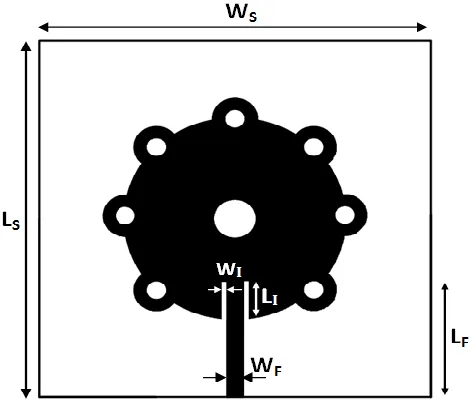
The geometry of proposed antenna is designed by applying the circular fractal elements of radius 2.52mm at the boundaries of circular patch of radius 12.6mm. The simulated geometry of proposed circular fractal antenna is shown in Figure 2 and the parametric values are shown in Table 2.
Figure 2. Simulated structure of proposed circular fractal antenna Table 2: Parametric values of proposed antenna
S. No. Parameters Description Values
1. WS Width of substrate 45mm
2. LS Length of substrate 44.92mm
3. WI Width of inset cut 0.4mm
4. LI Length of inset cut 3.06mm
5. WF Width of feed line 1.8mm
6. LF Length of feed line 12.99mm
III.RESULT AND DISCUSSION
Figure 3. Return loss v/s frequency plot of composite fractal antenna [7]
Figure 4. Return loss v/s frequency plot of star fractal antenna [8]
Figure 5. Return loss v/s frequency plot of proposed fractal antenna
International Journal of New Innovations in Engineering and Technology
Figure 6. Fabricated prototype of proposed circular fractal antenna Table 3: Comparison of designed antenna with existing antennas
Parameters Composite fractal
antenna [7]
Star fractal antenna [8]
Proposed circular fractal antenna
Simulated Measured
Frequency (GHz) 4.01 and 5.22 2.8 and 5.7 2.96, 4.88, 6.71,
7.47 and 8.44
3.08, 4.60, 5.68, 5.89, 8.23 and
8.48
Return loss (dB) -32.38 and -41.52 -20.8 and -49.5 15.44, 12.55,
19.44, 19.44 and -15.06
16.84, 11.43, 26.13, 21.00, -19.02 and -20.20
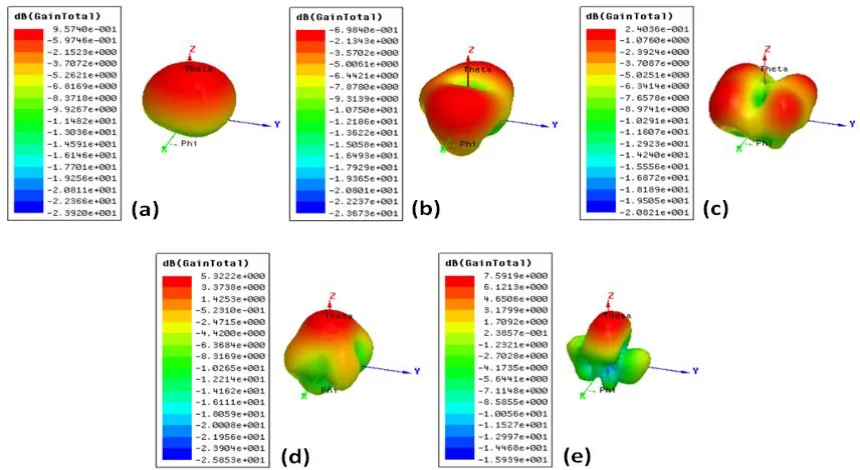
The acceptable value of gain for an antenna to work for practical applications is greater than 3dB. Gain of composite fractal antenna [7] and star shaped fractal antenna [8] is very less as compared to the proposed antenna. Composite antenna shows the value of gain less than 1.5dB at both the frequency bands. Similarly, the star shaped fractal antenna also shows the very less value of gain at both the frequency bands. To conquer this drawback the proposed antenna is designed which shows the high value of gain at the particular frequency bands. The value of gain is 9.57dB, -6.98dB, 2.40dB, 5.32dB and 7.59dB at the frequency bands of 2.96GHz, 4.88GHz, 6.71GHz, 7.47GHz and 8.44GHz respectively. The 3D gain plots at different frequency bands are shown in Figure 7.
IV.CONCLUSION
The main aim of this paper is to compare the existing antennas such as composite fractal antenna [7] and star fractal antenna [8] with the proposed circular fractal antenna. The results of different parameters such as return loss and gain of designed antenna is compared with the results of existing antennas. Comparison shows that the designed antenna has much better results as compared to the existing antennas. Proposed antenna works on five frequency bands with the maximum gain of 9.57dB at 2.96GHz frequency band; whereas the existing antennas works only on two resonant frequencies with a value of gain less than 1.5dB. Due to the better performance the proposed fractal antenna can be effectively used for wireless applications such as WLAN (4.82 - 5.95GHz), bluetooth (2.12 – 2.95GHz) and C – band (4 – 8GHz).
REFERENCES
[1] P. Wanjari, V. P. Meshram, P. Sangara and I. Chintawar, “Design and fabrication of wideband fractal antenna for commercial applications”, International conference on machine intelligence and research advancement, 978-07695-5013-/13, ICMIRA, pp. 150-154, 2013.
[2] B. K. Jeemon, K. Shambavi and Z. C. Alex, “Design and analysis of a multi-fractal antenna for UWB application”, IEEE International Conference on Emerging Trends in Computing, Communication and Nanotechnology (ICECCN 2013), 978-1-4673-5036-5/13, 2013. [3] B. L. Sahu, N. Chattoraj and S. Pal, “A novel CPW fed sierpinski carpet fractal UWB slot antenna”, IEEE, 978-1-4799-2174-4/13, 2013. [4] V. R. Anitha and M. Y. Sindhu, “Simulation of anovel design fractal tree antenna for multiband applications with re-configurability”,
IEEE, 978-1-4673-5689-3/13, 2013.
[5] B. H. Lincy, A. Srinivasan and B. Rajalakshmi, “Wideband fractal microstrip antenna for wireless application”, Proceedings of Conference on Information and Communication Technologies (ICT 2013), 978-1-4673-5758-6/13, IEEE, 2013.
[6] S. F. Jilani, H. U. Rahman and M. N. Iqbal, “Novel star-shaped fractal design of rectangular patch antenna for improved gain and bandwidth”, IEEE, 978-1-4673-5317-5/13, 2013.
[7] R. Choudhary, S. Yadav, P. Jain and M. M. Sharma, “Full Composite Fractal Antenna with Dual Band used for Wireless Applications,” International Conference on Advances in Computing, Communications and Informatics (ICACCI), pp. 2517-2520, 2014.
[8] S. Yadav, R. Choudhary, U. Soni, A. Dadhich and M. M. Sharma, “A Dual Band Star Fractal Antenna with Slot for Wireless Applications,” International Conference on Signal Propagation and Computer Technology (ICSPCT), IEEE, pp. 738-740, 2014.
![Figure 3. Return loss v/s frequency plot of composite fractal antenna [7]](https://thumb-us.123doks.com/thumbv2/123dok_us/1420948.1655374/4.612.80.545.70.644/figure-return-loss-frequency-plot-composite-fractal-antenna.webp)