Prevent Attacks in the Network and Scrutinizes Threshold for Authenticating
Message Communication
K.Lavanya
1, M.Subhashini
2, S.Deepadharani
3, S.Thangamalar
4, K.Megalakshmi
5, Dr.M.Ramesh Kumar
61,2,3,4,5 UG Students, Department of Computer Science and Engineering, VSB College of Engineering Technical Campus, Coimbatore, Tamilnadu, India.
6
Associate Professor, Department of Computer Science and Engineering, VSB College of Engineering Technical Campus, Coimbatore, Tamilnadu, India.
Article Received: 21 September 2017 Article Accepted: 23 December2017 Article Published: 07 January 2018
1. INTRODUCTION
A network is two or more computers linked together in order to share data. From a security stand point, the problem
with networks is that unauthorized individuals might also be able to access that data. Network security is a term that
encompasses your overall system for keeping your network as impenetrable as possible, be it hardware, software,
or company policies. Network security starts with authenticating the user, commonly with a username and a
password. Since this requires just one detail authenticating the user name—i.e. the password, which is something
the user 'knows'— this is sometimes termed one-factor authentication. With two-factor authentication, something
the user 'has' is also used (e.g. a security token or 'dongle', an ATM card, or a mobile phone); and with three-factor
authentication, something the user 'is' is also used (e.g. a fingerprint or retinal scan).
1.1. Various Issues in Network Security
1. Authentication
2. Confidentiality
3. Integrity
4. Denial of Service
1.2. Security
Computer security is a growing problem that becomes increasingly important every year as more communication
and business is conducted over the Internet. The threats are coming from various sources: Thieves looking to
making money through cybercrime, companies looking to steal trade secrets and countries or terrorist groups
A B S T R A C T
Cloud security is an important issue and particularly, attackers can explore vulnerabilities of a cloud system and compromise virtual machines to deploy further large-scale Distributed Denial-of-Service (DDoS). Within the cloud system, the detection of zombie exploration attacks is difficult because cloud users may install vulnerable applications on their virtual machines. To prevent this, a multiphase distributed vulnerability detection, measurement, and countermeasure selection mechanism called NICE is built on attack graph-based analytical models and reconfigurable virtual network-based countermeasures. In this work, we use Counter Attack Authentication Metrics model is used to prevent the vulnerable attacks such as DDOS and intrusion. This can also prevent attacks in the network and scrutinizes threshold for authenticating message communication. For validating the authorizing users and isolating the attackers from the network of cloud, attack graph model is proposed. The system and security evaluations demonstrate the efficiency and effectiveness of the proposed solution.
2. TYPES OF ATTACKS
Attacks that could set off an intrusion detection alarm come from various sources, typically referred to as malware
or malicious software. Trojan horses, worms, rootkits and even some spyware are all forms of malware that could
allow someone to access your PC illegally.
2.1 False Positives
A false positive occurs when a legitimate application or "normal" computer process sets off an alarm indicating
intrusion detection. Typically, this occurs if the application or process does something not recognized by the IDS.
Once the false positive is confirmed, a company's IT department and the IDS manufacturer can take steps to correct
the problem. False positives force companies to spend time and money troubleshooting the problem--time and
money that could be better spent on legitimate threats.
2.2 Denial of Service Attack
Denial-of-service attack (DoS attack) or distributed denial-of-service attack (DDoS attack) is an attempt to make a
machine or network resource unavailable to its intended users. Although the means to carry out, motives for, and
targets of a DoS attack may vary, it generally consists of efforts to temporarily or indefinitely interrupt or suspend
services of a host connected to the Internet.
A DOS is characterized by an explicit attempt by attackers to prevent legitimate users of a service from using that
service. There are two general forms of DoS attacks: those that crash services and those that flood services.
2.3 Leeching
In computing and specifically Internet, a leech is one who benefits, usually deliberately, from others' information or
effort but does not offer anything in return, or makes only token offerings in an attempt to avoid being called a
leech. Depending on context, leeching does not necessarily refer to illegal use of computer resources, but often
instead to greedy use according to etiquette: to wit, using too much of what is freely given without contributing a
reasonable amount back to the community that provides it.
2.4. Cloud Service
Cloud computing presents a number of management challenges. Companies using public clouds do not have
ownership of the equipment hosting the cloud environment, and because the environment is not contained within
their own networks, public cloud customers don’t have full visibility or control. Users of public cloud services must
also integrate with an architecture defined by the cloud provider, using its specific parameters for working with
cloud components. Integration includes tying into the cloud APIs for configuring IP addresses, subnets, firewalls
Provider’s infrastructure and services, public cloud users must integrate with the cloud infrastructure management.
Capacity management is a challenge for both public and private cloud environments because end users have the
ability to deploy applications using self-service portals. Applications of all sizes may appear in the environment,
consume an unpredictable amount of resources, then disappear at any time.
2.4.1 Chargeback - or, pricing resource use on a granular basis—is a challenge for both public and private cloud
environments. Chargeback is a challenge for public cloud service providers because they must price their services
competitively while still creating profit. Users of public cloud services may find chargeback challenging because it
is difficult for IT groups to assess actual resource costs on a granular basis due to overlapping resources within an
organization that may be paid for by an individual business unit, such as electrical power. For private cloud
operators, chargeback is fairly straightforward, but the challenge lies in guessing how to allocate resources as
closely as possible to actual resource usage to achieve the greatest operational efficiency. Exceeding budgets can be
a risk.
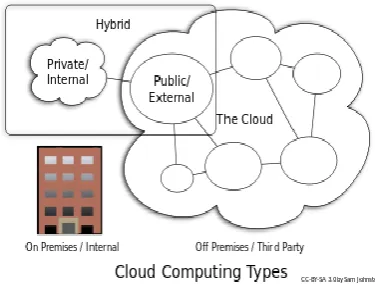
Which combine public and private cloud services, sometimes with traditional infrastructure elements, present their
own set of management challenges. These include security concerns if sensitive data lands on public cloud servers,
budget concerns around overuse of storage or bandwidth and proliferation of mismanaged images. Managing the
information flow in a hybrid cloud environment is also a significant challenge. Hybrid cloud environments also
typically include a complex mix of policies, permissions and limits that must be managed consistently across both
public and private cloud.
2.4.2 Cloud Clients
Users access cloud computing using networked client devices, such as desktop computers, laptops, tablets and
Smartphone. Some of these devices - cloud clients - rely on cloud computing for all or a majority of their
applications so as to be essentially useless without it. Many cloud applications do not require specific software on
the client and instead use a web browser to interact with the cloud application. With Ajax and HTML5 these Web
user interfaces can achieve a similar, or even better, look and feel to native applications.
3. CLOUD ARCHITECTURE
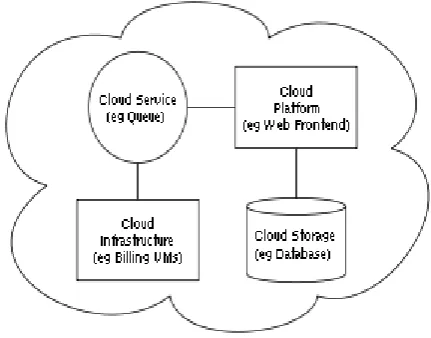
Figure 3.1 Cloud Architecture
Cloud architecture, the systems architecture of the software systems involved in the delivery of cloud computing,
typically involves multiple cloud components communicating with each other over a loose coupling mechanism
such as a messaging queue. Elastic provision implies intelligence in the use of tight or loose coupling as applied to
mechanisms such as these and others.
3.1. Service Modes
Cloud computing providers offer their services according to several fundamental models: infrastructure as a service
(IaaS), platform as a service (PaaS), and software as a service (SaaS) where IaaS is the most basic and each higher
model abstracts from the details of the lower models. Other key components in anything as a service (XaaS) are
described in a comprehensive taxonomy model published in 2009. Strategy-as-a-Service,
Collaboration-as-a-Service, Business Process-as-a-Service, Database-as-a-Service, etc. In 2012, network as a
service (NaaS) and communication as a service (CaaS) were officially included by ITU (International
Telecommunication Union) as part of the basic cloud computing models, recognized service categories of a
telecommunication-centric cloud ecosystem.
Infrastructure as a service (IaaS)
In the most basic cloud-service model, providers of IaaS offer computers - physical or virtual machines - and other
resources. IaaS clouds often offer additional resources such as a virtual-machine disk image library, raw (block)
and file-based storage, firewalls, load balancers, IP addresses, virtual local area networks (VLANs), and software
bundles. IaaS-cloud providers supply these resources on-demand from their large pools installed in data centers.
To deploy their applications, cloud users install operating-system images and their application software on the
cloud infrastructure. In this model, the cloud user patches and maintains the operating systems and the application
software. Cloud providers typically bill IaaS services on a utility computing basis cost reflects the amount of
resources allocated and consumed.
Platform as a service (PaaS)
In the PaaS model, cloud providers deliver a computing platform, typically including operating system,
programming language execution environment, database, and web server. Application developers can develop and
run their software solutions on a cloud platform without the cost and complexity of buying and managing the
underlying hardware and software layers. With some PaaS offers, the underlying computer and storage resources
scale automatically to match application demand so that the cloud user does not have to allocate resources
manually. The latter has also been proposed by an architecture aiming to facilitate real-time in cloud environments.
CAAM is used to prevent the vulnerable attacks such as DDOS and intrusion already thrived in the network. This
also prevents attacks like Leeching that occurs due to the usage of infrastructure as a service in cloud. In this model,
we prevent attacks in the network and scrutinizes threshold for authenticating message communication. For
validating the authorized users and isolating the attackers from the network of cloud we propose CAAM.
4. ARCHITECTURAL REPRESENTATION
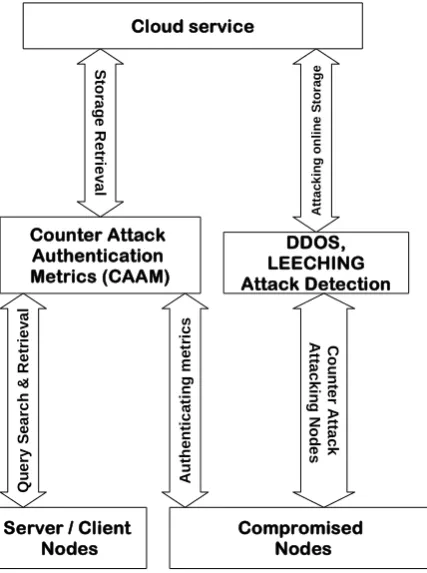
Figure 4.1 Architectural Representation Server / Client
Within the cloud service, the CAMM was introduced which will check for Authentication based details. It checks
for registered user clients for their authenticity and user metrics for having check over client/server system which
might be attached system. This will prevent the counter Attack attacking Nodes in the DDOS and Leeching in the
cloud service. The cloud service used for query search and storage retrieval. Cloud users may install vulnerable
applications on their virtual machines. In Attack Graph Model, every detected vulnerability is added to its
corresponding Virtual Memory entry in the database.
4.1 Server and Client Establishment
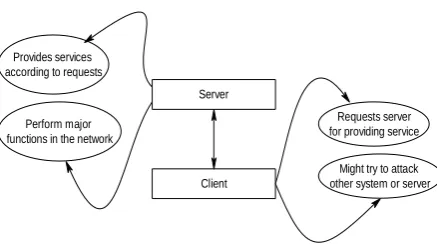
In this module a server & client systems is created. In Server and client systems a network structure is formed
between them for further communications. It provides a strong security so that no one can hack any message
communication. Thus we create more client systems in which some system are secured.
Here we create a single server and multiple client systems which have intermediate communications between each
other. Server will send more requests and client will respond for all the requests simultaneously. Thus they can
easily pass messages between server and client and the message communications between clients to client is also
possible.
Figure 4.2 Servers and Client Establishment
4.2. Cloud Storage Creation
Cloud Service was connected with the server and the client. Server accesses the Cloud Service and make request
according to the service and send to the client. Cloud Service can be created by connecting systems with each other
were one cloud service is connected with other cloud service and thus acquired cloud computing network. It
provides Infrastructure as a service environment which affords networking connection in cloud infrastructure. The
Cloud Service has a secured Cloud Storage Service. Database can be accessed through online in Cloud storage area.
Server
Client
Requests server for providing service
Might try to attack other system or server Perform major
Figure 4.3 Cloud Storage Creation
4.3 Propose Counter Attack Authentication Metrics
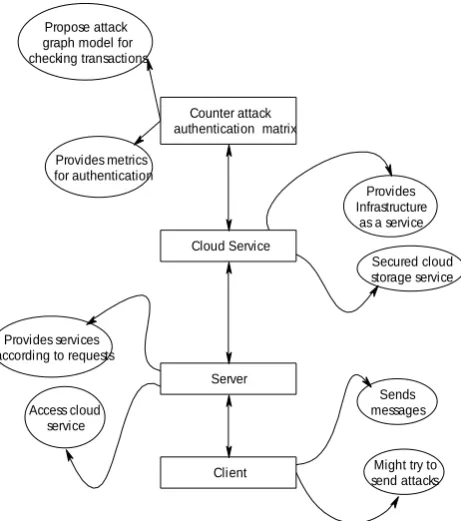
Our proposed CAAM is generated which provides a check for authenticated message communication in the
network of cloud. Attack graph model is connected with the server and client who provide transaction. Attack
graph based detection authenticates client and service registration. It manipulates metrics for checking based on
transactions made. It also prevents attacks that are vulnerable in the network and proposes all prevention measures
before any attack
Server
Client Provides services
according to requests
Provides Infrastructure
as a service
Secured cloud storage service
Access cloud service
Sends messages
Might try to send attacks Provides metrics
for authentication
Cloud Service Counter attack authentication matrix Propose attack
graph model for checking transactions
Server
Client Provides services
according to requests
Cloud Service
Provides Infrastructure
as a service
Secured cloud storage service
Access cloud service
Sends messages
4.4 Attack Prevention
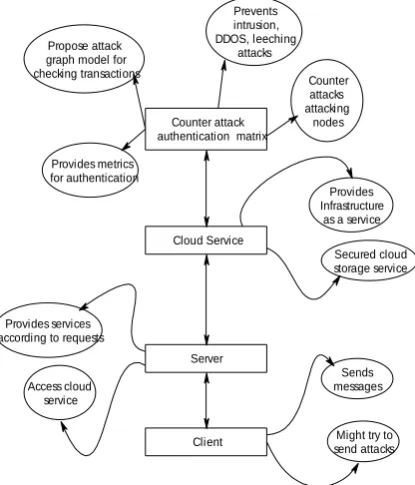
The existing network attacks such as intrusion , DDOS and the upcoming attacks through the Cloud network such
as leeching will be detected and prevented by the proposed model thus by eliminating those attacking nodes from
the network. It takes prevention measures for forthcoming attacks like DDOS, Leeching, and intrusion attacks.
Then give counter attacks to the nodes that try to attack the cloud infrastructure.
Server
Client Provides services
according to requests
Provides Infrastructure
as a service
Secured cloud storage service Access cloud service Sends messages
Might try to send attacks Provides metrics
for authentication Propose attack graph model for checking transactions Cloud Service Prevents intrusion, DDOS, leeching attacks Counter attacks attacking nodes Counter attack
authentication matrix
Figure 4.5 Attack Prevention
5. DATA FLOW DIAGRAM
Figure 5.1 Data Flow Diagram
Cloud Service
Client Attacking commandsSends Messages
Attack Graph based Model Authenticating metrics
Storage Infr astructure s
ervice D e te c tin g a ttac ks Counter attack Commands service storage or
infrastructure Prevents intrusion, DDOS, leeching attacks Counter attacks attacking nodes Provides metrics for authentication Propose attack
graph model for checking transactions Provides
Infrastructure as a service
6.
CONCLUSION
Herewith we confer results by using Attack Graph model to prevent the vulnerable attacks such as DDOS and
intrusion already thrived in the network and also prevents attacks like Leeching that can occur due to usage of
infrastructure as a service in cloud. In this model, we prevent attacks in the network and scrutinizes threshold for
authenticating message communication. Scrutinizes message communication in all centralized and decentralized
networks. For validating the authorized users and isolating the attackers from the network of cloud we propose
CAMM will check for authentication based details. It checks for registered user clients for their authenticity and
uses metrics for having check over clients systems which might be attacked system. Some attackers use their
system to intrude in the network and might try to Denial of service or intrusion; there is a possibility for leeching
attack also. All these attacks will be detected by checking with these metrics. Thus these found attacks will be
terminated and those attackers will be given counter attacks through this metrics model.
7.
FUTURE ENHANCEMENT
Future developments include the prevention of Zombie attacks and distributed denial of service attack in cloud
storage using Counter attack authentication metrics. Also it prevents attacks such as intrusion, Leeching and
scrutinizes message communication in all centralized and decentralized network. The entire detected attacker node
will be detached from the network and stored in a database.
REFERENCES
[1] G. Gu, P. Porras, V. Yegneswaran, M. Fong, and W. Lee, “BotHunter: Detecting Malware Infection through
IDS-driven Dialog Correlation,” Proc. 16th USENIX Security Symp. (SS ’07), pp. 12:1-12:16, January-2004.
[2] G. Gu, J. Zhang, and W. Lee, “BotSniffer: Detecting Botnet Command and Control Channels in Network Traffic,” Proc. 15th Ann. Network and Distributed Sytem Security Symp. (NDSS ’08), December-2004.
[3] NuSMV: A New Symbolic Model Checker,” http://afrodite.itc. it:1024/nusmv. June-2005.
[4] X. Ou, S. Govindavajhala, and A.W. Appel, “MulVAL: A Logic- Based Network Security Analyzer,” Proc.
14th USENIX Security Symp., pp. 113-128, May 2006.
[5] L. Wang, A. Liu, and S. Jajodia, “Using Attack Graphs for Correlating, Hypothesizing, and Predicting Intrusion Alerts,” Computer Comm., vol. 29, no. 15, pp. 2917-2933, June 2006.
[6] P. Mell, K. Scarfone, and S. Romanosky, “Veability Analysis of Network Diversificaton”
http://www.first.org/cvss/cvss-guide. html, August 2007.
[8] N. McKeown, T. Anderson, H. Balakrishnan, G. Parulkar, L. Peterson, J. Rexford, S. Shenker, and J. Turner,
“OpenFlow: Enabling Innovation in Campus Networks,” SIGCOMM Computer Comm. Rev., vol. 38, no. 2, pp.
69-74, February 2008.
[9] A. Roy, D.S. Kim, and K. Trivedi, “Scalable Optimal Countermeasure Selection Using Implicit Enumeration on Attack Countermeasure Trees,” Proc. IEEE Int’l Conf. Dependable Systems Networks (DSN ’12), October 2008.
[10] E. Keller, J. Szefer, J. Rexford, and R.B. Lee, “NoHype: Virtualized Cloud Infrastructure without the Virtualization,” Proc. 37th ACM Ann. Int’l Symp. Computer Architecture (ISCA ’10), pp. 350-361, March 2009.
[11] P. Ammann, D. Wijesekera, and S. Kaushik, “the Nepenthes Platform: an efficient approach to collect malware ,” Proc. 9th ACM Conf. Computer and Comm. Security (CCS’02), pp. 217-224, Sep 2009.
[12] N. Poolsappasit, R. Dewri, and I. Ray, “ NUSMV Scalable Network Vulnerability Analysis,” IEEE Trans.
Dependable and Secure Computing, vol. 9, no. 1, pp. 61-74,February 2010.
[13] R. Sadoddin and A. Ghorbani, “Alert Correlation Survey: Framework and Techniques,” Proc. ACM Int’l
Conf. Privacy, Security and Trust: Bridge the Gap between PST Technologies and Business Services (PST ’06), pp.
37:1-37:10, July 2010.
[14] A. Roy, D.S. Kim, and K. Trivedi, “Statl: An Attack Language for State-Based Intrusion Detection,” Proc. IEEE Int’l Conf. Dependable Systems Networks (DSN ’12), November 2010.
[15] Mitre Corporation, “Anomalous Payload Based Network Intrusion Detection,” http://cve.mitre.org/, Feb 2011
[16] Open Networking Fundation, “Using Machine Learning Technique to Identify botnet Traffic,” ONF White
Paper, July 2011.
[17] X. Ou, W.F. Boyer, and M.A. McQueen, “An algorithm for anamoly based botnet detection,” Proc. 13th ACM
Conf. Computer and Comm. Security (CCS ’06), pp. 336-345, Nov 2011.
[18] N. Poolsappasit, R. Dewri, and I. Ray, “Dynamic Security Risk Management Using Bayesian Attack Graphs,”